Importing Furniture from Indonesia to the US: Complete 2025 Guide
19 min read
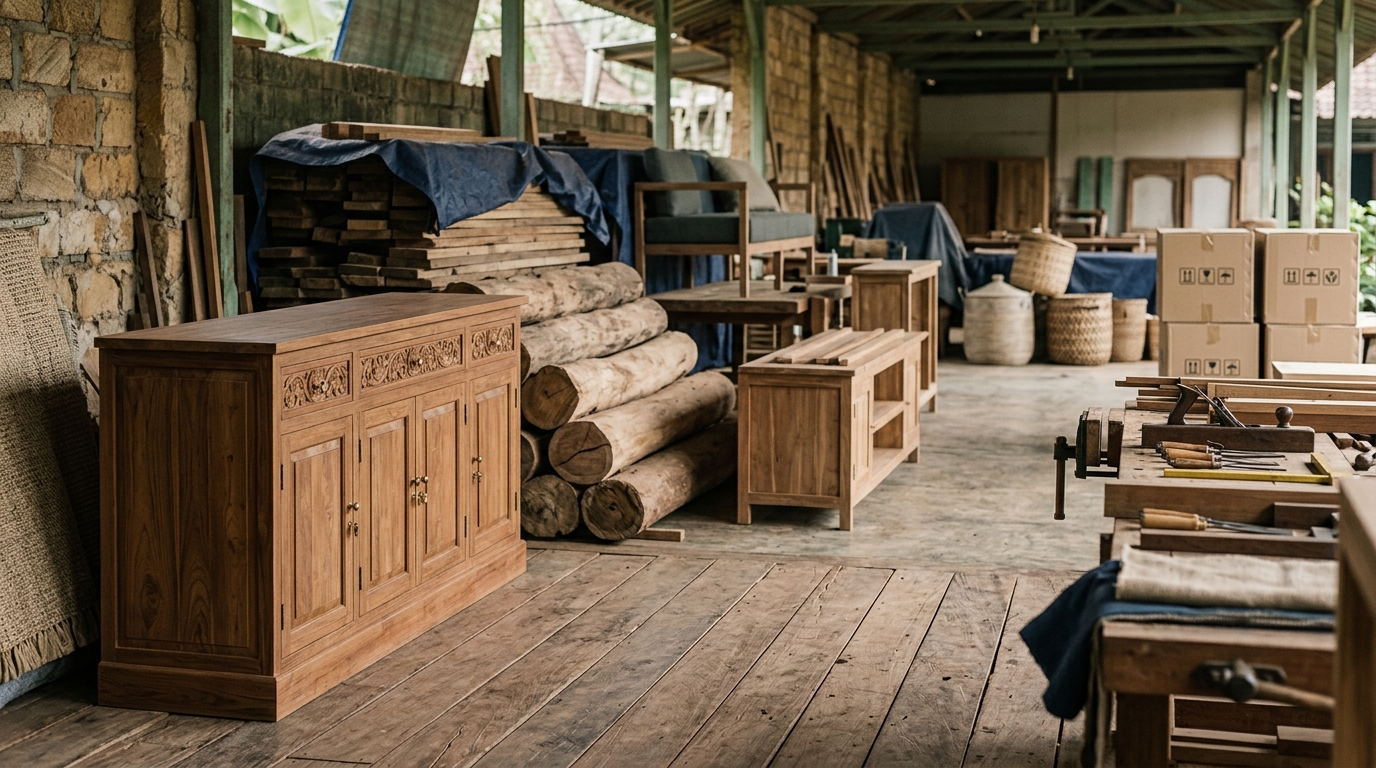
If you sourced a container of dining furniture from China in 2025, you likely paid a base product cost plus Section 301 tariffs that can add 25% or more on top of standard duties — a punishing overhead that has fundamentally reshaped sourcing math for US furniture buyers. Indonesia, by contrast,…
If you sourced a container of dining furniture from China in 2025, you likely paid a base product cost plus Section 301 tariffs that can add 25% or more on top of standard duties — a punishing overhead that has fundamentally reshaped sourcing math for US furniture buyers. Indonesia, by contrast, faces no Section 301 tariffs, standard US import duty rates that typically fall between 0% and 7% depending on the product category, and a manufacturing base that rivals China on quality for many furniture types while undercutting it significantly on total landed cost. That gap is why a growing number of US importers, Amazon FBA sellers, and retail buyers are actively redirecting purchase orders to Java and Bali.
This guide walks you through every stage of importing furniture from Indonesia to the US: how to find and vet suppliers, how to calculate your true landed cost before you commit, exactly which documents US Customs and Border Protection (CBP) will require, and how to stay compliant with US wood import law under the Lacey Act, CITES, and CPSC safety standards. Whether you are shipping your first less-than-container-load (LCL) sample order or scaling to multiple full-container-load (FCL) shipments per quarter, the frameworks here apply.
You will also find a worked numerical example of a 20-foot container shipment — a landed cost breakdown that most competitor guides simply omit — alongside a supplier evaluation table, common mistake warnings, and an FAQ section formatted to answer the questions CBP, customs brokers, and experienced importers hear most often. By the end, you will have a clear, actionable picture of what it actually costs and takes to bring Indonesian furniture profitably into the US market.
Why Indonesian Furniture Dominates the Value-Quality Equation for US Buyers
The Scale and Geography of Indonesia's Furniture Industry
Indonesia is one of the world's top furniture-exporting nations, with manufacturing concentrated in three primary regions. Jepara, on the north coast of Central Java, is widely regarded as the country's furniture capital, producing carved teak and mahogany pieces that have supplied export markets for decades. Bali is the hub for artisanal, resort-style, and rattan furniture, with a dense ecosystem of small workshops alongside larger export-ready factories. Surabaya and the broader East Java corridor hosts more industrial-scale upholstered furniture and flat-pack production oriented toward volume buyers.
This geographic concentration means supply chains are tight, subcontracting is mature, and export logistics infrastructure — particularly through the ports of Tanjung Priok (Jakarta) and Tanjung Perak (Surabaya) — is well-developed. You are not pioneering a new trade lane when you start importing furniture from Indonesia to the US; you are joining an established corridor that freight forwarders, customs brokers, and inspection agencies already service daily.
Material Advantages That Drive Export Demand
Indonesia's competitive edge is partly structural. The country is one of the world's primary sources of teak, a wood prized for its natural oils, dimensional stability, and resistance to weathering — qualities that make it ideal for outdoor dining sets, garden furniture, and high-end indoor pieces. Mahogany, reclaimed teak, albesia, and sustainably sourced bamboo and rattan round out a material palette that simply does not exist at scale in China or Vietnam. When US buyers want authentic teak outdoor furniture or handwoven rattan accent chairs, Indonesia is effectively the source of record.
The Tariff Advantage Over China and Vietnam
The comparison that matters most to your margin is the tariff stack. China-origin furniture currently carries a standard duty rate plus Section 301 additional tariffs that, depending on the HTS code, can exceed 25% of the FOB value. Vietnam has faced its own scrutiny over transshipment of Chinese goods, adding compliance risk and, in some product categories, anti-dumping or countervailing duty concerns. Indonesia faces neither. You pay the standard Most Favoured Nation (MFN) duty rate — typically 0% for certain rattan and wicker items, and up to approximately 7% for solid wood case goods — with no additional punitive tariff layer. For a container with a US$40,000 FOB value, that difference can represent several thousand dollars in duty savings per shipment.
The Step-by-Step Process for Importing Furniture from Indonesia to the US
Supplier Identification and Sample Ordering
Your sourcing journey typically begins with one of three entry points: attending an Indonesian trade show (more on those later), using a B2B platform to identify factories with export experience, or engaging a local sourcing agent in Jepara or Bali. Whichever route you take, your first goal is to narrow a long list of potential suppliers to three to five who have verifiable export history to the US or EU, hold relevant certifications (FSC, SVLK), and can produce samples within a defined timeline.
Request a formal sample before placing any production order. Specify your exact dimensions, finish, joinery method, and packaging requirements in writing. A reputable factory will charge for samples — often at a premium — and that cost is appropriate; it is your quality proof-of-concept. Evaluate the sample against your spec sheet methodically, not just visually.
Production Lead Times and Quality Control
Indonesian furniture factories typically require 60 to 90 days of production lead time for a standard FCL order, though complex carved or custom-upholstered pieces can run longer. Build this into your inventory planning from day one — it is one of the most consistently underestimated variables among first-time importers.
Schedule at minimum one pre-shipment inspection (PSI) conducted by an independent third-party inspector when production is approximately 80% complete. The inspector checks dimensions, finish quality, joinery integrity, quantity, and packaging against your approved sample and purchase order. The cost of a PSI is modest relative to the cost of receiving a container of substandard goods.
Packing, Container Stuffing, and Booking Freight
How your goods are packed directly affects whether they arrive in sellable condition. Specify protective packaging in your purchase order: corner guards, foam wrap, plastic sheeting for moisture, and sufficient internal bracing so pieces do not shift in transit. For bulky items like dining tables, knock-down (KD) construction significantly improves container utilisation.
Decide on FCL versus LCL early. A 20-foot FCL container (approximately 25–28 cubic metres of usable space) is cost-effective when your order fills at least 70–80% of that volume. Below that threshold, LCL — where your cargo shares a container with other shippers' goods — is typically more economical per cubic metre but adds handling time and slightly higher damage risk. Once you have your CBM (cubic metre) measurement from the factory, your freight forwarder can model both options.
Documentation Checklist
- ✓Commercial invoice (itemised, with HS code and FOB value per line)
- ✓Packing list (carton count, gross and net weights, dimensions)
- ✓Bill of lading (ocean) or airway bill
- ✓Certificate of origin (Form A or standard CO issued by Indonesian trade authority)
- ✓SVLK certificate or V-Legal document for wood furniture
- ✓Phytosanitary certificate if solid wood packing materials are present
- ✓CITES export permit if shipment includes restricted species (e.g. certain rosewood)
- ✓Fumigation certificate for wooden packaging (ISPM 15 compliance)
Import Duties, Tariffs, and Taxes You Must Budget for When Importing Indonesian Furniture
HTS Codes and Applicable Duty Rates
The Harmonized Tariff Schedule (HTS) code you declare determines your duty rate, and misclassifying it is one of the most expensive mistakes an importer can make. The most commonly used HTS chapters for furniture are Chapter 94 (furniture, bedding, mattresses) and, for rattan or bamboo goods, sometimes Chapter 46. Key examples include:
| Furniture Category | Common HTS Code Range | Typical MFN Duty Rate |
|---|---|---|
| Wooden furniture for the bedroom | 9403.50 | Approximately 0% |
| Wooden furniture for the dining room / kitchen | 9403.60 | Approximately 0% |
| Wooden furniture — other (living room case goods) | 9403.60 | Approximately 0%–7% |
| Upholstered seats with wooden frames | 9401.61 | Approximately 0%–5.3% |
| Rattan / wicker furniture | 9401.59 / 9403.89 | Often 0%–5.3% |
| Outdoor wooden furniture | 9403.89 | Approximately 0%–7% |
Section 301 Tariffs: Why Indonesia Is Not China
Section 301 tariffs were imposed specifically on goods of Chinese origin as a trade remedy measure. They do not apply to Indonesian-origin goods. This is not a loophole — it is simply how the tariff schedule works. Indonesian furniture exports qualify for the standard MFN rates listed above. This makes the effective duty cost on comparable furniture categories dramatically lower when sourced from Indonesia versus China in 2025.
MPF, HMF, and Other Import Fees
Beyond the ad valorem duty, two federal fees apply to most commercial imports. The Merchandise Processing Fee (MPF) is assessed at a small percentage of the declared customs value, subject to a minimum and maximum charge per entry. The Harbor Maintenance Fee (HMF) applies to ocean shipments and is calculated as a small percentage of the cargo value. Neither is large in absolute terms, but both must appear in your landed cost model. State sales or use tax may also apply once goods are in your warehouse, depending on your state and business structure.
Shipping Routes, Transit Times, and Real Cost Estimates for 2025
Sea Freight Routes and Transit Windows
The primary export ports for Indonesian furniture are Tanjung Priok (serving Jakarta and Jepara production) and Tanjung Perak (serving Surabaya). Container services to the US West Coast — Los Angeles and Long Beach — typically transit in approximately 25 to 35 days under normal port conditions. Services to the US East Coast, including New York and Savannah, route through the Suez Canal or Panama Canal and typically take approximately 35 to 45 days.
These are vessel transit times only. Add three to seven days for inland transport from factory to port, and a further three to ten days for port processing and drayage at the US destination. Your realistic door-to-door timeline from production completion to warehouse receipt is often 45 to 65 days.
FCL vs. LCL Cost Breakdown
| Shipping Mode | Typical Use Case | Rough Cost Range (2025) | Key Pros | Key Cons |
|---|---|---|---|---|
| 20-foot FCL | Orders filling ~25–28 CBM | Approximately USD 2,500–4,500 per container | Lowest cost per CBM; single handler; less damage risk | Requires sufficient volume to fill box |
| 40-foot FCL | Orders filling ~55–60 CBM | Approximately USD 3,500–6,000 per container | Best economies of scale for large orders | Higher absolute cost; needs larger order |
| LCL | Small orders under ~10–15 CBM | Approximately USD 80–160 per CBM | No minimum volume; good for samples/trials | Higher per-CBM cost; more handling; slower |
Air Freight: When It Makes Sense
Air freight from Indonesia to the US costs approximately five to ten times more per kilogram than sea freight, making it economically unsuitable for most furniture shipments. It becomes relevant in narrow circumstances: rushing replacement units for a stockout situation, shipping high-value small-quantity decorative accessories alongside a larger sea freight order, or sending samples that need to arrive before a trade show deadline.
US Customs Clearance: Documents, Agencies, and Compliance Requirements
The CBP Entry Process and Your Customs Broker's Role
US Customs and Border Protection (CBP) requires a formal entry filing for commercial shipments valued above the de minimis threshold. For furniture container shipments, you will file a formal entry (typically CBP Form 3461 for immediate delivery and CBP Form 7501 for entry summary). A licensed customs broker handles this on your behalf, coordinating with CBP, arranging any required bond, and ensuring your documents align with what CBP expects to see.
Your customs broker will need your commercial invoice, packing list, bill of lading, and certificate of origin at minimum. They will classify your goods using the 10-digit HTS code, calculate estimated duties, and arrange payment. CBP may elect to examine the shipment — either a document examination or a physical container exam — which can add several days and, in the case of a physical exam, modest additional costs.
Lacey Act Compliance for Wood Furniture
The Lacey Act (16 U.S.C. §§ 3371–3378) prohibits the import, export, transport, sale, or purchase of plants and plant products — including wood — that were harvested in violation of the laws of the source country. For furniture importers, this means you must be able to demonstrate that the wood in your products was legally harvested. A Plant and Plant Product Declaration (PPQ Form 505) is required at import for wood products, declaring the scientific name, country of harvest, and quantity of each wood species.
Indonesia's SVLK (Sistem Verifikasi Legalitas Kayu — Timber Legality Verification System) is a government-administered legality assurance framework that, when your supplier holds a valid SVLK certificate and issues a V-Legal document with your shipment, provides strong documented evidence of legal harvest. For FSC-certified products, the FSC chain-of-custody certificate from your supplier serves a similar evidentiary function. Always request copies of your supplier's current SVLK or FSC certificate before production begins.
CITES Permits for Protected Wood Species
The Convention on International Trade in Endangered Species of Wild Fauna and Flora (CITES) controls trade in certain timber species. Indonesian rosewood species (Dalbergia spp.) are listed under CITES Appendix II, meaning their trade requires both an export permit from Indonesian CITES authorities and an import permit from the US Fish and Wildlife Service. If you are sourcing furniture that contains rosewood — including as decorative inlay — confirm with your supplier whether the species is CITES-listed and factor the permit lead time into your production schedule. Many suppliers in Jepara have navigated this process before, but you need written confirmation of their CITES compliance history.
CPSC Safety Regulations for Upholstered and Children's Furniture
The Consumer Product Safety Commission (CPSC) enforces mandatory safety standards for certain furniture categories imported into or sold in the US. Children's furniture — including cribs, bunk beds, and children's chairs — is subject to mandatory CPSC standards (for example, 16 CFR Part 1513 for bunk beds and 16 CFR Part 1219/1220 for cribs). Upholstered furniture sold in California must comply with California's flammability requirements (TB 117-2013 is the current standard), and while some other states have their own regulations, TB 117-2013 has become a de facto national benchmark.
If you are importing children's furniture, work with your Indonesian supplier to ensure products are tested by a CPSC-accepted third-party laboratory before shipment. Certificates of conformity and test reports must be maintained and may be requested by CBP or CPSC at the border.
Finding and Vetting Reliable Indonesian Furniture Suppliers
Sourcing Hubs and What Each Produces
Jepara is your primary destination for solid wood furniture — teak dining sets, carved bedroom furniture, garden pieces — with hundreds of factories ranging from small workshops to large export-ready operations. Bali specialises in artisanal and resort-influenced pieces: rattan, natural fibre, reclaimed wood, and hand-finished decorative items. Surabaya and surrounding East Java areas offer more industrial-scale production for upholstered furniture and higher-volume orders. Emerging production clusters in Cirebon (rattan) and Semarang (various) are worth monitoring as capacity expands.
Trade Shows Worth Attending
The Indonesia International Furniture and Craft Fair (IFFINA), held annually in the Jabodetabek area near Jakarta, is the country's largest furniture trade show and a practical way to meet dozens of export-ready suppliers in a single trip. The Bali Home Furnishing trade event connects buyers with Bali's artisanal furniture and homewares producers. IFMAC/WOODMAC focuses on the machinery and wood processing side but also surfaces suppliers investing in modern production capability — a useful signal of quality orientation. Attending at least one of these events before committing to a supplier relationship is strongly recommended if you are building a meaningful import programme.
Supplier Evaluation Criteria
| Evaluation Criterion | What to Look For | Red Flag |
|---|---|---|
| Export experience | Verifiable US or EU export history; references from existing buyers | Claims of export experience but cannot provide packing lists or prior BLs |
| Certifications | Current SVLK V-Legal document; FSC CoC certificate; relevant CPSC test reports | Certificates that are expired, cannot be independently verified, or cover only one product |
| Production capacity | Factory visit or verified photos; staffing and equipment appropriate to order size | MOQ inconsistent with visible factory scale; reluctance to allow factory audit |
| Quality control | In-house QC team; willingness to allow third-party PSI; approved sample process | Resistance to pre-shipment inspection or requests to skip sample approval |
| Communication | Responsive, clear English communication; designated export manager | Slow responses, vague answers on pricing or lead time, no written confirmation of verbal agreements |
| Financial stability | Accepts standard payment terms (e.g. 30% deposit, 70% before shipment); uses a business bank account | Insists on full upfront payment; requests transfer to personal account |
Sourcing Agents vs. Direct Factory Relationships
A sourcing agent based in Jepara or Bali can accelerate your supplier identification, facilitate factory visits, manage quality control on the ground, and navigate language and cultural differences. This adds a layer of cost — typically a percentage of FOB value — but for buyers who cannot travel frequently to Indonesia or who are managing multiple SKUs across multiple factories, the operational value often exceeds the fee. As your volume grows and relationships mature, transitioning to direct factory relationships is straightforward.
Landed Cost Calculator: What a Container of Teak Furniture Actually Costs
Understanding your landed cost — not just the FOB price — is the single most important financial exercise you can do before committing to a sourcing programme. The formula is:
Landed Cost = FOB Price + Ocean Freight + Import Duty + MPF/HMF + Customs Brokerage + Drayage + Warehousing/Prep
Worked Example: 20-Foot FCL of Teak Dining Sets
The following example uses illustrative but realistic figures to demonstrate the calculation structure. Adjust each line with your actual quotes.
| Cost Component | Illustrative Amount |
|---|---|
| FOB value (factory price, Jakarta) | USD 22,000 |
| Ocean freight (20-foot FCL, Jakarta to Long Beach) | USD 3,200 |
| Import duty (approx. 0% on wooden dining furniture, HTS 9403.60) | USD 0 |
| Merchandise Processing Fee (MPF) | Approximately USD 500–600 |
| Harbor Maintenance Fee (HMF) | Approximately USD 50–100 |
| Customs brokerage fee | Approximately USD 250–400 |
| US port drayage (port to warehouse) | Approximately USD 400–700 |
| Warehousing / unloading / inspection | Approximately USD 300–500 |
| **Estimated Total Landed Cost** | **Approximately USD 26,700–27,500** |
If this container holds approximately 40 dining sets, your landed cost per unit is approximately USD 667–688. If comparable sets from a Chinese supplier carry a 25% Section 301 tariff on a similar FOB value, the duty line alone adds roughly USD 5,500 — demonstrating concretely why Indonesia's tariff position changes the unit economics.
Amazon FBA Sellers: Additional Cost Layers
If you are routing this shipment to Amazon FBA, add:
- FBA prep service fees (labelling, poly-bagging, carton marking): Approximately USD 1–3 per unit depending on the prep partner - Inbound shipping from your deconsolidation warehouse to the Amazon fulfilment centre: Variable by origin ZIP and destination FC - Amazon FBA fulfilment fees: Calculated per unit based on dimensions and weight (check the current FBA fee schedule for oversized items, as large furniture typically falls into the oversized tier) - Reserve capital for FBA storage fees if your inventory turns slowly
For furniture specifically, Amazon's oversized FBA fee tiers mean that fulfilment fees per unit can be substantial. Model this before finalising your retail price.
Margin Benchmarks by Channel
| Sales Channel | Typical Target Gross Margin | Implication for Landed Cost |
|---|---|---|
| Wholesale to US retailers | Approximately 40%–50% gross margin on sell price | Landed cost must support a wholesale price that still leaves the retailer a viable keystone markup |
| Amazon FBA direct-to-consumer | Approximately 25%–40% net after all fees | FBA fees and advertising costs compress margins; higher ASP products perform better |
| Own e-commerce / DTC | Approximately 50%–65% gross margin | Higher margin potential but requires customer acquisition cost discipline |
Costly Mistakes US Importers Make When Sourcing Indonesian Furniture
Skipping Pre-Shipment Inspection
The most common and most expensive mistake is waiving the pre-shipment inspection to save a few hundred dollars. Receiving a 20-foot container of furniture with finish defects, incorrect dimensions, or packaging failures costs orders of magnitude more — in rework, returns, negative reviews, or simply unsellable inventory. A third-party PSI is not optional; it is part of your quality cost of goods.
Misclassifying HTS Codes
Declaring furniture under an incorrect HTS code — whether to achieve a lower duty rate or simply through careless classification — exposes you to CBP audits, penalty duties, and potential seizure. CBP has authority to reclassify goods and assess back duties plus interest and penalties. A licensed customs broker costs a few hundred dollars per entry. An HTS misclassification audit can cost multiples of that and damage your importer record with CBP. Always have your broker review the 10-digit HTS code for each new product category before the first shipment.
Underestimating Lead Times
A 60 to 90 day production window plus 35 to 50 days of ocean transit and customs processing means your total replenishment cycle from purchase order to warehouse receipt can approach five months in a realistic scenario. If you plan your inventory based on two-month cycles, you will face stockouts. Build your reorder points around actual cycle times, not optimistic scenarios.
Operating Without a Written Supplier Contract
A pro forma invoice is not a contract. Before your first production order, execute a written agreement with your supplier that covers at minimum: product specification annexes (with approved sample reference), quality inspection rights, packaging specifications, intellectual property ownership (especially important if you are developing proprietary designs), defect claim procedures, and the governing dispute resolution mechanism. Suppliers in Jepara and Bali who work regularly with US buyers are accustomed to these agreements. A supplier who refuses to sign a basic contract is a supplier you should not use.
Frequently Asked Questions About Importing Furniture from Indonesia to the US
What is the import duty rate from Indonesia to the USA for furniture?
Most Indonesian wooden furniture falls under HTS Chapter 94 and attracts a US MFN duty rate of 0% for standard dining and bedroom furniture categories. Some upholstered and outdoor categories carry rates of approximately 5%–7%. Indonesia is not subject to Section 301 tariffs, so no additional punitive duty layers apply. Always verify the exact rate for your 10-digit HTS code with a licensed customs broker before importing.
Can US businesses legally import furniture into the US from Indonesia?
Yes. There are no prohibitions on importing furniture from Indonesia into the US. You must comply with standard import regulations: correct CBP entry filing, accurate HTS classification, Lacey Act wood declarations, CITES permits for any regulated species, and CPSC compliance for applicable product categories. Using a licensed customs broker ensures you meet all CBP requirements.
What documentation is required to clear furniture through US customs?
The core documents are a commercial invoice, packing list, ocean bill of lading, and certificate of origin. For wood furniture, you also need a Lacey Act Plant and Plant Product Declaration (PPQ Form 505) and your supplier's SVLK V-Legal document or FSC certificate. A CITES permit is required if the shipment contains regulated species such as certain rosewood varieties. Your customs broker will confirm the full document set for your specific shipment.
What is the HTS code for imported wooden and upholstered furniture from Indonesia?
Wooden furniture for dining rooms and kitchens is typically classified under HTS 9403.60. Upholstered seats with wooden frames fall under HTS 9401.61. Rattan and wicker furniture often uses HTS 9401.59 or 9403.89. These are broad category indicators; the full 10-digit classification determines your exact duty rate and must be confirmed for each product with your customs broker.
How long does shipping furniture from Indonesia to the US take?
Vessel transit from Jakarta or Surabaya to the US West Coast (Los Angeles/Long Beach) takes approximately 25 to 35 days. US East Coast ports add roughly 10 additional days. Door-to-door, including inland transport, port processing, and drayage, the realistic total is 45 to 65 days from production completion. Build at least 90 days of total supply chain lead time — production plus transit — into your inventory planning.
What is the total landed cost per container of furniture from Indonesia?
For a 20-foot FCL with an FOB value of approximately USD 22,000, total landed cost to a US warehouse typically ranges from approximately USD 26,000 to USD 28,000 when you include ocean freight, federal fees, customs brokerage, drayage, and basic warehousing. The exact figure varies with freight rates, your specific duty rate, and destination. Use the line-item table in the landed cost section of this guide as your calculation template.
Importing furniture from Indonesia to the US offers a genuinely compelling combination of material quality, design range, and tariff efficiency that no other major sourcing country currently matches — but the margin opportunity is only realised by importers who model their full landed cost accurately, comply rigorously with US customs and wood import law, and build supplier relationships on a documented quality foundation.
You now have the frameworks, the cost structures, the compliance requirements, and the supplier evaluation tools to move forward with confidence. The next step is converting that knowledge into a concrete freight plan.
You understand what importing furniture from Indonesia to the US involves — now get accurate numbers for your specific route, volume, and timeline. Request a free freight quote from an Indonesia-to-US furniture shipping specialist today and build your landed cost model on real 2025 rates.
Request Your Free Freight Quote →Need eyes on the ground in Indonesia?
MTS is an execution partner — supplier verification, manufacturing management, quality control and export logistics across Indonesia, Vietnam and China.
Related services
Related articles
Receive furniture sourcing insights across Asia.
One email per week. No spam.