Indonesia SVLK Timber Certification: The Complete Guide for US and EU Importers
19 min read
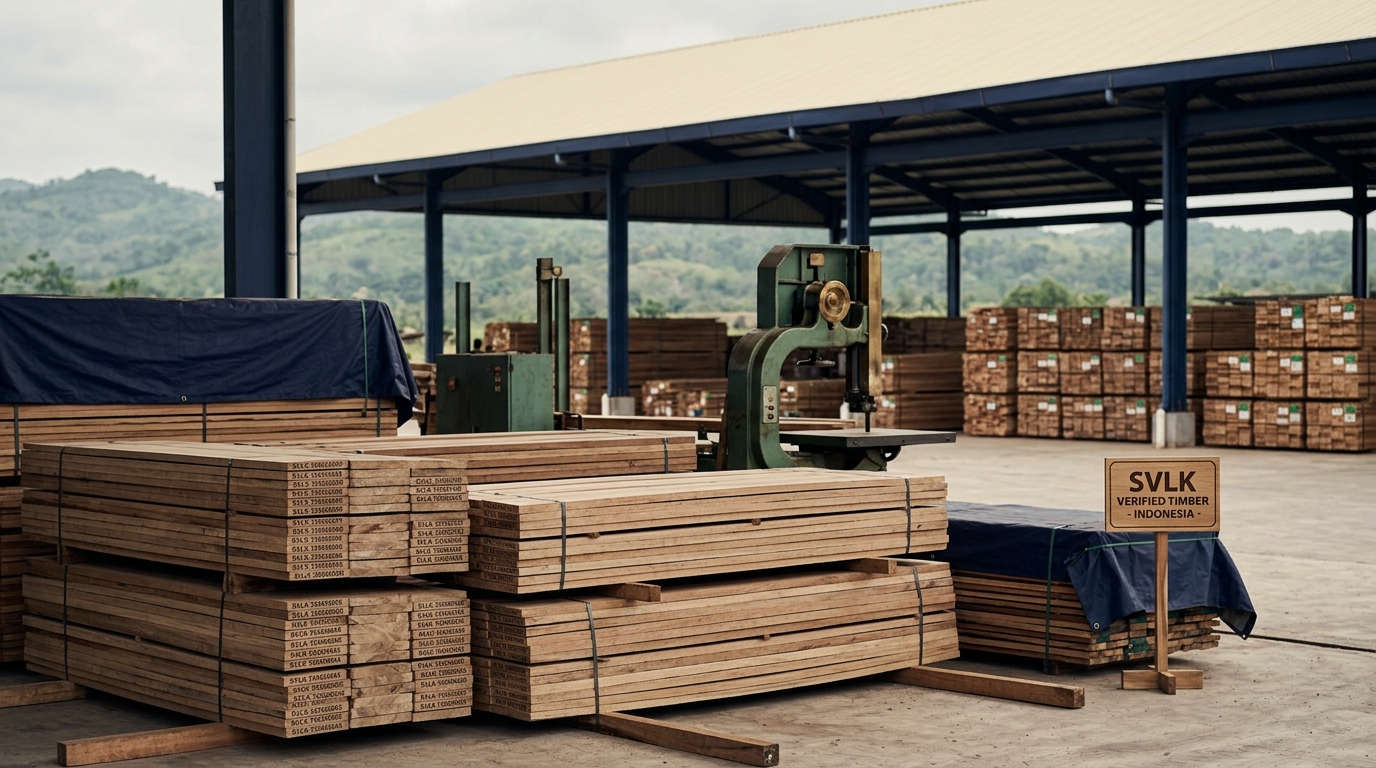
Your shipment of Indonesian teak furniture arrives at the Port of Rotterdam. Customs officers request documentation confirming the wood's legal origin. Without a valid V-Legal Document attached to the consignment, the shipment faces delays, potential seizure, and a formal investigation under EU…
Your shipment of Indonesian teak furniture arrives at the Port of Rotterdam. Customs officers request documentation confirming the wood's legal origin. Without a valid V-Legal Document attached to the consignment, the shipment faces delays, potential seizure, and a formal investigation under EU timber trade law. This scenario plays out regularly, and it is entirely avoidable — if you understand how Indonesia SVLK timber certification works before the cargo ever leaves Jakarta.
Indonesia is one of the world's largest exporters of wood products, supplying furniture, plywood, flooring, and engineered timber to buyers across North America, Europe, and Asia. For procurement managers and supply chain compliance officers sourcing from Indonesian manufacturers, understanding the country's timber legality framework is not optional — it is a legal and commercial necessity. Indonesia SVLK timber certification sits at the centre of that framework, and misunderstanding it creates real trade risk.
This guide explains what SVLK is, who must hold it, how V-Legal Documents function as export licences, and how the system interacts with the EU Deforestation Regulation, the EU Timber Regulation, and the US Lacey Act. It also provides a practical due diligence checklist, guidance on verifying supplier certification status, and a frank assessment of the fraud risks importers must guard against. Whether you are a first-time buyer of Indonesian timber products or an experienced sourcing professional reviewing your compliance posture, the sections below will give you an authoritative, up-to-date picture of what the system demands.
What Indonesia SVLK Timber Certification Is and Why Every Importer Must Understand It
Defining SVLK in Plain English
SVLK stands for Sistem Verifikasi Legalitas Kayu, which translates directly from Indonesian as the Timber Legality Verification System. It is Indonesia's national framework for assuring that timber and wood products entering global trade have been harvested, processed, and traded in compliance with Indonesian forestry law. The system applies to the entire value chain — from forest concession holders felling trees in Kalimantan to furniture factories in Java loading containers bound for Europe or the United States.
Unlike voluntary third-party certification schemes such as the Forest Stewardship Council (FSC), SVLK is a government-mandated regulatory requirement. FSC certification signals environmental and social excellence beyond legal minimums; SVLK confirms baseline legal compliance. The two systems are complementary rather than interchangeable, and holding FSC certification does not exempt an exporter from SVLK obligations. For importers, this distinction matters because due diligence frameworks in both the EU and US are built around legality, not sustainability ambition.
Why the System Matters to Buyers Outside Indonesia
For US and EU importers, Indonesia SVLK timber certification is the primary documentary foundation for demonstrating that Indonesian wood products in your supply chain were legally sourced. Regulatory regimes in your home markets — including the EU Timber Regulation, the EU Deforestation Regulation, and the US Lacey Act — require importers to exercise due care or due diligence over the legal origin of wood. SVLK, when properly verified, provides structured evidence that helps satisfy those requirements. Without it, importers must construct independent evidence of legality, which is significantly more resource-intensive and legally precarious.
The Origins and Legal Foundations of Indonesia's Timber Legality System
Indonesia's timber legality framework did not emerge overnight. It was developed through a multi-stakeholder process initiated in the early 2000s, formally introduced in 2009, and progressively strengthened through subsequent Indonesian government regulations issued by the Ministry of Environment and Forestry of Indonesia (Kementerian Lingkungan Hidup dan Kehutanan, or KLHK). The Ministry remains the central authority governing the system today, setting standards, accrediting verification bodies, and overseeing enforcement.
The development process was notably inclusive. Indonesian and international non-governmental organisations, industry associations, smallholder communities, and government agencies all participated in defining the standards. This multi-stakeholder origin gives the system a degree of credibility and robustness that purely industry-driven schemes often lack, and it was a deliberate design choice intended to build international confidence in Indonesian timber exports.
The legislative foundation rests on a series of Indonesian government regulations and Ministry decrees. These have been updated multiple times since 2009, with significant revisions occurring to strengthen chain-of-custody requirements and to align the domestic system with Indonesia's international trade commitments — most notably its Voluntary Partnership Agreement (VPA) with the European Union, concluded under the FLEGT (Forest Law Enforcement, Governance and Trade) initiative. Post-2022 updates have continued to refine auditor accreditation standards and expand the product categories subject to verification requirements, reflecting Indonesia's intent to maintain international market access as EU and US regulations become more stringent.
SVLK Is Mandatory: Understanding the Scope of Indonesia's Export Requirements
Who Must Hold SVLK Certification
Indonesia SVLK timber certification is not voluntary. All operators in the Indonesian timber supply chain — including state-owned forest enterprises, private forest concession holders, timber processing facilities, and exporters — are legally required to obtain and maintain valid SVLK certification. This obligation covers:
- Forest management units (both natural forest concessions and plantation enterprises) - Primary processing industries (sawmills, plywood mills, pulp facilities) - Secondary and tertiary processing industries (furniture manufacturers, flooring producers, wood component factories) - Smallholder and community forest operators, subject to specific simplified verification pathways
There is no minimum size threshold that exempts a supplier from the requirement. Small and medium-sized enterprises must comply, though the Indonesian government has created simplified certification schemes to reduce the administrative burden on smaller operators.
Export Prohibition Without Valid Certification
Any Indonesian company exporting timber products without valid SVLK certification is acting in violation of Indonesian law. Export documentation — specifically the V-Legal Document — cannot be issued for a shipment unless the exporting company holds a current SVLK certificate. This creates a direct link between domestic compliance and export authorisation: certification is the gateway to legal export, not a parallel system running alongside it.
For importers, this matters because it means that any shipment of Indonesian timber products arriving without proper V-Legal documentation was either exported illegally or involves documentation irregularities that warrant immediate investigation.
Penalties and Trade Consequences
Non-compliant Indonesian exporters face administrative sanctions, export licence suspension, and potential criminal liability under Indonesian forestry law. For the importer, receiving timber that was exported in violation of Indonesian law can trigger liability under the US Lacey Act (which prohibits trade in illegally harvested timber) and the EU Timber Regulation or EU Deforestation Regulation. The reputational and financial costs of a regulatory enforcement action — fines, shipment seizure, import bans — far exceed the cost of proper supplier vetting.
SVLK Certification Requirements: What the Audit Process Actually Involves
Categories of Operators and Applicable Standards
Different types of operators are assessed against different SVLK standards. Forest management units are audited against criteria covering legal land tenure, compliance with environmental regulations, worker rights, and community relations. Processing industries are assessed against chain-of-custody standards that verify the legal origin of input materials and the integrity of the production and export process. The applicable standard depends on the operator's position in the supply chain.
The Audit and Verification Process
SVLK certification is carried out by accredited independent verification bodies known in Indonesian as Lembaga Verifikasi Legalitas Kayu (LVLK) — Timber Legality Verification Bodies. These bodies are accredited by the National Accreditation Body of Indonesia (Komite Akreditasi Nasional, or KAN) and must operate according to internationally recognised auditing standards. Well-known international certification organisations such as SCS Global Services operate as LVLKs alongside Indonesian domestic bodies.
The audit process involves document review, field inspections, and interviews with workers and management. Auditors assess whether the operator's materials, processes, and records meet SVLK standards. Upon successful completion, the operator receives an SVLK certificate valid for a defined period, typically around three years for most processor categories, subject to surveillance audits conducted at regular intervals — commonly annually — to confirm ongoing compliance.
Ongoing Surveillance and Certificate Maintenance
SVLK certification is not a one-time event. Operators must maintain records, submit to surveillance audits, and notify their LVLK of significant operational changes. Certificates can be suspended or revoked if surveillance audits identify non-conformances that are not corrected within specified timeframes. This ongoing verification requirement is precisely why importers must check not only that a supplier holds a certificate, but that it is currently active and in good standing.
Understanding V-Legal Documents: The Export Licence That Clears Your Shipment
The V-Legal Document is the shipment-level export licence issued under the SVLK system. It is distinct from the SVLK certificate itself, and understanding the difference is essential for anyone handling Indonesian timber import documentation.
| Document | Issued To | Issued By | Covers | Level |
|---|---|---|---|---|
| SVLK Certificate | Operator (company) | Accredited LVLK | Company-level compliance status | Operator |
| V-Legal Document | Specific shipment | Exporting company (self-declaration via system) | Individual export consignment | Transaction |
| FLEGT Licence | Specific shipment (EU only) | Indonesian authority | EU-bound consignment under VPA | Transaction |
The SVLK certificate confirms that a company is certified as compliant with Indonesian timber legality standards. The V-Legal Document is generated for each individual export shipment by the certified exporter and accompanies the cargo. It references the exporter's SVLK certificate and attests that the products in that specific consignment comply with SVLK requirements.
How to Read and Verify a V-Legal Document
A V-Legal Document contains key fields that importers should review on every shipment:
1. Exporter name and address — must match your known supplier exactly 2. SVLK certificate number — cross-reference against the public database 3. Certificate validity dates — confirm the certificate was active at the time of export 4. Product description and HS codes — verify these match your purchase order 5. Quantity and unit of measure — confirm consistency with commercial invoice and packing list 6. Issuing date — must predate the shipment date
The Indonesian Ministry of Environment and Forestry operates an online verification portal where V-Legal Documents and underlying SVLK certificates can be authenticated. Always verify directly through official government systems rather than relying solely on copies provided by the supplier.
SVLK, FLEGT, and the EU and US Regulatory Frameworks: What Buyers Must Understand
Indonesia's FLEGT Voluntary Partnership Agreement with the EU
Indonesia was the first country in the world to achieve operational status under the EU's FLEGT (Forest Law Enforcement, Governance and Trade) initiative, signing its Voluntary Partnership Agreement (VPA) with the European Union and subsequently receiving recognition that its SVLK system could generate FLEGT licences accepted by EU customs authorities. This is a significant diplomatic and trade achievement that directly benefits Indonesian exporters and EU importers alike.
Under the VPA, SVLK-derived V-Legal Documents issued for EU-bound shipments function as FLEGT licences. When a FLEGT licence accompanies a timber shipment into the EU, it satisfies the EU Timber Regulation (EUTR) due diligence requirement for that consignment — EU operators are not required to conduct additional risk assessment for FLEGT-licensed products. This is a meaningful trade facilitation benefit.
The EU Deforestation Regulation: A Critical Gap in Current SVLK Coverage
Here is where many existing guides on SVLK fall short: the EU Deforestation Regulation (EUDR), which entered into force in 2023 and whose implementation timeline has been subject to revision, creates obligations that go beyond the EUTR. The EUDR requires operators placing specified commodities — including wood and wood products — on the EU market to demonstrate not only legal harvest but also that products are deforestation-free as of a defined reference date.
SVLK and FLEGT licences confirm legality under Indonesian law. They do not, by themselves, constitute proof of deforestation-free origin as defined by the EUDR. This means that EU importers of Indonesian timber products face a dual compliance burden: SVLK/FLEGT for legality, and additional geolocation and due diligence data for EUDR compliance. Indonesian suppliers and EU buyers are actively working through what additional documentation and geospatial evidence the EUDR will require. Importers should not assume that a FLEGT licence fully satisfies EUDR obligations and should engage legal counsel familiar with both frameworks.
SVLK and the US Lacey Act: An Explicit Comparison
The US Lacey Act prohibits the import, export, transport, sale, or purchase of plants — including timber — that were taken or traded in violation of the laws of the country of harvest. It imposes a due care standard on US importers, requiring them to take reasonable steps to establish the legal origin of imported wood products.
V-Legal Documents from certified Indonesian exporters constitute meaningful evidence supporting Lacey Act due care, but they do not provide automatic safe harbour the way FLEGT licences function under the EUTR. US importers should treat verified SVLK documentation as a strong component of their due care package — alongside supplier contracts that include legality warranties, supply chain mapping, and periodic supplier audits — rather than as a standalone compliance instrument. The US has not concluded a formal bilateral agreement with Indonesia equivalent to the EU-Indonesia VPA, which means the evidence-based approach to Lacey Act compliance must be maintained even where SVLK documentation is robust.
| Framework | SVLK/V-Legal Status | Practical Effect for Importer |
|---|---|---|
| EU Timber Regulation (EUTR) | FLEGT licence satisfies due diligence | No additional risk assessment required for FLEGT-licensed EU shipments |
| EU Deforestation Regulation (EUDR) | SVLK does not fully satisfy EUDR requirements | Additional deforestation-free evidence and geolocation data required |
| US Lacey Act | Strong supporting evidence for due care | Part of due care package; no formal safe harbour; additional measures recommended |
Certification Costs, Importer Due Diligence, and Avoiding Common Compliance Pitfalls
What SVLK Certification Costs Indonesian Suppliers
Certification costs are borne by the Indonesian exporter, not the importer. Cost estimates vary considerably depending on the size and complexity of the operation, the number of facilities being certified, and the LVLK engaged. Smaller processing facilities typically face lower audit fees, while large integrated operations with multiple sites face proportionally higher costs. These figures are estimates subject to change and vary by provider — importers should not use cost as a criterion for evaluating supplier compliance, as under-pricing by a certification body can itself be a red flag.
Importer Due Diligence: A Step-by-Step Approach
1. Request the SVLK certificate from your supplier before placing your first order. Confirm the certificate is current, covers the relevant product categories, and was issued by an accredited LVLK. 2. Verify certificate authenticity through the Indonesian government's official online database. Do not rely on photocopies or PDFs alone. 3. Request the V-Legal Document for each shipment at the time of booking, before the cargo is loaded. 4. Cross-check V-Legal Document fields against your commercial invoice, packing list, and bill of lading for consistency. 5. Verify the V-Legal Document reference number online through official Indonesian government systems. 6. Retain all documentation — SVLK certificate, V-Legal Document, purchase contracts, and supplier legality declarations — for a minimum period consistent with your applicable regulatory requirements (typically several years). 7. Conduct periodic supplier audits or third-party assessments to confirm ongoing compliance, particularly if your supplier has experienced changes in ownership, production volume, or raw material sourcing. 8. Monitor certificate renewal dates and set calendar reminders to request updated certificates before expiry.
- ✓Current SVLK certificate (with LVLK name and accreditation reference)
- ✓Certificate validity dates and scope of certification
- ✓V-Legal Document for each individual shipment
- ✓V-Legal Document reference number verified via official Indonesian database
- ✓Supplier's LVLK contact details for direct verification
- ✓Chain-of-custody records for key raw material inputs
- ✓Supplier legality declaration or warranty clause in purchase contract
- ✓Records of most recent surveillance audit outcome
- ✓HS codes covered under the SVLK certificate scope
- ✓Supplier notification of any certificate suspension or non-conformance
Common Compliance Pitfalls
Accepting expired certificates. SVLK certificates have defined validity periods. Receiving a certificate that expired before your shipment date is not compliant documentation — the supplier should have undergone renewal before exporting.
Mismatched HS codes. An SVLK certificate covers specified product categories. If your purchase order includes product types not covered by the exporter's certificate scope, that shipment is not fully documented. Always confirm scope alignment.
Failing to verify online. Document fraud exists in Indonesian timber trade, as in all global commodity sectors. A V-Legal Document that cannot be authenticated through official online systems should not be accepted.
Assuming FSC equals SVLK. Some suppliers hold FSC certification but not current SVLK. These are separate systems, and FSC does not substitute for SVLK in the context of Indonesian export law.
SVLK for Indonesian Furniture Imports: What Furniture Buyers Need to Know Specifically
How SVLK Applies to Processed Wood Products
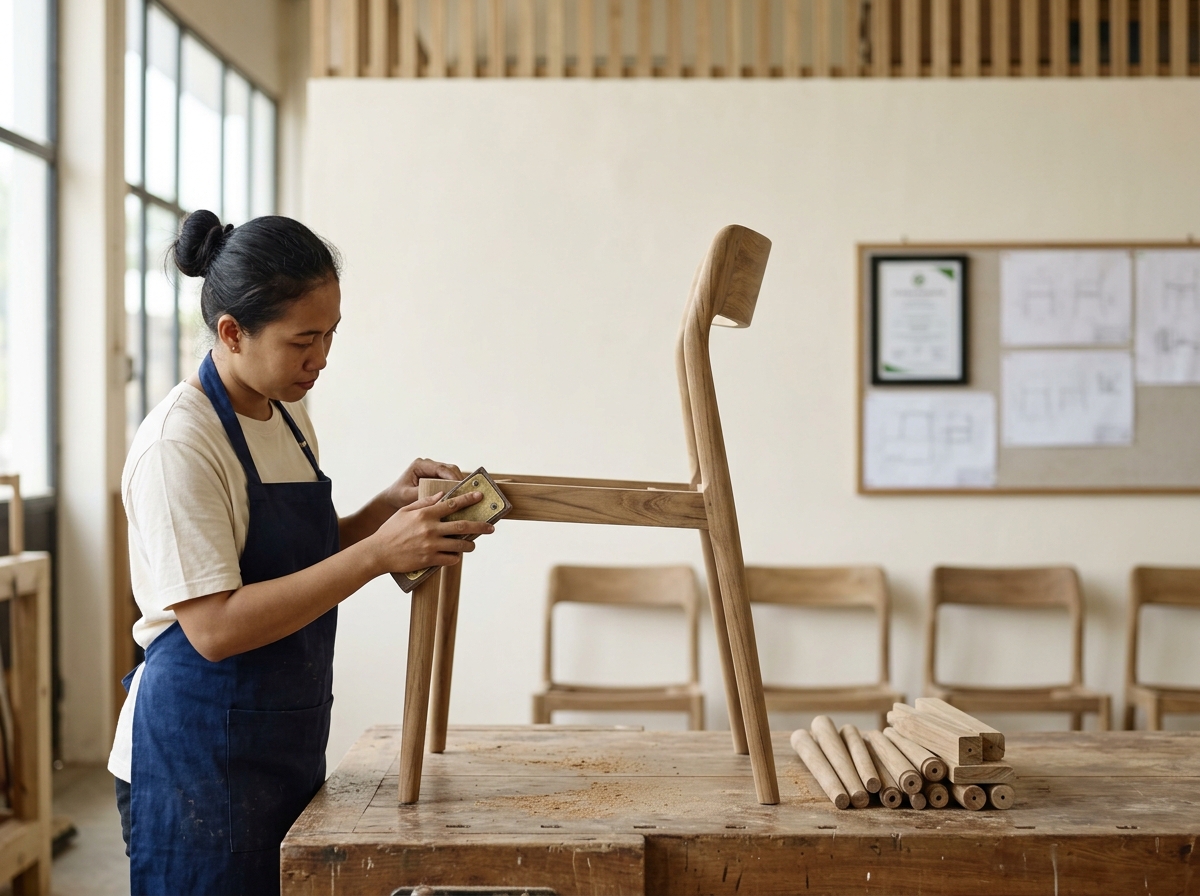
Indonesian furniture represents a major category of wood product exports, and the SVLK system applies fully to finished and semi-finished products including chairs, tables, bedroom furniture, garden furniture, and wood components. The fact that timber has been processed through multiple manufacturing stages does not reduce the documentation requirement — if the end product contains wood that originated in Indonesian forests, the exporter must hold a valid SVLK certificate covering that product category.
HS Codes and Product Scope
Indonesian SVLK export requirements cover a wide range of HS code categories, including wood and articles of wood (HS Chapter 44), furniture (HS Chapter 94 for wood furniture), and certain paper and paperboard products derived from wood pulp. Furniture buying offices should verify that their suppliers' SVLK certificates specifically list the relevant HS codes for the products being purchased. A certificate issued to a supplier for plywood production does not automatically cover furniture manufacturing at the same facility if furniture is processed under a separate operational unit.
Supplier Verification Best Practices for Furniture Procurement Teams
Furniture importers typically work with a network of multiple Indonesian suppliers across different product categories and regions. Managing SVLK compliance across a diverse supplier base requires systematic rather than ad hoc approaches. Tools such as the Preferred by Nature Sourcing Hub provide databases and verification support for buyers seeking to systematically track supplier certification status across their supply chains. Building SVLK verification into supplier onboarding protocols — alongside quality inspections and commercial due diligence — ensures that compliance is managed proactively rather than reactively at the point of shipment.
How to Verify an Indonesian Supplier's SVLK Certification Status Before You Place an Order
Official Government Databases and Online Tools
The Indonesian Ministry of Environment and Forestry maintains official online databases where the public can search for valid SVLK certificates and verify V-Legal Document authenticity. Importers should use these primary sources rather than relying on supplier-provided documentation alone. The databases allow searches by company name, certificate number, and product category, giving buyers direct access to authoritative compliance information.
The Role of Accredited LVLKs
Each SVLK certificate identifies the accredited LVLK that conducted the audit. Importers can contact the LVLK directly to confirm certificate validity and to understand the scope and current standing of the certification. Accredited LVLKs operating in Indonesia include both domestic bodies and internationally recognised organisations such as SCS Global Services. The national accreditation body KAN maintains a public register of accredited LVLKs, which is itself a useful verification tool.
Red Flags Indicating Fraudulent or Lapsed Certification
- Certificate validity dates that have passed without documented renewal - LVLK name on the certificate that does not appear in KAN's accredited body register - V-Legal Document reference numbers that return no results in the official database - Inconsistencies between the exporter name on the V-Legal Document and the company named on the commercial invoice - Reluctance by the supplier to provide direct contact details for their certifying LVLK - Certificates that cover a different facility address than the one producing your order
Third-Party Tools and Sourcing Support
Beyond government databases, tools such as the Preferred by Nature Sourcing Hub aggregate supplier certification data and provide importers with structured ways to monitor their supply base. These platforms do not replace official verification but can streamline the process for procurement teams managing large supplier networks. Combining official database checks with third-party monitoring tools creates a more robust and defensible due diligence record.
Frequently Asked Questions About Indonesia SVLK Timber Certification
What does SVLK stand for in English? SVLK stands for Sistem Verifikasi Legalitas Kayu, which translates as the Timber Legality Verification System. It is Indonesia's mandatory national framework for verifying that timber and wood products have been legally harvested, processed, and traded under Indonesian forestry law.
Is SVLK certification mandatory for all Indonesian timber exports? Yes. SVLK certification is mandatory for all Indonesian timber exporters, including state-owned enterprises, private companies, and processing facilities of all sizes. There are no exemptions based on company size or product type, though simplified certification pathways exist for smallholder and community forest operators. No V-Legal Document can be issued for an export shipment without a valid underlying SVLK certificate.
What is the difference between an SVLK certificate and a V-Legal Document? An SVLK certificate is issued at the company level by an accredited LVLK and confirms that the operator's overall business activities comply with Indonesian timber legality standards. A V-Legal Document is issued at the shipment level for each individual export consignment and references the exporter's SVLK certificate. Importers should request both: the certificate to confirm supplier status, and the V-Legal Document for each shipment.
Who developed the SVLK system and which government body oversees it? SVLK was developed through a multi-stakeholder process involving the Indonesian government, NGOs, industry, and community groups, and was formally introduced by the Indonesian government in 2009. It is overseen by the Ministry of Environment and Forestry of Indonesia (KLHK), which sets standards, accredits verification bodies, and enforces compliance requirements.
Does SVLK certification satisfy the US Lacey Act and EU Timber Regulation requirements? For the EU Timber Regulation, FLEGT licences derived from SVLK satisfy the due diligence requirement for EU-bound shipments, meaning no additional risk assessment is required. For the US Lacey Act, verified SVLK documentation is strong evidence supporting due care but does not provide automatic safe harbour — it should form part of a broader due care package. For the EU Deforestation Regulation, SVLK alone is insufficient; additional deforestation-free evidence is required.
How much does it cost for an Indonesian supplier to obtain SVLK certification? Certification costs are estimates that vary depending on facility size, operational complexity, number of sites, and the LVLK engaged. Smaller processing companies typically face lower audit costs than large integrated forest enterprises. Importers should not attempt to use cost as an indicator of certification validity; if anything, unusually low-cost certification claims from a supplier warrant additional scrutiny.
For US and EU importers sourcing wood products from Indonesia, Indonesia SVLK timber certification is the foundational element of a defensible, legally compliant supply chain. Understanding the difference between the SVLK certificate and the V-Legal Document, recognising the distinct — and evolving — requirements of the EU Deforestation Regulation alongside the EUTR, and treating the US Lacey Act as requiring a broader due care posture than SVLK alone provides are the three most important takeaways for any procurement or compliance professional working in this space today.
Now that you have a clear understanding of how SVLK works and what your obligations are as an importer, the logical next step is to apply this knowledge directly to your current supplier relationships and shipment documentation processes.
Verify your Indonesian timber supply chain with our step-by-step document request checklist, covering every certificate, V-Legal Document, and supplier verification step your compliance team needs to manage before your next shipment departs.
Download the Free SVLK Checklist →Need eyes on the ground in Indonesia?
MTS is an execution partner — supplier verification, manufacturing management, quality control and export logistics across Indonesia, Vietnam and China.
Related services
Receive furniture sourcing insights across Asia.
One email per week. No spam.