Indonesia Clothing Manufacturers Sourcing Guide: Everything Fashion Brands Need
14 min read
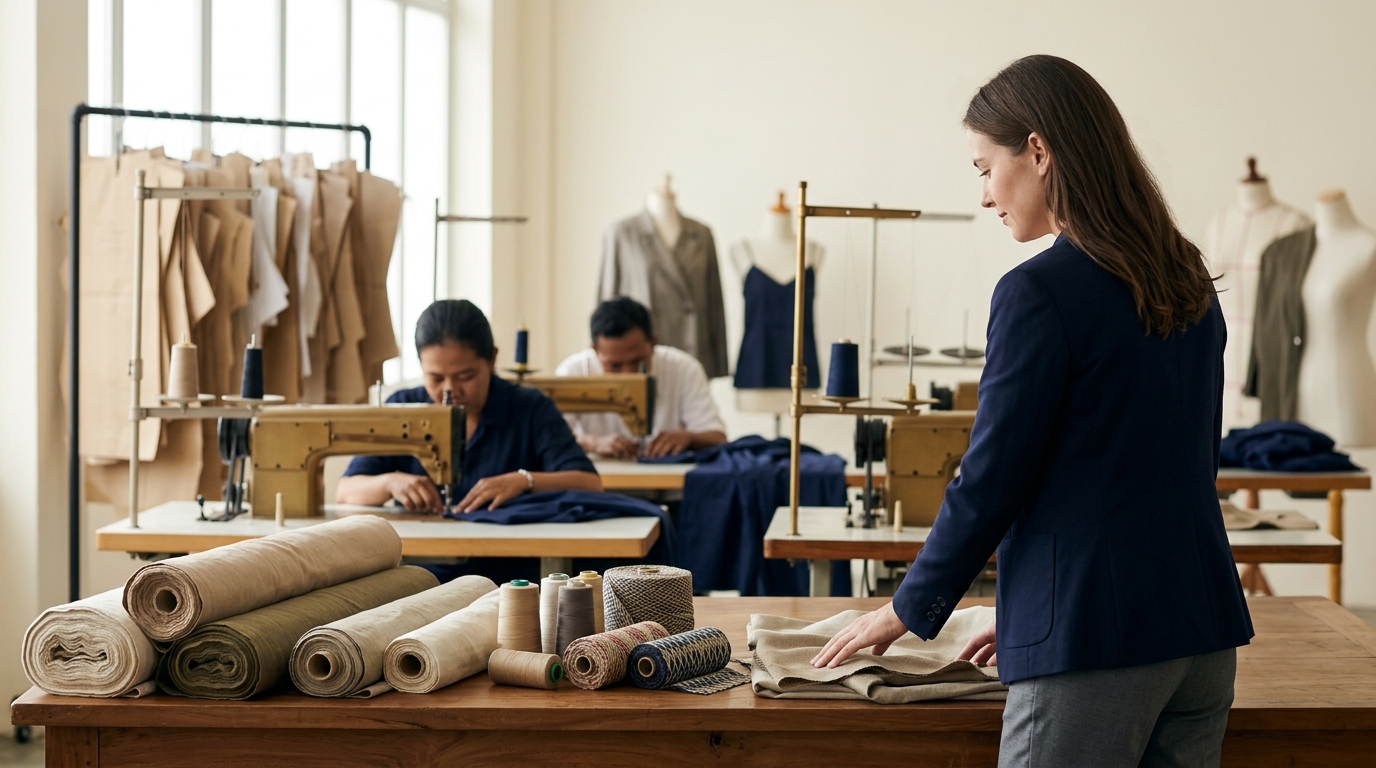
Evaluating Indonesia as a garment sourcing destination is a serious strategic decision. Labor costs, compliance infrastructure, MOQ flexibility, and production timelines all vary significantly from what brands experience in China or Vietnam. Getting those variables wrong on a first order can cost…
Evaluating Indonesia as a garment sourcing destination is a serious strategic decision. Labor costs, compliance infrastructure, MOQ flexibility, and production timelines all vary significantly from what brands experience in China or Vietnam. Getting those variables wrong on a first order can cost months and margin. This clothing manufacturers Indonesia sourcing guide is built to prevent that.
The sections below cover every critical decision point: factory tiers and regional clusters, CMT versus FOB production programs, realistic MOQ benchmarks, sample-to-shipment timelines, compliance certifications, fabric sourcing realities, cost structure drivers, and a direct comparison with Vietnam and Bangladesh. The goal is a decision-ready reference, not a vendor list.
Indonesia's garment and textile export value exceeds USD 4 billion annually (approximate figure, consistent with Indonesian Ministry of Industry reporting), placing it firmly in the top tier of global apparel suppliers. That scale is often underestimated by US brands still defaulting to China or Vietnam. If you are sourcing activewear, denim, modest fashion, swimwear, or woven shirts, Indonesia deserves a structured evaluation. This guide gives you the framework to run one.
Why Indonesia Is a Serious Garment Sourcing Alternative in 2025
Indonesia competes on several fronts simultaneously. Labor costs in Central Java's manufacturing clusters run meaningfully lower than coastal Chinese provinces and are increasingly competitive against Vietnam's Binh Duong corridor. For US importers, select product categories from Indonesia have historically benefited from Generalized System of Preferences (GSP) arrangements, though buyers should verify current US GSP status with a licensed customs broker before building it into landed cost models.
Quota positioning is another structural advantage. Indonesia is not subject to the Section 301 tariff environment that has raised costs on Chinese-origin goods since approximately 2018. That single factor has prompted many mid-market US brands to run parallel sourcing evaluations across Southeast Asia.
Product Categories Where Indonesia Excels
- Activewear and performance knits: Strong concentration in West Java - Denim: Established mill base and finishing infrastructure in Bandung and Tangerang - Woven shirts: Mid-tier and Tier 1 capacity across the Tangerang–Bogor corridor - Modest fashion and abayas: Growing Central Java specialization - Swimwear and resortwear: Bali-based boutique manufacturers
Risks to Factor Into Your Evaluation
- Lead times tend to run longer than China, especially when fabric must be imported - Performance fabrics and technical textiles are heavily dependent on imports from China, South Korea, or Taiwan - Factory digital visibility is low; Indonesian suppliers are significantly underrepresented on major B2B platforms - Inter-island domestic logistics introduce additional complexity for brands pursuing multi-cluster sourcing
Mapping Indonesia's Garment Manufacturing Clusters and Factory Tiers
Geography drives capability in Indonesian garment manufacturing. Factories cluster by region, and each cluster has a distinct production profile, tier composition, and compliance infrastructure.
West Java: High-Volume Export Hub
Bandung, Bogor, and Tangerang form Indonesia's primary export-oriented garment corridor. This region hosts the majority of Tier 1 factories — large-scale operations with 500 or more workers, established global brand audit histories, and standardized production systems. Brands sourcing at volume ( approximately 3,000 units per style and above) will find their primary options here. Compliance documentation — BSCI, Sedex, WRAP — is most consistently available from West Java suppliers.
Central Java: Growing Mid-Tier Capability
Solo and Semarang anchor a mid-tier cluster that has expanded steadily over the past decade. These factories typically employ 100 to 500 workers (Tier 2 classification) and specialize in uniforms, knitwear, and modest fashion categories. Minimum wage rates in Central Java run noticeably lower than West Java — a differential that directly reduces CMT and FOB labor components for brands that can absorb slightly longer coordination timelines.
Bali: Boutique and Artisan Production
Bali's manufacturing base is structurally different. Factories here are predominantly Tier 3: under 100 workers, artisan-oriented, and suited to low-MOQ private label programs, capsule collections, and product testing. Swimwear, resortwear, and handcrafted apparel are the primary strengths. Compliance certifications are less common at this tier, so buyers need to apply their own audit protocols.
Factory Tier Reference Table
| Tier | Workforce | Typical MOQ | Compliance Certifications | Best For |
|---|---|---|---|---|
| Tier 1 | 500+ workers | 3,000–10,000 units/style | BSCI, Sedex, WRAP, GRS | High-volume, retail-ready programs |
| Tier 2 | 100–500 workers | 500–3,000 units/style | Often BSCI or WRAP | Mid-size brands, varied construction |
| Tier 3 | Under 100 workers | 50–500 units/style | Rare; buyer audit required | Private label startups, capsule drops |
CMT, FOB, and Full-Package: Choosing the Right Production Program for Your Brand
Your choice of production program directly determines how the operational workload is divided between your team and the factory. Aligning that choice with your organization's actual internal capabilities is among the most consequential decisions covered in this clothing manufacturers Indonesia sourcing guide.
CMT (Cut, Make, Trim)
In this arrangement, all fabric, trims, labels, and packaging materials are provided by the buyer, while the factory contributes only its labor and equipment. Although CMT yields the lowest per-unit factory cost, the brand absorbs complete responsibility for material sourcing. Brands that already have an established fabric supply chain and an in-house technical team are the most suitable candidates. For a first Indonesia order, the coordination overhead of CMT typically outweighs whatever cost advantage it offers.
FOB (Free on Board)
FOB terms require the factory to source fabric and trims according to the buyer's specifications, manufacture the garments, and hand them over at the origin port. Among mid-size US brands sourcing from Indonesia, this is the dominant production model. Under this structure, the factory's ability to procure materials becomes a key evaluation criterion — particularly when performance fabrics must be imported.
Full-Package (OEM/ODM)
Under a full-package program, the factory takes ownership of design development, fabric and trim procurement, production, quality control, and export documentation. OEM (Original Equipment Manufacturer) arrangements are executed to the buyer's specifications, while ODM (Original Design Manufacturer) arrangements draw on factory-developed designs that are then adapted for the buyer. This model suits brands that lack in-house product development capacity, or those working in categories where the factory already has deep-rooted expertise.
Program Selection Decision Framework
| Factor | CMT | FOB | Full-Package |
|---|---|---|---|
| Buyer has fabric supply chain | Required | Not needed | Not needed |
| Internal tech pack capability | Required | Required | Optional |
| Best unit economics at volume | Yes | Moderate | Higher cost |
| Factory manages compliance docs | No | Partial | Yes |
| Suitable for first-time Indonesia buyer | Rarely | Yes | Yes |
MOQ Benchmarks by Factory Tier and Product Category in Indonesia
Minimum order quantities in Indonesia vary by factory tier, product category, and construction complexity. These figures are approximate industry ranges, not guarantees from specific factories.
- Tier 1 factories: Typically 3,000–10,000 units per style, per colorway. Strict size ratio standardization is expected. Deviation from standard ratios usually triggers a surcharge or MOQ increase. - Tier 2 factories: Generally 500–3,000 units per style. More flexibility on material substitutions and construction variations. Preferred entry point for growing brands. - Tier 3 / Bali boutique factories: Commonly 50–500 units per style. Suited to product testing, limited-edition drops, and private label capsule collections.
MOQ Negotiation Levers
Three approaches consistently move MOQ thresholds in your favor:
1. Consolidated orders: Combine multiple styles into a single purchase order to hit the factory's overall volume requirement even if individual style quantities are below minimum. 2. Repeat booking commitments: Offer a forward booking schedule for two or three seasons. Factories reduce MOQ for buyers who demonstrate pipeline predictability. 3. Simplified colorway structures: Reducing from four colorways to two on a style can halve the effective MOQ without changing unit count.
Sampling to Shipment: Realistic Timeline Expectations for Indonesia Orders
First-order timelines from Indonesia to a US warehouse are longer than many brands anticipate. Planning on five to seven months from first factory contact to warehouse receipt is realistic for a new supplier relationship.
| Stage | Typical Duration | Key Variables |
|---|---|---|
| Proto sample | 2–4 weeks from tech pack submission | Complexity, revision rounds (expect 1–3) |
| Salesman sample (SMS) | 3–5 weeks post proto approval | Fabric lead time |
| Bulk production | 60–120 days | Factory tier, order volume, fabric origin |
| Sea freight to US West Coast | 18–28 days | Port congestion, carrier schedule |
| Customs clearance + inland transit | 5–10 days | HTS classification, broker speed |
Compliance and Certification Standards Every Indonesia Factory Buyer Should Know
Compliance requirements are set by the retailer or end buyer, not the factory. Clarify which certifications are mandatory for your distribution channel before shortlisting factories.
Primary Social Compliance Certifications
BSCI (Business Social Compliance Initiative): An audit-based framework that evaluates labor rights, health and safety, and management systems. It is the most widely requested compliance standard among European and US retail buyers. BSCI audit results are graded on a tiered scale from A through E; a minimum score of B should be set as the threshold for supplier engagement.
Sedex / SMETA: Sedex functions as a supply chain data-sharing platform, while SMETA (Sedex Members Ethical Trade Audit) is the corresponding audit methodology. Both are mandatory for many UK-headquartered brands and large US multi-brand retailers. Tier 1 factories in West Java increasingly hold SMETA 4-pillar audit reports as a baseline compliance credential.
WRAP (Worldwide Responsible Accredited Production): US-centric certification with strong adoption across Indonesian export factories. WRAP certification is publicly verifiable via the WRAP database.
Product and Environmental Certifications
- GRS (Global Recycled Standard): Mandatory for any verified recycled content claim. Demand is rising among sustainable fashion brands that source recycled polyester activewear. - GOTS (Global Organic Textile Standard): Required to substantiate organic cotton claims from fiber stage through finished product. GOTS-certified suppliers in Indonesia are limited in number; confirm availability early in the sourcing process.
Verification Protocol
- ✓Request original certificate with issue date and expiry
- ✓Verify certificate number in the issuing body's public database (WRAP, GOTS, Sedex)
- ✓Confirm the certificate covers the specific production facility address
- ✓Check audit scope — some certificates cover only part of a factory's operations
- ✓Request the most recent audit report executive summary
How to Find and Vet Reliable Indonesian Garment Factories
Identifying dependable clothing manufacturers in Indonesia demands greater effort than comparable sourcing in China. Factories maintain limited digital profiles, and Alibaba's coverage of Indonesian suppliers is thin relative to its extensive Chinese supplier base.
Discovery Channels
- API Industri (Indonesian Textile Association): The primary industry body. Member directory provides a starting filter for export-oriented manufacturers. - Trade shows: Intertex Jakarta is the primary domestic textile and apparel trade event. Indonesian pavilions at Magic Las Vegas and Texworld New York offer direct contact with export-ready factories. - Sourcing agents based in Indonesia: Agents typically charge 3–8% of FOB value. Justified when your team lacks on-the-ground capacity for factory visits, sample chasing, and production monitoring. Verify agent independence — some receive undisclosed commissions from preferred factories.
Factory Audit Framework
Prior to placing an initial order, carry out or commission a factory audit that addresses the following areas:
- ✓Production capacity verification (active lines, not stated capacity)
- ✓Current customer list — reference check 1–2 active buyers
- ✓Compliance certificates with expiry verification
- ✓Sample quality review against tech pack — not just showroom samples
- ✓Worker headcount vs stated capacity ratio
- ✓Subcontracting policy — confirm no unauthorized subcontracting
- ✓Financial stability signals: bank reference, export history, payment terms offered
- ✓Lead time track record from at least two recent orders
Fabric Sourcing in Indonesia: Domestic Strengths and Import Realities
When building an Indonesia sourcing model, the variable brands most consistently underestimate is the factory's fabric sourcing capability.
Domestic Fabric Strengths
Indonesian mills hold genuine competitive strength across several fabric categories: - Rayon and viscose: A well-established regional mill base offers competitive pricing, making these fabrics well suited to resort and modest fashion - Cotton knits: West Java knitting mills serve as the primary fabric supplier for the domestic activewear cluster - Denim: Bandung and Tangerang are home to denim mills with a proven track record at export-grade quality - Batik fabrics: Unique to Indonesia and applicable across fashion and lifestyle product categories
Import Dependency Reality
Performance fabrics — moisture-wicking polyester, nylon-spandex blends, technical wovens — are typically imported from China, South Korea, or Taiwan. Luxury wovens follow the same import pattern. This creates two cost and timeline impacts: fabric cost is denominated in USD and exposed to currency fluctuation, and fabric transit adds 30– approximately 45 days to the production critical path.
Sustainable Fabric Options
- Recycled polyester from GRS-certified regional distributors is readily available and sees growing adoption among activewear manufacturers in West Java - TENCEL (Lyocell) can be sourced through regional authorized distributors, though quantities remain modest - Organic cotton (GOTS-certified) demands pre-verified supply chain coordination due to limited domestic availability
Cost Structure Breakdown: What Drives Your Ex-Factory Price in Indonesia
Understanding the cost structure is central to any clothing manufacturers Indonesia sourcing guide used by sourcing managers. These are directional ranges, not guaranteed quotes.
Labor Cost by Region
Central Java (Solo, Semarang) minimum wages run approximately 15–25% lower than West Java (Bandung, Tangerang) on a regional government-mandated basis (approximate differential based on publicly reported regional minimum wage data). For labor-intensive categories — embroidered modest fashion, cut-and-sew activewear — this differential directly reduces CMT pricing.
Material Cost as a Percentage of FOB
Material cost typically represents 40–65% of FOB price, depending on fabric content and trim complexity. Garments using imported performance fabrics sit at the higher end of that range.
Landed Cost Calculation Framework
| Component | Typical Range | Notes |
|---|---|---|
| FOB Indonesia | Varies by category | Starting point |
| Ocean freight (FCL, West Coast) | USD 2,000–4,500 per 40ft container (approximate) | Market-rate dependent |
| US import duty | 12–32% of dutiable value | Verify exact HTS code; knit vs woven classification matters |
| Marine insurance | ~0.3–0.5% of cargo value | Standard CIF equivalent |
| Customs broker fees | USD 150–400 per entry (approximate) | Variable by broker |
| Inland drayage + warehousing | USD 300–800+ | Port to warehouse |
Indonesia vs Vietnam vs Bangladesh: Where to Source What
This comparison addresses the most common decision US brands face when evaluating Southeast Asian sourcing alternatives.
| Factor | Indonesia | Vietnam | Bangladesh |
|---|---|---|---|
| Activewear / performance knits | Strong | Moderate | Moderate |
| Swimwear / resortwear | Strong (Bali) | Limited | Limited |
| Denim | Strong | Moderate | Limited |
| Woven shirts | Moderate–Strong | Strong | Moderate |
| High-volume basics / T-shirts | Moderate | Moderate | Very Strong |
| Outerwear | Limited | Strong | Moderate |
| Modest fashion | Strong | Limited | Moderate |
| Low-MOQ private label | Strong (Bali Tier 3) | Limited | Limited |
| Lead time to US | 5–7 months (first order) | 4–6 months | 4–6 months |
| CPTPP trade benefit | No | Yes | No |
| Compliance infrastructure | Strong (Tier 1–2) | Strong | Strong |
| FOB price point | Mid | Mid | Lowest |
Vietnam's CPTPP membership provides tariff advantages for eligible US trade partners — but US-Vietnam bilateral tariff treatment depends on ongoing trade policy. Bangladesh's ultra-low FOB pricing on basics and knitwear is structural, driven by the lowest regional labor costs and massive scale. Indonesia wins on product specificity: activewear, swimwear, denim, modest fashion, and boutique private label are categories where Indonesian factories deliver a quality-to-cost ratio that neither Vietnam nor Bangladesh matches.
Frequently Asked Questions
What is the minimum order quantity for clothing manufacturers in Indonesia? MOQs range from 50 units per style at Bali boutique factories to 10,000 units per style at Tier 1 West Java factories. Tier 2 factories — the most common entry point for growing US brands — typically require 500–3,000 units per style.
How long does it take to produce and ship a first order from Indonesia to the US? Plan for five to seven months from first factory contact to US warehouse receipt. Proto sampling, salesman sampling, bulk production (60–120 days), and sea freight (18–28 days to West Coast) each consume time sequentially.
What compliance certifications should I require from an Indonesian garment factory? The minimum standard for US retail distribution is BSCI or WRAP social compliance certification. Sedex/SMETA is required by many multi-brand retailers. Sustainable fashion brands should additionally require GRS (recycled content) or GOTS (organic cotton) where relevant to product claims.
Is it better to use a sourcing agent or contact Indonesian factories directly? For brands that have no staff based in Indonesia, working with a qualified sourcing agent — one who can demonstrate real factory relationships and clearly disclose fees — substantially lowers the risk on an initial order. Agent fees typically fall in the 3–8% of FOB range. The core trade-off comes down to cost versus the level of direct control the brand wishes to maintain.
What is the difference between CMT and FOB production in Indonesia? CMT requires the buyer to supply all fabric and trims, with the factory contributing only labor and machinery. Under FOB, the factory procures materials to the buyer's specification and delivers finished goods to the export port. For mid-size US brands entering Indonesia for the first time, FOB is the standard and most practical production model.
How does Indonesia compare to Vietnam and Bangladesh for apparel sourcing? When it comes to activewear, swimwear, denim, modest fashion, and low-MOQ private label, Indonesia holds a genuine competitive edge. Vietnam outperforms on woven shirts, outerwear, and faster lead times, aided by CPTPP advantages. Bangladesh dominates ultra-high-volume basics at the lowest available FOB prices. The right choice should be driven by product category and order scale rather than country preference alone.
Indonesia rewards brands that approach it with structured criteria. Factory tier selection, production program choice, compliance verification, and realistic timeline planning are the four levers that determine whether a first Indonesia order builds a durable supply chain or creates costly delays.
You now have the decision framework. The logical next step is connecting with factories that match your tier, category, and compliance requirements.
You have the sourcing framework — now apply it with confidence. Request verified factory introductions matched to your product category, tier requirements, and compliance standards, and start your Indonesia sourcing journey today.
Request Factory Introductions →Need eyes on the ground in Indonesia?
MTS is an execution partner — supplier verification, manufacturing management, quality control and export logistics across Indonesia, Vietnam and China.
Related services
Related articles
Receive furniture sourcing insights across Asia.
One email per week. No spam.