T-Shirt Manufacturers Indonesia Bulk Wholesale: Complete Buying Guide for US Brands
14 min read

Sourcing bulk t-shirts from Indonesia is a serious procurement decision, not a quick catalog browse. US brand owners and merchandise companies face a specific challenge: identifying which Indonesian factories can meet US-market fit specs, print quality standards, and compliance requirements —…
Sourcing bulk t-shirts from Indonesia is a serious procurement decision, not a quick catalog browse. US brand owners and merchandise companies face a specific challenge: identifying which Indonesian factories can meet US-market fit specs, print quality standards, and compliance requirements — without flying to Java for a factory visit. The stakes are real. A misaligned supplier choice costs sample fees, missed launch windows, and rework expenses that erode margin before a single unit sells.
This guide covers every factor driving a sound supplier decision. Topics include fabric construction, GSM selection, decoration capabilities, MOQ tiers, and pricing logic. Also covered: US size grading, private label packaging, quality control frameworks, and freight routing from Indonesian ports to US destinations. It is structured for buyers evaluating t shirtmanufacturers indonesiabulk wholesale for the first time or scaling beyond their current supplier.
Indonesia ranks consistently among the top-five global garment exporters, and its knit manufacturing base — concentrated in Java and Bali — has deepened over the past two decades. That depth translates into genuine capability across the supply chain, from ringspun yarn to retail-ready packaging. The sections below give you the evaluation framework to use it.
Why Indonesian T-Shirt Manufacturers Outperform for US Bulk Buyers
Production Scale and Labor Cost Positioning
Indonesia's garment industry is structurally well-suited for US bulk buyers. Labor costs remain competitive relative to comparable Asian exporters. Indonesia's cotton-knit infrastructure is concentrated in high-output clusters: Jakarta and its satellite zones for large-volume CMT, Bandung for mid-tier knit specialists, and Surabaya for full-package export factories. Bali serves premium and private-label runs targeting boutique brands.
The Java island corridor — Jakarta to Surabaya — hosts the highest density of export-capable knit factories. These are typically medium-scale OEM operations with 100 to 500 workers, experienced with US and EU buyer requirements, and capable of handling both blank wholesale and decorated full-package orders.
Trade Framework Considerations for US Importers
US importers should note that Indonesia does not currently hold a free-trade agreement with the United States. However, Indonesia has historically benefited from the Generalized System of Preferences (GSP), which has reduced or eliminated duties on eligible garment categories. Buyers should verify current GSP eligibility and applicable HTS code duty rates with a licensed customs broker before placing first orders, as trade frameworks shift. Landed cost modeling must account for duties, port fees, and freight — not just the FOB unit price.
Fabric Specifications and GSM Tiers Every Buyer Must Define Upfront
Fabric Constructions Available From Indonesian Mills
Indonesian knit factories supply a range of fabric constructions. The most common for t-shirt programs are:
- 100% combed cotton: Consistent hand-feel, good printability, reliable dye uptake - Ringspun cotton: Finer yarn, softer surface, slightly higher cost per unit - CVC (Chief Value Cotton): Typically 60% cotton / 40% polyester; wrinkle-resistant, useful for activewear manufacturers for startups managing cost - Tri-blend: Cotton, polyester, rayon combination; premium hand-feel, higher per-unit cost - Pique knit: Structured texture, used for polo-style cuts and performance shirts
GSM Tiers Matched to End Use
GSM (grams per square meter) is the single most important fabric variable to specify before sampling. Getting it wrong means the wrong hand, the wrong drape, and the wrong print result.
| GSM Range | Classification | Best End Use |
|---|---|---|
| 140–160 gsm | Lightweight | Promo merch, event tees, high-volume giveaways |
| 180–200 gsm | Midweight | Retail blanks, streetwear, everyday branded tees |
| 220–260 gsm | Heavyweight | Premium streetwear, oversized fits, cold-weather layers |
For retail-quality bulk t-shirts targeting US consumers, 180–200 gsm combed ringspun is the industry benchmark. Lightweight promo shirts at 140–160 gsm reduce unit cost but show print bleed more readily and wear thin faster. Heavyweight 240+ gsm garments command higher FOB prices but support structured silhouettes that hold shape through repeated washing.
Yarn Counts and Their Price Impact
Yarn count affects hand-feel and cost in a direct relationship:
- 20s count: Thicker yarn, coarser feel, lower cost — suited to promotional and workwear programs - 30s count: Mid-range softness, the most common count in standard wholesale shirts - 40s count: Finer, softer, more expensive — aligned with premium retail and private label t-shirt Indonesia programs
A shift from 30s to 40s combed ringspun typically increases fabric cost meaningfully per unit. Confirm yarn count in writing before pre-production sampling.
Certifications to Request From Suppliers
Two certifications matter most for US retail and DTC buyers:
- OEKO-TEX Standard 100: Confirms the finished garment and its components are tested against harmful substances. Relevant for any brand selling direct to consumers, especially children's categories. - GOTS (Global Organic Textile Standard): Required if you are sourcing organic cotton. Covers the full supply chain from fiber to finished product.
Request certification numbers and verify them directly on the issuing body's database. Certificates that cannot be verified online should be treated as invalid.
Printing and Decoration Capabilities at Indonesian T-Shirt Factories
Screen Printing: Volume Decoration Standard
Screen printing remains the dominant decoration method for wholesale t shirts in bulk. Indonesian factories generally offer:
- Plastisol inks: Durable, opaque, industry-standard for branded merch; not ideal for eco-positioned brands - Water-based inks: Softer hand, better breathability, preferred for premium retail; requires more precise curing control - Discharge printing: Removes dye from cotton and replaces it with pigment; produces a vintage, soft-hand result; works only on 100% cotton
Multi-color registration quality varies significantly between factories. Request a press-proof on your actual fabric before approving production. Screen setup charges (tooling) apply per color per screen — typically a fixed cost that amortizes across higher volumes.
DTG vs. Screen: Choosing the Right Method
| Decoration Method | Minimum Run | Best For | Per-Unit Cost at Volume |
|---|---|---|---|
| Screen printing | Typically 50–72 pcs per design | High-volume, spot-color designs | Lowest at 300+ pcs |
| DTG (direct-to-garment) | 1–50 pcs | Complex photographic prints, low-run customization | Higher per unit |
| Embroidery | Typically 12–24 pcs | Chest logos, cap fronts, structured placements | Driven by stitch count |
DTG is cost-effective for sampling and short runs but does not scale economically against screen for orders above 200 pieces on a single design. For bulk programs, screen printing is the correct choice.
Embroidery Specifications
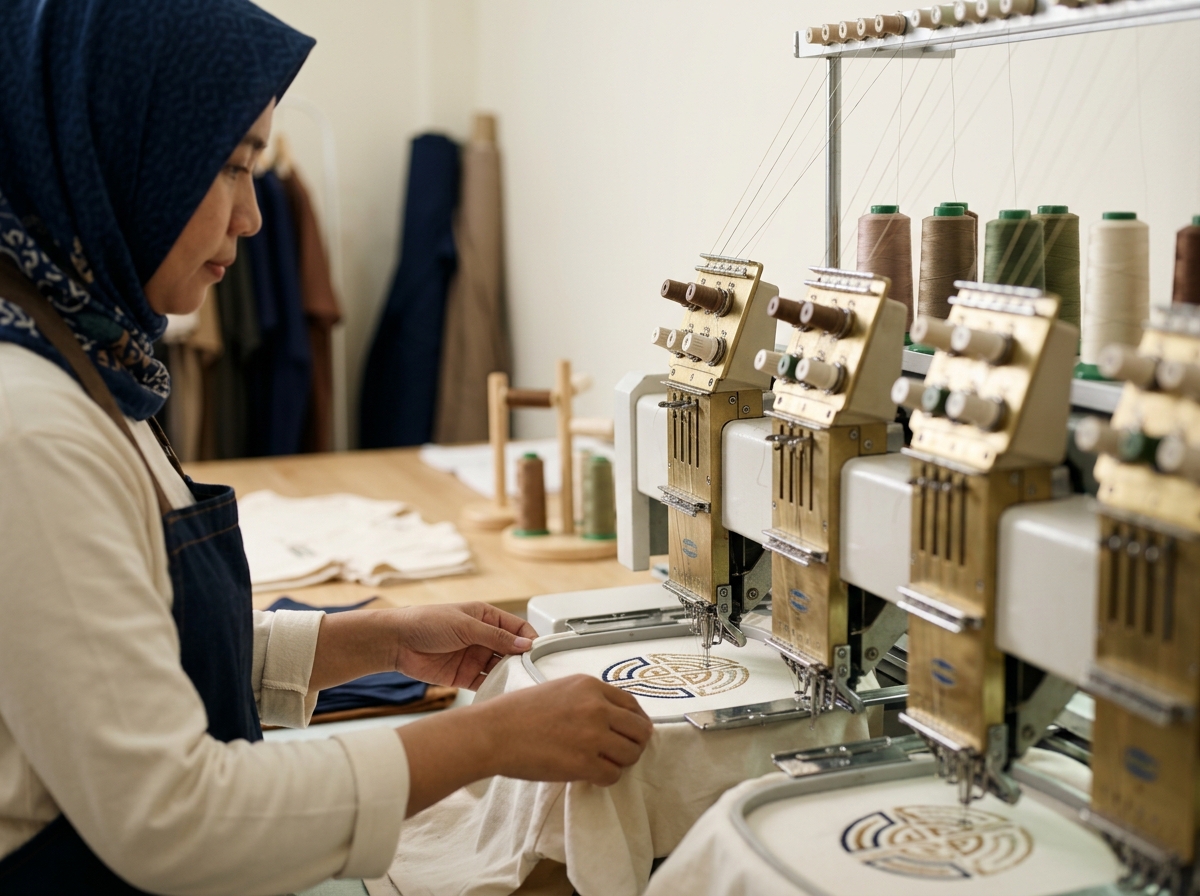
Embroidery pricing from Indonesian factories is primarily driven by stitch count. A standard left-chest logo at approximately 5,000–8,000 stitches is the most common tier. Designs exceeding approximately 15,000 stitches increase per-unit cost noticeably. Request digitizing fees upfront — these are typically a one-time charge and should be confirmed before sampling.
MOQ Tiers, Per-Unit Pricing Logic, and Volume Discounts Explained for Bulk Wholesale
MOQ Tiers Across Factory Types
T shirt manufacturers indonesia bulk wholesale operations fall into three broad MOQ categories:
| Factory Type | MOQ Range | Typical Profile |
|---|---|---|
| Low-MOQ specialist | 50–100 pcs per style | SME factories, startup-friendly, higher per-unit cost |
| Standard export factory | 300–500 pcs per style | Mid-scale OEM, most common for growing brands |
| Large-scale manufacturer | 1,000+ pcs per style | High-capacity, lowest per-unit cost, longer lead times |
For early-stage brands, low-MOQ factories allow market testing without overcommitting capital. The trade-off is a higher per-unit FOB price and sometimes limited decoration or fabric options.
CMT vs. Full-Package (FOB) Pricing
- CMT (Cut, Make, Trim): The buyer supplies fabric and trims; the factory provides labor and production. Lower FOB price, but the buyer manages fabric sourcing, quality, and logistics to factory. - Full-package (FOB): The factory sources fabric, cuts, sews, decorates, and packs to the buyer's spec. Higher per-unit cost, but the buyer has a single point of responsibility.
For US-based buyers sourcing remotely, full-package FOB is almost always the practical choice. Managing fabric procurement from the US into an Indonesian factory adds complexity that rarely saves money at mid-volume order sizes.
Hidden Cost Factors to Budget
- Sample fees: Typically charged per colorway or per style; sometimes credited against first bulk order - Tooling charges: Screen setup, embroidery digitizing, custom label dies - Revision rounds: Multiple sample rounds extend lead time and may carry additional charges
Size Grading and Fit Specifications Matched to the US Market
US vs. Asian Size Grading
This is one of the most consistently overlooked issues when US brands first order wholesale shirts in bulk from Indonesia. Asian domestic size grading runs significantly smaller than US market expectations. A factory's default 'L' may correspond to a US 'M' in chest width and body length.
The solution is a properly structured tech pack. It must include:
- Finished garment measurements (not body measurements) at each size - Grade rules: the increment added or subtracted at each size break - Tolerance range per measurement point (typically ±0.5 cm to ±1.0 cm)
Key Measurement Points for US T-Shirts
| Measurement Point | Typical US Men's M | Tolerance |
|---|---|---|
| Chest width (across) | Approximately 52–55 cm | ±1.0 cm |
| Body length (CB) | Approximately 71–74 cm | ±1.0 cm |
| Sleeve length | Approximately 22–24 cm (short sleeve) | ±0.5 cm |
| Shoulder width | Approximately 46–48 cm | ±0.5 cm |
For women's and unisex silhouettes, submit separate grade tables. Do not assume a factory will adapt Asian grading to US specs without explicit written instructions.
Pre-Production Fit Sample Process
The standard process is: tech pack submission → factory-made pre-production sample → buyer measurement review → comment sheet returned → revised sample if needed → approval signature. Allow two to three weeks per sample round for international shipping. Build at least two rounds into your launch timeline.
Private Label, Labeling, and Retail-Ready Packaging for Indonesian T-Shirt Programs
Indonesian factories support a full range of private label t-shirt Indonesia options. The main label types are:
| Label Type | Cost Profile | Best For |
|---|---|---|
| Woven label | Higher per-unit | Premium retail, brand positioning |
| Heat-transfer label | Mid-range | Athleisure, activewear, tagless programs |
| Screen-printed neck label | Lower per-unit | High-volume basics, promo programs |
For retail compliance in the US, garments must carry fiber content, country of origin, care instructions, and size — meeting FTC labeling requirements. Confirm your factory's label compliance process in writing.
Retail-ready packaging considerations:
- Polybag sizes must match folded garment dimensions; specify fold type (retail fold vs. flat fold) - Hang tags with barcodes and UPC stickers for warehouse receiving at 3PL or retail DC - Carton labels should include style, color, size breakdown, PO number, and country of origin
For sustainability-positioned brands, recycled polybags and FSC-certified hang tags are available from Indonesian suppliers. Request material certification documentation alongside the main product compliance files.
Quality Control Checkpoints From Fabric Inspection to Final Shipment
Four-Stage QC Framework
Effective QC on remote bulk orders from Indonesian factories follows a four-stage structure:
1. Fabric inspection: Uses the 4-point system to score fabric defects per 100 linear yards before cutting begins 2. Pre-production sample approval: Final sign-off on fit, fabric, color, and decoration before bulk cutting 3. During-production inline check: Random inspection at approximately 20–30% production completion to catch systematic defects early 4. Final random inspection: Conducted on finished packed goods using AQL 2.5 (Acceptable Quality Level)
Applying AQL 2.5 to Remote Orders
AQL 2.5 means that in a random sample drawn from the shipment, a defect rate above 2.5% in critical or major defect categories triggers rejection of the lot. At a shipment of 1,200 pieces, the standard AQL 2.5 sample size is approximately 125 units. If more than 7 major defects appear in that sample, the lot fails.
US buyers sourcing remotely should engage a third-party inspection agency for final inspection. Agencies operating in Indonesia include SGS, Bureau Veritas, and QIMA. Inspection costs are typically charged per man-day and represent a small fraction of order value relative to the risk they mitigate.
Common Defect Categories to Flag in Your Checklist
- Shade variation between cutting lots (fabric dye batch inconsistency) - Seam slippage at stress points (armhole, side seams) - Print registration misalignment on multi-color screen prints - Measurement deviation outside tolerance range - Label placement and content errors
- ✓Submit signed tech pack with tolerance ranges before cutting
- ✓Approve pre-production sample in writing before bulk begins
- ✓Commission third-party inline inspection at 20-30% production
- ✓Use AQL 2.5 final random inspection on packed goods
- ✓Request inspection report with photos before approving shipment release
How to Vet and Shortlist the Best Indonesian T-Shirt Manufacturers
Factory Audit Criteria
When evaluating t-shirt factory candidates, prioritize suppliers who can provide documentation across these categories:
| Criteria | What to Request |
|---|---|
| Compliance certification | WRAP, SEDEX, or ISO 9001 certificates with valid dates |
| Production capacity | Monthly output in pieces; dedicated knit lines |
| Export experience | Confirmed US or EU buyer references |
| Lead time transparency | Written production lead time by order size |
| Sample policy | Clear sample fee and revision policy in writing |
WRAP (Worldwide Responsible Accredited Production) certification is particularly relevant for US-market buyers. SEDEX membership indicates the factory participates in shared ethical data exchange. ISO 9001 confirms documented quality management systems.
Sourcing Agent vs. Direct Factory Engagement
| Approach | Advantages | Disadvantages |
|---|---|---|
| Direct factory | Lower per-unit cost at volume, direct control | Requires sourcing expertise, more time investment |
| Sourcing agent | Local expertise, factory vetting support | Commission cost (typically 3–10% of FOB), variable independence |
For first-time buyers or brands without in-market experience, a sourcing agent or operational partner reduces the risk of misaligned supplier selection. The key distinction: a transparent operational partner charges a service fee and has no undisclosed commission relationship with factories. An agent earning undisclosed supplier commissions has a structural conflict of interest.
Shipping, Lead Times, and Incoterms for Bulk T-Shirt Imports From Indonesia
Production Lead Times by Order Type
| Order Type | Typical Lead Time |
|---|---|
| Blank wholesale, no decoration | 30–45 days from deposit |
| Screen-printed, 1–4 colors | 45–60 days from approved sample |
| Embroidered or multi-technique | 60–75 days from approved sample |
| Large-volume (1,000+ pcs, complex) | 75–90 days |
These are general industry benchmarks. Lead times extend during Ramadan, year-end holidays, and peak export seasons. Build buffer time into any launch schedule.
Indonesian Port Routing to US Destinations
The primary export port for Jakarta-area factories is Tanjung Priok (Port of Tanjung Priok), Indonesia's largest container port. Bali-based factories typically route through Ngurah Rai or consolidate to Tanjung Priok for full container loads.
Approximate sea freight transit times:
| Route | Estimated Transit |
|---|---|
| Tanjung Priok → US West Coast (Los Angeles) | Approximately 18–24 days |
| Tanjung Priok → US East Coast (New York) | Approximately 28–35 days |
These are approximate figures and vary by carrier, vessel schedule, and transshipment routing.
Incoterms for First-Time Importers
| Incoterm | Seller Responsibility | Buyer Responsibility | Best For |
|---|---|---|---|
| FOB (Free On Board) | To vessel at named port | Ocean freight, insurance, US customs | Most common for experienced importers |
| CIF (Cost, Insurance, Freight) | To destination port | US customs, inland freight | Useful for buyers new to freight management |
| DDP (Delivered Duty Paid) | To named delivery address, duties paid | Nothing until delivery | Simplest for first-time importers; highest cost |
FOB Tanjung Priok is the standard term used by most Indonesian export factories. It places ocean freight responsibility with the buyer, allowing direct negotiation with a freight forwarder for better rates at volume.
Frequently Asked Questions About Bulk T-Shirt Sourcing From Indonesia
Who is the best wholesale t-shirt manufacturer in Indonesia for US brands? There is no single best factory — the right supplier depends on your order volume, fabric specification, decoration complexity, and compliance requirements. Evaluate candidates against audit criteria: WRAP or SEDEX certification, confirmed US-market export history, transparent MOQ and sample policies, and documented production capacity.
What is the typical MOQ when ordering bulk t-shirts from Indonesian factories? MOQs range broadly. Low-MOQ specialists accept orders from approximately 50–100 pieces per style. Standard export factories typically require 300–500 pieces per style. Large-scale manufacturers set minimums at approximately 1,000 pieces or more. Decoration type also affects MOQ — screen printing usually requires a minimum per design to amortize setup costs.
Where can I buy high-quality t-shirts in bulk from Indonesia? Direct factory engagement in Bandung, Jakarta, and Surabaya production clusters is the most cost-effective path at sufficient volume. For buyers without sourcing infrastructure, a vetted operational partner or sourcing agent with Indonesia expertise reduces supplier-selection risk.
Which country produces the most t-shirts and how does Indonesia rank? China remains the largest single producer of garments globally by volume. Indonesia ranks among the top-five global garment exporters and is particularly strong in knit categories including plain t-shirts in bulk wholesale. Bangladesh and Vietnam are also major competitors in the cotton knit segment.
What GSM is best for retail-quality bulk t-shirts? For standard retail t-shirts targeting the US market, 180–200 gsm combed ringspun cotton is the most widely accepted benchmark. Lightweight promo tees run 140–160 gsm. Premium streetwear programs often specify 220–260 gsm for structured weight and durability.
What clothing brands are manufactured in Indonesia? Indonesia manufactures garments for numerous international brands across fast fashion, activewear, and premium segments. Due to NDA agreements, specific brand-factory relationships are rarely confirmed publicly. However, Indonesia's WRAP and SEDEX-certified factories supply retailers and brands across the US and EU markets.
- ✓Can you provide current WRAP, SEDEX, or ISO 9001 certification documents?
- ✓What is your production lead time for my order size and decoration type?
- ✓What is your sample fee and revision policy, and is the fee credited against the bulk order?
- ✓What is your AQL inspection standard and do you accept third-party final inspection?
- ✓Can you provide references from current US-market buyers at a similar order volume?
Sourcing t shirt manufacturers indonesia bulk wholesale requires disciplined specification work upfront — fabric GSM, yarn count, size grading, and decoration method all need to be locked before a factory conversation goes anywhere useful. Combine that with a structured QC framework and clear Incoterms understanding, and Indonesia's manufacturing depth becomes a genuine advantage for US brands at any scale.
You now have the evaluation criteria, the benchmark numbers, and the supplier vetting framework. The logical next step is getting samples in hand from factories that meet your compliance and capability thresholds.
You have the specs and the sourcing framework. Request samples from vetted Indonesian t-shirt manufacturers and lock in your bulk wholesale pricing today.
Request Samples Now →Need eyes on the ground in Indonesia?
MTS is an execution partner — supplier verification, manufacturing management, quality control and export logistics across Indonesia, Vietnam and China.
Related services
Related articles
Receive furniture sourcing insights across Asia.
One email per week. No spam.