Indonesian Hardwood Species Guide: Teak, Merbau, Bengkirai, Ulin and More
13 min read
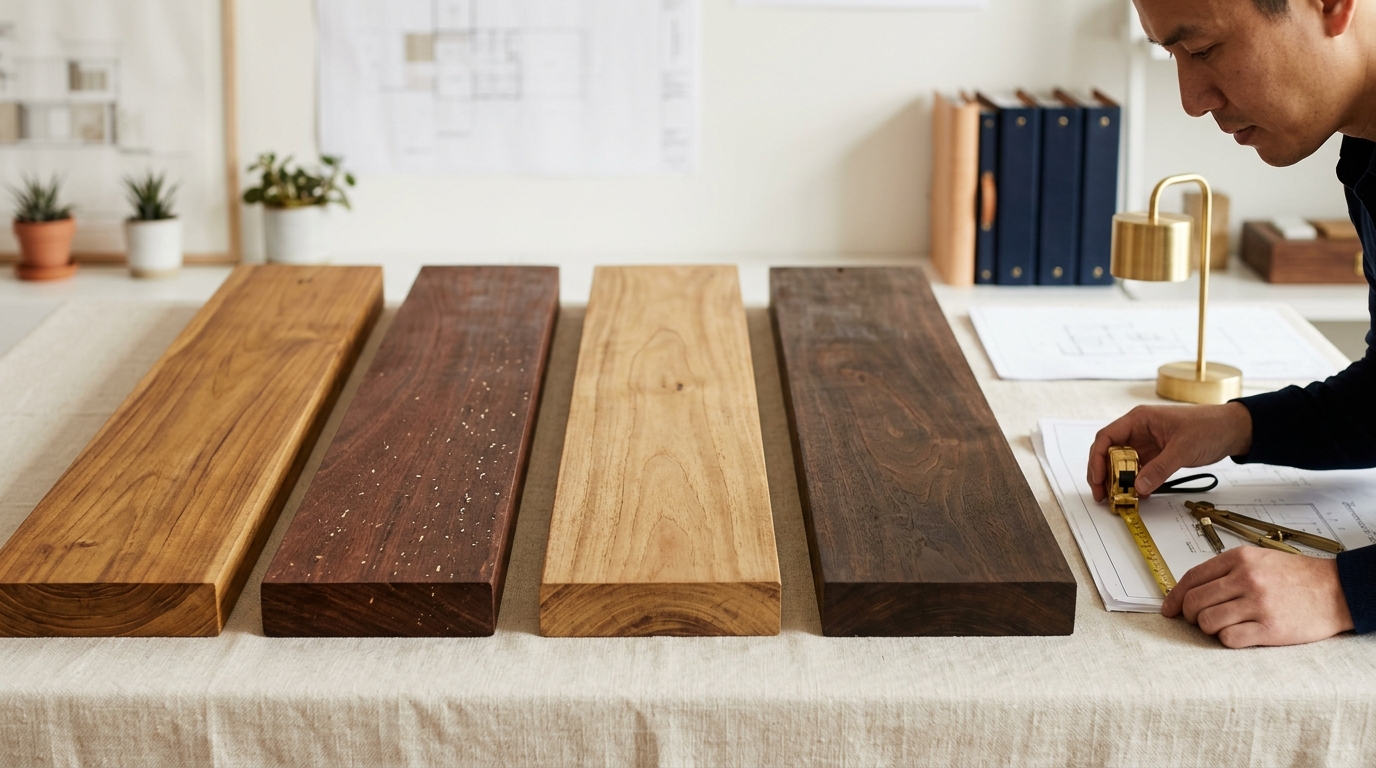
Specifying or importing tropical hardwood from Indonesia involves decisions with long-term structural, legal, and financial consequences. The wrong species selection causes premature decay, failed building inspections, or Lacey Act violations. The right choice delivers decades of performance at a…
Specifying or importing tropical hardwood from Indonesia involves decisions with long-term structural, legal, and financial consequences. The wrong species selection causes premature decay, failed building inspections, or Lacey Act violations. The right choice delivers decades of performance at a competitive price point versus comparable North American or European species.
This indonesian hardwood species guide covers the five species that dominate international B2B trade — teak, merbau, bengkirai, ulin, and mahogany — plus suar as a plantation alternative. Each section leads with verified technical data: Janka hardness, density class, durability rating, and certification status. A structured comparison table allows rapid cross-species evaluation. Sourcing logistics, export port details, and compliance requirements are addressed in dedicated sections.
Architects, hospitality developers, and importers can use this guide as a working reference — from species selection through to pre-shipment inspection. The content is structured so that a time-pressed specifier can navigate by heading and table without reading every word. Start with the comparison table in Section 7 if you already know your application and need to validate a species shortlist.
Why Indonesian Tropical Hardwoods Dominate Global Premium Timber Markets
Indonesia holds one of the largest tropical forest estates on the planet. Its archipelago spans three major island timber regions — Kalimantan, Sumatra, and Sulawesi — each yielding commercially significant hardwood species unavailable elsewhere at scale. That geographic reality underpins Indonesia's position as a top-tier supplier to the US, EU, Japan, and Australia.
Species Diversity and Natural Performance Advantages
No single temperate-zone country matches Indonesia's species breadth. Buyers can source Class 1 durability ironwood, mid-density plantation teak, and high-silica decking species from a single origin. Natural oil content in teak, extreme density in ulin, and tannin-driven color stability in merbau deliver performance that engineered alternatives struggle to replicate. These are not marketing attributes — they are measurable physical properties documented by timber research institutions globally.
Competitive Pricing Versus North American and European Hardwood
Indonesian hardwood reaches US and EU buyers at price points significantly below equivalent-durability domestic species such as white oak or ipe sourced from South America. Plantation teak, in particular, sits in the mid-range tier for tropical decking — delivering Class 1 durability data at a lower cost than old-growth alternatives. Merbau and bengkirai occupy the value tier for volume decking and flooring projects.
Sustainability Pressure and Certified Sourcing
ITTO (International Tropical Timber Organization) data consistently identifies Indonesia as a leading tropical log and processed wood exporter. That volume has attracted regulatory scrutiny. The US Lacey Act, the EU Timber Regulation, and Australia's Illegal Logging Prohibition Act all require importers to demonstrate legal origin. This has accelerated certified supply chain development — and raised the compliance bar for all buyers operating in these markets.
Teak (Tectona grandis): The Gold Standard for Interior and Exterior Applications
Botanical and Physical Profile
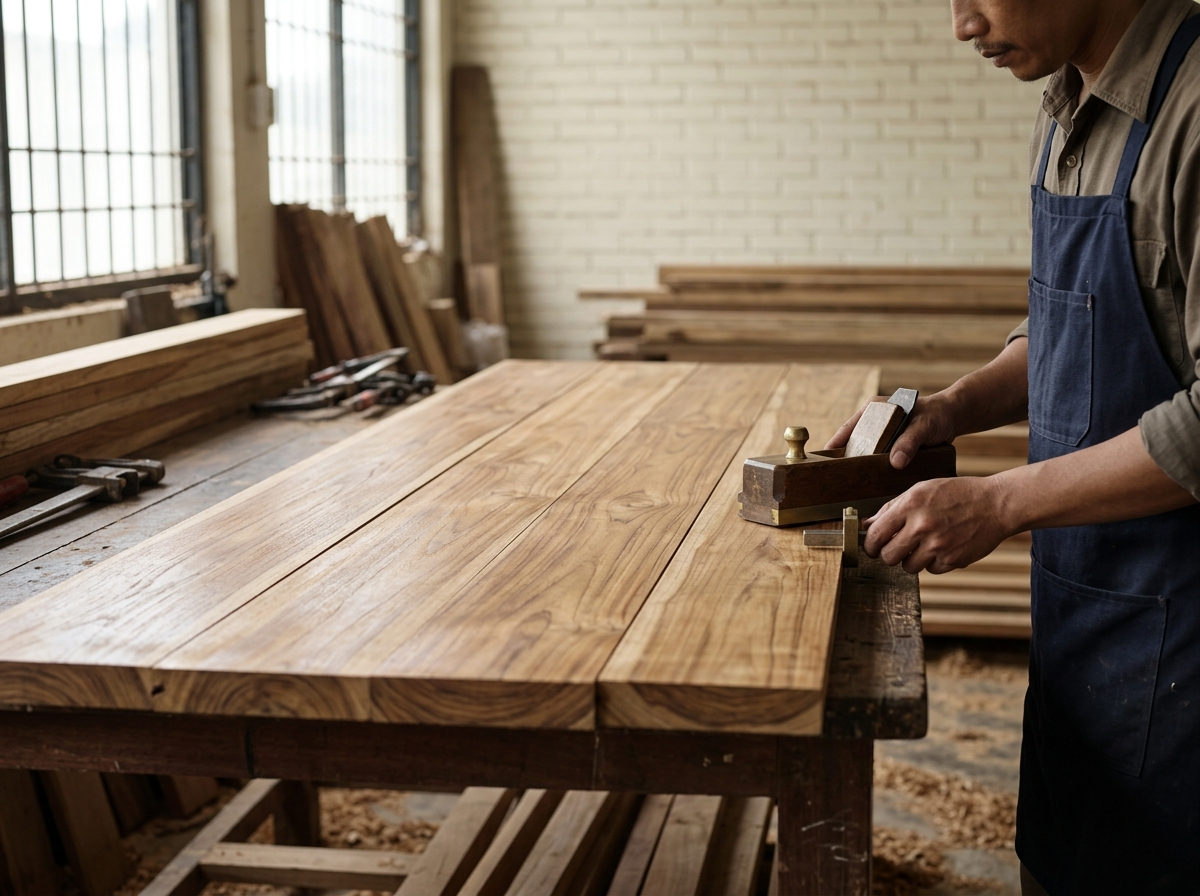
Tectona grandis (teak) registers approximately 1,070 lbf on the Janka hardness scale. Its density ranges around 655 kg/m³ (air-dry). High natural silica and oil content make it dimensionally stable and self-protective against moisture, insects, and fungal decay. Independent durability assessments classify teak as Class 1 — the highest rating — meaning it performs in ground-contact and marine-adjacent environments without chemical treatment.
Plantation Teak vs. Old-Growth Teak
This distinction is critical for importers. Old-growth teak — harvested from mature natural forests — exhibits a higher proportion of heartwood, tighter growth rings, and denser natural oil distribution. Plantation teak, grown in managed stands over approximately 20–40 years, contains more sapwood, wider rings, and lower average oil content. Both carry Class 1 durability ratings in published data, but plantation material may show faster surface weathering and greater color variation in exterior exposure. For structural and marine applications, specify heartwood-grade plantation teak and verify with mill certificates.
Jepara in Central Java is the primary processing cluster. Most export-grade teak passes through Semarang port.
Certification Status for US and EU Buyers
SVLK (Sistem Verifikasi Legalitas Kayu) — Indonesia's national Timber Legality Verification System — is mandatory for all Indonesian wood product exports. SVLK certificates are required for Lacey Act declaration compliance. FSC-certified plantation teak supply exists in Indonesia and is accessible through verified exporters, though volumes are smaller than the broader SVLK-certified supply chain. Always request the SVLK certificate number and verify it through the Indonesian Ministry of Environment and Forestry portal before committing to a shipment.
Merbau (Intsia bijuga): High-Density Hardwood for Flooring and Heavy Decking
Species Profile and Performance Data
Intsia bijuga (merbau) registers approximately 1,925 lbf Janka hardness — nearly double that of teak. Density typically reaches around 800–850 kg/m³ (air-dry). The species exhibits a distinctive reddish-brown to dark brown color that deepens with age and UV exposure. High tannin content contributes to natural decay resistance, placing merbau in Class 2 durability — appropriate for exterior use above ground and in protected structural applications.
Primary Applications and Known Issues
Merbau is widely specified for hardwood flooring, exterior decking, and structural beams in commercial and hospitality projects. Its hardness makes it highly resistant to indentation under heavy foot traffic.
Two issues require active management:
- Iron staining: Tannins react with ferrous fasteners and water, producing dark staining on the surface and adjacent materials. Use stainless steel or hot-dip galvanized fasteners exclusively. - Tannin bleed: Freshly installed merbau bleeds tannins in wet conditions, temporarily staining adjacent surfaces. Pre-sealing end grain and pre-washing boards before installation reduces bleed significantly.
CITES Compliance Requirements for US Importers
Intsia bijuga is listed under CITES Appendix II, meaning international trade is regulated but not prohibited. US importers must file a Lacey Act declaration disclosing species, country of harvest, and quantity. CITES export permits issued by Indonesian authorities are required on the export side. Importers should confirm that their supplier holds a valid CITES export permit for each shipment — not a blanket annual document. Failure to produce accurate Lacey Act declarations carries substantial civil and criminal penalties.
Bengkirai (Shorea laevis): The Preferred Decking Hardwood for Coastal and Resort Projects
Species Profile
Shorea laevis (bengkirai) registers approximately 1,580 lbf Janka hardness. Its density sits around 870–950 kg/m³ (air-dry) — among the densest commercially available Indonesian export species. Bengkirai is classified as Class 2 durability, performing well in exterior above-ground applications including decking, pergolas, and marine-adjacent structures. High silica content accounts for its exceptional hardness and contributes directly to its durability in wet and coastal environments.
Why Architects Specify Bengkirai for Coastal Projects
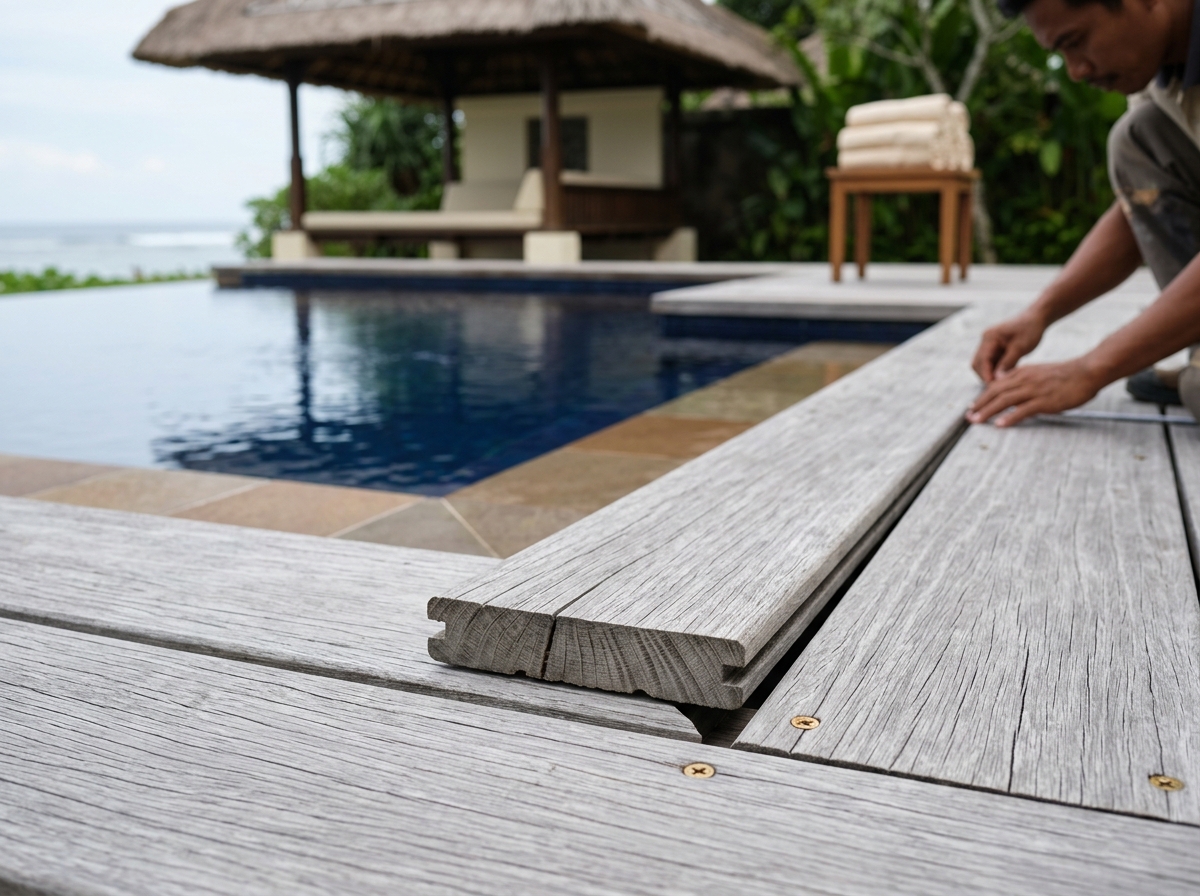
Resort pool decks, marine boardwalks, and beachside pergolas demand a species that resists moisture, biological attack, and the mechanical stress of thermal cycling. Bengkirai delivers on all three. Its natural color ranges from yellow-brown to medium brown, often with a slight golden tone in freshly milled boards. Weathering without treatment produces a silver-grey patina that many hospitality specifiers value aesthetically.
East Kalimantan is the primary sourcing region. Typical export dimensions include 19×90mm, 25×100mm, and 45×90mm decking profiles. Shipments move through Balikpapan or route to Surabaya for consolidation.
Workability Challenges
High silica content is bengkirai's main machining drawback. Silica dulls carbide cutting tools rapidly — sometimes within a single production run. Recommendations for importers and fabricators:
- Specify tungsten carbide or diamond-tipped tooling - Pre-drill all fastener holes to prevent splitting - Expect higher tooling cost per linear meter versus teak or mahogany
Pre-dimensioned export profiles reduce on-site machining requirements and are the standard approach for most B2B decking orders.
Ulin / Ironwood (Eusideroxylon zwageri): The Most Durable Indonesian Species Available
Unmatched Physical Properties
Eusideroxylon zwageri (ulin, also called Borneo ironwood or belian) is exceptional by any measure. Published Janka hardness values exceed 3,500 lbf — placing it among the hardest commercially referenced tropical species globally. Density typically ranges around 1,000–1,100 kg/m³ (air-dry), meaning it does not float in water. Ulin is classified Class 1 durability with documented resistance to marine borers, saltwater immersion, and ground-contact decay. Traditional applications include marine piling, coastal bridge decking, and structural posts in environments where other species fail within years.
Protected Status and Sourcing Documentation
Ulin is a protected species under Indonesian law. Harvest is subject to strict government quotas. Legal supply originates almost exclusively from salvage operations, legal land-clearing timber recovery, and small permitted harvests — not active forestry. This means:
- Supply is genuinely limited and inconsistent - Documentation requirements are extensive: harvest permits, chain-of-custody records, and SVLK certification are all mandatory - Lacey Act declarations must accurately name Eusideroxylon zwageri and the Indonesian province of origin
Price Premium and Availability Expectations
Ulin sits firmly in the premium tier — typically at a significant price premium above teak and bengkirai. Availability is seasonal and quota-dependent. B2B buyers should build extended lead times into project schedules and treat ulin as a specification-grade species for specific structural or prestige applications rather than a volume commodity.
Indonesian Mahogany (Swietenia spp.) and Suar: Interior Finishing Favorites
Indonesian Mahogany: Workability and Application Profile
True mahogany — Swietenia macrophylla and related species — registers moderate Janka hardness (approximately 800–1,000 lbf depending on source). Its primary commercial advantage is workability. Mahogany machines cleanly, holds fasteners well, accepts stains uniformly, and produces a fine, stable surface ideal for doors, wall paneling, and interior joinery in hotel and resort projects.
Swietenia spp. is listed under CITES Appendix II. The same compliance requirements applicable to merbau apply here — valid export permits and accurate Lacey Act declarations naming the species are mandatory. African mahogany (Khaya spp.) and plantation-grown alternatives are CITES-exempt but must not be misdeclared as Swietenia on import documentation.
Indonesian mahogany is processed primarily in Jepara (Central Java) alongside teak, often by the same mill clusters.
Suar (Albizia saman / Monkey Pod): Fast-Growing Plantation Alternative
Albizia saman (suar or monkey pod) delivers approximately 900 lbf Janka hardness — adequate for interior applications. It is not a CITES-listed species. Plantation supply is consistent, making it the most reliably available species in this guide for high-volume interior projects. Suar's wide, figured grain and natural color variation — cream sapwood transitioning to dark brown heartwood — make it popular for live-edge slabs and decorative wall paneling in boutique hospitality projects. It is not suitable for exterior or structural use. Price sits in the mid-range to value tier.
Indonesian Hardwood Species Guide: Side-by-Side Comparison Table
| Species | Janka (lbf approx.) | Density (kg/m³ approx.) | Durability Class | Best Use Cases | CITES Status |
|---|---|---|---|---|---|
| Teak (*Tectona grandis*) | ~1,070 | ~655 | Class 1 | Decking, marine, interior joinery | Not listed |
| Merbau (*Intsia bijuga*) | ~1,925 | ~830 | Class 2 | Flooring, decking, structural beams | Appendix II |
| Bengkirai (*Shorea laevis*) | ~1,580 | ~900 | Class 2 | Coastal decking, pergolas, boardwalks | Not listed |
| Ulin (*Eusideroxylon zwageri*) | ~3,500+ | ~1,050 | Class 1 | Marine piling, structural, premium decking | Protected (ID law) |
| Mahogany (*Swietenia* spp.) | ~900 | ~540 | Class 3 | Doors, paneling, interior joinery | Appendix II |
| Suar (*Albizia saman*) | ~900 | ~500 | Class 3–4 | Interior slabs, decorative panels | Not listed |
Interior vs. Exterior Suitability Matrix
| Species | Interior | Exterior Above Ground | Ground Contact | Marine / Wet |
|---|---|---|---|---|
| Teak | ✓ | ✓ | ✓ | ✓ |
| Merbau | ✓ | ✓ | Limited | Not recommended |
| Bengkirai | ✓ | ✓ | Limited | Adjacent only |
| Ulin | ✓ | ✓ | ✓ | ✓ |
| Mahogany | ✓ | Protected/covered only | ✗ | ✗ |
| Suar | ✓ | ✗ | ✗ | ✗ |
Common Species Substitution Mistakes
Importers frequently encounter misdeclared shipments. Common patterns include:
- Bengkirai sold as teak (similar color in finished boards; hardness and grain differ under inspection) - African mahogany (Khaya spp.) declared as Swietenia — a Lacey Act violation - Low-grade plantation teak with high sapwood content sold as premium heartwood teak - Ulin substituted with other dense Borneo species without disclosure
Third-party species verification through laboratory identification (wood anatomy or DNA testing) is available from specialist labs and is strongly recommended for high-value or legally sensitive shipments.
Certification, Legality, and Compliance: What Every Indonesian Hardwood Importer Must Verify
US Lacey Act Requirements
The Lacey Act requires US importers to file a Plant and Plant Product Declaration (PPQ 505) for all wood imports. Declarations must include: scientific name of the species, country of harvest, quantity, and value. Inaccurate or incomplete declarations — including generic species names — constitute a violation regardless of intent. Civil penalties and shipment seizure apply.
Understanding SVLK Certificates
SVLK (Sistem Verifikasi Legalitas Kayu) is Indonesia's mandatory timber legality verification system. All Indonesian wood products exported commercially must carry SVLK certification. The certificate confirms legal harvest, legal processing, and legal trade. Importers should:
- Request the SVLK certificate for every shipment - Verify the certificate number against the Indonesian government's official verification portal - Confirm the certificate covers the specific species and product type in the shipment
- ✓Confirm SVLK certificate number and verify online
- ✓Check CITES export permit for merbau and Swietenia mahogany
- ✓Prepare Lacey Act PPQ 505 declaration with correct scientific name
- ✓Confirm species identity matches Bill of Lading description
- ✓Request mill certificate specifying heartwood grade where relevant
- ✓Engage third-party inspector for species verification on high-value orders
FSC and PEFC Availability
FSC-certified Indonesian hardwood supply exists for teak and some merbau supply chains. Coverage is not universal. PEFC-certified supply is less common in Indonesia than FSC. Buyers in EU markets subject to the EU Deforestation Regulation (EUDR) should prioritize FSC or SVLK-certified supply and confirm certification scope with their supplier before contracting.
Sourcing Indonesian Hardwood: Logistics, MOQs, and Quality Control
Export Ports and Transit Times
| Port | Primary Species | US East Coast Transit (approx.) | US West Coast Transit (approx.) |
|---|---|---|---|
| Semarang | Teak, mahogany (Jepara cluster) | ~28–35 days | ~20–25 days |
| Surabaya | Merbau, bengkirai, suar | ~28–35 days | ~20–25 days |
| Jakarta (Tanjung Priok) | Mixed, container consolidations | ~28–35 days | ~20–25 days |
Transit times are approximate and subject to routing and transshipment. Add 2– approximately 4 weeks for production lead time on made-to-order dimensions.
Moisture Content, Grading, and Dimensions
Export-grade Indonesian hardwood ships in two moisture states:
- KD (Kiln-Dried): Typically 8–12% MC. Required for interior flooring and joinery. More stable in transit. - AD (Air-Dried): Typically 18–25% MC. Acceptable for exterior decking where on-site drying occurs. Lower cost.
Standard export grading follows either local Indonesian grading rules or buyer-specified grading (FAS equivalent, Select, or custom). Always specify grading criteria in the purchase contract — not verbally.
MOQ Norms by Species and Product
| Product Type | Typical MOQ |
|---|---|
| Decking boards (bengkirai, teak) | 1 × 20ft container (~15–18 m³) |
| Flooring blanks (merbau, teak) | 1 × 20ft container |
| Structural timber (ulin) | Negotiated; often <5 m³ given limited supply |
| Interior components (mahogany, suar) | 1 × 20ft container; smaller volumes via consolidation |
Frequently Asked Questions
What is the hardest Indonesian hardwood species available for commercial projects? Ulin (Eusideroxylon zwageri) registers approximately 3,500+ lbf Janka hardness — the hardest commercially referenced Indonesian species. Its protected status limits availability. For high-volume projects, merbau (~ approximately 1,925 lbf) is the practical high-hardness alternative.
Is Indonesian teak FSC certified and compliant with the US Lacey Act? FSC-certified plantation teak is available from Indonesian suppliers, though not all mills carry FSC. All legally exported teak carries SVLK certification, which supports Lacey Act declaration compliance. Request both certificates and verify SVLK numbers before import.
What is the difference between plantation teak and old-growth teak in terms of durability? Both are classified Class 1 durability. Old-growth teak has denser heartwood, tighter grain, and higher natural oil content. Plantation teak contains more sapwood and shows faster surface weathering in exposed exterior conditions. Specify heartwood-grade plantation teak and verify with mill documentation.
Can merbau be legally imported into the United States given its CITES status? Yes. CITES Appendix II listing regulates but does not prohibit trade. US importers must file an accurate Lacey Act declaration naming Intsia bijuga and confirm the supplier holds valid Indonesian CITES export permits per shipment.
Which Indonesian hardwood species is best for outdoor decking in coastal climates? Ulin is the top performer but supply is limited and costly. Bengkirai is the practical specification choice — Class 2 durability, high density, and high silica content make it highly resistant to coastal moisture, biological attack, and mechanical wear. Teak is suitable but at a higher price point.
How does Indonesian mahogany compare to African mahogany for interior joinery? True Swietenia mahogany offers slightly finer grain and marginally better stability than Khaya species (African mahogany). Both are appropriate for interior joinery. Swietenia carries CITES Appendix II obligations; Khaya does not. For volume interior projects, plantation mahogany or suar avoids CITES compliance complexity without significant performance trade-off.
Selecting the right species from this indonesian hardwood species guide requires matching technical performance data — Janka hardness, durability class, moisture behavior — against project environment and compliance obligations. Certification verification is not optional in US and EU markets; it is a contractual and legal necessity that must be built into every sourcing workflow.
Ready to move from specification to procurement? You now have the species data, compliance framework, and logistics baseline to make an informed decision.
Our verified Indonesian hardwood suppliers cover all major species — teak, merbau, bengkirai, ulin, mahogany, and suar — with full SVLK and FSC documentation available. Request a free species sample pack and sourcing consultation to validate your specification against real export-grade material.
Request Sample Pack and Consultation →Need eyes on the ground in Indonesia?
MTS is an execution partner — supplier verification, manufacturing management, quality control and export logistics across Indonesia, Vietnam and China.
Related services
Related articles
Receive furniture sourcing insights across Asia.
One email per week. No spam.