Indonesian Tropical Hardwood Decking: Bengkirai vs Ulin Compared for Contractors
14 min read
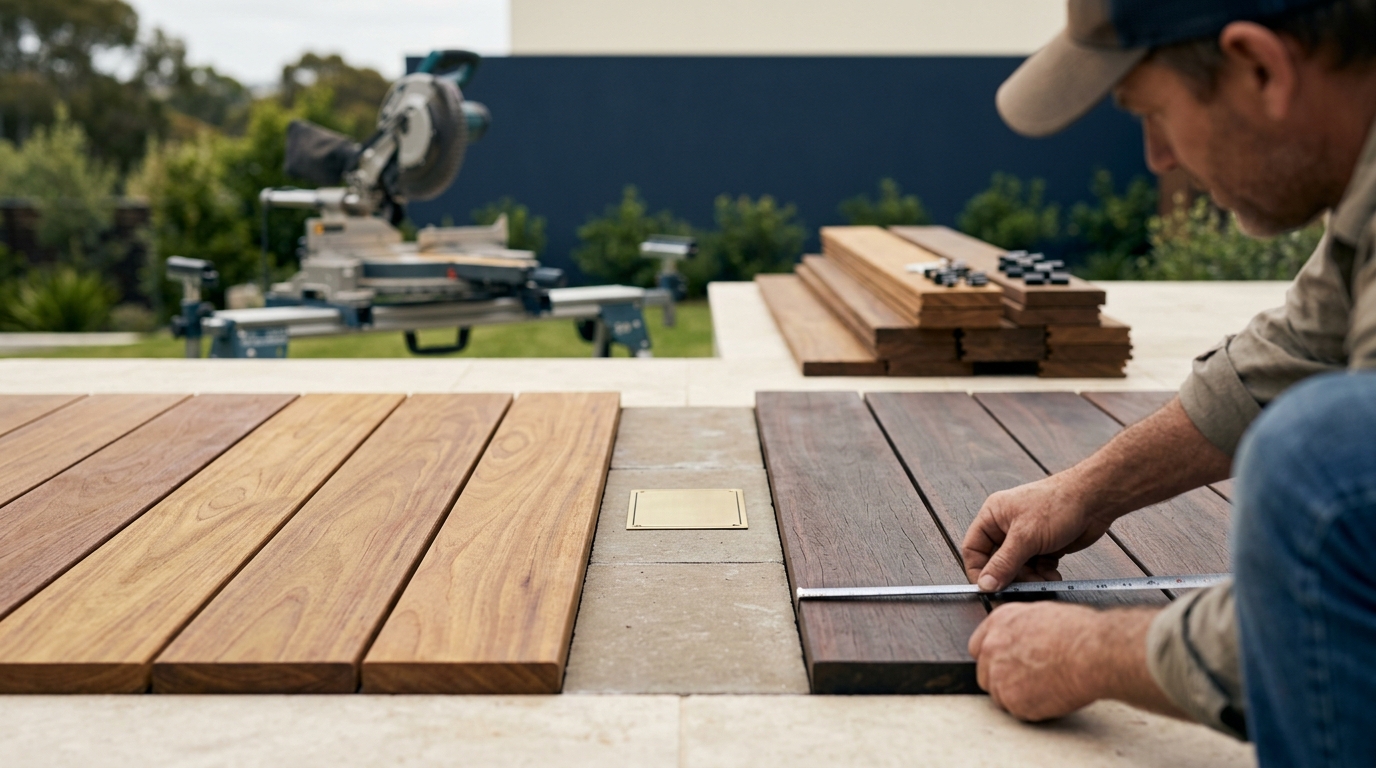
Specifying decking for a commercial project means committing to a material that will perform under foot traffic, UV exposure, moisture cycling, and maintenance schedules measured in decades. Contractors and developers sourcing indonesian tropical hardwood decking bengkirai ulin face a narrower…
Specifying decking for a commercial project means committing to a material that will perform under foot traffic, UV exposure, moisture cycling, and maintenance schedules measured in decades. Contractors and developers sourcing indonesian tropical hardwood decking bengkirai ulin face a narrower decision than it first appears: the species, the supplier, and the compliance chain all carry equal weight. Getting one wrong costs more than the material itself.
Indonesia produces several of the world's highest-performing decking species. Bengkirai (Shorea laevis), ulin (Eusideroxylon zwageri), merbau (Intsia bijuga), and teak (Tectona grandis) originate from Kalimantan, Sumatra, and Java. Each species occupies a distinct performance and price tier. Each carries different import compliance requirements for US buyers. This article gives you the specification-level data needed to write a project spec sheet, qualify a supplier, and navigate the Lacey Act and SVLK documentation chain — gaps that most competitor resources leave unfilled.
The sections below move in a logical procurement sequence: species performance, head-to-head comparison, installation practice, moisture management, certification requirements, and supplier qualification. First-time buyers sourcing bengkirai decking, ulin ironwood, or merbau from Indonesian mills should begin at the section four comparison table. Work backward to confirm your species choice. Then move forward to verify your compliance posture.
Why Indonesian Tropical Hardwoods Dominate Commercial Decking Projects
Performance Benchmarks Against South American Competitors
US contractors have long defaulted to ipe (Tabebuia spp.) and cumaru (Dipteryx odorata) for heavy-duty commercial decking. Indonesian species are competitive on every measurable axis and often exceed them on sourcing consistency.
Approximate Janka hardness benchmarks (lbf):
- Ulin (ironwood): ~3,800 lbf - Ipe: ~3,510 lbf - Cumaru: ~3,330 lbf - Bengkirai: ~2,090 lbf - Merbau: ~1,925 lbf - Teak (plantation): ~1,155 lbf
All four key Indonesian species achieve EN 350 Durability Class 1 or 2 — meaning very durable to durable in ground contact without preservative treatment. Ipe and cumaru reach similar ratings. The performance parity is real.
Market Availability and US Import Landscape
Indonesia is one of the few tropical timber origins with an established legal export verification system recognized by international trade partners. Mill capacity in Kalimantan and Sumatra supports container-scale orders of uniform kiln-dried decking boards. Lead times from Indonesian mills to US West Coast ports typically run eight to fourteen weeks depending on season, vessel availability, and order volume.
Hospitality developers — particularly resort and hotel groups — increasingly specify indonesian hardwood decking because Indonesian mills can supply long-length boards (up to approximately 6 meters) with consistent grain, a capability that South American suppliers often struggle to match at comparable price points.
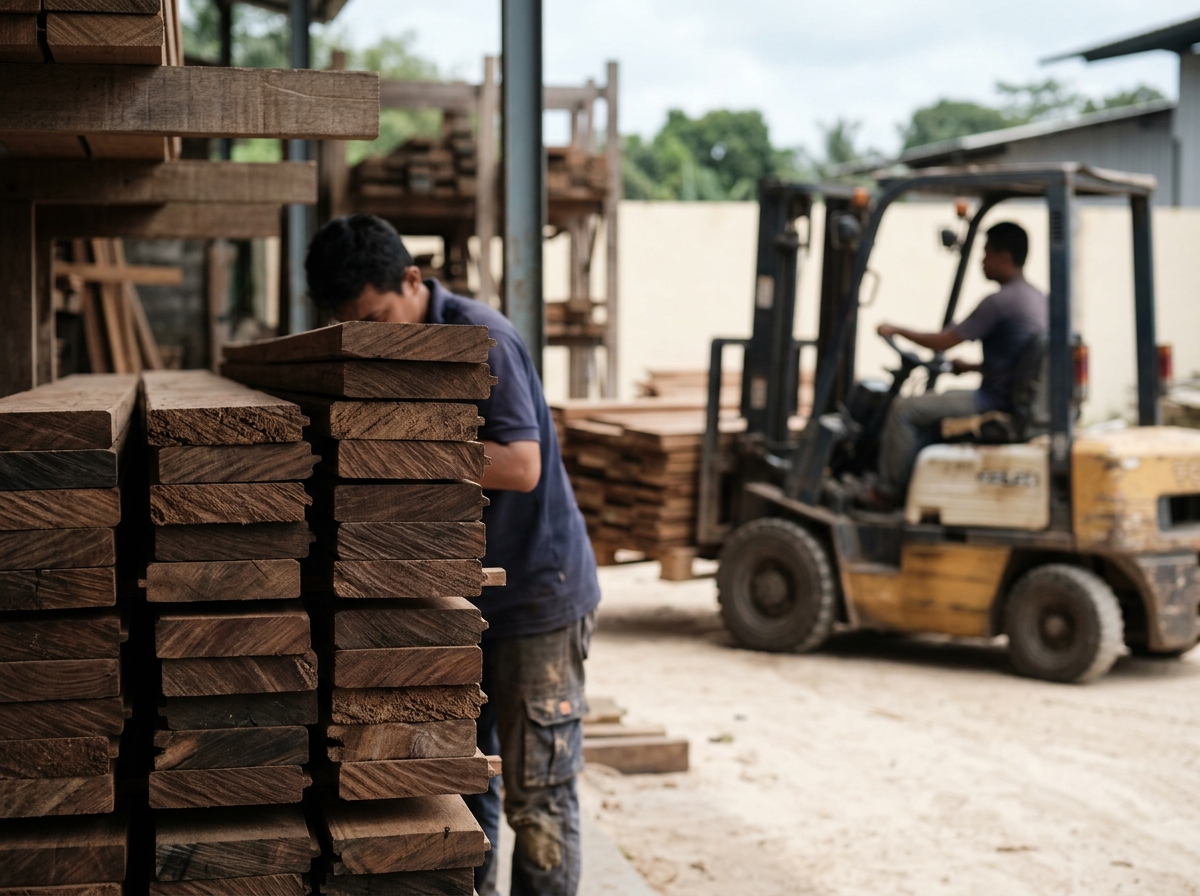
Bengkirai Decking: Technical Specifications, Best Applications, and What Contractors Need to Know
Species Profile and Durability Data
Bengkirai (Shorea laevis) is harvested primarily from Kalimantan and Sumatra. It is classified within the Yellow Balau group of the Shorea genus.
Key technical parameters (approximate):
- Air-dry density: 870–1,050 kg/m³ - Janka hardness: approximately 2,090 lbf - EN 350 Durability Class: 1–2 (very durable to durable) - Bending strength (MOR): approximately 130–160 N/mm²
Bengkirai contains natural silica and tannins that resist fungal decay, termite attack, and marine borer penetration. These properties make it suitable for outdoor exposure without chemical treatment in most climate zones.
Performance in Coastal and Humid US Climates
In coastal applications — pool decks, marina boardwalks, resort terraces — bengkirai consistently achieves service lives of approximately 25 years or longer when properly installed and maintained on appropriate intervals. This assumes correct substructure spacing, end sealing, and periodic oiling. The species is not immune to surface checking in low-humidity US interior climates; acclimatization protocols (covered in section six) directly affect this outcome.
Standard Dimensions from Indonesian Mills
Common board profiles available from Indonesian exporters:
- Thickness: 19 mm, 21 mm, 25 mm, 28 mm - Width: 90 mm, 120 mm, 145 mm - Length: 1.8 m to 5.4 m (longer lengths on request, subject to mill capacity) - Surface profiles: smooth, brushed, grooved (for hidden fastener systems), fine-sawn
MOQ from established exporters is typically one 20-foot container, approximately 20–25 m³ of decking boards.
Ulin Ironwood Decking: Performance Data Every Contractor Must Know Before Specifying
Density, Silica Content, and Self-Hardening Properties
Ulin (Eusideroxylon zwageri) is among the densest commercially available hardwoods on earth. It originates from Kalimantan and Sumatra. Its physical properties are exceptional by any benchmark.
Key technical parameters (approximate):
- Air-dry density: 900–1,100 kg/m³ - Janka hardness: approximately 3,800 lbf - EN 350 Durability Class: 1 (very durable) - Natural silica content: high — contributes to surface hardening in wet-dry cycling conditions
The self-hardening behavior is a documented property: repeated wetting and drying causes ulin's surface silica to consolidate, making the material increasingly resistant to wear over time. This is the inverse of what happens to softwood or lower-density tropical species. For dock decking, bridge decking, and heavy-traffic resort areas, this property is operationally significant.
Regulatory Status: CITES Appendix III and Reclaimed Sourcing
Ulin is listed on CITES Appendix III by Indonesia. This does not prohibit trade, but it requires specific documentation for every international shipment.
Required documents for importing ulin to the United States:
1. CITES export permit issued by the Indonesian CITES Management Authority 2. Phytosanitary certificate from the Indonesian Ministry of Agriculture 3. SVLK certificate (V-Legal document) — Indonesia's Timber Legality Verification System 4. Bill of lading specifying species by scientific name (Eusideroxylon zwageri) 5. Lacey Act declaration (APHIS PPQ Form 505) — species, country of harvest, quantity, value
Because of CITES Appendix III listing, reclaimed ulin is the dominant sourcing path for US buyers. Reclaimed ulin comes from decommissioned structures — traditional houses, old docks, bridge pilings — in Kalimantan. It carries full SVLK documentation and often exhibits superior dimensional stability due to decades of natural stress relief.
Head-to-Head: Bengkirai vs Ulin vs Merbau vs Teak — Full Species Comparison for Decking Projects
This table benchmarks all four primary Indonesian decking species against each other and against ipe and cumaru. Use it to align species selection with project budget, performance requirements, and maintenance capacity.
| Species | Scientific Name | Janka (lbf approx.) | EN 350 Class | Density kg/m³ approx. | Price Tier (US import) |
|---|---|---|---|---|---|
| Ulin / Ironwood | *Eusideroxylon zwageri* | ~3,800 | 1 | 900–1,100 | Premium |
| Ipe | *Tabebuia spp.* | ~3,510 | 1 | 950–1,100 | Premium |
| Cumaru | *Dipteryx odorata* | ~3,330 | 1 | 1,000–1,100 | Mid–Premium |
| Bengkirai | *Shorea laevis* | ~2,090 | 1–2 | 870–1,050 | Mid |
| Merbau | *Intsia bijuga* | ~1,925 | 1–2 | 800–1,000 | Mid |
| Teak (plantation) | *Tectona grandis* | ~1,155 | 1–2 | 600–750 | Mid–Premium |
Merbau note: Merbau (Intsia bijuga) produces significant red-brown tannin bleed when first wetted. This stains adjacent concrete and light stone. Specify neutralizing rinse protocols during the first wet season. Performance-wise, merbau and bengkirai are comparable. Merbau is typically priced slightly lower than bengkirai for equivalent dimensions from Indonesian mills.
Teak note: Plantation teak (Tectona grandis) from Indonesia carries lower density and hardness than old-growth equivalents. Its premium price reflects brand recognition and natural oil content, not structural performance. For high-traffic commercial applications, bengkirai or ulin deliver better mechanical performance per dollar.
Expected service life: Ulin and ipe, properly maintained, routinely achieve 40+ years in outdoor exposure. Bengkirai and merbau typically achieve 25–35 years. Plantation teak, 20–30 years with regular oiling.
Hidden-Fastener Systems and Pre-Drilling: Installation Best Practices for Dense Indonesian Hardwoods
Why Hidden Fasteners Are Mandatory for Bengkirai and Ulin
Face-screwing through bengkirai or ulin without pre-drilling splits the board. Both species have densities and hardness values that cause conventional fasteners to shear or the timber to fracture under stress. Hidden fastener systems eliminate surface penetration, preserve board integrity, and produce a cleaner finished deck surface — important on hospitality and resort projects.
Compatible Clip and Groove Systems
| System Type | Compatible Species | Notes |
|---|---|---|
| Stainless steel EB-TY clips | Bengkirai, merbau, teak | Requires 5 mm groove-cut boards; use 316-grade SS in coastal zones |
| Hardwood biscuit clips | Bengkirai, merbau | Lower cost; less forgiving on board warping |
| Side-fix stainless clips | Ulin, bengkirai | Used with boards pre-grooved at the mill; confirm groove depth matches clip spec |
| T-clip systems (composite-rated) | Merbau, teak | Check manufacturer load rating — not all are rated for hardwood densities above 900 kg/m³ |
Pre-Drilling Requirements and Fastener Specifications
Pre-drilling is not optional for bengkirai or ulin. Use carbide-tipped bits. Pilot hole diameter should be approximately 85–90% of the fastener shank diameter. For end fastening at board terminations, pre-drill 150 mm from each end minimum.
Use stainless steel fasteners (AISI 316) in all coastal and pool-adjacent installations. Carbon steel corrodes rapidly in chlorinated or salt-air environments, causing surface staining and fastener failure.
Expansion Gap and Substructure Recommendations
- Expansion gap between boards: 5–6 mm for boards installed at 15% MC; reduce to 4 mm in arid US climate zones (USDA Zone 9–11 desert regions) - End gaps: minimum 3 mm at all butt joints - Substructure spacing: maximum 400 mm on-center for boards under 25 mm thickness; 500 mm for 28 mm and above - End sealing: apply end-grain sealer immediately after cutting; tropical hardwoods lose moisture fastest through end grain, causing checking
- ✓Confirm groove profile matches clip system spec
- ✓Carbide drill bits sized to 85-90% of fastener shank
- ✓316 SS fasteners ordered for coastal or pool zones
- ✓End sealer on hand before first cut
- ✓Expansion gaps templated at 5-6 mm minimum
- ✓Substructure spacing confirmed at max 400-500 mm on-center
Moisture Handling, Acclimatization, and Dimensional Stability Across US Climate Zones
How Tropical Origin MC Differs from US Installation Conditions
Indonesian mills typically ship kiln-dried decking at 12–18% moisture content (MC). Timber arriving from equatorial Indonesia at approximately 18% MC installed into an arid US zone will lose moisture rapidly, shrink across the grain, and develop surface checks if gaps are not sized correctly.
Target installation MC by US region (approximate):
- Pacific Northwest / Northeast: 14–16% - Mid-Atlantic / Southeast: 13–15% - Southwest / Arid Mountain West: 10–13%
Acclimatization Protocol
- Minimum acclimatization period: 7–14 days on-site, stickered and covered - Storage: off-ground on stickers spaced at maximum 600 mm; covered but ventilated — not wrapped in plastic - Test MC with a quality pin-type meter calibrated for tropical hardwoods before installation. Generic softwood calibration tables underread dense tropical species.
Oiling vs Sealing vs Natural Weathering
| Maintenance Approach | Appearance Outcome | Interval | Best Species Match |
|---|---|---|---|
| Penetrating hardwood oil | Warm amber tone maintained | Every 12–18 months | Bengkirai, merbau, teak |
| Film-forming sealer | Consistent color, higher sheen | Every 12 months (recoat before failure) | Bengkirai, teak |
| Natural weathering (no treatment) | Silver-grey patina | None | Ulin, bengkirai |
| Combination (oil + UV inhibitor) | Color retained longer | Every 18–24 months | All species |
Ulin requires the least maintenance of any Indonesian species. Its silica content resists surface degradation even when left untreated. Merbau benefits most from oiling due to its higher tannin mobility — oil slows the tannin leaching cycle.
Certification, SVLK Compliance, and Lacey Act Requirements for US Importers of Indonesian Hardwood Decking
This is the section most US buyers handle incorrectly. Non-compliance with the Lacey Act carries civil and criminal penalties. Indonesian hardwood decking importers must understand the full documentation chain.
SVLK: Indonesia's Timber Legality Verification System
SVLK (Sistem Verifikasi Legalitas Kayu) is Indonesia's mandatory timber legality system. Every Indonesian timber exporter must hold a valid V-Legal certificate to ship to regulated markets. SVLK covers chain of custody from forest concession through mill processing to the export document.
For US buyers, SVLK is the primary evidence that timber was legally harvested. Request the current V-Legal document number from your supplier before placing an order. Verify it against Indonesia's Ministry of Environment and Forestry database (publicly accessible).
Lacey Act Compliance Workflow
The Lacey Act (amended approximately 2008) prohibits importing plant material — including timber — taken, possessed, or transported in violation of foreign law. For Indonesian hardwood decking, the compliance workflow is:
1. Obtain species verification from the mill: scientific name, country of harvest, state or province of harvest (Kalimantan, Sumatra, etc.) 2. File APHIS PPQ Form 505 (Plant and Plant Product Declaration) at the time of importation — required for all timber imports 3. Retain supplier documentation including SVLK V-Legal certificate, phytosanitary certificate, and mill chain-of-custody records for a minimum of five years 4. For ulin: additionally obtain and retain the CITES export permit
FSC and PEFC Certification Status
FSC-certified bengkirai and merbau are available from select Indonesian mills. FSC certification provides an additional due-diligence layer and is increasingly required by US hospitality developers under internal ESG procurement policies. Not all mills carry FSC — confirm certification status and certificate number directly with the Rainforest Alliance or FSC's public certificate database.
How to Evaluate and Qualify Indonesian Hardwood Decking Suppliers
Supplier Classification: What to Ask Before Requesting a Quote
Indonesian decking exporters fall into distinct categories: full-cycle mills (own forest concession or log sourcing, kiln drying, processing, and export), processing mills (buy logs or semi-finished lumber, process and export), and trading companies (aggregate and resell mill output). Full-cycle operations with their own kiln-drying facilities offer the strongest quality control. Any supplier that cannot specify whether it operates its own kiln-drying facility is a risk flag.
Key qualification questions:
- What is your SVLK V-Legal certificate number, and when does it expire? - Do you operate your own kiln-drying facility? What MC range do you certify at shipment? - What grading standard do you apply — Indonesian SNI, European EN 385, or custom? - Can you provide moisture content certificates per shipment lot? - What are your MOQ, lead time, and standard container pack quantities?
Red Flags in Supplier Quotes
- Species identified only by trade name (e.g., "yellow balau") without scientific name confirmation - No phytosanitary certificate offered - MC "certified" but no kiln records available - Lead time quoted under six weeks ex-works Kalimantan (operationally implausible for kiln-dried container orders) - No CITES documentation offered for ulin shipments
Sample Evaluation Checklist
- ✓Scientific species confirmed on shipping documents
- ✓MC reading at arrival between 12-18% (verify with calibrated meter)
- ✓End-grain check rating: no checks deeper than 1/3 board width
- ✓Grain consistency: no wild grain reversals in sample set
- ✓Surface defect count: knots, resin pockets, wane within specified grading limits
- ✓Groove profile depth and width matches stated fastener system spec
- ✓SVLK V-Legal document number provided and verifiable
- ✓Phytosanitary certificate included in document pack
MOQ, Lead Times, and Container Logistics
Typical parameters from established Indonesian hardwood exporters:
- MOQ: 1 × 20-foot container (approximately 20–25 m³) - Lead time: 8–14 weeks ex-works, depending on species availability and kiln schedule - Incoterms commonly offered: FOB Surabaya, FOB Banjarmasin, CIF US West Coast - Container packing: boards banded in bundles, separated by stickers; confirm moisture barrier wrapping for ocean transit
For ulin, lead times extend due to limited raw material availability. Reclaimed ulin sourcing adds 2– approximately 4 weeks for demolition, processing, and documentation.
Frequently Asked Questions: Indonesian Tropical Hardwood Decking Bengkirai and Ulin
Is bengkirai decking a good alternative to ipe for commercial projects? Yes, in most applications. Bengkirai delivers EN 350 Class 1–2 durability, comparable rot and insect resistance, and similar service life at a typically lower price point. Ipe has a higher Janka rating (~ approximately 3,510 lbf vs. ~ approximately 2,090 lbf), which matters in extreme heavy-traffic applications. For pool decks, resort terraces, and boardwalks, bengkirai performs comparably to ipe and is available in more consistent supply from Indonesian mills.
Can ulin ironwood be legally imported into the United States? Yes, with full documentation. Ulin is CITES Appendix III listed by Indonesia, which requires a CITES export permit with every shipment. Lacey Act declaration (APHIS PPQ Form 505) is also mandatory. Reclaimed ulin requires the same documentation. Shipments lacking CITES permits are subject to seizure at US ports.
What is the expected lifespan of bengkirai decking in a coastal environment? With correct installation — proper substructure spacing, end sealing, 316 SS fasteners, and oiling every 12–18 months — bengkirai commonly achieves 25–30 years in coastal exposures. Performance degrades significantly without end sealing and adequate ventilation underneath the deck plane.
Do Indonesian tropical hardwoods require pre-drilling before fastening? Yes, always for bengkirai and ulin. Both species exceed 870 kg/m³ in density. Face-screwing without a pilot hole splits the board and may shear the fastener. Pilot hole diameter should be approximately 85–90% of the fastener shank. Use carbide-tipped bits; standard HSS bits dull rapidly on silica-containing tropical hardwoods.
What certifications should I require from an Indonesian decking supplier? At minimum: SVLK V-Legal certificate (current and verifiable), phytosanitary certificate, and moisture content test records. For ulin: CITES export permit. For ESG-compliant projects: FSC or PEFC chain-of-custody certification. Always request the Lacey Act declaration support documents proactively — do not wait until customs clearance.
How does merbau compare to bengkirai in terms of price and performance? Merbau (Intsia bijuga) is typically priced slightly below bengkirai for equivalent dimensions from Indonesian exporters. Performance is similar: both achieve EN 350 Class 1–2, with merbau at approximately 1,925 lbf Janka vs. bengkirai at approximately 2,090 lbf. The key differentiator is tannin bleed: merbau produces significant red tannin leaching during initial weathering, which stains adjacent light surfaces. Bengkirai's tannin bleed is moderate and typically manageable.
Selecting the right species from the indonesian tropical hardwood decking bengkirai ulin range is a technical decision, not a brand decision. Bengkirai delivers reliable Class 1–2 durability at competitive mid-tier pricing and is the most accessible Indonesian decking species for US contractors. Ulin sets the benchmark for mechanical performance but demands rigorous CITES and Lacey Act compliance management. Both species reward contractors who specify correctly, source from verified full-cycle mills with SVLK documentation, and follow density-appropriate installation protocols.
You now have the specification data, compliance workflow, and supplier qualification criteria to move from species selection to procurement with confidence.
You have the spec sheet data — now verify it against actual material. Request a free sample kit of bengkirai and ulin deck boards from verified Indonesian exporters today. Evaluate grain consistency, MC at arrival, groove profile accuracy, and end-check rating against the checklist above before committing to a container order.
Request Your Free Sample Kit →Need eyes on the ground in Indonesia?
MTS is an execution partner — supplier verification, manufacturing management, quality control and export logistics across Indonesia, Vietnam and China.
Related services
Related articles
Receive furniture sourcing insights across Asia.
One email per week. No spam.