Indonesia Furniture Factory MOQ and Lead Times: The Complete Importer Guide
19 min read
For US-based importers evaluating Indonesia as a sourcing destination, two questions dominate every procurement conversation: how much do I have to order, and how long will it take? Furniture factory MOQ and lead times in Indonesia are not standardized across the industry, and the variance between…
For US-based importers evaluating Indonesia as a sourcing destination, two questions dominate every procurement conversation: how much do I have to order, and how long will it take? Furniture factory MOQ and lead times in Indonesia are not standardized across the industry, and the variance between factory tiers, product categories, and seasonal windows is wide enough to break a procurement plan that wasn't built around accurate data. Misreading either variable — by even 20 to 30 days on lead time, or by misunderstanding how container-based MOQs work — can cascade into missed retail floor dates, excess freight costs, or strained supplier relationships.
This guide is written for buyers who have moved past the "should we source from Indonesia?" question and are now working through the operational detail of how. You will find specific numeric benchmarks for MOQ thresholds across major product categories, a phase-by-phase breakdown of production timelines, an honest look at the delay factors competitors rarely explain (including SVLK compliance windows and wood drying time), and a framework for negotiating terms on your first or next order. You will also find cost structure context — FOB pricing, HTSUS tariff classification, and port logistics — so your landed cost math reflects reality before you commit to a purchase order.
Indonesia's reputation in global furniture supply is built on materials and craft that no other major sourcing country fully replicates. Understanding the operational constraints that come with that reputation is what separates importers who build durable supplier relationships from those who chase the lowest unit price and absorb the downstream costs. Start here.
Why Indonesia Remains One of the World's Most Compelling Furniture Sourcing Origins
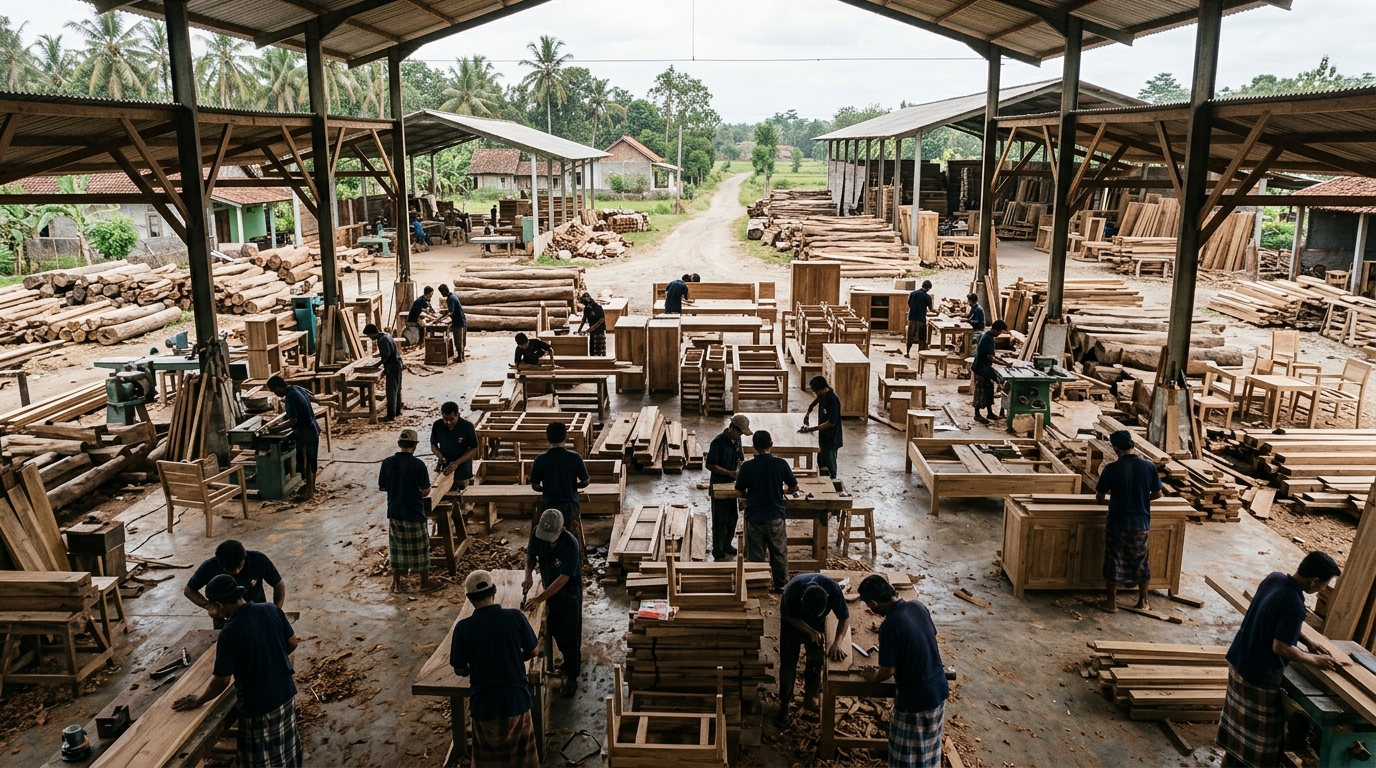
Indonesia occupies a structurally unique position in the global furniture supply chain. Unlike China, which dominates through automation scale, or Vietnam, which competes on modern processing efficiency, Indonesia's competitive advantage is rooted in natural material richness and deep craft heritage. The country's forests supply teak and mahogany at commercial scale, while its artisan clusters have accumulated generations of joinery, carving, and finishing expertise that cannot be easily replicated in higher-labor-cost countries.
The Production Clusters US Importers Need to Know
Three geographic hubs drive the majority of Indonesia's furniture exports to the United States:
Jepara, Central Java is the single most important cluster for solid wood furniture globally. The city and its surrounding districts are home to a dense concentration of teak and mahogany producers ranging from small craft workshops to mid-scale export factories with several hundred workers. Hand-carved dining tables, bedroom sets, and architectural pieces originate here at volumes and quality levels that no other region matches.
Semarang serves as both a production hub for outdoor and contract furniture and a critical export port for Central Java factories, including many Jepara-based producers. Its proximity to production clusters makes it a common loading point for 20-foot and 40-foot container shipments.
Surabaya, the capital of East Java, represents the more industrialized mid-market segment. Factories here tend to be larger, more mechanized, and better suited to buyers who need consistent production runs of catalog items rather than highly customized pieces.
Bali and Cirebon round out the key clusters: Bali for high-design luxury and hospitality furniture with strong artisan character, and Cirebon as Indonesia's center of gravity for rattan and woven furniture exports.
Materials That Drive Demand From US Buyers
Teak remains the flagship material — dense, naturally oil-rich, dimensionally stable, and visually distinctive in ways that justify premium retail pricing. Mahogany offers a comparable hardwood profile at more accessible price points. Rattan has seen a strong resurgence among US interior brands and direct-to-consumer retailers positioning around natural materials. Reclaimed and FSC-certified timber appeals to sustainability-oriented buyers and aligns with increasingly strict retailer sourcing standards.
Compared to Chinese factories producing panel furniture or Vietnamese manufacturers scaling solid wood dining sets, Indonesian producers offer a depth of handcraft detail — inlay work, mortise-and-tenon joinery, hand-applied oil finishes — that commands higher FOB prices but also higher retail margins. For mid-to-large importers supplying specialty retail, boutique hospitality, or premium wholesale channels, that trade-off is often the right one.
What MOQ Actually Means When Sourcing From an Indonesian Furniture Factory
How Indonesian Factories Set MOQ Thresholds — and Why It Differs From China
In China's furniture manufacturing ecosystem — particularly in high-volume clusters like Foshan or Shunde — MOQ is typically expressed per SKU, driven by production line economics and material minimums. An Indonesian factory, especially in Jepara or Bali, often thinks about MOQ differently: the primary unit of measure is the container, not the individual piece.
This distinction matters for planning. A factory may accept an order with no formal per-SKU minimum if your total order fills a 20-foot or 40-foot container to a commercially viable value. Conversely, ordering just a handful of pieces in a single SKU, far below container-fill economics, will either be declined or priced with a significant small-order premium — commonly referred to in the trade as a below-MOQ surcharge.
Per-SKU vs. Container-Based MOQ: How the Math Works
For solid wood furniture categories — teak dining tables, bedroom sets, carved cabinets — Indonesian mid-scale export factories commonly set per-SKU minimums in the range of approximately 5 to 20 units. However, that number is almost always subordinate to the container requirement. If 10 teak dining tables fill a 20-foot container, a factory producing only dining tables may accept 10 units as a complete order. If those same tables represent only a quarter of a container, expect the factory to request that you fill the remaining space with complementary pieces or pay a partial-container surcharge.
A 20-foot container typically accommodates roughly 25 to 33 cubic meters of cargo. A 40-foot standard container holds approximately 55 to 67 cubic meters, and a 40-foot high-cube extends that further. Understanding the cubic volume of your SKU mix before negotiating MOQ puts you in a structurally stronger position.
Mix-and-Match Container Policies
Many Indonesian exporters — particularly mid-tier factories with broader catalogs — offer mix-and-match container loading. This means a buyer can combine multiple SKUs from the same factory's catalog to meet the container minimum, even if no single SKU meets a standalone piece count threshold. For first-time buyers or brands testing a new category, this is the most practical entry point: build a container-filling order across four to eight SKUs rather than committing to deep inventory in one item.
Typical MOQ Benchmarks Across Indonesian Furniture Product Categories
The table below reflects commonly observed MOQ structures across factory tiers. Ranges vary based on factory size, order complexity, and buyer relationship history. Use these as planning anchors, not contractual guarantees.
| Product Category | Per-SKU MOQ (approx.) | Container Minimum | Notes |
|---|---|---|---|
| Teak solid wood dining | 5–15 units | 20ft or 40ft | Higher at design-stage customization |
| Mahogany bedroom sets | 3–10 sets | 20ft | Full set counts (bed + 2 nightstands + dresser) |
| Teak outdoor / garden | 10–25 units | 20ft or 40ft | Stackable items allow higher unit count |
| Rattan / woven furniture | 10–30 units | 20ft | Lower CBM per piece; mixes well |
| Carved accent / decorative | 10–50 units | 20ft | Artisan workshops may require fewer units |
| Custom design (new SKU) | 20–50 units | 40ft preferred | Tooling and sample costs factored in |
| Catalog / repeat order | 5–10 units | 20ft | Established buyers often get flexibility |
Custom vs. Catalog Items: A Critical MOQ Distinction
Catalog items — pieces already in a factory's established production line — carry the most flexible MOQs because tooling, material sourcing, and production sequencing are already optimized. Custom items, where a buyer introduces new dimensions, joinery details, or finish specifications, require a separate development process: sample production, buyer approval, and material pre-ordering. For custom designs, Indonesian factories commonly require higher per-SKU minimums (often 20 units or more) and will add a sample fee, typically FOB-priced, that may or may not be credited against the production order.
Indonesian vs. Chinese Furniture Factory MOQ Comparison
Chinese factories, particularly in panel furniture and upholstered categories, often work at higher per-SKU MOQs — commonly 50 to 200 units per SKU — because their economics are driven by automated line changeover costs. Indonesian solid wood factories typically accept lower unit counts but expect container-level order values. For a US importer moving 2 to 4 containers per year in solid wood or rattan, Indonesia's container-based MOQ model is often more accommodating than it first appears.
Indonesia Furniture Production Lead Times: What Happens Between Order and Shipment
Furniture factory MOQ and lead times in Indonesia are inseparable planning variables — the size of your order directly affects where you land in a factory's production queue, which determines your lead time. Knowing the phases that compose a production timeline lets you audit a supplier's quoted lead time against what is actually realistic.
Phase-by-Phase Lead Time Breakdown
Design confirmation and sample approval — For catalog items, this phase may require only a few days of exchange. For custom designs, factor approximately 2 to 4 weeks for sample production and a further 1 to 2 weeks for buyer review and revision approval. Buyers who compress or skip this phase to save time commonly encounter production errors mid-run.
Raw material sourcing — Teak and FSC-certified timber are not always held in warehouse inventory at Indonesian factories. Many mid-scale producers source material on a per-order basis, which introduces a pre-production window of approximately 1 to 3 weeks for standard timber and potentially longer for certified or reclaimed stock.
Wood drying and curing — This is the step most competitors' guides omit entirely. Solid hardwood — teak in particular — must be kiln-dried to appropriate moisture content before machining. If a factory does not carry pre-dried stock, this adds approximately 2 to 4 weeks to the timeline depending on initial moisture levels and kiln capacity. Skipping or shortcutting this step produces furniture that warps or cracks after import, a failure mode that surfaces months after delivery when it is hardest to address.
Production and finishing — Active manufacturing for a typical container order of solid wood furniture runs approximately 3 to 6 weeks at a mid-scale factory. Finishing — staining, oiling, lacquering — adds further time because oil and lacquer finishes require full cure cycles between coats. Rushing finish schedules is a quality risk, not just an aesthetic one; under-cured finishes fail more quickly in US humidity conditions.
Quality control and final inspection — A pre-shipment inspection, whether conducted by the buyer's agent, an independent QC firm, or the factory's internal team, should occur before container loading. Allocate approximately 2 to 5 days for inspection, defect correction, and re-inspection if needed.
Container loading and port transit — From factory floor to container yard at Semarang or Tanjung Priok, add approximately 3 to 7 days for transportation and documentation finalization, including the fumigation certificate required for wood products entering the United States.
Standard Total Lead Time Windows
For a mid-scale Indonesian factory under normal operating conditions:
- Catalog items, full container order: approximately 45 to 75 days from purchase order confirmation to cargo ready - Custom items, new SKU development: approximately 75 to 110 days from design approval to cargo ready - Artisan workshop, small mixed order: approximately 60 to 90 days, with higher variability
How Seasonality Compresses Available Production Windows
Year-end order surges — as US retailers push Q4 inventory — create a secondary congestion point between August and October, when Indonesian factories serving holiday gift and seasonal home categories are typically at peak capacity. Booking production slots during these windows without confirmed purchase orders puts you at a disadvantage against buyers who have established priority relationships.
Key Lead Time Delay Factors That Every Importer Should Build Into Their Planning
SVLK Certification and Timber Legality Compliance
Indonesia's Sistem Verifikasi Legalitas Kayu, known as SVLK, is the country's mandatory timber legality verification system. Furniture exported from Indonesia must carry SVLK documentation proving that the wood used was legally harvested and processed through a verified supply chain. No competitor article on furniture factory MOQ and lead times Indonesia adequately explains the operational impact of this compliance requirement.
In practice, SVLK verification adds processing time at two points: when the factory sources timber (the supplier must also be SVLK-certified), and when the export documentation is prepared and verified. Factories that are well-organized and maintain ongoing SVLK compliance absorb this as routine overhead. Factories that are not — or that source from sub-suppliers with certification gaps — can face verification delays of 1 to 3 weeks that directly push out your cargo-ready date. When vetting a new supplier, confirm not just that the factory holds SVLK certification, but that their primary timber suppliers do as well.
Port Congestion at Tanjung Priok and Semarang
Tanjung Priok, Jakarta's main international port and Indonesia's largest container terminal, is a chronically congested facility. Seasonal surges — particularly in the months surrounding major US import peaks — can add approximately 3 to 10 days to vessel booking lead times and documentation processing compared to off-peak periods. Buyers shipping from Central Java factories sometimes route through Semarang to avoid Tanjung Priok congestion, but Semarang has its own capacity constraints during peak export periods.
Ocean transit time from Indonesian ports to the US West Coast runs approximately 18 to 25 days under normal conditions. East Coast delivery via the Suez Canal or Panama Canal transit adds approximately 30 to 40 days from port of origin. These figures should be added to production lead times to calculate the full timeline from order to warehouse receipt.
Change Orders Mid-Production
Requesting design changes, finish modifications, or dimension adjustments after production has started carries a compounding cost. Material already processed to original specifications may be partially or fully wasted. Production sequencing must be re-planned, often pushing the order to the back of the active queue rather than resuming in place. A single mid-production change order on a solid wood furniture run can realistically add 3 to 6 weeks to your lead time and introduce rework costs that erode the FOB price advantage you negotiated at order placement.
How to Negotiate MOQ and Lead Times With Indonesian Suppliers Before You Commit
First-Order Trial Run Strategies
Many Indonesian factories will negotiate a reduced-MOQ trial order for new buyers, particularly when the buyer can demonstrate a credible business profile, share product specifications in advance, and commit in writing to a follow-on order contingent on quality outcomes. A trial order framed as a relationship-building investment — rather than a one-time transaction — signals to the factory that production slot allocation for your order has long-term value.
Concrete leverage points for trial run negotiation include: paying a higher per-unit FOB price in exchange for a lower unit count, offering faster payment terms (for example, 50% deposit plus balance against documents rather than net payment after delivery), or agreeing to use the trial order as a photo-rights sample for the factory's own marketing materials.
Locking In Lead Times Contractually
A purchase order that specifies only price and quantity is insufficient protection against lead time slippage. Your PO should include a confirmed cargo-ready date, a penalty or remediation clause for delays beyond a specified buffer (commonly 10 to 14 days beyond the agreed date), and written confirmation of the production start date. Factories that resist including a cargo-ready date in the PO are signaling that they intend to manage your order around higher-priority clients — a red flag worth addressing before deposit payment.
Sourcing Agents vs. Direct Factory Contact
A local sourcing agent based in Indonesia can provide meaningful value in managing lead time expectations, conducting factory-floor follow-ups, and catching production drift before it compounds into a delivery failure. However, buyers should understand that agents working on commission models (typically 3 to 10% of FOB value) have structural incentives that may not always align with the buyer's interests — particularly in supplier selection and MOQ negotiation. Independent operational partners who work on service fees rather than supplier commissions offer a more transparent alternative for buyers who need ongoing procurement support without embedded supplier bias.
Calculating Total Landed Cost: FOB, Tariffs, Freight, and Hidden Compliance Costs
FOB vs. CIF Pricing in Indonesian Furniture Exports
Most Indonesian furniture factories quote on FOB terms — Free On Board at the named Indonesian port. This means the buyer assumes responsibility for ocean freight, marine insurance, destination port charges, customs brokerage, and inland delivery once the goods are loaded onto the vessel. Some exporters offer CIF (Cost, Insurance, and Freight) pricing, which includes freight and insurance to the destination port, but FOB is more common and gives the buyer more control over freight vendor selection and cost.
HTSUS Tariff Classification for Indonesian Wooden Furniture
Wooden furniture imported from Indonesia is classified under Chapter 94 of the Harmonized Tariff Schedule of the United States. The applicable duty rate varies by product subheading — wooden furniture for bedroom use, dining room use, office use, and other categories each carry distinct HTSUS codes with different tariff treatment. Unlike Chinese wooden furniture, which became subject to additional Section 301 tariffs beginning in 2018, Indonesian furniture has generally remained outside the scope of those measures, preserving a meaningful landed cost advantage for buyers who previously sourced comparable products from China.
Hidden Compliance Costs That Reduce Your Margin
Beyond FOB price and ocean freight, Indonesian furniture shipments carry several compliance cost line items that US importers occasionally underestimate:
- Fumigation certificate — Wood products entering the United States must comply with ISPM 15 phytosanitary standards. Indonesian exporters typically arrange heat treatment and issue the required certificate, but the cost is either embedded in FOB pricing or invoiced separately. Confirm which applies. - Phytosanitary certificate — Required for solid wood and some rattan products. Issued by Indonesian agricultural authorities. Allow approximately 3 to 5 business days for processing. - FSC chain-of-custody documentation — Required if you are selling through retailers who mandate FSC-certified sourcing. Not all Indonesian factories carry FSC certification; those that do will charge a premium that reflects their compliance overhead. - SVLK export endorsement — Required for all Indonesian wood product exports. Factories with current SVLK certification include this in their documentation workflow, but verify the expiry date on the certificate before shipment.
Vetting Indonesian Furniture Factories Before Your First Purchase Order
Factory Audit Essentials
A credible factory audit for an Indonesian furniture supplier should cover production capacity relative to your order size, worker count and skill composition (ratio of skilled carpenters to general labor), kiln-drying infrastructure (presence of drying chambers is a quality signal), finishing line setup, and documented export history including past Bills of Lading to US-based importers. Factories that have exported to the US before will have established familiarity with container packing standards, fumigation requirements, and shipping documentation — reducing your onboarding friction.
- ✓Confirm SVLK certification and verify expiry date on official registry
- ✓Request FSC chain-of-custody certificate number and verify on FSC certificate database
- ✓Review past export records and Bills of Lading for US-bound shipments
- ✓Inspect kiln-drying facility — confirm capacity and typical drying cycle duration
- ✓Request factory floor walk-through to observe active production, not just showroom
- ✓Clarify subcontracting policy — confirm which production steps are performed in-house
- ✓Request sample of catalog item before placing production order
- ✓Confirm holiday schedule and production calendar for your target ship window
Red Flags That Predict MOQ or Lead Time Non-Compliance
Several patterns in early supplier communication predict problems before they appear in production. A factory that resists specifying a cargo-ready date in the purchase order is managing your expectations downward. A supplier who quotes unusually low MOQs relative to factory tier without explanation may be a trader misrepresenting access to a factory — a common structure in the Indonesian export ecosystem where merchant exporters act as intermediaries between small workshops and overseas buyers. Discrepancies between a factory's claimed production capacity and the physical scale evident in photos or video calls warrant a follow-up visit or third-party audit before deposit payment.
Certificate laundering is a specific risk in Indonesian timber supply: certificates presented as current may have been issued to a different legal entity or may have lapsed. Always verify FSC and SVLK certificate numbers directly on the issuing body's public database, not just by accepting the document from the supplier.
Frequently Asked Questions About Indonesian Furniture Sourcing
Is furniture made in Indonesia good quality for US import standards?
Indonesian furniture — particularly solid teak, mahogany, and rattan pieces produced by established export factories in Jepara, Semarang, and Cirebon — consistently meets and often exceeds quality expectations for US retail and wholesale channels. The combination of dense hardwoods and skilled hand-finishing produces furniture with durability and visual character that panel furniture and lower-grade solid wood alternatives cannot replicate. Quality variance exists between factory tiers: artisan workshops produce exceptional individual pieces but with less consistency across production runs, while mid-scale export factories offer more standardized quality control. Pre-shipment inspection is recommended regardless of factory tier.
What is the typical MOQ for an Indonesian furniture factory?
The most accurate answer is that Indonesian furniture factory MOQ is almost always expressed in container terms rather than unit counts alone. A 20-foot or 40-foot container of commercially viable cargo value is the practical threshold. Within that, per-SKU minimums commonly range from approximately 5 to 20 units for catalog items and 20 to 50 units for custom designs. Artisan workshops may accept smaller quantities but at higher per-unit prices.
How long does custom-made furniture from Indonesia take to produce and ship?
For a custom design order placed with a mid-scale Indonesian export factory, buyers should plan for approximately 75 to 110 days from design approval to cargo-ready date, plus ocean transit time of roughly 18 to 40 days depending on the US destination port. The wide range is driven by material sourcing, wood drying requirements, sample revision cycles, and factory queue position. Add a buffer of 2 to 3 weeks for holiday periods if your production window overlaps with Eid al-Fitr.
Which country offers the best furniture manufacturing value — Indonesia, China, or Vietnam?
Each country serves different buyer profiles. China offers the broadest factory base, highest automation for panel and upholstered furniture, and fastest catalog-item lead times, but Section 301 tariffs have significantly increased landed costs for US importers. Vietnam competes strongly on solid wood dining and bedroom furniture with modern production facilities and experienced US-export teams. Indonesia leads in natural hardwood quality — teak and mahogany in particular — artisan craftsmanship, and tariff favorability. For buyers sourcing solid wood, outdoor, or rattan furniture where material quality and craft detail are margin drivers, Indonesia typically offers superior value. For high-volume panel or upholstered goods where automation and consistency matter more than handcraft, China or Vietnam may be more suitable.
What types of furniture is Indonesia best known for manufacturing?
Indonesia is globally recognized for teak furniture, mahogany furniture, rattan and woven furniture, hand-carved accent pieces, luxury resort and hospitality furniture, and reclaimed wood furniture. The country's production clusters have deep specialization: Jepara for solid carved wood, Cirebon for rattan, Bali for high-design luxury pieces, and Semarang and Surabaya for broader mid-market and outdoor categories.
Can I negotiate lower MOQs as a first-time buyer from Indonesia?
Yes, and the negotiation is more straightforward than many buyers assume. Indonesian factories — particularly small and mid-tier producers — are accustomed to working with new overseas buyers and understand the commercial logic of a trial order. The most effective approach is to frame the negotiation as a relationship investment: offer a slightly higher per-unit FOB price in exchange for a lower unit count, provide clear product specifications upfront to reduce factory development risk, and commit in writing to a follow-on order conditional on quality. Buyers who approach first-order negotiations transactionally — focused only on unit price and minimum quantity — are less likely to secure meaningful flexibility than those who signal long-term intent.
Sourcing successfully from Indonesia requires treating MOQ and lead time data not as fixed constraints but as negotiable variables with specific levers. Factories reward buyers who understand the operational logic behind their thresholds — container economics, material sourcing windows, SVLK compliance workflow, and production queue management — and who come to the conversation with realistic timelines and credible order volumes.
You now have the framework to evaluate Indonesian furniture factory terms with the specificity your procurement plan requires. The natural next step is getting factory-confirmed numbers for your specific product categories and order volumes — so your budget and timeline are built on verified data, not industry averages.
Request a Factory Quote →Need eyes on the ground in Indonesia?
MTS is an execution partner — supplier verification, manufacturing management, quality control and export logistics across Indonesia, Vietnam and China.
Related services
Related articles
Receive furniture sourcing insights across Asia.
One email per week. No spam.