Ulin Ironwood Timber Suppliers Indonesia: The Complete Sourcing Guide
14 min read
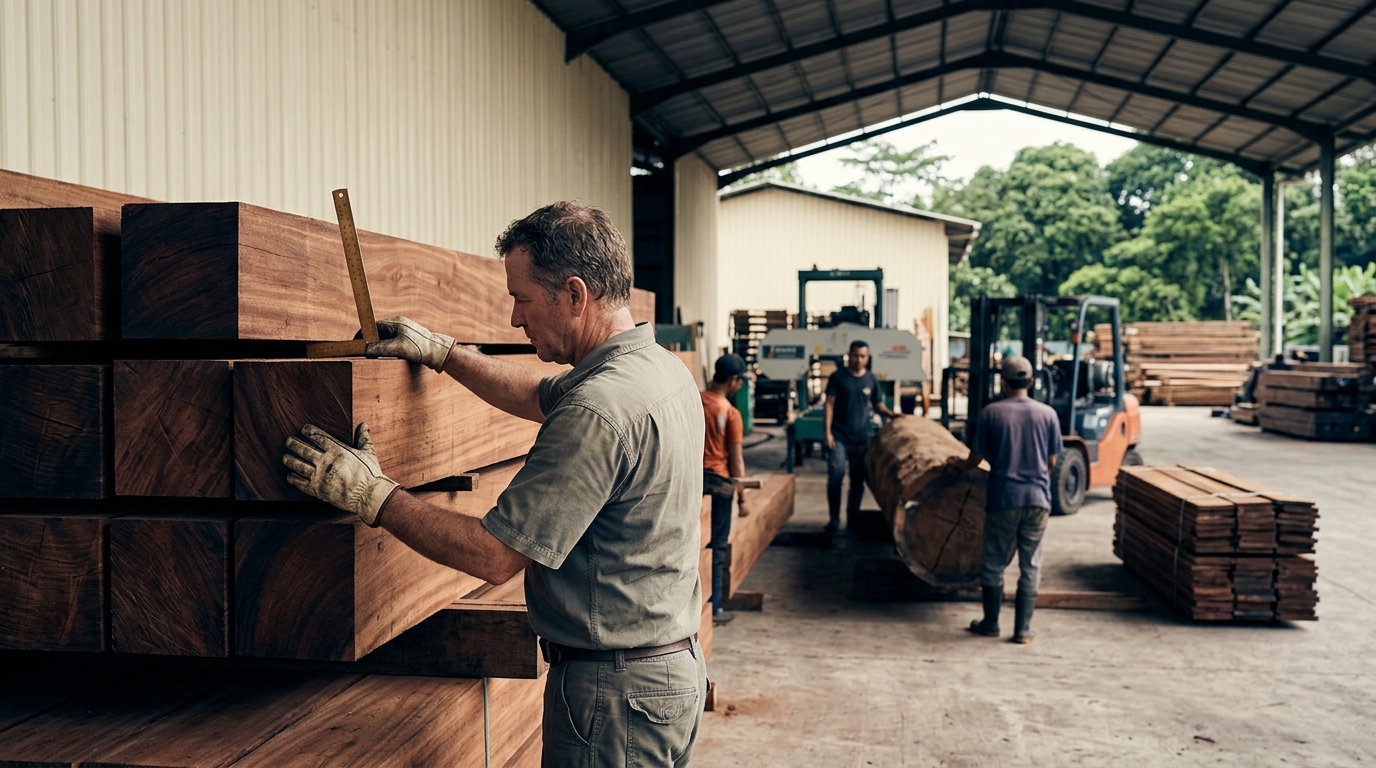
Procuring ulin ironwood from Indonesia is not a routine timber buy. You are dealing with a legally protected species, a constrained reclaimed supply chain, extreme material density, and a compliance framework that spans two jurisdictions. Marine contractors, bridge engineers, and professional…
Procuring ulin ironwood from Indonesia is not a routine timber buy. You are dealing with a legally protected species, a constrained reclaimed supply chain, extreme material density, and a compliance framework that spans two jurisdictions. Marine contractors, bridge engineers, and professional importers who approach ulin the same way they would a standard tropical hardwood order will encounter delays, documentation failures, and potential Lacey Act exposure.
This guide covers the full procurement picture: technical specifications, Indonesian legal requirements, supplier vetting, sawn size availability, freight density mathematics, and a direct comparison with bengkirai (Shorea laevis) for applications where substitution is viable. The goal is to give U.S.-based buyers a decision framework grounded in verifiable criteria rather than supplier marketing claims.
Understanding why ulin ironwood timbersuppliers Indonesiaoperate the way they do — sourcing reclaimed stock, navigating SVLK audits, and exporting through specific port channels — requires starting with the material itself. Its physical properties drive every downstream sourcing constraint.
Why Ulin Ironwood Outperforms Every Other Tropical Hardwood in Demanding Structural Applications
Botanical Identity and Physical Properties
Ulin, botanically Eusideroxylon zwageri, is endemic to Kalimantan and Sumatra. No commercial plantation stock exists. The species accumulates its exceptional properties over centuries of old-growth development, which is also why supply is finite and tightly regulated.
Key physical benchmarks (approximate, based on published forestry literature):
- Density: approximately 1,040 kg/m³ air-dried - Janka hardness: commonly cited above 3,500 lbf — among the highest of any traded tropical species - Natural durability class: Class 1 under European standard EN 350 equivalent classifications, meaning the heartwood is expected to resist decay for 25 years or more in ground contact, and far longer above-ground or in marine exposure
Marine Borer Resistance: The Decisive Differentiator
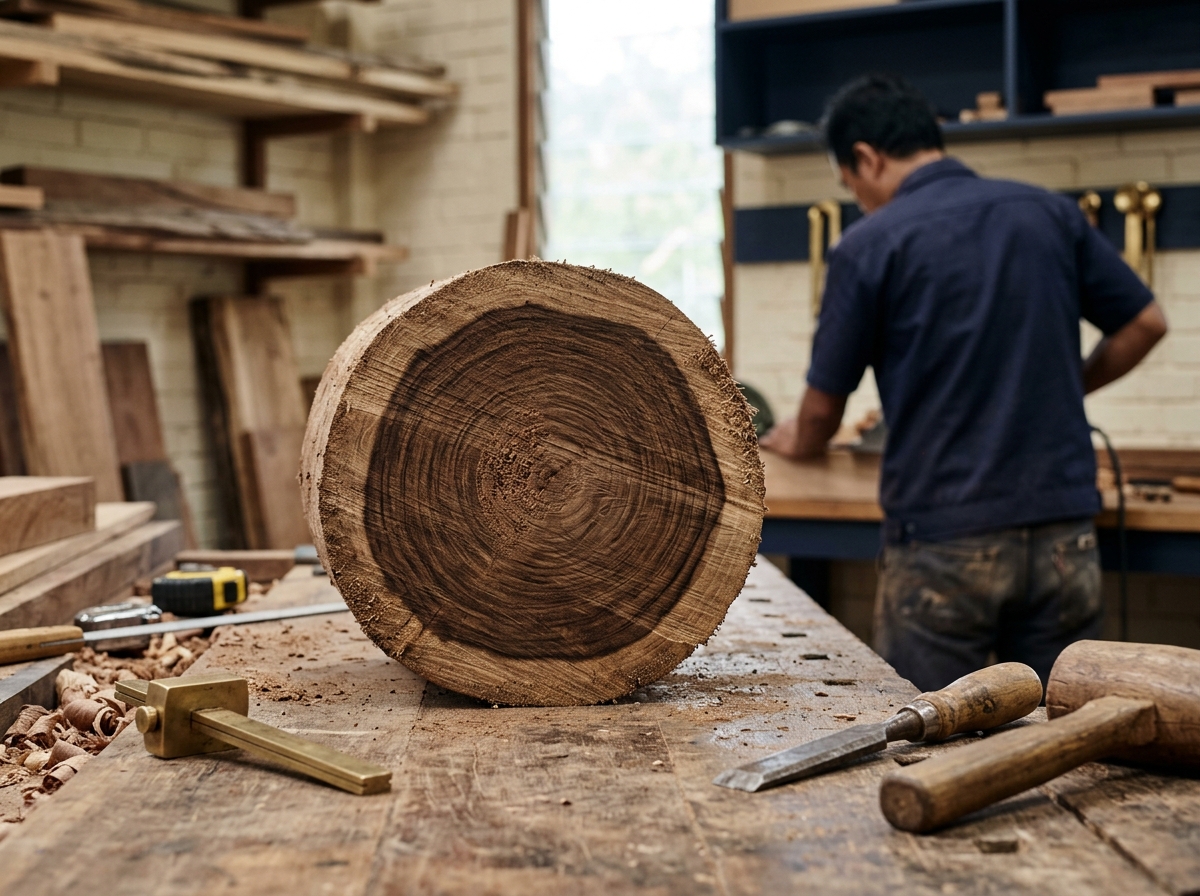
Most tropical hardwoods in Class 1 durability still require treatment for full marine immersion service. Ulin does not. Its heartwood chemistry — a combination of phenolic compounds and silica — provides documented resistance to marine borers including Teredo navalis and Limnoria species. This is the property that makes ulin irreplaceable for marine piling, tidal-zone decking, and submerged structural applications where mechanical treatment is impractical.
No other commercially available tropical timber replicates this combination of hardness, density, and innate marine borer resistance without chemical treatment.
Life-Cycle Cost Logic
At a project planning horizon of 50 to approximately 80 years, an untreated ulin pile in a marine environment can remain structurally sound. Pressure-treated alternatives typically require replacement on a 20 to 30-year cycle, with associated labour and mobilisation costs. For procurement decisions on long-span bridges, port infrastructure, or permanent marine structures, the life-cycle cost calculation often justifies ulin's premium FOB price per cubic metre.
Legal Status and SVLK Compliance: What Every U.S. Importer Must Understand Before Ordering Ulin Ironwood
CITES Appendix III and Indonesian Domestic Harvest Controls
Eusideroxylon zwageri is listed on CITES Appendix III by Indonesia. This listing means Indonesia has requested international cooperation in controlling trade. Any export shipment requires a CITES export permit issued by the Indonesian CITES Management Authority, and U.S. importers must present the corresponding CITES import documentation at port of entry.
Beyond CITES, Indonesia's Ministry of Environment and Forestry has effectively prohibited commercial harvest of wild-grown ulin. This means virgin-cut ulin — freshly felled and sawn from living trees — is not a legal export product. Any supplier offering new-cut material at prices below reclaimed market rates should be treated as a serious compliance risk.
SVLK: Indonesia's Timber Legality Verification System
The Sistem Verifikasi Legalitas Kayu (SVLK) is Indonesia's mandatory national timber legality assurance system. It was established under Ministry of Forestry regulations and is recognised under the EU FLEGT framework. SVLK audits verify:
- Legal origin of raw material - Chain of custody through processing - Compliance with Indonesian forestry law - Validity of export documentation
An SVLK certificate issued by an accredited Conformity Assessment Body (LPVI) is the baseline document you must request from any Indonesian supplier. It accompanies the export shipment and is distinct from a CITES permit — you need both.
U.S. Lacey Act Compliance Requirements
The U.S. Lacey Act (16 U.S.C. §§ 3371–3378, as amended by the 2008 Farm Bill) prohibits the import of wood products taken, possessed, transported, or sold in violation of the laws of the country of harvest. For ulin imports, this means:
- ✓HS tariff code for the wood product
- ✓Scientific name: Eusideroxylon zwageri
- ✓Country of harvest: Indonesia
- ✓Quantity and value
- ✓SVLK certificate number and issuing body
- ✓CITES export permit number
- ✓Supplier ETPIK (Eksportir Terdaftar Produk Industri Kehutanan) license number
The Lacey Act declaration (PPQ Form 505) must be filed with U.S. Fish and Wildlife Service at first port of entry. Failure to file, or filing with incorrect species data, can result in seizure of the shipment and civil penalties. Engage a licensed customs broker with experience in restricted timber species before your first shipment.
Where Ulin Ironwood Timber Suppliers in Indonesia Actually Source Their Stock
Old-Growth Structure Salvage from Kalimantan
Because fresh harvest is banned, the commercial supply of ulin runs entirely through reclaimed channels. Primary salvage sources include:
- Decommissioned bridge timbers from Kalimantan's river-crossing infrastructure - Old house frames and stilted structures in coastal and riverine communities - Retired water wheels and mill components - Harbour piling removed during port redevelopment
This material is often several decades old when salvaged, meaning it has already proven its durability in service. Structurally, well-graded reclaimed ulin is not inferior to virgin-cut stock for most structural applications. The challenge is consistency, not inherent quality.
Processing Hubs and Export Channels
Banjarmasin (South Kalimantan) and Samarinda (East Kalimantan) are the primary sawmill and grading centres for reclaimed ulin stock. Bali-based operations handle finishing and sometimes consolidation for export. Jakarta's Tanjung Priok port handles the majority of containerised timber exports to the United States. Balikpapan offers direct loading options for large-volume orders originating in East Kalimantan, reducing inland haulage cost.
Grading Challenges with Reclaimed Stock
Virgin-cut sawn timber arrives in predictable, consistent dimensions from a single log run. Reclaimed ulin does not. Buyers should expect:
- Variable cross-sections within a stated nominal size - Surface checking and weathering on outer faces (typically sawn off during remilling) - Occasional embedded fasteners or historic treatment residues requiring inspection - Batch-to-batch variation in colour and grain density
Reputable ulin ironwoodtimber suppliers Indonesiawill provide grading reports specific to each container lot, not generic catalogue specifications. Request photographic documentation of the salvage source and the remilling process.
Chain of Custody Documentation
A credible supplier should be able to provide a documented chain of custody from salvage site (with GPS-referenced location or administrative district record) through transport to the sawmill, through SVLK audit, to export container stuffing. Gaps in this chain are a compliance liability under both SVLK and the Lacey Act.
Standard Export Dimensions, MOQs, and Lead Times for Ulin Ironwood
Typical sawn dimensions available from Indonesian exporters (approximate, varies by supplier):
| Product Form | Thickness (cm) | Width (cm) | Length (m) |
|---|---|---|---|
| Decking boards | 2.5–5.0 | 10–25 | 2–4 |
| Structural beams | 5.0–10.0 | 10–30 | 2–6 |
| Piling blanks | 10.0–20.0 | 10–20 | 3–6 |
| Shingle blocks | 2.5–5.0 | 5–15 | 0.5–1.0 |
Custom milling to project specifications is possible but adds lead time. Most exporters work from existing reclaimed stock dimensions. Requesting a non-standard section reduces your effective supplier pool significantly.
Surface finish options: - Rough-sawn (RS): standard for structural and marine piling applications - Surfaced four sides (S4S): available from finishing mills, adds cost and lead time - Kiln-dried (KD): rarely available given the density of ulin — most export stock is air-dried to approximately 15–20% moisture content
MOQ and lead time reality: Given constrained reclaimed supply, most credible suppliers require a minimum order of one 20-foot FCL. Lead times from order confirmation to container loading typically run 8 to 16 weeks, depending on current stock levels and the complexity of the grading specification.
Freight Density Mathematics: How Ulin's Weight Affects Your Landed Cost per Board Foot
Payload Calculations for a 20-ft FCL
A standard 20-foot dry container has a maximum payload of approximately 28,000 kg (varies by shipping line and container tare weight). At approximately 1,040 kg/m³ air-dried, ulin fills that payload limit at roughly 27 m³ of timber — before accounting for dunnage and load securing.
A lighter species such as teak (approximately 650 kg/m³ air-dried) would yield around 43 m³ in the same container before hitting the weight limit. Bengkirai (approximately 870–950 kg/m³) sits between the two.
Worked freight example (indicative figures):
Assume an ocean freight rate of approximately USD 2,800 per 20-ft FCL from Tanjung Priok to a U.S. West Coast port (rates fluctuate — verify current rates with your freight forwarder).
| Species | Volume per FCL (approx. m³) | Freight cost per m³ | Freight cost per board foot (approx.) |
|---|---|---|---|
| Ulin (air-dried) | ~27 m³ | ~USD 104 | ~USD 0.30 |
| Bengkirai (air-dried) | ~31 m³ | ~USD 90 | ~USD 0.26 |
| Teak (air-dried) | ~43 m³ | ~USD 65 | ~USD 0.19 |
These are illustrative calculations only. Actual freight, port handling, and inland delivery costs vary. The key takeaway: ulin's density compresses FCL volume efficiency by approximately 35–40% versus teak, which materially increases freight cost per board foot even when the ocean rate per container is identical.
Port and Phytosanitary Requirements
U.S. Customs and USDA APHIS require a phytosanitary certificate from Indonesia's Ministry of Agriculture for all wood imports. Heat treatment to ISPM 15 standard (56°C core temperature for 30 minutes) is required for solid wood packaging material (dunnage, pallets, crating). The timber itself must be declared free of bark and soil. Fumigation with methyl bromide is an alternative treatment but is being phased down under the Montreal Protocol — confirm current APHIS requirements with your broker before shipment preparation.
Ulin vs. Bengkirai: An Honest Performance and Cost Comparison for Procurement Decisions
Bengkirai (Shorea laevis) is the most common alternative specification when ulin is unavailable or over-budget. It is a Class 2 durability tropical hardwood, widely available as virgin-cut sawn timber from Indonesia and Malaysia, and substantially cheaper.
| Specification | Ulin (Eusideroxylon zwageri) | Bengkirai (Shorea laevis) |
|---|---|---|
| Natural durability class | Class 1 | Class 2 |
| Density (approx. air-dried) | ~1,040 kg/m³ | ~870–950 kg/m³ |
| Janka hardness | ~3,500+ lbf | ~2,000–2,500 lbf |
| Marine borer resistance | Innate, untreated | Moderate; treatment recommended |
| Harvest status | Protected; reclaimed only | Virgin-cut commercially available |
| Indicative FOB price premium vs. bengkirai | 40–80% higher | Baseline |
| Supply availability | Constrained, batch-dependent | Reliable, larger volumes |
| CITES listing | Appendix III (Indonesia) | Not listed |
| Typical lead time | 8–16 weeks | 4–10 weeks |
Where bengkirai is an acceptable substitute: - Above-ground bridge decking not subject to tidal immersion - Structural framing with periodic exposure - Heavy-duty outdoor applications where Class 2 durability is contractually acceptable
Where ulin is non-negotiable: - Marine piling in tidal and fully submerged zones - Applications where chemical treatment is prohibited (potable water infrastructure, aquaculture) - Project specifications that explicitly require Class 1 untreated natural durability
Hybrid specification strategy: Experienced marine contractors often specify ulin only for below-waterline piling and tidal-zone elements, and bengkirai for above-waterline decking and superstructure. This approach can reduce material cost on a large project by 25–40% while maintaining durability integrity at the critical exposure zones. Engage your structural engineer to confirm where the durability class boundary sits in your specific design.
For further detail on bengkirai specifications and sourcing, refer to the bengkirai structural timber sourcing guide. For applications requiring moderate durability at lower cost, merbau is also worth evaluating.
How to Qualify Ulin Ironwood Timber Suppliers in Indonesia Before Committing to a Container
Mandatory Credentials to Request Upfront
Before negotiating price, request these documents in writing:
- ✓Current SVLK certificate with issuing LPVI body name and audit validity dates
- ✓ETPIK (Eksportir Terdaftar Produk Industri Kehutanan) export license — confirms legal timber exporter status
- ✓CITES export permit history — request copies from prior shipments
- ✓Sample Lacey Act PPQ 505 declaration filed on a previous U.S. export
- ✓Chain-of-custody documentation for the specific stock lot you are quoting
- ✓Bank references or trade references from prior U.S. or EU importers
Red Flags That Signal Compliance Risk
- 'New-cut' ulin offered at any price. Commercially harvested ulin from living trees is not legally available. A supplier claiming to offer it is either misrepresenting the species or operating outside Indonesian law. Either scenario creates Lacey Act exposure for the U.S. importer. - No SVLK certificate or an expired certificate. The audit cycle is annual. An expired certificate means the supplier's legal compliance has not been recently verified. - Refusal to provide salvage source documentation. Reclaimed material without a documented origin cannot be verified under the Lacey Act's due care standard. - Pricing 40%+ below current reclaimed market benchmarks. Ulin's scarcity is reflected in its price. Anomalously low pricing almost always indicates species substitution.
Species Substitution Fraud and Third-Party Verification
Species substitution — shipping a lower-value dense tropical hardwood while declaring it as ulin — is a known risk in this supply chain. Visually, several Borneo hardwoods can resemble ulin to a non-specialist. The only reliable mitigation is third-party wood anatomy verification by an accredited xylotomy laboratory. A competent lab can identify Eusideroxylon zwageri from a small sample using microscopic cell structure analysis. Build this requirement into your sample order specification and your purchase contract for full container shipments.
Sample Order Protocol
Before committing to a full FCL, place a sample order of approximately 0.5–1.0 m³ covering each size specification you intend to order at scale. Inspect for:
- Correct species identity (via lab verification if required) - Dimensional accuracy against your specification tolerances - Moisture content (request a supplier MC certificate and verify independently) - Grading consistency — proportion of clear heartwood vs. sapwood or defect material - Quality of SVLK and CITES documentation accompanying the sample shipment
Pricing Benchmarks, Market Conditions, and Supply Outlook for Ulin in 2025
Indicative FOB Price Ranges
These are approximate market benchmarks only — not guaranteed quotes. Actual prices depend on dimension, grade, current stock availability, and individual supplier terms.
| Product | Indicative FOB Price Range (per m³) |
|---|---|
| Reclaimed ulin decking (S4S) | USD 1,200–1,800 |
| Reclaimed ulin structural beams (rough-sawn) | USD 900–1,400 |
| Ulin shingle blocks | USD 800–1,200 |
| Ulin piling blanks (large section) | USD 1,000–1,600 |
Bengkirai virgin-cut structural timber typically ranges from approximately USD 500–750 FOB per m³ for comparable dimensions, illustrating the 40–80% price premium for ulin.
Supply Trajectory and Market Pressure
Indonesia's domestic construction and renovation market — particularly resort and heritage architecture in Bali and Kalimantan — competes directly with export demand for reclaimed ulin stock. As old-growth infrastructure continues to be decommissioned and processed, the total available reclaimed pool shrinks each year. Supply constraints are expected to tighten through the late 2020s, with price increases likely outpacing general tropical hardwood inflation.
U.S. Tariff Policy and Landed Cost
Indonesian wood products exported to the United States are subject to the applicable U.S. Harmonized Tariff Schedule rates for the relevant product category. As of current schedules, most sawn tropical hardwood timber from Indonesia enters at relatively low Most Favoured Nation (MFN) rates — typically in the range of zero to a few percent ad valorem depending on the HS code. However, U.S. trade policy has been subject to change.
Frequently Asked Questions on Importing Ulin Ironwood from Indonesia
Is ulin ironwood legal to import into the United States from Indonesia?
Yes, reclaimed ulin with correct documentation is legal to import. You need a CITES export permit, an SVLK certificate from the Indonesian exporter, and you must file a U.S. Lacey Act declaration (PPQ Form 505) at the port of entry. New-cut ulin is not legally available for export from Indonesia.
What is the difference between ulin and bengkirai for marine applications?
Ulin is Class 1 durability with innate marine borer resistance — it does not require chemical treatment in marine immersion environments. Bengkirai is Class 2 with moderate marine borer resistance; treatment is recommended for submerged applications. For piling in tidal or fully submerged zones, ulin is the superior specification. For above-water structural decking, bengkirai is often an acceptable and significantly cheaper alternative.
Why is new-cut ulin unavailable, and is reclaimed ulin structurally reliable?
Indonesia has prohibited commercial harvest of Eusideroxylon zwageri. New-cut material cannot be legally exported. Reclaimed ulin sourced from old bridges, house frames, and piling is structurally reliable when properly graded — the material has already proven its durability in service, often for 40 to 80 years. Grading and dimensional consistency are the key variables to manage through supplier qualification and sample inspection.
What sawn sizes can Indonesian ulin suppliers provide for export?
Typical export sections range from 2.5 cm thickness for decking boards up to 20 cm for large structural sections, with widths up to approximately 30 cm and lengths from 2 to 6 metres. Custom dimensions are possible but constrain supplier options and extend lead times. MOQ is generally one 20-foot FCL.
How heavy is ulin ironwood and how does that affect shipping costs per container?
At approximately 1,040 kg/m³ air-dried, a 20-ft FCL reaches its weight limit at roughly 27 m³ of ulin — compared to approximately 43 m³ for teak. This reduces volumetric efficiency and increases freight cost per board foot by approximately 35–40% relative to lighter tropical species at the same ocean rate.
What certifications should I request from an Indonesian ulin timber supplier?
SVLK certificate (current, from an accredited LPVI), ETPIK export license, CITES export permit, chain-of-custody documentation for the specific stock lot, and a copy of a prior Lacey Act PPQ 505 declaration. For species verification, also request or commission a wood anatomy lab report confirming Eusideroxylon zwageri identification.
Sourcing ulin ironwood from Indonesia is viable for U.S. professionals who approach it as a compliance-driven procurement process. The material's Class 1 durability and unique marine borer resistance justify the premium — but only when the documentation chain from Kalimantan salvage site to U.S. port of entry is complete and verifiable. Combining ulin for critical exposure zones with bengkirai for secondary structural elements is the most cost-effective strategy on large projects.
You now have the specification benchmarks, legal framework, freight mathematics, and supplier vetting criteria to evaluate any Indonesian supplier with confidence.
You understand the compliance requirements, the supply constraints, and the documentation you need. The next step is connecting with suppliers who can meet that standard. Request a certified ulin ironwood quote from verified Indonesian suppliers today — with SVLK, ETPIK, and CITES documentation confirmed before any commercial discussion begins.
Request a Verified Supplier Quote →Need eyes on the ground in Indonesia?
MTS is an execution partner — supplier verification, manufacturing management, quality control and export logistics across Indonesia, Vietnam and China.
Related services
Related articles
Receive furniture sourcing insights across Asia.
One email per week. No spam.