Negotiating with Indonesian Furniture Factories: A Complete Import Manager's Guide
19 min read
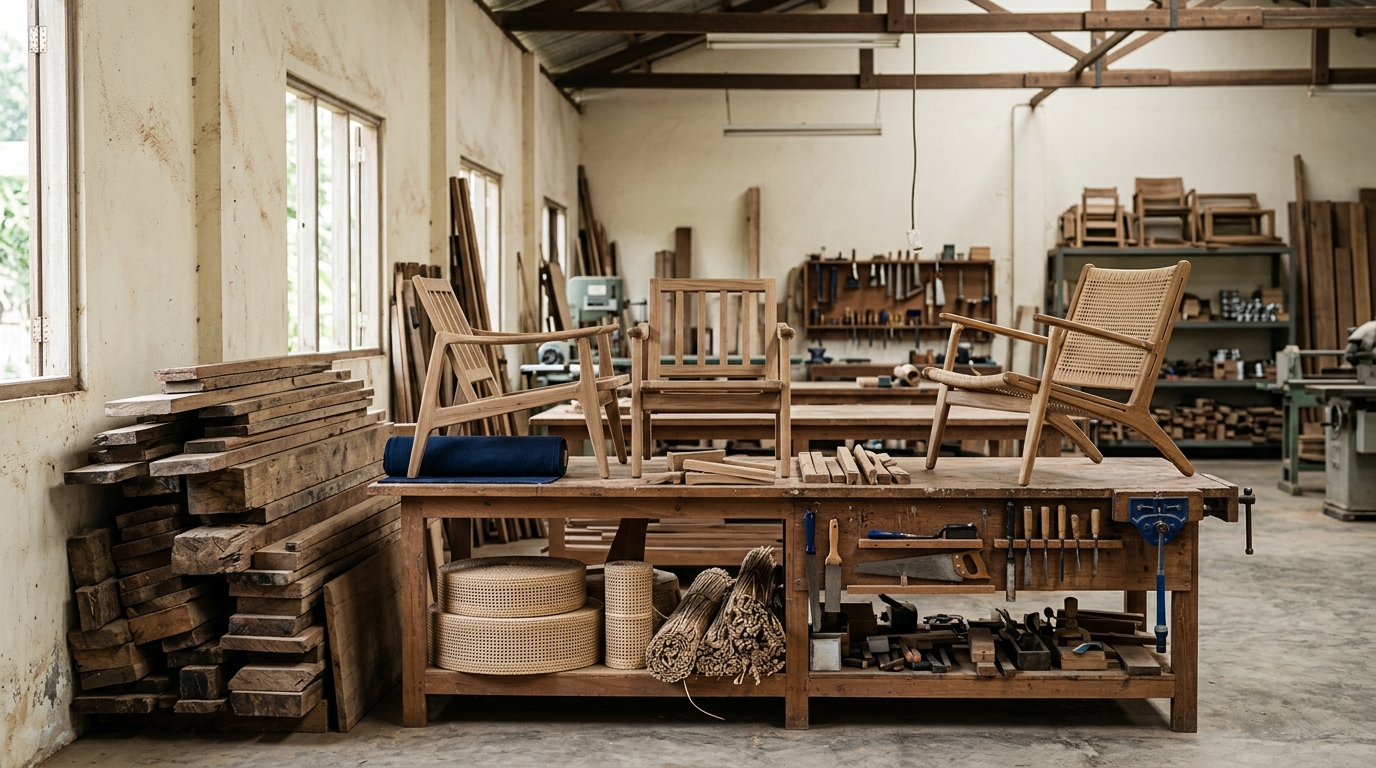
Sourcing furniture directly from Indonesian factories is one of the highest-leverage decisions a US import manager can make — and one of the most technically demanding to execute well. The gap between a mediocre deal and an exceptional one rarely comes down to price alone. It comes down to…
Sourcing furniture directly from Indonesian factories is one of the highest-leverage decisions a US import manager can make — and one of the most technically demanding to execute well. The gap between a mediocre deal and an exceptional one rarely comes down to price alone. It comes down to cultural fluency, preparation depth, and the contractual structure you build around every agreement. Import managers who treat Indonesian suppliers the way they would treat a domestic vendor routinely overpay, under-specify, and damage relationships that took years to build.
This guide is written for procurement professionals who are already in the market — benchmarking factories, comparing FOB quotes, and navigating the operational complexity of furniture sourcing Indonesia demands. What follows is a field-level breakdown of every major negotiation dimension: culture, pricing mechanics, payment structures, specification control, quality assurance, and long-term partnership strategy. It covers the intelligence that most sourcing guides skip entirely, including how to request itemized cost breakdowns, how milestone-based payment schedules protect your capital, and how the current trade environment creates genuine leverage windows for US buyers.
If you are evaluating whether direct factory negotiation is worth the complexity compared to using a trading company, the math speaks clearly: trading company margins onIndonesian furniturecommonly add a meaningful layer of cost that compounds across every order. Understanding the full picture before your next factory conversation will make every meeting more productive.
Why Indonesian Furniture Factories Deserve a Place in Your Direct Sourcing Strategy
Indonesia holds a structural position in global furniture manufacturing that no other country fully replicates. The combination of teak supply, skilled artisan labor, and deep export infrastructure creates a sourcing profile that serves US importers across hospitality, retail, and contract furnishing channels.
The Raw Material Advantage That Sets Indonesia Apart
Indonesian teak is widely regarded as among the highest-quality hardwoods available for furniture manufacturing. Grown in well-managed plantation systems and, in legacy stocks, from natural forests, teak offers exceptional dimensional stability, natural oil content that resists moisture and insects, and a grain density that supports fine joinery work. Compared to alternatives such as rubberwood or plantation pine, teak commands a premium — but it also delivers a finished product that justifies higher retail price points in the US market.
Beyond teak, Indonesia is the dominant global source of rattan, a material that commands strong demand in both indoor and outdoor furniture categories. The country's mahogany and reclaimed wood supply further extends the range of product categories available to importers without switching supplier countries.
Export Clusters and Why Geography Matters in Your Supplier Selection
The three primary clusters for US-bound furniture sourcing are distinct in their specialization:
- Jepara (Central Java): The heartland of Indonesian solid wood and teak furniture manufacturing. Jepara concentrates the highest density of OEM-capable factories producing bedroom, dining, and occasional furniture for export. Artisan skill levels here are well-developed and generations deep. - Surabaya: A mid-market manufacturing hub with stronger industrial infrastructure and larger factory footprints, suited for higher-volume programs. - Bali: The premium artisan cluster, producing luxury resort furniture, handcrafted decorative pieces, and high-design hospitality items. Bali factories often operate as ODM producers with in-house design catalogs available for modification and branding.
Direct Factory vs. Trading Company: A Cost Structure Reality Check
When you source through a trading company or merchant exporter, you pay a margin on top of the factory's FOB price. On a $100,000 order, even a conservative intermediary margin of 8–12% represents $8,000–$12,000 in cost that disappears from your margin without adding product value. Across multiple annual orders, that figure becomes material.
Direct negotiating with Indonesian furniture factories eliminates that layer — but it requires you to absorb the sourcing, audit, and relationship management work that a trading company otherwise handles. The break-even point depends on your order frequency and volume, but for any importer running consistent annual programs, the direct model almost always wins economically.
How the Current Trade Environment Creates Leverage for US Buyers
Shifts in US tariff policy toward Chinese furniture have redirected significant buyer attention toward Southeast Asia, including Indonesia. As US importers accelerate diversification away from China under Section 301 tariff pressure, Indonesian factories are experiencing increased inquiry volume — which cuts both ways. Buyers gain leverage by representing committed, recurring demand in a market where factories are actively competing for long-term US partnerships. Importers who position themselves as preferred buyers early in a relationship cycle extract better terms than those who arrive as transactional, price-only inquirers.
Understanding Indonesian Negotiation Culture Before You Enter Any Factory Meeting
This is where most Western import managers leave significant value on the table. Negotiating with Indonesian furniture factories is not a transaction — it is a relationship-building process that happens to include commercial terms. Misreading the cultural operating system produces outcomes that feel like wins in the room but unravel in production.
The Role of Face (Muka) in Every Commercial Conversation
The Indonesian concept of muka — broadly equivalent to "face" — governs how disagreement, refusal, and correction are communicated. A factory owner or sales manager will rarely say "no" directly. Instead, you will hear expressions of difficulty, phrases like "it may be challenging," extended pauses, or redirections to different topics. These are functionally equivalent to a Western "no" and should be read as such.
The practical implication: never put an Indonesian counterpart in a position where agreeing with you requires them to publicly admit a mistake or concede defeat. Negotiations structured as zero-sum confrontations — where one side visibly wins — produce surface agreement and backstage quality shortcuts. Structure your asks so that the factory can say yes while maintaining dignity.
Bapakism and the Relationship-First Dynamic
Indonesian business culture operates on a hierarchical relationship framework sometimes described as bapakism — a patronage-influenced dynamic where trust between individuals precedes commercial agreement. Deals are made between people, not between companies. If the factory owner does not trust you personally, the contract terms become secondary.
This means your first one or two interactions with a new factory should invest time in relationship-building before any serious price negotiation begins. Share your company's history, your plans for the Indonesian market, and your long-term sourcing intentions. Ask questions about the factory's history, the owner's background, and the team. This is not small talk — it is the foundation on which every subsequent negotiation stands.
Reading Indirect Communication and the Patience Advantage
Indonesian negotiators typically use indirect communication styles that convey meaning through implication, tone, and context rather than explicit statement. When a factory contact says "we will try our best," that phrase contains a range of possible meanings depending on what preceded it. Developing the ability to read these signals takes time — but the shortcut is to ask clarifying questions gently and create space for your counterpart to volunteer concerns rather than forcing direct answers.
Patience is a negotiation asset in this context. Importers who push for quick resolution signal that they either do not value the relationship or are operating from a position of urgency — both of which reduce your leverage. Allowing negotiations to develop over multiple meetings or communications, without artificial deadline pressure, is consistently more productive.
Pre-Negotiation Preparation Every Import Manager Must Complete Before the First Quote Request
Arriving at a factory conversation without comprehensive preparation is the fastest way to pay retail for a wholesale product. The intelligence you build before contacting a factory determines the ceiling of your negotiating outcome.
Benchmarking FOB prices: Obtain comparable FOB quotes from at least three factories before entering serious negotiation with any one of them. This gives you a defensible reference range and prevents anchoring to the first number you hear. Factories know that buyers who quote competing prices are serious — it signals market knowledge and purchase intent simultaneously.
Preparing a detailed product specification sheet: Arrive with a written specification document that defines wood species, material grade, dimensions with tolerances, moisture content requirements, finish type and sheen level, hardware specifications, joinery method, and packaging requirements. Factories that receive vague briefs produce vague quotes. Specificity protects you from scope creep and post-production disputes.
Understanding material grades and certifications: Indonesian teak comes in materially different grades with different cost profiles: - FSC-certified teak carries independent chain-of-custody verification and is increasingly required by US retail and hospitality buyers with sustainability commitments. - SVLK-certified wood (Indonesia's national timber legality verification system) is the minimum legal export standard for Indonesian timber products — verify that any factory you source from holds current SVLK documentation. - Reclaimed teak is sourced from demolished structures and carries a distinct aesthetic and price point. - Plantation teak is cost-effective but younger and less dense than old-growth equivalents.
Verifying factory credentials before negotiating: Confirm the factory's export history, production capacity, and whether it operates as a full-cycle facility or an assembly-only operation. Full-cycle factories control their own kiln drying, maintain lumber yards, and operate finishing lines internally — this matters because wood moisture content must typically reach 8–12% for furniture destined for US markets with central heating or air conditioning. Assembly-only operations purchase pre-processed components externally and have limited control over the upstream quality variables that cause warping, cracking, and edge failure in the first year of use.
- ✓Obtain FOB quotes from minimum three competing factories
- ✓Prepare written product specification sheet with tolerances
- ✓Confirm FSC or SVLK certification status
- ✓Verify full-cycle vs. assembly-only production model
- ✓Request factory export history and references
- ✓Confirm kiln-drying capability and target moisture content
- ✓Check factory capacity against your projected order volume
Negotiating Price with Indonesian Furniture Factories Without Sacrificing Quality or Trust
Price negotiation is the moment most import managers focus on — but it is also the moment most likely to produce unintended consequences if handled poorly.
Anchoring with Data, Not Pressure
Present your target price with supporting rationale: your benchmark FOB data, your knowledge of material costs at current commodity rates, and your volume commitment. This approach frames your position as commercially informed rather than adversarially aggressive. Indonesian factory owners respond well to buyers who demonstrate that they understand the cost structure — it signals that you are a professional peer, not a buyer trying to extract something unfair.
One concrete tool for this is the itemized cost breakdown request. Ask the factory to provide a production cost breakdown segmented by: raw material, labor, finishing, hardware, packaging, and factory overhead. Most competitors sourcing from Indonesia never make this request — they negotiate against a black-box total price. An itemized breakdown reveals where margin exists, where genuine cost constraints apply, and which line items are negotiable. A factory that resists providing any breakdown deserves scrutiny; one that engages transparently is signaling a partnership orientation.
Volume Bundling and Multi-SKU Strategies
If your program includes multiple SKUs, negotiate them as a package rather than sequentially. Bundling a dining set, a bedroom group, and an occasional collection into a single annual volume commitment gives the factory production planning certainty — which they value and will price accordingly. Volume-based tiering (e.g., different unit price levels at different annual quantity thresholds) formalizes this into contractual structure.
The Quality Degradation Risk of Excessive Price Pressure
A 5% price reduction on a $100,000 FOB order saves $5,000 at the point of purchase. But if that pressure causes a factory to substitute lower-grade timber, reduce finishing steps, or accelerate drying cycles, the downstream cost of rework, returns, or reputation damage with end customers routinely exceeds the original saving by a factor of three to five. The goal of price negotiation is not the lowest number — it is the best value at a sustainable margin for both parties.
Payment Terms, Deposits, and Letters of Credit: Structuring Financial Agreements That Protect Both Sides
Payment structure is a significant negotiating variable that most import managers treat as fixed. It is not.
Standard Indonesian factory terms typically run as a 30% deposit at order confirmation with the remaining 70% due before shipment. This structure protects the factory against buyer default and is the default starting position for most negotiations.
Variations worth negotiating:
- Milestone-based payment schedules: Structure payments against production verification events rather than simply a deposit/balance split. For example: 30% at order confirmation, 40% after pre-production sample approval and materials inspection, 30% after pre-shipment inspection sign-off. This ties your capital release to confirmed production quality rather than elapsed time. - Letters of Credit (LC): An LC issued through your US bank provides the factory with payment security while giving you documentary control over shipment conditions. LCs are particularly valuable for large orders or new factory relationships where trust is still being established. The factory is assured of payment upon document compliance; you are assured that payment is only triggered by compliant documentation. - Net-30 or Net-60 terms: Factories will generally not accept open-account terms with new buyers. Net-30 or Net-60 can sometimes be negotiated after 12–18 months of successful order history and a demonstrated payment track record.
Specification Negotiation: Locking In Exactly What Your Market Requires
Verbal agreements about product specifications are functionally worthless. Every specification must be documented in writing, attached to the purchase order, and acknowledged by the factory in writing before production begins.
Critical specification parameters for US-bound Indonesian furniture:
- Wood moisture content: Specify a maximum moisture content of 8–12% for interior furniture shipped to US markets with HVAC environments. Furniture arriving above this threshold is at high risk of cracking and warping in heated or air-conditioned spaces. Require documentation from the factory's kiln-drying process. - Finish type and sheen level: Define whether you require catalyzed lacquer, water-based finish, oil finish, or wax — and specify the sheen level numerically (e.g., 20-degree matte, 60-degree semi-gloss). Subjective descriptions produce inconsistent results across production runs. - Hardware sourcing: Specify whether hardware should be locally sourced or imported, the required material grade (e.g., stainless steel for outdoor pieces), and the finish standard. - Joinery method: Define acceptable joinery for structural components (mortise and tenon vs. dowel vs. bracket-assisted) to prevent factories substituting faster but weaker assembly methods under cost pressure. - Approved sample clauses: Every production run should be contractually tied to an approved pre-production sample. Include a tolerance specification — for example, acceptable deviation of no more than ±3mm on key dimensions and no more than one shade step on finish color.
Lead Times, MOQ Flexibility, and Capacity Planning for Indonesian Suppliers
Realistic lead time planning prevents the two most common operational failures in Indonesian furniture sourcing: overpromising to your end customers and placing orders too late to meet seasonal demand.
Typical lead times by product type:
| Product Category | Typical Lead Time | Notes |
|---|---|---|
| Simple solid wood occasional | 8–10 weeks | Fewer components, faster finishing |
| Dining sets (4–8 pieces) | 10–14 weeks | Multiple SKUs, finish matching required |
| Bedroom collections | 12–16 weeks | High component count, QC complexity |
| Rattan or upholstered pieces | 10–14 weeks | Material sourcing variables |
| Custom / bespoke hospitality | 14–20 weeks | Sample development adds time |
MOQ flexibility strategies: - Pilot orders: Propose a smaller initial order at a slightly higher unit cost as a relationship-entry mechanism. Frame it explicitly as a qualification order with a follow-on volume commitment contingent on quality confirmation. - Rolling forecasts: Providing a 6–12 month forward forecast — even non-binding — gives factories production planning visibility that they value enough to offer MOQ flexibility in return. - Annual volume commitments: A written annual commitment (even a letter of intent) triggers preferred buyer treatment at many mid-size factories, including lower MOQ thresholds and priority production scheduling.
Penalty clauses for late delivery: These are negotiable but must be introduced carefully. Frame penalty clauses as mutual protection — including reciprocal protections for the factory if you delay confirming specifications or artwork. Indonesian counterparts will not accept penalty clauses imposed unilaterally; they will accept them when structured as a fair bilateral risk-sharing mechanism.
Quality Control Levers You Can Build Into Every Negotiation With Indonesian Suppliers
Quality assurance is not a post-production activity — it is a negotiation variable that must be established contractually before production begins.
AQL frameworks in purchase orders: Define your Acceptable Quality Limit (AQL) level in writing before production starts. AQL 2.5 is a common standard for furniture, meaning that in a random sample inspection, up to 2.5% defective units in a lot is acceptable before rejection. Higher-value or lower-volume programs may apply AQL 1.5. Factories that have never been asked to produce to a stated AQL level are factories that have never been managed to a quality standard — treat this as a supplier capability signal.
Inspection options:
1. Third-party inspection (SGS, Bureau Veritas): Independent inspection firms with established Indonesian operations provide pre-shipment inspection reports that are accepted by US customs, finance institutions, and retail buyers. Negotiate the cost-sharing arrangement upfront — factories sometimes contribute to inspection costs as a relationship signal. 2. Agent-managed inspection: A local sourcing agent or quality representative can conduct production milestone inspections at lower per-visit cost than a formal third-party firm. 3. Photo and video production milestones: For ongoing relationships where full inspection is not cost-justified on every order, require factories to provide photo and video documentation at defined production stages — raw material receipt, white-wood stage, finishing, and packaging. This is a low-cost oversight layer that creates factory accountability without requiring physical presence.
Rework and replacement clauses: Define in writing the process for handling defective goods discovered at pre-shipment inspection or upon arrival. Specify whether the factory is obligated to rework at their cost, replace, or issue a credit note — and set the timeline within which they must respond to a defect claim.
Building Long-Term Supplier Partnerships That Unlock Preferential Terms Over Time
The compounding returns of a well-managed Indonesian supplier relationship are substantial. Factories that regard you as a preferred buyer allocate their best production capacity to your orders, flag material availability issues proactively, and extend payment flexibility that new buyers never receive.
Preferred buyer status mechanics: After two to three successful order cycles, initiate an explicit conversation with your factory contact about formalizing preferred buyer status. This might include: first-right-of-refusal on new capacity, access to exclusive or semi-exclusive designs, improved payment terms, and priority scheduling during peak production periods (pre-Christmas and post-Lunar New Year windows when factory capacity is consistently constrained).
Annual business reviews: Schedule an annual review — ideally in person — where you share your forward-looking program, give feedback on the previous year's quality and delivery performance, and discuss factory investment plans. Factories that receive structured annual feedback from buyers feel respected and are more likely to invest in capabilities that serve your program.
Factory visits: Visiting a factory in person signals serious intent. It also gives you verification opportunities that no document or video can replicate — walking the lumber yard, inspecting kiln-drying facilities, observing finishing lines, and meeting production staff. Factories consistently report that buyers who visit are taken more seriously and receive better terms over time.
Local sourcing agent vs. direct management: A local agent with established factory relationships, Indonesian language fluency, and cultural fluency can accelerate relationship-building and provide on-the-ground quality oversight. The tradeoff is cost and potential information asymmetry. For importers running large, multi-factory programs, a trusted local agent is often net-positive; for focused single-factory relationships, direct management with periodic visits is often more effective.
Common Negotiation Mistakes US Import Managers Make When Sourcing From Indonesia
Awareness of the most frequent failures is itself a competitive advantage when negotiating with Indonesian furniture factories.
Accepting initial quotes without negotiating: Indonesian factories price their initial quote with room for negotiation built in. Accepting the first number without engaging in any discussion signals inexperience and costs money on every order.
Applying aggressive Western negotiation tactics: Ultimatums, hard deadlines, and confrontational anchoring produce factory disengagement or, worse, surface compliance that masks production quality decline. The factory will find a way to meet the price you demanded — just not the way you intended.
Ignoring hidden costs in the total landed calculation: FOB price is not landed cost. Factor in inland freight from factory to Indonesian port, export documentation and customs fees, ocean freight, US customs duties, and any applicable inspection costs. On a $100,000 FOB order, these additional costs can add 15–25% before the goods reach your distribution center. Negotiate knowing your full landed cost target, not just your FOB target.
Failing to document verbal agreements: In relationship-oriented cultures, conversations carry significant weight — but purchase order specifications are what the factory's production team actually works from. Any verbal agreement on specification, timeline, or pricing must be confirmed in writing before production begins. This is not about distrust; it is about ensuring that the understanding you reached with the sales contact is what gets communicated to the production floor.
Frequently Asked Questions About Sourcing and Negotiating With Indonesian Furniture Suppliers
What is the typical negotiation style in Indonesia and how should importers adapt?
Indonesian negotiation style is relationship-first, indirect, and consensus-oriented. Importers should invest in personal relationship-building before pursuing commercial terms, avoid direct confrontation or public disagreement, read indirect communication signals carefully, and allow negotiations to develop over multiple interactions rather than pushing for immediate resolution.
Which country offers the best quality furniture manufacturing for US importers?
The answer depends on category. Indonesia leads for solid teak, rattan, and handcrafted premium furniture. Vietnam is highly competitive for solid wood dining and bedroom collections. Malaysia excels in mechanized rubberwood furniture. For US importers sourcing natural hardwood and artisan-quality pieces, Indonesia consistently delivers a product profile that commands strong retail and hospitality price points.
Is Indonesian teak wood high quality and how does it compare to other hardwoods?
Indonesian teak is widely regarded as among the most durable and dimensionally stable hardwoods available for furniture. Its natural oil content provides inherent resistance to moisture, insects, and weathering. Compared to rubberwood, pine, or oak alternatives, teak's density and stability make it particularly well-suited for both indoor and outdoor furniture in the US market.
How do US import managers find and vet manufacturers in Indonesia?
The most reliable approach combines trade show contact (international furniture fairs where Indonesian factories exhibit), export directory research cross-referenced with factory audits, and referrals from other non-competing importers. Vetting should include verification of SVLK and relevant FSC certification, a factory audit that confirms full-cycle vs. assembly-only production capability, review of export history and references, and a pilot order before full program commitment.
What payment terms are standard when buying furniture from Indonesian factories?
The standard starting position is 30% deposit at order confirmation and 70% before shipment. Importers with established relationships may negotiate milestone-based payment tied to production inspection events. Letters of Credit provide security for both parties on large orders. Net-30 or Net-60 open-account terms are typically only available after 12–24 months of demonstrated payment reliability.
How can importers avoid quality problems without visiting the factory in person?
Define AQL levels in the purchase order before production begins. Commission pre-shipment inspection through an independent firm such as SGS or Bureau Veritas. Require photo and video documentation at defined production milestones. Include rework and replacement clauses in the purchase order. For ongoing relationships, a local sourcing agent with quality oversight responsibilities provides continuous on-the-ground coverage.
The importers who consistently outperform their peers when negotiating with Indonesian furniture factories share three characteristics: they arrive culturally prepared, they document everything that matters, and they build relationships that compound in value over time. Treating each order as an isolated transaction is the surest path to average outcomes — the buyers who invest in factory relationships and structured quality frameworks extract preferential terms, better capacity allocation, and product quality that sustains their competitive position in the US market.
Now that you have a complete framework for navigating every dimension of these negotiations, the next step is translating that knowledge into a ready-to-use tool for your next factory conversation.
You now have the strategic framework — make sure you walk into your next factory meeting with every lever mapped and ready to deploy. Download our free Indonesian supplier negotiation checklist covering price benchmarking, specification sign-off, payment structure, AQL standards, and quality control checkpoints.
Download the Free Checklist →Need eyes on the ground in Indonesia?
MTS is an execution partner — supplier verification, manufacturing management, quality control and export logistics across Indonesia, Vietnam and China.
Related services
Related articles
Receive furniture sourcing insights across Asia.
One email per week. No spam.