Semarang Central Java Furniture Manufacturers: The Complete B2B Sourcing Guide for US Importers
18 min read
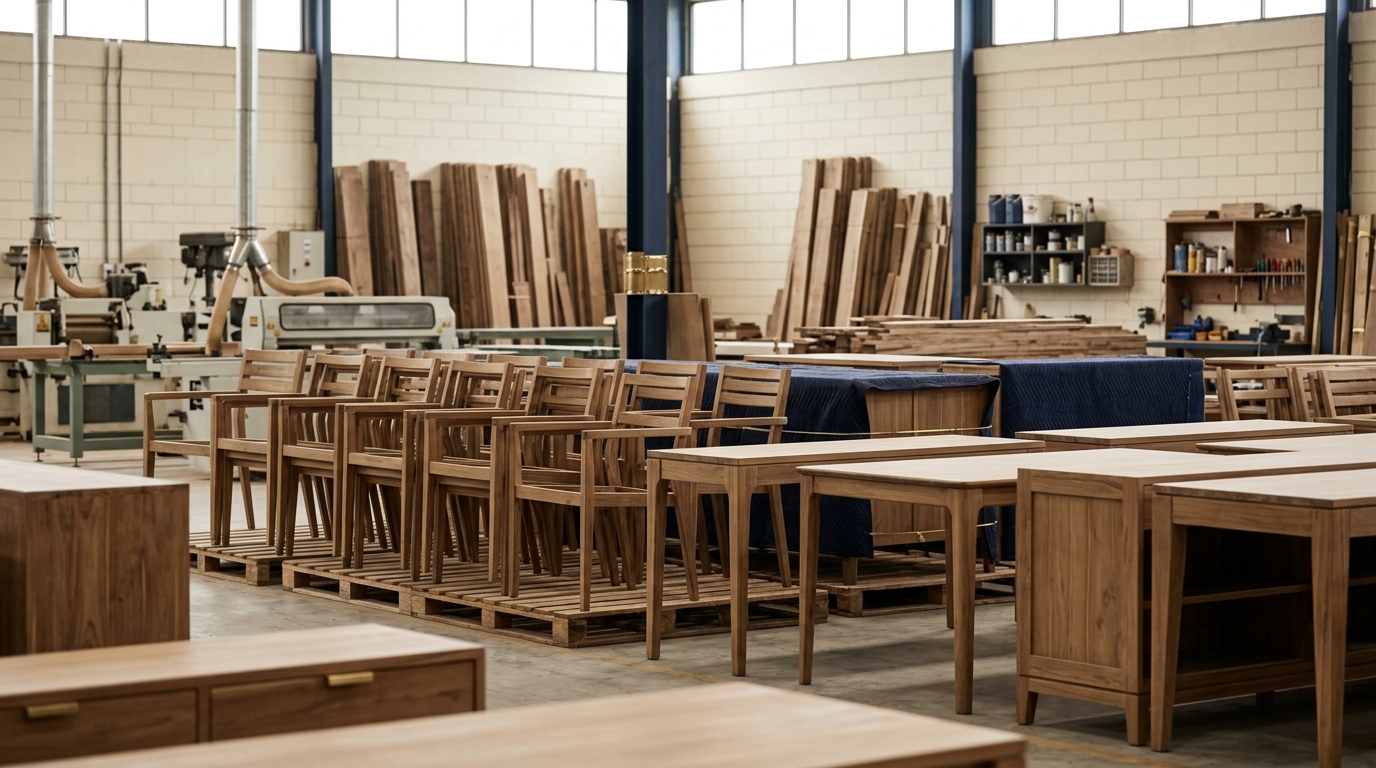
Sourcing furniture from Indonesia requires more than a supplier list — it demands a clear understanding of which city does what, which certifications protect your import, and how to move a container from a Central Java factory floor to a US receiving dock without costly surprises. For procurement…
Sourcingfurniture from Indonesiarequires more than a supplier list — it demands a clear understanding of which city does what, which certifications protect your import, and how to move a container from a Central Java factory floor to a US receiving dock without costly surprises. For procurement professionals evaluating Indonesian supply chains, the decision often comes down to one question: where in Central Java should we be buying from, and why?
This guide focuses specifically on Semarang Central Java furniture manufacturers and the broader production ecosystem surrounding them. It covers the types of factories operating in the region, the wood species and materials they work with, how Semarang compares to Jepara for different sourcing objectives, and the compliance steps — including Lacey Act documentation and SVLK certification — that US importers cannot afford to skip. You will also find realistic guidance on pricing structures, container logistics through Tanjung Emas Port, and pre-shipment inspection protocols that experienced buyers use to protect order quality.
Whether you are placing your first container order or rationalizing an existing Indonesian supply base, the sections below give you a decision-ready framework built around the realities of Central Java's manufacturing landscape.
Why Semarang Is Central Java's Premier Furniture Manufacturing and Export Hub
Semarang is the provincial capital of Central Java and the administrative, logistical, and commercial anchor of one of the world's most productive furniture manufacturing regions. Its importance to B2B buyers is not incidental — it reflects decades of industrial investment, proximity to raw material sources, and the presence of Tanjung Emas Port, the primary maritime gateway for furniture exports moving out of Central Java to destinations including the United States, Europe, and Australia.
Geographic and Industrial Foundations
Central Java's furniture industry has deep roots. The region developed its woodworking identity through a combination of abundant teak forests managed under Indonesia's state forestry system, a dense population of skilled craftspeople, and trade networks that connected inland production centers to coastal export points. Semarang sits at the center of this geography — approximately 80 kilometers from Jepara, roughly 100 kilometers from the Solo corridor, and directly connected to plantation teak supply zones in surrounding regencies.
The city functions as an industrial hub rather than a single-cluster manufacturing town. It hosts mid-to-large factories producing indoor, outdoor, office, and contract furniture alongside a supporting ecosystem of component suppliers, finishing specialists, and freight forwarders familiar with US and European import requirements.
Competitive Advantages That Matter to B2B Buyers
Semarang Central Java furniture manufacturers benefit from several structural advantages that translate directly into lower sourcing risk and more predictable supply chains:
- Skilled labor supply: Central Java has a long-trained woodworking workforce, including joiners, carvers, finishing technicians, and quality inspectors with experience serving international buyers. - Raw material access: Plantation teak, mahogany, acacia, and albasia are all sourced regionally, reducing material lead times and supply chain complexity. - Export infrastructure: Tanjung Emas Port handles regular container shipping to major US West Coast and East Coast ports, with established freight forwarding services and customs documentation support for SVLK-compliant exporters. - Factory scale: Unlike the predominantly artisan structure of Jepara, Semarang hosts mid-to-large factories capable of fulfilling commercial-volume orders across multiple product categories in a single production run.
Product Categories Produced for Export
The region's output covers a wide range of furniture segments relevant to US importers:
- Indoor residential furniture: Solid teak and mahogany dining sets, bedroom collections, and living room pieces - Outdoor and garden furniture: Recycled teak, rattan, and aluminum-frame products for retail and hospitality markets - Office and contract furniture: Workstations, storage, and commercial seating for project-based buyers - Hotel and hospitality furniture: Case goods, headboards, and custom millwork for FF&E specifications - Handicraft and decorative pieces: Carved accent furniture and artisan items targeting premium retail channels
The Full Range of Furniture Types Exported by Semarang and Central Java Factories
Solid Wood Indoor Collections
The dominant export category from this region is solid wood indoor furniture, particularly pieces made from teak and mahogany. Dining tables, extension tables, buffets, bedroom suites, and TV consoles represent high-volume SKUs produced by multiple factories in and around Semarang. These pieces are typically available in both standard catalog configurations and custom dimensions, which makes the region especially suited to buyers serving interior designers, boutique retailers, or hospitality procurement teams with specific layout requirements.
Outdoor and Garden Furniture
Recycled teak outdoor furniture — made from reclaimed teak sourced from demolished structures and old-growth timber salvage — is a significant export product from Central Java. This category aligns well with US buyers targeting the premium garden, patio, and resort market. Rattan and synthetic rattan seating, aluminum-frame dining sets, and teak steamer chairs are all produced in the region. Outdoor furniture from Semarang Central Java furniture manufacturers regularly moves through Tanjung Emas Port in full 40-foot high-cube containers, typically mixed with indoor pieces on consolidated orders.
Office, Contract, and Hospitality Furniture
Larger factories in the Semarang industrial corridor produce commercial-grade furniture for contract channels. This includes hotel bedroom furniture built to FF&E specifications, restaurant seating, commercial storage, and workspace furniture. For US buyers sourcing for commercial interiors or hotel renovation projects, this segment offers the advantage of factory-scale production capacity combined with the natural material aesthetics that distinguish Indonesian manufacturing from the panel-dominant output of Chinese or Vietnamese factories.
Custom and Luxury Orders
Several established exporters in the region accept fully custom orders with buyer-supplied specifications, drawings, or samples. Lead times for custom work are longer — typically toward the upper end of the 45–90 day production window — but the capability allows US importers to develop proprietary product lines manufactured under private-label or OEM arrangements.
Key Wood Species and Materials Used by Central Java Factories
Teak: Indonesia's Benchmark Export Timber
Teak (Tectona grandis) is the species most associated withIndonesian furnitureexports and remains the primary material used by Semarang Central Java furniture manufacturers serving the US market. Indonesian plantation teak — grown under the management of Perum Perhutani, Indonesia's state forestry enterprise — offers a consistent supply of legal, traceable timber. Buyers prize teak for its natural oil content, resistance to moisture and insects, dimensional stability, and the warm grain character that ages well in both indoor and outdoor environments.
For US importers, the traceability of teak is directly relevant to Lacey Act compliance. Legally sourced plantation teak with proper SVLK documentation satisfies the due-care requirements of the Act, while undocumented or unverified teak creates import risk.
Alternative Species: Mahogany, Acacia, and Albasia
- Mahogany (typically Swietenia macrophylla or African alternatives) is used for indoor furniture where a finer grain and darker finish are preferred. It is generally less expensive than teak and widely available from Central Java suppliers. - Acacia (Acacia mangium) has grown in use as a plantation-grown, fast-yield alternative. It produces dense, attractive furniture at a lower price point than teak and is favored by buyers targeting the mid-market segment. - Albasia (Falcataria moluccana) is a lightweight, fast-growing species used for painted furniture, picture frames, and decorative components. It is cost-effective but not suited to structural applications requiring the durability of teak or acacia.
Rattan, Bamboo, and Eco-Friendly Materials
Rattan furniture production is more heavily concentrated in Cirebon (West Java), but Semarang-area factories increasingly incorporate rattan and synthetic rattan into outdoor and accent furniture collections. Bamboo is used for decorative and lifestyle products. Both materials carry strong positioning for US buyers whose retail or hospitality customers prioritize sustainability narratives.
SVLK and FSC Certification: Non-Negotiable for US Market Access
Indonesia's mandatory timber legality verification system — SVLK (Sistem Verifikasi Legalitas Kayu) — is a government-administered framework that all Indonesian wood furniture exporters must comply with to legally export to the US and EU. SVLK certificates are issued to factories after audits covering timber sourcing documentation, chain-of-custody records, and production processes.
FSC (Forest Stewardship Council) certification is a voluntary but commercially valuable addition for buyers whose end customers — including major US retailers — require third-party sustainability assurance. Not all Central Java factories carry FSC; buyers should explicitly request FSC documentation when evaluating suppliers for environmentally sensitive retail accounts.
Established Semarang and Central Java Furniture Manufacturers Worth Evaluating
The following companies represent a cross-section of the established exporter base operating in and around Semarang and the broader Central Java region. Profiles are based on publicly available trade and company information.
| Company | Primary Focus | Market Positioning | Notable Capabilities |
|---|---|---|---|
| **Woodexindo** | Indoor teak and mahogany furniture | Mid-to-premium export | OEM/ODM, custom finishes, US/EU markets |
| **Saniharto** | Indoor solid wood furniture | Premium, design-forward | Proprietary collections, luxury retail buyers |
| **PT Majati Furniture** | Teak indoor and outdoor | Mid-market export | High-volume capacity, catalog and custom |
| **PT Alinea Java** | Contract and commercial furniture | Hospitality and office | FF&E project experience, commercial MOQs |
| **Canspira Indonesia** | Outdoor and garden furniture | Mid-to-premium export | Recycled teak, rattan, sustainable products |
| **Wisanka** | Indoor, outdoor, and rattan | Broad export catalog | Wide SKU range, multiple materials |
| **Permata Furni** | Solid wood indoor collections | Mid-market B2B | Standard catalog, consistent volume output |
Understanding Supplier Types Before You Engage
Central Java's exporter base spans at least three distinct supplier types, each suited to different buyer profiles:
- Mid-to-large industrial factories (typically 100–500+ workers) are suited to buyers placing 40-foot container orders on repeating cycles. They offer competitive per-unit pricing, consistent quality systems, and experience with international compliance documentation. - Boutique and design-oriented manufacturers like Saniharto operate closer to the luxury or premium retail segment. They typically have stricter MOQs in terms of value rather than units, and they produce distinctive collections with higher finish quality. - Smaller SME factories and artisan workshops — more prevalent in Jepara than Semarang — offer lower entry MOQs and craft-level quality but require more active quality oversight from the buyer or their agent.
Semarang vs. Jepara: Choosing the Right Central Java Sourcing Base for Your Order
For US buyers evaluating Central Java as a sourcing region, the Semarang versus Jepara question comes up in nearly every sourcing conversation. The two cities serve complementary but distinct functions within the same supply ecosystem.
| Dimension | Semarang | Jepara |
|---|---|---|
| **Primary strength** | Industrial-scale production, export logistics | Artisan carving, solid wood craftsmanship |
| **Factory size** | Mid-to-large (100–1,000+ workers typical) | Small-to-mid (20–200 workers typical) |
| **MOQ** | Higher — typically full container or near-full | Lower — suitable for mixed or partial containers |
| **Product focus** | Indoor, outdoor, office, contract, hospitality | Carved solid wood, bedroom, dining, accent |
| **Lead time** | Often faster for standard catalog orders | Longer for carved and hand-finished pieces |
| **Port access** | Direct — Tanjung Emas Port, Semarang | Via Tanjung Emas (approx. 80 km inland) |
| **Best for** | Large-volume, commercial, multi-category orders | Artisan, carved, design-specific, lower MOQ |
| **SVLK compliance** | Broadly adopted among established exporters | Variable — verify factory by factory |
When Semarang Is the Right Choice
Choose Semarang as your primary sourcing base when:
- You are filling 40-foot containers on a regular replenishment cycle - Your order includes multiple product categories (indoor, outdoor, office in one shipment) - You are sourcing for a commercial contract (hotel, restaurant, corporate interior) with defined specifications and delivery windows - You need a factory with documented ISO quality management or existing US retail account references
When to Add Jepara to Your Sourcing Itinerary
Jepara remains the dominant center for hand-carved solid wood furniture and artisan-level craftsmanship. If your product line requires intricate carving, traditional Javanese motifs, or the kind of hand-finished detail that commands a premium in US boutique or design retail, a Jepara supplier visit is warranted. Many experienced Central Java buyers source from both cities on a single trip, splitting volume orders between Semarang factories and craft-intensive pieces from Jepara workshops.
How to Import Furniture from Semarang to the US: A Step-by-Step Process
Step 1: Identify and Vet Suppliers
Start with trade show contacts (IFFINA in Indonesia, High Point Market US), B2B directories (Alibaba, Global Sources), and import data tools like Panjiva or ImportYeti that show real shipping records. For buyers without in-region expertise, engaging a sourcing agent or an end-to-end procurement partner removes the identification risk — but verify that the agent operates transparently and does not receive undisclosed commissions from factories, which creates a conflict of interest.
Step 2: Request Samples and Establish Quality Benchmarks
Before committing to a production order, request physical samples — not photos — of the specific SKUs you intend to order. Evaluate joinery tightness, finish consistency, moisture content (teak should typically be kiln-dried to around 12–15% MC for US indoor use), and hardware quality. Document your quality benchmarks in writing and attach them to your purchase order as a quality standard exhibit.
Step 3: Negotiate MOQs, Pricing, and Incoterms
Most established Semarang factories quote on FOB Semarang (Tanjung Emas) terms, meaning the seller is responsible for all costs and risks until the goods are loaded aboard the vessel at Tanjung Emas Port. For US buyers, FOB is generally the preferred Incoterm because it gives you direct control over freight forwarding, marine insurance, and carrier selection from the point of loading.
Clarify minimum order quantities early. Larger factories commonly set MOQs at container level (one 20-foot or one 40-foot container), while mid-size factories may negotiate lower thresholds for first orders with the expectation of growing volume.
Step 4: Manage US Customs Compliance
US imports of woodfurniture from Indonesiarequire attention to three compliance areas:
- The Lacey Act (16 U.S.C. § 3372): Requires US importers to declare the scientific name, country of harvest, and quantity of plant materials in imported products. For teak furniture, this means declaring Tectona grandis, Indonesia, and the volume of wood content. The Lacey Act places the compliance burden on the importer — not the exporter — so you cannot fully delegate this responsibility to your supplier. - SVLK documentation: Your Indonesian supplier must provide a valid SVLK certificate and the associated V-Legal document accompanying the shipment. These documents demonstrate that the timber in your order was legally sourced and are your primary evidence of Lacey Act due care. - HS codes: Wood furniture typically falls under HS Chapter 94. Confirm the correct 10-digit HTS code for your specific product category with your customs broker before shipment, as duty rates vary by product type.
- ✓Obtain valid SVLK certificate from exporter
- ✓Collect V-Legal document for each shipment
- ✓File Lacey Act declaration with correct scientific name and country of harvest
- ✓Confirm HS/HTS code with licensed customs broker
- ✓Verify FSC certificate if required by retail buyer
- ✓Confirm FOB Semarang terms and freight forwarding arrangements
- ✓Arrange pre-shipment inspection before container loading
Quality Standards, Certifications, and Pre-Shipment Inspection for Central Java Suppliers
Certification Hierarchy for US-Bound Orders
For US buyers evaluating Semarang Central Java furniture manufacturers, certifications serve as a baseline filter before you invest time in factory visits or sampling:
- SVLK is the non-negotiable baseline. Any factory without a current SVLK certificate cannot legally export wood furniture to the US under Lacey Act compliance frameworks. - FSC Chain of Custody certification adds third-party assurance of sustainable forest management and is increasingly required by US specialty retailers, hotel chains, and commercial interior firms. - ISO 9001 quality management certification signals that a factory operates documented quality systems — not just good intentions. Larger Semarang factories with US retail accounts commonly hold ISO 9001; smaller operations typically do not. - BSCI or SEDEX social compliance audits are relevant for buyers whose own supply chain policies require labor practice verification.
Pre-Shipment Inspection Protocols
A pre-shipment inspection (PSI) conducted at the factory before the container is loaded is the single most effective quality control tool available to an overseas buyer. Key elements of an effective PSI for furniture:
- Visual inspection of finish quality, joint tightness, and surface defects on a statistically representative sample of the order - Measurement verification against purchase order dimensions - Packaging and labeling review to confirm US market requirements - Moisture content testing for solid wood pieces - Hardware and mechanism function testing
Third-party inspection agencies operating in Central Java include internationally recognized firms with Indonesian offices. Request that your supplier confirm access for third-party inspectors as a condition of your purchase order — any factory resistant to pre-shipment inspection warrants additional scrutiny.
Pricing, MOQs, Lead Times, and Container Planning: What US Buyers Should Expect
Typical Price Ranges (Ex-Factory, FOB Semarang)
Furniture pricing from Central Java varies significantly based on material, complexity, and factory tier. The following ranges are qualitative benchmarks rather than fixed rates — actual quotes depend on specification, volume, and finish:
- Solid teak dining table (standard 6-person size): mid-range to premium ex-factory pricing, with recycled teak versions typically less expensive than new plantation teak - Teak bedroom suite (bed frame, two nightstands, dresser): varies considerably by joinery complexity and finish level - Outdoor teak bench or steamer chair: lower per-unit cost relative to indoor pieces of comparable timber volume - Custom or carved accent pieces: highest per-unit cost, reflecting labor intensity
Always request an itemized FOB quote that separates material cost, labor, finishing, packaging, and export documentation so you can identify where value and risk sit.
MOQ Expectations by Factory Type
| Factory Type | Typical MOQ |
|---|---|
| Large industrial factory (200+ workers) | One 40-ft container or equivalent value |
| Mid-size export factory (100–200 workers) | One 20-ft container, sometimes less for repeat buyers |
| Smaller SME factory | Flexible, but expect price premium below container volume |
| Artisan workshop (Jepara) | Low unit count, high per-unit cost |
Production Lead Times
Standard production lead times for Central Java factories run approximately 45–90 days from confirmed order and deposit receipt, depending on:
- Complexity of the order (catalog vs. custom specifications) - Current factory capacity utilization - Material availability (plantation teak availability can fluctuate seasonally) - Finishing and quality inspection time
Build buffer time into your buying calendar — particularly for first orders with a new factory, where production oversight requirements are higher.
Container Loading from Tanjung Emas Port
Tanjung Emas Port in Semarang handles international container shipping with regular sailings to major US gateway ports. Planning guidance for container utilization:
- A 20-foot container typically accommodates a moderate mixed furniture order — suitable for sampling or smaller replenishment runs - A 40-foot high-cube container is the standard workhorse for furniture imports, maximizing cubic volume for large-format pieces like dining tables and bed frames - Efficient container packing requires coordination between your factory and freight forwarder — knocked-down (flat-pack) pieces maximize container utilization; assembled pieces reduce it significantly - Transit times from Tanjung Emas to US West Coast ports (Los Angeles, Long Beach) run approximately 20–28 days; East Coast ports add roughly 7–10 days depending on routing
Frequently Asked Questions: Sourcing Furniture from Semarang and Central Java
What types of furniture are manufactured in Semarang, Central Java? Semarang and the surrounding Central Java region produce solid wood indoor furniture (dining, bedroom, living room), outdoor and garden furniture in teak and rattan, office and contract furniture, hospitality case goods, and decorative artisan pieces. The region's industrial factories are particularly competitive in mid-to-large volume orders across multiple categories within a single shipment.
What wood is Indonesian furniture made from, and is it sustainably sourced? The dominant species is plantation teak (Tectona grandis), grown under Indonesia's state-managed forestry system and exported under SVLK timber legality certification. Mahogany, acacia, and albasia are also widely used. SVLK certification is mandatory for all Indonesian wood furniture exports and provides US buyers with the documentation needed for Lacey Act compliance. FSC certification is available from select factories for buyers requiring voluntary third-party sustainability assurance.
How do I verify and vet a Semarang furniture manufacturer before ordering? Start with import data tools (Panjiva, ImportYeti) to verify actual US export history. Request current SVLK and FSC certificates. Ask for references from existing US or European buyers. Conduct a factory audit — either in person or through a third-party inspection agency with Central Java presence — before committing to a production order. Any factory that declines independent audit access warrants serious caution.
What certifications should Indonesian furniture exporters have for the US market? At minimum: a valid SVLK certificate and the V-Legal document for each shipment (required for Lacey Act compliance). Commercially valuable additions includeFSC Chain of Custody certification, ISO 9001 quality management, and BSCI or SEDEX social compliance audit status. Confirm that certificates are current and not expired at the time of your order placement.
How does Semarang compare to Jepara for B2B furniture sourcing? Semarang offers larger industrial-scale factories, direct port access through Tanjung Emas, and stronger capability for multi-category, high-volume commercial orders. Jepara is the established center for hand-carved and artisan solid wood furniture, with smaller factories, lower entry MOQs, and greater craft specialization. Many US buyers source from both within a single Central Java trip and consolidate into one Tanjung Emas export.
Which countries produce the best quality furniture, and where does Indonesia rank? Quality leadership depends on segment. China dominates volume and panel furniture; Vietnam excels in mid-market solid wood and upholstered pieces; Italy and Scandinavia lead in design-driven premium furniture. Indonesia's competitive position is strongest in natural material categories — particularly solid teak and rattan — where its raw material base, craft tradition, and plantation timber traceability combine to produce products that are difficult to replicate at comparable quality levels from competing countries. For US buyers targeting the natural, sustainable, or artisanal positioning, Indonesia ranks among the top two or three global sourcing destinations.
Semarang Central Java furniture manufacturers offer US importers a combination of industrial-scale production capacity, certified sustainable timber supply, and direct ocean freight access that few other regions in Asia can match across the full range of solid wood furniture categories. The compliance framework — particularly SVLK documentation and Lacey Act due care — is well-established among experienced exporters in the region, and the proximity to Jepara's artisan base makes Central Java a uniquely flexible sourcing destination for buyers with diverse product requirements.
Now that you have a complete picture of Central Java's manufacturing landscape, certification requirements, logistics infrastructure, and supplier types, the logical next step is putting that knowledge to work with verified contacts on the ground.
You now have the framework to evaluate Central Java suppliers with confidence. Let us do the verification work for you — request a supplier shortlist and get connected with vetted Semarang furniture manufacturers matched to your product category, volume, and compliance requirements.
Request Your Supplier Shortlist →Planning a sourcing project in Asia?
MTS is an execution partner — supplier verification, manufacturing management, quality control and export logistics across Indonesia, Vietnam and China.
Related services
Related articles
Receive furniture sourcing insights across Asia.
One email per week. No spam.