Storage Furniture Wholesale Indonesia: Cabinets and Shelving Sourcing Guide
13 min read
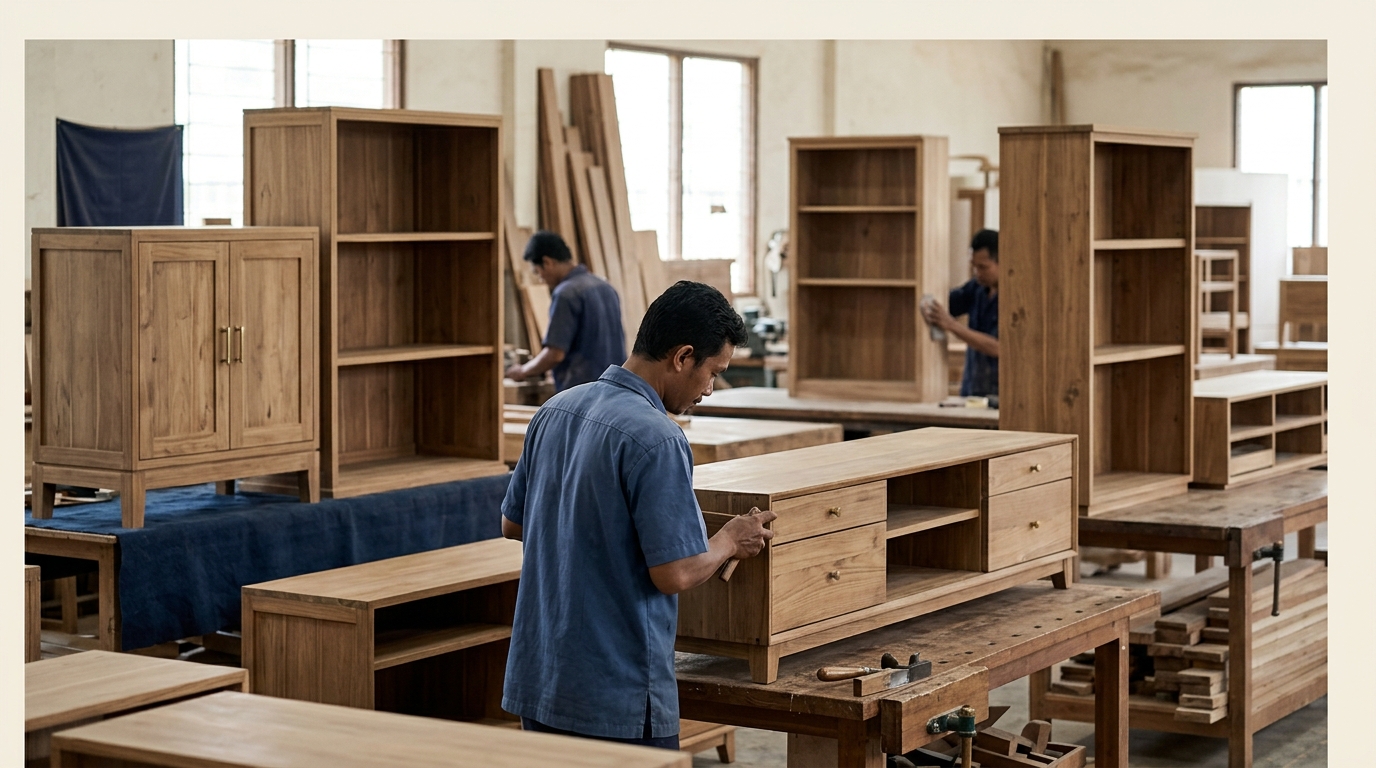
US buyers sourcing storage furniture wholesale from Indonesia face a specific set of decisions. Material grade, hardware specification, shipping format, and supplier verification all affect landed cost and retail performance. Getting any one of these wrong costs money — in returns, rework, or…
US buyers sourcing storagefurniture wholesalefrom Indonesia face a specific set of decisions. Material grade, hardware specification, shipping format, and supplier verification all affect landed cost and retail performance. Getting any one of these wrong costs money — in returns, rework, or freight inefficiency.
This guide covers the full sourcing chain for storage furniturewholesale Indonesiacabinets shelving — from production hubs and material selection to flat-pack economics, compliance requirements, and supplier vetting signals. It is written for retail buyers, hospitality procurement managers, and project importers who already know Indonesia produces quality furniture and want the operational detail to source it confidently.
Indonesia's furniture export sector is one of the most mature in Southeast Asia. The country has established production clusters with deep craft heritage, access to premium hardwoods, and a growing base of export-ready factories capable of private label and custom-dimension work. For storage categories specifically — cabinets, shelving units, bookcases, wardrobes, and bathroom storage cabinets — Indonesian manufacturers offer a range that spans artisan-grade solid teak to cost-efficient veneer-over-MDF runs suitable for mid-market retail.
This guide moves sequentially through the sourcing decision. It covers why Indonesia, what categories to source, and how to specify materials and hardware. Shipment structure, MOQs, pricing, compliance, and supplier vetting are also addressed.
Why Indonesia Leads the Market for Wholesale Storage Furniture Production
Indonesia ranks among the world's top furniture exporters, with the United States consistently one of its largest destination markets. The country's export base is built on natural material advantages that few competing nations can replicate at scale.
Production Clusters That Matter for Storage Categories
Three regions dominate storagefurniture wholesaleIndonesia production:
- Jepara (Central Java): The primary hub for solid teak and mahogany cabinetry, carved sideboards, and handcrafted bookcases. Jepara has centuries of woodworking heritage and a dense ecosystem of factories ranging from small workshops to mid-size export operations. - Surabaya (East Java): A more industrialized center handling mid-market storage lines, including veneer-core cabinets and modular shelving systems. Strong logistics infrastructure supports container exports through Tanjung Perak port. - Bali: Focused on luxury and resort-grade storage pieces — decorative wardrobes, artisan-finished media consoles, and rattan-integrated storage for hospitality projects. - Semarang: A key export gateway for Central Java production, with FOB pricing commonly quoted through Tanjung Emas port.
Competitive Advantages Relevant to US Buyers
- Raw material access: Indonesia has domestic teak plantations (Perum Perhutani-managed) and access to mahogany, sengon, and mindi — all relevant to storage furniture construction. - Labor cost structure: Skilled woodworking labor remains competitive relative to comparable quality in Europe or North America, though costs have risen versus Vietnam in recent years. - Craft depth: Joinery skills, hand-finishing, and surface detailing at Jepara-level factories are difficult to replicate in fully automated production environments.
Certifications US Buyers Must Verify
| Certification | What It Covers | Why It Matters for US Import |
|---|---|---|
| **SVLK** (Timber Legality Assurance System) | Indonesian timber legality verification | Required for EU; signals legal chain-of-custody for US buyers |
| **FSC** (Forest Stewardship Council) | Sustainable forest management | Preferred by retail chains with ESG commitments |
| **ISPM-15** | Phytosanitary treatment of wood packaging | Mandatory for all solid wood crates and pallets entering the US |
Storage Furniture Categories Available from Indonesian Wholesale Manufacturers
Indonesian factories cover the full range of storage furniture relevant to US retail and hospitality buyers.
Cabinets: Closed-door storage cabinets, open-frame display cabinets, media consoles, and TV stands are widely produced. Jepara factories commonly offer solid teak versions; Surabaya-based operations often run veneer-over-plywood lines at higher volumes.
Shelving units: Wall-mounted shelving, freestanding bookcases, modular cube storage, and ladder shelves are available from factories across Java. BookcasesIndonesia wholesalepricing is typically quoted per unit at FOB, with finish and hardware options affecting price by approximately 10–25%.
Specialty storage: Wardrobes with sliding or hinged doors, sideboards, bathroom storage cabinets with moisture-resistant finishes, and under-bed storage drawers are all produced at wholesale volumes. Lead times for custom dimensions in these categories are typically 45–75 days from order confirmation.
Rattan and mixed-material storage: Rattan-wrapped cabinet frames, cane-panel door inserts, and bamboo-accented shelving units are gaining significant traction in US retail — particularly for coastal, bohemian, and resort-influenced interiors. Cirebon (West Java) is the primary rattan production cluster.
Solid Wood vs. Veneer vs. Finger-Joint: Choosing the Right Material for Your SKU
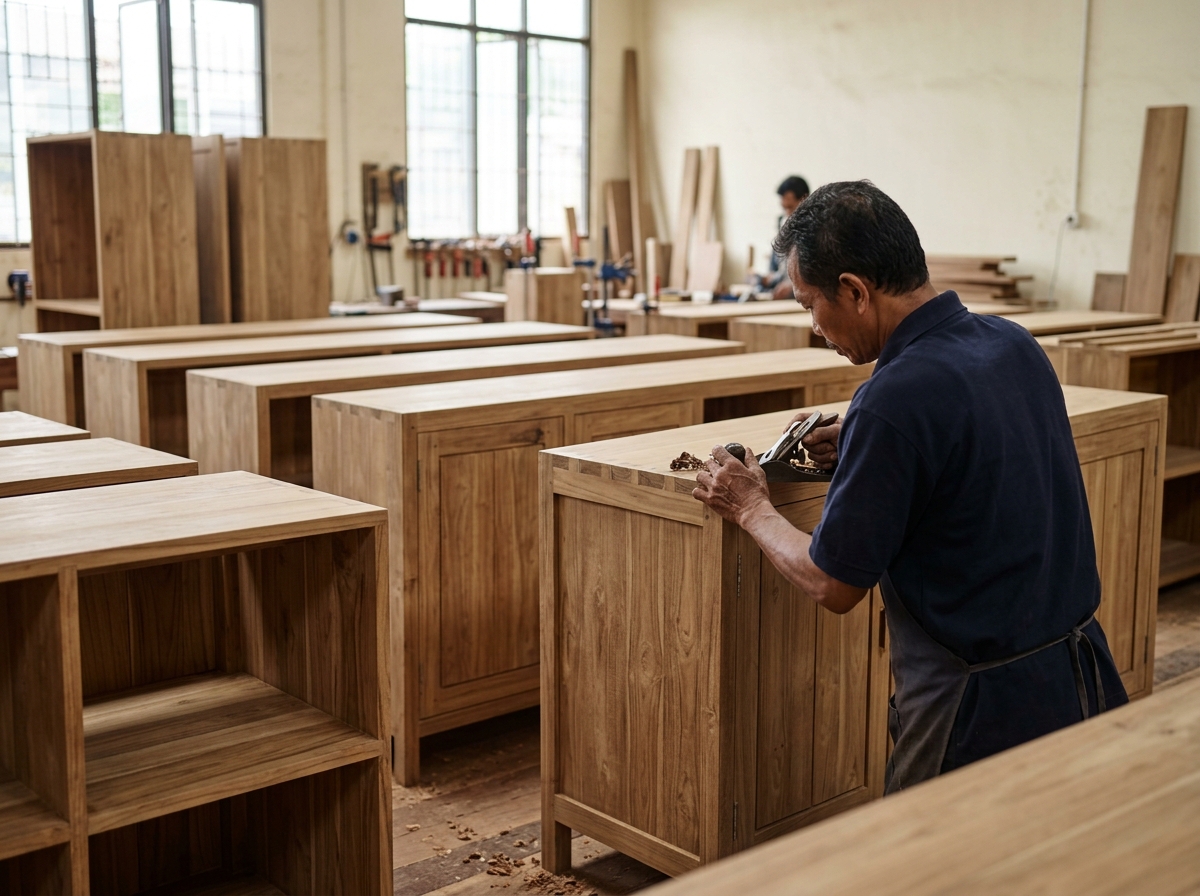
Material specification is the single largest driver of price, weight, and retail positioning in wholesale Indonesian storage furniture. Substitution risk — receiving a different core material than specified — is a real issue without clear purchase order documentation.
Core Material Comparison
| Material | Typical Use Case | Price Index (relative) | Weight | Finish Consistency | Retail Positioning |
|---|---|---|---|---|---|
| **Solid teak** | Premium cabinets, sideboards, hospitality | High | Heavy | Variable (natural grain) | High-end, heirloom |
| **Solid mahogany** | Mid-premium cabinets, bookcases | Medium-high | Medium-heavy | Moderate | Mid-premium |
| **Veneer over MDF** | High-volume retail SKUs, flat-pack | Low-medium | Light-medium | Consistent | Mass-market to mid |
| **Veneer over plywood** | Commercial storage, kitchen storage cabinets | Medium | Medium | Consistent | Mid-market |
| **Finger-joint / blockboard** | Mid-range structural carcass | Low-medium | Medium | Moderate | Value to mid |
Solid Teak and Mahogany: When the Premium Is Justified
Solid teak offers exceptional durability and natural oil content that resists moisture — relevant for bathroom storage cabinets and kitchen storage cabinets operating in humid US environments. The price premium is real. Expect solid teak pieces to cost approximately 2–3× equivalent veneer-core SKUs at FOB. For US retail, this positions solid teak storage at a price point that supports margins in the approximately $400–$1,200+ retail range.
Mahogany offers a middle path: genuine hardwood durability at a lower price than teak, with good staining properties for US consumer finishes like walnut, espresso, and natural oak looks.
Veneer Over MDF or Plywood: The Volume Play
Veneer-core construction offers finish consistency that solid wood cannot match across a large production run. Color and grain uniformity improve predictability for catalog retail. MDF core is lighter, machines cleanly, and accepts edge banding well — critical for flat-pack cabinet doors and drawer fronts.
The trade-off: MDF does not hold screws as well as solid wood or plywood, and it is sensitive to moisture at cut edges. Specify moisture-resistant (MR) grade MDF for bathroom storage cabinet and kitchen storage cabinets applications.
Preventing Substitution in Purchase Orders
Specify the following in writing on every PO:
- Core material by name (e.g., "teak plantation solid wood, minimum 18mm thickness") - Panel substrate grade (e.g., "E1-grade plywood, 15mm, 9-ply minimum") - Veneer species and thickness (e.g., "0.6mm teak veneer, rotary-cut") - MDF grade if applicable (e.g., "MR-grade MDF, 16mm")
Vague PO language like "solid wood construction" without species and thickness is the most common cause of substitution disputes.
Hardware Quality Grades and Their Direct Impact on Retail Return Rates
Hardware is where wholesale storage furniture most often fails at retail. A well-built cabinet carcass with poor hinges generates customer returns within 6– approximately 18 months. Hardware spec decisions made at sourcing stage directly affect warranty liability and brand reputation.
Hinge Grades
- Standard zinc alloy hinges: Basic cup hinges, suitable for value-tier storage. Adjustment range is limited. Longevity under heavy-use retail conditions is lower. - Soft-close European-style hinges (Blum equivalents or branded Blum/Grass): Full-overlay, 165° opening, integrated soft-close damping. Significantly higher cost per unit — but reduces cabinet-door return rates substantially. Specify "soft-close hinge with integrated damper" in the PO; "soft-close style" without specification may receive a low-grade imitation.
Drawer Slide Options
| Slide Type | Load Rating (approx.) | Retail Positioning | Notes |
|---|---|---|---|
| Wooden runner | Low | Value tier | Limited extension, no weight tolerance |
| Epoxy-coated steel side-mount | Medium | Mid-market | Good for closet shelving and garage cabinets |
| Full-extension undermount | Medium-high | Mid to premium | Required for kitchen storage cabinets at mid-retail |
| Soft-close undermount | High | Premium | Pairs with soft-close hinge spec for full suite |
Shelf Pin Systems
Plastic shelf pins fail under heavy load in bookcases and storage cabinets. For any unit likely to carry books, kitchen items, or garage storage loads, specify 5mm or 6mm metal shelf pins with a minimum load rating. Confirm the shelf pin hole spacing is standard (32mm system) if the buyer needs to offer replacement parts.
Flat-Pack vs. Assembled Shipping: A Real Cost Comparison for Indonesian Storage Furniture
This is the analysis most sourcing guides omit. The decision between knock-down (KD) flat-pack and fully assembled shipping is not simply about freight — it affects labor cost, damage risk, and end-user experience.
CBM and Container Capacity
A standard assembled three-door storage cabinet occupies approximately 0.35–0.50 CBM. The same cabinet in flat-pack KD format typically occupies 0.10–0.18 CBM — a reduction of roughly 60–65%. A 40ft HQ container holds approximately 65–70 CBM of usable space.
| Shipping Format | Est. CBM per Cabinet Unit | Units per 40ft HQ (approx.) | Freight Cost per Unit (relative) |
|---|---|---|---|
| Fully assembled | 0.40–0.50 | 130–160 | Higher |
| Flat-pack KD | 0.12–0.18 | 360–500 | Lower |
These are approximate estimates. Actual CBM varies by unit dimensions and packaging. The freight cost-per-unit difference between formats can be substantial — often 2–3× higher for assembled on an equivalent-unit basis.
Assembly Labor Costs in the US
Flat-pack savings on freight must be weighed against US assembly labor. For retail end-consumers, assembly is a known friction point. For hospitality projects, on-site assembly requires skilled labor at US rates — often $50–$100+ per hour depending on market. A complex wardrobe or multi-door storage cabinet requiring 2–3 hours of assembly adds approximately $100–$300 to landed cost per unit.
When Assembled Shipping Makes Sense
- Solid teak and mahogany pieces: These have complex joinery that is difficult to replicate in field assembly. Disassembly and reassembly risks finish damage at joint lines. - Hospitality and contract projects: FF&E buyers installing 50–200 units in a hotel need installation certainty. Assembled units reduce on-site risk. - Large-format units: Wardrobe cabinets and garage cabinets above 200cm height are structurally complex to field-assemble at quality standards.
Packaging Standards for Flat-Pack Ocean Freight
Specify: individual component foam wrapping, corrugated cardboard separation between stacked panels, corner foam or cardboard protectors, and outer carton crush-strength rated for stacking in a container. Hardware packets (screws, cams, hinges) must be individually bagged and secured to prevent rattling damage.
MOQ and Pricing Benchmarks for Indonesian Storage Furniture Wholesale
Typical MOQ by Category
| Category | Typical MOQ Range | Notes |
|---|---|---|
| Storage cabinets (standard SKUs) | 20–50 pcs | Lower MOQ for stocked designs |
| Bookcases / shelving sets | 50–100 pcs | Modular systems may allow mixed finish runs |
| Wardrobes and large storage | 20–40 pcs | Higher per-unit FOB; lower MOQ feasible |
| Bathroom storage cabinets | 30–60 pcs | MR-grade spec may increase MOQ slightly |
| Cube storage / modular systems | 50–100 sets | Often flat-pack; mixed color runs negotiable |
| Custom dimension or finish variants | 50–100 pcs per variant | Lead time extends to 60–90 days |
MOQs listed are approximate and vary by factory size and design complexity.
FOB Pricing Benchmarks
FOB pricing from Semarang, Surabaya, or Bali varies significantly by material, hardware spec, and finish. As approximate market-level guidance:
- Veneer-over-MDF storage cabinet (standard 2-door): FOB price typically in a low-to-mid range per unit at container volumes. - Solid teak storage cabinet (equivalent size): Typically 2–3× the veneer equivalent at FOB. - Open-frame bookcase, solid wood: Mid-range FOB depending on height and shelf count.
Provide exact dimensions, material spec, finish, and hardware grade when requesting quotes. Vague RFQs generate non-comparable prices.
Container Load Price Breaks
A 20ft container suits smaller initial orders or heavy solid wood items. A 40ft HQ container delivers better per-unit economics for flat-pack shelving and cabinet lines. Mixing SKUs across a 40ft HQ — for example, combining kitchen storage cabinets, bookcases, and under-bed storage — is a practical way to hit container volume while testing multiple lines.
Quality Control and Compliance Requirements Before Your First Shipment
Pre-Shipment Inspection Scope
A pre-shipment inspection (PSI) for storage furniture should cover:
- ✓Squareness check on all carcass assemblies
- ✓Door and drawer alignment within spec tolerance
- ✓Hinge function and soft-close operation
- ✓Drawer slide extension and load test
- ✓Finish consistency across production batch
- ✓Hardware completeness and correct packaging
- ✓CARB Phase 2 documentation for veneer and MDF-core pieces
- ✓ISPM-15 stamp visible on all wood packaging and crates
CARB Phase 2 Compliance
CARB Phase 2 refers to the California Air Resources Board's formaldehyde emission standards for composite wood products — now effectively a national standard under the federal Toxic Substances Control Act (TSCA Title VI). Any storage furniture containing MDF, plywood, or veneer substrates entering the US must meet CARB Phase 2 limits. Non-compliance can result in US Customs holds, product recalls, and retailer chargebacks.
Require the factory to provide a CARB Phase 2 compliance certificate from their panel supplier or a third-party test report. This applies to all veneer-core cabinets, MDF-core shelving, and composite-panel storage pieces.
Third-Party QC in Indonesia
SGS and Bureau Veritas both operate in Indonesia and conduct furniture pre-shipment inspections. Local Indonesian QC agents also operate in Jepara and Surabaya and offer lower-cost inspection services for buyers with established supplier relationships. For first containers, using an internationally accredited agency is lower risk.
How to Evaluate and Shortlist Indonesian Storage Furniture Suppliers
Factory Audit Criteria
Evaluate suppliers on:
- Export history: Confirmed US or EU shipment records. Ask for bill of lading references, not just claims. - Production capacity: Monthly output in pieces or CBM relative to your projected order volumes. - Sample quality: Request a physical sample, not photos. Evaluate joinery, finish, hardware function, and squareness before committing to a production order. - SVLK and FSC documentation: Current certificates, not expired copies.
Red Flags in Supplier Vetting
- Stock photography only — no factory or production photos - SVLK documentation unavailable or expired - MOQ "flexible" without any written baseline - No export references for the US market - Inability to provide CARB Phase 2 documentation for composite-panel products
Trade Shows for Indonesia Sourcing
IFEX (Indonesia International Furniture Expo) in Jakarta is the primary dedicated sourcing event for Indonesian manufacturers. High Point Market in North Carolina hosts Indonesian pavilions where export-ready factories present collections to US buyers. Both events allow direct factory contact and sample evaluation before any order commitment.
Private Label and Custom Branding Options
Many mid-size and larger Indonesian factories support private label production — custom branding on packaging, branded hardware pulls, custom finish colors, and proprietary dimension sets. Confirm in writing: minimum volumes for private label, packaging artwork lead time, and whether custom-branded cartons are included in FOB price or quoted separately. Custom dimension variants typically require a sample approval cycle of 3–4 weeks before production.
Frequently Asked Questions
What is the typical MOQ for wholesale cabinets from Indonesian manufacturers? Approximately 20–50 pieces for standard cabinet designs at most mid-size factories. Custom dimensions or finishes typically require 50–100 pieces per variant.
Is solid teak or veneer better for retail storage furniture sold in the US? Solid teak suits premium retail positioning at higher price points. Veneer-over-plywood or MDF delivers finish consistency and lower landed cost for mid-market volume retail. Specify material grade explicitly in the PO to avoid substitution.
How does flat-pack shipping from Indonesia compare to assembled in terms of total landed cost? Flat-pack typically reduces CBM by 60–65% per unit, cutting ocean freight cost significantly. However, US assembly labor ( approximately $50–$100+/hour) offsets savings for hospitality and contract installs. For retail consumer products, flat-pack is generally more cost-efficient at scale.
What certifications should Indonesian storage furniture have for US import compliance? ISPM-15 on all wood packaging is mandatory. CARB Phase 2 compliance is required for any composite wood components. SVLK and FSC are not US legal requirements but are strong due-diligence signals. Confirm all certifications before production, not at shipment.
Can Indonesian suppliers produce custom dimensions or finishes at wholesale volumes? Yes. Most export-oriented factories in Jepara and Surabaya accommodate custom dimensions and finish colors at MOQs of approximately 50–100 pieces per variant. Lead times extend to 60– approximately 90 days for custom runs.
How long does ocean freight from Indonesian ports to US West or East Coast take? Approximately 18–28 days to US West Coast ports (Los Angeles, Long Beach) from Semarang or Surabaya. US East Coast transit adds approximately 7–10 days via direct or transshipment routing. These are approximate estimates; confirm current transit times with your freight forwarder.
Sourcing storage furniture wholesale from Indonesia requires decisions across at least five distinct dimensions: material grade, hardware specification, shipping format, compliance documentation, and supplier verification. Each decision compounds — a well-specified solid teak cabinet with incorrect hardware documentation or missing CARB Phase 2 records will be stopped at the US border or returned by the retailer. Buyers who control specification at PO stage and invest in pre-shipment inspection consistently achieve better landed cost outcomes than those who defer these decisions to the factory.
Request wholesale pricing and samples from verified Indonesian storagefurniture manufacturerstoday — now that you have the specification framework to evaluate what you receive.
You now have the material specs, compliance requirements, and supplier vetting criteria to evaluate Indonesian cabinet and shelving suppliers accurately. The next step is requesting factory-verified pricing and physical samples against your exact specifications.
Request Wholesale Pricing and Samples →Need eyes on the ground in Indonesia?
MTS is an execution partner — supplier verification, manufacturing management, quality control and export logistics across Indonesia, Vietnam and China.
Related services
Receive furniture sourcing insights across Asia.
One email per week. No spam.