Suar Wood Furniture Indonesia: The Complete Sourcing Guide for Retailers and Interior Designers
22 min read
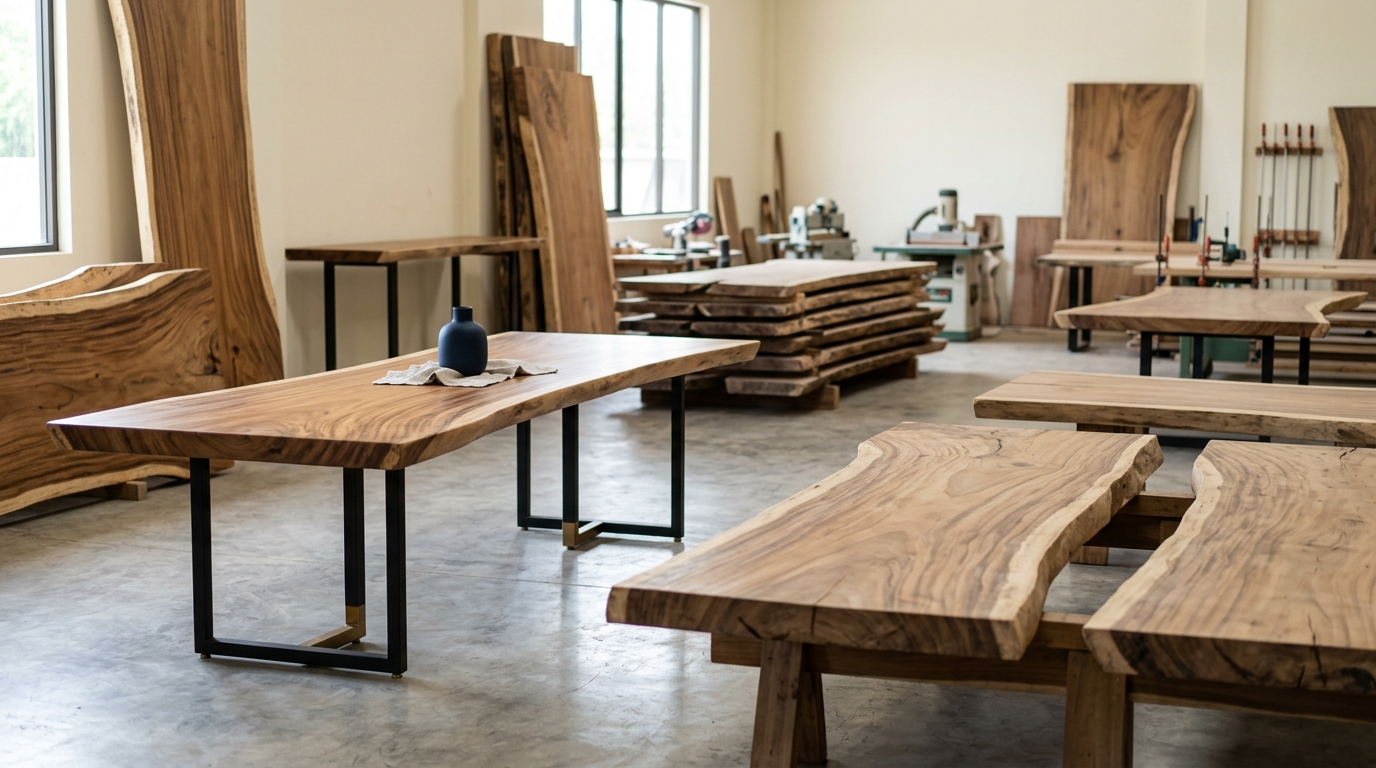
Sourcing live-edge statement pieces from Indonesia sounds straightforward until you are standing between a factory quote, a customs broker, and a client deadline with no clear framework for evaluating what you are actually buying. The US market for solid wood furniture from Southeast Asia has…
Sourcing live-edge statement pieces from Indonesia sounds straightforward until you are standing between a factory quote, a customs broker, and a client deadline with no clear framework for evaluating what you are actually buying. The US market for solid wood furniture from Southeast Asia has grown steadily, and suar wood furniture Indonesia has emerged as one of the most commercially compelling categories within that wave — yet most available information online stops at aesthetics. Product pages describe grain. Nobody explains Janka hardness, SVLK certification, Lacey Act obligations, or how to structure an FOB contract that actually protects you.
This guide is intended for trade professionals — high-end US retailers, interior designers, and procurement leads who need to make sourcing decisions they can stand behind. It covers the material properties of suar wood, Indonesia's furniture manufacturing geography, a structured framework for vetting suppliers, the US import compliance obligations that apply to this product category, realistic cost benchmarks, and a direct comparison with teak and mango wood. By the end, you will have the vocabulary, the regulatory context, and a working checklist to engage Indonesian manufacturers as a knowledgeable counterparty — rather than as someone navigating the process for the first time.
The sections that follow move from material fundamentals to market logistics in the order a real procurement cycle unfolds. Whether you are building your first container shipment or diversifying an existing catalog of solid wood furniture Indonesia suppliers, this guide is designed to close the knowledge gaps that product listings never address.
Why Suar Wood Has Become a Signature Material in High-End Interior Design
Botanical Identity and Geographic Origin
Suar wood comes from Samanea saman, commonly called the rain tree, a fast-growing tropical hardwood native to Central and South America that was introduced across Southeast Asia during the colonial era and is now cultivated extensively across Java and Bali. The tree's broad canopy and rapid growth cycle — reaching harvestable diameter in roughly two to three decades under plantation conditions — make it a commercially sustainable species with a very different supply-chain profile than old-growth teak.
The rain tree's trunk grows wide and often irregular, which is precisely what makes it so valuable for live-edge slab production. Single slabs can commonly reach widths of 40 to 80 inches, allowing a dining table top to be cut from one or two matched pieces rather than edge-glued strips. That scale, combined with the tree's naturally undulating form, is structurally impossible to replicate with plantation species that grow straight and narrow.
Grain Character and Color Range — With the Numbers Behind Them
The aesthetic appeal of suar is not arbitrary. The interlocking grain — caused by alternating spiral growth patterns within the trunk — creates a natural chatoyance, a visual depth that shifts with light angle. Color variation runs from golden honey in the sapwood zones through warm amber and into dark espresso chocolate at the heartwood, often within a single slab. These tonal gradients are not defects; in high-end retail contexts, they are the primary driver of perceived value.
From a durability standpoint, suar registers approximately 1,010 lbf on the Janka hardness scale. That places it meaningfully above softer domestic species like walnut (around 1,010 lbf as well, making them near peers) and comparably below Brazilian cherry or hard maple. What matters for commercial dining use is that suar is sufficiently hard to resist denting under normal table-service conditions while remaining workable enough for the detailed shaping and finishing that live-edge pieces require.
Why Live-Edge Slabs From Suar Command a Design Premium
The combination of slab width, grain drama, and natural edge complexity puts suar wood dining tables in direct competition with American walnut slabs and claro walnut river tables — at a landed price point that typically lands meaningfully lower. For designers specifying a residential dining room or a boutique hotel restaurant, a suar live-edge table delivers the provenance narrative, the material uniqueness, and the visual scale that clients at the upper end of the market expect.
The Material Properties That Make Suar Wood Commercially Viable at Scale
Hardness, Density, and Dimensional Stability
Beyond the Janka figure, density is the practical metric for commercial furniture buyers. Suar falls in the medium-to-high density range, typically between approximately 600 and 750 kg/m³ when kiln-dried to standard export moisture content (around 8–12% MC). At that density, properly dried slabs hold their shape through North American seasonal humidity swings without the chronic checking that plagues improperly seasoned wood shipped from tropical climates.
Dimensional stability — the wood's resistance to movement as ambient humidity changes — is where kiln-drying protocol separates quality Indonesian manufacturers from opportunistic ones. Suar that has been slow-dried in a properly calibrated kiln to the target MC performs well across the humidity range typical in US homes and commercial spaces. Suar that was air-dried or rushed through the kiln will move, check, and potentially split after delivery.
Finish Compatibility for Retail and Hospitality Use
Suar accepts a wide range of finishes reliably. Natural oil finishes — hardwax oils and tung-based products — penetrate well and enhance the grain's depth without obscuring the color variation. Two-component polyurethane and conversion varnish lacquers provide the harder surface film needed for restaurant and commercial hospitality applications. Water-based finishes are increasingly requested by US buyers with LEED-compliant projects, and suar is compatible with these, though grain-raising during application requires proper sealing steps.
Specify your finish system in writing before production begins. Finish choice directly affects lead time, unit cost, and CARB Phase 2 compliance implications if any secondary adhesives or sealers are involved.
Sustainability Profile Compared to Old-Growth Alternatives
Suar's sustainability case rests on two foundations: it is a plantation-grown species that does not require harvesting of primary forest, and Samanea saman grows rapidly enough that harvest cycles can be managed within a generation. This contrasts sharply with the sourcing pressures historically associated with teak, which — despite significant plantation expansion — still carries deforestation associations that generate scrutiny in US retail environments. For buyers positioning product lines toward sustainability-conscious consumers, suar's plantation origin is a marketable differentiator, not just a compliance footnote.
Indonesia's Suar Wood Manufacturing Hubs: Where Quality Is Actually Made
Understanding Indonesian manufacturing geography is not academic. It directly affects your lead times, minimum order quantities, customization flexibility, and the types of certifications your supplier can realistically hold.
Jepara, Central Java is the country's dominant solid wood furniture export cluster. The region concentrates hundreds of manufacturers ranging from mid-size factories with CNC equipment and kiln-drying chambers to smaller workshops that blend hand-carving traditions with export-grade finishing. Jepara suppliers typically export through the port of Semarang, making FOB Semarang the standard pricing basis for this region. Lead times for custom suar wood dining tables from established Jepara factories commonly run 60 to 120 days depending on slab availability and finishing complexity.
Bali workshops serve a distinct market segment: artisan-forward, lower-volume production with strong design sensibility oriented toward hospitality and luxury residential buyers. Bali producers typically command higher unit prices than their Jepara counterparts and are better suited to designers specifying one-of-a-kind or very small-batch pieces. MOQs from Bali artisan producers may be as low as one to three pieces, which is structurally different from the economics of Jepara volume manufacturers.
East Java suppliers, including those in and around Surabaya, tend to operate at higher production volume with a more industrial orientation. This cluster is better suited to retailers placing larger repeat orders where consistency across units matters more than individual slab uniqueness.
| Manufacturing Hub | Primary Strength | Typical MOQ | Export Port | Best For |
|---|---|---|---|---|
| Jepara, Central Java | Custom solid wood, live-edge | 5–20 pieces | Semarang | Mid-to-large retail orders |
| Bali | Artisan luxury, high-design | 1–5 pieces | Bali / Denpasar | Designers, boutique hospitality |
| Surabaya / East Java | Volume production, consistency | 20+ pieces | Surabaya | High-volume repeat buyers |
How to Vet an Indonesian Suar Wood Supplier Before You Send a Deposit
This is the section that product pages and manufacturer websites never provide. Vetting a supplier for the US market requires evaluating compliance documentation, production capability, and communication quality as a combined picture — not any single factor in isolation.
Certifications That Should Be Non-Negotiable
SVLK (Sistem Verifikasi Legalitas Kayu) is Indonesia's mandatory timber legality assurance system, operating under the authority of the Ministry of Environment and Forestry. All Indonesian wood products exported on a commercial basis must be accompanied by SVLK documentation. The V-Legal mark appearing on export paperwork confirms that the timber's chain of custody has been legally verified. A verbal guarantee from a supplier that their wood is legally sourced is not sufficient — the documentation itself must be obtained and reviewed.
FSC (Forest Stewardship Council) certification is increasingly required by US retailers with sustainability commitments and by designers working on LEED-certified projects. FSC chain-of-custody certification goes beyond SVLK in that it verifies management practices across the entire supply chain. Not all suar suppliers carry FSC; those that do command a modest price premium that is justified for market-facing sustainability claims.
CARB Phase 2 compliance applies specifically to composite wood products — MDF, plywood, particleboard — and any finished goods containing them. If your suar dining table includes a plywood apron, a composite wood base component, or uses adhesives that fall under California Air Resources Board jurisdiction, your supplier must demonstrate CARB Phase 2 compliance. Pure solid suar pieces with no composite content have limited CARB exposure, but confirm this in writing with your supplier.
Factory Audit Checklist
- ✓Kiln-drying equipment on-site with calibrated temperature and humidity controls
- ✓Moisture content testing capability (pin meter or oven-dry method)
- ✓SVLK documentation for all timber in current inventory
- ✓FSC chain-of-custody certificate (if required for your market)
- ✓CARB Phase 2 compliance statement for any composite components
- ✓Sample finishing quality: surface uniformity, edge treatment, joint tightness
- ✓Photographs or video of slab inventory currently in stock
- ✓Clear written MOQ, lead time, and payment terms
- ✓Willingness to provide production tracking and pre-shipment inspection access
- ✓Export references from existing US or EU buyers
Red Flags to Watch For
A supplier who cannot provide SVLK documentation, refuses factory video calls, or quotes suspiciously short lead times for custom live-edge work (under 30 days for a custom order) should be treated as high-risk. Similarly, watch for suppliers who cannot answer specific questions about kiln-drying protocols or moisture content targets — these are basic technical capabilities that any serious export manufacturer should be able to discuss.
Using Trade Shows and B2B Platforms to Pre-Screen
IFFINA (Indonesia International Furniture and Craft Fair) and IFMAC (Indonesia International Woodworking Machinery and Furniture Component Exhibition) are Indonesia's two principal furniture trade events, and they offer the most time-efficient way to assess a broad range of suppliers in a single visit. Both attract established export manufacturers who have committed resources to a trade-show presence — which itself functions as a modest quality signal. Walking the floor at IFFINA in particular enables direct, side-by-side evaluation of finishing quality, slab inventory, and communication capability before any formal RFQ process begins.
Live-Edge Slab Table Specifications: What Retailers Must Communicate in Writing
Ambiguous purchase orders are the primary cause of specification disputes with Indonesian manufacturers. A well-structured specification sheet eliminates the most common failure modes.
Slab Dimensions and Acceptable Natural Characteristics
Standard dining table slabs for the US market typically run 84 to 120 inches in length, 36 to 48 inches in width, and 2 to 3 inches in thickness. Communicate thickness tolerances explicitly — a tolerance of plus or minus one-quarter inch is standard; tighter tolerances add cost. Natural characteristics including live edges, small voids, hairline checks, and bark inclusions are generally expected and desirable in live-edge suar; specify which types are acceptable and which are deal-breakers. Filled voids (using tinted epoxy matched to the wood tone) are standard practice and should be called out as acceptable or not in your spec sheet.
Base Options and Their Cost Implications
| Base Type | Material | Approximate Relative Cost | Lead Time Impact |
|---|---|---|---|
| Hairpin legs (steel) | Powder-coated steel | Lowest | Minimal |
| Solid steel pipe / tube | Raw or powder-coated | Medium | Low |
| Flat bar steel trestle | Fabricated steel | Medium-high | Moderate |
| Solid suar wood trestle | Matching suar wood | High | Higher |
| Custom fabricated base | Steel or mixed material | Variable | Case by case |
Communicating Finish Requirements Clearly
Specify: finish system (oil, lacquer, water-based), sheen level (matte, satin, semi-gloss), any color-matching requirements, and the number of finish coats. Request a finished sample board — not just a photo — before approving production. Photos of finishes are unreliable; physical samples are the only accurate reference.
Pricing Benchmarks and Landed Cost: What US Buyers Should Actually Expect
Understanding FOB Pricing From Indonesian Ports
Ex-works pricing captures the cost of goods at the factory gate, before any export logistics are factored in. FOB Semarang or FOB Surabaya pricing layers in inland transport to the port, export documentation, port handling, and vessel loading — all of which become the seller's responsibility under FOB terms. For US buyers, FOB is the most widely used pricing basis when conducting initial supplier comparisons, because it creates a level playing field regardless of which freight forwarder each buyer has engaged.
Typical Price Ranges for Live-Edge Suar Dining Tables
These figures are realistic market benchmarks drawn from general trade-level knowledge and should not be read as quotes from specific suppliers.
| Table Type | Approximate FOB Price Range |
|---|---|
| Standard suar slab table, 72–84 in., oil finish, hairpin base | USD 350–600 per piece |
| Live-edge suar, 84–96 in., lacquer finish, steel trestle base | USD 600–1,100 per piece |
| Large format live-edge, 108–120 in., matched pair slabs, custom base | USD 1,100–2,200+ per piece |
| FSC-certified, custom spec, hospitality-grade finish | Add approximately 15–25% to above ranges |
Landed Cost: The Full Picture for US Importers
FOB price is not your cost. Landed cost adds:
- Ocean freight (LCL or FCL): LCL (less than container load) is the standard choice for smaller shipments and is quoted per cubic meter. FCL (full container load) typically becomes the more economical option once orders reach 15 to 20+ CBM. - US customs duties: Wooden dining tables from Indonesia generally fall under HTS heading 9403.60 (wooden furniture for domestic purposes). These carry a moderate tariff rate as of current schedules — confirm the applicable rate with your customs broker, since trade policy is subject to change. Notably, Indonesia is not subject to the Section 301 tariffs imposed on Chinese goods, which translates into a meaningful landed-cost advantage. - Import bond and customs brokerage fees - Domestic drayage and last-mile delivery
A widely used rule of thumb in the trade is to apply a 30 to 50 percent premium on top of the FOB value to arrive at a fully landed cost estimate, though actual figures will vary considerably depending on freight rates, order volume, and delivery destination.
Importing Suar Wood Furniture Into the United States: Legal Compliance You Cannot Ignore
This section addresses the US import obligations that are frequently absent from competitor content in this category. Overlooking any of these requirements exposes importers to genuine legal risk.
The Lacey Act: What It Requires and Why It Matters
The Lacey Act (16 U.S.C. § 3371–3378), as amended in 2008, prohibits the import, export, sale, or purchase of plants — including timber and wood products — that were harvested, transported, or sold in violation of the laws of the country of origin. For suar wood furniture Indonesia importers, this means you are legally responsible for knowing and declaring the species, country of harvest, quantity, and value of all plant materials in your shipment.
Practical obligations for US importers:
- File a Plant and Plant Product Declaration (PPQ 505 form) with US Customs and Border Protection at time of import entry. This applies to all shipments containing wood. - Declare the scientific name (Samanea saman for suar), the country of harvest (Indonesia), the quantity (typically in cubic meters for sawn wood), and the value. - Maintain supplier documentation — including SVLK certificates and invoices — as supporting records. CBP may request these during review. - Due care is the legal standard: you must have made a reasonable, documented effort to verify the legality of the timber in your supply chain. SVLK documentation from your supplier is a key component of demonstrating due care.
Fumigation and Phytosanitary Requirements
Any wood packaging materials — pallets, crating, dunnage — included in shipments destined for the US must meet the requirements of ISPM 15 (International Standards for Phytosanitary Measures No. 15), which mandates heat treatment or methyl bromide fumigation of solid wood packaging along with the IPPC mark as proof of compliance. Ensuring compliant packaging is the Indonesian supplier's responsibility; this obligation should be confirmed in writing before any shipment departs.
Finished wood furniture itself (the table) is not subject to the same fumigation requirement as raw wood packaging, but phytosanitary certificates may be required depending on the species and any attached bark or natural material. Confirm current requirements with your freight forwarder or USDA APHIS prior to shipping.
LCL vs. FCL and Incoterms Selection
For first-time importers or smaller orders (under approximately 10 to 15 cubic meters of finished furniture), LCL shipment consolidation through a freight forwarder is typically more cost-efficient. FCL becomes the better value at higher volumes and provides better protection against moisture and handling damage during transit.
Regarding Incoterms selection: FOB (Free On Board, named Indonesian port) is the standard recommendation for buyers who have an established freight forwarder relationship and want control over the freight leg. CIF (Cost, Insurance, and Freight) may suit first-time importers who prefer the supplier to handle ocean freight arrangements, though this comes at the cost of reduced transparency into what the freight actually costs. EXW (Ex Works) is generally inadvisable for international buyers without a local representative on the ground in Indonesia, since the full logistics burden — export clearance included — shifts entirely to the buyer.
Suar vs. Teak vs. Mango Wood: A Material Comparison for Commercial Buyers
| Property | Suar Wood | Teak | Mango Wood |
|---|---|---|---|
| Janka Hardness (approx.) | ~1,010 lbf | ~1,070 lbf | ~1,070–1,290 lbf |
| Density (dry, approx.) | 600–750 kg/m³ | 630–720 kg/m³ | 560–740 kg/m³ |
| Natural oil content | Low-medium | High | Low |
| Live-edge slab width potential | Very high (40–80 in.) | Limited (typically 12–24 in.) | Moderate (18–36 in.) |
| Color range | Honey to dark chocolate | Golden to medium brown | Honey, pink, green variations |
| Sustainability profile | Plantation, fast-growing | Plantation + legacy old-growth | Plantation (upcycled fruit trees) |
| Typical US retail price positioning | Mid-premium | Premium to luxury | Mid-range |
| Primary US market appeal | Live-edge statement pieces | Classic, legacy brand recognition | Entry-to-mid solid wood |
| Main Indonesian sourcing region | Java, Bali | Jepara, Java | Java, primarily |
When Teak Still Commands a Premium
Teak's sustained price premium in the US market comes down to two core factors: its naturally high oil content, which delivers genuine outdoor durability with minimal finishing requirements, and the decades of brand recognition it has built with American consumers. For outdoor dining furniture, teak remains the technically superior option. For indoor live-edge dining tables, however, suar wood furniture from Indonesia offers comparable hardness, greater slab width, more dramatic natural grain character, and a landed cost that typically runs 20 to 40 percent lower — making it the more strategically attractive material for designers who want high-impact aesthetics without teak-level pricing.
Mango Wood's Positioning in a Diversified Catalog
Mango wood, sourced primarily from retired fruit trees, carries a strong sustainability narrative and a lower price point than either suar or teak. Its color variation — which can include pinks, greens, and ambers in a single piece — appeals to buyers seeking eclectic, globally-inspired aesthetics. Mango is best positioned in a retail catalog as an accessible entry point to the solid wood Indonesia category, while suar occupies the live-edge statement tier and teak anchors any outdoor or legacy-traditional offering.
Glossary of Key Terms for Suar Wood Furniture Importers
Frequently Asked Questions: Suar Wood Furniture Indonesia
Is suar wood good quality for high-end furniture?
Yes. Suar wood registers approximately 1,010 lbf on the Janka hardness scale — comparable to American black walnut — and is dimensionally stable when properly kiln-dried to 8–12% moisture content. Its wide slab format, interlocking grain, and natural color variation from honey to dark chocolate make it technically and aesthetically appropriate for high-end residential and commercial dining furniture.
Is furniture made in Indonesia reliable for US retail?
Indonesian furniture, when sourced from vetted manufacturers in established clusters like Jepara or Bali, meets US retail quality standards. The key variables are kiln-drying protocol, finishing system, and whether the supplier holds SVLK and, where applicable, FSC certifications. Supplier vetting — including sample review and factory audit — is the primary quality control lever for US buyers.
What kind of wood is suar and how does it grow?
Suar is the trade name commonly used for Samanea saman, also known as the rain tree. Native to Central America, this fast-growing tropical hardwood is now widely cultivated across Java and Bali in Indonesia. Under plantation management, trees reach harvestable diameter in roughly two to three decades, yielding broad trunks that are particularly well suited to the production of wide live-edge slabs.
What certifications should Indonesian suar wood furniture carry?
As a baseline, SVLK (Sistem Verifikasi Legalitas Kayu) documentation confirming legal timber sourcing must be required from any supplier. Where products are positioned around sustainability, FSC chain-of-custody certification should also be mandated. If the product incorporates any composite wood components, CARB Phase 2 compliance documentation is required in addition. Together, these three requirements address the due-diligence expectations of US retailers and designers across the majority of market segments.
How does suar wood furniture pricing compare to teak?
At FOB origin, suar wood dining tables typically arrive in the US priced 20 to 40 percent below comparable teak pieces — a gap driven primarily by suar's greater abundance and faster growth cycle relative to plantation teak. That differential compresses when suar tables carry FSC certification or require complex custom finishing work. For indoor live-edge applications specifically, suar delivers aesthetics that match or exceed teak at a substantially lower cost basis.
What are the import rules for wooden furniture from Indonesia into the US?
At the time of import, US importers are required to file a Lacey Act Plant Declaration (PPQ 505 form) with CBP, declaring the wood species (Samanea saman for suar), country of harvest (Indonesia), quantity, and value. Indonesian furniture is assessed under standard wooden furniture HTS tariff rates — typically classified under heading 9403.60 — and falls outside the scope of the Section 301 China tariffs. All solid wood packaging must meet ISPM 15 phytosanitary requirements. For importers new to this product category, engaging a licensed customs broker with wood products experience is strongly advisable.
Suar wood furniture Indonesia stands out as one of the most commercially sound sourcing opportunities currently available to US retailers and designers: a material backed by genuine technical credentials, a manufacturing base spanning artisan Bali workshops and high-volume Jepara factories alike, and a landed cost structure that holds up favorably against domestic hardwood alternatives. Buyers who extract the most value from this category are those who approach suppliers with specific documentation requirements, precise written specifications, and a clear understanding of their Lacey Act obligations — not those whose decisions rest on product photography alone.
Now that you have the framework — from material specs and supplier vetting to import compliance and cost structure — the logical next step is to put it to work with a qualified manufacturing partner.
You now have the specification framework, compliance checklist, and cost structure knowledge to engage Indonesian suar wood manufacturers as a confident, informed buyer. Connect with a vetted suar wood furniture Indonesia manufacturer today to request production samples or a custom wholesale quote tailored to your catalog requirements.
Request Samples or Wholesale Quote →Need eyes on the ground in Indonesia?
MTS is an execution partner — supplier verification, manufacturing management, quality control and export logistics across Indonesia, Vietnam and China.
Related services
Receive furniture sourcing insights across Asia.
One email per week. No spam.