Third-Party Quality Control Services for Indonesian Furniture: Choosing the Right QC Partner
14 min read
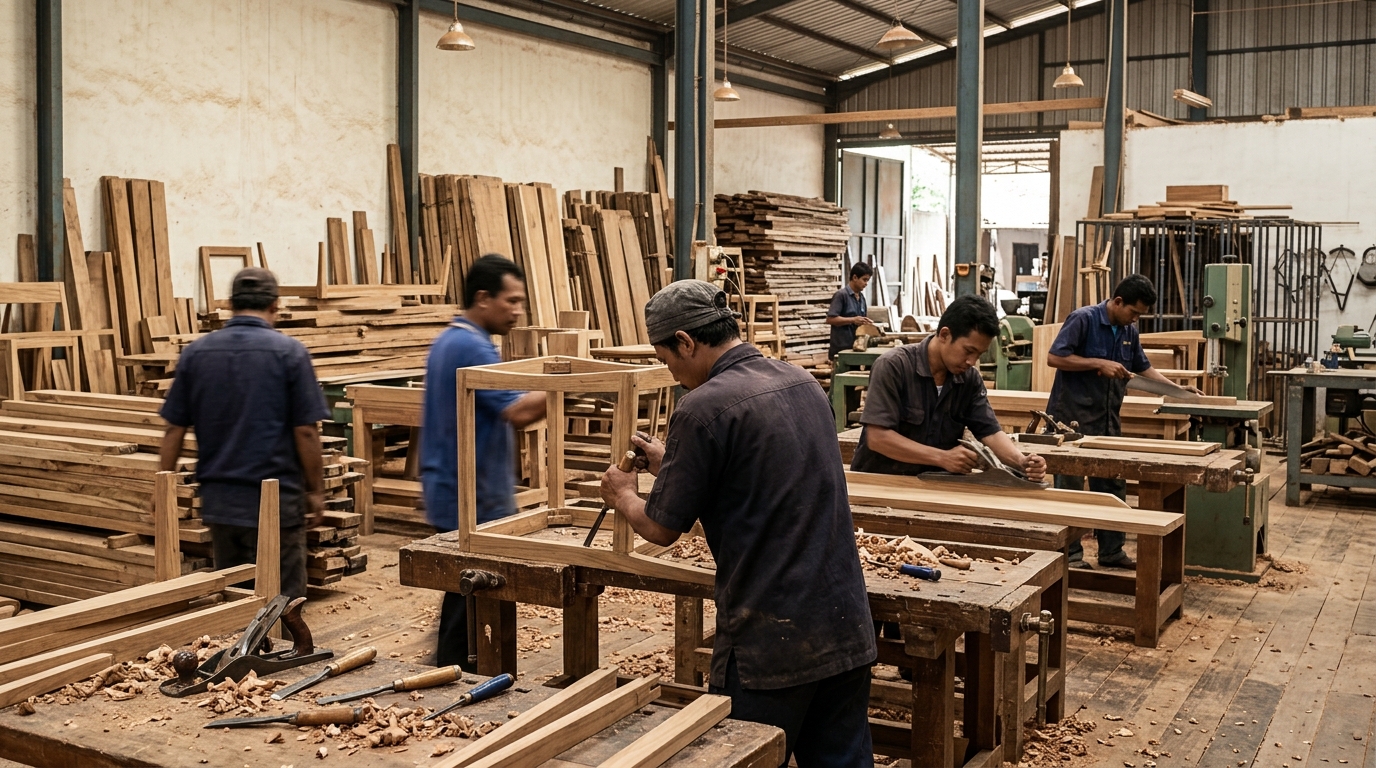
US import buyers sourcing furniture from Indonesia face a specific operational problem. The product is premium, the factories are distributed across Java, Bali, and Sulawesi, and the materials — teak, mahogany, rattan — are inherently variable. A single shipment can combine handcrafted joinery,…
US import buyers sourcing furniture from Indonesia face a specific operational problem. The product is premium, the factories are distributed across Java, Bali, and Sulawesi, and the materials — teak, mahogany, rattan — are inherently variable. A single shipment can combine handcrafted joinery, natural timber, and applied lacquer finishes. Each variable multiplies the risk of a costly defect reaching your warehouse.
Third party quality control services furniture Indonesia are not a nice-to-have. They are a margin-protection tool. Factory self-inspection consistently fails import buyers because producers have a structural incentive to pass product through. Independent verification breaks that conflict of interest.
This guide helps US sourcing managers evaluate, compare, and select a furniture inspection partner in Indonesia. It covers service models, AQL frameworks adapted for handcrafted goods, embedded versus fly-in inspector economics, report standards, pricing, and the compliance extensions — SVLK, Lacey Act — that only a well-configured QC partner can address. It does not walk you through how to inspect furniture yourself.
If you are currently running inspections with a generalist provider or relying on factory photos, this guide gives you the framework to upgrade your approach.
Why Indonesian Furniture Sourcing Demands a Dedicated QC Partner
The Scale and Complexity of Indonesia's Export Hubs
Indonesia's furniture production is geographically concentrated but stylistically diverse. Jepara in Central Java is the country's largest solid wood cluster, specializing in teak and mahogany. Cirebon is the rattan centre. Bali produces luxury artisan pieces for the hospitality and resort segment. Semarang handles outdoor furniture. Surabaya serves the mid-market.
Each cluster has its own factory typology, skills base, and quality culture. A QC program that works in Jepara does not automatically transfer to Bali. Your inspection partner needs on-the-ground coverage across all active clusters, not just the most visible one.
Risks Unique to Furniture: Why General Inspection Falls Short
Furniture defects are not like hardlines defects. A missed dimension on a flat-pack panel is measurable. Finish bleed on a hand-applied lacquer, a joint gap that appears only under load, or veneer bubbling on a curved surface — these require trained furniture eyes.
Indonesian furniturecompounds this because natural materials behave inconsistently. Teak density varies between heartwood and sapwood. Rattan moisture content affects structural integrity over time. Handcrafted joinery tolerances are tighter on some days than others. A generalist inspection service applying a standard hardlines checklist will miss the defects that actually drive US customer returns.
Factory Self-Inspection: Why It Consistently Fails Import Buyers
Factories have a production incentive. Every unit passed is revenue recognised. Self-inspection systems — even honest ones — accumulate optimistic bias. When defects do surface, root cause documentation is rarely preserved in a usable format for buyer corrective action requests.
Independent QC removes this bias. It also creates a documented record that supports chargeback negotiations, customs compliance, and supplier performance conversations.
SVLK, Lacey Act, and the Compliance Extension Your QC Partner Should Cover
The US Lacey Act prohibits the import of illegally harvested timber. Indonesia's equivalent instrument is SVLK (Sistem Verifikasi Legalitas Kayu) — the country's timber legality verification system. Reputable Indonesian exporters carry SVLK certification, and FSC certification is increasingly standard among factories targeting the US market.
A qualified third-party QC partner can verify SVLK documentation at the factory level during an audit or inspection visit. This is not a substitute for full legal due diligence, but it is a meaningful first screen.
The Three Inspection Service Models That Cover Indonesian Furniture Production
| Service Model | Trigger Condition | Production Stage | Typical Man-Days Required |
|---|---|---|---|
| IPC (Initial Production Check) | New factory, new SKU, high-risk material | Before cutting begins | 0.5–1 per visit |
| DUPRO (During Production) | Orders >200 units, complex finishing, prior defect history | 20–50% completion | 1–2 per visit |
| PSI (Pre-Shipment Inspection) | Every shipment, all factories | 80–100% packed | 1–2 per order |
| Combined IPC + PSI | First order from any factory | Start + end | 2–3 total |
| Full Three-Point | High-value or high-complexity orders | All stages | 3–5 total |
IPC: Catching Problems Before Material Is Committed
An Initial Production Check happens before cutting begins. The inspector verifies raw material specifications — timber species, moisture content, hardware components — against your purchase order and approved samples. For teak furniture, this is where substandard sapwood substitution or incorrect hardware grades are caught before they are locked into finished product.
IPC is essential for first orders from a new factory. It is also worth repeating whenever a factory changes timber supplier or introduces a new finishing process.
DUPRO: Inline Monitoring When Production Is Underway
A DUPRO inspection occurs at approximately 20–50% production completion. The inspector reviews in-process units against dimensional tolerances, joinery standards, and finishing quality. Problems found at this stage can still be corrected on the production line.
DUPRO is the most underused service model in Indonesianfurniture sourcing. Buyers who rely only on pre-shipment inspections discover defects when the entire batch is finished and packed. Rework at that stage is expensive. Correction during production is not.
PSI: Final AQL Sampling Before Container Loading
A Pre-Shipment Inspection applies AQL sampling to the finished, packed lot. The inspector selects units randomly, unpacks them, measures dimensions, assesses finish quality, checks hardware function, and records all findings against your defect classification system.
PSI alone is insufficient for complex or high-value furniture orders. Used in combination with DUPRO, it serves as a final confirmation gate rather than a primary defect discovery mechanism.
Applying AQL Sampling Standards to Handcrafted Indonesian Furniture
The ISO 2859-1 Framework and Its Furniture-Specific Limits
AQL (Acceptable Quality Limit) sampling follows ISO 2859-1. The framework defines lot sizes, inspection levels, and acceptance/rejection thresholds. For furniture, General Inspection Level II is the standard default. The recommended AQL levels commonly applied to wood furniture are:
- Critical defects: AQL 0 (zero tolerance — structural failure, safety hazard) - Major defects: AQL 2.5 (functional or appearance defects that will cause rejection by the end consumer) - Minor defects: AQL 4.0 (cosmetic imperfections acceptable within defined limits)
These thresholds should be written into your purchase order and inspection service agreement. Do not allow your QC partner to apply their own default AQL without your explicit sign-off.
Sample Size Determination for Mixed-SKU Furniture Orders
Indonesian furnitureshipments are frequently multi-SKU. A container may hold dining tables, chairs, sideboards, and benches from the same factory. Each SKU should be treated as a separate lot for AQL purposes when dimensions or materials differ significantly.
Aggregating mixed SKUs into a single lot distorts the sample. A table with a structural defect can pass inspection because chairs — which are compliant — numerically dominate the lot. Your inspection partner should have a clear protocol for lot segregation on mixed orders.
AQL Adaptation for Handcrafted and Bespoke Lots
Handcrafted furniture does not behave like injection-moulded hardlines. Natural timber variation means that two units from the same batch will never be identical. Your defect definitions must distinguish between natural material character — grain variation, minor colour shift in teak — and genuine manufacturing defects.
This distinction needs to be documented in a golden sample or approved sample with written tolerances. The QC partner inspects against that agreed standard, not against an abstract ideal. Without this document, AQL results are subjective and unenforceable.
Furniture Defect Classification Frameworks Your QC Partner Must Implement
A professional furniture inspection service Indonesia should apply a three-tier defect classification system customised to your SKU list. Generic checklists pulled from hardlines templates are not adequate.
Critical defects include structural failure risk, sharp edges, unstable load-bearing joints, and any material that violates Lacey Act or SVLK compliance. These trigger automatic shipment hold.
Major defects include: - Finish bleed or runs exceeding agreed tolerance - Joint gaps visible at normal viewing distance - Dimensional deviation outside purchase order tolerance - Veneer bubbling, peeling, or delamination - Hardware misalignment or non-function - Colour variation outside approved sample range
Minor defects include: - Surface scratches in non-visible areas - Minor grain variation within documented tolerance - Small finish texture inconsistency on secondary surfaces
- ✓Three-tier classification: critical / major / minor
- ✓SKU-specific defect thresholds aligned to your golden sample
- ✓Photographic documentation of every defect found
- ✓Measurement log for all dimensional checks
- ✓Structural stability test protocol for seating and tables
- ✓Finish adhesion test where applicable
- ✓Hardware function test checklist
Defect checklists should be built per SKU and material type. A rattan chair checklist differs from a solid teak dining table checklist. If your QC partner offers a single universal furniture checklist, treat that as a qualification red flag.
Embedded Local QC Teams Versus Fly-In Inspectors: A Decision Framework for Indonesian Routes
This is the decision point that most buyers and most inspection guides ignore entirely. It materially affects cost, response time, and inspection quality.
Cost Comparison: Fly-In Versus Locally Embedded
A fly-in inspector model means inspectors travel from a regional hub — typically Singapore, Hong Kong, or Jakarta — to the production location for each assignment. Travel costs are either passed through directly or absorbed into a higher man-day rate. For inspections in Jepara, Cirebon, or Bali, travel adds meaningful cost and reduces available inspection time on day one.
A locally embedded model means inspectors are resident in the key production clusters. They have no travel day. They are available on shorter notice. Their daily cost is typically lower when travel is excluded. For buyers running frequent inspections — monthly or more — the embedded model delivers lower cost per inspection cycle.
| Factor | Fly-In Inspector | Embedded Local Inspector |
|---|---|---|
| Travel cost | High — added per trip | Minimal or zero |
| Notice period required | Typically 3–5 days | Often 1–2 days |
| Factory familiarity | Low on first visits | High with repeat factories |
| Language / cultural fit | Variable | Strong |
| Senior expertise level | Often higher | Variable — depends on provider |
| Best use case | New factory audits, escalations | Routine IPC / DUPRO / PSI |
When Fly-In Senior Auditors Are Still the Right Choice
Embedded inspectors handle routine work well. But two situations justify a fly-in senior auditor.
First, new factory qualification. A first-time factory audit for an unknown supplier benefits from a senior, cross-market auditor who has seen failure patterns across multiple Indonesian clusters and can benchmark the factory against regional peers.
Second, escalations. If an embedded inspector has flagged a recurring defect and the factory is disputing findings, a senior auditor with direct buyer authority creates a different dynamic in the room.
The most effective programs combine both: embedded inspectors for production monitoring, fly-in senior auditors for factory qualification and dispute resolution.
What a Professional Furniture Inspection Report Must Actually Contain
Report quality is where third party quality control services furniture Indonesia vary most. A professional report is not a pass/fail stamp. It is a structured dataset.
Mandatory Report Components
Every inspection report should include:
- Cover summary: AQL result (pass/fail), total units inspected, defect count by category - Photo evidence: minimum one photo per defect found, with unit identifier and defect type labelled - Measurement log: dimensional readings for every unit sampled, compared to PO tolerance - Defect frequency table: defect type ranked by occurrence - Structural test results: stability, load, hardware function - SVLK/FSC document verification status (if in scope)
Turnaround Time and Digital Delivery Standards
Same-day report delivery is achievable and should be specified in your service agreement for PSI inspections. DUPRO reports may reasonably allow 24 hours given more complex data capture.
Leading providers offer buyer-facing dashboards where report data aggregates over time. This allows trend analysis — which factories produce which defect types, which SKUs generate the most rework. This data is more valuable than any single inspection report.
Using Report Data to Drive Corrective Action Requests
A corrective action request (CAR) is your commercial instrument for requiring a factory to address a root cause. It should be grounded in inspection data: defect type, frequency, measurement deviation, photographic evidence, and the specific standard or golden sample that was not met.
Structure your CAR with three elements: the defect evidence from the report, the required corrective action (process change, rework, or replacement), and a verification deadline tied to a follow-up inspection. Without a reinspection clause, CARs are unverifiable.
Understanding QC Man-Day Costs and Total Program Pricing in Indonesia
Current Market Rate Ranges
The market rate for furniture inspectionservices in Indonesiatypically falls in the range of approximately $240–$350 per man-day for a standard inspection by an established third-party provider. Rates vary by provider tier, inspector seniority, and whether travel costs are included.
Volume and Retainer Pricing Models
Buyers running five or more inspections per month should negotiate a monthly retainer or volume-discount structure. Retainer models provide cost predictability and usually include priority scheduling. They are well-suited to import programs with consistent production flow from established Indonesian factories.
Calculating ROI on QC Investment
The cost of a single PSI inspection — approximately one to two man-days — is a fraction of the cost of one returned container. US furniture importers face return processing costs, freight, potential chargebacks from retail partners, and reputational risk with key accounts. QC cost is an insurance premium with a calculable return. Buyers who treat it as an overhead to minimise consistently absorb larger losses downstream.
How to Evaluate and Select the Right Third-Party QC Partner for Your Indonesian Furniture Program
Key Qualification Criteria
Evaluate prospective providers against these minimum criteria:
- Furniture-specific inspector training: Can they demonstrate furniture defect classification protocols, not just generic hardlines checklists? - Local inspector density in Indonesia: Do they have resident inspectors in Jepara, Cirebon, Bali, and Semarang — or do all inspections require travel? - SVLK and FSC verification capability: Do inspectors know how to verify timber legality documentation? - Accreditations: ISO 17020 accreditation for inspection bodies is the relevant benchmark. - Report format and data access: Do they offer digital dashboards and structured data export?
Questions to Ask Before Signing
- How many inspectors do you have resident in Central Java and Bali specifically? - What is your furniture-specific defect classification training protocol? - Can you provide sample reports from furniture inspections in Indonesia? - How do you handle mixed-SKU AQL lot segregation? - What is your SVLK/FSC document verification process? - What is included and excluded in your man-day rate? - What is your escalation process if a factory disputes findings?
Red Flags to Screen Out
A generalist inspection agency with no dedicated furniture or wood-products expertise is a high-risk choice for Indonesian furniture programs. If their sample report shows the same checklist format for furniture, electronics, and apparel — walk away. If they cannot name the production clusters they cover in Indonesia — walk away.
Also screen for vague inspector coverage claims. 'We cover all of Indonesia' from a provider with no resident inspectors means all assignments involve travel surcharges and longer lead times.
Run a Pilot Inspection Before Any Long-Term Commitment
The most reliable way to evaluate a QC partner is a paid pilot. Commission one PSI and one DUPRO on an active production order. Evaluate the report against these criteria: photo quality and labelling, measurement log completeness, AQL calculation accuracy, defect classification alignment with your own standards, and turnaround time.
A provider that performs well on a pilot with no long-term contract incentive will perform at least as well under a retainer. A provider that underdelivers on a pilot will not improve under contract pressure.
Frequently Asked Questions
What is the typical cost per man-day forfurniture quality controlin Indonesia? Approximately $240–$350 per man-day for a standard inspection from an established provider. Travel, lab testing, and overtime are typically billed separately. Volume and retainer agreements can reduce the effective rate.
What AQL level should I specify for Indonesian furniture inspections? AQL 2.5 for major defects and AQL 4.0 for minor defects are widely applied to wood furniture under General Inspection Level II of ISO 2859-1. Critical defects should be set to zero tolerance regardless of lot size.
What is the difference between DUPRO and pre-shipment inspection for furniture? DUPRO occurs at 20–50% production completion and allows defects to be corrected on the production line. PSI occurs when the order is 80– approximately 100% packed and determines whether the shipment is released or held. DUPRO prevents defects; PSI confirms their absence.
Should I use a local Indonesia-based QC company or an international inspection firm? Both models have merit. Local providers often have stronger cluster-level coverage and lower travel costs. International firms may offer more standardised reporting and cross-market benchmarking. The embedded inspector coverage within Indonesia is more important than the provider's headquarters location.
How do I ensure my QC partner understands furniture-specific defects versus general hardlines? Request a sample inspection report from a furniture assignment in Indonesia. Verify that it includes SKU-specific defect checklists, dimensional measurement logs, finish quality criteria, and structural stability results. Generic checklists that do not differentiate between furniture and other product categories are a disqualifying signal.
Can a third-party QC company also verify SVLK or FSC timber compliance in Indonesia? Yes, within defined scope. A qualified inspector can verify that SVLK and FSC certificates are current, correctly issued to the supplying entity, and verifiable against the issuing body's registry. This is a meaningful compliance screen for Lacey Act purposes, but it does not replace formal legal due diligence on your supply chain.
Selecting the right furniture inspection partner in Indonesia is a commercial decision with direct financial consequences. The key variables — service model coverage, embedded inspector density, AQL configuration for handcrafted goods, and compliance scope including SVLK — determine whether your QC program actually protects margins or simply creates paperwork. A pilot inspection is the most efficient way to test a provider before any volume commitment.
You now have a clear framework for evaluating, pricing, and structuring a QC program for your Indonesian furniture supply chain. The logical next step is to match that framework against a provider that can deliver it.
You understand the service models, cost structures, and qualification criteria. Let us map that framework to your specific production clusters, SKU complexity, and inspection frequency — and propose a program built around your actual program requirements.
Request Your QC Service Proposal →Need eyes on the ground in Indonesia?
MTS is an execution partner — supplier verification, manufacturing management, quality control and export logistics across Indonesia, Vietnam and China.
Related services
Related articles
Receive furniture sourcing insights across Asia.
One email per week. No spam.