Indonesian Furniture Finishing Quality Standards: A Complete Buyer's Guide
17 min read
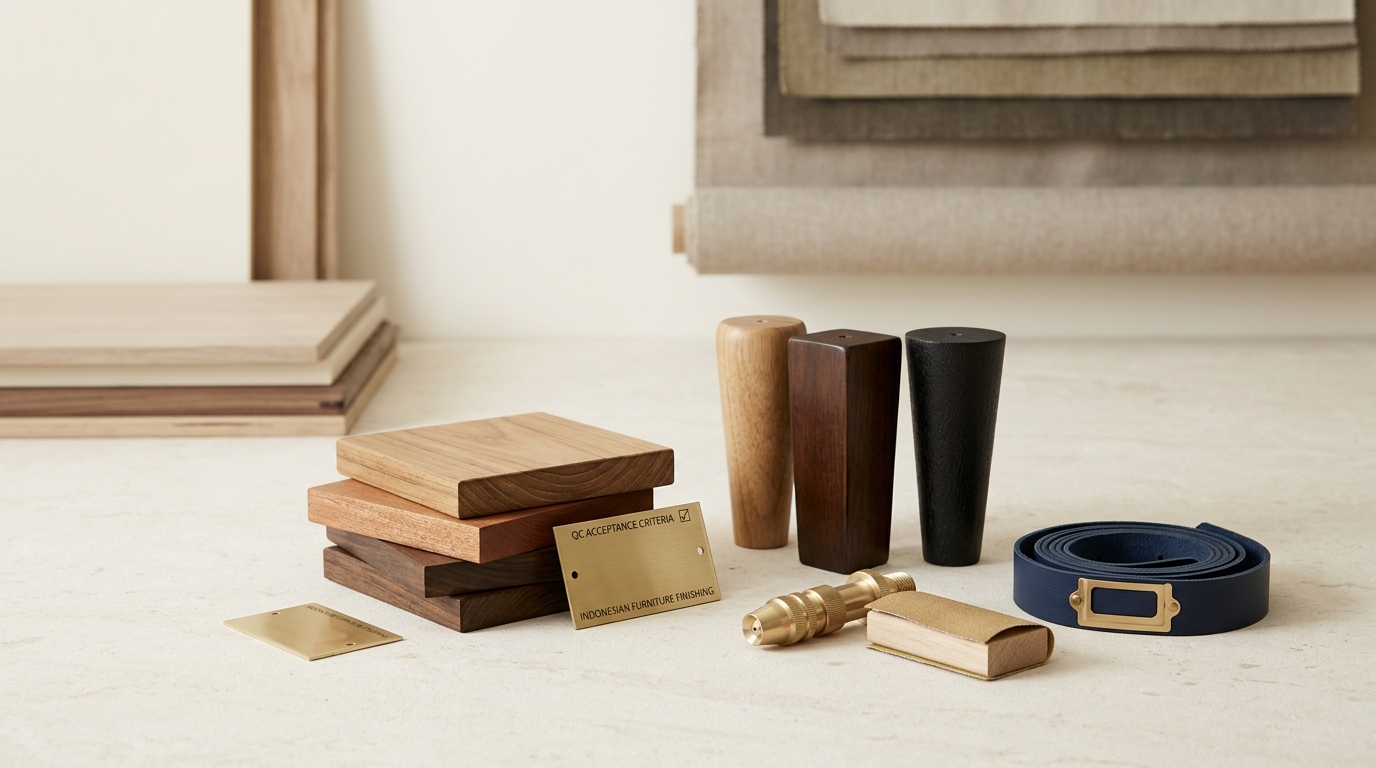
Finishing failures are not a cosmetic inconvenience — they are the single most common cause of chargebacks, return shipments, and margin erosion on Indonesian furniture imports. A purchase order that precisely specifies wood species, joinery method, and hardware but leaves finishing to "factory…
Finishing failures are not a cosmetic inconvenience — they are the single most common cause of chargebacks, return shipments, and margin erosion onIndonesian furnitureimports. A purchase order that precisely specifies wood species, joinery method, and hardware but leaves finishing to "factory standard" is an open invitation for disputes. Yet that omission remains routine among first-time and mid-volume importers sourcing from clusters in Java and Bali.
Indonesia's furniture manufacturing base — anchored in Jepara (Central Java) for solid teak and mahogany, Cirebon for rattan, Bali for luxury artisan work, and Semarang for outdoor production — spans a wide capability range. Artisan workshops of ten craftspeople and export-grade factories with automated spray booths operate in the same geography. The gap between what each delivers in finishing quality is substantial, and it is rarely visible in a product catalog photograph.
This guide is written for B2B procurement professionals, importers, and interior designers who need actionable, measurable standards to embed directly into purchase orders, supplier agreements, and pre-shipment inspection checklists. It covers finishing system selection, multi-step process expectations, quantitative QC acceptance criteria, defect classification, chemical compliance, and contract language — the technical specifics that separate a protected margin from a contested shipment.
The sections that follow build from system selection through supplier evaluation, giving you a working reference you can apply before your next order is placed.
Why Finishing Quality Determines the Profitability of Indonesian Furniture Imports
Indonesia occupies a globally recognized position in premium natural-wood furniture, particularly teak, reclaimed teak, and mahogany. That reputation, however, reflects the ceiling of what Indonesian manufacturers can produce — not a guaranteed floor. The gap between artisan-grade and export-grade finishing is the single most important quality variable a US importer needs to manage.
The Cost of Underspecified Finishing
When finishing is not specified quantitatively, factories default to whatever process is fastest for their equipment and workforce. That may mean a single sealer coat instead of three, a color match done visually against a Pantone swatch rather than a calibrated reference panel, or a topcoat applied below minimum dry-film thickness because the spray booth operator is managing twelve SKUs simultaneously. The result reaches your distribution center looking acceptable in artificial light and fails under retail or hospitality conditions within months.
Chargebacks for finishing defects — blush, cracking, color inconsistency, poor adhesion — are among the most expensive to resolve because they typically surface after delivery, require photographic documentation across hundreds of units, and trigger corrective action cycles that consume 60 to 90 days of supplier bandwidth. Specifying finishing upfront eliminates the ambiguity that makes those disputes possible.
How Specification Protects Margin and Brand
A finish specification sheet embedded in a purchase order converts a subjective judgment ("the finish looks wrong") into a measurable contractual claim ("DFT measured at 52 microns against a specified minimum of 75 microns, failing ASTM D3359 adhesion test"). That shift from subjective to quantitative is what makes chargeback recovery enforceable and what motivates supplier compliance before production rather than after.
For importers supplying US retailers, contract furniture buyers, or hospitality procurement programs, finishing quality is also a brand exposure. A single high-profile defect on a teak dining collection or a resort bedroom program can cost a supplier relationship that took years to build. Indonesian furniture finishing quality standards, properly specified, function as a brand protection mechanism as much as a QC tool.
The Core Finishing Systems Indonesian Manufacturers Use and When to Specify Each
Understanding the chemistry and performance characteristics of each finishing system is a prerequisite for writing a specification that a factory can actually execute. Indonesian manufacturers work with several distinct systems; the wrong specification for an end-use environment is as damaging as no specification at all.
Oil and Wax Systems
Teak oil, Danish oil, linseed oil, and hard-wax oil finishes penetrate the wood fiber rather than forming a surface film. They are appropriate for solid teak and reclaimed teak pieces where the natural surface texture and patina are design features. Penetrating oils are widely used in outdoor teak furniture sold into the US market because they are easy to field-maintain and do not crack or peel as the wood moves seasonally.
For export specification, oil-finished pieces require a defined number of application coats (typically two to three), a minimum drying interval between coats, and a final surface condition standard (no pooling, no uneven sheen). Oil systems are not appropriate where uniform, film-forming color matches are required, or where the end-use environment involves frequent liquid contact such as restaurant dining surfaces.
Lacquer and Polyurethane Systems
Nitrocellulose lacquer is fast-drying and common in Indonesian factories because it is easy to spray and sand between coats. It produces a clear or tinted film with a traditional furniture appearance. Its limitations are meaningful for export: nitrocellulose has lower chemical and heat resistance than polyurethane, and it is more susceptible to moisture blush in high-humidity shipping conditions.
Polyurethane lacquer (PU lacquer) is the dominant export-grade finish for Indonesian furniture sold into the US market. Two-component polyurethane systems (2K PU) offer significantly superior hardness, scratch resistance, and moisture resistance compared to nitrocellulose. UV-cured finishes, applied in factories with curing ovens and UV lamps, provide the highest hardness and chemical resistance and are increasingly specified for contract and hospitality furniture where durability benchmarks are non-negotiable.
Water-based lacquers are growing in specification frequency as US retailers and contract buyers impose low-VOC requirements. They require more careful application and longer flash times but meet CARB Phase 2 and emerging retailer sustainability mandates.
Stain, Glaze, and Paint Systems
Color-matched collections require stain or glaze systems applied over a sealer before the clear topcoat. Consistency across a production run is the critical variable — Indonesian factories commonly produce batches weeks apart, and without a colorimetric control process, color drift across a collection is common. Paint systems — primer plus pigmented topcoat — require specification of sheen level (matte, satin, gloss by 60-degree gloss meter reading) and primer adhesion protocol, particularly on dense tropical hardwoods where adhesion failure is a known risk.
| Finish System | Typical End Use | Key Specification Parameter |
|---|---|---|
| Teak oil / Danish oil | Outdoor teak, natural indoor teak | Coat count, drying interval, final sheen |
| Nitrocellulose lacquer | Indoor decorative pieces | DFT, hardness, VOC compliance |
| 2K polyurethane lacquer | Export-grade indoor and outdoor | DFT (mils/microns), hardness, adhesion |
| UV-cured finish | Contract, hospitality, high-traffic | Cure energy (mJ/cm²), hardness, scratch resistance |
| Water-based lacquer | Low-VOC specified programs | VOC g/L, DFT, adhesion |
| Pigmented paint system | Color-program furniture | Sheen (gloss meter), primer adhesion, color Delta-E |
The Multi-Step Finishing Process Your Indonesian Suppliers Should Follow
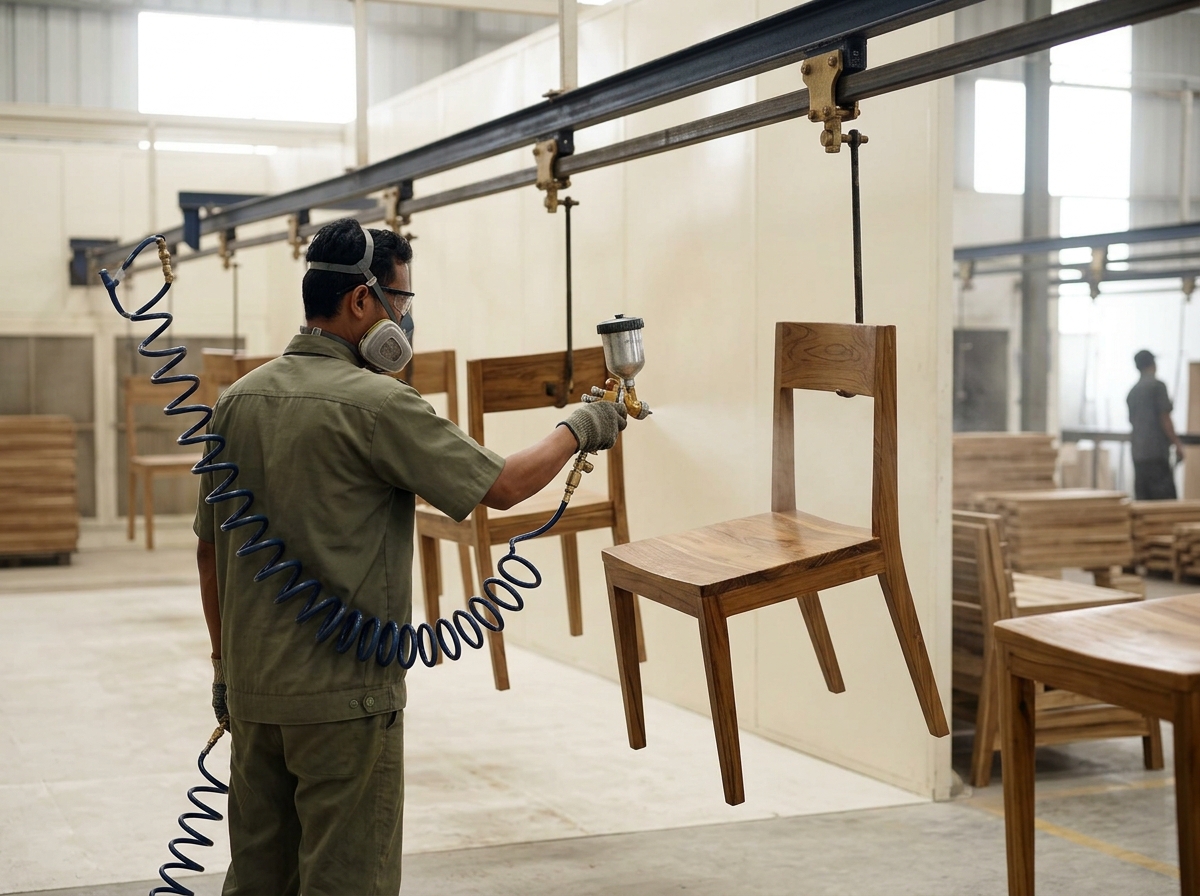
A properly executed finishing process on export-grade Indonesian furniture is not a two-step spray-and-pack operation. Buyers who understand the expected process stages can audit supplier capability and identify shortcuts before they become defects.
Stage 1 — Raw Sanding and Surface Preparation
Sanding should follow a defined grit progression: typically 80-grit for stock removal, 120-grit for surface leveling, and 180-grit for final preparation before the first coating stage. On teak and other oily tropical hardwoods, the surface must be solvent-wiped after final sanding to remove natural oils that inhibit sealer adhesion. This step is frequently skipped in factories without explicit specification, and it is a leading cause of adhesion failure on teak furniture.
Stage 2 — Sealer Application
The sealer (not "base coat" — these are technically distinct products) serves to penetrate the substrate, stabilize the surface, and provide a foundation for subsequent coats. Sealer dry-film thickness targets vary by system but typically range from 15 to 25 microns. Wash coats applied too thin fail to seal adequately; applied too thick, they create a surface that sands unevenly and traps contamination.
Stages 3 Through 6 — Build, Color, and Topcoat
Intermediate sanding between coats (typically 240-grit or finer) removes dust nibs and surface imperfections and ensures inter-coat adhesion. Stain or color coats must be applied against an approved colorimetric reference (see QC criteria below). The topcoat is the performance and appearance layer: film thickness, coverage uniformity, and sheen must meet the specified minimums. A final QC scrutiny under raking light before packing is the last opportunity to catch runs, sags, fish-eye, and other defects before they enter cartons.
Measurable QC Acceptance Criteria to Embed in Every Purchase Order
This is where Indonesian furniture finishing quality standards become contractually enforceable. Vague language such as "good quality finish" is legally meaningless. The following quantitative criteria can be written directly into specification sheets.
Dry-Film Thickness (DFT) Benchmarks
DFT is measured with a calibrated coating thickness gauge (magnetic induction for metal substrates, ultrasonic for wood). Buyers should specify both minimum DFT per coat and total system DFT.
| Finish System | Typical Total DFT Target | Measurement Method |
|---|---|---|
| Teak oil (penetrating) | Not film-measured; coat count specified | Visual / application record |
| Nitrocellulose lacquer | 60–90 microns (approximately 2.4–3.5 mils) | Ultrasonic DFT gauge |
| 2K polyurethane lacquer | 80–120 microns (approximately 3.2–4.7 mils) | Ultrasonic DFT gauge |
| UV-cured finish | 60–100 microns depending on pass count | Ultrasonic DFT gauge |
| Pigmented paint (primer + topcoat) | 100–150 microns (approximately 4.0–5.9 mils) | Ultrasonic DFT gauge |
Color Uniformity and Delta-E Tolerance
Color consistency is measured using a spectrophotometer against an approved golden sample. Delta-E (ΔE) is the standardized unit of color difference. For furniture finishing, a typical specification is ΔE ≤ 1.5 for premium collections and ΔE ≤ 3.0 for standard commercial programs. Anything above ΔE 3.0 is visually perceptible to most observers and should be classified as a major defect.
Adhesion, Hardness, and Resistance Tests
- Adhesion: ASTM D3359 cross-cut tape test. Specify a minimum rating of 4B (less than 5% area removal) for all export-grade lacquer and paint systems. - Pencil hardness: ASTM D3363. Specify a minimum of H for standard interior furniture, 2H for tabletop and contract surfaces. - Scratch resistance: Define load threshold (commonly 500g to 1,000g stylus load) with no visible scratch on the topcoat. - Humidity resistance: 24-hour exposure at 95% relative humidity with no blushing, delamination, or swelling exceeding defined limits.
Common Finishing Defects, AQL Sampling, and How to Apply Both on Inspection Day
Defect Classification for Furniture Finishing
Not all defects warrant rejection. A structured classification system lets inspectors make consistent, defensible decisions.
| Defect Type | Classification | Typical Reject Threshold |
|---|---|---|
| Runs / sags on primary surface | Critical | Zero tolerance on primary surfaces |
| Fish-eye (cratering) | Critical | Zero tolerance |
| Cracking or checking | Critical | Zero tolerance |
| Milky blush (moisture entrapment) | Critical | Zero tolerance |
| Orange peel (minor) | Major | No single area > 25 cm² on primary surface |
| Color deviation > ΔE 3.0 | Major | Reject if > 10% of pieces in sample |
| Dust nibs / minor contamination | Minor | No nib > 0.5 mm on primary surface; ≤ 3 per piece |
| Slight sheen variation | Minor | Within ± 5 gloss units at 60° against reference |
Primary surfaces are defined as those visible in normal use: tabletops, chair seats and backs, door fronts, drawer fronts. Secondary surfaces (undersides, back panels, interior drawer sides) carry lower tolerances.
Applying AQL Sampling to Finishing Inspection
AQL (Acceptable Quality Level) sampling uses statistically defined sample sizes to make accept/reject decisions on a shipment without inspecting every piece. For finishing quality on Indonesian furniture exports to the US, the most commonly applied levels are:
- AQL 2.5 for critical and major defects on premium and contract programs - AQL 4.0 for major and minor defects on standard commercial programs
Using ANSI/ASQ Z1.4 sampling tables, a shipment of 1,000 pieces at inspection level II with AQL 2.5 requires a sample of approximately 80 pieces. If more than 5 pieces in the sample carry major or critical finishing defects, the shipment is rejected.
- ✓Verify DFT readings at 5 points per piece against specification
- ✓Conduct ASTM D3359 cross-cut tape test on 3 pieces per sample
- ✓Measure color Delta-E against golden sample on all color-program pieces
- ✓Inspect primary surfaces under raking light for runs, sags, fish-eye, blush
- ✓Confirm sheen level with 60-degree gloss meter against reference
- ✓Check for cracking or delamination on joints and edges
- ✓Document all defects with photographic evidence and location map
- ✓Confirm sample size and AQL level match PO specification
- ✓Verify finish system matches approved specification sheet (not substituted product)
- ✓Check golden sample archive reference number on inspection report
Chemical and Environmental Compliance Standards That Directly Affect Finish Selection
US-market compliance requirements are not optional considerations forIndonesian furniture importers— they are de facto specification requirements for any retailer or contract buyer with a compliance program.
CARB Phase 2 and California Prop 65
The California Air Resources Board (CARB) Phase 2 standard limits formaldehyde emissions from composite wood products used as substrates under finishing coats. If your Indonesian furniture uses MDF, plywood, or particleboard components — common in case goods even from factories marketing "solid teak" collections — those panels must be CARB Phase 2 compliant. Non-compliant panels are not addressable by the topcoat system; they must be replaced at the substrate level.
California Proposition 65 requires warning labels for products containing chemicals known to cause cancer or reproductive harm above defined threshold levels. Several solvents and pigments used in conventional furniture finishes are Prop 65-listed. Specifying low-VOC, water-based finishing systems and requesting safety data sheets (SDS) from the factory's finish material supplier is the primary mitigation strategy.
VOC Content Limits and Water-Based Finishes
The US EPA and multiple state regulations limit VOC content in architectural and industrial coatings. For furniture sold into US retail channels, VOC limits are increasingly embedded in retailer compliance manuals rather than just federal regulation. Water-based lacquer and UV-cured systems typically comply with current VOC limits; conventional nitrocellulose and oil-based polyurethane systems may not, depending on formulation. Require the factory to provide the VOC content (grams per liter) for every finish product used in your specification.
Formaldehyde, REACH, and Contract Furniture Requirements
Sealers and adhesives used beneath topcoats can contribute formaldehyde emissions independent of the topcoat chemistry. For hospitality and contract furniture, fire-retardant coating requirements may apply under NFPA or local building codes — specify these at the PO stage, as FR additives must be incorporated into the finishing system, not applied afterward. REACH compliance (relevant for chemical substances in articles exported to the US market by EU-aligned buyers and increasingly adopted as a US retailer standard) should be confirmed for all finish materials.
Embedding Indonesian Furniture Finishing Quality Standards into Purchase Orders and Supplier Agreements
Writing a Finish Specification Sheet
A finish specification sheet should include, at minimum: finish system type, product brand and grade, color code (referencing an approved golden sample number), sheen level (gloss meter reading range at 60°), DFT minimum per coat and total system, applicable test methods (ASTM D3359, D3363, etc.), and VOC content. The spec sheet should be attached to the PO as a numbered exhibit and referenced in the acceptance criteria clause.
Golden Samples and Pre-Production Approval
No bulk production run should proceed without an approved pre-production finish sample — commonly called a golden sample — that has been physically reviewed and signed off by the buyer. Golden samples should be archived by both buyer and factory, labeled with the PO number, SKU, approval date, and the approver's name. This archive is the reference against which all pre-shipment inspections are conducted.
Third-Party Inspection in Java and Bali
Several internationally recognized inspection agencies operate pre-shipment inspection services in Indonesia's main furniture production regions. Buyers should specify that the pre-shipment inspection must be conducted by an accredited third-party agency and that the inspection report must include finishing-specific findings using the buyer's defect classification and AQL level. Inspection reports without DFT measurements, colorimetric readings, and adhesion test results should not be accepted as compliant.
Chargeback Clause Language
Include a clause specifying that finishing defects identified at destination that were present at time of shipment (documented by photographic evidence from pre-shipment inspection or upon container opening) entitle the buyer to a defined chargeback per defective unit, or to require corrective re-finishing at the factory's cost before the next shipment is released. The clause should reference the finish specification sheet exhibit and the AQL level specified for that PO.
Evaluating Indonesian Suppliers on Finishing Capability Before Placing an Order
Factory Audit Criteria for Finishing Lines
A factory audit that does not specifically evaluate the finishing line is incomplete for furniture procurement. Key audit checkpoints include: dedicated spray booth with appropriate extraction and climate control; dust separation between sanding and finishing areas; curing ovens or UV curing equipment for the specified finish system; DFT measurement tools (ultrasonic gauges) in the QC department; a spectrophotometer for colorimetric control; and a documented golden sample archive.
Factories in Jepara and other Central Java clusters that produce primarily for domestic or regional markets may have none of these. Factories producing for export to the US and European markets at scale typically have at least the spray booth and basic measurement capability. The presence of a documented finishing process, a trained QC finishing inspector, and a golden sample archive are the clearest signals of finishing quality maturity.
Questions to Ask About Finish Material Sourcing
Ask the factory to identify the brand and grade of every finish product in their system for your specification. Batch consistency — using the same product from the same supplier across a production run — is a prerequisite for color and performance consistency. Factories that purchase finish materials from multiple local suppliers based on price are a high-risk sourcing environment for color-matched collections.
Certifications as Signals of Quality Maturity
ISO 9001 certification indicates that the factory has documented quality management processes, which typically include finishing process documentation. FSC certification is relevant for teak and reclaimed teak sourcing. Neither certification guarantees finishing quality on its own, but their absence in a factory claiming export-grade capability is worth probing.
- ✓No dedicated spray booth — open-area spraying only
- ✓No DFT measurement tools in QC department
- ✓No spectrophotometer for colorimetric control
- ✓Finish materials sourced ad hoc from multiple local suppliers
- ✓No golden sample archive — samples discarded after production
- ✓Manual brush application only for lacquer or PU systems
- ✓No intermediate sanding between coats in standard process
- ✓No written finishing process sheet for any SKU
- ✓Curing done at ambient temperature only — no oven for 2K PU
- ✓No separation between sanding and finishing areas
Frequently Asked Questions on Indonesian Furniture Finishing
What is the standard number of finishing coats required for export-grade Indonesian furniture?
For a 2K polyurethane lacquer system, export-grade Indonesian furniture typically requires one sealer coat, one to two build coats, optional stain or color coat, and one to two topcoat passes — totaling four to six application stages. The specific count should be defined in the finish specification sheet rather than left to factory discretion, as coat count directly determines total DFT and performance properties.
How do I specify color tolerance for Indonesian furniture finishing in a purchase order?
Reference a physical golden sample by its archive number and specify a maximum Delta-E tolerance (e.g., ΔE ≤ 1.5 for premium programs, ΔE ≤ 3.0 for standard programs) measured with a spectrophotometer against the golden sample under D65 illuminant. Include this measurement as a required field in the pre-shipment inspection report.
What finishing systems are best for outdoorIndonesian teak furnituresold in the US?
Penetrating teak oil or hard-wax oil systems are appropriate for outdoor teak furniture where natural weathering and field re-finishing are acceptable. For outdoor teak that will be sold as a maintenance-free product, a two-component water-based polyurethane or UV-cured exterior system with documented UV resistance and film integrity under ASTM G154 accelerated weathering testing provides better long-term performance. Specify exterior-grade products explicitly — indoor PU lacquers are not appropriate for outdoor use.
Which third-party inspection agencies can verify finishing quality in Indonesian furniture factories?
Several internationally accredited inspection agencies operate in Java and Bali, covering pre-shipment inspection, factory audits, and production monitoring. When selecting an agency, confirm that their inspectors are trained in furniture finishing evaluation specifically, and that their report templates include DFT measurement, colorimetric readings, adhesion test results, and AQL-based defect sampling — not just a visual pass/fail summary.
What VOC and chemical compliance requirements apply to Indonesian furniture finishes imported into the United States?
The primary requirements are CARB Phase 2 for formaldehyde emissions from composite wood substrates, California Prop 65 for listed chemicals in finish materials, and EPA and state-level VOC limits for the finish products themselves. Retailers and contract buyers often impose additional requirements through their own compliance manuals. Water-based and UV-cured systems are the lowest-risk choice for broad US market distribution. Always request SDS documents for all finish materials and verify VOC content in grams per liter.
How do I use AQL sampling to inspect finishing quality on an Indonesian furniture shipment?
Apply ANSI/ASQ Z1.4 sampling tables using inspection level II. Define your defect classification (critical, major, minor) and corresponding AQL levels in the PO before inspection. A typical approach is AQL 2.5 for critical and major finishing defects and AQL 4.0 for minor defects. The sample size is determined by the shipment quantity; the accept/reject decision is made by comparing the number of defective pieces in the sample against the acceptance number in the table. Document all defects photographically with location annotations for supplier claims.
Specifying Indonesian furniture finishing quality standards quantitatively — with DFT targets, Delta-E tolerances, ASTM test method references, and AQL sampling plans embedded in your purchase orders — is the single most effective lever you have for protecting margin, reducing chargebacks, and building supplier accountability before a container leaves Java or Bali. Combined with factory audit criteria focused on finishing line infrastructure and a golden sample approval process, these standards give you a technical framework that is enforceable, not just aspirational.
Now that you have the criteria, the next step is putting them into a format your suppliers and inspection teams can use on the factory floor.
You now have the technical framework for specifying and inspecting finishing quality on Indonesian furniture. Download our pre-shipment finishing QC checklist to embed these standards directly into your supplier agreements and inspection briefs before your next order.
Download the QC Checklist →Need eyes on the ground in Indonesia?
MTS is an execution partner — supplier verification, manufacturing management, quality control and export logistics across Indonesia, Vietnam and China.
Related services
Related articles
Receive furniture sourcing insights across Asia.
One email per week. No spam.