Indonesia Furniture Factory Audit: Capability Assessment Guide for Sourcing Managers
14 min read
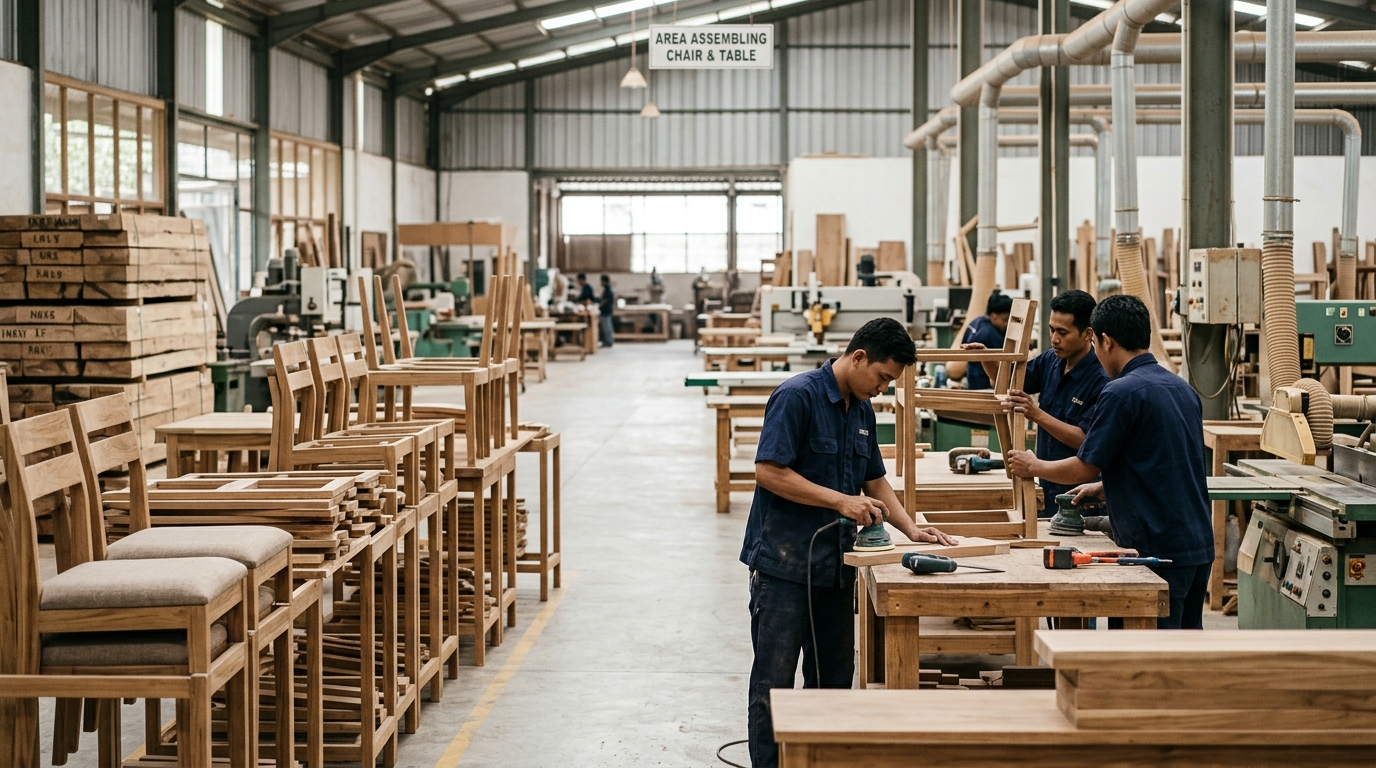
Placing a first purchase order with an Indonesian furniture manufacturer without a prior on-site audit is one of the most common and costly sourcing mistakes US importers make.
Placing a first purchase order with anIndonesian furnituremanufacturer without a prior on-site audit is one of the most common and costly sourcing mistakes US importers make.
This guide is written for sourcing managers and procurement professionals who need to commission a structured, pre-order, on-site capability audit of an Indonesianfurniture factory. It is not about pre-shipment product inspection, which evaluates finished goods against specifications after production is complete.
The sections below move through every major audit pillar — machinery, kiln-drying, workforce depth, material traceability, and social compliance — and then address how to structure the audit report, navigate Indonesia-specific regulations, and select an independent audit provider.
Why a Pre-Order Capability Audit Is Not the Same as a Pre-Shipment Inspection
These two tools serve different purposes and happen at different points in the supply chain. Confusing them is expensive.
A pre-shipment inspection is a product-level check. An inspector visits the factory after production is complete — typically when 80–100% of goods are finished and packed — and verifies that the physical product matches the approved sample, purchase order specifications, and applicable standards. It is reactive by nature.
A pre-order factory capability audit is a systems-level assessment. It happens before any production begins — ideally before a purchase order is issued. The auditor is not looking at finished goods.
The strategic question a capability audit answers is: Should I place this order with this factory at all?
Key differences at a glance:
| Dimension | Capability Audit | Pre-Shipment Inspection |
|---|---|---|
| Timing | Pre-order | Post-production |
| Subject | Factory systems | Finished goods |
| Purpose | Supplier qualification | Product conformance |
| Output | Capability scorecard + risk flags | Pass/fail AQL report |
| Decision enabled | Whether to place the order | Whether to release the shipment |
Schedule a capability audit after initial factory shortlisting and before issuing any purchase order or deposit. For most Indonesia sourcing relationships, this means after catalog review and price negotiation but before contract signing.
Defining the Scope of a Furniture Factory Audit Indonesia Capability Assessment
The Five Core Audit Pillars
A well-scopedfurniture factory audit Indonesiacapability assessment covers five pillars:
1. Machinery and equipment — type, age, maintenance status, capacity headroom 2. Kiln-drying operation — kiln type, moisture content protocol, documentation 3. Workforce and skill depth — headcount, skill distribution, tenure, management layers 4. Material sourcing chain — timber legality, certifications, component suppliers, single-source risks 5.
Scope is not one-size-fits-all. A solid teak furniture audit in Jepara needs heavy emphasis on kiln-drying and timber legality (SVLK chain-of-custody). An upholstered furniture audit near Surabaya shifts weight toward foam and fabric sourcing, sewing room capacity, and frame construction.
Define scope in writing before briefing the auditor.
Audit Duration, Team, and Report Format
A typical on-site capability audit runs one to two full working days for a factory employing up to approximately 300 workers. Larger or more complex operations may require a third day.
Recommended team composition:
- One lead auditor with furniture manufacturing experience - One technical specialist (woodworking or upholstery, depending on category) - An Indonesian-speaking note-taker or interpreter if the auditor is not locally fluent
The audit report should include: factory profile, capability scorecard by pillar, photographic evidence, identified risk flags, corrective action plan (CAP) recommendations, and a final auditor recommendation (approve / conditional approve / reject).
Machinery and Equipment: Evaluating Production Capability for Export-Grade Output
Key Machines to Inspect
For solidwood furniture, inspect the following:
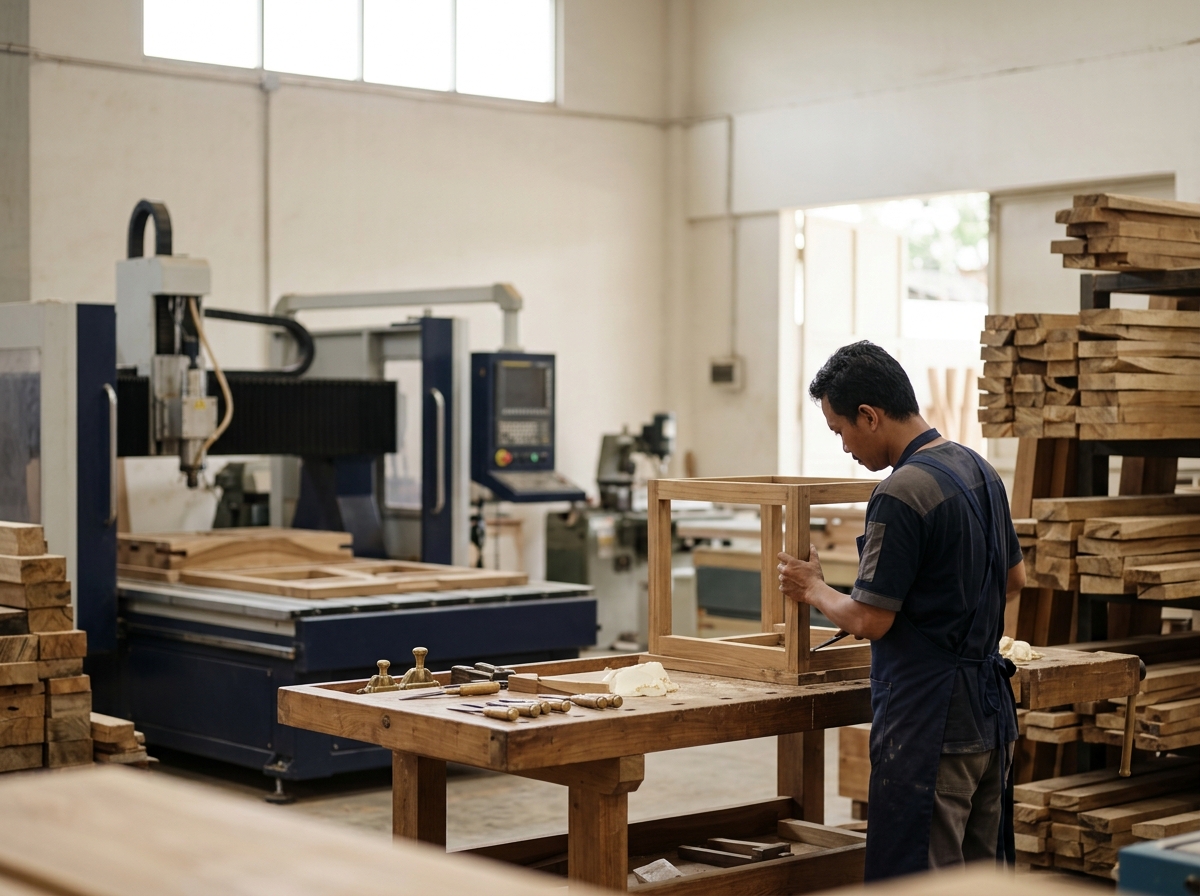
- CNC routers and machining centers — for precision joinery and carved detail - Band saws and rip saws — for dimensioning lumber - Mortise and tenon machines — structural joint quality determines long-term durability - Wide-belt and orbital sanding lines — surface prep before finishing - Spray booths with exhaust systems — finish quality and VOC containment - Edge-banding machines (MDF-based product lines) - High-frequency presses (panel glue-ups)
For upholstered furniture, add: industrial sewing machines, cutting tables, foam compression equipment, and staple/spring webbing lines.
Capacity and Condition Signals
Machine age alone is not the deciding factor. Maintenance discipline matters more. Request:
- Maintenance logs for primary machines (monthly at minimum) - Tooling inventory — worn tooling causes dimensional drift - Calibration records for sanding and finishing lines
Assess capacity headroom by asking: How many shifts per day does this machine run? What is the longest queue at the bottleneck station? A factory running at near-full single-shift utilization on key machines has limited surge capacity for your order without compromising lead times.
Verify that the factory owns — not leases or borrows — its critical equipment. Assembly-only operations often rent CNC time from neighboring factories. This is a significant risk factor for quality consistency and schedule reliability.
Kiln-Drying Assessment: The Critical Verification Step Most Auditors Skip
Why Moisture Content Determines Export Success
Kiln-drying is the single most consequential process in solid wood furniture production for US markets. The equilibrium moisture content (EMC) of wood in a centrally heated US interior is approximately 6–8%.
Most pre-shipment inspectors do not check kiln records. Most capability auditors treat kiln-drying as a checkbox. This is where a serious furniture factory audit Indonesia capability assessment earns its cost.
Kiln Types and What to Look For
Indonesian factories use three kiln types:
| Kiln Type | Typical MC Achieved | Control Precision | Throughput |
|---|---|---|---|
| Conventional (steam/heat) | 6–10% | High | High |
| Dehumidification | 8–12% | Medium | Medium |
| Solar kiln | 12–18% | Low | Low |
Solar kilns are adequate for furniture intended for humid tropical export markets. They are not adequate for US or Northern European interiors. If a factory producing teak for export relies solely on solar kilns, flag it as a significant risk.
Species-Specific Moisture Content Targets
Target MC at point of production (before shipping) should account for in-transit and destination EMC:
- Teak (Tectona grandis): target 8–10% MC for US interiors - Mahogany / suar / mindi: target 8–10% MC - Rubber wood: target 8–9% MC (more hygroscopic than teak) - MDF and engineered panels: inherently stable; verify face veneer MC separately
These figures are approximate industry benchmarks. Final targets should be specified in your product technical pack.
Documentation to Request During the Audit
- Kiln drying schedules (time-temperature-humidity cycles per species) - Moisture meter log sheets by batch and species - Species-specific drying curves used by the kiln operator - Destination climate adjustment records (if any)
A factory that cannot produce batch-level MC logs is not controlling this process. That is a pass/fail threshold item.
Workforce and Skill Depth: Assessing the Human Capability Behind the Machines
Machinery is only as good as the people operating it. Skilled joinery, hand-carving, and finishing work — defining characteristics of Indonesian furniture's premium positioning — cannot be assessed from a machine list.
Headcount and Skill Distribution
Request a departmental headcount breakdown:
- Rough milling and kiln operation - Joinery and assembly - Carving (if applicable) - Sanding and surface prep - Finishing (spray or hand application) - Upholstery (if applicable) - QC and packing
The ratio of skilled artisans to general labor is a capability signal. A factory producing high-end carved teak with approximately 80% general labor and 20% skilled artisans is structurally misaligned for that product category.
Skill Verification Through Sample Review
Ask the factory to show you work in progress across departments. Examine:
- Joint fit and gap tolerance on assembled frames - Carving detail consistency across matching pieces - Finish uniformity (lap marks, sanding scratches, color consistency) - Upholstery seam alignment and foam compression evenness
Do not rely solely on the showroom sample. The showroom sample is the factory's best work. The production floor shows you what the average is.
Workforce Stability and Management Depth
Two questions that reveal structural risk:
1. What is the average tenure of skilled workers? High turnover in finishing or carving departments creates quality inconsistency across production runs. 2. What happens to quality oversight when the owner or production manager is absent?
A factory where QC authority lives entirely with one senior individual — a common pattern in family-owned SME factories in Jepara — is a single-point-of-failure risk for multi-container orders.
Also probe subcontracting reliance. Some Indonesian factories subcontract finishing, carving, or upholstery to off-site village workshops during peak periods. This is not automatically disqualifying, but it must be disclosed and the subcontractors must be assessable.
Material Sourcing Chain: Tracing Timber and Components Back to Origin
Timber Legality: SVLK Is Mandatory
SVLK (Sistem Verifikasi Legalitas Kayu) is Indonesia's mandatory timber legality verification system, governed by Ministry of Environment and Forestry regulations. Any Indonesian company exporting wood products must hold a valid SVLK certificate or operate under a SVLK-certified supply chain.
During the audit, request:
- Current SVLK certificate (V-Legal document or equivalent) - Chain-of-custody documentation for the timber species in your product - Supplier invoices linking purchased timber to SVLK-certified sources
FSC (Forest Stewardship Council) or PEFC chain-of-custody certification is a higher-tier voluntary standard and signals more rigorous sourcing discipline. It is increasingly required by US retailers and hospitality buyers with sustainability commitments.
Wood Species Sourcing Map
Common species in Indonesian export furniture and their supply chain risks:
| Species | Primary Source Region | Typical SVLK Status | Notes |
|---|---|---|---|
| Teak (plantation) | Java (Perhutani concessions) | Generally well-documented | Verify plantation vs. natural forest origin |
| Mahogany | Java, Sulawesi | Variable | Check supplier-level documentation |
| Suar (rain tree) | Java, Bali | Generally available | Often from agricultural land clearing |
| Mindi | Java | Variable | Less standardized supply chain |
| Rubber wood | Sumatra, Kalimantan | Generally certified | Often FSC-eligible plantation origin |
Hardware, Fabric, Foam, and Finish Suppliers
Capability risk lives in the sub-tier. Assess:
- Where does the factory source hinges, drawer slides, and hardware? Are they consistent suppliers or spot-market? - For upholstered product: who supplies foam (density specs?), fabric (Martindale rub count?), and webbing? - What finishing products are used? Are they CARB-compliant or low-VOC for the US market?
Identify any single-source dependencies — a situation where one raw material or component comes from only one supplier with no backup. A disruption to that supplier directly disrupts your order.
Social Compliance Basics: Minimum Standards Every Sourcing Manager Should Verify
A capability audit social compliance check is a baseline screen. It is not a full SA8000 or SMETA (Sedex Members Ethical Trade Audit) audit. Those are separate, dedicated engagements.
Non-Negotiable Pass/Fail Items
Working hours and wages - Does the factory comply with Indonesia's UMP/UMK (provincial/district minimum wage) for all worker categories? - Are overtime hours within the legal limit (approximately 3 hours per day, 14 hours per week under Indonesian labor law)? - Are workers paid on time and in full, with documented payslips?
Fire safety and emergency egress - Are fire extinguishers present, tagged, and accessible? - Are emergency exits clearly marked, unobstructed, and functional? - Is there a posted emergency evacuation plan?
Basic PPE provision - Are workers using appropriate PPE in finishing/spray booth areas (respirators, gloves)? - Are sanding and machine operators using eye and ear protection?
Child and forced labor indicators - No workers visibly under age (verify against Indonesian minimum working age of 15, with restrictions below 18) - Workers move freely; no evidence of debt bondage, document retention, or locked dormitories
These items are aligned with ILO core conventions and represent the minimum threshold any serious US importer should apply.
Audit Report Structure and Scoring: Converting Field Observations Into a Sourcing Decision
Recommended Report Sections
1. Factory profile — legal name, location, ownership type, product categories, export markets, headcount 2. Capability scorecard — section scores by pillar (see below) 3. Risk flags — critical issues requiring corrective action before order placement 4. Photographic evidence — timestamped photos of each major area assessed 5.
Scoring Framework: Set Thresholds Before the Audit
This is a critical discipline that most sourcing teams skip. Define minimum acceptable scores for each pillar before the audit report comes back. Setting thresholds after you see the results introduces post-hoc rationalization — the tendency to lower the bar because you like the factory's price.
Example scoring concept (weighted pillar model):
| Audit Pillar | Weight | Minimum Acceptable Score |
|---|---|---|
| Machinery and equipment | 20% | 60/100 |
| Kiln-drying operation | 20% | 70/100 (pass/fail on documentation) |
| Workforce and skill depth | 25% | 65/100 |
| Material sourcing chain | 20% | 70/100 (SVLK = mandatory pass) |
| Social compliance baseline | 15% | Pass/fail (any critical = reject) |
Weights and thresholds should be calibrated to your product category and retailer requirements. A hospitality buyer with sustainability commitments should weight material sourcing and social compliance higher than shown above.
Using the CAP as a Negotiation Tool
An audit that surfaces corrective action items is not necessarily a rejection. Many capable factories have fixable gaps — incomplete kiln documentation, inconsistent PPE use in spray booths, or a hardware supplier with no backup. A well-structured CAP, issued before purchase order signing, converts audit findings into contractual commitments.
This approach is more commercially productive than a binary approve/reject — and it establishes a quality management relationship from the start.
Indonesia-Specific Context: Regulations, Regional Hubs, and Certifications That Affect Factory Qualification
Regional Production Clusters and Capability Profiles
Indonesia's furniture export industry is concentrated in four main clusters. Capability profiles differ meaningfully:
| Cluster | Location | Primary Specialization | Typical Scale |
|---|---|---|---|
| Jepara | Central Java | Solid teak, carved furniture, reproduction styles | SME to mid-size |
| Cirebon | West Java | Rattan, bamboo, wicker, natural fiber | SME artisan to mid-size |
| Surabaya / East Java | East Java | Mixed wood, MDF-based, contract manufacturing | Mid-size to large |
| Bali | Bali Province | Boutique solid wood, resort/hospitality, decorative | SME artisan |
Jepara is Indonesia's largest furniture export hub with hundreds of factories ranging from village workshops to mid-size exporters. Capability variance is high.
Cirebon specializes in rattan and natural fiber — a different audit emphasis focused on raw material sourcing, drying and curing processes, and hand-weaving skill depth rather than kiln operations.
Indonesian Regulatory Framework
SVLK is mandatory for all timber product exports. The Ministry of Environment and Forestry administers the system. Exporters must hold a V-Legal certificate or operate through a SVLK-certified chain. Non-compliant exports can be blocked at customs.
SNI (Standar Nasional Indonesia) sets voluntary national product standards. Some SNI standards for furniture are applied as export quality benchmarks, particularly for dimensional tolerances and finish durability.
Ministry of Trade export licensing applies to certain wood and furniture product categories. Verify that the factory holds current export registration (Eksportir Terdaftar, or ET) status if required for your product category.
APKINDO (Indonesian Wood Panel Association) and related industry bodies influence timber supply policies and export quota management for certain species. Awareness of these bodies is relevant context when assessing a factory's timber sourcing stability.
Indonesian companies are not universally required to undergo third-party audits before exporting. However, SVLK verification itself involves periodic third-party auditing of the factory's timber procurement and traceability systems. Factories holding FSC or PEFC chain-of-custody have additionally undergone independent certification audits.
How to Select and Brief an Independent Audit Provider in Indonesia
Selection Criteria
Not every quality inspection company has furniture-specific capability audit expertise. Evaluate providers against these criteria:
- Indonesian physical presence — auditors must be on-site; remote audits are not acceptable for a capability assessment - Furniture sector experience — ask for sample reports from comparable factory audits (teak, upholstered, or rattan depending on your category) - Technical competence — does the team include someone who can assess kiln operations and woodworking machinery, not just administrative compliance? - Reporting language and format — English-language reports with structured scoring, not narrative-only summaries - Independence — no financial relationship with the factory or its brokers
Questions to Ask Before Engaging
- Have you audited factories producing [my product category] in [Jepara / Cirebon / Surabaya] before? - Can you show me a redacted sample audit report for a comparable factory? - Who specifically will conduct the on-site visit, and what is their manufacturing background? - Does your report include a CAP template or only findings? - What is your standard turnaround for the written report after the site visit?
Pre-Audit Briefing: What to Provide
A poorly briefed auditor produces a generic report. Provide:
- Product specifications and approved samples (or technical drawings) - Target order volume and production schedule - Specific compliance requirements (SVLK mandatory; FSC if required; CARB, Prop 65, or other US regulatory requirements) - Pre-defined scoring thresholds by pillar (see scoring section above) - Any known concerns from prior factory visits or sample reviews
Cost and Turnaround Expectations
Audit costs vary by provider, factory location, and scope. Expect approximately one to two days of auditor time plus a half-day for report preparation. Report delivery typically runs three to five business days after the site visit. Costs are generally structured as a flat day-rate plus travel.
Frequently Asked Questions: Factory Audits for Indonesian Furniture Suppliers
Does an Indonesian company need to be audited before export? Indonesian companies are not legally required to undergo a buyer-commissioned capability audit before exporting. However, SVLK-certified exporters are subject to periodic third-party timber legality verification.
What is the standard framework for a furniture factory audit? There is no single universal standard. Most professional audit providers use a proprietary framework covering machinery, workforce, materials, QC systems, and social compliance.
What audit or compliance thresholds apply in Indonesia forfurniture manufacturers? SVLK compliance is mandatory for export. SNI standards provide voluntary benchmarks. Social compliance thresholds are defined by Indonesian labor law (UMP/UMK wages, overtime limits, minimum age).
Is Indonesian furniture good enough quality for the US market? Yes — when sourced from the right factory type. Indonesia's full-cycle factories producing teak, mahogany, and rattan furniture for export have decades of experience supplying US retailers and hospitality buyers.
How is a factory capability audit different from a pre-shipment inspection? See the comparison table in the first section of this guide. The short answer: a capability audit assesses whether a factory can produce your product reliably.
Is furniture manufacturing in Indonesia profitable and scalable for buyers? Indonesia offers a competitive combination of premium natural materials, skilled craft labor, and established export infrastructure — particularly for solid wood, rattan, and hospitality-grade furniture.
A capability audit in Indonesia requires covering three distinct layers simultaneously: technical production systems, material chain integrity, and people.
You now have the framework to evaluate any Indonesian furniture factory before placing an order. The next step is commissioning a structured, on-site capability audit with an independent provider who has furniture sector expertise and Indonesian presence. Commission a structured factory capability audit before placing your first Indonesia furniture order.
Request a Factory Audit →Need eyes on the ground in Indonesia?
MTS is an execution partner — supplier verification, manufacturing management, quality control and export logistics across Indonesia, Vietnam and China.
Related services
Related articles
Receive furniture sourcing insights across Asia.
One email per week. No spam.