Furniture Sourcing Agent Indonesia: Direct Buy vs. On-Ground Agent — What US Importers Need to Know
16 min read
Roughly one in three first-time furniture import orders from Southeast Asia arrives with significant quality defects, spec deviations, or missing documentation — problems that are far harder and more expensive to resolve once goods are on the water. For US buyers evaluating Indonesia as a supply…
Roughly one in three first-time furniture import orders from Southeast Asia arrives with significant quality defects, spec deviations, or missing documentation — problems that are far harder and more expensive to resolve once goods are on the water. For US buyers evaluating Indonesia as a supply base, that single reality shapes every procurement decision, including the most fundamental one: source directly from Indonesian manufacturers, or engage a furniture sourcing agent Indonesia to manage the process on the ground.
This article walks through both paths in full detail. You will find a breakdown of what sourcing agents actually do and what they cost, an honest assessment of the risks and rewards of buying direct, a practical look at how Indonesia tariffs and US compliance rules affect your landed cost, and a step-by-step framework for vetting an agent before you commit. The comparison table in the final section gives you a side-by-side decision tool you can use immediately.
Whether you are placing your first container or scaling a furniture retail program, the goal here is simple: help you make the right structural decision for your order profile before a costly mistake makes it for you.
Why Indonesia Remains One of the Strongest Furniture Supply Bases for US Importers
Indonesia consistently ranks among the world's top furniture exporters, and its competitive position has only strengthened as US buyers search for alternatives to China following the Section 301 tariff increases. The country combines rare natural materials, deep craft tradition, and a maturing export infrastructure that few competitors can match.
The Three Manufacturing Hubs You Need to Understand
Indonesia's furniture industry is concentrated in distinct regional clusters, each with its own specialization.
Jepara, in Central Java, is the country's most important solid wood furniture hub. The city and its surrounding districts host hundreds of factories and workshops producing teak, mahogany, and reclaimed wood furniture. Jepara's strength is in hand-carved and hand-finished pieces — dining tables, bedroom sets, and outdoor furniture that command genuine premium positioning in the US market.
Bali serves a different function. The island is known for luxury artisan production: resort furniture, villa-grade pieces, and high-design items that blend Indonesian craft with international aesthetic sensibility. Sourcing agent Bali furniture expertise is particularly valuable here because Bali's supplier base is fragmented and relationship-driven.
Surabaya anchors the mid-market. Factories in and around Surabaya tend to be larger, more industrialized, and better suited to buyers who need consistent volume across standardized SKUs.
Materials That Give Indonesian Furniture Its Market Position
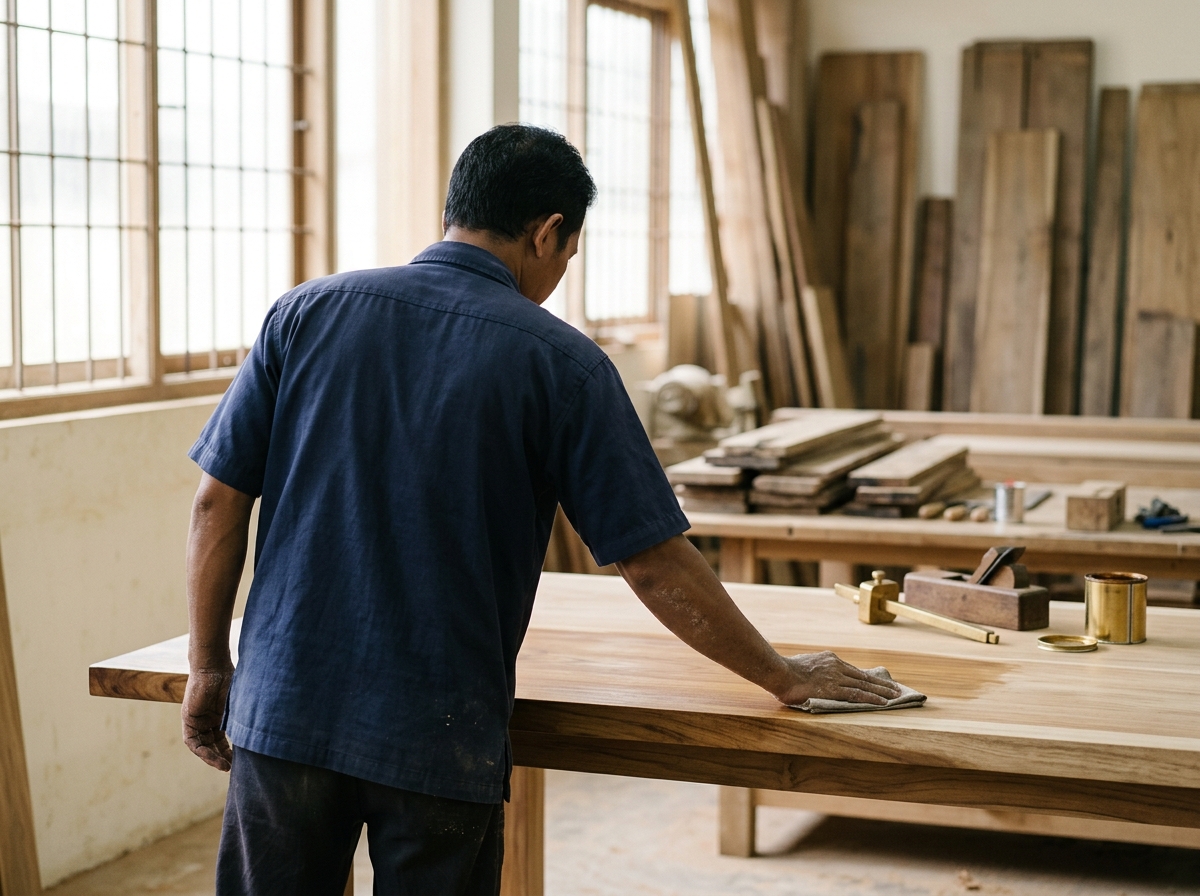
Teak grown in Java is widely recognized as among the finest in the world — dense, naturally oily, and highly resistant to outdoor conditions. Mahogany, rattan, and reclaimed wood round out an material palette that no single competitor country can replicate. These materials are not merely aesthetic differentiators; they justify retail price points that make Indonesian furniture genuinely profitable for US importers when the supply chain is managed correctly.
The Post-Tariff Cost Equation
Under the post-2018 US-China trade environment, Chinese furniture exports to the US face Section 301 tariffs that can add significantly to landed cost. Indonesian furniture typically enters under more favorable terms (see the trade compliance section below), giving Indonesian producers a structural price advantage on many product categories. For US importers running margin-sensitive programs, this differential can be decisive.
What a Furniture Sourcing Agent in Indonesia Actually Does
The term "sourcing agent" is used loosely in trade circles. Understanding the precise service scope is essential before you can evaluate whether an agent is worth the fee — or whether a specific agent is even qualified to protect your order.
Core Operational Services
A qualified furniture sourcing agent Indonesia provides, at minimum, the following:
Supplier identification and shortlisting. An experienced agent maintains active relationships with verified factories across Jepara, Bali, Surabaya, and other clusters. Rather than a cold search through Alibaba or trade directories, they match your product specification, price target, and volume to factories they have physically visited and vetted.
Sample development and specification management. Agents translate buyer briefs into factory-legible tech packs, manage sample rounds, and document deviations before you approve production. This step alone eliminates a large share of end-of-production disputes.
Factory audit. A proper furniture factory audit Indonesia goes beyond a checklist. It verifies whether the factory is a full-cycle operation — owning its own lumber yard, kiln-drying facility, CNC equipment, finishing line, and packaging capability — or an assembly-only operation that outsources critical steps and cannot control material quality or moisture content. Assembly-only factories frequently cause warping, splitting, and edge delamination on furniture shipped to US markets with central heating or air conditioning.
Pre-shipment quality control inspection. Agents conduct in-person QC at the production and pre-loading stages, using documented inspection reports with photo evidence. This is the mechanism that catches defects before the container is sealed.
Order management and communication. Time-zone gaps and language differences create real production friction for US buyers dealing with Indonesian factories directly. An on-ground agent handles daily follow-up, escalates delays, and translates both language and business culture.
Packaging and labeling compliance. US customs and retail compliance requirements around labeling, carton marking, and documentation are specific. A competent agent ensures these are met before goods leave the factory.
Buying Direct From Indonesian Manufacturers: Real Pros and Cons
Direct purchasing from Indonesian factories is not inherently wrong. For some buyers, in some situations, it is the right strategy. But the risks are specific and quantifiable, and they need to be weighed honestly.
Where Direct Buying Genuinely Works
The primary argument for direct buying is margin. When order volumes are high — typically multiple containers per SKU — a direct factory relationship eliminates the agent commission layer, which commonly runs between approximately 3% and 10% of FOB value. At scale, that percentage represents real money.
Direct relationships also give experienced importers greater control over product development, exclusivity arrangements, and long-term pricing. Buyers who have already established trusted factory partners through several agent-assisted orders often transition to direct purchasing precisely because the groundwork has been laid.
Where Direct Buying Creates Serious Risk
For buyers who have not physically visited a factory or worked with it previously, direct purchasing carries compounding risks.
Unverified factory capability. Without a physical audit, you cannot confirm whether a factory is a full-cycle producer or an assembly-only operation. Many Indonesian factories present well online but subcontract core production steps. This is one of the most common sources of quality failures on first orders.
Specification inconsistencies. Without local oversight, production deviations accumulate across a run. A 2mm dimensional variance on a chair leg may seem minor until 200 units arrive that do not stack correctly or fit specified packaging.
No pre-shipment inspection. Without a local agent or independent inspector, defects are discovered at the US port or — worse — by the end customer. Rework and claims at that stage typically cost multiples of what a pre-shipment inspection would have cost.
Language and time-zone friction. Indonesian factory managers are generally responsive, but technical communication in English across a 12-to-13-hour time difference is genuinely difficult. Misunderstood specs are a leading cause of production failures.
Payment term exposure. Indonesian factories typically require a deposit of approximately 30% to 50% against order confirmation. Without local presence and ongoing production oversight, you are exposed if a factory deprioritizes your order or substitutes materials.
Using an On-Ground Agent: Cost Structure and Hidden Value
Understanding agent economics is the prerequisite to evaluating whether the fee is justified. The calculation is more straightforward than most buyers expect.
How Agents Structure Their Fees
Most furniture sourcing agents in Indonesia charge in one of two ways:
Commission on FOB value — typically in the range of approximately 3% to 10%, varying by order size, complexity, and the scope of services included. Larger, more commercially sophisticated agents tend toward the lower end of this range on higher-value orders.
Flat retainer or project fee — more common for defined-scope engagements such as a factory audit, a single production run with QC, or a new supplier search project. This model is often preferred by buyers who want cost certainty.
Some agents blend both: a reduced commission plus discrete fees for specific services like factory audits or inspection reports.
Quantifying the ROI: Agent Fee vs. Defect Cost
Consider a representative scenario: a US buyer orders approximately 300 units of solid teak dining chairs at an FOB value in the range of $50,000. An agent charging 5% costs roughly $2,500 for the engagement.
A pre-shipment inspection that catches a finish defect affecting 40% of units — requiring rework — saves costs that can include: rework at destination (typically far more expensive than at-factory rework), freight for replacement units, customer claims, and loss of reorder. Even a modest defect rate on a $50,000 order quickly generates costs that exceed the agent fee by a significant multiple. The agent fee in this scenario is not a cost — it is insurance with a high probability of positive return.
Speed as a Real Value Driver
Experienced agents accelerate supplier shortlisting from what can be weeks of email correspondence to days of direct factory contact. In a market where lead times run approximately 60 to 120 days and production slots fill seasonally, faster shortlisting has a real commercial value that does not appear in the commission line but affects delivery and sales cycles.
How Indonesia Tariffs and Trade Compliance Rules Affect Your Sourcing Decision
This is the area most sourcing guides ignore entirely, but it materially affects your landed cost calculation and your compliance exposure.
Indonesia Tariffs and HTS Code Basics
Indonesian furniture enters the US under Chapter 94 of the Harmonized Tariff Schedule. The applicable HTS codes vary by product type — wooden seats, bedroom furniture, case goods, and outdoor furniture each carry specific subheadings. General duty rates for Indonesian furniture have historically been in the range of approximately 0% to 7%, depending on the specific HTS code — a significant advantage over Chinese furniture subject to Section 301 tariffs that can reach 25% or higher on equivalent products.
However, these Indonesia tariff advantages are only captured if your goods correctly classified and if country-of-origin documentation is clean. US Customs and Border Protection (CBP) scrutinizes country-of-origin claims on furniture carefully, particularly when materials may have passed through third countries.
An experienced furniture sourcing agent Indonesia can help ensure that your supplier's export documentation — commercial invoice, packing list, certificate of origin — accurately reflects Indonesian origin and withstands CBP review. This is not a theoretical risk; CBP has issued penalties on furniture importers whose documentation was insufficient to support claimed origin.
CARB Compliance and Formaldehyde Regulations
If your furniture contains composite wood components — MDF, plywood, particleboard — you must comply with California Air Resources Board (CARB) Phase 2 regulations on formaldehyde emissions. CARB compliance is required not just for California sales; major national retailers require it as a baseline standard.
Indonesian factories vary widely in their ability to supply CARB-compliant panels and to document compliance properly. An on-ground agent with QC experience will confirm panel sourcing, request mill certificates, and ensure that CARB compliance documentation is in order before production is completed. A direct buyer who does not ask the right questions at the sample stage often discovers the gap only when a retailer requires documentation.
Lacey Act Considerations for Teak and Hardwood
The Lacey Act, enforced by US Fish and Wildlife Service and CBP, requires that wood products imported into the US be accompanied by a declaration of the scientific name and country of harvest of the wood used. For teak furniture sourced from Jepara, this means your supplier must be able to document that teak originates from legal, certified sources — typically Indonesian government-sanctioned plantation teak.
Lacey Act violations carry significant penalties. An agent who regularly works with teak suppliers will know which factories maintain the required documentation chain and which cannot demonstrate legal harvest origin. This is a meaningful due-diligence function that a direct buyer without local expertise is poorly positioned to perform.
How to Vet a Furniture Sourcing Agent in Indonesia: A Practical Step-by-Step Process
The quality variance among Indonesian sourcing agents is wide. The following steps reduce the risk of engaging an underqualified or misaligned partner.
Step 1: Confirm Physical Presence in the Right Clusters
An agent who claims to cover Jepara but is based exclusively in Jakarta is not providing the on-ground access that justifies the fee. Verify that the agent or their team physically operates in the manufacturing clusters relevant to your product category. Ask for office addresses and visit them on Google Street View as a baseline check.
Step 2: Request References From US or EU Importers
A qualified agent will provide references from current or recent Western importer clients. Contact those references directly and ask specific questions: Did the agent conduct factory audits in person? Were QC reports delivered before shipment? Were there production problems, and how did the agent handle them?
Step 3: Evaluate QC Inspection Methodology
Ask to see a sample inspection report. A professional report includes: pre-defined AQL (Acceptable Quality Level) sampling criteria, photographic evidence of defects found, dimensional measurement records, and a clear pass/fail recommendation. Vague reports that simply state "quality is acceptable" are a red flag.
Step 4: Clarify Fee Structure and Legal Agreement
A legitimate agent will provide a written service agreement that specifies: scope of services, fee basis, payment schedule, confidentiality obligations, and what happens if goods fail inspection. Agents who resist putting terms in writing or who have vague, verbal fee arrangements should be disqualified. In Indonesia, written agreements are enforceable and standard practice among professional service providers.
- ✓Physical presence confirmed in Jepara, Bali, or relevant cluster
- ✓US or EU importer references provided and contacted
- ✓Sample QC inspection report reviewed and evaluated
- ✓Factory audit capability confirmed with methodology explained
- ✓Fee structure in writing — commission basis or flat fee clearly stated
- ✓Written service agreement reviewed before engagement
- ✓No hidden supplier-side commissions or undisclosed factory relationships
- ✓Lacey Act and CARB documentation capability confirmed
Red Flags That Should End the Conversation
- Agent cannot name specific factories they have audited in the past 12 months - No written fee agreement offered - Claims to represent "all furniture categories" across all of Indonesia with no specialization - Reluctant to provide references - Offers unusually low fees with vague service descriptions
Direct Buy vs. Agent: A Decision Framework Matched to Your Order Profile
The right answer is not the same for every buyer. The framework below helps you match the decision to your actual situation.
Order Value Thresholds and Risk Tolerance
For first orders with a new Indonesian supplier, virtually no order is too small to benefit from agent involvement. The risk of an unaudited first order — regardless of dollar value — is high enough that agent fees are nearly always justified.
For repeat orders with established, audited suppliers, direct buying becomes progressively more rational as volume grows. Many experienced importers use a hybrid model: engage an agent for the first two or three orders with a new factory, then transition to direct purchasing once the factory relationship is proven and the production process is understood.
For high-volume, multi-container programs with existing vetted suppliers, direct purchasing with periodic independent QC inspections is a standard and cost-effective model.
When Even Experienced Importers Need an Agent
- Entering a new product category or material type - Working with a factory in an unfamiliar cluster (e.g., a China-focused importer expanding into Jepara) - Navigating a compliance-sensitive material such as teak (Lacey Act) or composite wood (CARB) - Managing a custom product development project that requires multiple sample rounds and close production oversight
Comparison Table: Direct Buy vs. On-Ground Agent
| Decision Factor | Direct From Manufacturer | On-Ground Sourcing Agent |
|---|---|---|
| Upfront cost | Lower — no agent fee | Higher — commission 3–10% of FOB |
| Factory verification | Buyer's responsibility; high risk if unaudited | Agent conducts physical audit |
| Quality control | No local oversight unless buyer arranges independently | Integrated pre-shipment QC |
| Language and communication | Significant friction risk | Agent bridges language and culture |
| Compliance (CARB, Lacey Act) | Buyer must self-manage; documentation gaps common | Agent verifies documentation chain |
| Speed of supplier shortlisting | Slow — cold outreach and directory research | Fast — existing verified factory relationships |
| Best suited for | High-volume repeat orders with proven factories | New suppliers, first orders, complex products |
| Risk level on first order | High | Low to moderate |
| Hybrid model possible? | Yes — after agent-assisted first orders | Yes — transition to direct once factory is proven |
Frequently Asked Questions
How much does a furniture sourcing agent in Indonesia typically charge?
Most agents charge a commission of approximately 3% to 10% of the FOB value of the order, with the rate depending on order size, service scope, and the agent's market position. Some agents offer flat project fees for defined-scope work such as factory audits or supplier searches. Always obtain a written fee agreement before engagement.
Is it safe to buy furniture directly from Indonesian factories without an agent?
It depends on your experience and the factory's track record with you. For first orders with unaudited factories, the risk of quality failures, spec deviations, and documentation gaps is meaningfully high. For repeat orders with verified factories you have audited and worked with successfully, direct buying is often both safe and cost-effective.
What is the difference between a sourcing agent and a trading company in Indonesia?
A sourcing agent works in your interest for a fee — they do not buy or resell goods. A trading company buys goods in its own name and resells them to you, adding its margin to the price. Agents typically offer greater transparency into factory pricing and production, while trading companies take on more risk but also more control. For buyers who want full price transparency and factory access, an independent agent is generally preferable.
How do Indonesia furniture tariffs affect landed cost for US importers?
Indonesian furniture benefits from lower US import duty rates compared to Chinese furniture subject to Section 301 tariffs. Most wooden furniture HTS codes for Indonesian-origin goods carry general MFN duty rates in the range of approximately 0% to 7%. The difference versus equivalent Chinese-origin goods subject to additional tariffs can represent a significant landed cost advantage — but only if country-of-origin documentation is correctly prepared and withstands CBP review.
Which Indonesian cities are the best hubs for furniture sourcing?
Jepara is the primary hub for solid wood furniture — teak, mahogany, and reclaimed wood. Bali is the center for luxury artisan and resort furniture. Surabaya serves the mid-market volume segment. Cirebon is a key cluster for rattan furniture. The right hub depends entirely on your product category and positioning.
Can a sourcing agent help with custom furniture design and product development?
Yes, and this is one of the strongest use cases for agent engagement. A qualified agent manages the full product development cycle: translating design briefs into factory-legible specifications, coordinating sample production across one or multiple factories, documenting revision rounds, and ensuring the approved sample is used as the binding production standard. For custom or private-label programs, this function is critical to maintaining design integrity.
Choosing between direct buying and agent-assisted procurement is not a permanent decision — it is a strategy that should evolve as your factory relationships mature and your Indonesian sourcing program scales. Start with verified agents, build the compliance documentation baseline, and transition to direct purchasing from proven partners when the volume justifies it.
You now understand the cost structures, the compliance obligations, the quality risks, and the decision thresholds that separate profitable Indonesian furniture sourcing from expensive mistakes. The next step is putting the right partner on the ground.
You understand the risks of unverified factories, the compliance requirements, and the value a qualified on-ground partner delivers. Now connect with a sourcing partner who has physical presence across Jepara, Bali, and Surabaya — and the factory audit, QC inspection, and export management capability to protect your order from sample to shipment.
Start Your Indonesia Sourcing Inquiry →Need eyes on the ground in Indonesia?
MTS is an execution partner — supplier verification, manufacturing management, quality control and export logistics across Indonesia, Vietnam and China.
Related services
Related articles
Receive furniture sourcing insights across Asia.
One email per week. No spam.