Hotel Chain Franchise Furniture Program Brand Standards: A Complete Guide
14 min read

Franchise hotel owners face a specific operational problem: franchisor brand standards for FF&E are written for design intent, not for factory floors. The gap between a brand standards manual PDF and a production-ready shop drawing is where compliance failures begin. Sourcing furniture without…
Franchise hotel owners face a specific operational problem: franchisor brand standards for FF&E are written for design intent, not for factory floors. The gap between a brand standards manual PDF and a production-ready shop drawing is where compliance failures begin. Sourcing furniture without bridging that gap produces rejected samples, failed inspections, and Property Improvement Plan delays that threaten the franchise flag itself.
This guide covers the full procurement cycle, from parsing mandatory franchisor specifications to multi-property consistency. It also covers building an attic stock program around Indonesian-manufactured furniture. It is written for procurement teams and franchise owners who need precision, not generalizations. Every section connects brand standard requirements to factory-level decisions and supply chain mechanics.
Indonesia sits at the center of this guide's sourcing framework. Indonesian manufacturers — particularly in Jepara, Semarang, and Bali — specialize in solid-wood hospitality furniture. These are the categories major chains typically require. Aligning Indonesian production capabilities with US franchisor compliance workflows is a competency gap. This guide closes that gap directly.
What Hotel Franchise Furniture Program Brand Standards Actually Require
Brand standards in the FF&E context are not aesthetic guidelines. They are binding contractual specifications. Franchisors define acceptable materials, finish systems, dimensional envelopes, and joinery methods. They also set durability ratings and in some cases approved vendor lists. Non-compliance is not a design disagreement — it is a contract breach.
Mandatory Specifications vs. Approved Alternates
Most major chain brand standards documents distinguish two tiers of specification:
- Mandatory specifications: Fixed requirements with no substitution. These typically cover structural dimensions, durability ratings (BIFMA for seating, for example), fire-retardant requirements (CAL 117 for upholstered items sold into California), and finish durability minimums. - Approved alternates: A list of pre-vetted substitutions franchisors accept. These give procurement teams flexibility on species, hardware grade, or finish color within defined parameters.
Knowing which tier a specification falls into determines how much flexibility your factory partner has.
How Major Chains Structure Their Standards Documents
Marriott International, Hilton Hotels & Resorts, IHG (InterContinental Hotels Group), and Wyndham Hotels & Resorts each publish brand standards through proprietary portals. Access is typically gated to franchisees and approved vendors.
| Chain | Document Type | Update Frequency | Key FF&E Sections |
|---|---|---|---|
| Marriott International | Brand Standards Manual (per brand) | Periodic revision cycles | Room FF&E, material specs, finish boards |
| Hilton / Hampton by Hilton | Design & Construction Standards | Brand-specific cadence | Guestroom, corridor, public area FF&E |
| IHG | Brand Standards Portal | Rolling updates | FF&E schedules, approved alternates |
| Wyndham Hotels & Resorts | Franchise Disclosure Document + Standards Manual | Annual + interim | PIP requirements, FF&E matrices |
Each chain segments standards by brand tier. Hampton by Hilton operates differently from Waldorf Astoria. Wyndham's mid-scale brands carry different requirements from their upper-midscale portfolio. Always source the brand-specific document, not the parent company's general standards.
Why Non-Compliance Creates Serious Financial Risk
A failed brand inspection triggers a formal cure period. Repeated failures escalate to potential flag termination. Beyond flag risk, non-compliant FF&E found during a PIP audit forces replacement at the franchisee's cost. Replacement is often required on accelerated timelines. The financial exposure is significant. It includes replacement furniture, expedited freight, and potential lost revenue during remediation. Compliance is cheaper than correction.
Translating Franchisor Spec Sheets Into Factory-Ready Documents
This is the manufacturing bridge that most procurement guides skip entirely. A brand standards PDF is written for architects and interior designers. An Indonesian factory needs a different document format entirely.
Converting Brand PDFs Into Bill-of-Materials and Shop Drawings
A typical Marriott or IHG FF&E specification sheet includes: - Finish color reference (often a proprietary brand code or Benjamin Moore / Sherwin-Williams equivalent) - Overall dimensions (width × depth × height) - Material category (e.g., "solid hardwood case construction") - Hardware specification (drawer slide rating, pull finish) - Upholstery requirements (COM yardage, rub count, fire rating)
None of that is sufficient for a factory in Jepara to begin production. The procurement team — or their sourcing partner — must translate it into:
- Bill of Materials (BOM): Species by component, board thickness, hardware part numbers, finish product codes - Shop Drawings: Dimensioned elevations, joinery details (mortise-and-tenon vs. dowel vs. pocket screw), section cuts through drawer and door assemblies - Finish System Specification: Number of coats, application method (spray vs. wipe), sheen level (measured by gloss meter), topcoat type (lacquer, polyurethane, UV-cure)
Concrete example: A brand standard specifies "medium walnut stain, satin finish, solid wood case." The factory-ready document specifies: mahogany substrate (approved alternate for walnut grain character), Sherwin-Williams Fast Dry Wood Stain WB equivalent mixed to Pantone 8003C, satin finish at 25–35 GU (gloss units measured at 60°), two-coat sealer plus two-coat topcoat system, dry film thickness minimum 3 mils per coat.
Critical Specification Elements for Indonesian Factories
| Element | Brand Standard Language | Factory Document Language |
|---|---|---|
| Wood species | "Solid hardwood" | Mahogany (Swietenia macrophylla), 8–10% MC |
| Joinery | "Commercial grade construction" | Double mortise-and-tenon, 38mm depth, glued and pinned |
| Finish | "Warm walnut, satin" | PU lacquer, 25–35 GU, Pantone reference provided |
| Hardware | "Grade 4 drawer slide" | 100lb-rated undermount, full extension, soft-close |
| Tolerances | Not stated | ±1.5mm on overall dimension, ±0.5mm on drawer gap |
Dimensional Tolerances and Documentation
Indonesian factories working in hospitality-grade production should document tolerances formally. A tolerance sheet becomes part of the approved production record. Franchisors increasingly require this documentation during pre-production sample approval. A master specification matrix maps each brand requirement to the corresponding factory capability confirmation. It is the single most useful document a procurement team can maintain.
Navigating the Franchisor Furniture Approval Workflow Step by Step
Understanding who approves what, and when, prevents the most common delay in hotel chain franchise furniture program brand standards compliance.
Typical Approval Stages
1. Design Intent Submission: CAD drawings and material callouts submitted to the brand design team. No physical sample required at this stage. 2. Sample Approval: Physical prototype reviewed against spec. Finish boards, hardware samples, and upholstery memo samples submitted simultaneously. 3. Pre-Production Sign-Off: Approved sample locked as the production standard. Factory retains the signed-off sample. Changes after this point require a new approval cycle. 4. Final Inspection / Pre-Shipment: Third-party or brand-appointed inspector verifies production units match the approved sample.
Who Holds Approval Authority
Brand design teams at the corporate level set the standards. Regional brand managers may have authority to approve alternates for specific markets. For major PIPs, corporate design team sign-off is typically required regardless of regional relationships. Knowing the approval hierarchy prevents wasted sample submissions routed to the wrong contact.
Required Documentation Franchisors Demand
- Finish boards: Physical panels showing stain color, grain character, and topcoat sheen — typically 12" × 12" minimum - Mock-up room photos: Full room set installed per brand planogram, photographed with brand-specified lighting - Third-party test reports: BIFMA X5.1 (for seating), BIFMA X5.4 (for lounge/stacking), CAL 117 (for upholstered items), ASTM E84 (surface burning in some jurisdictions) - FSC Chain of Custody certificate: Required by several chains for wood components, especially when sourcing from Indonesia
Common Rejection Reasons and How to Prevent Them
- Finish color outside the approved tolerance range — use a spectrophotometer, not visual matching - Structural test reports missing or expired — BIFMA reports have defined validity windows - Species substitution not pre-approved — get written approval before sampling - Hardware grade not documented — submit hardware spec sheets with the sample package
Sourcing Brand-Standard Hotel Furniture From Indonesian Manufacturers
Indonesia is a primary sourcing destination for solid-wood hospitality furniture for documented reasons. Indonesia's furniture cluster in Jepara, Central Java, concentrates teak and mahogany production capability. This capability operates at commercial scale. Semarang handles mid-market outdoor and contract hospitality. Bali serves the luxury artisan segment.
Why Indonesian Factories Suit Hospitality-Grade Specifications
Indonesian manufacturers offer: - Teak: Naturally high oil content, dimensional stability, insect resistance — well-suited to beach resort and coastal hospitality environments - Mahogany: Consistent grain, accepts stain systems predictably, widely used as a cost-effective solid-wood alternative - Rubberwood: Increasingly common for budget-tier and mid-scale hotel specifications
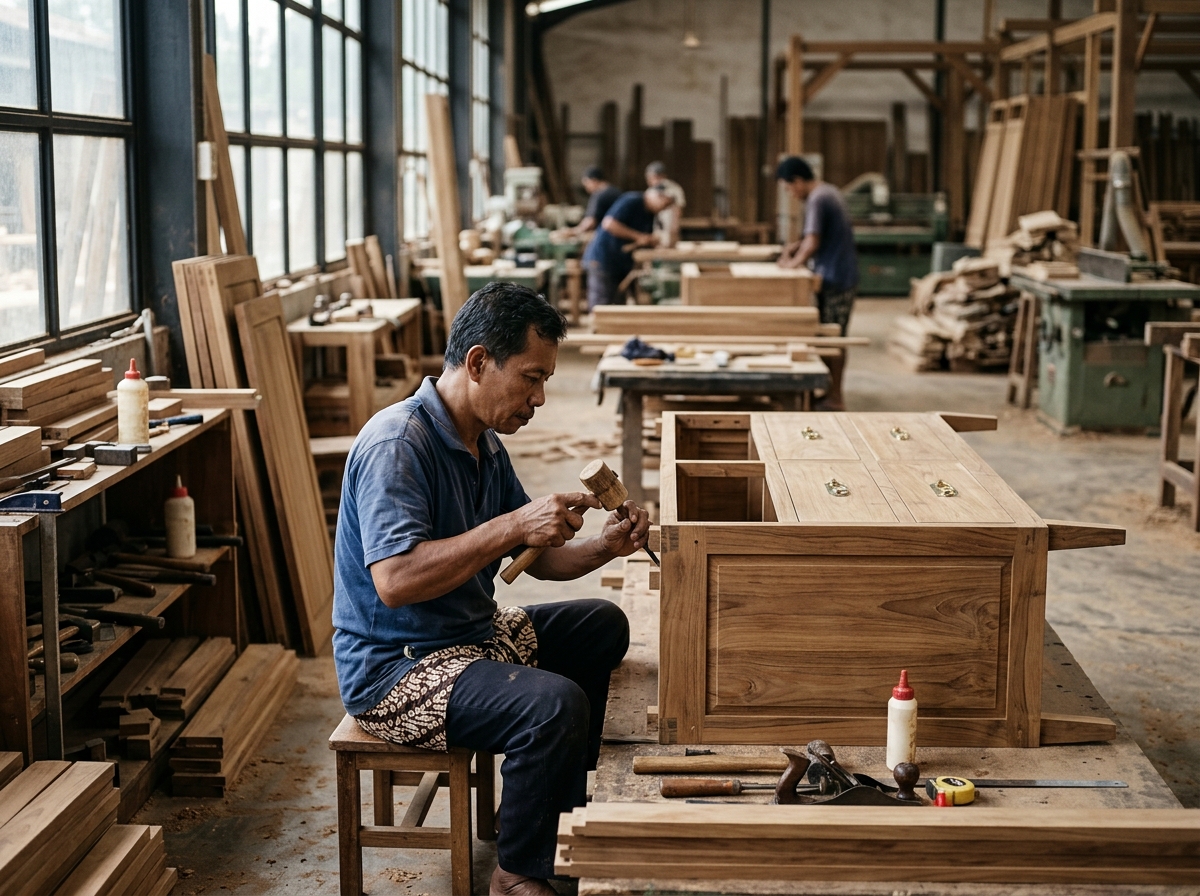
The mid-sized export-oriented factories in Jepara — typically 100 to 500 workers — are the most relevant for hotel furniture programs. They hold stable client relationships and maintain dedicated finishing lines. They can also document production processes to the level franchisors require.
Factory Audit Requirements Franchisors May Impose
Several major chains require — or strongly recommend — factory audits covering: - Social compliance: Worker conditions, wage compliance, no forced or child labor (often verified against SA8000 or equivalent) - FSC Chain of Custody certification: Verifies timber originates from responsibly managed forests - Environmental compliance: Finish system solvent management, waste disposal
Franchisees sourcing from Indonesia should verify these certifications before sample submission, not after.
Lead Time Planning Against PIP Deadlines
Indonesian factory lead times for hospitality case goods typically run 90 to 120 days from approved pre-production sample to container loading. Add approximately 30 days for ocean freight to US West Coast ports, plus inland transit. Total origin-to-property lead time commonly reaches 150 to 180 days.
PIP deadlines from franchisors are typically fixed. Back-calculate from the compliance deadline — not from the order date.
| Milestone | Typical Duration |
|---|---|
| Factory spec translation + sample production | 30–45 days |
| Brand approval cycle (sample + revisions) | 30–60 days |
| Pre-production approval + production run | 60–90 days |
| Ocean freight (Indonesia to US West Coast) | 25–35 days |
| US inland transit + final delivery | 7–21 days |
Quality Control Milestones in Indonesian Production
- Pre-production sample: First unit built to approved spec. Inspected by buyer or third-party QC firm before full production begins. - Mid-production inspection (DUPRO): Conducted when approximately 20–30% of the production run is complete. Catches systemic defects early. - Pre-shipment inspection (PSI): Final verification of finished goods before container loading. Covers dimensions, finish, hardware function, and quantity.
Maintaining Furniture Consistency Across a Multi-Property Franchise Portfolio
Portfolio-level consistency is one of the most underaddressed challenges in franchise management. This applies specifically to hotel chain furniture program brand standards. A single approved item built identically across twelve properties requires deliberate systems.
Approved Item Library and Version Control
Maintain a master item library: every approved furniture SKU with its full specification document, approved finish board photos, and the factory production record attached. When a brand standard updates mid-procurement cycle, the library flags which active orders are affected. Without version control, a portfolio can simultaneously operate under two incompatible specifications. This creates a compliance risk during brand inspections.
Centralized vs. Property-Level Purchasing
| Approach | Advantages | Risks |
|---|---|---|
| Centralized procurement | Consistent spec, volume pricing, single factory relationship | Slower response to property-level urgent needs |
| Property-level purchasing | Faster local decisions | Spec drift, unauthorized substitutions, brand compliance exposure |
For portfolios of three or more properties under the same brand flag, centralized procurement is strongly preferable. A single Indonesian factory partner is the recommended approach. Volume consolidation also supports meaningful price negotiation.
Building a Re-Order Program and Attic Stock Strategy for Indonesian-Sourced Hotel Furniture
Attic stock is a franchisor-required or franchisor-recommended reserve of furniture and FF&E components. It is held on-property or in a nearby warehouse for in-kind replacement. The strategic case for attic stock is straightforward. A broken headboard replaced with a non-matching unit creates a compliance deficiency. Brand inspectors note it. Cure notices follow.
Calculating Attic Stock Quantities
Calculate attic stock per room type based on replacement frequency patterns for each item category. High-contact items — desk chairs, luggage racks, upholstered headboards — turn over more frequently than case goods. A reasonable starting framework:
- Upholstered seating: stock approximately 5–10% of total room count per category - Case goods (dressers, nightstands, desks): stock approximately 2–5% - Headboards: stock approximately 5%, higher for properties with active guest programs
These are approximate guidelines. Actual quantities depend on property age, occupancy rates, and historical damage records.
Locking Production Runs With Indonesian Factories
The critical attic stock risk with overseas sourcing: a factory discontinues a finish, changes a hardware component, or closes entirely. The replacement units no longer match the installed product. Lock attic stock into a production run agreement with the factory — same finish batch, same hardware spec, same substrate — before the main production run closes. Factories in Jepara and Semarang with hospitality export experience understand this requirement. They can accommodate it with appropriate lead time.
Warehousing and Logistics for US-Based Attic Stock
- Use a third-party logistics (3PL) provider with furniture-specific handling capabilities - Require furniture-grade packaging (corner protection, moisture barriers) from the factory - Label each carton with property code, room type, item SKU, and production batch number - Store headboards and upholstered items vertically to prevent compression damage
Triggering Re-Orders Before Standards Lapse
Monitor the brand's standards update calendar. When a brand announces a specification revision, assess the remaining attic stock quantity against the transition timeline. Place a re-order before the old specification is formally retired. This locks in brand-compliant replacement stock for the transitional period. It also avoids emergency sourcing under compressed timelines.
Cost Management and ROI of a Brand-Compliant Franchise Furniture Program
The total cost of Indonesian-sourced hotel furniture extends beyond factory price. A complete cost model includes:
| Cost Element | Notes |
|---|---|
| Factory (FOB) price | Basis for all cost comparisons |
| Third-party QC (DUPRO + PSI) | Typically charged per inspection day |
| Ocean freight (FCL, Indonesia to US) | Varies by port pair and market conditions |
| US import duty | Dependent on HTS classification; verify current tariff schedule |
| Drayage and inland freight | Port to warehouse or property |
| Warehousing (attic stock) | Monthly per-pallet cost at 3PL |
| Duty drawback potential | If items are re-exported; consult a licensed customs broker |
Brand-compliant FF&E reduces guest satisfaction penalties over time. Consistent, well-maintained furniture contributes to brand score metrics. Those metrics directly affect franchise fee structures at some chains. Franchisors commonly expect 7 to 10 years depreciation for case goods and 5 to 7 years for upholstered items — approximate industry norms. These schedules should anchor capital planning decisions.
Volume pricing negotiation across a multi-property portfolio is one of the strongest cost levers available. A single Indonesian factory partner enables this negotiation. Consolidating three or more properties into a single annual production program typically supports meaningful per-unit price improvement. This applies across the consolidated portfolio. This compares favorably to property-by-property ordering.
Pre-Submission Checklist Before Sending Furniture Samples for Brand Approval
- ✓Finish board submitted: 12x12 minimum, matching production sample
- ✓Physical prototype matches approved shop drawing dimensions within tolerance
- ✓BIFMA test report current and applicable to item category
- ✓CAL 117 report included for all upholstered items
- ✓FSC Chain of Custody certificate attached (if required by brand)
- ✓Hardware spec sheet included with grade rating
- ✓Species and substrate documented in writing
- ✓Dimensional tolerance sheet signed by factory QC manager
- ✓Mock-up room photography completed per brand planogram
- ✓Submission routed to correct approval authority (corporate vs. regional)
Build a minimum 60-day buffer between sample submission and your PIP compliance deadline. Brand approval cycles rarely run faster than approximately 30 days even when submissions are clean. Revision cycles add time. Factor in shipping time for physical samples traveling from Indonesia to US brand offices.
When an approval stalls inside the franchisor's design team, escalate through the franchisee's regional brand manager. Document all submission dates and communications in writing. Franchisors generally recognize that approval delays on their side should not count against the franchisee's cure period — but only if the timeline is documented.
Frequently Asked Questions About Hotel Franchise Furniture Brand Standards
What are hotel brand standards and what do they cover for furniture? Hotel brand standards are contractual specifications that define acceptable FF&E materials, dimensions, finishes, durability ratings, and installation requirements. They cover mandatory requirements (non-negotiable) and approved alternates (pre-vetted substitutions). Non-compliance triggers cure notices and, in repeated cases, franchise agreement termination.
What are Marriott brand standards for FF&E and furniture? Marriott International publishes brand-specific standards documents through a gated portal accessible to franchisees. Standards vary by brand tier — Marriott Bonvoy's portfolio covers brands from Courtyard to Ritz-Carlton, each with separate FF&E requirements. Typically covered: room furniture dimensions, finish system specifications, upholstery rub counts, hardware grades, and fire ratings.
What are IHG brand standards for franchise hotel furniture programs? IHG (InterContinental Hotels Group) publishes brand standards through its franchisee portal. Requirements differ across IHG's portfolio (Holiday Inn, Holiday Inn Express, Crowne Plaza, InterContinental). FF&E sections typically specify approved case good construction, finish families, and performance ratings. IHG has periodically updated standards to include sustainability sourcing preferences.
What are Wyndham hotel brand standards and how are they enforced? Wyndham Hotels & Resorts enforces brand standards through property inspection programs. Deficiencies identified during inspections generate formal cure notices with defined remediation timelines. Wyndham's mid-scale brands (La Quinta, Baymont, Microtel) carry their own FF&E specifications. Franchisees access standards through Wyndham's franchisee support platform.
How does the franchisor furniture approval process work from submission to sign-off? The process runs in four stages: design intent submission, physical sample review, pre-production sign-off, and pre-shipment inspection. Approval authority sits primarily with the brand's corporate design team. Regional brand managers sometimes hold delegated authority for alternates. Documentation requirements include finish boards, structural test reports, and FSC certificates where applicable.
What is attic stock and why is it required in hotel franchise furniture programs? Attic stock is a reserved inventory of brand-approved replacement furniture held on-property or in nearby storage. It exists to ensure damaged or worn items can be replaced in-kind — with an identical approved unit — rather than with a non-compliant substitute. Some franchisors formally require attic stock quantities. Others recommend it as a compliance risk-management practice.
Executing hotel chain franchise furniture programs at scale demands three parallel workstreams. First, brand documents must translate precisely into factory drawings without specification drift. Second, a disciplined approval workflow with documented timelines and an attic stock re-order program must prevent compliance gaps between production cycles. Indonesian manufacturers — particularly in Jepara and Semarang — offer solid-wood hospitality capability. This works provided procurement is structured around their lead times and documentation requirements.
You now understand how franchisor specifications translate into factory-ready documents. You also know how to manage the full compliance lifecycle from PIP deadline to attic stock replenishment. The natural next step is engaging a manufacturing partner who operates in this ecosystem daily.
Our team specializes in translating US franchisor FF&E specifications into production-ready documents for Indonesian factories — covering solid-wood case goods, finish system matching, third-party test report coordination, and multi-property attic stock programs. Tell us your brand, your PIP timeline, and your property count.
Request a Brand-Compliant FF&E Quote →Supplying a complete project from Asia?
MTS runs turnkey procurement — sourcing, contracting, production, QC and consolidated delivery across furniture and building materials.
Related services
Related articles
Receive furniture sourcing insights across Asia.
One email per week. No spam.