Blockboard Manufacturers Indonesia Export: Complete Sourcing Guide for US Buyers
12 min read
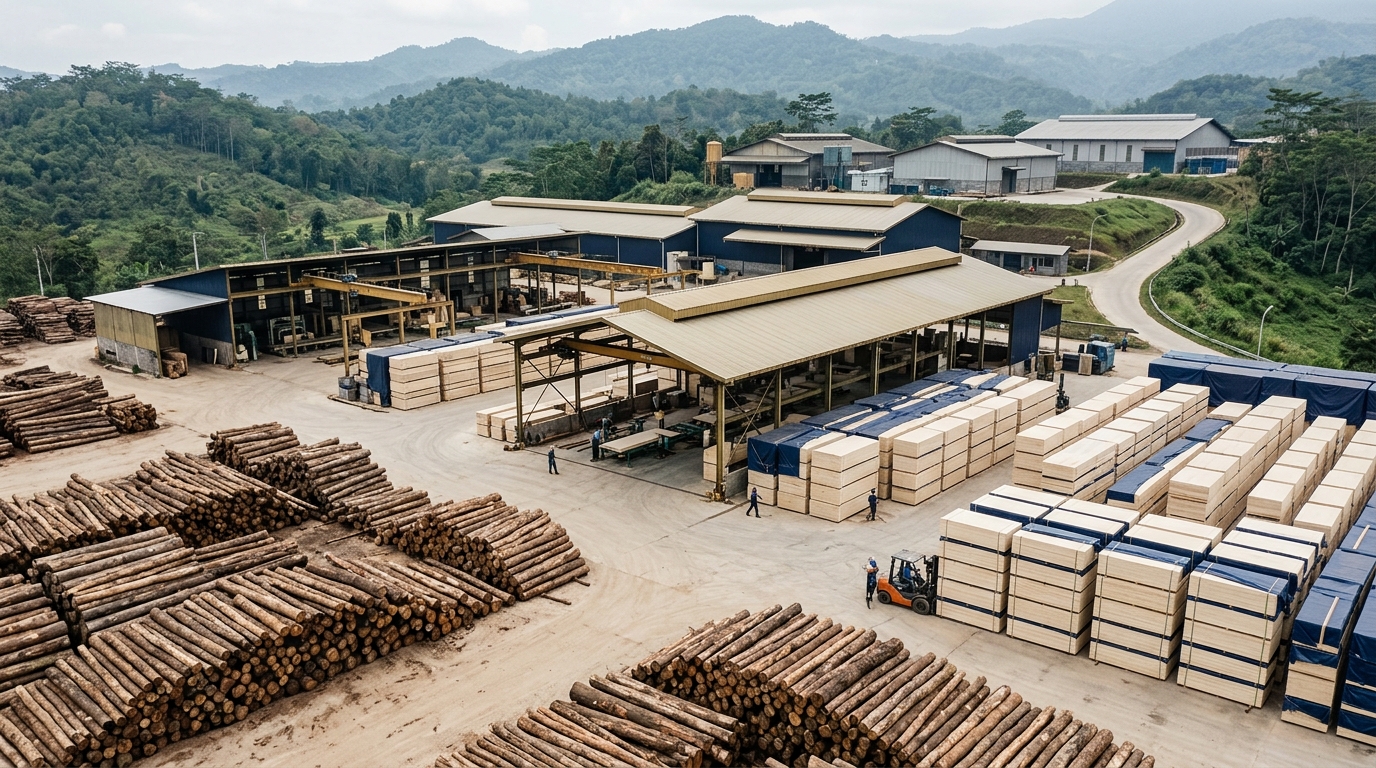
Indonesian blockboard has become a primary panel option for US furniture manufacturers and distributors looking to reduce material costs without compromising structural performance. The decision to source from Indonesia involves more than price. It requires understanding core species, emission…
Indonesian blockboard has become a primary panel option for US furniture manufacturers and distributors looking to reduce material costs without compromising structural performance. The decision to source from Indonesia involves more than price. It requires understanding core species, emission certifications, mill verification, and container economics before you commit to a first purchase order.
This guide covers every dimension of that decision. You will find technical construction details, grade classifications, a side-by-side comparison of blockboard versus plywood versus MDF, mill profiles, pricing structure, and a supplier vetting checklist. The information is written for procurement teams and panel buyers who need specifics, not generalities.
Indonesia's position in the global panel market rests on a combination of fast-growing plantation timber, competitive labor costs, and a well-developed export infrastructure concentrated in East Java, Central Java, and West Kalimantan. Understanding how those supply-side factors translate into product specifications and logistics is where sourcing decisions get made.
Why Indonesian Blockboard Dominates the Global Wood Panel Export Market
Blockboard is a structural panel built from solid wood core strips arranged edge-to-edge and bonded between a face veneer and a back veneer. The core strips run parallel to the panel's length. The face and back veneers run perpendicular. This cross-banded construction resists warping and delivers rigidity at lower weight than comparable solid wood.
Indonesia's competitive advantage in this category comes directly from Paraserianthes falcataria — commercially known as falcata or albasia. This plantation species reaches harvestable size in approximately five to eight years (approximate, varies by growing region and management practice). That rotation speed keeps raw material costs structurally lower than countries relying on slower-growing hardwoods.
Key producing regions include:
- East Java (Surabaya port hub): High mill density, strong export logistics infrastructure - Central Java (Semarang port hub): Major concentration of albasia plantation land and processing mills - West Kalimantan: Secondary production zone, more meranti-core product
The United States ranks among the top destination markets for Indonesian wood panel exports, alongside Japan, Australia, and several European markets. US import volumes have grown as furniture manufacturers seek alternatives to Chinese-sourced panels amid tariff pressure.
Core Construction: Falcata vs. Albasia and How Species Choice Affects Performance
Falcata and Albasia Are the Same Species
Falcata (Paraserianthes falcataria) and albasia refer to the same tree. The name varies by region and trading convention. Mills in Central Java commonly use "albasia." Export documents from some West Java operations use "falcata." When reviewing quotations, confirm the Latin species name to avoid ambiguity.
Falcata core properties relevant to US buyers:
- Density: Approximately 250–320 kg/m³ (low-density range, approximate) - Weight advantage: A standard 18mm sheet typically weighs noticeably less than a comparable plywood sheet — a meaningful factor for furniture assembly and freight cost - Workability: Machines cleanly; accepts screws reasonably well when core strips are properly dried and bonded - Warping resistance: Good when manufactured to correct moisture content (typically 8–14% MC at export)
Meranti and Eucalyptus Cores: Trade-offs to Know
Some mills substitute meranti or eucalyptus for core strips, particularly when falcata supply tightens or when buyers specify higher density. Meranti core increases sheet weight and generally improves screw-holding strength. Eucalyptus core is denser still and appears in product lines targeting structural applications.
Trade-offs:
| Core Species | Density (approx.) | Screw-Holding | Weight | Cost Signal |
|---|---|---|---|---|
| Falcata/Albasia | Low | Moderate | Light | Lower FOB |
| Meranti | Medium | Good | Medium | Mid-range FOB |
| Eucalyptus | Medium-high | Good-Strong | Heavier | Higher FOB |
Always specify core species explicitly in your purchase order. Vague specs allow mills to substitute without notice.
Face Veneer Options, Surface Grades, and Thickness Specifications for US Orders
Standard Face Veneers Available from Indonesian Mills
Indonesian blockboard manufacturers export sheets with a range of face veneer options:
- Okoume: Light, smooth, widely used for painted or primed surfaces - Pencil cedar: Aromatic, stable, popular for drawer bottoms and secondary surfaces - Meranti: Affordable, moderate grain, suitable for opaque finishes - White birch: Fine grain, natural appearance, used where a cleaner face is required - Teak overlay: Premium option for visible furniture surfaces
Grade Classifications US Buyers Should Specify
| Grade Combination | Face | Back | Typical Application |
|---|---|---|---|
| BB/BB | Sound, minor repairs allowed | Same | Both faces visible, furniture interiors |
| BB/CC | Sound face | Knots, patches allowed | One face visible, cabinet sides |
| CP/CC | Plugged, smooth | Patched | Paint-grade, structural use |
BB/BB is the standard specification for US casegood manufacturers who need consistent face quality. Specify this explicitly — some mills default to BB/CC unless instructed otherwise.
Thickness Range and Dimensional Tolerances
Standard commercial thicknesses: 12mm, 15mm, 18mm, 25mm. Custom thicknesses (9mm, 30mm) are available from larger mills with minimum order commitments.
Recommended tolerance specifications for purchase orders:
- Thickness: ±0.5mm - Length/Width: ±2mm on 1220×2440mm sheets - Squareness: ≤2mm diagonal difference - Moisture content at shipment: 8–14%
Emission Standards, Legal Timber Certification, and What US Customs Requires
Formaldehyde Emission Classes Explained
Blockboard uses urea-formaldehyde (UF) or melamine-urea-formaldehyde (MUF) adhesives. Emission classes define how much formaldehyde the bonded panel releases:
- E2: Up to 5.0 mg/L (not acceptable for US residential or commercial furniture imports) - E1: Up to 1.5 mg/L (common export standard; acceptable in many markets) - E0: Up to 0.5 mg/L (tighter standard) - CARB Phase II: ≤0.05 ppm for hardwood plywood panels (applies to compositewood productssold in California and — under the Composite Wood Products Rule — effectively nationwide for US importers)
CARB Phase II is the controlling standard for US buyers. It is stricter than E1. Do not assume E1 compliance equals CARB Phase II compliance — it does not. Require a CARB Phase II certificate issued by an approved Third Party Certifier (TPC) listed by CARB.
SVLK: Indonesia's Mandatory Legal Timber Verification
SVLK (Sistem Verifikasi Legalitas Kayu) is Indonesia's government-mandated timber legality verification system. The V-Legal mark on export documents confirms that wood was legally harvested and processed under Indonesian forestry law.
Key facts:
- SVLK is mandatory for all wood product exports from Indonesia. It is not optional. - SVLK is not equivalent to FSC. It verifies legality, not sustainable forest management. - The V-Legal mark appears on the Phytosanitary Certificate and export documentation. - US Customs does not require SVLK specifically, but the Lacey Act requires importers to declare species and country of origin — SVLK documentation supports Lacey Act compliance.
JAS, FSC, and PEFC for US Buyers
- JAS (Japanese Agricultural Standard): Common requirement for Japan-market exports. Some US buyers in food-contact adjacent applications request JAS emission standards. Not a standard US import requirement, but signals tight quality control. - FSC: Relevant if your customers include retailers with sustainability procurement policies (large home furnishing chains, B-corp buyers). - PEFC: An alternative chain-of-custody standard; less common in Indonesian blockboard supply chains but available from some mills.
Blockboard vs. Plywood vs. MDF: Panel Selection for Casegood Construction
This comparison is the practical decision point for most US furniture manufacturers. Each panel type has a distinct performance profile.
| Attribute | Blockboard (Falcata Core) | Structural Plywood | MDF |
|---|---|---|---|
| Density (approx.) | Low (280–380 kg/m³) | Medium (450–650 kg/m³) | High (680–800 kg/m³) |
| Weight per sheet (18mm, approx.) | Lighter | Medium | Heaviest |
| Screw-holding (face) | Moderate | Good | Moderate-Good |
| Screw-holding (edge) | Moderate | Good | Poor |
| Moisture resistance | Moderate (MR glue available) | Good (BWP grade) | Low-Moderate |
| Machinability | Excellent | Good | Excellent (dust) |
| Edge finishing | Requires banding | Requires banding | Routes cleanly |
| Typical US import FOB price range (approx.) | Lower-mid | Mid | Low-mid |
| Best use case | Cabinet boxes, door cores, shelving | Structural furniture, flooring | Flat-pack casegoods, routed doors |
For standard casegood box construction — cabinet sides, tops, bottoms, shelves — blockboard offers the best weight-to-rigidity ratio. MDF wins on edge machinability and paint surface uniformity but fails at edge screw-holding, which is critical for cabinet assembly. Plywood outperforms both in moisture-exposed environments.
Leading Indonesian Blockboard Manufacturers: Mill Profiles and Evaluation Criteria
PT Mustika Buana Sejahtera (Mustikatama)
This East Java–based mill produces blockboard and other wood panels with documented SVLK certification and reported CARB Phase II compliance through a third-party certifier. Their product range includes falcata-core blockboard in standard thicknesses with okoume and meranti face options. Export history includes documented shipments to US and Japanese buyers. Buyers should verify current TPC certificate validity and request a Certificate of Analysis (COA) for each production batch.
PT Albasia Bhumiphala Persada
Specializes in albasia-core panels. Located in Central Java, close to primary falcata plantation regions. Product range focuses on albasia blockboard and laminated timber products. Their proximity to raw material supply supports competitive FOB pricing on falcata-core specifications. Confirm CARB TPC certificate status and request full SVLK V-Legal documentation before placing an order.
Hasil Albizia Nusantara and Other Central Java Mills
Central Java hosts a cluster of mid-sized mills producing albasia blockboard for export. Hasil Albizia Nusantara is one name in this cluster. When evaluating any Central Java mill, apply the same vetting protocol: confirm SVLK, CARB TPC certification, species labeling accuracy, and MOQ alignment with your order volume.
Mill Vetting Checklist
- ✓SVLK V-Legal certificate (current, not expired)
- ✓CARB Phase II TPC certificate with certifier name and certificate number
- ✓Certificate of Analysis (COA) for target product grade
- ✓Species labeling with Latin name on all documents
- ✓Mill capacity and current lead time confirmation
- ✓MOQ and standard payment terms in writing
- ✓Sample pack with bond line shear test and MC reading
- ✓Export history — HS code 4410 or 4412 in Indonesian export database
Blockboard Manufacturers Indonesia Export: Pricing, MOQs, and Container Loading
FOB Price Ranges by Specification
All pricing below is approximate, subject to exchange rate fluctuation, species availability, and order volume. Use these as orientation points, not fixed benchmarks.
| Specification | Approx. FOB Price Range (per m³) |
|---|---|
| 18mm falcata core, BB/CC, okoume face | Lower range of market |
| 18mm falcata core, BB/BB, okoume face | Mid-range |
| 18mm falcata core, BB/BB, birch face, CARB Phase II | Upper-mid range |
| 18mm meranti core, BB/BB, okoume, CARB Phase II | Higher range |
CARB Phase II certification adds cost due to third-party testing and certification fees. Meranti core commands a premium over falcata. Face veneer species and grade are the second largest price driver after core species.
Container Loading: 20ft vs. 40ft High-Cube
Standard sheet size: 1220mm × 2440mm.
- 20ft container: Typically loads approximately 300–380 sheets of 18mm blockboard (approximate, varies by stacking method and dunnage) - 40ft high-cube container: Typically loads approximately 700–900 sheets of 18mm blockboard (approximate)
For 12mm product, sheet count per container increases proportionally. For 25mm product, count decreases. Always confirm exact loading plan with the mill's export team before finalizing freight cost calculations.
Payment Terms Common in Indonesian Mill Trade
- LC (Letter of Credit): Preferred by mills for new buyer relationships and large orders - TT (Telegraphic Transfer): 30% deposit, 70% before shipment — common for established relationships - Open account: Rare; typically reserved for buyers with multi-year purchase history and high volume
How to Qualify an Indonesian Blockboard Supplier Before Your First Order
Documentation You Must Have Before Customs Entry
A US importer needs the following documents for smooth entry:
- Commercial Invoice with HS code (typically 4410.11 or 4412.33 — confirm with your customs broker) - Packing List with bundle count, sheet count, and total weight - Bill of Lading - SVLK V-Legal certificate or accompanying export declaration - CARB Phase II TPC certificate (if selling into California or to CARB-aware buyers) - Phytosanitary Certificate (required for solid wood and wood products) - Certificate of Analysis for formaldehyde emission testing
Sample Evaluation Protocol
Before committing to a container order, request a certified sample pack and run these checks:
1. Bond line shear test: Cut a cross-section and attempt to separate core strips from face veneer by hand. Delamination under moderate pressure signals adhesive quality failure. 2. Formaldehyde test strip: Basic indicator test on fresh-cut samples. Not a substitute for lab testing but flags obvious high-emission product. 3. Moisture content meter reading: Target 8–14% MC. Readings above approximately 16% indicate improper drying — warping and mold risk in transit. 4. Core strip gap inspection: Cut a cross-section and examine core strip joints. Gaps wider than approximately 3mm between strips indicate low-grade core construction.
Red Flags in Quotations
- No HS code specified - Core species listed as "hardwood" without Latin name - CARB compliance claimed without TPC certificate number - No SVLK documentation offered - Lead time quoted under three weeks for a full container (signals inventory product, not fresh production — investigate batch dating)
Using Trade Data to Cross-Check Suppliers
Indonesian export shipment data is accessible through commercial trade data platforms. Search the mill's name against HS code 4410 or 4412 to verify export history, buyer relationships, and shipment frequency. A mill claiming US export experience but showing no matching shipment records is a verification failure.
Frequently Asked Questions
What is the difference between falcata core and albasia core blockboard? They are the same species — Paraserianthes falcataria. "Albasia" is the regional commercial name used commonly in Central Java. "Falcata" is used in other regions and on some export documents. Always confirm with the Latin species name.
Does Indonesian blockboard meet CARB Phase II standards for US import? Some mills do; many do not. CARB Phase II compliance requires testing and certification by a CARB-approved Third Party Certifier. It is not automatic. Require the TPC certificate number and verify it against the CARB database before import.
What thickness tolerances should I specify when ordering blockboard from Indonesia? Specify ±0.5mm for thickness and ±2mm for length and width on standard 1220×2440mm sheets. Include these tolerances in the purchase order and in the pre-shipment inspection criteria.
How many sheets of 18mm blockboard fit in a 40-foot high-cube container? Approximately 700–900 sheets of standard 1220×2440mm size (approximate; depends on bundle configuration and dunnage). Confirm the exact loading plan with the mill before booking freight.
Is SVLK certification mandatory for all wood panel exports from Indonesia? Yes. SVLK is a mandatory government requirement for all wood product exports from Indonesia. No SVLK documentation means the shipment cannot legally depart Indonesia. It is not equivalent to FSC but does support Lacey Act species declaration compliance for US importers.
How does blockboard compare to MDF in terms of weight and screw-holding for cabinet construction? Blockboard with falcata core is significantly lighter than MDF of the same thickness. For face screws, performance is comparable. For edge screws — the most critical joint in cabinet box construction — blockboard substantially outperforms MDF. MDF edges crush under repeated screw torque, especially in flat-pack applications.
Sourcing blockboard from Indonesia rewards buyers who treat specification, certification verification, and supplier documentation as non-negotiable prerequisites. Mills capable of consistent CARB Phase II compliance, accurate species labeling, and clean export documentation exist — but identifying them requires structured vetting, not directory browsing. The price and weight advantages of falcata-core blockboard are real; capturing them without quality or compliance risk is a process discipline, not luck.
You now have the technical framework, comparison data, and vetting criteria to evaluate Indonesian mills with confidence. The next step is putting a qualified shortlist in front of verified suppliers.
You have the specifications and the vetting criteria. Connect with vetted Indonesian blockboard mills to request FOB quotations by thickness and grade, along with certified sample packs that include SVLK documentation and CARB Phase II TPC certificates.
Request Quotes and Samples →Need eyes on the ground in Indonesia?
MTS is an execution partner — supplier verification, manufacturing management, quality control and export logistics across Indonesia, Vietnam and China.
Related services
Related articles
Receive furniture sourcing insights across Asia.
One email per week. No spam.