Finger Joint Laminated Boards Manufacturers Indonesia: Complete Buyer's Guide
13 min read
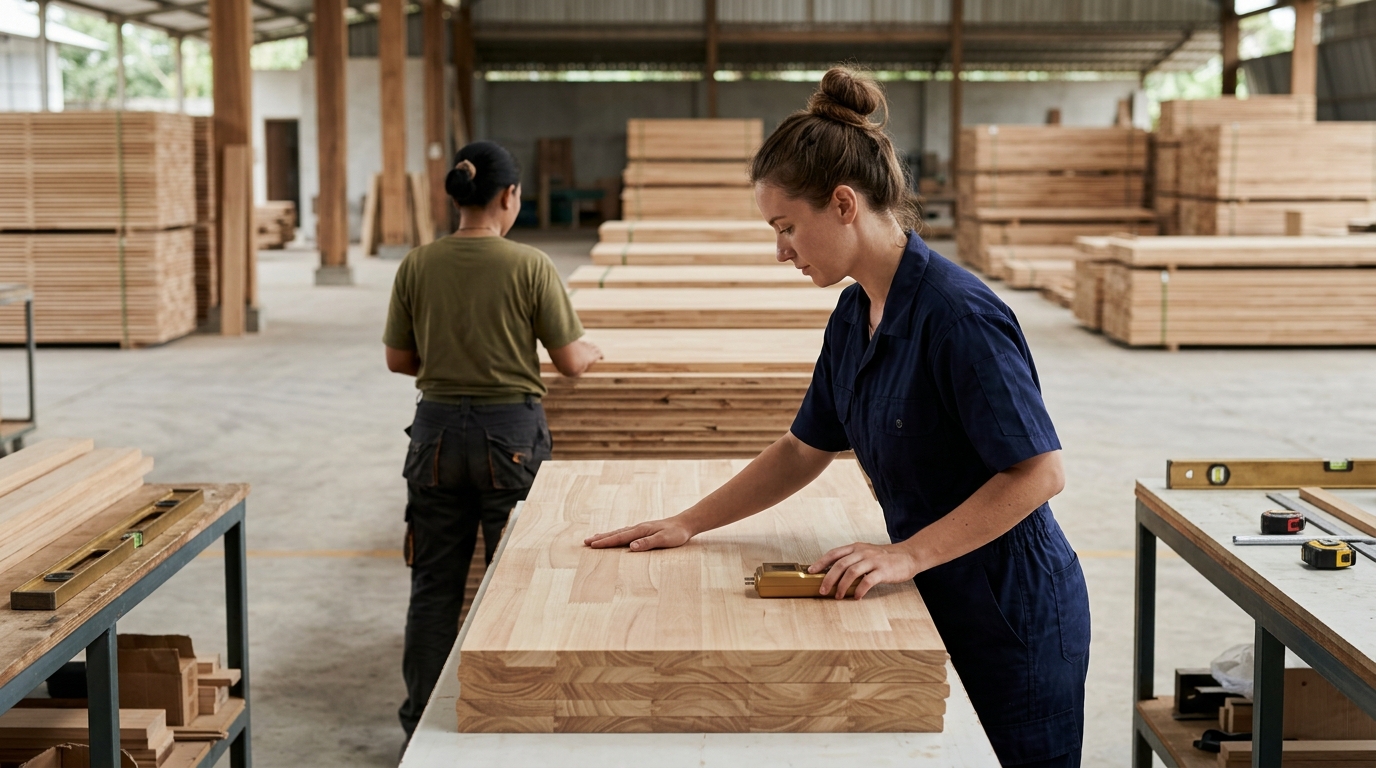
Sourcing finger joint laminated boards from Indonesia is a high-stakes decision for US panel importers and furniture factories. The country produces some of the most cost-competitive solid wood laminated boards in Southeast Asia, drawing on plantation species like rubberwood and albasia. But…
Sourcing finger joint laminated boards from Indonesia is a high-stakes decision for US panel importers and furniture factories. The country produces some of the most cost-competitive solid wood laminated boards in Southeast Asia, drawing on plantation species like rubberwood and albasia. But competitive pricing alone does not guarantee a trouble-free import. Moisture content failures, missing SVLK certification, and ambiguous species labeling have all generated costly claim disputes for US buyers who skipped due diligence.
This guide covers every layer of that decision: how finger joint laminated boards are constructed, which species Indonesian manufacturers favor, what dimensions and surface grades to specify, and how to read the glue and emission certifications that US compliance requires. You will also find a direct comparison between finger joint laminated boards and edge-glued panels, a supplier vetting checklist, and container-level pricing benchmarks that most competitor guides omit entirely.
The content is structured for panel importers, furniture factories, and joinery suppliers who are either evaluating their first Indonesian supplier or benchmarking an existing one. Start with the construction fundamentals, then move to the commercial and compliance sections most relevant to your sourcing stage.
How Finger Joint Laminated Boards Are Engineered for Structural Performance
Defining the product and its manufacturing steps
A finger joint laminated (FJL) board is a solid wood panel assembled from short timber segments joined end-to-end using interlocking finger profiles, then laminated width-wise into a full-dimension panel. The result is a dimensionally stable, engineered solid wood product — not a veneer over composite, not plywood, not MDF.
Manufacturing follows a clear sequence. Raw timber is cross-cut, kiln-dried, and sorted for defects. A milling head then cuts the interlocking finger profile into each piece end. Adhesive is applied to the fingers, and the pieces are pressed end-to-end to form long staves. Those staves are then edge-glued side-by-side to reach the target panel width. Final steps include surface sanding, thickness calibration, and — for export grades — a final moisture check.
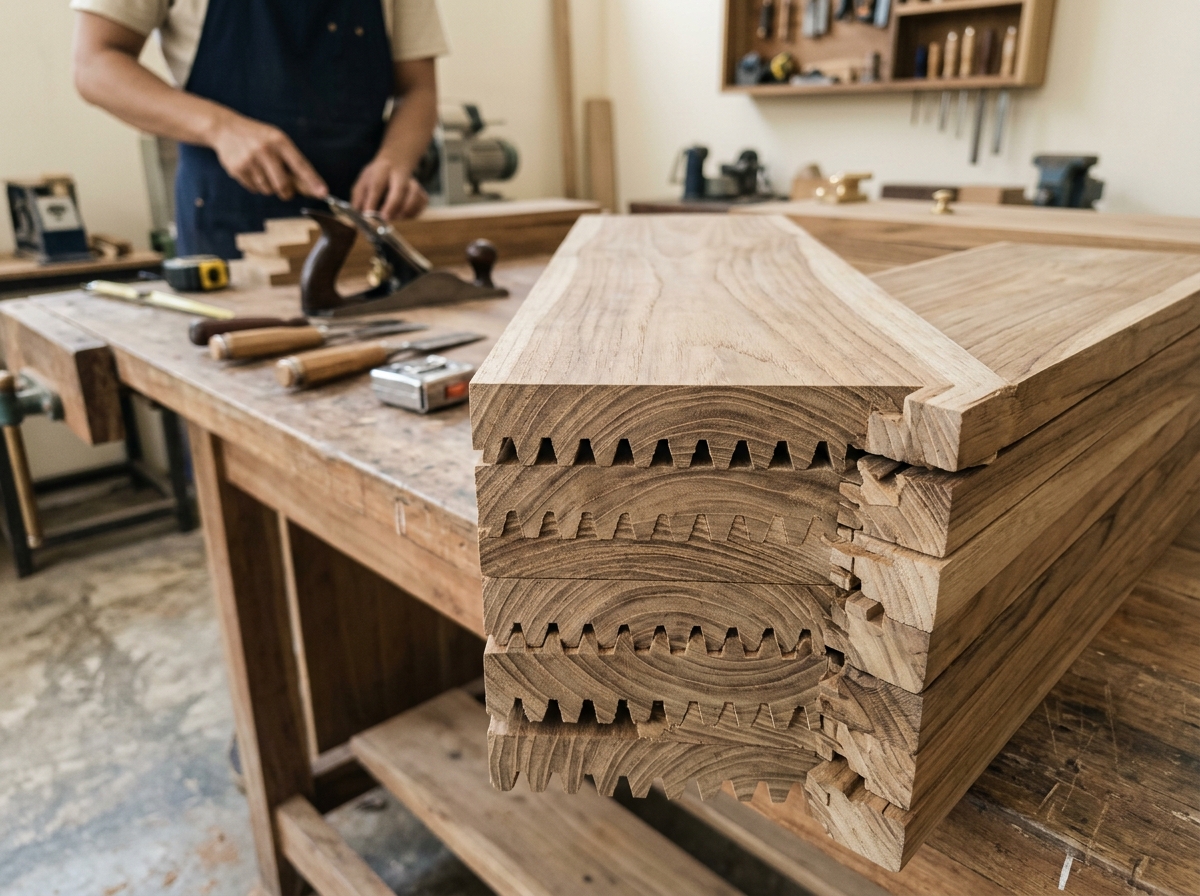
The finger joint profile matters structurally. It multiplies the glue surface area compared with a straight butt joint. Greater glue contact area means higher tensile strength along the joint line. Independent wood science references confirm that well-executed finger joints can approach the tensile strength of clear solid wood when the species, glue, and moisture content are correctly matched.
Horizontal vs. vertical finger joint orientation
Orientation affects appearance and application. In a horizontal finger joint, the fingers run parallel to the board face — the joint is visible on the face and back surfaces. This is the standard configuration for most furniture-grade FJL boards. In a vertical finger joint, the fingers run perpendicular to the face — visible only on the edge. Vertical orientation is more common in structural and framing applications.
For US furniture buyers, horizontal orientation is the norm. Specify this clearly in your purchase order if a painted or opaque finish will conceal the joint lines.
Wood Species Used by Finger Joint Laminated Boards Manufacturers Indonesia
Rubberwood and albasia: the plantation workhorses
Rubberwood (Hevea brasiliensis) dominates Indonesian FJL board production. It is plantation-grown, harvested at end-of-latex-life (approximately 25–30 years), and replanted — making it a commercially sustainable raw material. Rubberwood is a medium-density hardwood with uniform grain and good glue adhesion. It accepts paint, stain, and lacquer consistently. For US importers buying painted furniture components or shop fixtures, rubberwood FJL boards offer the strongest cost-to-quality ratio in the Indonesian product range.
Albasia (Falcataria moluccana), also called sengon laut, is a fast-growing plantation species widely grown across Java, Sumatra, and parts of Kalimantan. It is significantly lighter than rubberwood — a practical advantage for flat-pack furniture and lightweight shelving. FSC-certified albasia is available from several Indonesian producers. PT Albasia Indah Adiperkasa is among the suppliers associated with albasia processing in the Indonesian export sector. Buyers should verify current FSC chain-of-custody status directly with each factory.
Premium and budget-tier species
Teak and merbau sit at the premium end. Teak grown in Java's managed plantations carries strong market recognition among US joinery and outdoor furniture buyers. Merbau is denser and harder, suited to flooring and heavy-duty joinery. Both species command significantly higher FOB prices than rubberwood and carry longer lead times due to tighter raw material supply.
Sengon (the same genus as albasia but sometimes used interchangeably in trade) and pine fill the budget tier. Pine is typically sourced from Sumatra. Both are appropriate for industrial shelving, packaging inserts, and interior components where appearance grade is secondary.
Standard Dimensions, Thickness Tolerances, and Surface Grades for Export Panels
Dimensional ranges buyers should specify
Indonesian finger joint board Indonesia production runs predominantly in these ranges:
| Parameter | Common Range | Notes |
|---|---|---|
| Width | 600–1,220 mm | 600, 900, 1,220 mm most stocked |
| Length | Up to 2,440 mm | 2,440 mm aligns with 8-ft sheet |
| Thickness | 12–40 mm | 18 mm and 25 mm most common |
| Thickness tolerance | ±0.2 mm (sanded) | Verify in QC spec sheet |
Custom widths and lengths are available from most factories at minimum order quantities of one full container. Non-standard sizes typically add 5–10% to unit cost and extend lead times.
Surface grade classifications
Surface grades determine downstream processing requirements and end-use suitability.
- A/A — Both faces clear of open knots, checks, and glue stains. Used for natural-finish furniture and visible joinery. - A/B — One clear face, one face with minor imperfections acceptable under paint. The most common export grade. - B/B — Both faces allow small tight knots, slight color variation. Suited for painted components and cabinet interiors. - Off-grade / utility — Open defects, significant color variation. Industrial or structural applications only.
Sanding finish affects downstream processing directly. A 120-grit factory finish allows most finishing lines to apply stain or lacquer without additional sanding. Coarser finishes (80-grit) require the buyer's factory to re-sand, adding cost and cycle time.
Moisture Content Standards and Kiln-Drying Requirements for US-Bound Shipments
Target moisture content and why it matters
For interior applications in the United States, finger joint boards should arrive at 6–8% equilibrium moisture content (EMC). The US interior climate — particularly climate-controlled retail environments and homes — demands this range to prevent post-delivery movement. Boards shipped above 10% MC will likely experience shrinkage, surface checking, or joint delamination after arriving in drier US conditions.
Indonesian ambient humidity is high. Without proper kiln-drying, freshly processed boards absorb atmospheric moisture rapidly. Reputable finger joint laminated boards manufacturers in Indonesia run continuous kiln-drying programs and test final MC before packing.
Phytosanitary compliance and documentation
All solid wood packaging materials entering the US must comply with ISPM-15, the international phytosanitary standard that requires heat treatment or methyl bromide treatment of wood packaging. For the board product itself — not the packaging — the key document is a kiln-drying certificate or a moisture content test report issued at point of production.
Request the following documents before shipment:
- Kiln-drying certificate specifying temperature and duration - Final MC test report (pin or resistance meter, sample size stated) - Phytosanitary certificate issued by Indonesia's Ministry of Agriculture for the specific shipment
Glue Certifications and Formaldehyde Compliance Every US Importer Must Verify
Adhesive types and their appropriate applications
Indonesian FJL board manufacturers use three main adhesive types:
- PVA (polyvinyl acetate) — Standard for interior, dry-condition applications. Not moisture-resistant. Sufficient for most furniture-grade FJL boards destined for indoor use. - MUF (melamine-urea-formaldehyde) — Moisture-resistant. Appropriate for kitchen components, bathroom furniture, and applications with occasional humidity exposure. - PRF (phenol-resorcinol-formaldehyde) — Fully waterproof. Used in structural and outdoor applications. Less common in standard FJL production.
Specify the adhesive type in your purchase order. Confirm it matches the end-use environment. A PVA-bonded board used in a bathroom vanity will fail.
CARB Phase 2 and formaldehyde emission standards for US import
The California Air Resources Board (CARB) Phase 2 standard limits formaldehyde emissions from compositewood productssold in California — and by extension, through the federal Formaldehyde Standards for Composite Wood Products Act (TSCA Title VI), across all US states. For solid wood FJL boards bonded with compliant adhesives, emissions are typically well within limits. However, buyers must still obtain a third-party test report from a CARB-approved laboratory confirming compliance.
E0 and E1 are Japanese Industrial Standard (JIS) and European (EN) emission classes. E1 (≤0.1 ppm formaldehyde) is broadly equivalent to CARB Phase 2 for most practical purposes, but it is not a substitute for a CARB-specific test report when selling into the US market. Require CARB Phase 2 documentation explicitly. Do not accept E1 alone as proof of US compliance.
FSC and SVLK: timber legality for the US market
FSC (Forest Stewardship Council) certification covers chain-of-custody from forest to finished product. It is not legally required for US import, but it is increasingly expected by US retailers and furniture brands with sustainability commitments.
SVLK (Sistem Verifikasi Legalitas Kayu) is Indonesia's mandatory timber legality verification system. All Indonesian wood product exporters are required to hold SVLK certification issued by an approved independent auditor. For US importers, SVLK is the primary document proving that the wood was legally harvested and processed under Indonesian law. It is also recognized under the EU Timber Regulation framework, giving it international credibility.
To verify SVLK authenticity: ask for the certificate number and verify it against the Indonesian Ministry of Environment and Forestry's online registry (SILK system). Do not accept a scanned copy alone without cross-checking the registry.
- ✓CARB Phase 2 third-party lab test report (TSCA Title VI compliance)
- ✓Adhesive type specification (PVA, MUF, or PRF) in writing
- ✓SVLK certificate number — verified against Indonesian SILK registry
- ✓FSC chain-of-custody certificate (if sustainability is a buyer requirement)
- ✓E0/E1 emission class test report (supplementary, not a CARB substitute)
Edge-Glued Panels vs. Finger Joint Boards: Choosing the Right Construction for Your Application
Understanding the structural and cost differences between these two panel types prevents misspecification and protects margin.
| Attribute | Finger Joint Laminated Board | Edge-Glued Panel |
|---|---|---|
| Construction | Short staves finger-joined end-to-end, then edge-glued | Full-length staves edge-glued side-by-side |
| Raw material yield | Higher — uses shorter off-cuts | Lower — requires longer clear staves |
| Typical cost difference | Approximately 15–30% less expensive | Higher raw material cost |
| Appearance | Visible finger joints on face and back | Continuous grain, no end joints visible |
| Structural strength | Comparable for furniture applications | Comparable for furniture applications |
| Best for | Painted furniture, cabinet components, shelving | Natural-finish joinery, tabletops, countertops |
| Surface grade range | A/A through off-grade | Typically A/A and A/B only |
The cost advantage of FJL boards comes directly from raw material yield. Shorter staves can be finger-joined and laminated into a full panel, using timber that would otherwise be scrap or low-value stock. Edge-glued panels require longer, wider clear pieces — those command a premium in the market for plantation species.
For US furniture factories running painted product lines, FJL boards are the logical choice. For natural-finish tabletops or countertops where grain continuity matters to the end consumer, edge-glued panels justify the price premium.
How to Vet and Select Reliable Finger Joint Laminated Boards Manufacturers in Indonesia
Core due-diligence checklist before placing an order
Indonesian wood panel exporters range from large vertically integrated mills to small subcontracting operations. The supplier type determines risk profile. Established mid-sized export factories — typically 100–500 workers — represent the most accessible tier for US importers. Companies such as PT Karunia Jayama Sentra and Cipta Jaya Wood are referenced in the Indonesian panel export sector, though buyers should conduct independent verification of current production capacity and certification status.
- ✓SVLK certificate — verify number in Indonesian SILK registry
- ✓CARB Phase 2 or TSCA Title VI test report from approved third-party lab
- ✓Species specification with botanical name in writing
- ✓Factory audit or third-party inspection report (DUPRO or pre-shipment)
- ✓Production capacity and confirmed lead times in writing
- ✓Kiln-drying program documentation and MC test protocol
- ✓Minimum order quantity and container loading specifications
- ✓Sub-contracting disclosure — does the factory own the production line or outsource?
- ✓References from current US or EU buyers
- ✓Bank or trade reference for payment term negotiations
Red flags that signal elevated risk
Certain supplier behaviors indicate structural risk rather than isolated incidents:
- Missing or unverifiable SVLK — A legal requirement for all Indonesian wood exporters. No SVLK means the supplier is either non-compliant or misrepresenting their status. - Vague species labeling — "Mixed hardwood" or "local species" without a botanical name is a substitution risk. - No third-party lab reports — Self-declared compliance is not compliance for US import purposes. - Reluctance to allow factory audits — Transparent producers welcome inspection. Resistance is a signal. - Unusually low pricing — Below-market FOB prices often indicate grade substitution, under-dried boards, or uncertified adhesives.
Finding verified suppliers
Trade directories and export databases — including Indonesia's customs export data — provide shipment-level records of actual FOB volumes and consignee histories. The Indonesia International Furniture Expo (IFEX) and IFFS Singapore are the two most relevant regional trade shows for US buyers evaluating Indonesian panel suppliers in person. Factory visits to production clusters in East Jakarta, Surabaya, and Semarang area mills are practical for buyers placing container-volume orders.
Container Loading, MOQs, and FOB Pricing Benchmarks for Indonesian FJL Boards
Container volumes and minimum order quantities
Most Indonesian finger joint board manufacturers set MOQ at one full container. Approximate loadable volumes:
| Container Type | Approximate Volume | Typical Board Weight |
|---|---|---|
| 20-foot standard | 22–25 m³ | Approximately 12–15 MT (rubberwood) |
| 40-foot standard | 55–60 m³ | Approximately 28–35 MT (rubberwood) |
| 40-foot high-cube | 62–68 m³ | Marginally more than 40-ft standard |
Lighter species like albasia will load more cubic meters per container at the same weight limit. Confirm maximum gross weight per container with your freight forwarder — chassis and port weight limits vary by US destination.
FOB pricing benchmarks by species and grade
The following are approximate FOB ranges from Tanjung Priok (Jakarta) and Belawan (Sumatra). These are indicative benchmarks based on publicly reported trade patterns and should be verified with live RFQs:
| Species | Grade | Approx. FOB Price Range |
|---|---|---|
| Rubberwood | A/B sanded | USD 280–370 per m³ |
| Albasia | A/B sanded | USD 200–280 per m³ |
| Pine (Sumatra) | B/B | USD 180–240 per m³ |
| Teak (plantation) | A/A | USD 600–900+ per m³ |
| Merbau | A/B | USD 450–650 per m³ |
Prices fluctuate with exchange rates, raw material costs, and shipping demand. Always request a formal FOB quotation that specifies species, grade, thickness, MC target, adhesive type, and certification inclusions. A quote missing any of these parameters is not a comparable quote.
Production lead times
Standard production lead times after order confirmation run approximately 30–60 days for stocked species and grades. Custom dimensions, premium species, or large volumes (multiple containers) extend this to 60–90 days. Factor in approximately 25–35 days for ocean freight from Jakarta or Belawan to US West Coast ports, or 35–45 days to East Coast ports. Total sourcing cycle from PO to US warehouse receipt is typically 60–100 days for a well-managed first order.
Frequently Asked Questions
What is finger joint laminated wood and how does it differ from solid wood? Finger joint laminated wood is made from short solid wood pieces joined end-to-end with interlocking finger cuts and adhesive, then laminated into a full panel. It uses real wood throughout — no veneer, no composite core — but it is engineered rather than cut from a single timber. Solid wood (clear lumber) is milled from a single piece without end joints.
Which wood species are most commonly used in Indonesian FJL boards? Rubberwood is the most common. Albasia is the second most common. Pine, sengon, teak, and merbau are also produced, covering a range from budget to premium grades.
What moisture content should finger joint boards have for US import? Target 6–8% MC for interior furniture applications. Boards above 10% MC risk dimensional movement and joint failure in the lower-humidity US interior environment.
What glue certifications should I require from Indonesian suppliers? Require a CARB Phase 2 third-party test report (TSCA Title VI compliance) for US-bound shipments. Confirm the adhesive type matches the end-use application. Do not accept E1 certification alone as proof of US market compliance.
What is the minimum order quantity for importing FJL boards from Indonesia? Most factories start at one 20-foot container, approximately 22–25 cubic meters. Some mid-sized exporters will consolidate smaller volumes, but expect a price premium.
How do I verify SVLK and FSC certification from an Indonesian manufacturer? For SVLK: request the certificate number and check it against Indonesia's SILK online registry maintained by the Ministry of Environment and Forestry. For FSC: verify the chain-of-custody certificate code on the FSC certificate database at info.fsc.org. Never rely solely on a scanned certificate.
Sourcing finger joint laminated boards from Indonesia offers real cost advantages — particularly for rubberwood and albasia grades destined for painted furniture applications. The competitive edge holds only when moisture content, glue compliance, and timber legality documentation are verified before, not after, your first shipment.
You now have the technical specifications, compliance framework, and supplier evaluation criteria to make that sourcing decision with confidence. The logical next step is to put this framework to work with real suppliers.
You have the specifications and vetting criteria — now apply them to verified Indonesian finger-joint board manufacturers. Request a factory quote and free sample from verified Indonesian finger-joint board manufacturers today, and compare species, grades, and certifications side by side before committing to a purchase order.
Request Quote and Free Sample →Need eyes on the ground in Indonesia?
MTS is an execution partner — supplier verification, manufacturing management, quality control and export logistics across Indonesia, Vietnam and China.
Related services
Related articles
Receive furniture sourcing insights across Asia.
One email per week. No spam.