Coconut Wood Products Suppliers Indonesia: Complete Sourcing Guide for B2B Buyers
13 min read
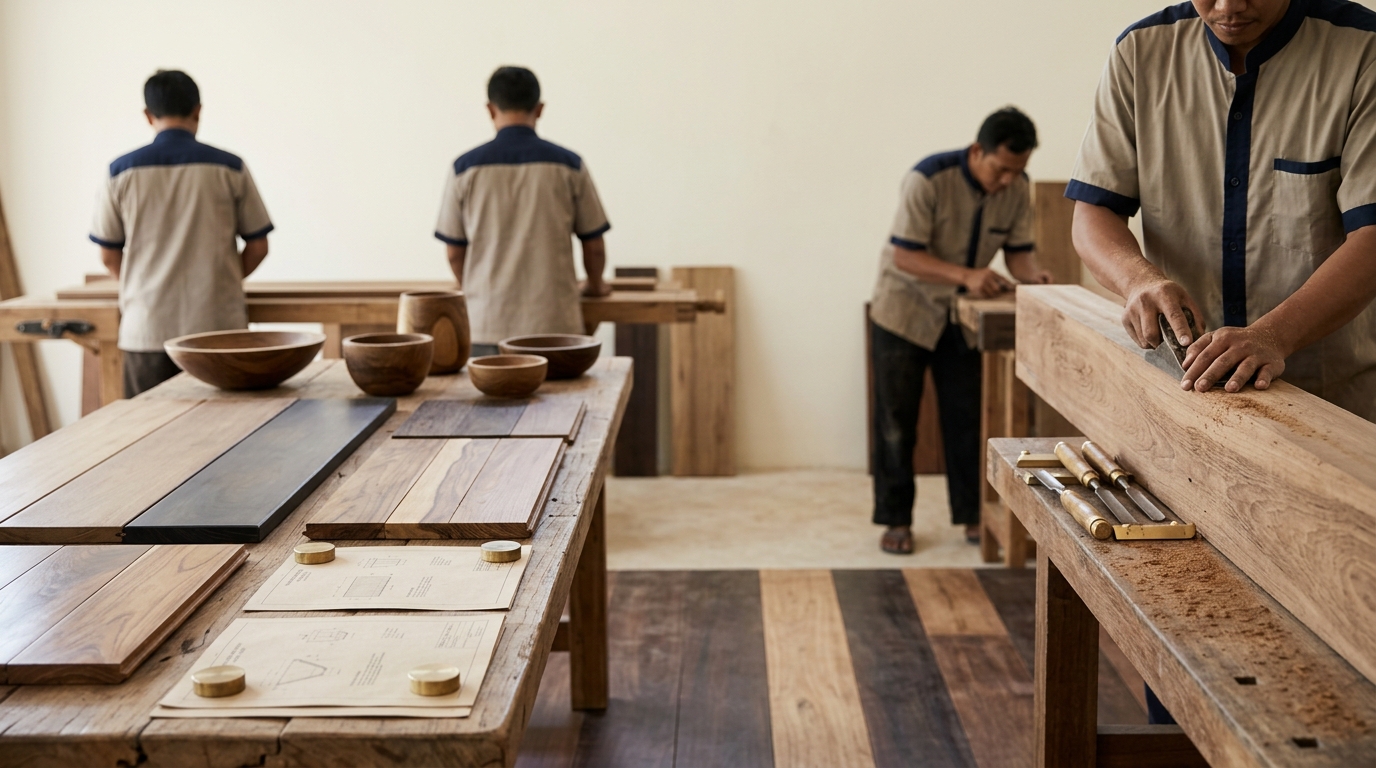
Sourcing sustainable hardwood alternatives from Indonesia requires more technical precision than most procurement teams expect. Coconut wood is not a uniform material. A single Cocos nucifera palm stem contains three distinct density zones, and which zone ends up in your shipment determines…
Sourcing sustainable hardwood alternatives from Indonesia requires more technical precision than most procurement teams expect. Coconut wood is not a uniform material. A single Cocos nucifera palm stem contains three distinct density zones, and which zone ends up in your shipment determines whether you receive flooring-grade hardwood or panel-grade filler. That single variable — density zone specification — separates successful import programs from expensive reworks.
This guide is written for U.S.-based flooring importers, eco-material distributors, and architectural panel buyers who are evaluating coconut wood productssuppliers Indonesiaas a viable, sustainable hardwood source. It covers palm stem science, product lines, regional supply geography, supplier qualification signals, pricing benchmarks, and U.S. import compliance. Every section is built around B2B decision criteria, not marketing narratives.
Indonesia holds the largest concentration of mature coconut estates globally, with North Sulawesi and East Java supplying the majority of export-grade timber. The supply chain feeds directly from agricultural renewal cycles — senile palms replaced after 25 to 60-plus years of fruit production. That origin story matters for Lacey Act compliance and ESG procurement reporting. Understanding it before you issue your first RFQ will sharpen every negotiation that follows.
Why Coconut Wood Is Earning Serious Attention from Global Hardwood Importers
Buyers who previously sourced teak, merbau, or ipe are facing tightening restrictions. Teak exports from several Southeast Asian origins are subject to permit controls. Merbau faces ongoing deforestation scrutiny. Ipe from Brazil carries Lacey Act risk if chain-of-custody documentation is incomplete. Coconut palm timber sidesteps most of these problems structurally.
Cocos nucifera palms are harvested at the end of their agricultural life — typically after 25 to 60-plus years of coconut fruit production. No virgin forest is cleared. The timber is a byproduct of an existing agricultural renewal cycle. That positioning gives coconut wood a clean compliance profile and a credible sustainability narrative for ESG procurement documentation.
Competitive Positioning Against Conventional Hardwoods
Coconut wood competes primarily on sustainability credentials and price, not on universal hardness parity. Outer-zone coconut wood approaches teak-level performance in Janka hardness and density. Mid-zone and inner-zone boards do not. Buyers who understand this distinction make better product-line decisions from the start.
U.S. import growth in plantation-sourced hardwood alternatives has accelerated since stricter enforcement of the amended Lacey Act (16 U.S.C. § 3371 et seq.), which requires importers to declare the scientific name, country of harvest, and quantity of all imported wood products. Coconut palm timber — harvested from agricultural estates with documented replanting records — is well-positioned to meet these declaration requirements. SVLK-certified Indonesian exporters provide the legality documentation needed for Lacey Act compliance directly.
How Lacey Act Compliance Works for Indonesian Coconut Wood
The Lacey Act requires a Plant and Plant Product Declaration (PPQ Form 505) at import. For coconut wood, the relevant data points are: scientific name (Cocos nucifera), country of harvest (Indonesia), and quantity in cubic metres or board feet. SVLK certification — Indonesia's Sistem Verifikasi Legalitas Kayu — is the primary legality assurance document. FLEGT-licensed exporters generate FLEGT licenses, which USDA APHIS recognises as satisfying Lacey Act due-care requirements. Buyers should require SVLK documentation from every Indonesian supplier they qualify.
Palm Stem Density Zones: The Technical Factor Every Purchase Order Must Address
This is the variable that separates informed buyers from buyers who receive inconsistent shipments. A single coconut palm trunk is not homogeneous. Wood density decreases from the outer periphery toward the inner core — a gradient driven by vascular bundle density within the monocot stem structure.
Three Zones, Three Performance Profiles
| Zone | Approximate Density | Approx. Janka Hardness | Typical Applications |
|---|---|---|---|
| Outer periphery | ~900 kg/m³ | ~2,000–2,500 lbf | Flooring, decking, structural cladding |
| Mid-zone | ~500–650 kg/m³ | ~1,200–1,800 lbf | Wall panels, furniture components |
| Inner core | ~200–350 kg/m³ | ~800–1,100 lbf | Craft-grade blocks, low-load paneling |
Hardness ranges are approximate industry figures based on monocot stem mechanics; actual values vary by palm age and growing region.
For context: white oak registers approximately 1,290 lbf on the Janka scale. Teak registers approximately 1,070–1,155 lbf depending on origin. Outer-zone coconut wood significantly exceeds both. Inner-core coconut wood falls below white oak. A purchase order that does not specify zone will receive a mixed-zone product — which explains why many first-time buyers report inconsistent hardness and appearance across a single shipment.
Why Zone Selection Must Appear in Every Purchase Order
Flooring applications must specify outer-zone only. Decking and structural cladding follow the same rule. Paneling and ceiling boards can tolerate mid-zone, provided the buyer has reviewed sample boards from that zone and accepted the appearance variation. Craft blocks and furniture blanks are the only applications where inner-core material is appropriate.
Ask every supplier to provide density test data (kg/m³) per product line, not just per palm species. If a supplier cannot provide zone-specific density data, treat that as a qualification failure.
Core Product Lines Available from Coconut Wood Products Suppliers Indonesia
Indonesian exporters offer a broader product range than most U.S. buyers initially expect. The market has matured beyond raw planks into finished and semi-finished export formats.
Flooring, Decking, and Structural Panels
Solid coconut wood flooring is the highest-value export format. Standard dimensions run 90–120 mm in width, 10–18 mm in thickness, and 900–1,800 mm in length. Tongue-and-groove profiles are standard. Pre-finished and unfinished options are both available, with unfinished preferred by distributors who apply proprietary coatings.
Outdoor decking uses outer-zone boards, typically 19–25 mm thick, in smooth or grooved surface profiles. Natural silica content provides inherent resistance to insect damage, though outdoor installations still require appropriate penetrating oil treatment.
Wall paneling and ceiling cladding boards are commonly mid-zone material, 9–15 mm thick. These are sold in standard lengths of 1,800–2,400 mm and are used in hospitality interiors, retail fit-outs, and residential feature walls.
Furniture Blanks and Craft-Grade Products
Furniture tabletops, countertop blanks, and edge-glued panels are available in widths up to approximately 1,200 mm through finger-jointing and edge-gluing of narrower outer-zone boards. Craft-grade blocks — often inner-core material — serve the decorative accessory and turned-goods market.
Export Packaging and Container Loading
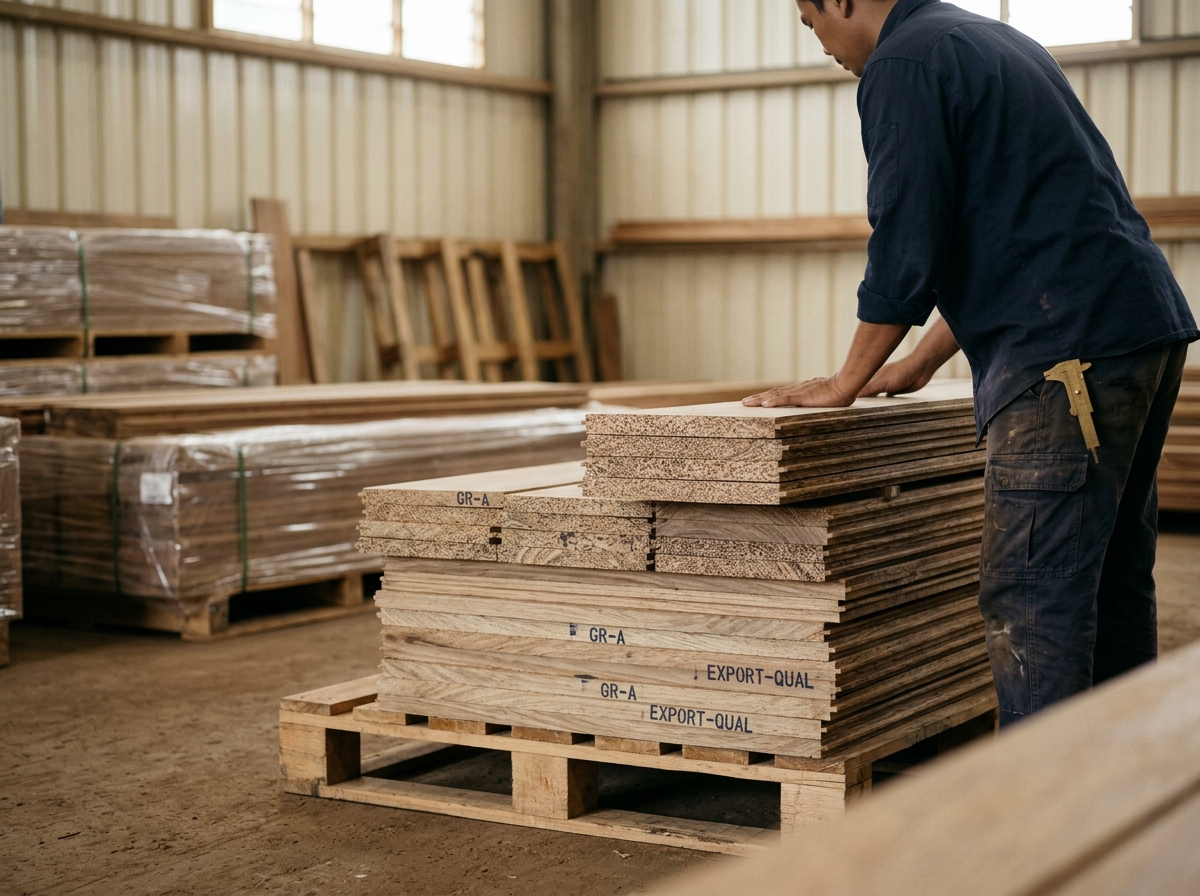
Standard export packaging uses 5-ply corrugated cartons or timber-bundled strapping on pallets. A standard 20-foot FCL typically holds approximately 18–22 m³ of flooring product, depending on packing density and board dimensions. A 40-foot FCL holds approximately 38–45 m³. These are approximate figures — confirm exact loading volumes with your supplier based on specific product dimensions.
The Sustainability Case: Senile Palm Replanting and What It Means for ESG Procurement
Indonesia's coconut timber supply is structurally tied to agricultural replanting cycles. When a coconut palm reaches the end of its fruit-bearing life — typically after 25 to 60-plus years — it is felled and replaced with a young seedling. The felled trunk, previously burned or left to rot in many smallholder operations, is now processed into timber.
This model means no dedicated felling occurs for timber production. Lumber is a byproduct of agricultural renewal. Smallholder farmers in regions like Minahasa in North Sulawesi receive additional income from trunk sales to processing mills, improving livelihood outcomes without expanding agricultural land into forest.
Certifications to Require from Indonesian Suppliers
- SVLK (Sistem Verifikasi Legalitas Kayu): Indonesia's mandatory timber legality verification system. Required for all Indonesian wood product exports. Provides chain-of-custody documentation directly usable for Lacey Act declarations. - FLEGT license: Issued under the EU-Indonesia Voluntary Partnership Agreement. USDA APHIS accepts FLEGT licenses as Lacey Act due-care evidence. Not all exporters hold this — it requires an additional verification layer beyond SVLK. - FSC certification: Forest Stewardship Council certification is available for some Indonesian coconut timber operations but is not yet universal. FSC chain-of-custody certification from a processor adds credibility for retail-facing sustainability claims.
- ✓SVLK certificate with current validity date
- ✓FLEGT license (if EU-pattern documentation is required)
- ✓FSC chain-of-custody certificate (preferred for retail ESG claims)
- ✓Replanting documentation or estate management records
- ✓Smallholder sourcing declaration (if applicable)
Hardness, Workability, and Finishing: What Fabricators Need to Know Before the First Cut
Coconut wood behaves differently from conventional hardwoods in fabrication. Buyers who pass this information to their installation partners avoid costly surprises.
Tool Wear and Machining Requirements
High silica content is the defining fabrication challenge. Silica concentrations in outer-zone coconut wood are significantly higher than in teak or oak. Silica dulls standard HSS (high-speed steel) tooling rapidly. Carbide-tipped sawblades and router bits are required for all primary machining. Diamond-tipped tooling extends edge life further in high-volume operations.
Interlocked fibre patterns — common in coconut palm due to its monocot structure — cause tearout on longitudinal passes if feed rates are too aggressive. Reduce feed rate by approximately 20–30% compared to oak equivalents when ripping or profiling.
Sanding Sequence and Finishing Behaviour
Start sanding sequences at 60-grit minimum on outer-zone boards. The high density resists material removal, and finer grits used on softer woods will glaze the surface rather than cut it. Progress through 80, 120, and 150 grit before applying finish.
Oil-based penetrating finishes outperform film-forming lacquers on dense outer-zone coconut wood. Film-forming products — polyurethane, nitrocellulose lacquer — tend to delaminate at the grain boundaries over time due to the wood's low absorption rate and silica content. Tung oil, hardwax oils, and modified alkyd penetrating oils are the recommended finish categories.
Pre-Acclimatisation for U.S. Climate Zones
Coconut wood's moisture response requires attention for U.S. buyers. Boards manufactured and dried in Indonesia's tropical humidity (typically 70–85% RH) must be acclimatised to the target installation environment before installation. For U.S. climate zones with interior winter RH of 30–50%, a minimum acclimatisation period of approximately 7–14 days in the installation space is standard practice. Failure to acclimatise adequately results in gapping or cupping post-installation. Specify kiln-dried boards (target moisture content of 8– approximately 12% for interior U.S. applications) in your purchase order.
Supply Regions, Port Access, and Logistics Timelines for Indonesian Coconut Timber
North Sulawesi and the Minahasa Heartland
North Sulawesi — particularly the Minahasa regency — is the primary source region for export-grade coconut timber in Indonesia. The region contains the highest concentration of mature coconut estates, many with palms in the 40-to-60-year age range. Processing mills in Manado and surrounding areas handle primary breakdown and initial drying. Export moves through Bitung port, North Sulawesi's main commercial port, with direct feeder services to Singapore and Surabaya for transhipment to U.S.-bound vessels.
East and Central Java: Secondary Processing Hubs
East Java — centred on Surabaya — provides secondary processing capacity and better direct vessel access for larger consolidations. Many North Sulawesi processors ship semi-finished boards to Surabaya-based exporters for final milling, grading, and container stuffing. Surabaya offers direct or one-transhipment routing to U.S. West Coast ports (Los Angeles, Long Beach) and East Coast ports (Houston, Savannah) via major carrier networks.
Bali: Artisan and Furniture-Grade Supply
Bali suppliers — concentrated around Denpasar and Gianyar — focus on furniture-grade coconut wood, decorative panels, and smaller-volume artisan products. Export moves through Benoa port. Minimum order quantities tend to be lower, but price-per-unit is higher than North Sulawesi volume suppliers.
Lead Times and Freight Routing
| Origin Port | Typical Production Lead Time | Ocean Transit to U.S. West Coast | Ocean Transit to U.S. East Coast |
|---|---|---|---|
| Bitung (North Sulawesi) | 45–75 days | ~18–22 days (via Singapore/Tanjung Pelepas) | ~28–35 days |
| Surabaya (East Java) | 30–60 days | ~16–20 days | ~26–32 days |
| Benoa (Bali) | 30–45 days | ~18–22 days | ~28–35 days |
Transit times are approximate and subject to carrier schedule and transhipment port congestion.
How to Qualify Coconut Wood Products Suppliers Indonesia Before Committing Capital
Document Verification Checklist
- ✓Valid SVLK certificate with exporter ID
- ✓NIB (Nomor Induk Berusaha) or legacy SIUP business registration
- ✓Export history documentation — at least 2–3 prior FCL shipments to Western markets
- ✓Product-specific density zone test reports (kg/m³)
- ✓Moisture content certification for KD products
- ✓Sample policy — supplier must provide paid or complimentary physical samples before order placement
Red Flags That Signal High-Risk Suppliers
Any supplier who cannot specify which density zone their flooring product uses is a material risk. Zone ambiguity is the most common cause of rejected shipments and quality disputes in coconut wood imports. Additional red flags:
- Inconsistent or unverifiable Janka data (e.g., citing a single hardness value for all products regardless of zone) - No SVLK certificate or an expired certificate - Unwillingness to permit third-party pre-shipment inspection - No FOB pricing transparency — suppliers who quote only CIF and resist FOB breakdowns may be obscuring margin layers
Pre-Shipment Inspection
Third-party pre-shipment inspection (PSI) by an accredited inspection firm is strongly recommended on first orders. Inspection should cover: board dimension conformance, moisture content spot-checks, grading consistency, zone verification (density sampling), and carton packaging integrity. Arrange PSI at least 7– approximately 10 days before the confirmed vessel booking date.
Pricing, MOQs, Tariffs, and Payment Terms for U.S. Buyers
FOB Price Benchmarks by Product Category
| Product | Approx. FOB Price Range (USD/m²) | Notes |
|---|---|---|
| Solid flooring (outer zone, unfinished) | $18–$28 | T&G, 15mm thickness |
| Solid flooring (outer zone, pre-finished) | $25–$35 | Oil finish applied |
| Wall paneling (mid-zone) | $12–$22 | 9–12mm, rough or sanded |
| Outdoor decking (outer zone) | $20–$40 | 19–25mm, grooved profile |
| Furniture blanks / tabletop panels | $15–$30 | Edge-glued, varies by size |
Prices are approximate FOB Surabaya/Bitung ranges based on industry sourcing patterns. Actual quotes will vary by volume, finish, and supplier tier.
MOQs and Volume Leverage
The typical minimum order quantity for flooring is 1 FCL (approximately 15–20 m³). Below this threshold, most North Sulawesi and Java volume suppliers will not engage on standard commercial terms. Bali artisan suppliers may accommodate smaller LCL orders, but per-unit pricing increases significantly.
Volume leverage begins at 2+ FCLs per order. Buyers committing to quarterly programs of 3–5 FCLs typically negotiate 5–10% reductions from opening FOB prices, though this varies by supplier and market conditions.
U.S. Import Tariff Context
Coconut wood flooring and panels are classified under Chapter 44 of the U.S. Harmonized Tariff Schedule (HTS). The primary relevant headings are:
- HTS 4418.xx — for wooden flooring panels - HTS 4409.xx — for continuously shaped wood (profiled/T&G boards) - HTS 4412.xx — for plywood and engineered panels
Indonesia is not subject to Section 301 tariffs (which apply to Chinese-origin goods). Standard MFN (Most Favored Nation) tariff rates for wooden flooring from Indonesia are generally in the 0–3.2% range depending on the specific HTS subheading. Confirm the exact classification with a licensed U.S. customs broker before issuing purchase orders, as misclassification creates retroactive liability.
Payment Terms
Standard Indonesian export payment terms are approximately 30% T/T deposit against purchase order, with 70% balance paid against copy of Bill of Lading. On established relationships, some exporters offer 30/70 against original documents at destination. Letters of Credit (LC at sight) are accepted by larger exporters but add processing costs.
Frequently Asked Questions from U.S. Buyers Evaluating Coconut Palm Timber
Is coconut wood as durable as teak or merbau for flooring applications? Outer-zone coconut wood is comparable to or harder than teak on the Janka scale (approximately 2,000–2,500 lbf vs. teak's approximately 1,070–1,155 lbf). It is not interchangeable with inner-zone material. Specify outer-zone only for flooring applications and require density test data.
What certifications should I require from Indonesian coconutwood suppliers? SVLK is the baseline requirement for Lacey Act compliance. FLEGT licensing provides an additional layer of due-care documentation. FSC chain-of-custody adds retail-level credibility. All three are available from compliant Indonesian exporters.
What is the typical minimum order quantity (MOQ) for coconut wood flooring from Indonesia? One FCL — approximately 15–20 m³ — is the standard MOQ from volume suppliers in North Sulawesi and Java. Smaller LCL quantities are available from Bali suppliers at higher per-unit cost.
How does the density zone of the palm stem affect final product quality? Zone determines hardness, durability, and appearance. Outer periphery boards deliver flooring-grade performance. Mid-zone boards are suitable for paneling. Inner-core material is appropriate only for craft and low-load applications. Never accept a shipment without zone specification in the PO.
Is coconut wood considered sustainable or legally harvested under U.S. import law? Yes, when sourced from SVLK-certified Indonesian exporters with documented replanting records. Coconut timber is a byproduct of agricultural renewal — no primary forest is cleared. Lacey Act declarations using SVLK documentation satisfy due-care requirements.
What finishing products work best on high-silica coconut wood surfaces? Oil-based penetrating finishes — tung oil, hardwax oil, modified alkyd oils — outperform film-forming products. High silica content prevents adequate adhesion for polyurethane and lacquer systems on dense outer-zone boards. Always sand to 60-grit minimum before any finish application.
Coconut wood from Indonesia offers a technically defensible, sustainability-credible alternative to conventional tropical hardwoods — but only when buyers specify correctly. Density zone, moisture content, SVLK certification, and HTS classification are the four variables that determine whether a shipment succeeds or creates problems at the U.S. port of entry.
You now have the technical framework, the supplier qualification criteria, and the pricing context to issue an informed RFQ. The next step is physical samples and a verified FOB quote.
You understand the density zones, the certification requirements, and the price benchmarks. Requesting verified supplier introductions and sample packs is the natural next step — connect with screened coconut wood products suppliers Indonesia who can provide SVLK documentation, zone-specific density data, and export references before you commit to a full container order.
Request Supplier Introductions and Samples →Need eyes on the ground in Indonesia?
MTS is an execution partner — supplier verification, manufacturing management, quality control and export logistics across Indonesia, Vietnam and China.
Related services
Receive furniture sourcing insights across Asia.
One email per week. No spam.