Teak Root Furniture Indonesia: The Ultimate Sourcing Guide for Retailers and Designers
16 min read
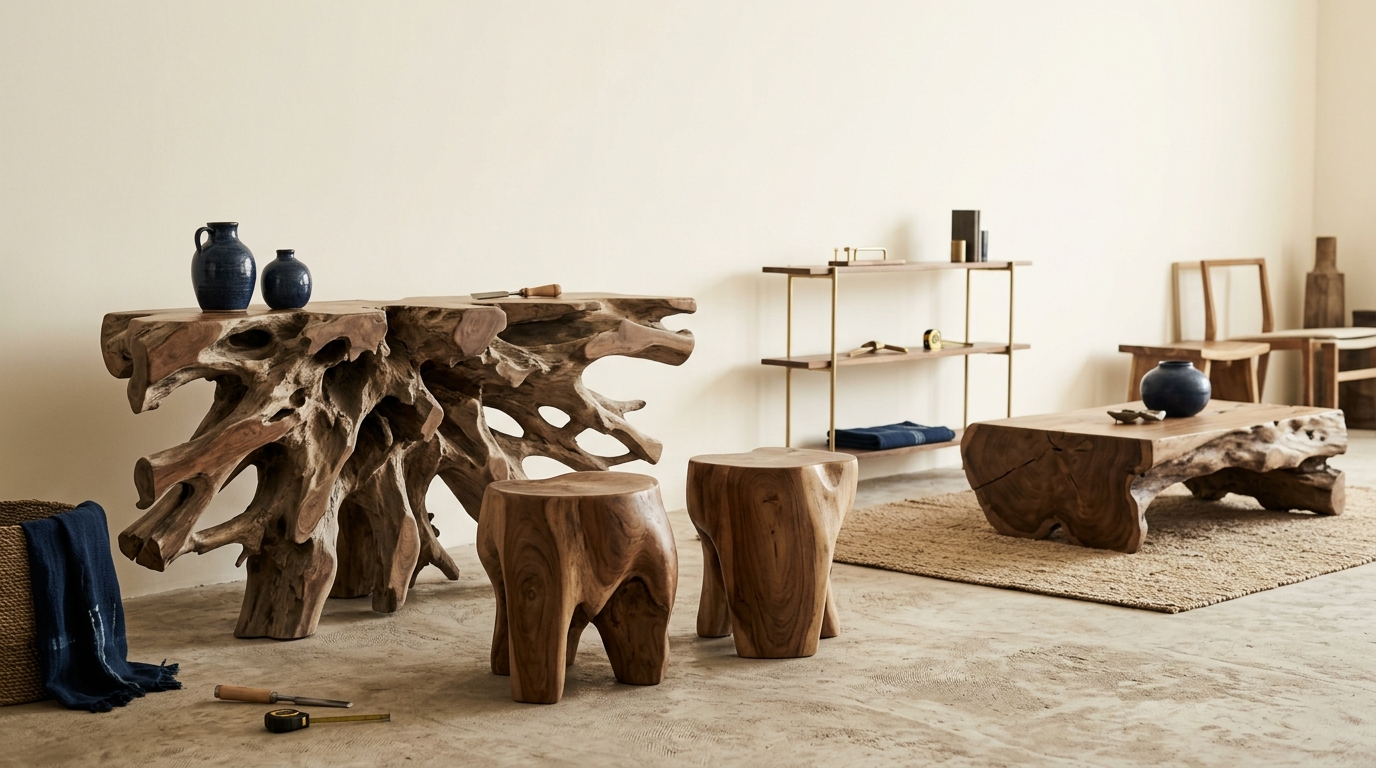
Sourcing teak root furniture from Indonesia is not a casual procurement decision. For boutique retailers and interior designers, it represents a deliberate commitment to stocking pieces that cannot be mass-produced, replicated by a competitor, or undercut by a flatpack alternative. The challenge…
Sourcing teak rootfurniture from Indonesiais not a casual procurement decision. For boutique retailers and interior designers, it represents a deliberate commitment to stocking pieces that cannot be mass-produced, replicated by a competitor, or undercut by a flatpack alternative. The challenge is that the supply chain behind these sculptural, root-form tables and consoles is fragmented across family workshops, mid-scale exporters, and trading intermediaries — and distinguishing between them requires a level of due diligence most SERP-level articles never address.
This guide is written specifically for US-based buyers evaluating teak root furniture Indonesia as a wholesale category. It covers the full sourcing lifecycle: quality evaluation, pricing structures, supplier vetting, Lacey Act and SVLK compliance, total landed cost modeling, and retail positioning. Whether you are placing your first container order or renegotiating terms with an existing Indonesian supplier, the sections below give you the sourcing intelligence to act with confidence.
The Indonesian teak furniture sector is concentrated in Central Java, with Jepara as the dominant export hub, Yogyakarta as the artisan center, and Blora as a key raw material supply region. Understanding how each region operates — and what type of buyer each suits — is the first filter in building a reliable supply relationship.
Why Indonesian Teak Root Furniture Is a Retail Differentiation Asset
The Organic Form No Mill Can Reproduce
Conventional teak lumber furniture is cut from the trunk — predictable, plannable, and replicable. Teak root furniture Indonesia draws from the subterranean root system of mature plantation trees, which grows in unpredictable, site-specific patterns. The result is a sculptural mass of interlocking grain directions, voids, and organic contours that no two pieces share. For boutique retailers competing against mass-market furniture imports, that irreproducibility is a commercial advantage, not merely an aesthetic one.
Each teak root coffee table, dining table, or console table is effectively a one-of-a-kind SKU. You cannot reorder the exact same piece. This scarcity dynamic creates urgency in the retail environment and supports premium price positioning that commoditized furniture cannot sustain.
Key Forms and Their Retail Applications
The primary furniture forms produced from Indonesian teak root include:
- Teak root coffee tables — the highest-volume category; often paired with glass tops for living room applications - Teak root dining tables — commanding centerpieces for residential and hospitality interiors; available in slab or base configurations - Teak root console tables — popular for entryways and narrow retail display environments - Teak root side tables — lower price-point entry pieces ideal for driving store traffic and add-on sales - Benches and stools — smaller-footprint sculptural accent pieces
Production Geography: Jepara, Yogyakarta, and Beyond
Indonesia's teak root furniture production is anchored in three overlapping geographic zones. Jepara, in Central Java, is the country's most export-oriented furniture manufacturing hub — home to hundreds of producers ranging from family workshops to mid-scale factories with established freight forwarding relationships. Yogyakarta is known for more artisan-oriented production, typically smaller batch runs with higher craft content. Blora, also in Java, is a primary supply zone for raw teak root material, feeding processors across the region. Bali hosts a smaller but influential luxury-positioned cluster serving resort and hospitality buyers.
How Indonesian Teak Root Is Harvested, Dried, and Finished for Export
Responsible Sourcing: Reclaimed Plantation Roots
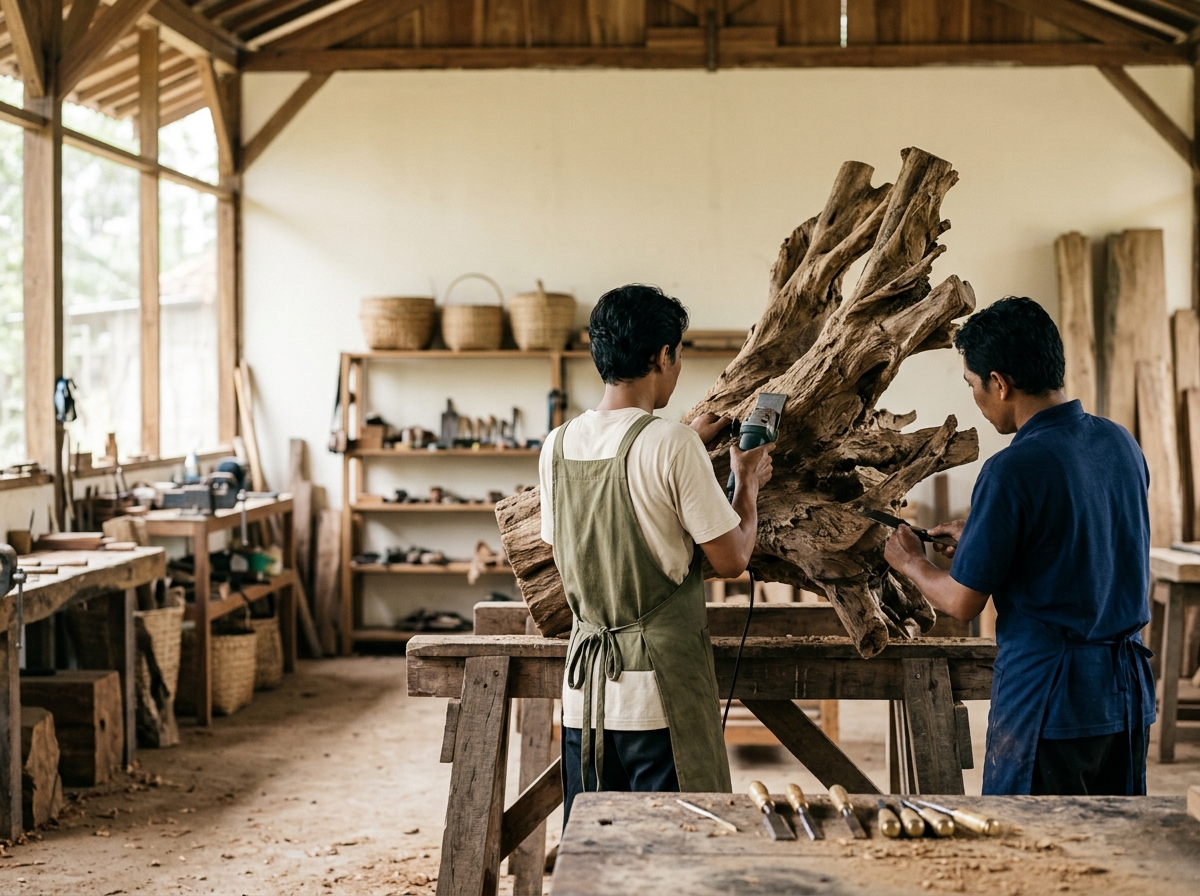
Commercially available teak root furniture Indonesia is produced almost entirely from reclaimed root systems of decommissioned plantation teak trees — not from old-growth forest extraction. When a teak plantation cycle ends and trees are harvested for timber, the root systems are excavated as a secondary material stream. This is the legitimate sourcing baseline. Buyers should be skeptical of suppliers who cannot explain their raw material origin clearly.
Alas Gembol, a region in East Java, is one recognized source of aged teak root with particularly dense grain structure, and pieces originating from this area often carry a provenance premium in the retail market.
Drying Methods and Moisture Content
Root wood is denser and more moisture-retentive than trunk lumber, making the drying process critical to the long-term structural integrity of finished pieces. Two methods are used:
Kiln-drying brings moisture content down to a controlled level — typically targeting under 12% for pieces destined for air-conditioned interior environments in the US — and does so in a fraction of the time required for air-drying. It is the preferred method for export-quality pieces.
Air-drying is still used by smaller workshops and can produce excellent results, but the process takes considerably longer and is more variable. Pieces that have not been adequately dried are prone to cracking, checking, and joint failure after arriving in lower-humidity US interior environments.
Always ask a prospective supplier for documented moisture content readings at the point of shipment. This is a basic quality control request, and a supplier who cannot provide it is a red flag.
Finishing Options for the US Market
Common finishing approaches include:
- Natural wax or oil finishes — preserve the raw organic character of the root; popular with luxury and organic interior aesthetics - Lacquer finishes — provide more durable surface protection; appropriate for dining tables and higher-contact applications - Raw/unfinished — occasionally requested by buyers who apply their own finishing on arrival; requires careful moisture control during transit
SVLK Certification and Why It Matters for US Importers
The SVLK (Sistem Verifikasi Legalitas Kayu) is Indonesia's mandatory timber legality verification system, administered at the national level. For US importers, SVLK certification from a supplier is the foundational documentation that the wood was legally sourced and processed. Under the Lacey Act (discussed in detail in a later section), importers bear legal responsibility for the legality of the timber in their supply chain. An SVLK-certified supplier provides the document trail that satisfies that requirement.
Evaluating Teak Root Furniture Quality Before You Place a Wholesale Order
Structural Quality Indicators
Quality in a teak root piece is assessed differently than in milled lumber furniture. The key indicators are:
Root density: Denser root material, particularly from older plantation trees, produces a harder, more stable finished piece. Ask suppliers about the approximate age of the source trees and the geographic origin of the root material.
Crack treatment: Surface checking and cracks are natural in root wood and are not inherently a defect — but how they are treated matters. Quality producers fill cracks with matching wood filler, epoxy, or resin in a controlled, consistent manner. Poorly treated cracks, or cracks that have been cosmetically concealed for photography but left structurally untreated, will worsen over time.
Base stability: For coffee tables and dining tables, the root base must be leveled and stabilized so the piece sits flat without rocking. This is a production step that separates professional exporters from casual workshop output. Request video of the piece on a flat surface before approving any shipment.
Questions to Ask Suppliers Before Ordering
- ✓What is the documented moisture content of finished pieces at time of shipment?
- ✓What drying method is used — kiln or air drying?
- ✓Can you provide SVLK certification documentation?
- ✓How are cracks and voids treated in your finishing process?
- ✓What is your base-leveling and stability testing protocol?
- ✓Do you offer pre-shipment inspection access or third-party QC reports?
- ✓What is your lead time from order confirmation to FOB?
- ✓Can you provide references from US or EU wholesale buyers?
Red Flags in Factory Photos and Showroom Listings
Online listings for Indonesian teak furniture, particularly on platforms like Alibaba or Made-in-China, frequently show best-case photographs that do not represent production-line quality. Watch for:
- Images showing only one or two hero pieces with no workshop or production context - Inability to provide video walkthroughs of current inventory - Refusal to share factory location or registration details - Price points significantly below regional market norms (often a signal of green wood or untreated material) - No mention of SVLK or any timber legality documentation
Pricing Structures and Total Landed Cost for US Wholesale Buyers
FOB Price Ranges by Furniture Type
The table below reflects approximate FOB Jepara price ranges for standard teak root furniture forms. Actual prices vary based on root density, size, finish complexity, and supplier tier.
| Furniture Type | Approx. FOB Jepara Range | Notes |
|---|---|---|
| Teak root coffee table (small) | $150 – $350 | Glass top adds $30–$80 |
| Teak root coffee table (large) | $300 – $700 | High-density root, kiln-dried |
| Teak root dining table | $500 – $1,800 | Depends on span and base complexity |
| Teak root console table | $200 – $550 | Narrower form; often faster production |
| Teak root side table | $80 – $220 | Highest-volume, lowest-risk entry SKU |
| Teak root table base only | $180 – $600 | Buyer sources glass or stone top locally |
Total Landed Cost: What US Buyers Actually Pay
Beyond the FOB price, the realistic cost breakdown for a wholesale shipment ofindonesia teak wood furnitureincludes:
- Ocean freight (LCL or FCL): LCL (Less than Container Load) is suitable for smaller initial orders but carries a higher per-cubic-meter rate. A Full Container Load (FCL) becomes cost-efficient when ordering enough volume to fill a 20-foot or 40-foot container. - US customs duties: Teakfurniture from Indonesiafalls under specific HTS codes — typically within Chapter 94 of the Harmonized Tariff Schedule. Applicable duty rates vary by product classification; work with a licensed customs broker to confirm the correct code for your specific pieces. - Port handling and drayage: Destination charges at US ports (Los Angeles, Long Beach, Houston, New York/New Jersey) vary and should be confirmed with your freight forwarder. - Customs broker fees: An experienced broker who handles wood furniture imports is not optional — it is a cost of doing business correctly. - Inland freight: Delivery from the port to your warehouse or showroom adds further cost depending on distance.
A conservative rule of thumb for US buyers is to expect total landed cost to run approximately 40–70% above FOB price depending on order size, destination port, and freight market conditions at the time of shipment.
MOQ Expectations: Workshop vs. Exporter
Family-owned workshops in Yogyakarta and smaller Jepara operations may accept orders of as few as five to ten pieces, but lead times can be longer and production consistency more variable. Larger, export-oriented manufacturers in Jepara typically set minimum order quantities at a container level or by minimum FOB value — often in the range of a 20-foot container worth of goods.
| Supplier Type | Typical MOQ | Lead Time | Best For |
|---|---|---|---|
| Family workshop (Yogyakarta) | 3–10 pieces | 8–16 weeks | Boutique retail, trial orders |
| Mid-scale Jepara exporter | 1 x 20ft container | 10–14 weeks | Established retailers, mixed SKUs |
| Large Jepara manufacturer | 1 x 40ft container+ | 8–12 weeks | High-volume importers |
Custom sizing, bespoke shapes, and glass-top configurations are generally available from Jepara exporters at MOQ minimums — but expect a longer sample approval process and additional per-piece tooling time for non-standard configurations.
Top Sourcing Regions in Indonesia and How to Verify Supplier Legitimacy
Jepara: Indonesia's Export Furniture Capital
Jepara is the undisputed center of Indonesian export furniture manufacturing. The city and surrounding district in Central Java host a dense ecosystem of producers, finishing operations, quality control services, and freight forwarders. For US buyers seeking established wholesale relationships with reliable export documentation, Jepara is the logical starting point. Suppliers here are generally familiar with US import requirements, including SVLK documentation, and many have existing relationships with American importers.
Yogyakarta: Artisan Craft and Smaller-Batch Production
Yogyakarta-area workshops produce teak root furniture with a higher craft content and more pronounced artisan character. These are the operations to consider when differentiation through provenance storytelling matters — boutique hospitality projects, high-end residential interior design commissions, or retail environments where each piece is sold individually as a statement object. MOQs are lower, but buyers should invest in a sourcing agent or independent inspection service to manage quality consistency.
Blora and the Raw Material Supply Chain
Blora, in Central Java, is a primary source of raw teak root material feeding processors across the region. Understanding this geography helps buyers evaluate supplier claims about material origin and supports due diligence conversations about timber legality.
Verifying Supplier Legitimacy
Do not rely solely on platform ratings or self-reported certifications. Practical verification steps include:
- Cross-referencing supplier names and company registration numbers against Indonesian export databases (Indonesia's Ministry of Trade publishes exporter data) - Requesting a copy of the supplier's SVLK certificate and verifying the issuing body independently - Commissioning a pre-shipment inspection through a third-party inspection service with on-the-ground Indonesia presence - Requesting video factory walkthroughs and cross-referencing the facility against satellite imagery of the address provided
US Import Compliance: Lacey Act, SVLK, CITES, and Freight Logistics
Lacey Act Compliance for Teak Root Importers
The Lacey Act is US federal law that prohibits the import of plants and plant products — including wood furniture — that were illegally sourced or harvested in their country of origin. As a US importer, you are legally responsible for the legality of the wood in every shipment you bring into the country, regardless of whether you sourced it directly or through an intermediary.
In practical terms, Lacey Act compliance for teak root furniture imports requires:
- A completed Plant and Plant Product Declaration (PPQ 505 form) filed with US Customs at time of importation - Documentation of the scientific name of the wood species (Tectona grandis for teak), country of harvest (Indonesia), and quantity - Supporting documentation from your supplier — SVLK certification is the primary Indonesian document that demonstrates legal origin
Teak (Tectona grandis) is not a CITES-listed species, so no CITES permit is required for standard teak root furniture imports. However, if a supplier offers pieces that incorporate other wood species or materials, verify their CITES status before importing.
Sea Freight: FCL vs. LCL for Wholesale Orders
LCL (Less than Container Load): Suitable for initial trial orders or boutique buyers with limited warehouse capacity. Your cargo is consolidated with other shippers' goods. Rates are higher per cubic meter and transit times can be longer due to consolidation and deconsolidation handling.
FCL (Full Container Load): Becomes the economical standard once order volume justifies filling a 20-foot or 40-foot container. Offers faster, more predictable transit and lower per-unit freight cost. Transit time from Indonesian ports to US West Coast ports is typically in the range of three to four weeks at sea, with total port-to-door timelines varying based on customs clearance and inland freight.
Working With a Customs Broker
A licensed US customs broker with specific experience in wood furniture imports is essential. They will ensure correct HTS code classification, manage Lacey Act declarations, and flag any documentation gaps before your shipment arrives at the port. Attempting to self-file complex wood furniture entries without professional guidance carries meaningful financial and legal risk.
Merchandising and Positioning Teak Root Pieces as Premium Retail SKUs
Retail Positioning: Scarcity, Provenance, and Price Architecture
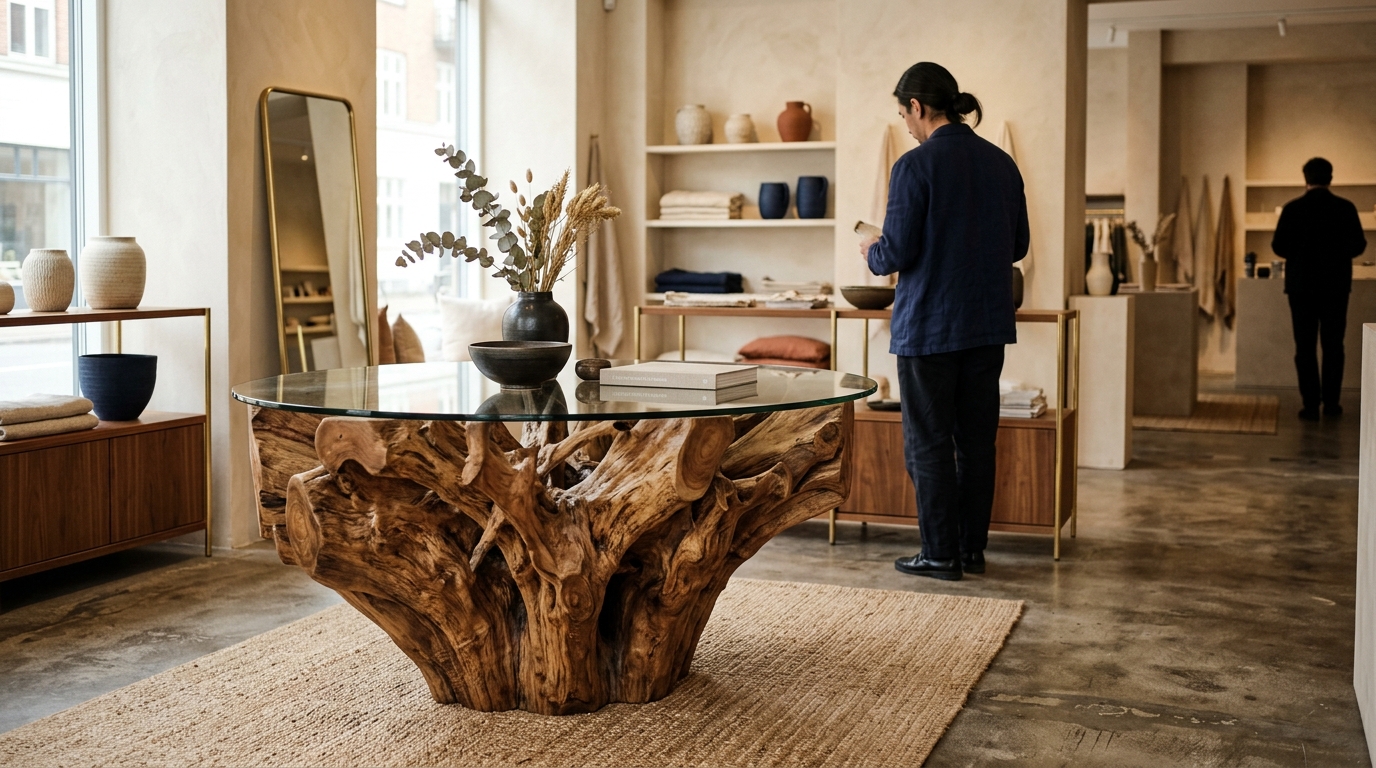
A teak root coffee table or dining table is not a volume SKU — it is a destination piece that anchors a room vignette and justifies a showroom visit. Effective boutique retail positioning treats each piece as an individual, named object: documented with its origin region, wood age estimate, and finishing details. This transforms a furniture purchase into a collectible acquisition and supports retail price points that wholesale margins can sustain.
Position teak root furniture Indonesia within a curated natural materials assortment. The category performs best when surrounded by complementary organic textures: linen upholstery, handwoven wool rugs, rattan accent chairs, ceramic vessels, and woven textile throws. These pairings are not merely aesthetic — they signal a coherent design philosophy that validates the premium price.
Pairing and Vignette Strategies
- Living room: Teak root coffee table anchoring a low-profile linen sofa, flanked byrattan furniture from Indonesiaor woven side chairs - Dining: Teak root dining table as a focal centerpiece with bench seating and pendant lighting; linen or washed cotton table linens - Entryway or gallery: Teak root console table styled with a mirror, ceramic objects, and a single statement textile
Photography for E-Commerce
The organic grain, voids, and sculptural mass of teak root furniture require specific photographic treatment to translate effectively online. Shoot against neutral backgrounds — warm white, natural linen, or raw plaster — to allow the wood's color and texture to read clearly. Use directional natural or artificial lighting that rakes across the surface to emphasize grain depth. Always include scale references (a book, a vase, a human hand) and multiple angles including a top-down view. High-resolution detail shots of the root structure itself are among the highest-converting images for this category.
Storytelling as a Sales Tool
Provenance narrative is one of the most underleveraged assets in teak root retail. Buyers — both retail customers and interior design clients — respond to the story of where a piece came from, how it was made, and why no other piece like it exists. Develop point-of-sale and product page content that communicates:
- The plantation origin and responsible harvesting context - The region of production (Jepara, Yogyakarta) and the artisan or workshop involved - The finish applied and the care instructions specific to that finish - The estimated age of the root material where known
This storytelling infrastructure also supports the sustainable sourcing narrative that is increasingly important to US residential and hospitality design clients.
Frequently Asked Questions About Sourcing Teak Root Furniture From Indonesia
Is teak root furniture from Indonesia legal to import into the United States?
Yes — teak root furniture Indonesia is legal to import into the United States, provided it is accompanied by proper documentation. US importers must comply with the Lacey Act, which requires a Plant and Plant Product Declaration identifying the wood species, country of harvest, and quantity. Teak (Tectona grandis) is not a CITES-restricted species, so no CITES permit is required. The SVLK certificate from your Indonesian supplier is the key supporting document demonstrating legal origin.
What is the average price of a wholesale teak root coffee table from Indonesia?
Wholesale FOB Jepara pricing for a teak root coffee table typically ranges from approximately $150 to $700, depending on size, root density, finish, and whether a glass top is included. Smaller side tables start lower; large-format dining tables can run considerably higher. US buyers should model total landed cost — including freight, duties, and broker fees — at roughly 40–70% above the FOB price.
How do I verify that an Indonesian teak root furniture supplier is legitimate?
Request the supplier's company registration number and cross-reference it with Indonesian Ministry of Trade export data. Ask for their SVLK certificate and verify the issuing certification body independently. Commission a third-party pre-shipment inspection before releasing payment. Request video factory walkthroughs and verify the facility address. Legitimate manufacturers and established exporters will accommodate all of these requests without resistance.
What certifications should I look for when sourcing teak root furniture from Indonesia?
The SVLK (Sistem Verifikasi Legalitas Kayu) certificate is the primary mandatory certification for Indonesian timber exports and is your most important compliance document for Lacey Act purposes. For broader sustainability claims, FSC (Forest Stewardship Council) certification is internationally recognized, though less common among Indonesian teak root producers. ISO 9001 quality management certification is a positive indicator of process maturity in larger manufacturing operations.
Can Indonesian manufacturers produce custom sizes and shapes for teak root pieces?
Yes, most established Jepara exporters accommodate custom sizing, and some will work with buyers on bespoke configurations — including specific span lengths for dining tables, glass-top cutout specifications, or non-standard base heights. Custom work typically requires a longer sample approval timeline and may carry additional tooling charges. Discuss customization requirements explicitly before issuing a purchase order.
How long does shipping from Indonesia to the US typically take for furniture orders?
Sea freight transit from Indonesian ports to major US West Coast ports (Los Angeles, Long Beach) takes approximately three to four weeks. East Coast ports add additional transit time. Total order-to-delivery timelines, including production lead time (typically eight to sixteen weeks depending on supplier and order size), customs clearance, and inland delivery, commonly run four to six months for new supplier relationships. Build this timeline into your buying calendar accordingly.
Sourcing teak root furniture from Indonesia successfully comes down to three decisions made before any purchase order is issued: selecting the right supplier type for your volume and quality requirements, building compliance documentation into your contract terms from the outset, and understanding your true landed cost so your retail margins are protected. Suppliers exist across a wide range of capabilities in Jepara, Yogyakarta, and beyond — but only a structured vetting process separates reliable partners from high-risk ones.
Now that you understand how to evaluate quality, model costs, verify suppliers, and position these pieces for premium retail environments, the logical next step is to connect with verified sources.
You now have the sourcing framework to evaluate teak root furniture Indonesia with confidence. Request a wholesale catalog from verified Indonesian teak root furniture suppliers today — compare FOB pricing, available forms, SVLK documentation, and lead times before committing to your first order.
Request Wholesale Catalog →Need eyes on the ground in Indonesia?
MTS is an execution partner — supplier verification, manufacturing management, quality control and export logistics across Indonesia, Vietnam and China.
Related services
Related articles
Receive furniture sourcing insights across Asia.
One email per week. No spam.