FSC Certified Furniture Indonesia: The Complete Importer Compliance Guide
20 min read
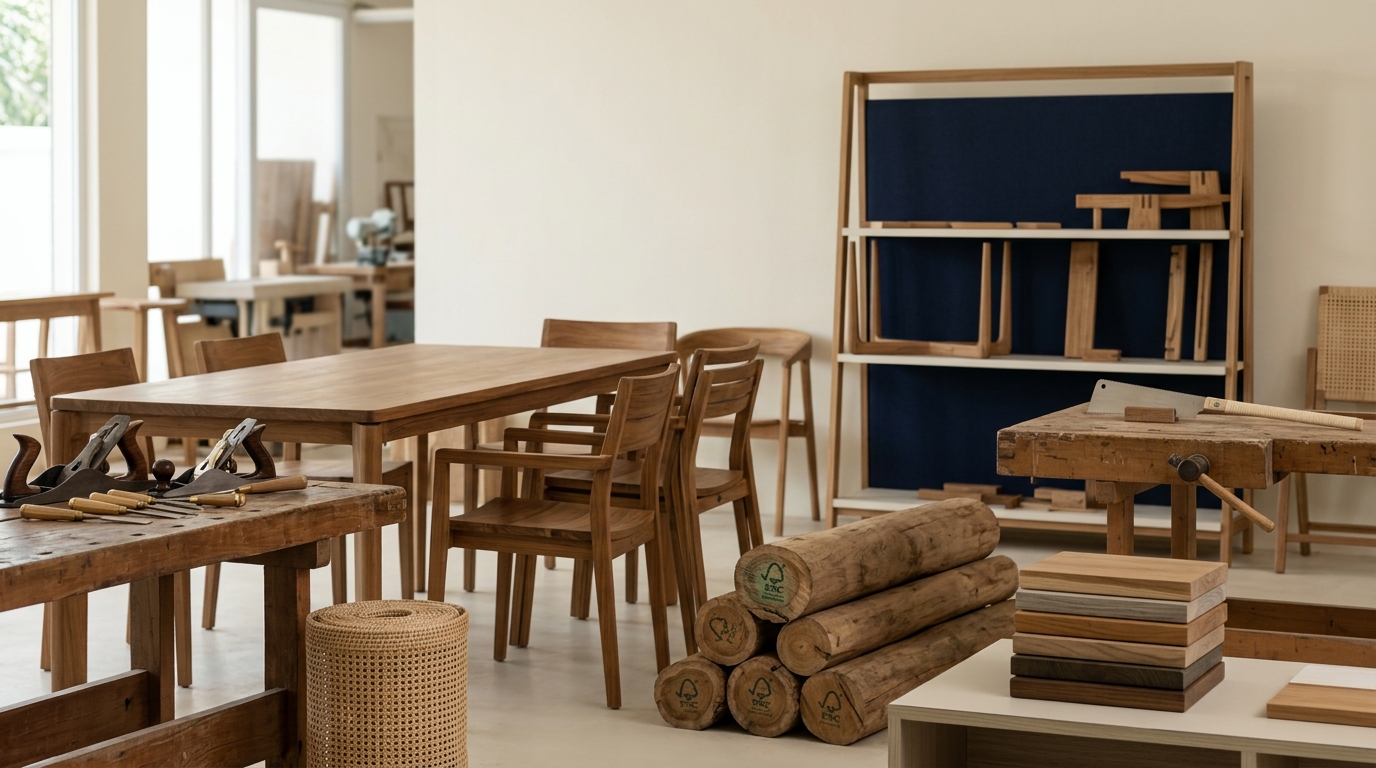
Procurement managers and retail buyers sourcing furniture from Indonesia face an increasingly high-stakes compliance environment. The EU Deforestation Regulation (EUDR), the EU Timber Regulation (EUTR), and the US Lacey Act have collectively raised the documentation bar for every shipment of wood…
Procurement managers and retail buyers sourcing furniture from Indonesia face an increasingly high-stakes compliance environment. The EU Deforestation Regulation (EUDR), the EU Timber Regulation (EUTR), and the US Lacey Act have collectively raised the documentation bar for every shipment of wood furniture crossing an international border. Selecting a supplier who claims to be sustainable is no longer sufficient — importers must verify, document, and audit the entire chain from forest to finished product. FSC certified furniture Indonesia is at the center of this conversation, because Indonesia remains one of the world's premier sources of solid wood furniture, and the FSC Chain of Custody framework is the most internationally recognised mechanism for proving that the timber inside each piece is legally and responsibly sourced.
This guide is written for procurement officers, compliance managers, and retail buying teams who need to understand not just what FSC certification means, but how to verify it, how it interacts with Indonesia's own SVLK and FLEGT frameworks, and how to structure supplier relationships that hold up under regulatory scrutiny. The article covers the wood species and production regions that define Indonesian furniture manufacturing, the step-by-step process for auditing supplier documentation, and the cost-benefit logic that makes FSC-certified Indonesian furniture a sound commercial investment — not merely an ethical one.
The regulatory pressure driving this demand is not theoretical. Both the EU and the US have significantly strengthened timber due-diligence obligations in recent years, and major retail buyers are cascading those requirements directly onto their supply chains. Understanding how to navigate this landscape — and how Indonesia's certification infrastructure maps onto it — is a prerequisite for any importer who wants to stay compliant and commercially competitive.
Why Sourcing FSC Certified Furniture From Indonesia Is Now a Compliance Imperative
Indonesia occupies a unique position in the global furniture industry. Its production clusters, particularly in Central Java, are globally recognised for solid wood craftsmanship using premium species such as teak, mahogany, and acacia. For international buyers in the US and EU, Indonesia is a primary sourcing destination for handcrafted, natural-material, and hospitality furniture. However, this strength comes paired with an obligation: sourcing from a tropical timber-producing country triggers heightened scrutiny under every major timber legality regulation currently in force.
The Regulatory Wave Hitting Importers Right Now
The EU Timber Regulation established the principle that importers bear responsibility for ensuring the legality of the timber in their products. The incoming EU Deforestation Regulation — which applies to timber and timber products, including furniture — goes further by requiring importers to demonstrate that the goods they place on the EU market have not contributed to deforestation or forest degradation. For Indonesian furniture, this means that a simple supplier declaration is no longer sufficient. Importers need verifiable, audited documentation tracing timber origin.
In the United States, the Lacey Act requires importers to exercise due care to confirm that wood products were harvested and traded in compliance with the laws of the country of origin. Indonesia is a country where enforcement of forest regulations has historically been inconsistent, making due-care documentation especially important for US importers. Regulators have made clear that ignorance of supply chain provenance is not a defence.
Reputational and Commercial Consequences Beyond Regulation
Beyond direct regulatory liability, FSC-certified wood furniture is now a commercial prerequisite in many B2B channels. Major retail groups and e-commerce platforms have introduced supplier codes of conduct that mandate FSC Chain of Custody certification for wood furniture. Buyers who cannot supply certified product risk delisting, contract termination, or exclusion from tender processes — consequences that often cost far more than any certification premium.
What FSC Certification Actually Guarantees and How It Protects Your Supply Chain
FSC Forest Management vs. Chain of Custody: A Critical Distinction
The Forest Stewardship Council (FSC) operates two distinct certification types that are frequently conflated. FSC Forest Management (FM) certification applies to the forest or plantation where timber is harvested, confirming that management practices meet FSC's ecological and social standards. FSC Chain of Custody (CoC) certification applies to every company in the supply chain — the sawmill, the component manufacturer, the furniture factory, and the exporter — confirming that certified material has been tracked and not mixed with uncertified timber without disclosure.
For an importer, the CoC certificate held by the Indonesian furniture manufacturer is the critical document. If that certificate does not exist or has lapsed, the FSC label on the product has no legal standing, regardless of where the timber originated.
Understanding FSC Label Types
FSC products carry one of three label types, each with a specific meaning:
- FSC 100%: All wood in the product comes from FSC-certified forests. This is the most rigorous standard. - FSC Mix: The product contains a mixture of FSC-certified material, recycled material, and/or FSC Controlled Wood. Controlled Wood excludes the most controversial sources but is not equivalent to full Forest Management certification. - FSC Recycled: All wood-based content is reclaimed post-industrial or post-consumer material.
Importers should be explicit with suppliers about which label type is required for their retail contracts or regulatory context. Substituting FSC Mix for FSC 100% can create compliance gaps if the buyer's downstream contract specifies the latter.
The Verification Chain and ISEAL Recognition
FSC is accredited by ISEAL, the global membership organisation for sustainability standards, which means its certification methodology is subject to independent oversight. This distinguishes FSC from self-declared sustainability claims — a meaningful distinction when a retailer's legal team or an EU customs authority is reviewing documentation. Third-party certification bodies such as Bureau Veritas, SGS, and Preferred by Nature conduct annual audits of CoC certificate holders, creating a documented audit trail that holds up to regulatory scrutiny.
Indonesian Wood Species and Why They Are Suited to Certified Furniture Production
The Primary Species: Teak, Mahogany, Acacia, and Mango Wood
Indonesia's furniture industry is built on a portfolio of wood species with strong commercial and technical profiles.
Teak is the flagship species. Indonesian plantation teak — grown in managed, government-licensed plantations predominantly in Java — is internationally regarded for its natural oil content, dimensional stability, and resistance to moisture and insects. Sustainable teak furniture Indonesia has commanded premium pricing in both the EU and US markets for decades, and plantation teak provides a legally cleaner sourcing pathway than old-growth equivalents.
Mahogany grown in Indonesian plantations offers comparable workability and an attractive grain profile. It is widely used in dining furniture, bedroom collections, and hospitality casegood production.
Acacia has grown substantially as a plantation species. It is fast-growing, amenable to FSC plantation certification, and produces a dense, durable timber suitable for outdoor and contract furniture. Its lower price point relative to teak makes it attractive for volume orders.
Mango wood is typically a by-product of retired fruit orchards, giving it an inherent sustainability narrative. It is used predominantly in decorative and accent pieces and appeals to buyers seeking FSC Recycled or FSC Mix product lines.
Why Plantation Timber Reduces EUDR and Lacey Act Risk
From a compliance perspective, plantation timber — as opposed to timber extracted from natural tropical forests — generally carries a lower deforestation risk profile, which is relevant to EUDR due-diligence assessments. Buyers should confirm with suppliers whether the timber they use is plantation-sourced, and request the relevant forest management certificates or plantation registration documents to support this claim.
Jepara, Solo, and Yogyakarta: Indonesia's Certified Production Heartland
Central Java hosts the densest concentration of FSC CoC-certified furniture manufacturers in Indonesia. Jepara is the country's most recognised solid wood cluster, producing teak and mahogany furniture for export markets across decades. Solo and Yogyakarta have developed complementary clusters with manufacturers covering mid-market and higher-volume production. Many factories in these regions have pursued FSC CoC certification specifically to satisfy EU and US buyer requirements, making them natural partners for compliance-focused procurement.
Semarang serves as the primary logistics hub for Central Java's exports, offering efficient access to container shipping for both LCL and FCL consignments. Buyers sourcing Indonesian wood furniture wholesale from this region can typically expect established export processes and familiarity with documentation requirements.
SVLK, FLEGT, and FSC: Indonesia's Timber Legality Framework Explained
Indonesia operates a mandatory timber legality system called SVLK — Sistem Verifikasi Legalitas Kayu — which applies to all timber and timber product companies operating in Indonesia. SVLK verification results in a V-Legal licence, which is attached to export shipments as proof of legal origin. Under the FLEGT (Forest Law Enforcement, Governance and Trade) partnership between Indonesia and the EU, V-Legal licences issued by Indonesia are automatically recognised by EU customs as proof of timber legality under the EUTR.
However, the compliance landscape is changing. The EUDR introduces requirements that go beyond legality verification to include geolocation-based deforestation risk assessment. V-Legal and SVLK alone do not currently satisfy EUDR's full due-diligence requirements, because they do not generate the plot-level geographic data the regulation demands. FSC Chain of Custody certification, by requiring audited traceability back to certified forests, adds a layer of documentation that substantially strengthens an importer's EUDR due-diligence file.
For US importers relying on Lacey Act due care, SVLK provides a useful baseline — it demonstrates that the Indonesian supplier is operating within a government-regulated legality framework. However, FSC CoC provides a more robust due-care argument because it involves independent third-party audits by accredited certification bodies, rather than government-administered verification alone.
The table below summarises how each framework maps to key regulatory requirements:
| Framework | EUTR Compliance | EUDR Due Diligence | US Lacey Act Due Care | Independent Audit |
|---|---|---|---|---|
| SVLK / V-Legal alone | Yes (FLEGT recognised) | Partial — no geolocation data | Useful baseline | Government-administered |
| FSC CoC alone | Yes | Strong — audited traceability | Strong — third-party verified | Accredited body (BV, SGS, etc.) |
| SVLK + FSC CoC | Yes | Strongest combination | Strongest combination | Both government and third-party |
| Self-declared only | No | Not accepted | Insufficient | None |
How to Verify an Indonesian Supplier's FSC Chain-of-Custody Status Before You Order
Step-by-Step Importer Verification Checklist
Verification of FSC CoC status should be a mandatory step in any sourcing due-diligence process. The following sequence reduces the risk of certificate misuse or greenwashing:
- ✓Obtain the supplier's FSC CoC certificate number and the name of the issuing certification body
- ✓Verify the certificate is active and not suspended at info.fsc.org
- ✓Confirm the product scope on the certificate covers the specific product categories you are ordering
- ✓Request an FSC sales invoice (or FSC transaction certificate) for a previous completed order as a sample document
- ✓Review the most recent surveillance audit report summary if the supplier will provide it
- ✓Check that the certificate holder name matches the legal entity you are contracting with — not a sister company or trading name
- ✓Confirm which FSC label type (100%, Mix, Recycled) the supplier can legitimately apply to your specific order
- ✓Ask whether subcontractors are used for any production stage, and verify whether those subcontractors hold their own CoC certificates
Key Documentation to Request from Any Supplier
Beyond the certificate itself, importers should expect to receive an FSC-labelled sales invoice that includes the supplier's CoC certificate number, the FSC claim type, and the FSC licence code for the product. This document is what allows the importer to pass the FSC claim down their own supply chain — and it is what a retail buyer or auditor will ask for first.
Red Flags That Indicate Certificate Misuse
The furniture industry has documented patterns of FSC certificate misuse. As flagged in experienced sourcing practice, certificate laundering — presenting certificates that are not held by the actual producing entity — is a known risk. Common red flags include: a supplier who cannot produce an FSC sales invoice for a previous transaction; a certificate that covers a different legal entity than the one signing your contract; a certificate with a product scope that does not include the category you are ordering; and any reluctance to have the certificate number independently verified.
Indonesia's Leading Production Regions and What to Ask Certified Suppliers
Jepara remains the benchmark cluster for FSC certified furniture Indonesia sourcing. Manufacturers in this region — including facilities that supply internationally recognised brands and buying groups — have in many cases maintained FSC CoC certification continuously for well over a decade. Wisanka, based in the Solo area, is frequently cited as an example of a vertically integrated Indonesian manufacturer with active FSC CoC status and export capacity to EU and US markets. ScanCom-partnered facilities in the region represent another category: international buying groups that have invested in manufacturing partnerships with FSC-compliant Indonesian producers, providing a model of what structured compliance looks like in practice.
Mentioning these names is illustrative, not endorsement. Buyers should verify any manufacturer's current certificate status independently through info.fsc.org before relying on historical reputation.
When conducting supplier due diligence, the following questions are productive starting points:
- What is your FSC CoC certificate number and when was your last surveillance audit? - Does your certification cover finished furniture, or only timber or semi-finished components? - Do you use subcontractors for any production stage, and if so, do they hold independent CoC certificates? - What is your minimum order quantity for FSC-labelled product, and can you produce an FSC sales invoice for a sample order within your normal lead time? - What export documentation package do you provide, including V-Legal licence, bill of lading, and FSC transaction certificate?
Typical lead times for made-to-order solid wood furniture from Central Java range from approximately six to fourteen weeks depending on complexity and volume, with export documentation processing adding a further one to two weeks. Affordable furniture Indonesia B2B pricing remains competitive relative to European production, even with the FSC certification premium factored in.
The EU and US Regulatory Landscape Driving Demand for FSC Certified Indonesian Furniture
EUTR, EUDR, and What Indonesian Importers Must Prepare For
The EU Timber Regulation established mandatory due-diligence obligations for operators who first place timber and timber products on the EU market. FLEGT-licensed Indonesian timber — covered by the SVLK/V-Legal system — has simplified EUTR compliance for EU importers. However, the EUDR expands the scope and raises the evidentiary standard: importers must demonstrate that products are free from deforestation risk, supported by geographic data, and backed by a due-diligence system that has been actively maintained.
For Indonesian furniture specifically, the EUDR's focus on deforestation means importers must understand not just whether timber was legally harvested, but whether the land from which it came was forested after the regulation's reference date. Plantation teak and plantation acacia, which are traceable to registered plantation areas, present a more manageable compliance pathway than timber from natural forest concessions.
US Lacey Act: What Due Care Requires in Practice
US importers must complete a Lacey Act declaration for wood products, including furniture, specifying the genus and species of timber used, the country of harvest, and the quantity. Due care requires that importers have made reasonable efforts to verify this information. FSC CoC certification provides strong due-care evidence because it demonstrates that an accredited third-party auditor has verified the supply chain. SVLK provides supplementary evidence of legality under Indonesian law.
How Major Retailers Are Cascading FSC Requirements
Large retail groups and e-commerce platforms have incorporated FSC CoC requirements into their supplier codes of conduct. For importers who distribute through these channels, FSC certification is not optional — it is a condition of doing business. Procurement teams should build FSC CoC status into their supplier qualification criteria from the outset, rather than retroactively seeking certification after a retail contract demands it.
- ✓Confirm supplier holds active FSC CoC certificate covering finished furniture — verify at info.fsc.org
- ✓Confirm certificate holder name matches contracting entity
- ✓Identify which FSC label type (100%, Mix, Recycled) applies to your order
- ✓Request SVLK/V-Legal licence confirmation for all timber in the order
- ✓Assess EUDR deforestation risk for timber species and origin regions
- ✓Complete Lacey Act declaration with accurate genus, species, and harvest country data
- ✓Obtain FSC sales invoice template from supplier before production commences
- ✓Include FSC audit clause in supplier contract requiring notification of any certificate changes
- ✓Confirm subcontractor CoC status if any production stages are outsourced
- ✓Retain all documentation for minimum five years for audit purposes
Cost-Benefit Analysis: What the FSC Premium Costs and What Non-Compliance Costs More
Understanding the Price Differential
FSC certified wood furniture from Indonesia typically carries a modest price premium over equivalent non-certified product from the same region. This premium reflects the cost of annual CoC audits, the administrative burden of maintaining documented traceability systems, and in some cases the higher cost of purchasing certified timber inputs. In practice, buyers sourcing Indonesian wood furniture wholesale report that this differential is often smaller than anticipated, particularly when purchasing from manufacturers who have maintained FSC certification for multiple years and have absorbed the compliance infrastructure into their operating model.
The premium must be evaluated against what non-certified sourcing actually costs when things go wrong.
The Real Cost of Non-Compliance
Regulatory enforcement under the Lacey Act has resulted in seizure of shipments, substantial financial penalties, and criminal liability for corporate officers in documented cases involving illegally sourced timber. EU enforcement under EUTR has resulted in shipment delays, import prohibitions, and market withdrawal requirements. Under EUDR, the enforcement regime is expected to be more rigorous still. Downstream, a single deforestation scandal involving a named supplier can trigger product recalls, retail delisting, and reputational damage that dwarfs any certification saving.
Structuring Supplier Contracts with FSC Audit Clauses
A frequently overlooked element of sustainable sourcing practice is embedding FSC compliance obligations directly into supplier contracts. Importers should include contractual clauses that require: immediate notification of any change to the supplier's FSC CoC certificate status; the right to audit or commission third-party audits of FSC documentation at any point during the contract term; and the right to suspend or terminate orders without penalty if the FSC certificate lapses or is suspended. This creates accountability between audit cycles and protects the importer if a supplier's certification status changes after a purchase order has been placed.
Positioning FSC as a Commercial Asset, Not Just a Cost
For retailers and hospitality buyers, FSC certified furniture Indonesia provides a consumer-facing sustainability narrative that justifies premium positioning. End consumers in the US and EU increasingly scrutinise sustainability claims, and FSC's third-party verification framework is among the most credible signals available for wood products. Importers who build FSC-certified Indonesian furniture into their catalogue are not simply managing risk — they are investing in a product attribute that supports margin, brand differentiation, and long-term retail partnerships.
Frequently Asked Questions From Importers Sourcing Indonesian Certified Furniture
What is FSC certified furniture and what does the label guarantee?
FSC certified furniture carries either an FSC Forest Management or FSC Chain of Custody claim. For finished furniture, the relevant certification is Chain of Custody, held by every entity in the supply chain from timber processor to exporter. The label guarantees that an accredited, independent certification body has audited the supply chain and confirmed that certified material has been correctly tracked, segregated, and documented. It does not guarantee any particular quality standard for the furniture itself — it addresses timber origin and traceability.
Is furniture made in Indonesia suitable for commercial and retail use?
Yes. Indonesia is one of the world's leading producers of solid wood furniture, with particular strength in teak, mahogany, acacia, and rattan. The Jepara cluster in Central Java has supplied European and American markets for decades. Manufacturers in this region produce furniture for hospitality, retail, and distribution contracts across all major market tiers. Quality varies by manufacturer and price tier, so pre-production sampling and quality inspections remain important.
What wood species are commonly used in Indonesian furniture manufacturing?
The primary species are teak, mahogany, acacia, and mango wood. Teak and mahogany dominate premium and mid-market solid wood production. Acacia is widely used for outdoor and contract furniture. Mango wood is common in accent and decorative pieces. Rattan and bamboo remain important for outdoor and lifestyle categories.
Is Indonesian wood durable and suitable for EU and US climate conditions?
Plantation teak and mahogany are well suited to the climatic variation found across EU and US markets. Teak's natural oil content provides inherent moisture resistance, making it effective in humid coastal environments and for outdoor applications. Acacia is similarly dense and durable. Buyers specifying furniture for extreme cold or high-humidity environments should confirm species, treatment, and finish specifications with their supplier, as performance varies by production standard.
How do I check if an Indonesian supplier has a valid FSC chain-of-custody certificate?
Visit info.fsc.org, enter the supplier's certificate number or company name, and confirm that the certificate status is active, that the certificate holder name matches your supplier's legal entity, and that the product scope includes the category you are ordering. This verification should be repeated periodically, not just at onboarding, because certificates can be suspended between annual audits.
What is the difference between SVLK, FLEGT, and FSC certification in Indonesia?
SVLK is Indonesia's mandatory national timber legality verification system. FLEGT refers to the EU-Indonesia Voluntary Partnership Agreement under which V-Legal export licences — issued through SVLK — are recognised by EU customs as proof of legal timber origin under the EUTR. FSC certification is an independent, internationally recognised standard administered by the Forest Stewardship Council, involving third-party audits at each stage of the supply chain. SVLK establishes a legal baseline; FSC CoC provides a more robust traceability and audit framework that satisfies a wider range of compliance requirements, including the stronger documentation demands of the EUDR and the US Lacey Act due-care standard.
FSC certified furniture Indonesia represents the intersection of commercial opportunity and regulatory necessity: Indonesia's manufacturing strength in solid wood furniture is undisputed, and FSC Chain of Custody certification is the most credible, internationally accepted mechanism for demonstrating that what you are importing meets the timber legality and sustainability standards your retail partners and regulators require. Importers who combine FSC CoC verification with a thorough understanding of SVLK, FLEGT, and the evolving EUDR framework are positioned to source confidently, defend their supply chains under audit, and build long-term supplier relationships that deliver compliance value across every order.
Now that you understand how FSC Chain of Custody certification works, how to verify it, and why it matters for your regulatory and commercial obligations, the logical next step is to connect with Indonesian manufacturers who can deliver on these requirements.
Work with Indonesian manufacturers who hold active FSC Chain of Custody certificates across teak, mahogany, and acacia product lines. Get documented compliance from the first order.
Request a Verified FSC Quote →Need eyes on the ground in Indonesia?
MTS is an execution partner — supplier verification, manufacturing management, quality control and export logistics across Indonesia, Vietnam and China.
Related services
Receive furniture sourcing insights across Asia.
One email per week. No spam.