LVL Laminated Veneer Lumber Manufacturers Indonesia: A Complete Sourcing Guide
13 min read
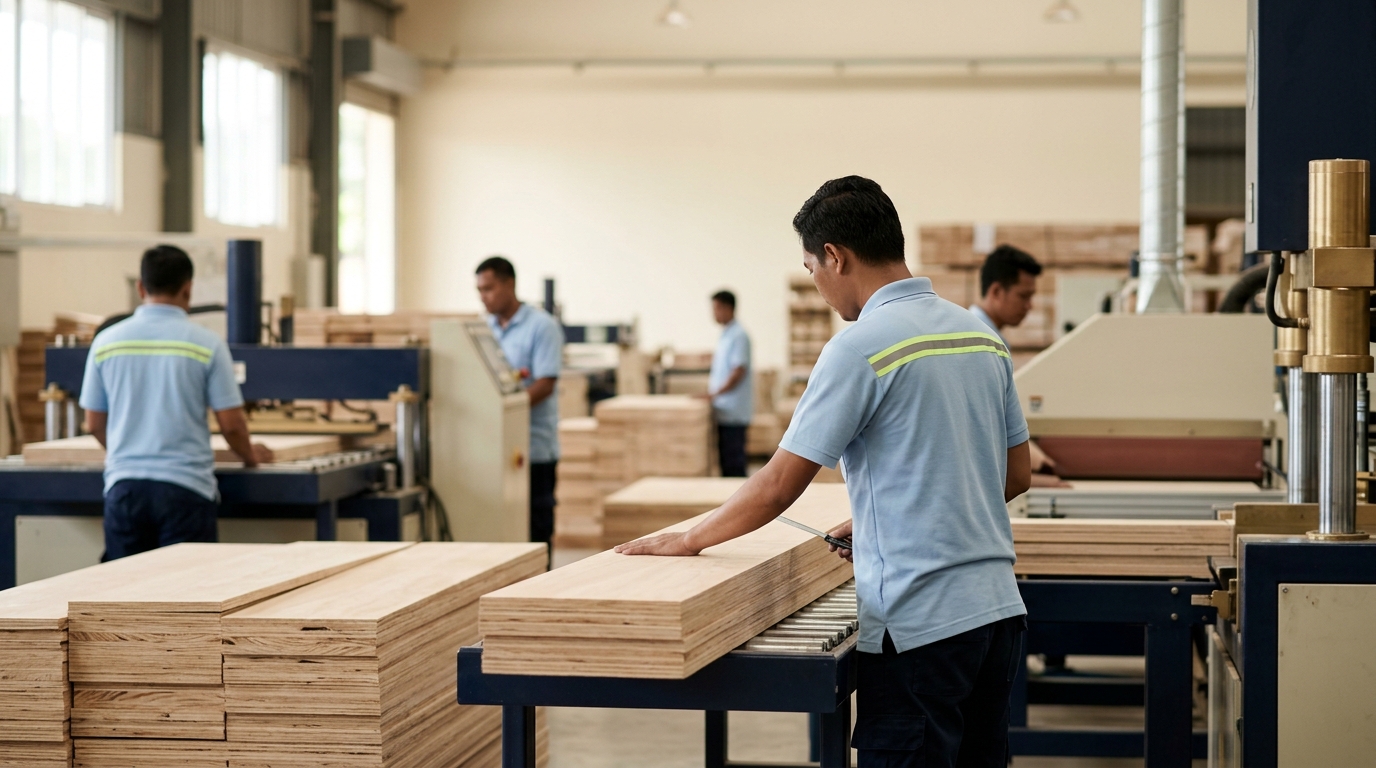
Sourcing structural-grade LVL from Indonesia looks straightforward until you request documentation. Then the problems surface fast. Certification confusion is common — suppliers present JAS certificates for non-structural panels, misrepresent glue bond classes, or conflate formaldehyde emission…
Sourcing structural-grade LVL from Indonesia looks straightforward until you request documentation. Then the problems surface fast. Certification confusion is common — suppliers present JAS certificates for non-structural panels, misrepresent glue bond classes, or conflate formaldehyde emission grades. Grade inconsistency is another recurring issue: veneer lay-up configurations vary between mills, and without a clear specification in your purchase order, you may receive product that fails US structural design value thresholds. Factory audit gaps compound the risk. Many Indonesian mills have never hosted a Western buyer's inspector, and visual-only audits miss the critical process controls — veneer moisture content, press calibration, glue mixing records.
This guide addresses those three pain points directly. It covers structural versus non-structural LVL grade differentiation, the certifications that matter for US import compliance, standard dimensions and adhesive specifications, and a factory audit framework built specifically for Indonesian LVL mills. It also maps HTS codes, tariff rates, and logistics lead times so your procurement team can model total landed cost before committing to a bulk order.
The Indonesian LVL laminated veneer lumber manufacturing sector has grown substantially over the past decade. Production is concentrated in East Kalimantan, West Java, and Central Java. Fast-growing plantation species — primarily sengon, pine, and eucalyptus — give Indonesian mills a raw material cost advantage that European and North American structural LVL producers cannot match. What follows gives you the technical depth to evaluate that advantage against real compliance and quality requirements.
Why Indonesia Has Become a Leading LVL Manufacturing Hub for Export Markets
Plantation Timber Supply and Species Advantages
Indonesia's LVL laminated veneer lumber manufacturing base is built on fast-growing plantation species. Sengon (Falcataria moluccana) reaches harvestable size in approximately eight to twelve years. Pine and eucalyptus plantations, concentrated in Sumatra and Java, provide alternative species for higher-density structural grades. This rotation speed keeps raw material costs low relative to temperate hardwood markets.
The plantation base is government-regulated under the SVLK system (Sistem Verifikasi Legalitas Kayu — Indonesian Timber Legality Verification). SVLK matters for US importers specifically because it satisfies the "due care" requirement under the US Lacey Act. Any LVL imported into the United States must be accompanied by documentation proving the timber was legally harvested. SVLK certification, issued by accredited independent verifiers, provides that chain-of-custody evidence. Without it, your shipment carries legal exposure under Lacey Act enforcement.
Production Regions and Export Infrastructure
Three regions dominate Indonesian LVL production. East Kalimantan hosts larger integrated mills with direct port access at Balikpapan. West Java and Central Java (particularly around Surabaya and Semarang) concentrate mid-size exporters producing formwork panels and scaffold boards. FOB shipment from Surabaya or Jakarta connects to major US West Coast and East Coast ports within typically thirty to sixty days, depending on routing and transshipment.
Competitive labour costs relative to European producers translate directly into ex-works price advantages. Indonesian structural LVL typically arrives at US ports at a meaningful discount to comparable North American or Finnish product — though that gap narrows once tariffs, freight, and quality-control costs are factored in.
Structural vs Non-Structural LVL: What US Importers Must Specify Before Ordering
This distinction is the most common source of procurement errors when working with lvl laminated veneer lumber manufacturers indonesia.
| Parameter | Structural LVL | Non-Structural LVL |
|---|---|---|
| Primary applications | Beams, headers, rim boards, columns | Formwork panels, scaffold boards, concrete shuttering |
| MOE requirement | Typically 10,000–14,000 MPa | Not specified or low threshold |
| MOR requirement | Typically 30–45 MPa minimum | Not specified |
| Veneer species | Pine, eucalyptus, or mixed hardwood | Sengon, mixed plantation |
| Lay-up configuration | Parallel grain throughout | Parallel or cross-banded |
| Applicable standard | JAS 600 (structural) / APA PRG 320 equivalent | JAS (non-structural) or in-house spec |
| Glue class required | WBP / phenol formaldehyde | MR acceptable for interior use |
| Certification required | JAS structural, CE EN 14374 | SVLK minimum |
Mapping Indonesian Grades to US NDS Design Values
US structural engineers specify LVL using design values from the National Design Specification (NDS) published by the American Wood Council. Indonesian JAS-certified structural LVL can be mapped to NDS values, but this requires mill-specific documentation. The mill must provide a published design value table derived from testing under recognised protocols — typically ASTM D5456 or equivalent. Request this document before specifying Indonesian structural LVL in an engineered drawing. Do not accept JAS certification alone as proof of specific NDS-equivalent design values without the supporting test data.
Veneer Lay-Up and Grade Classification
Lay-up configuration — the number of veneers, individual veneer thickness, and grain orientation — directly affects bending stiffness and shear strength. Structural LVL uses fully parallel grain lamination. Cross-banded lay-ups, sometimes used in formwork panels for dimensional stability, are non-structural by classification. Specify lay-up configuration explicitly in your purchase order: number of plies, individual veneer thickness (typically 2.5mm to 3.2mm per ply), and grain orientation requirement.
Certifications to Require From Indonesian LVL Suppliers Before Approving a Shipment
JAS and CE Marking
JAS (Japanese Agricultural Standard) is the dominant export certification for structural LVL from Indonesia. It covers veneer quality, adhesive performance, moisture content, and mechanical property thresholds. JAS-certified mills undergo periodic third-party audits by accredited inspection bodies. For US buyers, JAS structural certification is the strongest available signal of process control in Indonesian LVL production — though it does not automatically map to NDS design values without supplementary test documentation.
CE marking under EN 14374 applies to structural LVL sold into European-influenced markets. Some Indonesian exporters hold both JAS and CE certification. If your customer base includes European-spec projects or international construction contracts referencing Eurocode, require EN 14374 compliance documentation.
SVLK, FSC, and Lacey Act Relevance
SVLK is mandatory for all Indonesian timber exports. It satisfies Lacey Act due-care requirements. FSC (Forest Stewardship Council) chain-of-custody certification goes further — it verifies sustainable forest management, not just legality. PEFC (Programme for the Endorsement of Forest Certification) is an equivalent alternative accepted by sustainability-focused buyers. If your clients specify FSC-certified engineered wood, confirm the mill holds a current FSC CoC certificate, not merely an FSC-controlled wood claim.
Formaldehyde Emission Classes
| Class | Formaldehyde Emission Limit | US Import Relevance |
|---|---|---|
| E0 | ≤ 0.5 mg/L | Exceeds CARB Phase 2 requirement |
| E1 | ≤ 1.5 mg/L | Meets CARB Phase 2 for most composite wood |
| E2 | ≤ 5.0 mg/L | Does NOT meet CARB Phase 2 — import risk |
The California Air Resources Board (CARB) ATCM Phase 2 standard applies to compositewood productssold or used in California. E2-class LVL cannot legally enter the California market. For nationwide US distribution, specify E1 minimum. For formwork panels used on sensitive sites, specify E0. Write the emission class explicitly into your purchase order and request a test certificate from an accredited laboratory with each production batch.
Standard LVL Dimensions and Specifications Available From Indonesian Mills
Most lvl laminated veneer lumber manufacturers indonesia produce to the following standard dimensions, with custom sizing available at larger mills:
Structural LVL — common thicknesses: 36mm, 45mm, 63mm, 75mm, 90mm Widths: 200mm to 600mm in standard increments Lengths: up to 12,000mm; finger-jointed extensions available at some mills
Formwork panels: typically 1220mm × 2440mm, 18mm or 21mm thick, film-faced one or two sides
Scaffold boards: commonly 225mm wide × 38mm thick, lengths of 3,000mm to 4,000mm
Custom sizing is negotiable with mills operating large-format hot presses. Lead time for non-standard dimensions typically adds two to four weeks to production schedule. Confirm available press platen size before specifying widths above 600mm — not all Indonesian mills can produce wider sections in a single pressing.
Glue Bond Classes and Adhesive Types: How to Write Them Into Purchase Orders
This is the specification detail most competitors omit entirely. Getting it wrong leads to delamination failures in service.
| Adhesive Type | Bond Class | Service Condition | Indonesian LVL Application |
|---|---|---|---|
| Phenol Formaldehyde (PF) | WBP (Weather and Boil Proof) | Exterior / wet conditions | Structural beams, exterior formwork, scaffold boards |
| Melamine Urea Formaldehyde (MUF) | MR (Moisture Resistant) | Interior / dry conditions | Interior formwork panels, non-structural LVL |
| Urea Formaldehyde (UF) | INT (Interior only) | Dry conditions only | Not recommended for any load-bearing or wet-contact use |
Bond class under EN 314 is defined by delamination performance after cyclic soaking. JAS equivalents use similar wet-condition testing protocols. For structural LVL and any formwork or scaffold application involving concrete contact or outdoor exposure, specify WBP / phenol formaldehyde adhesive explicitly.
How to write glue class into a purchase order:
> "Adhesive: Phenol Formaldehyde (PF) resin. Bond class: WBP per EN 314-2 Class 3 or JAS equivalent. Formaldehyde emission: E1 maximum per JAS or equivalent standard. Supplier to provide batch test certificate."
This language removes ambiguity. Mills defaulting to MUF for cost reasons cannot substitute without explicit buyer approval when this language appears in the contract.
Formwork and Scaffold Board Performance: Sengon vs Pine Core Compared
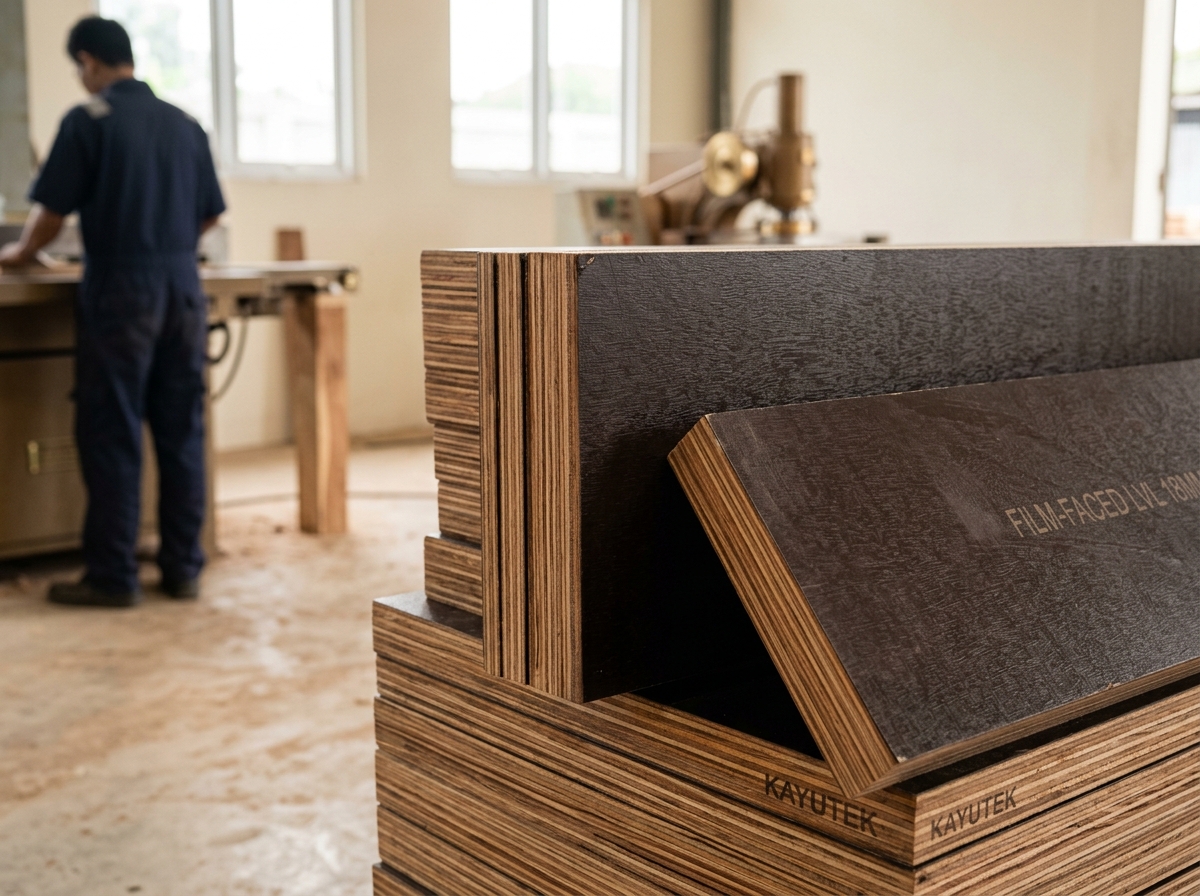
Reuse cycle performance is the key economic metric for formwork LVL buyers. Indonesian LVL formwork boards with film facing (typically 120g/m² to 220g/m² phenolic film) are commonly rated for approximately eight to twenty reuse cycles depending on film weight, core species, and site handling practices. These figures are approximate and vary by manufacturer — request mill-specific reuse data based on their testing protocols.
| Parameter | Sengon Core LVL | Pine Core LVL |
|---|---|---|
| Density (approximate) | 300–450 kg/m³ | 500–600 kg/m³ |
| Bending stiffness (MOE) | Lower | Higher |
| Reuse cycles (film-faced) | 8–12 cycles (approximate) | 12–20 cycles (approximate) |
| Cost relative | Lower | Higher |
| Weight per panel | Lighter — handling advantage | Heavier |
| Recommended for | Light-duty formwork, low-rise | Structural formwork, heavy concrete loads |
For scaffold board applications, deflection limits matter as much as bending strength. Specify maximum allowable deflection (commonly L/60 or L/100 depending on application) in addition to MOR. Indonesian mills producing to BS EN 13374 scaffold board standards can provide compliance documentation — confirm this before ordering scaffold-grade product.
Factory Audit Checklist for Indonesian LVL Mills: What to Verify Before a Bulk Order
No top competitor in this space publishes a mill-specific audit framework for Indonesian LVL. This checklist is derived from standard engineered wood production quality requirements.
- ✓Verify veneer drying line capacity and kiln calibration records — target veneer moisture content 6–10% before pressing
- ✓Check veneer thickness consistency across a sample of 20+ veneers — variation above ±0.2mm is a red flag
- ✓Review glue mixing records: PF resin mix ratios, pot life controls, temperature logs at glue spreader
- ✓Inspect hot press calibration certificates — pressure uniformity across platen is critical for bond integrity
- ✓Observe or request results of delamination test bath testing per JAS or EN 314 protocol
- ✓Request MOR and MOE bending test records — in-house test rig should be visible and recently calibrated
- ✓Check moisture content of finished LVL — above 10% MC in finished product indicates inadequate conditioning
- ✓Review batch traceability records: veneer origin, pressing logs, QC sign-off per production run
- ✓Confirm SVLK certificate validity and scope — check accreditation body and expiry date
- ✓Request mill test reports for at least three recent production batches matching your specification
- ✓Verify formaldehyde emission test certificates from accredited external laboratory — not in-house only
- ✓Ask for third-party pre-shipment inspection reports from previous export shipments (SGS, Bureau Veritas, Intertek)
- ✓Check storage conditions for finished product — LVL stored outdoors without wrapping indicates poor MC control
- ✓Review export history: request SIERA system export records or Indonesian customs data printout for verification
Third-party pre-shipment inspection by SGS, Bureau Veritas, or Intertek is strongly recommended for first and second orders. Specify inspection scope in the purchase contract: dimensional check, visual grading, moisture content measurement, and documentation review at minimum.
US Import Tariffs, HTS Codes, and Logistics for Indonesian LVL
HTS Classification and Tariff Rates
LVL imports into the United States classify under HTS Chapter 44. The primary subheading is 4412.10 (plywood consisting solely of sheets of wood, each ply not exceeding 6mm thickness — this covers most LVL configurations). Specific sub-classifications depend on species and construction. Confirm the correct 10-digit HTS code with a licensed customs broker before first import — misclassification creates penalty exposure.
Indonesian engineered wood products currently benefit from the US Generalised System of Preferences (GSP) for eligible product categories, though GSP eligibility status can change with trade policy updates. The baseline Most Favoured Nation (MFN) tariff rate for engineered wood panels under 4412.10 is generally in a low single-digit percentage range — verify the current rate with US Customs and Border Protection (CBP) or your customs broker at time of ordering, as rates are subject to legislative change.
Indonesia is not currently subject to Section 301 tariffs (which apply to China), making it a preferred alternative source for US buyers redirecting engineered wood procurement away from Chinese suppliers.
Phytosanitary and Logistics Requirements
ISPM 15 (International Standards for Phytosanitary Measures No. 15) requires that all wood packaging material — pallets, dunnage, crating — accompanying an LVL shipment be heat-treated or fumigated and marked with the official ISPM 15 mark. Non-compliant wood packaging will be detained or destroyed at the US port of entry. Confirm with your Indonesian supplier that all packaging wood meets ISPM 15 and that the mark is applied before container loading.
Typical lead times (approximate):
- Production lead time: 21–45 days from purchase order confirmation - FOB Surabaya or Jakarta to US West Coast: approximately 18–25 days transit - FOB to US East Coast: approximately 28–35 days transit - Total order-to-port timeline: typically 45–80 days
Container loading:
- 20ft container: suitable for smaller trial orders, approximately 18–20 MT capacity - 40ft HC container: standard for bulk orders, approximately 25–27 MT of LVL panels
MOQ expectations vary by mill size. Smaller Central Java exporters may accept one 20ft container as MOQ. Larger integrated mills typically require one or more 40ft HC containers per order.
Evaluating Indonesian LVL Supplier Profiles: Key Differentiators and Verification Steps
Notable exporters in the Indonesian LVL space include companies operating under or associated with groups such as Sumber Mas Group (which includes PT Kayan River Indah), and smaller exporters such as CV Sengon Maju Lancar and Pangestu Guru Timber Industry. These names appear in Indonesian customs export data and represent a cross-section of mill sizes and product focus areas.
When comparing suppliers, evaluate on these criteria:
| Differentiator | What to Ask / Verify |
|---|---|
| Production capacity | Monthly output in m³; press capacity and number of lines |
| Export markets served | US, Japan, Australia, Middle East — signals familiarity with compliance requirements |
| Certifications held | JAS, SVLK, FSC CoC, CE EN 14374 — request current certificates with expiry dates |
| Species and grade range | Sengon, pine, eucalyptus; structural vs non-structural capability |
| In-house testing | MOR/MOE bending rig, delamination bath, moisture meter calibration records |
| Export history | Verify via SIERA (Indonesia's export reporting system) or commercial customs data providers |
To verify company registration and export legitimacy, request the supplier's NIB (Nomor Induk Berusaha — Indonesian business registration number) and cross-reference export transaction history through Indonesian customs data services. Third-party commercial intelligence platforms can pull shipment records showing actual export volumes, destination ports, and consignee names — use this data to validate supplier claims about export market experience before committing to an audit visit.
Questions to ask in initial supplier contact: - What is your current JAS certificate number and accreditation body? - Can you provide ASTM D5456-equivalent bending test data for your structural grades? - What glue systems do you use for exterior-rated LVL, and who is your resin supplier? - What is your standard MOQ and production lead time for 45mm structural LVL in pine? - Have you previously supplied US importers, and can you provide a reference contact?
Frequently Asked Questions: Indonesian LVL for US Procurement
What certifications should Indonesian LVL manufacturers hold for US structural applications? JAS (Japanese Agricultural Standard) for structural grades is the most widely recognised. SVLK is mandatory for Lacey Act compliance. For formaldehyde compliance, require E1 or E0 class with laboratory test certificates. FSC CoC is required if your end-use specification demands certified sustainable wood.
What is the difference between structural and non-structural LVL from Indonesia? Structural LVL meets defined MOE and MOR thresholds and uses parallel grain lay-up throughout. Non-structural LVL (formwork panels, scaffold boards) may use sengon core, cross-banded lay-up, and MR-class adhesive. See the comparison table in the grade section above.
What glue bond class is required for exterior or formwork LVL? WBP (Weather and Boil Proof) bond class, achieved with phenol formaldehyde (PF) resin, is required for any wet-condition, exterior, or concrete-contact application. MR-class adhesive is acceptable only for interior dry-condition use.
How many reuse cycles can Indonesian LVL formwork boards achieve? Approximately eight to twenty cycles for film-faced panels, depending on core species (pine core outperforms sengon core), film weight, and site handling. Request mill-specific test data rather than relying on general claims.
What are the standard LVL dimensions available from Indonesian mills? Common structural thicknesses: 36mm, 45mm, 63mm, 75mm, 90mm. Widths: 200mm–600mm. Lengths: up to 12,000mm. Formwork panels: 1220×2440mm at 18mm or 21mm. Scaffold boards: 225×38mm cross-section.
What US import tariffs apply to LVL from Indonesia? LVL classifies primarily under HTS 4412.10. Indonesia is not subject to Section 301 tariffs. The applicable MFN tariff rate is in the low single-digit range — confirm the current rate with your customs broker before importation, as rates change.
Sourcing from lvl laminated veneer lumber manufacturers indonesia offers a genuine cost and supply-chain diversification advantage for US importers — but only when certification requirements, glue bond specifications, and factory audit controls are applied rigorously. The mills that meet JAS structural standards, hold valid SVLK documentation, and can demonstrate batch-level MOR/MOE test records are the ones worth the audit investment.
You now have the technical framework to evaluate Indonesian LVL suppliers against real compliance and performance standards. The logical next step is hands-on validation. Request a free LVL sample pack — covering structural and formwork grades in your specified dimensions — along with a completed factory audit checklist from verified Indonesian manufacturers. Compare adhesive class, emission certification, and dimensional tolerance before committing to a container order.
Request Your Free LVL Sample Pack →Need eyes on the ground in Indonesia?
MTS is an execution partner — supplier verification, manufacturing management, quality control and export logistics across Indonesia, Vietnam and China.
Related services
Related articles
Receive furniture sourcing insights across Asia.
One email per week. No spam.