Suar Wood Slabs Suppliers Indonesia Live Edge: A Trade Buying Guide for US Importers
14 min read
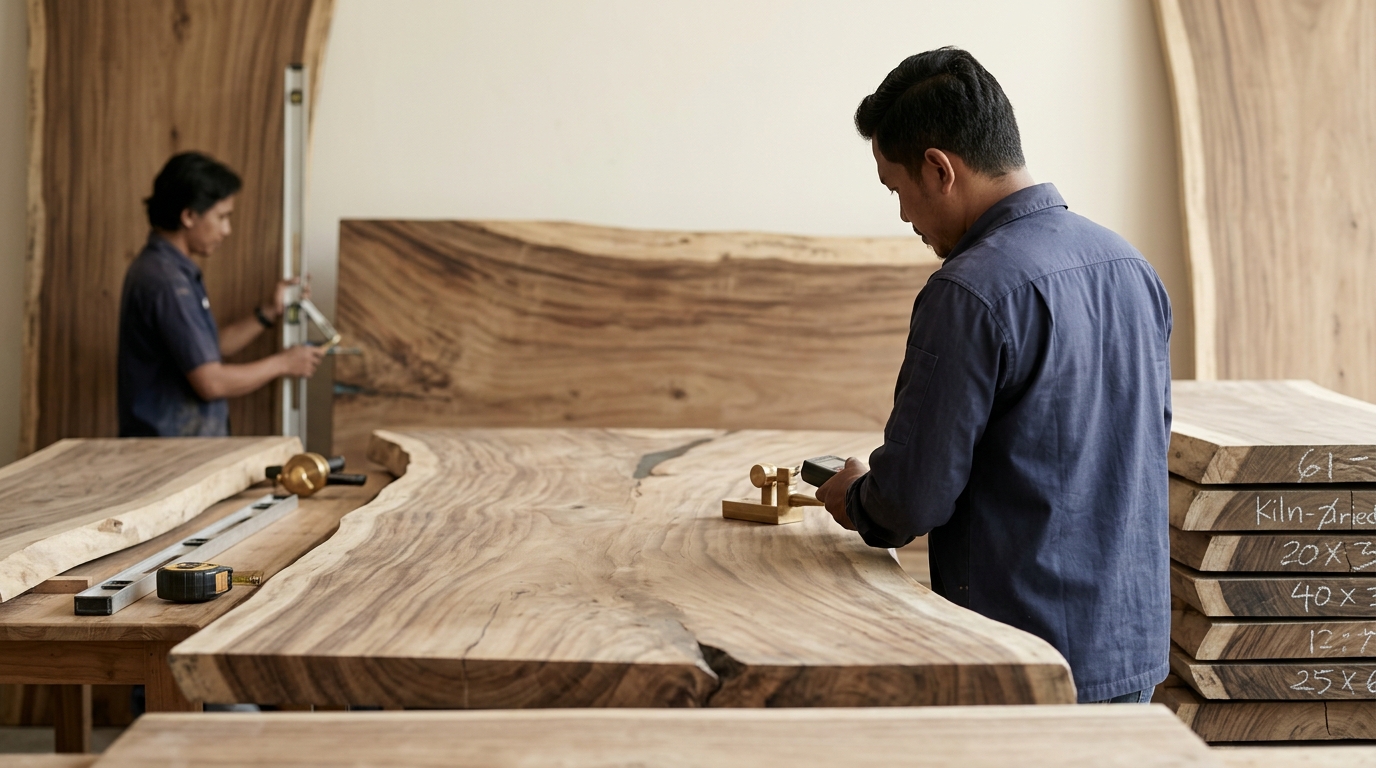
Sourcing live edge suar wood slabs from Indonesia involves more than finding a supplier with good photos. US furniture makers and table manufacturers face a specific set of procurement risks: inconsistent moisture content, vague grading, insufficient kiln documentation, and landed cost surprises…
Sourcing live edge suar wood slabs from Indonesia involves more than finding a supplier with good photos. US furniture makers and table manufacturers face a specific set of procurement risks: inconsistent moisture content, vague grading, insufficient kiln documentation, and landed cost surprises that erode margin before a slab reaches the shop floor.
This guide addresses those risks directly. It covers slab dimensions, kiln drying schedules for thick stock, book-matched grading criteria, epoxy-ready prep specifications, container logistics, and total landed cost structure. It also provides a supplier qualification framework built for remote buyers who cannot visit Jepara or Bali before placing a deposit.
Indonesian suppliers dominate the global live edge slab market for a practical reason: Samanea saman grows to exceptional diameter across Java and Bali, producing slabs at widths and lengths rarely available from other origins.
What Suar Wood Is and Why Indonesian Slabs Outperform Other Origins
Botanical Identity and Visual Character
Suar wood comes from Samanea saman, commonly called monkeypod. It is a fast-growing tropical hardwood planted extensively across Java, Bali, and other Indonesian islands. The tree reaches large diameters relatively quickly, which explains why slabs wider than 100 cm are routinely available from Indonesian suppliers at commercial volume.
The wood displays a warm color range from dark chocolate heartwood to golden-amber sapwood. Grain figure varies from tight straight runs to broad, sweeping cathedral patterns. Natural voids, bark pockets, and occasional crotch figure are characteristic — not defects. These features drive demand in the US live edge dining table market.
Hardness falls in the moderate range, making suar workable with standard tooling. It holds finish well and responds to both oil and film-forming topcoats. Density is typically lower than teak, which has direct implications for freight weight calculations.
Why Indonesia Leads on Supply Volume and Price
Indonesia's dominance among suar wood slabs suppliers in the live edge segment comes down to three factors. First, plantation and agroforestry-sourced Samanea saman is abundant, particularly in Central and East Java.
Legality and Certification: SVLK
Indonesia's SVLK (Sistem Verifikasi Legalitas Kayu) is the national timber legality verification system. For US buyers, SVLK-certified exports satisfy the Lacey Act's due diligence requirement on legal harvest documentation. Any legitimate Indonesian suar exporter should hold a valid SVLK certificate or work through an SVLK-licensed export company.
Standard Slab Dimensions and Thickness Options Available at Export Scale
Typical Size Ranges and What to Specify
Indonesian suar wood slabs suppliers working at export scale typically offer the following dimensional ranges (approximate figures based on common trade practice):
| Dimension | Typical Range | Notes |
|---|---|---|
| Length | 150–400 cm | Slabs above 300 cm require 40 ft HC container |
| Width | 60–180 cm | Widths above 120 cm are premium-priced |
| Thickness (finished) | 5 cm, 7 cm, 10 cm, 12 cm | Some suppliers offer 15 cm for bar tops |
Thickness is the most consequential variable for freight and drying. A single slab at 200 × 100 × 10 cm weighs approximately 150–170 kg (weight varies with moisture content and species density). At 12 cm thickness, that same slab approaches 200 kg. Plan structural loading accordingly when specifying container packing.
Dimensional Tolerances: Template for Purchase Orders
Specify tolerances explicitly in your purchase order. A workable template:
Slab Dimensional Specification — Purchase Order Template - Nominal length: [X] cm, tolerance ± 5 cm - Nominal width at widest point: [X] cm, tolerance ± 3 cm - Finished thickness: [X] cm, tolerance ± 2 mm (after surfacing) - Square-cut ends: yes / no (specify if end-grain sealing is required) - Sapwood inclusion: permitted / excluded / max [X] cm on each edge - Live edge: both edges / one edge / buyer's choice
Book-matched pairs require an additional tolerance note: specify that both slabs in a pair must fall within ± 3 mm of the same finished thickness to prevent step joints at the glue line.
Single Slab vs. Book-Matched Pairs
Single slabs ship more easily and cost less per piece. Book-matched pairs come from the same log, cut sequentially, and opened like a book. They are the dominant format for dining table tops above 100 cm width.
Kiln Drying Thick Suar Slabs: Schedules, MC Targets, and How to Verify Compliance
Why Thick Slabs Demand Slow Multi-Stage Schedules
This is the section where most competitor content fails US buyers. Kiln drying a 5 cm slab is straightforward. Drying a 10 cm or 12 cm slab is a fundamentally different process.
Thick suar slabs are prone to case hardening — a condition where the outer shell dries and stiffens before the core releases moisture. Once case hardened, the shell restricts further core shrinkage. The result is residual stress that manifests as checking, cupping, or surface cracking months after the slab arrives at the shop.
Proper kiln schedules for slabs 7 cm and above require:
- An initial low-temperature, high-humidity conditioning phase to equalize surface and core moisture - Gradual temperature increases in stages, not a single set-point run - A final equalization and stress-relief phase before the kiln is opened - Total cycle time for 10 cm suar: commonly 30–60 days depending on kiln type (approximate; conventional kilns run longer than vacuum or radio-frequency kilns)
Moisture Content Targets for US Export
The equilibrium moisture content (EMC) for interior environments across most of the continental US ranges from approximately 6% to 9%, depending on climate zone (USDA Forest Products Laboratory data). Target kiln-dried MC for slabs destined for US interior applications is 6–8%. Slabs above approximately 10% MC at core are at meaningful risk of movement after installation.
| Slab Thickness | Recommended Kiln Schedule Type | Target MC at Core | Minimum Drying Time (approx.) |
|---|---|---|---|
| 5 cm | Standard conventional | 6–8% | 14–21 days |
| 7 cm | Slow conventional or RF-assisted | 6–8% | 21–35 days |
| 10 cm | Multi-stage conventional | 6–8% | 35–55 days |
| 12 cm | Multi-stage conventional or vacuum | 6–8% | 45–70 days |
Times are approximate and vary with kiln type, loading density, and initial green MC.
Requesting Kiln Documentation
Specify the following in your purchase order and proforma invoice:
- Kiln drying certificate stating start date, end date, final MC reading (surface and core), and kiln operator signature - Photographs of MC meter probe inserted into end grain at mid-thickness - Third-party MC verification if order value exceeds your risk threshold — a local QC agent in Jepara or Semarang can perform this for a modest per-inspection fee
- ✓Kiln drying certificate with dates and final MC readings
- ✓Core probe MC measurement (not surface only)
- ✓Kiln type identified (conventional, RF, vacuum)
- ✓Third-party MC verification for orders above threshold
- ✓Certificate issued per batch, not per container
Book-Matched Suar Slab Sets: Grading Criteria and Defect Tolerances for Dining Tables
What a True Book-Match Requires
A book-matched pair consists of two consecutive slices from the same log, rotated open along the shared edge so the grain pattern mirrors. The visual effect depends on grain consistency across both slices. A supplier who offers "matching" slabs from different logs is not providing a book-match — they are providing a color-matched pair, which is a lower-value product.
Confirm with the supplier: are the slabs from the same log position, cut in sequence? Request a photograph of both slabs laid flat side by side before any deposit is paid.
Grading Tiers: What Each Allows
| Grade | Knots | Voids | Sapwood | Surface Checks | Bark Pockets |
|---|---|---|---|---|---|
| Select | Small, tight, ≤ 3 cm dia. | Hairline only | ≤ 5 cm on one edge | None | None |
| Standard | Moderate, ≤ 8 cm dia. | Open, ≤ 3 cm wide | ≤ 15 cm on both edges | Minor, ≤ 10 cm length | 1–2 small permitted |
| Rustic | Large, through | Large open | Unlimited | Multiple permitted | Multiple permitted |
Select grade commands the highest FOB price and is appropriate for hotel and high-end residential projects. Rustic grade suits epoxy-fill table tops where voids are a design feature. Standard grade is the most commonly traded for commercial dining furniture.
Specifying Defect Tolerances in Writing
Do not rely on grade labels alone. Different Indonesian suppliers use different grade definitions. Write your defect tolerance specification into the purchase order. Example language:
"All slabs graded Standard shall contain no single void exceeding 4 cm in width before epoxy fill. Surface checks shall not exceed 20 cm in length or penetrate more than 30% of slab thickness. Bark pockets shall be limited to two per slab face, each not exceeding 3 cm diameter."
Epoxy-Ready Slab Preparation: Specifications to Set Before Shipment
Surface Preparation Options
Suar wood slabs suppliers in Indonesia typically offer three surface states at export:
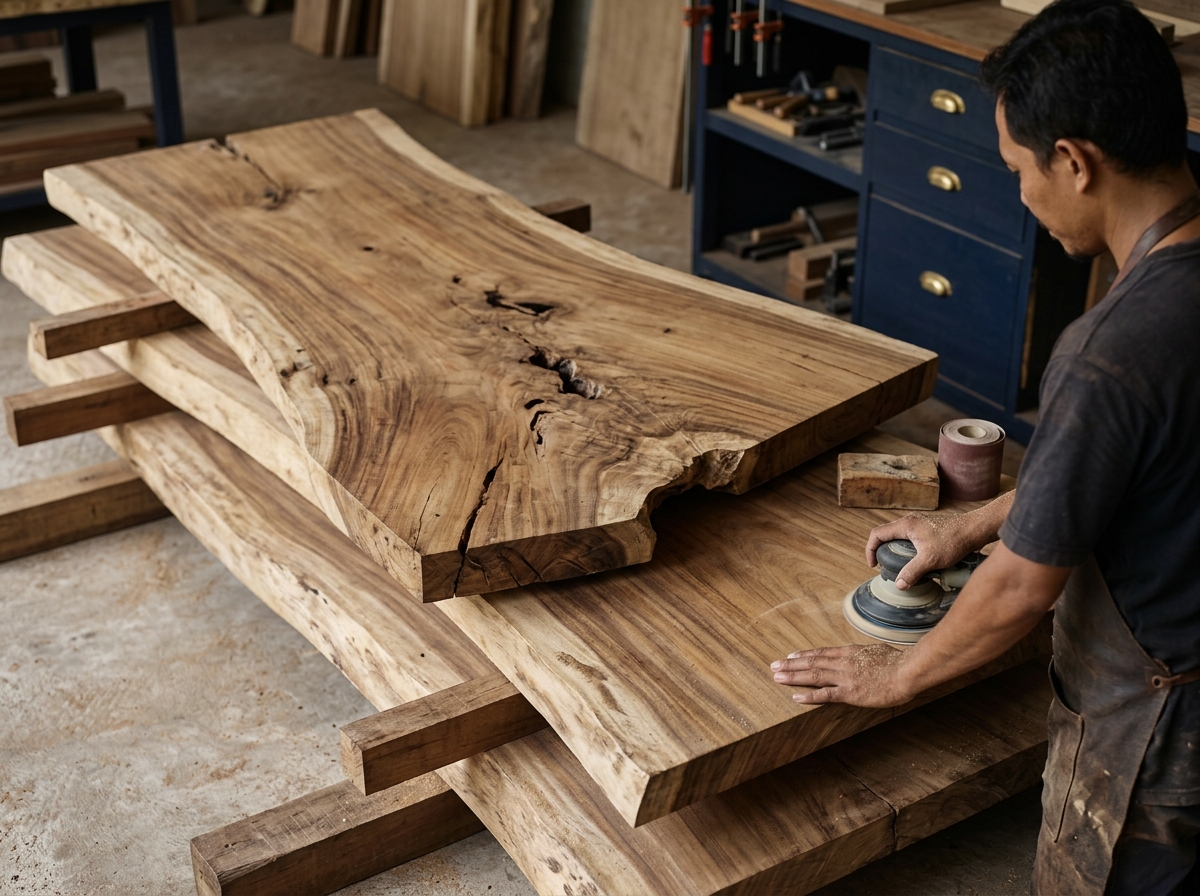
1. Rough-sawn: Direct from the bandsaw, minimal planing. Buyer performs all milling. Lowest cost, most flexibility for thickness calibration. 2. Planed/surfaced to 80-grit: Supplier runs slabs through a wide-drum or wide-belt sander. Surface is flat and ready for inspection, but final finishing remains with the buyer. 3.
For most US table manufacturers sourcing live edge wood slabs at volume, 80-grit surfaced is the practical specification. It allows accurate void mapping and custom epoxy work without paying for a finish that may be compromised in transit.
Void and Crack Treatment at Origin
Specify explicitly whether voids should arrive open or filled:
- Open voids: Preferred by buyers doing custom epoxy work (colored resin, embedded objects, specific brand of epoxy). Requires proper sealing of void walls to prevent moisture ingress during transit. - Filled at origin: Supplier fills with clear or neutral epoxy. Faster to finish on arrival. Risk: fill quality varies; some fills require grinding and refinishing anyway.
Live Edge Stabilization and End-Grain Sealing
The live edge — the natural, uncut perimeter of the slab — is structurally vulnerable during ocean transit. Specify:
- Bark removal prior to shipment (bark retains moisture and can harbor insects, which creates phytosanitary risk) - Application of a stabilizing consolidant or thin sealer coat to the live edge to prevent checking during the 25–35 day ocean freight period - End-grain sealing with wax emulsion or equivalent to limit moisture fluctuation at the most vulnerable cross-section
Container Loading, Port Options, and Freight Logistics for Oversized Suar Slabs
Container Capacity Planning
| Container Type | Internal Length | Practical Slab Count (10 cm thick, avg 200 × 90 cm) | Notes |
|---|---|---|---|
| 20 ft standard | ~590 cm | Approximately 8–12 slabs | Limited for long slabs |
| 40 ft standard | ~1200 cm | Approximately 18–26 slabs | Standard for slab orders |
| 40 ft high-cube (HC) | ~1200 cm / 270 cm high | Approximately 22–30 slabs | Preferred; extra height aids stacking |
Counts are approximate; actual capacity depends on slab dimensions, packing method, and weight distribution.
A 40 ft HC container is the default recommendation for suar slab orders. It accommodates slabs up to approximately 390 cm in length and allows proper foam-pad interleaving between layers. Total container weight, including slabs and packing, typically runs 12,000–18,000 kg for a full load of 10 cm suar (approximate; verify against gross weight limit with your freight forwarder).
Packing Specifications
Require the following packing standards in writing:
- Minimum 10 mm EPE foam pad between each slab layer - Hardwood corner blocks at each corner to prevent edge crushing - Polyester strapping at minimum two points per slab bundle - Moisture barrier wrap (polyethylene film) over the full bundle before stuffing - No direct slab-to-container floor contact — timber bearers minimum 5 cm height
Indonesian Port Options and Transit Times
| Port | Nearest Supplier Cluster | Transit to US West Coast (approx.) | Transit to US East Coast (approx.) |
|---|---|---|---|
| Semarang | Jepara, Central Java | 22–28 days | 30–38 days |
| Surabaya | East Java suppliers | 23–29 days | 31–39 days |
| Bali (Benoa) | Bali artisan suppliers | 24–30 days | 32–40 days |
Transit times are approximate and subject to carrier schedule and transshipment routing.
Customs Classification and Required Documents
Suar wood slabs classify under HS code 4407 (wood sawn or chipped lengthwise, sliced or peeled). The US import duty rate under 4407 for Indonesian hardwood is typically 0% (verify current tariff schedule with your customs broker — rates can change).
Required export documents from an Indonesian supplier:
- Commercial invoice and packing list - Phytosanitary Certificate (issued by Indonesian agricultural quarantine authority) - SVLK legality certificate or V-Legal document - Bill of lading (FOB terms: supplier arranges to named port, buyer arranges ocean freight from port) - Certificate of Origin (Form E or standard Indonesian CO) if relevant to duty preference claims
How to Evaluate and Qualify Suar Wood Slab Suppliers in Indonesia
Key Supplier Locations and Their Trade Profiles
Jepara (Central Java) is Indonesia's largest solid wood furniture export cluster. Suppliers here have the most developed export infrastructure: dedicated container yards, established freight forwarder relationships, and familiarity with US import documentation. Kiln facilities are widespread. This is the default sourcing region for suar wood slabs suppliers handling export volume.
Bali suppliers tend to be smaller, design-oriented, and positioned toward premium and hospitality markets. Pricing is often higher than Jepara. MOQs are frequently lower. Lead times can be longer due to smaller kiln capacity.
Surabaya serves as a mid-market export hub for East Java production. Supplier base is mixed — some large exporters, many trading companies. Verify carefully whether you are dealing with a manufacturer with kiln capacity or a trader buying from third-party kilns.
Supplier Qualification Red Flags
- ✓No kiln drying certificate available or offered only after payment
- ✓Cannot provide SVLK certificate number for verification
- ✓Grading described only as 'good quality' with no written defect tolerance
- ✓No export license number available
- ✓Refuses video call showing actual slab inventory
- ✓MC readings offered only as surface figures, no core data
- ✓Lead times quoted as fixed without acknowledging kiln schedule duration
Remote Qualification Process
For buyers who cannot travel to Indonesia before their first order:
1. Request a video walkthrough of the specific slabs in your order — not generic workshop footage. Insist on seeing end-grain, surface conditions, and the kiln area. 2. Commission a local QC agent in Jepara or Semarang. Independent inspection agents can verify slab dimensions, MC readings, packing quality, and export documentation before container sealing.
Typical MOQs and Deposit Structures
Most export-grade suar slab suppliers in Indonesia operate with the following approximate structures:
- MOQ: 1 CBM minimum for sample/trial orders; 5–10 CBM for full production runs - Deposit: 30–50% on order confirmation, balance before container loading - Lead time: 45–90 days from deposit for kiln-dried slabs (longer for thick stock requiring extended drying cycles)
Total Landed Cost Breakdown and Pricing Benchmarks for US Importers
FOB Price Structure by Thickness and Grade
FOB pricing for Indonesian suar wood slabs is quoted per cubic meter (CBM). Indicative ranges (approximate, subject to market conditions and exchange rate):
| Grade | 5 cm thick | 7–8 cm thick | 10–12 cm thick |
|---|---|---|---|
| Select | Higher end of range | Higher end of range | Premium |
| Standard | Mid-range | Mid-range | Mid-to-upper |
| Rustic | Lower end of range | Lower end of range | Mid-range |
Avoid publishing specific dollar figures without current supplier quotes. FOB prices fluctuate with IDR/USD exchange rate, timber availability, and demand cycles. Request current FOB quotes from at least three Indonesian suar suppliers before budgeting.
Landed Cost Components
A realistic landed cost model for a 40 ft HC container of suar slabs, FOB Indonesia to a US port:
| Cost Component | Approximate Share of FOB |
|---|---|
| Ocean freight (FCL, Indonesia to US West Coast) | 15–30% of FOB |
| Marine insurance | 1–2% of FOB |
| US customs bond and entry fees | 1–3% of FOB |
| US import duty (HS 4407, Indonesia origin) | Typically 0% — verify |
| Drayage (port to warehouse) | 5–10% of FOB |
| Port handling and THC | 3–6% of FOB |
| Total estimated landed cost premium over FOB | 25–50% of FOB |
All percentages are approximate and depend on freight market conditions, port of entry, and drayage distance.
Exchange Rate and Direct vs. Trading Company Pricing
The IDR/USD exchange rate directly affects your repeat-order budgeting. A 10% depreciation of the USD against the IDR increases your effective FOB cost by approximately 10% on the next order, assuming the supplier prices in IDR. Lock exchange rate assumptions into your pricing model and build a buffer for currency movement.
Direct factory pricing from Jepara producers typically runs 15–25% lower than purchasing through a Bali or Jakarta trading company (approximate). The trade-off: trading companies often have lower MOQs, consolidated logistics, and English-speaking account management. For first orders, the premium may be justified. For repeat volume, direct factory relationships deliver better margin.
Frequently Asked Questions
What moisture content should suar slabs have for shipment to the United States? Target 6–8% MC measured at the core for interior US applications. Surface readings alone are insufficient for slabs 7 cm and thicker. Require core probe documentation in the kiln drying certificate.
Can Indonesian suppliers provide book-matched suar slab sets with consistent grain figure? Yes, provided you specify it explicitly and pay the associated premium. Confirm that both slabs originate from the same sequential cuts of the same log. Request side-by-side photographs of the open pair before approving production.
How many suar wood slabs fit in a 40-foot high-cube container? Approximately 22–30 slabs at 10 cm thickness and average dimensions of 200 × 90 cm, depending on packing method and exact dimensions. Consult your freight forwarder for a precise CBM and weight calculation before stuffing.
What certifications should a legitimate Indonesian suar wood exporter provide? At minimum: SVLK (Sistem Verifikasi Legalitas Kayu) certificate or V-Legal document, Phytosanitary Certificate, and a valid export license. FSC certification is desirable but not universal among Indonesian suar suppliers.
How long does ocean freight from Indonesia to a US port take for a slab order? Approximately 22–30 days to US West Coast ports and 30–40 days to East Coast ports, depending on departure port (Semarang, Surabaya, or Bali) and carrier routing. Add 7– approximately 14 days for US customs clearance and drayage.
Is suar wood the same as monkeypod or acacia? Suar and monkeypod refer to the same species: Samanea saman. Acacia is a different genus entirely. Indonesian suppliers sometimes label suar as "acacia" informally, which is botanically incorrect.
Sourcing live edge suar wood slabs from Indonesia at commercial scale is achievable with the right documentation framework, clear dimensional and grading specifications, and a verified supplier who can produce kiln drying certificates with core MC data.
You now have the specification framework, the documentation checklist, and the landed cost model. The next step is putting current FOB pricing and available slab inventory against your project requirements. Request a slab inventory list and FOB quote from verified Indonesian suar suppliers today.
Request Inventory and FOB Quote →Need eyes on the ground in Indonesia?
MTS is an execution partner — supplier verification, manufacturing management, quality control and export logistics across Indonesia, Vietnam and China.
Related services
Related articles
Receive furniture sourcing insights across Asia.
One email per week. No spam.