Crocodile Leather Goods Suppliers Indonesia: A Compliance-First Sourcing Guide
16 min read
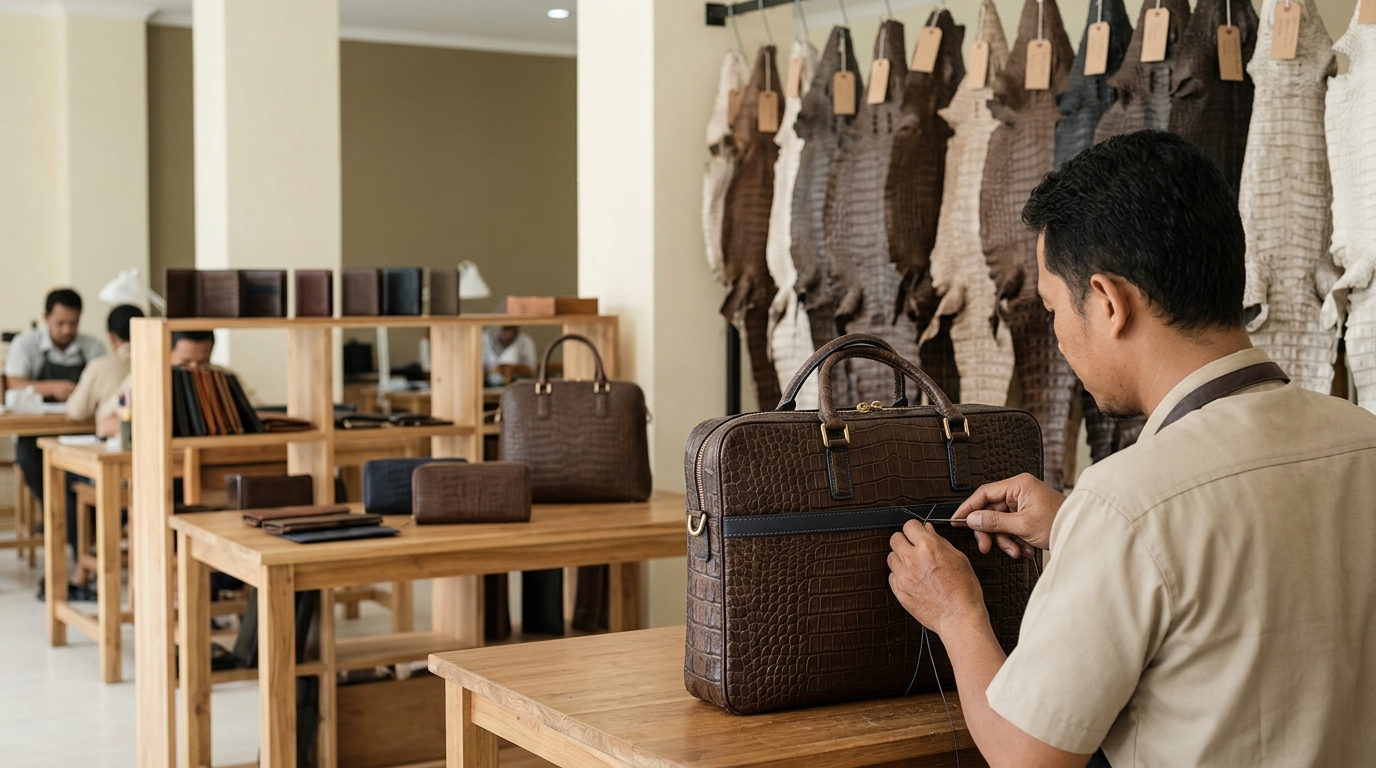
Sourcing crocodile leather goods suppliers Indonesia requires more than finding a factory with competitive prices. It demands a structured compliance framework before a single purchase order is placed. The species at the center of this trade — Crocodylus porosus, the saltwater crocodile — is…
Sourcing crocodileleather goods suppliers Indonesiarequires more than finding a factory with competitive prices. It demands a structured compliance framework before a single purchase order is placed. The species at the center of this trade — Crocodylus porosus, the saltwater crocodile — is listed under CITES Appendix II, meaning every export shipment must be backed by verified government permits. Skipping that step exposes your brand to import seizure, USFWS prosecution, and reputational damage that no margin justifies.
This guide is written for sourcing managers, product developers, and compliance officers at mid-to-large fashion houses. It covers Indonesian regulatory requirements, skin grading standards, finish options, supplier audit protocols, program structures, and quota timing. Each section is designed to support a defensible due-diligence record from the first supplier conversation through customs clearance in the United States.
Compliance disclaimer: Wildlife trade regulations change. Indonesian export quotas, CITES permit procedures, and US import requirements are subject to revision. Nothing in this guide constitutes legal advice. Consult qualified legal counsel and your USFWS import specialist before contracting any supplier.
The sections that follow move in the order a compliance-first sourcing process actually runs — regulatory foundation first, supplier verification second, product specifications third, and commercial planning last.
Why Indonesia Leads the World in Captive-Bred Crocodile Leather Supply
Indonesia is not simply a source country for exotic leather. It is one of the most significant CITES-registered exporters of crocodilian skins globally, with a captive-breeding infrastructure built over several decades specifically to supply luxury markets.
The Species Advantage: Crocodylus porosus
Crocodylus porosus — the Indo-Pacific saltwater crocodile — produces belly scales that luxury tanneries consistently rank among the finest available. The belly section is wide, the tile rows are symmetrical, and the osteoderms (bony skin inclusions) are minimal compared to other species. That combination drives high yield per skin for structured bags, smallleather goods, and watch straps.
For context: Crocodylus siamensis (Siamese crocodile), farmed in parts of Southeast Asia, has a narrower belly and more pronounced osteoderm interference. It can be used in luxury goods, but yield per skin for Grade 1 applications is lower. C. porosus remains the preferred species for full-belly bag panels and premium strap programs.
Geographic Concentration of Farms
Captive-breeding farms (penangkaran) are concentrated in:
- Papua Province — the largest production zone, benefiting from proximity to wild populations and established farm infrastructure - West Papua Province — secondary production, with a growing number of registered facilities - East Indonesia broadly — Maluku and Sulawesi host smaller operations
Papua and West Papua together account for the majority of Indonesia's C. porosus captive-bred skin output (approximate, based on CITES trade database patterns). Farms in Java and Bali exist but typically process skins from eastern Indonesian farms rather than breeding at scale.
Competitive Position vs. Alternatives
| Factor | Indonesia (*C. porosus*) | Australia (*C. porosus*) | Southeast Asia (*C. siamensis*) |
|---|---|---|---|
| Belly scale width | Large, consistently wide CBW | Large, high quality | Narrower average CBW |
| Osteoderm interference | Low to moderate | Very low | Moderate to high |
| CITES status | Appendix II, captive-bred quota | Appendix II, ranched | Appendix I/II depending on origin |
| Farm registration system | KLHK izin penangkaran | State-licensed stations | Varies by country |
| Price positioning | Competitive for luxury tier | Premium, limited volume | Lower entry price |
| MOQ accessibility | Moderate — viable for mid-size programs | High — limited export volume | Variable |
Australia produces exceptional C. porosus skins but at lower annual volumes and higher price points. Indonesian captive-bred C. porosus offers a combination of scale, quality, and regulatory tractability that most luxury sourcing programs can build around.
CITES Appendix II Compliance: The Non-Negotiable Legal Foundation for Every Order
Crocodylus porosus is listed on CITES Appendix II. Commercial trade is permitted — but only with valid documentation issued by competent national authorities. Ignorance of the permit chain is not a legal defense.
How the Indonesian Permit System Works
The primary regulatory body is Kementerian Lingkungan Hidup dan Kehutanan (KLHK) — the Ministry of Environment and Forestry. KLHK is Indonesia's CITES Management Authority. It oversees farm registration, quota allocation, and the issuance of CITES export permits.
Quota allocation is administered through the Balai Konservasi Sumber Daya Alam (BKSDA) — the Natural Resources Conservation Agency, operating at the regional level. BKSDA regional offices in Papua and West Papua manage farm inspections and issue quota allocations to registered facilities.
The distinction between wild-harvested and captive-bred specimens is critical:
- Wild-harvested C. porosus: heavily restricted, subject to separate CITES reporting codes, and practically unavailable for commercial luxury export in significant volume - Captive-bred C. porosus: quota-allocated annually to registered farms, eligible for CITES export permits under Appendix II provisions
Any supplier claiming to export wild-harvested skins at commercial volumes should be treated as a serious compliance risk.
CITES Permit Verification Workflow for US Importers
Before contracting an Indonesian supplier, US importers must interface with the US Fish and Wildlife Service (USFWS), which enforces the LACEY Act and administers CITES import permits.
Step-by-step verification:
1. Request the supplier's CITES export permit number before signing any contract 2. Verify the issuing authority — it must be KLHK or a delegated BKSDA regional office 3. Cross-check the quota year — permits reference the annual allocation; confirm the quota has not been exhausted 4. Check specimen codes — captive-bred C. porosus skins carry specific CITES source codes (typically 'C' for captive-bred); confirm this matches the permit 5. Apply for a USFWS import permit (Form 3-200-27 for CITES Appendix II wildlife imports) 6. Declare the shipment at a USFWS-designated port of entry 7.
EU importers must comply with EU Wildlife Trade Regulation 338/97 and obtain an import permit issued by their member state's CITES Management Authority. The documentation requirements parallel the US process but run through EU channels.
Farm Registration and Legal-Origin Documentation Every Supplier Must Provide
A compliant supplier is a documented supplier. The documentation chain runs from the living animal through to the finished goods shipment. Any gap in that chain creates an import compliance problem.
The Izin Penangkaran: Indonesia's Farm Registration Certificate
Suppliers must hold an active izin penangkaran — a captive-breeding facility registration issued by KLHK. This is the foundational legal document proving the farm operates within Indonesia's regulatory framework. It includes:
- Facility registration number - Approved species (C. porosus) - Approved breeding capacity - Validity period and renewal dates
Request the izin penangkaran certificate early in supplier vetting. A supplier who cannot produce it promptly is a red flag.
The Full Chain-of-Custody Document Set
For a US import of finished crocodile leather goods, the complete documentation package includes:
| Document | Issued By | Purpose |
|---|---|---|
| Izin penangkaran | KLHK | Proves legal farm registration |
| Slaughter/harvest records | Farm operator | Links specific skins to farm batch |
| CITES export permit | KLHK/BKSDA | Authorises export under Appendix II |
| CITES import permit | USFWS | Authorises US entry |
| Tannery processing certificate | Tannery | Confirms legal processing of raw skins |
| Commercial invoice with species declaration | Exporter | Customs declaration requirement |
| Phytosanitary certificate | Indonesian agricultural authority | Required for some leather shipments |
- ✓Missing or undated izin penangkaran
- ✓Farm registration number not verifiable with KLHK
- ✓CITES permit issued by an unrecognised authority
- ✓Quota year on permit does not match shipment year
- ✓Specimen source code inconsistent with captive-bred classification
- ✓Supplier refuses to share permit numbers before contract signing
- ✓Slaughter records absent or undated
LACEY Act Due Diligence for US Buyers
The LACEY Act requires US importers to declare the species, country of origin, and legal harvest status of wildlife products. False declarations are a federal offense. Your due-diligence file — containing all documents in the table above — is your primary defense in the event of a USFWS inquiry. Maintain it per shipment, not per supplier relationship.
Skin Grading for Crocodile Leather Goods Suppliers Indonesia: CBW, Symmetry, and Defect Thresholds
Skin grading determines product yield, price per skin, and the goods categories each skin can supply. Luxury brand sourcing managers need to specify grade requirements contractually, not leave them to supplier discretion.
CBW Measurement and What It Means for Yield
Centimetre belly width (CBW) is the standard measurement unit for raw C. porosus skins. It is measured at the widest point of the belly cut, expressed in centimetres. CBW correlates directly to usable panel size:
- Higher CBW = larger panels available for handbag bodies and structured goods - Lower CBW skins are viable for straps, wallets, and small goods but not full bag panels
Raw skins are typically priced per CBW centimetre. A finished goods cost model must account for: raw skin price × CBW, plus tannery conversion costs, plus manufacturing overhead.
Grade Classifications
| Grade | Belly Scale Symmetry | Defects Permitted | Minimum CBW | Primary Applications |
|---|---|---|---|---|
| Grade 1 (Prime) | Perfect symmetry, uniform tile rows | None visible | ~35 cm+ | Luxury handbag bodies, exotic leather accessories |
| Grade 2 | Minor asymmetry, slight tile irregularity | Minor, non-central defects | ~28 cm+ | Wallets, cardholders, secondary bag panels |
| Grade 3 | Moderate irregularity | Multiple minor or one notable defect | ~22 cm+ | Watch straps, key fobs, lining panels |
CBW thresholds listed are approximate industry conventions; verify with your specific tannery partner.
Common Defect Types
- Bite marks: from intra-farm aggression; appear as healed or unhealed surface scarring - Horn buttons: calcium nodules disrupting scale surface — common in older animals - Uneven tile rows: symmetry breaks that reduce visual appeal in bag panels - Parasitic scarring: subcutaneous scarring from parasitic infection, visible as surface irregularity - Processing defects: caused at slaughter or tanning stage — not a farm quality issue, but equally disqualifying for Grade 1
Specify defect tolerance thresholds by product category in your purchase agreement. Grade 3 skins are fully acceptable for strap programs where edge finishing covers border defects. Grade 1 is non-negotiable for full-belly bag panels on luxury SKUs.
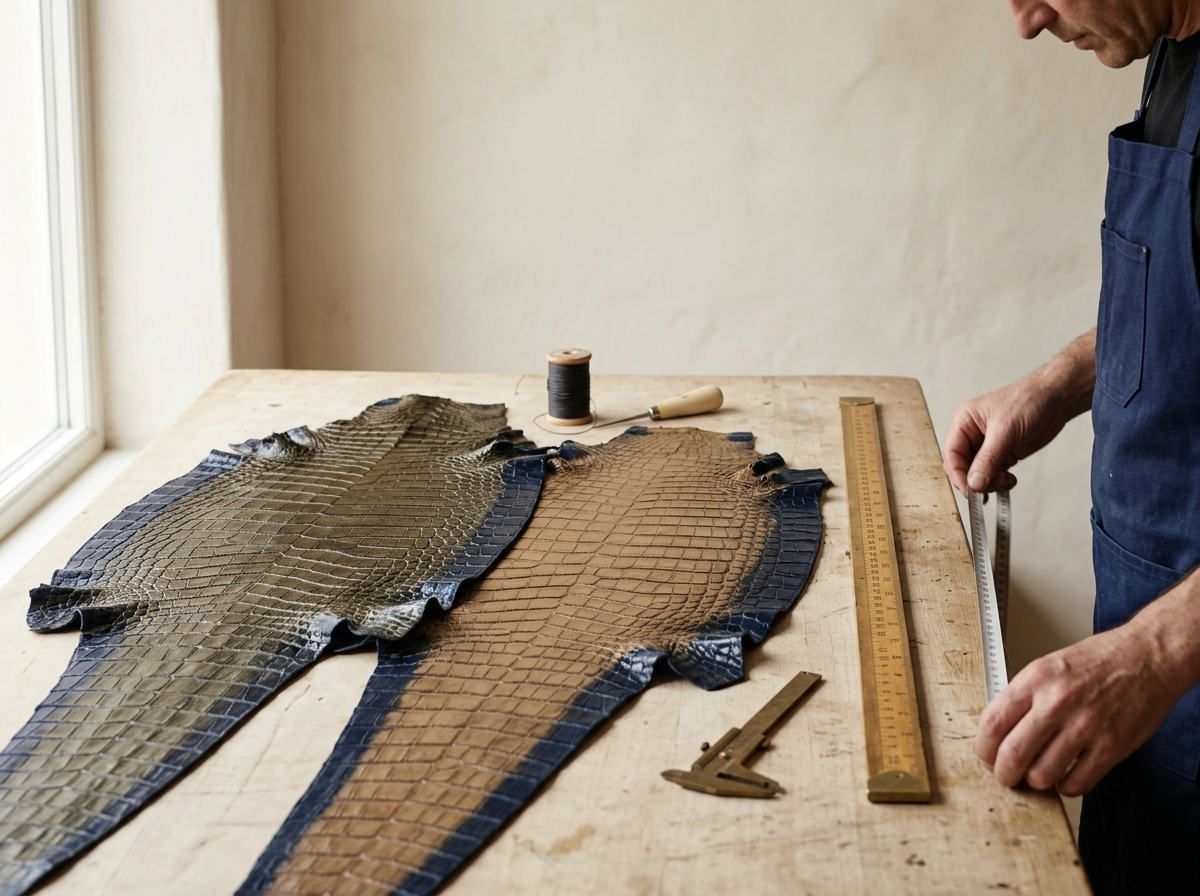
Gloss, Matte, and Satin Finishes: Matching Surface Treatment to Your Product Program
Surface finish affects visual identity, durability, and price. Indonesian tanneries and their downstream manufacturing partners offer multiple finish options, though capabilities vary by facility.
Classic Gloss (Laqué)
High-sheen lacquer coat applied over the natural grain. This finish is standard for:
- Structured handbags and clutches - Belts and shoe uppers in traditional luxury positioning - Any product where scale definition and visual depth are primary design drivers
Gloss finish is more sensitive to surface scratches during use. It amplifies scale symmetry — Grade 1 skins become visually spectacular; Grade 2 defects become more visible.
Matte Finish
Achieved through micro-sanding or wax-buffing to reduce surface sheen. Matte finish is increasingly specified for:
- Contemporary luxury collections seeking a less formal aesthetic - Watch straps, where tactile comfort and strap flexibility are prioritised - Products destined for markets where understated luxury positioning is commercial strategy
Matte finish is more forgiving of minor Grade 2 scale irregularities. It also tends to show less fingerprinting and edge wear in daily use.
Semi-Gloss and Satin Options
A small number of Indonesian tannery partners offer semi-gloss and satin finishes — intermediate sheen levels achieved through controlled lacquer dilution or burnishing techniques. These are less standardised across the supply base. If your product line requires satin finish, confirm capability with the specific tannery before committing to a program.
Finish Durability: Tropical Dyeing vs. European Finishing
Some Indonesian tanneries carry skins through full finishing in-country. Others export semi-processed (crust) leather to European tanneries — primarily in Italy and France — for final finishing. European-finished Indonesian C. porosus typically achieves tighter colour consistency and finish durability benchmarks. The trade-off is longer lead times and higher conversion costs. For Grade 1 luxury programs, European finishing is often worth the premium.
Small-Goods and Strap Programs: MOQs, Lead Times, and How Indonesian Suppliers Structure Orders
Indonesian crocodile leather goods suppliers structure their commercial programs in two primary ways — OEM (original equipment manufacturer, full design and production responsibility) and CMT (cut, make, trim — you supply the design and specification, they execute). Both are available from established Indonesian suppliers.
Small-Goods Programs
Small leather goods — wallets, cardholders, key fobs, coin purses — represent the lower-MOQ entry point for brands new to Indonesian crocodile leather sourcing. Typical program parameters:
- MOQ: commonly 50–150 units per style per skin grade (approximate; varies by supplier) - Lead time: 8–12 weeks from skin confirmation to finished goods - Skin usage: Grade 2 and Grade 3 skins are standard for most small-goods categories - Lining: sourced separately; specify material (lambskin, calfskin, fabric) in the CMT brief
Watch Strap Programs
Watch strap programs are one of the most technically specific product categories in Indonesian crocodile leather sourcing. Key specifications to define upfront:
- Lug widths: standardised at 18 mm, 20 mm, 22 mm, and 24 mm — confirm your watchmaker's lug specification exactly - Taper: strap taper from lug end to buckle end (e.g., 20 mm tapering to 18 mm) - Lining material: tropical stitch-through lining (rubber, nylon) or leather (calfskin, ostrich); specifying lining material affects both feel and longevity - Stitching: single vs. double stitch, thread colour, stitch count per centimetre — all contractually specifiable - Padding: flat vs. slightly padded profile - Edge finish: burnished, painted, or raw bevelled
Strap programs typically carry lower per-unit MOQs than bag programs. Many Indonesian suppliers accept strap programs starting at approximately 100–200 units per lug width. Confirm with each supplier individually.
Lead Times by Program Type
| Program Type | Typical Lead Time | Key Variables |
|---|---|---|
| Small goods (CMT) | 8–12 weeks | Skin availability, quota cycle timing |
| Small goods (OEM) | 10–14 weeks | Add design finalisation time |
| Watch straps | 8–12 weeks | Lining and hardware sourcing |
| Structured bags (OEM) | 14–18 weeks | Grade 1 skin allocation, pattern complexity |
Lead times lengthen significantly when orders are placed at the start of a new quota cycle before skins are allocated and released from the farm.
How to Vet Crocodile Leather Goods Suppliers Indonesia Before Placing Orders
Supplier verification for Indonesian exotic leather is more rigorous than for conventional leather goods. The legal stakes justify the additional diligence steps.
Factory Audit Checklist
- Active izin penangkaran (or verified tannery partnership with a registered farm) - CITES registration and most recent export permit copies - ISO 9001 or equivalent quality management system certification - Tannery partner identity and tannery's own compliance documentation - Slaughter and processing records for the most recent quota cycle - References from existing luxury brand clients (verifiable, not just names) - Physical production facility — not a trading office presenting itself as a manufacturer
Third-Party Audit and Trade Association Context
Indonesia's exotic leather sector does not have a single dominant certification body equivalent to, say, the Leather Working Group for conventional leather. Factory audits in this category are typically conducted by:
- Independent quality inspection firms operating in Indonesia - Brand-appointed technical teams or agent-based auditors based in Jakarta or Surabaya - Sourcing partners with established exotic leather audit protocols
Membership in Indonesian leather trade associations is a secondary positive signal, but not a substitute for a primary audit.
Building a USFWS-Ready Due-Diligence File
Your import compliance file for each shipment should be assembled before goods ship, not after arrival. It must contain every document listed in the chain-of-custody table above, plus your internal audit report. USFWS port inspectors may request documentation at point of entry. A complete file enables clearance. An incomplete file triggers detention and potential seizure.
Pricing, Quota Cycles, and Supply-Chain Risks in Indonesian Crocodile Leather Sourcing
Commercial planning for Indonesian crocodile leather goods requires aligning your sourcing calendar with Indonesia's regulatory cycle — not just your brand's merchandising calendar.
The Annual Quota Calendar
KLHK and BKSDA set annual export quotas for captive-bred C. porosus skins. The timing of quota announcement and release varies year to year, but the pattern is broadly annual. Sourcing managers should:
- Track quota announcements through KLHK communications or through an in-country sourcing partner - Place supplier commitments early in the quota cycle, when allocation is freshest - Avoid contracting for delivery in Q4 of the quota year without confirming remaining quota balance
Quota exhaustion mid-cycle is a real commercial risk. It does not void your purchase order, but it makes delivery impossible until the next cycle begins.
Price Structure
Raw C. porosus skins are priced per CBW centimetre. Finished goods pricing layers on top of raw skin cost:
- Tannery conversion (dyeing, finishing, grading) - Manufacturing (cutting, stitching, hardware, lining) - Compliance and documentation overhead - Supplier margin
Grade 1 skins command a significant premium over Grade 2–3. Luxury brands with full-belly bag programs should model skin cost as the dominant variable in their COGS — not manufacturing labour.
Supply-Chain Risks and Mitigation
| Risk | Probability | Mitigation |
|---|---|---|
| Quota exhaustion before delivery | Moderate | Contract early in quota cycle; confirm balance before PO |
| Disease outbreak on farms | Low-moderate | Multi-supplier panel across Papua and West Papua |
| IDR/USD currency fluctuation | Moderate | USD-denominated contracts; advance deposit to lock price |
| Skin quality shortfall below contracted grade | Moderate | Pre-production grading sample approval; QC inspection at tannery |
| Permit delays or CITES authority processing backlogs | Low-moderate | Build 2–3 week buffer into lead-time planning |
A multi-supplier panel — relationships with two or three registered Indonesian suppliers across different farm regions — provides the most effective hedge against single-source disruption.
Frequently Asked Questions
<div itemscope itemtype="https://schema.org/FAQPage">
<div itemscope itemprop="mainEntity" itemtype="https://schema.org/Question"> <h3 itemprop="name">Is it legal to import Indonesian crocodile leather goods into the United States?</h3> <div itemscope itemprop="acceptedAnswer" itemtype="https://schema.org/Answer"> <p itemprop="text">Yes, provided all documentation is in order. Crocodylus porosus is listed on CITES Appendix II, which permits commercial trade with valid permits. The Indonesian exporter must hold a CITES export permit issued by KLHK.
<div itemscope itemprop="mainEntity" itemtype="https://schema.org/Question"> <h3 itemprop="name">What documents prove a crocodile skin is legally captive-bred and CITES-compliant?</h3> <div itemscope itemprop="acceptedAnswer" itemtype="https://schema.org/Answer"> <p itemprop="text">The core documents are: the supplier's izin penangkaran (Indonesian captive-breeding facility registration), farm slaughter and harvest records linking specific skins to the registered farm batch, the CITES export permit issued by KLHK or BKSDA with the correct captive-bred source code, and the USFWS import permit for the US receiving party.
<div itemscope itemprop="mainEntity" itemtype="https://schema.org/Question"> <h3 itemprop="name">What is the difference between Grade 1 and Grade 2 crocodile skin for luxury goods?</h3> <div itemscope itemprop="acceptedAnswer" itemtype="https://schema.org/Answer"> <p itemprop="text">Grade 1 (Prime) skins have perfect belly scale symmetry, no visible defects, and meet minimum CBW thresholds (approximately 35 cm+). They are used for luxury handbag bodies and premium accessories where the full belly panel is visible. Grade 2 skins have minor asymmetry or non-central defects and a lower minimum CBW.
<div itemscope itemprop="mainEntity" itemtype="https://schema.org/Question"> <h3 itemprop="name">How do Indonesian annual export quotas affect my sourcing timeline?</h3> <div itemscope itemprop="acceptedAnswer" itemtype="https://schema.org/Answer"> <p itemprop="text">KLHK and BKSDA set annual quotas for captive-bred C. porosus skins. Once a farm's annual quota is exhausted, no further CITES export permits can be issued under that cycle. Brands that place orders late in the quota year risk supplier quota exhaustion before delivery can occur.
<div itemscope itemprop="mainEntity" itemtype="https://schema.org/Question"> <h3 itemprop="name">Which regions of Indonesia are the main sources of captive-bred saltwater crocodile skins?</h3> <div itemscope itemprop="acceptedAnswer" itemtype="https://schema.org/Answer"> <p itemprop="text">Papua Province and West Papua Province are the primary production zones for captive-bred Crocodylus porosus in Indonesia. These regions host the largest concentration of KLHK-registered breeding facilities (izin penangkaran holders). Smaller operations exist in Maluku and Sulawesi.
<div itemscope itemprop="mainEntity" itemtype="https://schema.org/Question"> <h3 itemprop="name">What is the typical minimum order quantity for a crocodile leather strap or small-goods program?</h3> <div itemscope itemprop="acceptedAnswer" itemtype="https://schema.org/Answer"> <p itemprop="text">MOQs vary by supplier and program type. Watch strap programs from Indonesian suppliers typically start at approximately 100–200 units per lug width specification. Small-goods programs (wallets, cardholders, key fobs) commonly start at 50–150 units per style. Structured bag programs carry higher MOQs due to Grade 1 skin allocation requirements.
</div>
Indonesian crocodile leather goods suppliers offer a legally accessible, scalable supply chain for luxury brands — but only when the compliance infrastructure is treated as the foundation, not an afterthought. Grading standards, quota timing, and documentation integrity are the variables that separate a sustainable program from a high-risk one.
You now have the framework to evaluate Indonesian crocodile leather suppliers against regulatory, quality, and commercial criteria. The next step is connecting with verified suppliers who can provide active izin penangkaran certificates, current CITES permit documentation, and pre-production skin samples with grading certificates.
Request Verified Supplier Profiles →Need eyes on the ground in Indonesia?
MTS is an execution partner — supplier verification, manufacturing management, quality control and export logistics across Indonesia, Vietnam and China.
Related services
Receive furniture sourcing insights across Asia.
One email per week. No spam.