Stingray Leather Goods Suppliers Indonesia: Complete Sourcing Guide for Brands
14 min read
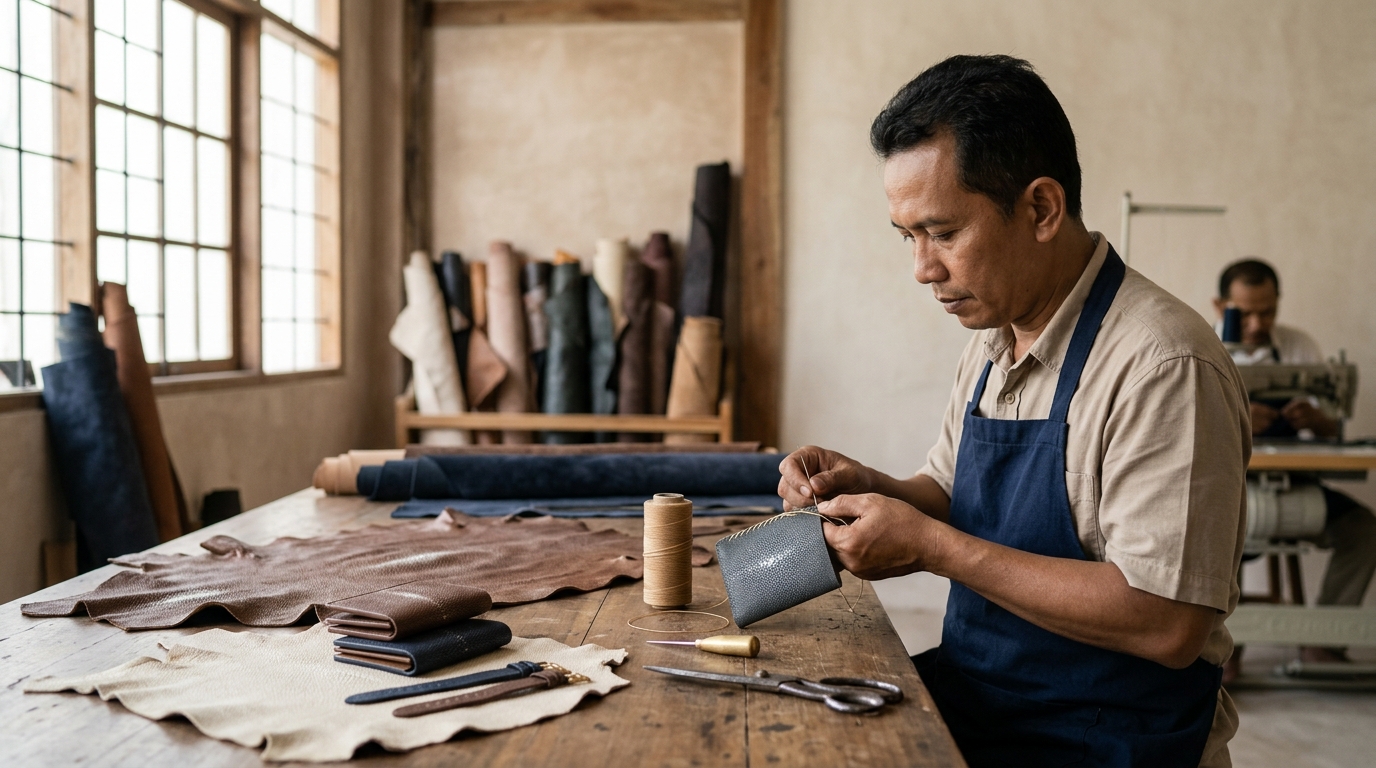
US accessories brands sourcing stingray leather goods face a specific set of decisions before a single sample arrives. Which Indonesian supplier operates a full tannery versus a finishing-only workshop? Which species documentation satisfies US Customs? Which skin grade supports a $200 retail…
US accessories brands sourcing stingrayleather goodsface a specific set of decisions before a single sample arrives. Which Indonesian supplier operates a full tannery versus a finishing-only workshop? Which species documentation satisfies US Customs? Which skin grade supports a $200 retail wallet versus a $75 cardholder? These questions determine margin, compliance exposure, and brand positioning simultaneously.
Indonesia has emerged as the dominant supply base for commercial shagreen leather goods. The country combines Indo-Pacific access to permitted ray species, established tanning infrastructure across Java and Bali, and deep artisan small-goods manufacturing traditions. For US brands, that combination is difficult to replicate elsewhere at comparable cost.
This guide covers the full sourcing decision chain: material properties, skin grading, finish selection, product program structures, legal compliance under US and Indonesian law, supplier qualification signals, and realistic cost and lead time expectations. It is written for sourcing managers who need to evaluate stingrayleather goods suppliers Indonesiaoffers — and filter out suppliers who cannot perform.
The species question matters before everything else. Not all rays are legally equivalent. Understanding that distinction separates compliant, scalable sourcing programs from expensive regulatory problems at US Customs entry.
Why Indonesia Dominates Global Stingray Leather Goods Manufacturing
Geographic Access to Commercial Ray Species
Indonesia sits at the center of the Indo-Pacific, the world's most biodiverse marine region. Species in the Himantura and Dasyatis genera — the primary commercial leather rays — are harvested as byproduct of artisanal fishing operations across the archipelago. This is not trophy hunting. These species enter the supply chain through established fisheries already operating for food markets. The skin is a secondary output.
That byproduct model matters to sourcing managers. It means raw skin supply is tied to regional fishing activity, not dedicated ray harvesting. Suppliers in Java and Bali have spent decades building procurement relationships with fishing communities across Sulawesi, Kalimantan, and East Java coastal zones.
Tannery Infrastructure and Artisan Manufacturing Depth
Java — particularly the Yogyakarta and East Java corridors — hosts tanneries specializing in exotic skins, including shagreen. Bali adds a layer of premium artisan finishing capability oriented toward export. The infrastructure gap between Indonesian exotic leather tanneries and comparable operations in Thailand or the Philippines is meaningful. Indonesian facilities have processed stingray skin for export markets long enough to develop species-specific tanning protocols, bead preservation techniques, and dye consistency that newer markets have not matched.
Labor costs for skilled small-goods construction in Indonesia remain significantly below European alternatives and are competitive with southern China for equivalent hand-finishing quality. For wallets, cardholders, and watch straps — all labor-intensive to assemble — that cost differential translates directly to landed margin for US brands.
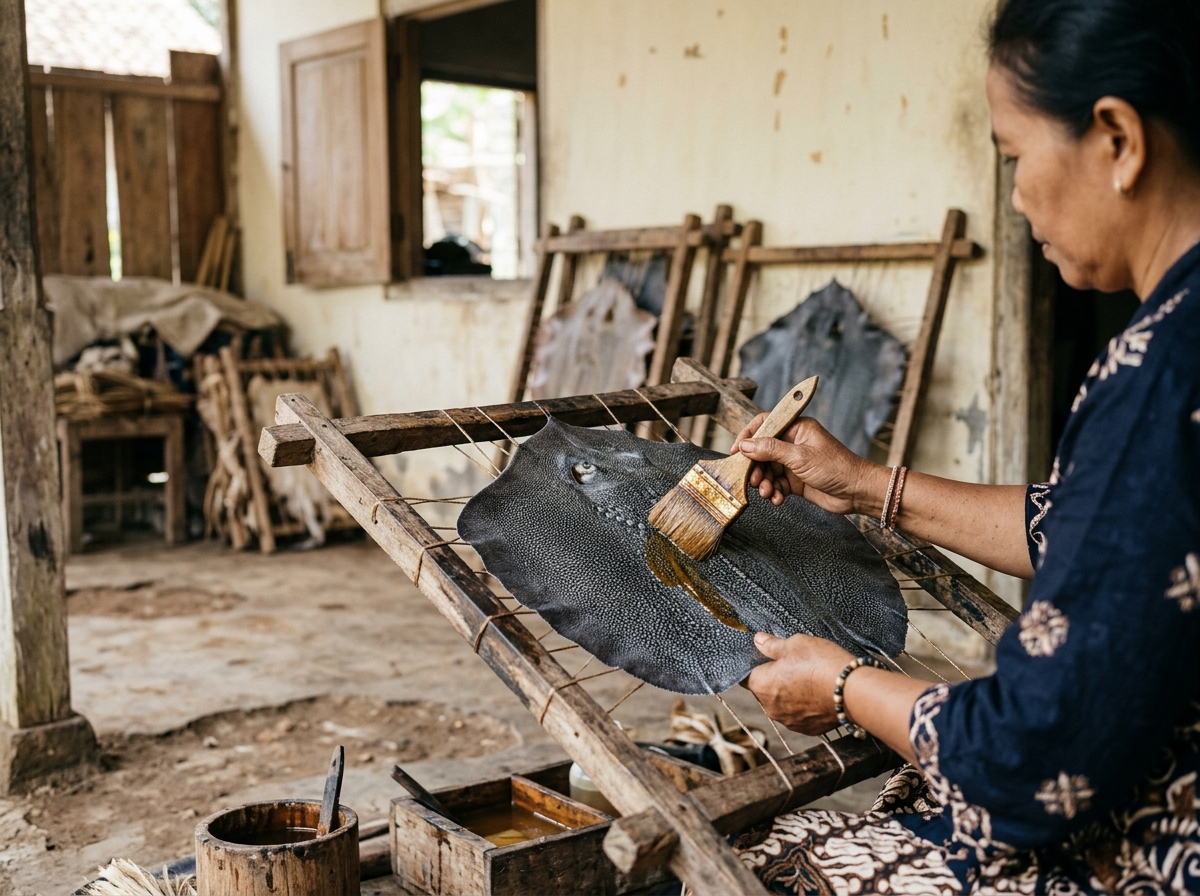
Stingray Leather Durability and Material Properties: What Sourcing Managers Need to Know
The Calcium Carbonate Denticle Structure
Shagreen leather is structurally unlike bovine or python leather. The surface consists of calcium phosphate denticles — small, mineralized bead-like protrusions — embedded in a dense collagen matrix. This structure creates a leather that resists surface abrasion at a level no other commercial skin matches at equivalent thickness.
For wallets and card holders, the practical implication is significant. A stingray leather wallet will show virtually no surface wear at points of contact — pocket friction, bag abrasion, edge rubbing — that would visibly age a cowhide product within months.
Tensile Strength and Water Resistance
Tensile strength in stingray skin is approximately several times higher than standard bovine leather of comparable thickness, based on material property comparisons reported in tannery technical literature. The tightly packed collagen fiber arrangement also creates natural water resistance. The denticle layer itself does not absorb moisture in the way porous bovine grain does.
This makes shagreen particularly well-suited to watch straps, key fobs, and card holders — products that encounter moisture and daily mechanical stress. The water resistance is inherent to the material, not a coating applied at finishing.
Luxury Market Validation
Major European luxury houses have used stingray leather in accessories for decades. The material appears in watch straps, small leather goods, and jewelry boxes across the luxury tier. That precedent matters to US brand buyers positioning in the $150–$400 accessory segment. The material carries pre-existing luxury recognition that cowhide does not.
Pearl Mark and Caviar Bead Grading: How Indonesian Tanneries Evaluate Skin Quality
The Central Pearl Mark
Every stingray skin has a central marking — called the pearl or eye — located on the dorsal surface. This is a cluster of enlarged, smoother denticles that contrasts with the surrounding caviar bead field. The pearl's size, symmetry, and position relative to the skin center are the primary grade signal Indonesian tanneries use to classify skins.
A centered, well-defined pearl with symmetrical surround indicates a premium skin. An off-center, fragmented, or small pearl typically indicates a younger or lower-grade specimen. For products where the pearl will be visible — a bifold wallet center panel, for example — pearl quality directly affects the retail story the product can support.
Caviar Bead Uniformity and Density
Beyond the pearl, the bead field across the skin's usable surface determines how consistently a finished product will read visually. Higher-grade skins show uniform bead density with minimal bare patches, scarring, or size variation. Lower-grade skins have irregular bead fields that require more aggressive layout planning to yield usable panels.
| Grade | Pearl Definition | Bead Field Uniformity | Recommended End-Use |
|---|---|---|---|
| Grade A | Centered, clear, symmetrical | High uniformity, minimal variation | Bifold wallets, luxury cardholders, watch straps |
| Grade B | Slightly off-center or partially defined | Moderate uniformity, some variation | Coin purses, key fobs, interior panels |
| Grade C | Fragmented or indistinct | Low uniformity, visible scarring | Trim panels, lining accents, practice samples |
Requesting Grading Specification Sheets
Qualified Indonesian tanneries maintain written grading standards. When evaluating stingrayleather goods suppliers Indonesiaoffers, request the supplier's grading spec sheet before ordering samples. The document should define pearl dimensions, acceptable bead field irregularity tolerances, and how each grade maps to usable yield per skin. Suppliers unable to produce this document are operating without quality controls that export programs require.
Polished vs Natural Stingray Finish: Choosing the Right Surface for Your Product Line
Finish choice is a product positioning decision, not just an aesthetic one. It affects retail price anchoring, MOQ structure, and lead time with Indonesian suppliers.
Polished (Glazed) Finish
Polished stingray leather undergoes a mechanical pressing and lacquer application process that partially flattens the denticle peaks and deposits a glossy topcoat. The result is a smooth, reflective surface that reads as elevated and contemporary. Bead texture variation across the skin is partially hidden under the lacquer layer, which means lower-grade skins can yield acceptable polished-finish products.
Polished finish suits mid-tier retail positioning and styles where a clean, consistent surface is preferred. The lacquer layer does reduce some of the natural tactile interest of the raw bead field.
Natural (Matte) Finish
Natural finish preserves the full denticle topography. The bead field is visible and tactile. Skin grade variation is fully exposed — which is why Grade A skins command a premium in natural finish programs. This finish positions well for luxury and artisan market segments where material authenticity is part of the retail narrative.
Natural finish typically requires Grade A or strong Grade B skins to deliver a commercially acceptable surface. That grade requirement affects raw material cost and yield, which flows through to unit pricing.
| Finish Type | Surface Character | Minimum Skin Grade | Positioning | MOQ Impact |
|---|---|---|---|---|
| Polished (glazed) | Smooth, high sheen | Grade B acceptable | Mid-to-premium retail | Standard |
| Natural (matte) | Full bead texture visible | Grade A preferred | Luxury, artisan | Higher per-unit cost |
| Dyed, polished | Color-consistent, glossy | Grade B | Fashion accessories | Standard |
| Dyed, natural | Color with texture visibility | Grade A | Premium DTC brands | Higher per-unit cost |
Colorfastness and Dye Standards
Dyed shagreen should meet a minimum rub fastness standard (AATCC or equivalent) that your brand specifies at the sample stage. Indonesian tanneries oriented toward US export are generally familiar with REACH compliance for restricted substances in dyes, but confirm this explicitly. Request a material safety data sheet or test report for dyed skins before production approval.
Stingray Leather Wallets and Small Goods: Program Structures from Indonesian Suppliers
Indonesian manufacturers offering shagreen leather goods typically operate across three program structures, each suited to a different brand stage.
OEM, ODM, and Private Label Options
OEM (Original Equipment Manufacturing): The brand provides technical specifications, patterns, and hardware selections. The factory manufactures to spec. Full creative control rests with the buyer. Typically requires the most complete technical package at order placement.
ODM (Original Design Manufacturing): The factory provides existing designs that the brand selects, modifies minimally, and orders under its own label. Lower development cost and faster time to first delivery. Less differentiation from other brands using the same factory.
Private Label: The factory produces a defined range of stock styles. The brand applies its own labeling, packaging, and color selections. Lowest development investment. Best suited to brands testing the stingray category before committing to custom development.
MOQ Ranges and Sample Timelines
Minimum order quantities vary by program type and supplier scale. As an approximate range:
- Private label stock programs: commonly around 50–100 units per style - ODM with minor modifications: typically 100–200 units per style - Full OEM custom development: often 200–500 units per style minimum
Sample development from an Indonesian supplier typically runs approximately 3–6 weeks for first samples, depending on hardware sourcing and skin grade availability. Build this into your product calendar.
Packaging and US Market Labeling
Indonesian suppliers experienced with US export can provide branded boxes, hang tags, and country-of-origin labeling. Confirm that "Made in Indonesia" labeling is correctly applied to finished goods — US Customs requires accurate country-of-origin marking on all imported articles. Work with your supplier to align on retail-ready packaging specifications before production begins.
- ✓Confirm OEM/ODM/private label program availability
- ✓Request grading spec sheet for skin quality
- ✓Specify colorfastness and REACH requirements
- ✓Agree MOQ and payment terms in writing
- ✓Review sample timeline against your product launch calendar
- ✓Confirm country-of-origin labeling compliance
- ✓Obtain packaging specification sign-off before bulk production
CITES Permits, Species Compliance, and US Import Documentation for Stingray Leather
This section covers the most consequential compliance area for US brands sourcing stingray leather goods from Indonesia. Get this wrong and shipments are seized at entry.
Species Distinction: Commercial Leather Rays vs Protected Species
Not all rays are regulated equally. This distinction is where most general content on stingray leather fails sourcing professionals.
CITES Appendix II listed species — including Manta birostris (oceanic manta ray) and all Mobula species — require CITES export permits from Indonesia and CITES import permits or declarations at US entry. These species are not used in commercial leather production by legitimate suppliers. Any supplier claiming to offer manta ray leather should be treated as an immediate disqualification.
Commercially permitted species used in stingray leather goods — primarily within the Himantura and Dasyatis genera — are not currently listed under CITES Appendix I or II (verify current listings before order placement, as CITES listings are reviewed periodically). These species do not require CITES permits for export or import, but they do require accurate species documentation.
Indonesian Export Documentation
For commercially permitted ray species, Indonesian export documentation typically includes:
- Health certificate issued by Indonesian veterinary or fisheries authorities - Packing declaration specifying species, quantity, and skin weight - Export license from Indonesia's Ministry of Marine Affairs and Fisheries or relevant authority - Species identification documentation linking skins to permitted species
US Import Requirements: Lacey Act and USFWS
At US Customs entry, stingray leather goods are subject to the Lacey Act, which prohibits import of wildlife products taken, possessed, or sold in violation of foreign law. This means your supplier's compliance with Indonesian fisheries law is your compliance exposure.
The US Fish and Wildlife Service (USFWS) requires an import declaration (Form 3-177) for all wildlife products, including leather goods made from fish species. The declaration must include:
- Species scientific name - Country of origin - Quantity and value - Description of the product
Work with a licensed US customs broker experienced in wildlife product imports. USFWS declarations are filed separately from standard CBP entry documents. Missing this filing creates seizure risk regardless of the product's actual legal status.
How to Evaluate and Qualify Stingray Leather Goods Suppliers in Indonesia
Certifications and Audit Standards
Established Indonesian exporters serving US brands often hold or operate toward:
- ISO 9001 quality management certification - REACH compliance documentation for chemical substances in dyes and finishes - Sedex/SMETA social compliance audit records
Certification presence does not guarantee product quality, but absence of any compliance documentation in a supplier serving developed markets is a risk signal.
Factory Qualification Questions
When evaluating a supplier, distinguish between full-cycle tannery operations and finishing-only workshops. A full-cycle operation controls skin intake, liming, tanning, drying, and finishing under one roof. A finishing-only workshop buys pre-tanned skins and applies color and surface treatment. Both can produce acceptable products, but the risk and quality control profile differs significantly.
Ask directly:
- Do you operate your own tannery or source pre-tanned skins? - Can you provide species documentation for every batch of raw skins? - What is your internal QC process for bead field grading before cutting? - Can you provide CITES documentation if required for specific species in future orders?
Red Flags in Supplier Evaluation
| Red Flag | Risk Implication |
|---|---|
| Cannot provide species-level documentation | Lacey Act exposure at US Customs |
| Pricing significantly below market range | Possible undocumented or misidentified species |
| No grading spec sheet available | No quality control framework |
| Unwilling to disclose tannery location or setup | Possible assembly-only operation misrepresented as manufacturer |
| No export history to US or EU markets | Unfamiliarity with USFWS declaration requirements |
Pricing, MOQs, and Lead Times: Budget Parameters for US Brands
Typical FOB Price Ranges
Stingray leather wallets from Indonesian suppliers typically range from approximately $25–$80 FOB per unit depending on skin grade, finish type, construction complexity, and hardware. Cardholders and coin purses generally fall in a lower range. Watch straps vary significantly by width and buckle specification.
These are approximate ranges. Actual quotes depend on your technical specifications and the supplier's current raw skin costs, which fluctuate with fishing seasonality and regional supply.
How Grade and Finish Affect Unit Cost
Grade A natural finish products carry the highest material cost per usable panel due to raw skin grade requirements and lower yield. Polished finish on Grade B skins reduces per-unit material cost but positions the product differently at retail. Build your target retail price first, then work backward to the FOB cost your margin structure requires.
MOQ Negotiation for Smaller US Brands
Smaller US brands entering the shagreen category often face MOQ friction with larger Indonesian factories. Practical strategies:
- Start with a private label or ODM program to access lower minimums - Consolidate multiple SKUs into a single skin color run to reach MOQ with variety - Accept standard hardware in the first order; customize after the relationship establishes volume history
Lead Times and Freight
Production lead time after sample approval typically runs approximately 6–10 weeks for a first production order. Repeat orders on established styles often run 4–6 weeks. Air freight from Indonesia to the US West Coast runs approximately 3–5 days transit. Sea freight runs approximately 20–30 days. For initial orders, air freight cost may be worth the speed to validate the product before committing to sea freight volumes.
Frequently Asked Questions
Is stingray leather legal to import into the United States from Indonesia?
Yes, for commercially permitted species such as Himantura and Dasyatis. These species are not CITES-listed and can be imported with proper documentation. USFWS Form 3-177 must be filed at US Customs entry. CITES-listed species such as Manta birostris require additional permits and are not used in legitimate commercial leather production.
What is the difference between polished and natural stingray leather finishes?
Polished finish applies a lacquer layer that smooths denticle peaks and creates a high sheen. Natural finish preserves the full bead topography for a tactile, matte surface. Polished suits mid-tier retail; natural supports luxury and artisan positioning.
How durable is stingray leather compared to cowhide or python leather?
Stingray leather is significantly more abrasion-resistant than cowhide due to its mineralized denticle structure. It also outperforms python leather in tensile strength and surface hardness. For everyday carry items, shagreen shows minimal surface wear over periods that would visibly age cowhide alternatives.
What does the pearl or eye mark on a stingray skin indicate about quality?
The pearl mark is a central cluster of enlarged denticles on the dorsal surface. Its size, symmetry, and position are the primary quality grade indicators. A centered, well-defined pearl indicates a Grade A skin. Off-center or fragmented pearls indicate Grade B or C.
What documents does an Indonesian stingray leather supplier need to provide for US import?
Species identification documentation, health certificate, export license, packing declaration, and USFWS Form 3-177 filing at US entry. For non-CITES species, no CITES permit is required, but all other documentation must be complete and species-accurate.
What is the minimum order quantity for stingray leather wallets from Indonesian manufacturers?
Approximately 50–100 units per style for private label programs. Custom OEM programs typically require 200–500 units minimum. MOQs vary by supplier scale and program type.
Indonesia's position as the leading source for shagreen leather goods reflects genuine structural advantages: species access, tannery depth, artisan manufacturing capability, and export compliance experience. For US brands, the sourcing opportunity is real — but it requires species-level regulatory clarity, grading discipline, and supplier verification that many first-time buyers skip.
Working with verified stingray leather goods suppliers Indonesia offers — suppliers who can produce species documentation, grading spec sheets, and USFWS-ready export paperwork — is the difference between a scalable product program and a customs hold.
You now have the framework to evaluate suppliers, specify materials, and structure a compliant import program.
You have the grading criteria, compliance checklist, and program structure in hand. The logical next step is evaluating actual material. Request a curated stingray leather sample pack from verified Indonesian suppliers — including Grade A and Grade B skins in both polished and natural finish — so your team can make sourcing decisions against physical material, not descriptions.
Request Your Sample Pack →Need eyes on the ground in Indonesia?
MTS is an execution partner — supplier verification, manufacturing management, quality control and export logistics across Indonesia, Vietnam and China.
Related services
Related articles
Receive furniture sourcing insights across Asia.
One email per week. No spam.