Leather Jackets Manufacturers Indonesia Garut: Complete Sourcing Guide
14 min read
Sourcing leather jackets from overseas is a decision with real consequences for margin, quality, and brand reputation. For US buyers, the question is rarely whether to source from Asia — it's where within Asia to find factories with the right combination of material quality, technical capability,…
Sourcing leather jackets from overseas is a decision with real consequences for margin, quality, and brand reputation. For US buyers, the question is rarely whether to source from Asia — it's where within Asia to find factories with the right combination of material quality, technical capability, and export readiness. Garut, a regency in West Java, Indonesia, has emerged as the answer for buyers who prioritize premium hides, particularly sheepskin, over cost-only optimization.
This guide covers the full sourcing picture: why Garut's manufacturing cluster outperforms alternatives for leather apparel, what materials and construction specs are available, how MOQ and lead times actually work, what compliance checkpoints apply to US imports, and how to vet leather jacketsmanufacturers IndonesiaGarut before committing to a sample order. The goal is to give US brand owners and product developers a decision-ready framework, not a tourist brochure.
The information is organized to follow the typical sourcing workflow — from material selection through production specs, quality control, and supplier verification. If you are early in your sourcing process, read sequentially. If you already have a shortlist of Garut suppliers, jump directly to the vetting and compliance sections.
Why Garut's Manufacturing Cluster Dominates Indonesian Leather Jacket Production
A Manufacturing Heritage Spanning More Than a Century
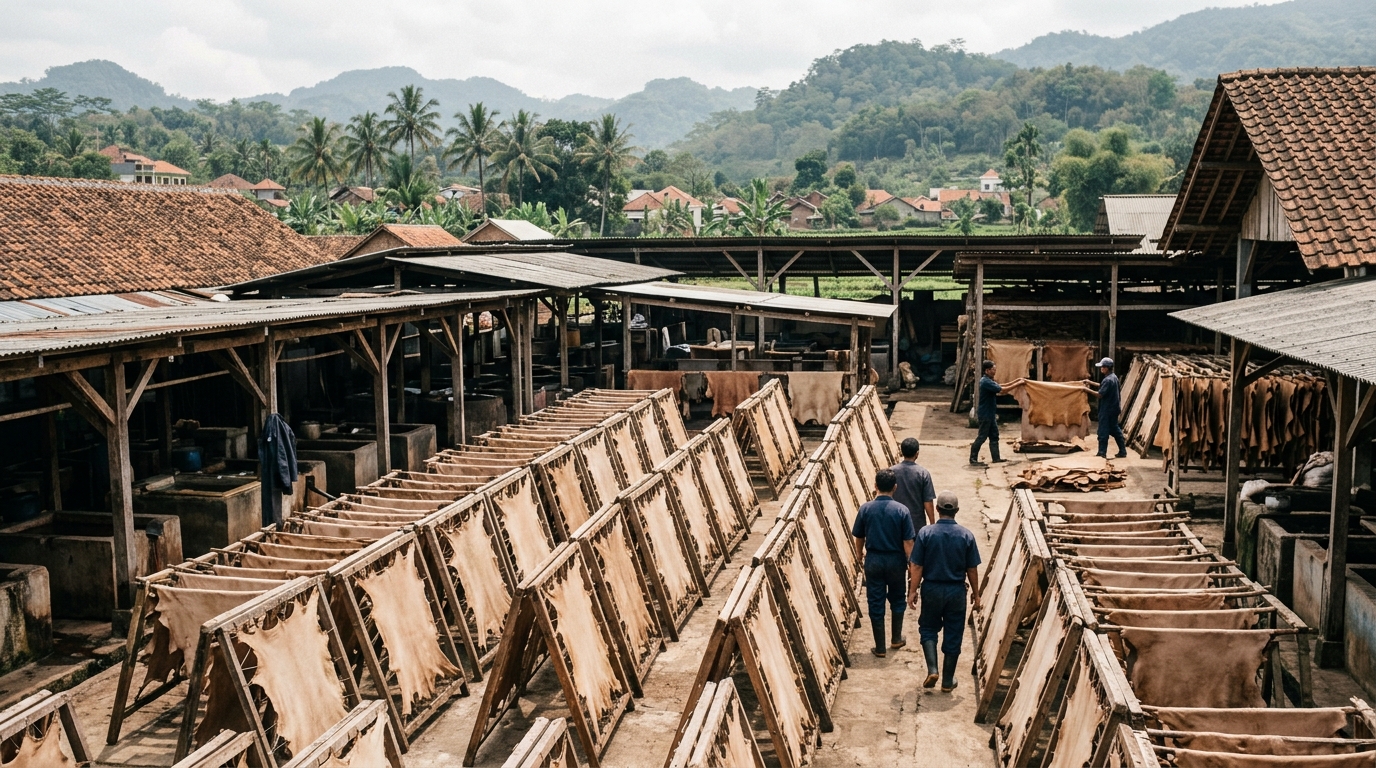
Garut's leather industry dates back to the Dutch colonial period, when the region's abundant livestock — particularly the Domba Garut, a local sheep breed — made it a natural center for hide processing. Over generations, tanning knowledge transferred from master craftsmen to factory operators. Today, that accumulated expertise shows up in production quality that newer manufacturing clusters simply cannot replicate quickly.
The region now hosts a dense network of tanneries, pattern-making studios, and garment factories within a relatively compact area. A jacket can move from raw hide through tanning, cutting, assembly, and finishing without leaving the cluster. That vertical integration reduces lead time risk and makes communication between production stages faster.
Geographic and Logistics Advantages for Export
Garut sits approximately 60 kilometers southeast of Bandung, the capital of West Java. Bandung connects by road and rail to the Port of Tanjung Priok in Jakarta — Indonesia's largest and most active export gateway. For US-bound shipments, this means efficient container loading without the inland logistics complications common in more remote manufacturing regions.
West Java's infrastructure investment has continued to improve road access between Garut and Bandung, reducing friction in the final export mile. Buyers sourcing from leather jacketsmanufacturers Indonesia Garutcan realistically plan for factory-to-port transit of one to two days under normal conditions.
Certifications and Export-Grade Standards
Factories oriented toward US and European export typically carry or are working toward certifications relevant to leather garment buyers. These include ISO 9001 for quality management systems and BSCI (Business Social Compliance Initiative) for ethical manufacturing audits. Some tanneries have additionally sought compliance with REACH regulation requirements, relevant when exportingfinished leathergoods to regulated markets. Buyers should request documentation during supplier vetting — not assume it exists.
Leather Hide Options From Garut Tanneries: Sheep, Goat, and Cow Compared
The Domba Garut Sheep and Its Distinctive Hide
The Domba Garut is a breed native to the Garut regency, descended from crosses of Merino, Texel, and local Indonesian sheep. The breed's unique genetics produce a hide with tighter, finer fiber structure than most commercial sheep hides sourced elsewhere in Asia. The result is a leather that is noticeably softer to the touch, drapes well for garment construction, and retains a natural grain that finishing can enhance rather than cover.
For buyers accustomed to Italian lambskin pricing, Domba Garut sheepskin offers a comparable hand-feel at a lower landed cost. It is not identical to European lambskin — the grain pattern differs slightly and the hide weight is typically lighter — but for fashion outerwear positioned at accessible luxury or mid-premium price points, it is a credible material choice.
Goat leather from Garut tanneries is firmer than sheepskin, with a more pronounced natural pebble grain. It performs better in structured jacket styles — bomber silhouettes, moto jackets with heavy quilting — where body retention matters more than drape. Cow leather, available in full-grain and top-grain variants, is the heaviest option. Full-grain cow leather retains the complete outer surface of the hide, offering maximum durability and a patina that develops with use. Top-grain cow leather is sanded to remove surface imperfections and then finished, producing a more uniform appearance at a moderately lower price point.
Side-by-Side Material Comparison
| Hide Type | Typical Weight (oz/sq ft) | Grain Texture | Primary Jacket Applications | Relative Price Tier |
|---|---|---|---|---|
| Domba Garut Sheepskin | Approx. 1.5–2.5 | Fine, tight, natural | Fashion jackets, moto, biker, aviator | Mid |
| Goat Leather | Approx. 2.0–3.0 | Pebbled, structured | Bomber, structured moto, cafe racer | Mid |
| Cow Top-Grain | Approx. 3.0–4.5 | Sanded, uniform | Classic trucker, workwear, heavy outerwear | Mid-to-high |
| Cow Full-Grain | Approx. 3.5–5.0 | Natural, variable | Premium outerwear, heritage styles | High |
Weight ranges are approximate and vary by tannery finishing process.
How Tannery Grade Affects Your Final Product
Tannery grade is not always visible in a supplier's catalog. Key variables include the chromium or vegetable tanning method used, the dyeing process (drum-dyed through the full hide versus surface-coated), and the finishing layer applied. Drum-dyed leather shows consistent color on cut edges — important for burnished edge treatments. Surface-coated leather may crack at stress points over time. Buyers should specify tannery grade and request cross-section samples to verify dye penetration before committing to bulk production.
Custom Design Capabilities at Leather Jackets Manufacturers Indonesia Garut
Accepted Design Inputs
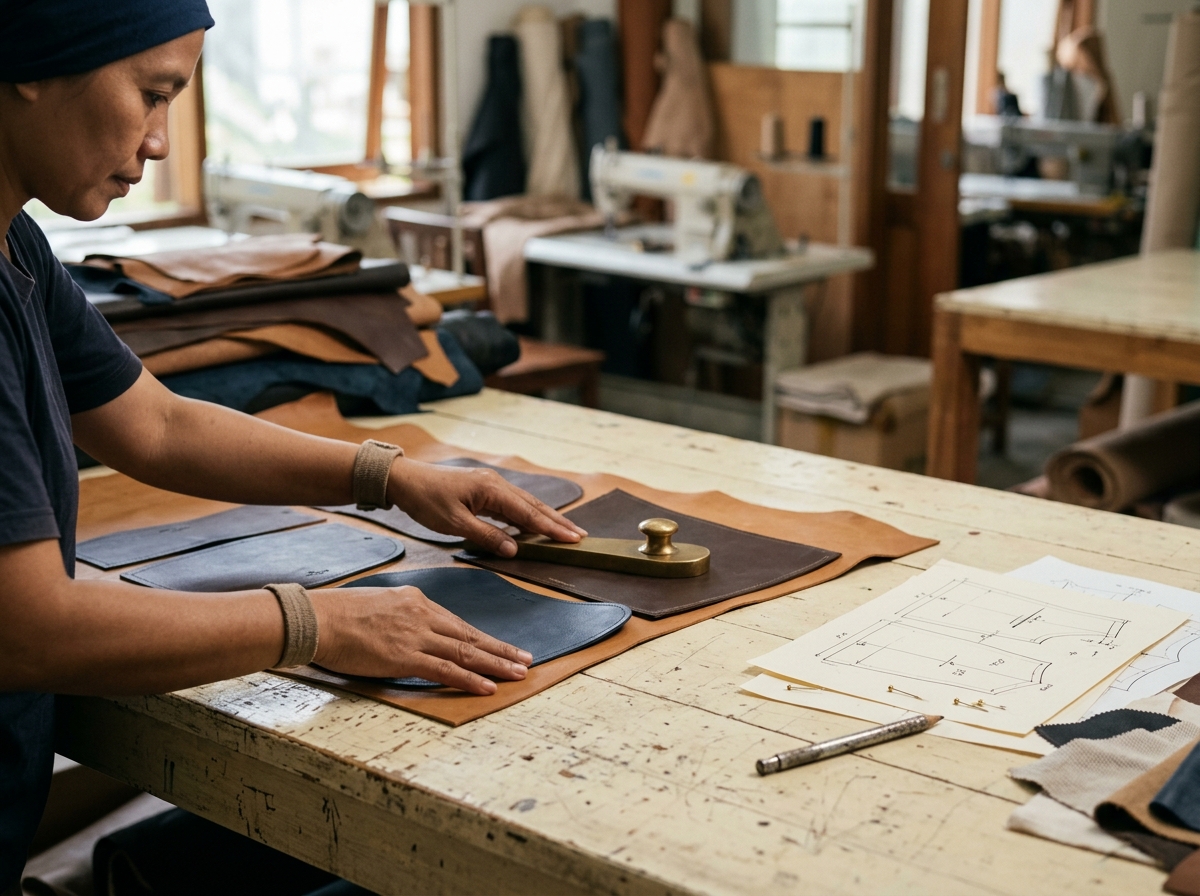
Most mid-scale factories in Garut accept design input in several formats. A fully developed tech pack — with construction details, seam types, hardware specs, and graded measurements — is the fastest path to an accurate first sample. Factories can also work from detailed sketches combined with a reference sample. Providing a physical reference garment alongside dimensional notes reduces interpretation errors significantly.
Vector-format flat sketches (AI or PDF) are widely accepted for style development. Some factories have in-house pattern engineers who can digitize sketches into CAD patterns. Confirm this capability directly — not all factories have it, and those that outsource pattern development add time to the sampling phase.
Fit and Grading for US Market Sizing
Indonesian base patterns are typically drafted for a leaner, shorter torso profile than US market averages. When developing size runs for US retail, buyers must specify US size chart standards explicitly. A common oversight is providing only S/M/L/XL labels without specifying chest, waist, hip, sleeve length, and back length measurements for each size.
Extended size runs (1X through 4X or US plus sizing) require dedicated grading work. Not all Garut factories grade above XL without additional pattern development fees. Confirm the factory's grading capacity and request a size specification sheet before approving the proto sample. Fit issues discovered after bulk cutting are expensive to resolve in leather — unlike woven fabric, leather cannot be re-cut without material loss.
In-House Value-Added Capabilities
Better-equipped Garut factories offer embroidery, laser cutting for surface patterns, hand distressing, and panel washing to achieve vintage effects. These capabilities vary widely by factory. Verify with physical samples, not factory claims.
Brand integration — woven labels, embossed leather patches, custom metal hardware, and private label neck tags — is standard practice among Garut OEM factories. Hardware customization (custom zipper pulls, branded snaps, proprietary logo buttons) typically requires a tooling investment and minimum run quantity. Lead time for custom hardware is separate from the jacket production timeline and should be planned in parallel.
Construction Specs Every Buyer Should Define Before Production Starts
Lining Materials
Lining choice affects both comfort and perceived quality at retail. Common options from Garut factories include:
- Viscose satin — lightweight, smooth, low cost. Adequate for fashion jackets in moderate climates. - Quilted polyester — adds warmth and structure. Common in moto and biker styles. - Bemberg cupro — a regenerated cellulose fiber with a silk-like hand. Positions a jacket at premium retail and is the preferred choice for brands competing on interior finish.
Bemberg cupro is available from Garut manufacturers but typically requires explicit specification. It is not a default option at most factories.
Hardware Standards
Zipper quality directly affects long-term wearability. Specify YKK zippers by name in your tech pack. YKK is widely available in Indonesia and accepted by all export-grade Garut factories. Generic zipper substitutions are a common cost-cutting move on unspecified orders — prevent it by naming the hardware brand and pull style explicitly.
For D-rings, buckles, and snaps, specify metal composition (solid brass, zinc alloy) and finish (antique nickel, gunmetal, antique brass, matte black). Finish consistency across a production run is a common QC checkpoint — hardware color drift between units is a legitimate defect category.
Stitching and Edge Finishing
Stitch-per-inch (SPI) requirements should be specified by leather weight:
| Leather Weight | Recommended SPI Range | Thread Type |
|---|---|---|
| Light (sheepskin, approx. 1.5–2.5 oz) | 7–9 SPI | Polyester or nylon, bonded |
| Medium (goat, approx. 2.0–3.0 oz) | 6–8 SPI | Bonded nylon or linen |
| Heavy (cow, approx. 3.0–5.0 oz) | 5–7 SPI | Heavy bonded nylon |
SPI ranges are industry-standard guidelines; confirm with your factory's QC team.
Edge finishing options — burnished, painted, or raw — should be specified panel by panel where construction varies. Burnished edges require drum-dyed leather for color consistency. Painted edges work on surface-finished leather but may crack over time at flex points.
- ✓Leather type, hide origin, and tannery grade
- ✓Lining material by style zone (body vs. sleeve vs. yoke)
- ✓Hardware brand, metal composition, and finish
- ✓SPI by seam type
- ✓Edge finish by panel
- ✓Size run with full measurement chart per size
- ✓Brand labeling placement and attachment method
- ✓Packaging and hang-tag requirements
MOQ, Pricing Tiers, and Production Timelines in Garut
Minimum Order Quantities by Factory Scale
MOQ varies significantly by factory size and style complexity. Typical ranges:
| Factory Scale | MOQ per Style | Best Fit For |
|---|---|---|
| Small SME (20–80 workers) | Approximately 50–100 pieces | New brands, test runs, complex custom styles |
| Mid-scale OEM (100–300 workers) | Approximately 100–200 pieces | Established brands, repeat programs |
| Large export factory (300+ workers) | Approximately 200–500 pieces | High-volume private label, department store programs |
Sheepskin jackets with moderate complexity can often be sampled and produced at lower MOQ than cow leather styles, due to smaller hide sizes and simpler panel counts.
Pricing Benchmarks
Exact unit costs depend on leather grade, hardware specification, lining choice, and order volume. General patterns from the Garut market:
- Domba Garut sheepskin jackets typically land at a lower ex-factory price than equivalent cow full-grain styles, reflecting hide cost differences. - Cow full-grain jackets with YKK zippers, Bemberg cupro lining, and solid brass hardware represent the highest cost tier. - Goat leather falls between the two in both cost and perceived quality.
Buyers should request itemized cost breakdowns — hide cost, cutting, sewing, trimming, hardware, lining, finishing — to understand where margin is built and where substitution risk exists.
Lead Times and Sampling Process
Standard production timelines from Garut factories:
- Proto sample: approximately 14–21 days from tech pack receipt - Fit revision rounds: 7–14 days each (plan for at least two rounds) - Pre-production sample (PPS) approval: required before bulk cutting - Bulk production: approximately 45–90 days from PPS approval, depending on order volume and factory load
Sampling fees are standard practice. Expect to pay per sample, with costs typically credited against bulk order invoices upon confirmation. Pre-production deposits of 30–50% of the FOB value are common. Negotiate deposit return terms for delayed production in the purchase order.
Quality Control and US Import Compliance for Indonesian Leather Jackets
Chemical Safety Requirements
Leather jackets imported into the US must comply with CPSC (Consumer Product Safety Commission) regulations covering restricted substances, including azo dyes, heavy metals in hardware, and formaldehyde levels in finishing chemicals. REACH regulation — technically a European standard — is widely referenced by US buyers as a chemical safety benchmark because many Garut factories producing for EU markets already comply with it.
Request test reports from an accredited third-party laboratory for each new leather type and colorway. Do not accept factory self-certifications as a substitute for independent testing.
US Import Duty and HTS Classification
Leather jackets imported from Indonesia into the US are classified under HTS Chapter 42, specifically subheadings covering leather apparel. The applicable duty rate depends on exact construction — whether the outer shell is leather or has a leather face. Indonesia is not currently part of a free trade agreement with the US, so standard MFN (Most Favored Nation) duty rates apply. Buyers should confirm the specific HTS subheading with a licensed customs broker before the first shipment. Misclassification creates retroactive duty liability.
Inspection Stages
Three-stage inspection is the recommended approach for new supplier relationships:
1. Inline inspection — conducted during cutting and initial assembly. Checks hide selection, panel consistency, and hardware installation. 2. Mid-line inspection — at approximately 30–40% production completion. Checks stitching quality, lining attachment, and color consistency. 3. Final inspection (pre-shipment) — 100% carton count, AQL sampling of finished units, hardware function test, measurement check against spec sheet.
Third-party inspection firms with West Java presence can conduct these on your behalf. This is a non-negotiable step for first orders from any new Garut factory.
Documentation for US Customs Clearance
| Document | Purpose | Who Provides It |
|---|---|---|
| Commercial Invoice | Declares FOB value and goods description | Factory or exporter |
| Packing List | Carton counts, weights, dimensions | Factory |
| Certificate of Origin | Confirms Indonesian origin for duty assessment | Indonesian Chamber of Commerce or authorized body |
| Bill of Lading | Shipping contract and title document | Freight forwarder |
| Lab Test Reports | Chemical safety compliance evidence | Third-party laboratory |
How to Vet and Contact Verified Garut Leather Jacket Suppliers
Key Questions to Ask Before Committing to a Sample
Before placing a sample order with any leather jacket OEM manufacturer in Indonesia, ask:
- What percentage of your production is currently exported to the US or EU? - Can you provide references from active overseas buyers (brand names or categories acceptable)? - Do you own your tannery supply, or do you source hides from independent tanneries? Who are your primary tannery suppliers? - What is your current production lead time and factory capacity utilization? - Can you provide current copies of ISO, BSCI, or other compliance certifications? - What is your sampling fee, and is it credited against bulk orders?
Factories unable or unwilling to answer these questions clearly are high-risk for first-time buyers.
Red Flags in Supplier Communication
Finding Verified Manufacturers
Trade directories including Alibaba, Made-in-China, and GlobalSources list Indonesian leather garment factories, but online verification status on these platforms does not substitute for independent factory audits. Indonesian government trade promotion agencies periodically publish directories of verified export manufacturers — these are worth cross-referencing.
Trade shows including Jakarta International Leather Goods and Accessories Fair (JILFA, approximately annual) and Indonesia's participation in international apparel trade shows provide direct access to Garut factory representatives.
The Role of Local Sourcing Agents
West Java-based sourcing agents and quality inspection firms provide on-the-ground services that remote buyers cannot replicate. A credible local agent can conduct factory visits, review production facilities, facilitate communication, manage inline and mid-line inspections, and handle pre-shipment documentation. They typically charge a commission on FOB value or a flat service fee per inspection visit. Verify that any sourcing agent you engage is independent from the factories they recommend — undisclosed factory relationships are a structural conflict of interest.
Frequently Asked Questions About Sourcing From Garut Leather Jacket Factories
What is the minimum order quantity for leather jackets from Garut manufacturers? MOQ typically ranges from approximately 50 pieces for small SME factories to 200–500 pieces for larger export-oriented OEM operations. Style complexity, leather type, and factory scale all influence the floor.
What types of leather hides are available from Garut tanneries? Domba Garut sheepskin is the signature material. Goat leather and cow leather (full-grain and top-grain) are also widely available. Some tanneries offer suede and nubuck finishing on sheep and goat hides.
How long does it take to produce a custom leather jacket order in Indonesia? From tech pack submission to shipment, plan for approximately 16–22 weeks when accounting for sampling rounds, PPS approval, bulk production, and inspection. Rush production is possible but increases risk and cost.
Can Garut factories produce leather jackets in US plus sizes and extended size runs? Yes, but extended grading requires explicit specification. Factories do not automatically grade to US plus sizing standards. Buyers must provide a full measurement chart for each size in the run, including extended sizes.
What certifications should I request from an Indonesian leather jacket supplier? At minimum: ISO 9001, BSCI audit report, and third-party chemical test reports for leather and hardware covering CPSC-relevant restricted substances. REACH compliance documentation is additionally useful for brands selling in US and EU markets simultaneously.
How does Garut sheep leather compare to lambskin leather in quality and price? Domba Garut sheepskin offers a comparable softness and drape to European lambskin, with a slightly different grain pattern. It is generally available at a lower ex-factory price than Italian or Spanish lambskin, making it attractive for mid-premium positioning. Quality varies by tannery grade and finishing method.
Garut offers US buyers a rare combination: deep manufacturing heritage, distinctive raw material in Domba Garut sheepskin, and an integrated cluster that can take a jacket from hide to finished garment with export-grade documentation. The buyers who succeed here are those who arrive with clear specs, realistic timelines, and a structured vetting process — not those who treat Garut as a low-cost shortcut.
Now that you understand the full production landscape — materials, specs, compliance, and supplier signals — the logical next step is connecting with factories directly qualified for your category and volume requirements.
You now have the framework to evaluate materials, specs, MOQ, and compliance requirements. The next step is getting factory introductions and sample quotes from Garut manufacturers already producing for US market clients. Request a verified factory introduction and sample quote today.
Request Factory Introduction and Sample Quote →Need eyes on the ground in Indonesia?
MTS is an execution partner — supplier verification, manufacturing management, quality control and export logistics across Indonesia, Vietnam and China.
Related services
Related articles
Receive furniture sourcing insights across Asia.
One email per week. No spam.