Leather Goods Manufacturers Indonesia Garut: Complete Sourcing Guide for US Importers
13 min read
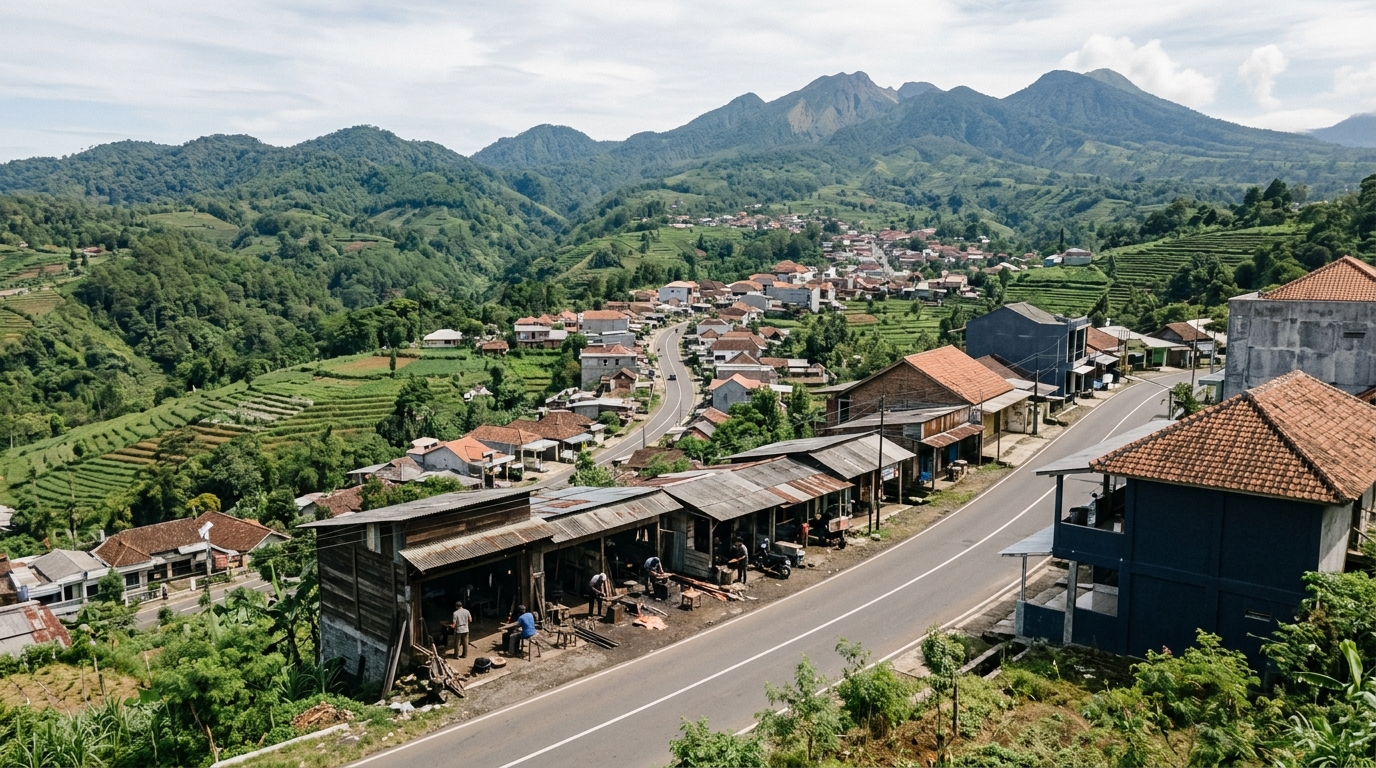
Sourcing leather goods from Indonesia requires more than finding a factory with a website. US buyers face a layered decision: which cluster, which tanning method, which supplier tier, and how to clear customs cleanly. The wrong answer at any step costs time, capital, and brand equity.
Sourcing leather goods from Indonesia requires more than finding a factory with a website. US buyers face a layered decision: which cluster, which tanning method, which supplier tier, and how to clear customs cleanly. The wrong answer at any step costs time, capital, and brand equity.
Garut, in West Java, is Indonesia's most concentrated leather manufacturing cluster. It sits at the intersection of raw hide supply, generational craft skill, and growing export capability. But Garut does not operate in isolation. The full supply chain runs from cattle hide tanneries in Sidoarjo, East Java, through Garut's workshops and mid-scale factories, and out through Tanjung Priok port in Jakarta. Understanding each link is what separates efficient sourcing from costly rework.
This guide covers the complete chain. It addresses leather goodsmanufacturers IndonesiaGarut, the role of Sidoarjo tanneries as raw material suppliers, tanning method trade-offs, MOQ tiers, private label workflows, quality grading, and US import compliance. Every section is written for B2B buyers making real procurement decisions — not for readers browsing general content.
If you are evaluating Garut as a sourcing destination for the first time, or benchmarking an existing supplier relationship, the sections below give you the decision criteria and specification language to move with confidence.
Why Garut Is Indonesia's Premier Leather Manufacturing Hub for Global Buyers
A Century of Sheepskin and Goatskin Craft
Garut's leather industry traces back over a century. The region's mountainous terrain supports large sheep and goat populations, giving local tanners and craftspeople direct access to raw hides. That proximity shaped a cluster built around sheepskin leather and goatskin leather — materials that dominate Garut's output today.
The knowledge transfer is generational. Families have run tanning and stitching operations across multiple generations. That depth of craft skill is difficult to replicate in newer industrial clusters. For premium and private label buyers, it translates into finishing quality that mid-scale factories in other regions often cannot match at comparable price points.
Cluster Structure: From Artisan Workshops to Mid-Scale Factories
Garut's supplier base is layered. At the base are artisan workshops — typically 5 to 30 workers — producing handmade jackets, bags, and small leather goods. Above them sit mid-scale factories with 50 to 200 workers, semi-industrial production lines, and dedicated export departments. A smaller number of larger operations serve high-volume buyers directly.
This structure gives buyers genuine flexibility. Small workshops handle low-MOQ custom orders. Mid-scale factories manage consistent bulk production. Most serious exporters sit in the mid-scale tier and carry prior experience with US and European buyers.
Garut vs Sidoarjo: Two Different Roles in One Supply Chain
Garut and Sidoarjo are frequently compared, but they serve different functions.
| Attribute | Garut (West Java) | Sidoarjo (East Java) |
|---|---|---|
| Primary role | Finished goods manufacturing | Raw and finished leather tanning |
| Hide specialization | Sheepskin, goatskin | Cattle hide |
| Output | Jackets, bags, shoes, accessories | Crust leather, finished leather panels |
| Buyer type | Brands, importers, private label | Manufacturers, converters |
| Export readiness | High (many direct exporters) | Moderate (mostly B2B to manufacturers) |
| Craft heritage | 100+ years | Industrial-scale, decades |
Garut manufacturers typically source cattle leather from Sidoarjo tanneries for product lines requiring heavier, sturdier material — structured bags, belts, and shoe soles. For jackets and softer accessories, local sheepskin and goatskin remain the primary inputs.
Full Product Range Available From Leather Goods Manufacturers in Garut Indonesia
Outerwear: Leather Jackets
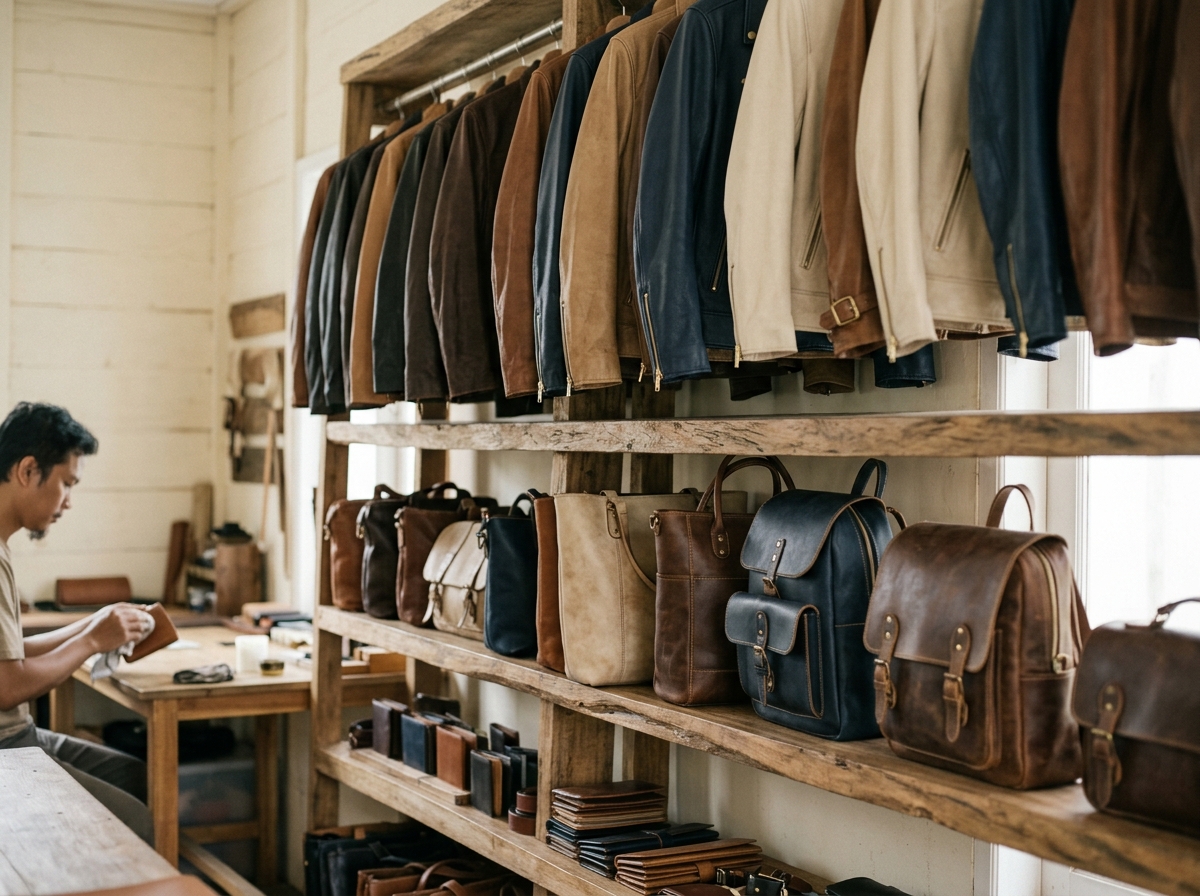
Jackets are Garut's highest-volume export category. Manufacturers produce men's and women's styles across biker, bomber, moto, and classic silhouettes. Both OEM (buyer-supplied design) and ODM (factory-developed design) arrangements are common.
Sheepskin leather dominates jacket production due to its weight-to-softness ratio. Goatskin is used for structured or textured finishes. Chrome-tanned hides are standard for volume jacket orders. Vegetable-tanned options exist but typically carry longer lead times and higher per-unit costs.
Bags and Accessories
Garut manufacturers produce totes, crossbody bags, backpacks, duffel bags, and structured handbags. Luxury handbag production is available at select workshops with experience in precision stitching and hardware fitting — though buyers should verify capacity before placing large orders.
Small leather goods — wallets, cardholders, belts, key fobs, and passport covers — are produced across the full workshop spectrum. These items typically carry the lowest MOQs in the cluster and the fastest sampling turnaround.
Footwear
Leather shoes and sandals are produced in Garut, though footwear is less dominant than bags and jackets. Handmade sandals and semi-industrial shoe production coexist. Buyers sourcing footwear alongside bags or jackets can often consolidate with a single mid-scale manufacturer.
Vegetable Tanning vs Chrome Tanning: What Every Importer Must Evaluate
Attribute Comparison
| Attribute | Vegetable Tanning | Chrome Tanning |
|---|---|---|
| Process duration | Weeks to months | Hours to days |
| Patina development | Yes — deepens with use | Minimal |
| Durability | High — stiffens over time | Good — stays supple |
| Environmental profile | Lower chemical load | Chromium VI risk if uncontrolled |
| Cost | Higher | Lower |
| Best fit | Premium, heritage, sustainable brands | Volume orders, fashion, fast-moving SKUs |
| Garut availability | Limited — specialist workshops | Widely available |
| Sidoarjo availability | Available at select tanneries | Standard output |
Which Facilities Specialize in Each Method
Vegetable tanning in Indonesia is concentrated at a smaller number of specialist tanneries, some operating in the Garut region and others supplying from Central Java. Sidoarjo tanneries primarily produce chrome-tanned cattle leather at scale, though select facilities have added vegetable-tan lines to serve premium buyers.
Garut workshops buying vegetable-tanned leather as input typically source from these specialist tanneries and carry a price premium of approximately 20 to 40 percent over chrome-tanned equivalents — treat this as an industry estimate and confirm with your supplier.
Chemical Compliance Implications
Chrome-tanned leather can contain residual Chromium VI if tanning controls are inadequate. This is a live compliance issue for US importers. The CPSC monitors chemical hazards in consumer goods. REACH restrictions (relevant if you also sell to EU markets) set strict limits on Chromium VI in leather articles.
Specify Chromium VI limits in your purchase order. Request test reports from an accredited third-party lab — SGS, Bureau Veritas, or Intertek operate in Indonesia and can test to ASTM and ISO standards.
Vegetable-tanned leather carries lower Chromium VI risk but may require testing for other restricted substances (formaldehyde, azo dyes) depending on your target market.
Quality Grading Standards for Indonesian Leather Goods and How to Specify Them
Hide Grades Explained
| Grade | Description | Typical use |
|---|---|---|
| Full-grain | Surface intact, natural markings visible | Premium bags, belts, structured goods |
| Top-grain | Surface sanded, more uniform appearance | Mid-market bags, jackets |
| Corrected-grain | Heavy sanding + embossed pattern applied | Value-tier goods, high-volume fashion |
| Split leather | Lower layer of hide, weaker structure | Linings, low-cost accessories |
Garut manufacturers grade incoming sheepskin and goatskin hides by thickness uniformity, scar density, and surface defect count. Full-grain sheepskin commands a significant premium and is used primarily for jackets and luxury bags. Most volume production runs on top-grain material.
Common Defects to Specify Against
Include the following in your purchase order terms:
- Thickness variance tolerance (example: ±0.2mm across panel) - Maximum allowable scar area per hide (specify in cm²) - Color consistency — define acceptable Delta-E tolerance if color accuracy is critical - Stitching density — specify stitches per inch (SPI) minimum - Hardware finish — specify plating standard and pull-force minimum
- ✓Hide grade specified (full-grain / top-grain / corrected-grain)
- ✓Tanning method confirmed in PO
- ✓Thickness tolerance defined
- ✓Scar and defect area limits stated
- ✓Stitching density (SPI) specified
- ✓Hardware pull-force test required
- ✓Chromium VI test report requested
- ✓Third-party pre-shipment inspection booked
Third-Party Inspection Options
Pre-shipment inspection (PSI) services are available in West Java through international QC firms. Book inspection at approximately 80 percent production completion. For first orders with any new Garut manufacturer, a during-production (DUPRO) inspection at 30 to 50 percent completion adds meaningful risk reduction.
Private Label Programs: Customization Workflow for Garut Manufacturers
OEM vs ODM in the Garut Context
Most mid-scale Garut manufacturers offer both OEM and ODM arrangements.
- OEM: You supply the tech pack, pattern, hardware spec, and brand assets. The factory produces to your specification. Best for buyers with defined product IP. - ODM: The factory develops the design from your brief. You select from existing or modified styles. Best for buyers entering new categories without in-house design resources.
Customization Options Available
- Hardware: Buckles, zippers, D-rings, snaps — specify finish (antique brass, gunmetal, nickel-free) - Lining: Cotton, polyester, jacquard, or leather lining options - Stitching: Contrast or tonal thread, specify color and SPI - Embossing: Logo deboss, pattern emboss on body panels - Labels and tags: Woven labels, leather patches, hang tags — supply artwork in vector format - Packaging: Custom boxes, dust bags, tissue paper — confirm spec early; packaging lead times can equal production lead times
Sampling Timeline and Development Costs
Typical timelines in the Garut cluster (industry estimates):
| Stage | Timeline |
|---|---|
| Tech pack review and quote | 3–5 business days |
| First sample (proto) | 2–4 weeks |
| Revision sample | 1–2 weeks per round |
| Pre-production sample (PPS) | 1–2 weeks after approval |
| Bulk production | 6–12 weeks depending on volume |
Sample development fees are standard practice. Expect fees roughly proportional to product complexity. These fees are commonly credited against the first bulk order above a defined minimum. Confirm this in writing before submitting a tech pack.
MOQ Tiers, FOB Pricing Benchmarks, and Lead Times for Garut Leather Goods
MOQ by Supplier Tier
| Supplier type | Typical MOQ | Best fit |
|---|---|---|
| Artisan workshop | 10–50 units per style | Sampling, limited editions, luxury small runs |
| Small factory (SME) | 50–150 units per style | Emerging brands, multi-SKU collections |
| Mid-scale factory | 150–500 units per style | Established importers, retail programs |
| Large factory | 500+ units per style | Volume buyers, department store programs |
MOQs are often negotiable on first orders if you commit to a development fee or agree to a planned reorder timeline. Document any MOQ exception in the purchase order.
Indicative FOB Price Bands
These are industry-estimate ranges based on typical Garut cluster output. Actual quotes depend on hide grade, hardware, construction complexity, and order volume. FOB port is typically Tanjung Priok (Jakarta).
| Product | Chrome-tanned (approx. FOB) | Vegetable-tanned (approx. FOB) |
|---|---|---|
| Leather jacket | $35–$90 per unit | $70–$150+ per unit |
| Tote bag (mid-size) | $20–$55 per unit | $45–$100 per unit |
| Crossbody bag | $15–$40 per unit | $35–$80 per unit |
| Wallet / cardholder | $6–$18 per unit | $15–$35 per unit |
| Belt | $8–$22 per unit | $18–$40 per unit |
Sidoarjo Tanneries: The Raw Leather Supply Chain Behind Garut Production
Sidoarjo, located in East Java near Surabaya, functions as Indonesia's primary industrial cattle hide tanning center. While Garut handles finished goods manufacturing, Sidoarjo supplies the processed leather panels that many Garut factories use for bags, belts, shoes, and structured accessories.
How the Supply Chain Connects
Cattle hides arrive at Sidoarjo tanneries from Indonesian livestock slaughterhouses. Tanneries process hides through beamhouse operations, tanning, and finishing. Finished leather — typically in side or half-hide form — is then sold to manufacturers across Java, including Garut workshops and factories.
Transit from Sidoarjo to Garut is approximately 8 to 12 hours by road (roughly 500 km). Manufacturers typically hold buffer stock of 2 to 4 weeks of leather to avoid production interruptions. Lead time from Sidoarjo tannery to Garut manufacturing start is commonly 1 to 3 weeks depending on tannery load and finishing requirements.
Environmental Certifications and US Importer Considerations
Tannery wastewater management is a known issue in the Sidoarjo cluster. Some facilities have invested in effluent treatment systems and hold certifications. Others have not.
For US buyers, tannery compliance matters at two levels:
1. Brand risk: Downstream media and NGO scrutiny of tannery conditions can affect brand reputation. 2. Chemical compliance: Poor tannery controls increase the risk of restricted substance violations in finished goods.
Request your Garut manufacturer's leather supplier name and ask for any available tannery compliance documentation. Third-party audited tanneries are preferable. If the manufacturer cannot or will not disclose their leather source, treat this as a risk signal.
US Import Compliance: Export Documentation and Duty Rates for Indonesian Leather Goods
Required Export Documents
- ✓Commercial invoice (FOB value, HS code, country of origin)
- ✓Packing list (carton count, weights, dimensions)
- ✓Certificate of origin (Form A or standard CO from Indonesian Chamber of Commerce)
- ✓Bill of lading or airway bill
- ✓Phytosanitary certificate (if any natural fiber components)
- ✓CITES permit (only if exotic species — not applicable to sheep, goat, cattle leather)
- ✓Manufacturer's test reports for restricted substances (Chromium VI, formaldehyde, azo dyes)
US Customs HS Codes and Duty Rates
| Product category | HS Code (US) | General duty rate (approx.) |
|---|---|---|
| Leather handbags and bags | 4202.21 / 4202.22 | 6.3–9% |
| Leather wallets and small goods | 4202.31 / 4202.32 | 8% |
| Leather jackets (men's) | 4203.10 | 6% |
| Leather belts | 4203.30 | 2.7–3.7% |
| Leather footwear (uppers) | 6403 series | Varies 5–37.5% |
Indonesia does not currently benefit from the US Generalized System of Preferences (GSP) for most leather goods categories, as the GSP program has experienced lapses in recent years. Confirm current GSP status with your customs broker before building duty costs into your landed cost model.
REACH and CPSC Compliance
Even if you sell only in the US market, REACH compliance is worth building in — particularly if you operate any EU distribution. For the US market, CPSC regulations on restricted substances in consumer goods apply to leather products sold in children's categories especially.
Specify restricted substance limits in your purchase order. Request third-party lab test reports before shipment approval. Testing costs are modest relative to customs hold or recall exposure.
How to Vet and Select the Right Garut Leather Manufacturer for Your Brand
Key Supplier Evaluation Criteria
| Criterion | What to look for |
|---|---|
| Production capacity | Matches your target order volume — request monthly capacity by category |
| Export experience | Prior shipments to US or EU — ask for references |
| Material traceability | Can name leather supplier, provide tannery documentation |
| Quality systems | In-house QC staff, documented inspection process |
| Sampling capability | Dedicated sample room, development fee structure |
| Communication | English-proficient export staff, responsive turnaround |
| Compliance readiness | Can facilitate third-party inspection and lab testing |
Remote Vetting Protocol
If an on-site audit is not feasible for a first evaluation, use this sequence:
1. Request a factory profile — workforce size, machinery list, production categories 2. Request export records or references — redacted commercial invoices or buyer references 3. Video call walkthrough of production floor and sample room 4. Order a paid sample — evaluate construction, material, and finish against your spec 5. Book a third-party pre-shipment inspection before releasing payment on bulk order
Red Flags to Disqualify Suppliers
- Cannot or will not name their leather supplier - No prior US or EU export documentation available - Quotes vary by 50 percent or more with no explanation - Refuses third-party inspection access - No written sampling agreement or development fee structure - Cannot provide material test reports on request
Frequently Asked Questions: Garut Leather Goods Sourcing
What types of leather goods are produced in Garut, Indonesia? Garut manufacturers produce leather jackets (biker, bomber, custom styles), bags (totes, crossbody, backpacks, handbags), shoes and sandals, and small leather goods including wallets, belts, and cardholders. Jackets and bags are the dominant export categories.
What is the minimum order quantity for leather goods from Garut manufacturers? MOQs range from 10 to 50 units at artisan workshops to 150 to 500 units at mid-scale factories. MOQs are often negotiable for first orders with a development fee commitment.
How does vegetable tanning differ from chrome tanning in Indonesian leather production? Vegetable tanning uses plant-based tannins, takes longer, and produces leather that develops patina. It suits premium and heritage brands. Chrome tanning is faster and cheaper and dominates volume production. Chrome-tanned leather carries a Chromium VI compliance risk if tannery controls are poor.
What export documents are required when importing leather goods from Indonesia to the US? Core documents include a commercial invoice, packing list, certificate of origin, and bill of lading. Restricted substance test reports are required for compliance. CITES permits apply only to exotic species — standard sheep, goat, and cattle leather does not require CITES documentation.
Which leather goods manufacturers are based in Garut? The Garut cluster contains hundreds of registered producers ranging from family workshops to mid-scale factories. Verified supplier lists are available through APKI (Indonesia's leather goods association), the Indonesian Ministry of Trade exporter database, and Asia Pacific Leather Fair exhibitor records. No specific manufacturer is endorsed here — vet directly using the criteria above.
Are Garut leather manufacturers able to handle private label and custom branding? Yes. Most mid-scale Garut manufacturers offer OEM and ODM services including custom hardware, embossing, woven labels, custom lining, and branded packaging. Submit a tech pack in PDF and DXF format and negotiate a sample development fee before production begins.
Garut's strength as a sourcing destination lies in its combination of craft depth, raw material proximity, and a supplier base that spans artisan workshops to export-ready mid-scale factories. Pairing that with a clear understanding of the Sidoarjo tannery supply chain, the right tanning specification, and US import compliance gives your sourcing program a defensible foundation.
You now have the specification framework, MOQ benchmarks, and compliance checklist to evaluate leather goods manufacturers in Indonesia Garut with confidence. The next step is getting verified supplier profiles and formal MOQ quotes matched to your product categories and volume requirements.
Request Supplier Profiles and MOQ Quotes →Need eyes on the ground in Indonesia?
MTS is an execution partner — supplier verification, manufacturing management, quality control and export logistics across Indonesia, Vietnam and China.
Related services
Related articles
Receive furniture sourcing insights across Asia.
One email per week. No spam.