Custom Furniture Manufacturing Indonesia: A Complete B2B Sourcing Guide
18 min read
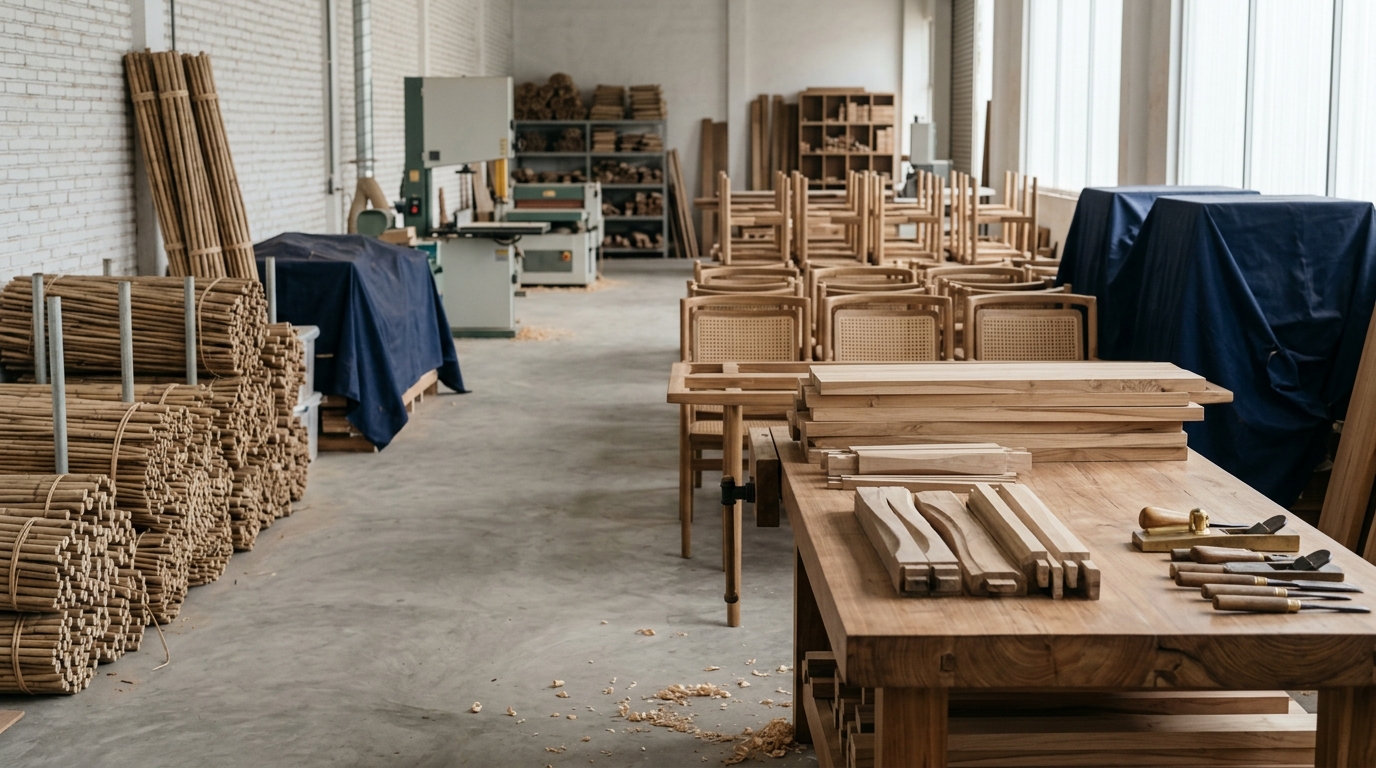
US-based retailers, private-label brands, and interior procurement teams are under increasing pressure to diversify their supply chains away from China — and Indonesia has emerged as one of the most strategically sound alternatives. The country combines an abundance of premium natural materials, a…
US-based retailers, private-label brands, and interior procurement teams are under increasing pressure to diversify their supply chains away from China — and Indonesia has emerged as one of the most strategically sound alternatives. The country combines an abundance of premium natural materials, a centuries-old woodworking tradition, and competitive production costs in a single sourcing destination. Yet most sourcing guides stop at surface-level descriptions of Indonesian craftsmanship, leaving buyers without the practical intelligence they actually need: how tariffs affect landed costs, what certifications to require, and how to structure an OEM or ODM relationship that protects your intellectual property.
This guide is written specifically for US buyers placing their first or next bulk furniture order from Indonesia. It covers everything from choosing the right production model and regional manufacturing cluster to navigating US import duties, CPSC compliance, and private-label packaging — the angles that generic supplier directories consistently ignore. Whether you are launching a new outdoor furniture SKU, scaling a hospitality contract, or building a private-label bedroom collection, the sections below give you a repeatable, risk-aware framework for sourcing custom furniture from Indonesia at scale.
Indonesia is consistently ranked among the top five furniture-exporting nations globally, and the United States remains one of its largest destination markets. That position is no accident — it reflects decades of investment in export-oriented production infrastructure across multiple regional clusters. Understanding how that ecosystem is structured is the essential first step before you contact a single factory.
Why Indonesia Has Become a Global Powerhouse for Custom Furniture Manufacturing
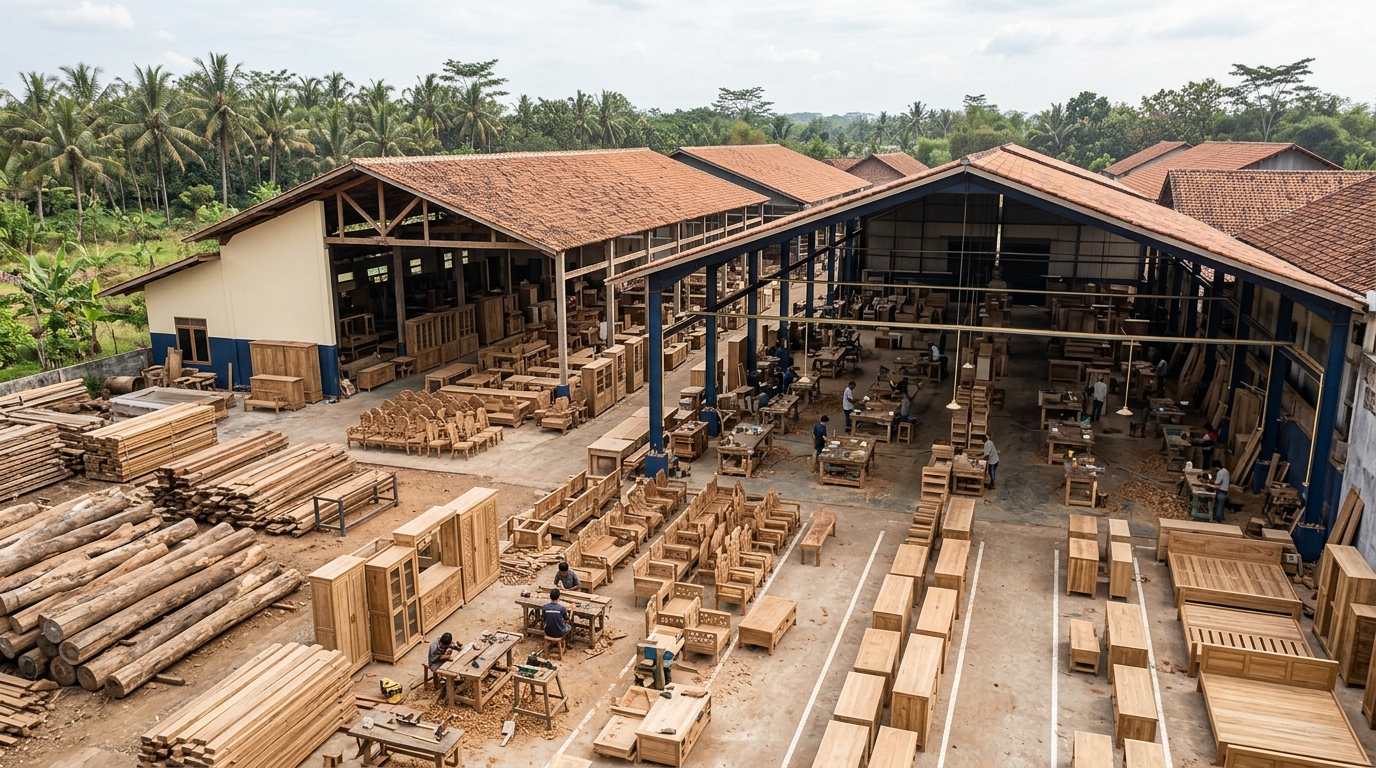
Indonesia's status as a top-tier sourcing destination for custom furniture manufacturing is built on three interlocking structural advantages that competing countries in Southeast Asia cannot fully replicate: raw material depth, artisan labor heritage, and competitive cost positioning.
Unmatched Access to Premium Natural Materials
Indonesia sits atop some of the world's most commercially valuable timber and fiber resources. Plantation-grown teak — widely regarded as the premier hardwood for outdoor and indoor furniture due to its natural oil content, durability, and grain stability — is produced in significant volumes across Java. Mahogany, sungkai, and other tropical hardwoods are available for indoor case goods and dining furniture. Rattan, the fast-growing vine that has become a global interior design staple, is harvested across the archipelago at a scale no other country can match, making Indonesia the dominant global source for natural fiber furniture. This raw material proximity translates directly into shorter upstream lead times and lower material input costs compared to manufacturers in Vietnam or China who must import equivalent hardwoods.
A Skilled Artisan Labor Base That Commands Premium Margins
The woodworking traditions concentrated in Jepara (Central Java) are centuries old. Jepara craftsmen have historically produced ornate carved teak furniture for both domestic royal courts and export markets, which means the skill base for complex joinery, hand carving, and high-quality finishing exists at a workforce scale that is difficult to replicate elsewhere. This heritage is commercially significant: it means Indonesian factories can execute detailed custom specifications — carved aprons, mortise-and-tenon joinery, hand-applied oil finishes — that would require entirely different production setups in more industrialized furniture manufacturing hubs.
Cost Competitiveness in the Southeast Asian Landscape
When compared to China, where rising labor costs and Section 301 tariffs have meaningfully increased the landed cost of furniture for US importers, or even Vietnam, where capacity has tightened significantly following the post-2018 sourcing surge, Indonesia offers a genuinely competitive cost structure. Labor costs for skilled woodworking in Central Java remain lower than equivalent skills in coastal Chinese manufacturing clusters. For natural material categories — teak outdoor sets, rattan accent pieces, mahogany dining collections — Indonesia's combination of raw material access and skilled labor creates a cost-quality ratio that is difficult to match globally.
OEM vs. ODM: Selecting the Right Custom Production Model for Your Brand
Before you request a single quote from an Indonesian manufacturer, you need to answer a foundational question: are you bringing your own designs to a factory, or asking a factory to design products you will sell under your brand? The answer determines your IP exposure, your tooling investment, your lead times, and your contractual obligations.
Understanding the OEM Model for Private-Label Furniture Brands
In an Original Equipment Manufacturer (OEM) arrangement, the buyer supplies the technical specifications — detailed drawings, material callouts, finish samples, and dimensional tolerances — and the factory manufactures to that brief. The design IP remains with the buyer. This model suits US private-label brands that have invested in proprietary SKU development, brands that carry consistent collections across multiple product categories, and retailers with established spec-sheet workflows. The trade-off is higher upfront investment: you are responsible for the design quality, and any tooling or jigging required to produce your specific shapes is typically charged as a one-time tooling fee. OEM furniture Indonesia relationships also require stronger NDA and IP assignment clauses in your purchase order terms, since you are sharing proprietary design assets with the factory.
Understanding the ODM Model for Faster Market Entry
In an Original Design Manufacturer (ODM) arrangement, the factory presents an existing design catalog — often updated seasonally — and the buyer selects styles to be manufactured under their private label. The factory owns the underlying design; the buyer licenses the right to sell it. This model is significantly faster for retailers launching new furniture categories, because no design development or tooling lead time is required. It is also lower risk for first-time importers who have not yet validated demand for a category. The key contractual consideration is exclusivity: in a pure ODM arrangement without an exclusivity clause, the same design may be sold by multiple competing brands. If differentiation matters to your brand, negotiate territorial or category exclusivity before committing to volume.
Key Contractual Differences to Negotiate
Regardless of model, three contractual elements require explicit attention with any Indonesian manufacturer: IP ownership clauses that clearly assign design rights, tooling fee terms that specify whether molds or jigs are owned by the buyer upon payment, and exclusivity scope that defines geography, sales channel, and duration. Indonesian commercial law does recognize IP agreements, but enforcement can be inconsistent — the most practical protection is structural: never share final CAD files or spec sheets before a signed NDA, and include design-ownership language directly in the purchase order rather than relying on a separate agreement that may not be cross-referenced.
Indonesia's Key Manufacturing Regions and Their Specialized Capabilities
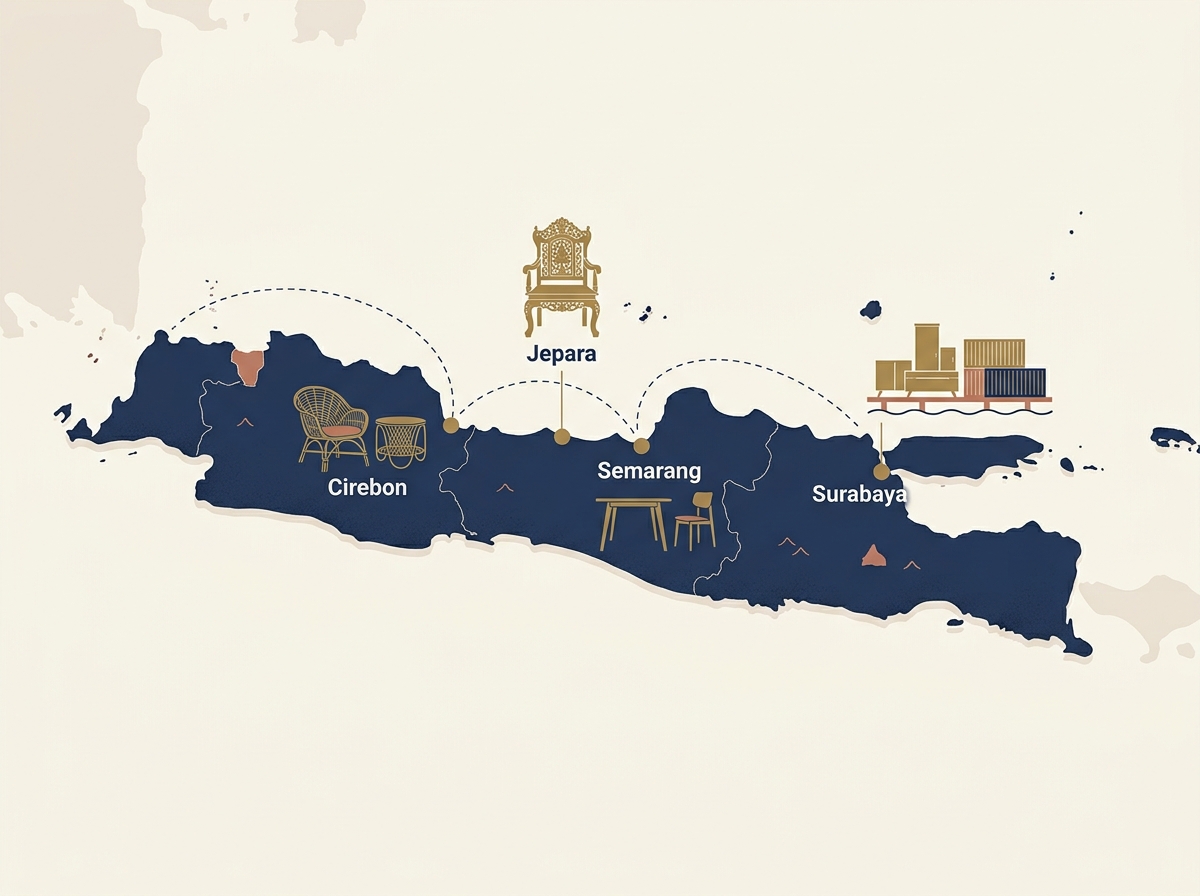
Indonesia's furniture industry is not geographically uniform. Each major cluster has developed around distinct raw material access, craft traditions, and infrastructure, and matching your product category to the right region is one of the most impactful decisions you will make in the sourcing process.
Jepara (Central Java) is the undisputed center of solid wood and teak furniture production in Indonesia, and arguably in Southeast Asia. Factories here range from large export-oriented manufacturers with CNC capability alongside traditional carving workshops, to medium-sized ateliers that specialize in made-to-order carved dining sets, bedroom collections, and garden furniture. If your product spec calls for teak, mahogany, or any carved solid wood detail, Jepara should be your first regional focus.
Cirebon (West Java) is the primary hub for rattan, wicker, and natural fiber furniture. Manufacturers here operate at scale and have long export histories to European and US buyers. Cirebon factories typically have strong experience with container-load export logistics and understand US retailer compliance requirements. If your collection includes rattan accent chairs, wicker baskets, or seagrass occasional pieces, Cirebon is the appropriate sourcing cluster.
Surabaya and East Java represent a more industrialized profile — larger factories with CNC-driven production lines, flat-pack capability, and experience producing hospitality and contract furniture to tight dimensional tolerances. This region suits buyers who need modern panel or engineered wood furniture with consistent repeatability across large volume runs.
Semarang (also in Central Java) functions as a key export port and is home to manufacturers who bridge the outdoor teak and mid-market indoor segments. FOB Semarang pricing is a common Incoterm reference point for Central Java production.
| Region | Primary Specialization | Best For |
|---|---|---|
| Jepara | Solid teak, carved hardwood, indoor/outdoor | Private-label collections, custom carved pieces |
| Cirebon | Rattan, wicker, natural fiber | Accent furniture, natural material trends |
| Surabaya / East Java | CNC, flat-pack, hospitality contract | Volume retail, hospitality procurement |
| Semarang area | Outdoor teak, mid-market indoor | Mixed container orders, FOB export hub |
How to Vet and Qualify Indonesian Custom Furniture Manufacturers
Due diligence on Indonesian suppliers is non-negotiable before you commit to a purchase order. The ecosystem includes a spectrum of operator types: full-cycle export manufacturers with ISO 9001 certification and in-house quality control, smaller artisan workshops with genuine craft capability but limited documentation, and trading companies that present as factories but actually subcontract production. Each carries a different risk profile.
Factory Audit Checklist
A credible factory audit — whether conducted in person, by a third-party inspection firm, or via a trusted operational partner — should verify: physical production facility size and owned equipment, workforce headcount and skill composition, documented lead time history on comparable orders, evidence of prior export shipments (freight records or commercial invoices), and on-site finishing and quality control capability. Any supplier that refuses to share basic facility information or cannot provide references from existing US or European buyers should be treated as high-risk.
- ✓Verify physical factory address and conduct facility walkthrough or third-party audit
- ✓Confirm FSC or SVLK (Indonesian timber legality) certification for wood products
- ✓Request ISO 9001 certificate and verify current validity
- ✓Review export documentation history: prior commercial invoices and bills of lading
- ✓Request references from US or EU buyers with comparable order profiles
- ✓Evaluate in-house finishing and quality control capabilities
- ✓Confirm MOQ, lead time, and payment terms in writing before sampling
Certifications That Matter for US Export
Three certifications are particularly important for US-bound shipments. FSC (Forest Stewardship Council) certification demonstrates that wood inputs come from responsibly managed forests — increasingly required by US retailers and major e-commerce platforms. SVLK (Sistem Verifikasi Legalitas Kayu) is Indonesia's mandatory timber legality verification system; any Indonesian wood furniture exporter should be able to produce a V-Legal declaration. ISO 9001 certifies a quality management system, which indicates that the factory has documented production and inspection processes — a proxy for consistency on repeat orders.
Sample Orders Before MOQ Commitment
Regardless of how confident you are in a factory's audit profile, always place a pre-production sample order before signing a bulk purchase order. Samples reveal finishing quality, dimensional accuracy, joinery strength, and packaging protection in a way that no audit or catalog can. Budget for the cost of samples and shipping as a normal line item in your sourcing process.
Pricing, MOQs, and Lead Times for Bulk Custom Orders From Indonesia
Understanding the cost architecture of custom furniture manufacturing in Indonesia allows you to build realistic landed-cost models before you commit to supplier conversations.
Typical MOQ Ranges by Product Category
MOQs in Indonesia vary significantly by product type and factory scale. The table below reflects commonly observed ranges — treat these as planning benchmarks, not fixed rules:
| Product Category | Typical MOQ Range | Notes |
|---|---|---|
| Teak outdoor dining set | 20–50 sets | Lower MOQ possible for simpler designs |
| Rattan accent chairs | 50–200 pieces | Depends on frame complexity |
| Solid wood bedroom suite | 20–40 sets | Higher if custom carving required |
| Flat-pack dining chairs (CNC) | 200–500 pieces | Larger runs reduce per-unit cost significantly |
| Custom carved decorative pieces | 30–100 pieces | Artisan workshops may accept lower |
Cost Breakdown and FOB Pricing Structure
The factory-gate price for Indonesian furniture typically comprises: raw material cost (teak and rattan inputs represent a larger share of total cost than in panel-furniture production elsewhere), skilled labor, surface finishing and treatment, export packaging, and inland freight to the port of export. FOB Semarang and FOB Surabaya are the most common Incoterm references for Central and East Java production respectively. When building a landed-cost estimate for US delivery, add ocean freight, marine insurance, US port handling, customs brokerage, and applicable import duties to the FOB price. The gap between FOB price and landed-duty-paid cost commonly ranges from 15 to 35 percent of FOB depending on shipping mode, port pair, and duty rate.
Production Lead Times
Standard in-stock or minimal-customization orders from established factories typically carry lead times of approximately 45 to 75 days from purchase order confirmation. Fully custom ODM or OEM tooled SKUs — particularly those requiring new jigs, carved pattern development, or custom hardware — commonly run 90 to 120 days for the first production run. Repeat orders on established tooling are generally faster. Factor port congestion and vessel booking lead times (typically two to four weeks additional) into your delivery planning.
Navigating US Import Regulations, Tariffs, and Customs for Indonesian Furniture
This is the section most sourcing guides skip entirely — and the one that most directly affects your margin model. Getting the compliance and duty picture right before you place a large order can save significant cost and prevent clearance delays.
HTS Codes and Applicable Tariff Rates
US import duties on furniture from Indonesia are assessed under the Harmonized Tariff Schedule (HTS). The applicable rate depends on the specific product: wooden bedroom furniture, wooden seating, upholstered seating, and outdoor furniture each fall under different HTS chapter 94 subheadings, and rates vary from duty-free to several percentage points of the FOB or customs value. Unlike Chinese furniture, which became subject to significant additional Section 301 tariffs beginning in 2018, Indonesian furniture is not subject to those additional duties. This structural advantage materially improves the landed-cost competitiveness of Indonesian supply for US importers.
Indonesia's GSP Status and Its Practical Impact
Indonesia has historically been eligible under the US Generalized System of Preferences (GSP), which allows qualifying products from designated developing countries to enter the US duty-free. However, GSP eligibility has been subject to periodic legislative renewal and product-specific exclusions in the US Congress. At the time of any order placement, confirm current GSP eligibility for your specific HTS subheading with your customs broker, as the program's renewal status can change. When GSP is active and applicable, it can reduce the effective duty rate on covered furniture products to zero, which is a material benefit worth tracking.
Customs Documentation Requirements
Every Indonesian furniture shipment entering the US requires a commercial invoice (with accurate description, quantity, unit value, and country of origin), a detailed packing list, and a certificate of origin. For wood products, a V-Legal declaration under the SVLK system serves as evidence of legal timber sourcing and should be included in your shipment documentation package. Your customs broker will also file an ISF (Importer Security Filing) at least 24 hours before vessel departure.
CPSC and CARB Compliance
US-bound furniture must comply with Consumer Product Safety Commission (CPSC) requirements relevant to the product type — this includes stability standards for clothing storage units under ASTM F2057 and tip-over requirements for free-standing furniture, which have received increased regulatory attention. For any furniture product containing composite wood components — MDF, plywood, particleboard — California Air Resources Board (CARB) Phase 2 compliance for formaldehyde emissions is legally required for California sales and is effectively a national market standard given California's retail footprint. When specifying panel components to Indonesian factories, explicitly require CARB-compliant materials and request documentation.
Private-Label Branding and Packaging Capabilities at Indonesian Factories
Larger export-oriented Indonesian manufacturers — particularly those in Cirebon and the Semarang/Surabaya corridor — have developed robust private-label capabilities that go well beyond simple hang-tag attachment.
Factory-level branding services commonly available include: custom printed carton boxes and retail-ready packaging with your brand artwork, branded hang tags and care label inserts, custom fabric or finish labeling for upholstered components, and assembly instruction booklets with your brand identity. Larger factories often maintain in-house graphic design support for packaging artwork, though you should supply brand guidelines and finished artwork files to ensure output quality.
On the co-design side, a growing number of Indonesian manufacturers offer CAD drafting and basic 3D rendering services as part of ODM or custom OEM development. This is commercially useful for US buyers who have a design concept but lack in-house technical drawing capability. Be explicit about who retains ownership of any CAD files produced — this should be addressed in writing before the design work begins.
Protecting Your Designs in Indonesia
Indonesia is a signatory to major international IP conventions, and Indonesian commercial law does provide mechanisms for IP protection. However, practical enforcement can be slow and uncertain. The most reliable protection strategy is contractual and structural: require a signed NDA before sharing any design files, include explicit IP assignment language in your purchase order terms, use watermarked or dimensionally incomplete drawings for initial supplier evaluation, and only release full production-ready files after a binding purchase order is in place.
Step-by-Step Process for Placing Your First Custom Furniture Order in Indonesia
The following workflow applies to first-time importers and experienced buyers entering a new product category. Each step reduces risk and improves cost predictability.
Step 1: Define Your Specifications Before Contacting Factories
Before you send a single inquiry, document your target spec: product dimensions, primary materials (teak, rattan, mahogany, engineered wood), finish type (oiled, lacquered, painted, natural), packaging requirements, target landed cost range, and annual volume estimate. Buyers who approach factories with incomplete specifications receive inaccurate quotes and waste weeks in back-and-forth clarification.
Step 2: Build a Shortlist and Issue a Structured RFQ
Identify three to five qualified manufacturers appropriate to your product category and regional cluster. Issue a structured Request for Quotation that includes your spec sheet, target FOB price range, MOQ expectations, required certifications (FSC, SVLK, ISO 9001), and CARB compliance requirement. A structured RFQ signals to factories that you are a serious buyer and generates comparable quotes.
Step 3: Evaluate Samples, Negotiate, and Finalize Your Purchase Order
Once you have narrowed to one or two preferred factories based on quote and audit response, place sample orders. Evaluate samples against your spec on dimensions, finish quality, joinery, and packaging protection. Negotiate unit price, payment terms (typically 30 percent deposit, 70 percent against bill of lading), lead time, and shipment terms. Finalize a purchase order that includes spec attachment, certification requirements, CARB compliance language, IP ownership clause, and inspection rights.
Step 4: Manage Production Inspection, Freight, and Customs Clearance
Schedule a pre-shipment inspection — either in-person, through a third-party quality inspection firm, or via a trusted operational partner with presence in Indonesia — before the factory loads the container. Book ocean freight with adequate lead time; LCL (less-than-container-load) is available for smaller orders, but FCL (full-container-load) offers better per-unit economics for most bulk furniture orders. Engage your US customs broker before goods ship to prepare ISF filing, confirm HTS classification, verify documentation package, and calculate expected duty liability.
- ✓Specifications document completed with materials, finishes, dimensions, and target cost
- ✓RFQ issued to 3–5 qualified manufacturers with certification requirements
- ✓Factory audit completed (in-person or third-party)
- ✓Sample order placed and evaluated against spec
- ✓NDA signed before sharing full technical drawings
- ✓Purchase order signed with IP, CARB, and inspection rights language
- ✓Pre-shipment inspection scheduled
- ✓ISF filed with US customs broker before vessel departure
- ✓HTS classification and duty estimate confirmed
Frequently Asked Questions About Sourcing Custom Furniture From Indonesia
What is the minimum order quantity for custom furniture from Indonesia?
MOQs vary by factory scale and product type. Teak outdoor furniture sets commonly start at around 20 to 50 units per style. Rattan accent pieces often start at 50 to 200 units. CNC-driven dining chairs from East Java factories may have MOQs of 200 or more. Artisan workshops in Jepara will sometimes accept lower quantities for simpler designs. MOQ is always negotiable against unit price — higher volumes unlock lower per-unit costs.
How long does it take to manufacture and ship custom furniture from Indonesia to the US?
Expect approximately 45 to 75 days for production on standard or repeat designs, and 90 to 120 days for fully custom OEM or new-tooling SKUs. Add approximately 25 to 35 days for ocean freight from Semarang or Surabaya to US West Coast ports, and slightly longer for East Coast destinations. Total order-to-delivery cycles commonly run 90 to 150 days depending on design complexity and freight routing.
What certifications shouldIndonesian furniture manufacturershold for US exports?
For wood furniture: FSC certification for responsibly sourced timber, SVLK (V-Legal) for Indonesian timber legality compliance, and ISO 9001 for quality management systems. For composite wood components: CARB Phase 2 formaldehyde compliance documentation. These are the baseline requirements for serious US retail and e-commerce channels.
How do US import tariffs affect the cost of sourcing furniture from Indonesia?
Indonesian furniture is not subject to Section 301 tariffs (which apply to Chinese goods), making it structurally more cost-competitive for US importers than equivalent Chinese production. Standard HTS Chapter 94 duty rates apply; the exact rate depends on the furniture subcategory. When GSP coverage is active and applicable to your specific product, the effective duty rate may be zero. Always confirm current tariff and GSP status with your customs broker before finalizing cost models.
Can Indonesian factories produce furniture under my private label or brand?
Yes. The majority of export-oriented Indonesian manufacturers have private-label capabilities including custom packaging, branded hang tags, retail-ready carton printing, and in some cases co-design services. Private-label furniture Indonesia is a standard offering at factories across Jepara, Cirebon, and Surabaya. Formalize IP ownership and branding rights in your purchase order terms before production begins.
What are the most common materials used in Indonesian custom furniture manufacturing?
Teak is the flagship material — plantation-grown, durable, and globally recognized for quality. Mahogany and other tropical hardwoods are widely used for indoor case goods. Rattan is Indonesia's dominant natural fiber, used across accent furniture, seating, and decorative categories. Bamboo, sungkai, and engineered wood panels are used for specific product segments. Many manufacturers work across multiple material categories within a single factory.
Indonesia offers US buyers a rare combination of premium natural materials, genuine craft heritage, and a regulatory environment that does not impose the additional tariff burden that has reshaped sourcing away from China — but realizing that advantage requires disciplined supplier vetting, a clear understanding of your OEM or ODM model, and a proactive approach to US import compliance from the moment you begin planning an order.
The buyers who get the most from custom furniture manufacturing in Indonesia are those who invest in proper due diligence upfront — auditing factories, verifying certifications, and clarifying IP terms before production begins — and who work with partners who understand both the Indonesian production landscape and the US import compliance environment.
Now that you have a complete framework for evaluating, qualifying, and ordering from Indonesian furniture manufacturers, the logical next step is connecting with a vetted production partner who can execute against your specific product brief and volume requirements.
Request a free quote from a vetted Indonesian custom furniture manufacturer today. Share your product specifications and volume requirements, and receive a structured proposal covering factory options, FOB pricing, lead times, and compliance documentation.
Request a Free Quote →Need eyes on the ground in Indonesia?
MTS is an execution partner — supplier verification, manufacturing management, quality control and export logistics across Indonesia, Vietnam and China.
Related services
Receive furniture sourcing insights across Asia.
One email per week. No spam.