Engineered Teak Flooring Manufacturers Indonesia: Complete Sourcing Guide for US Importers
14 min read
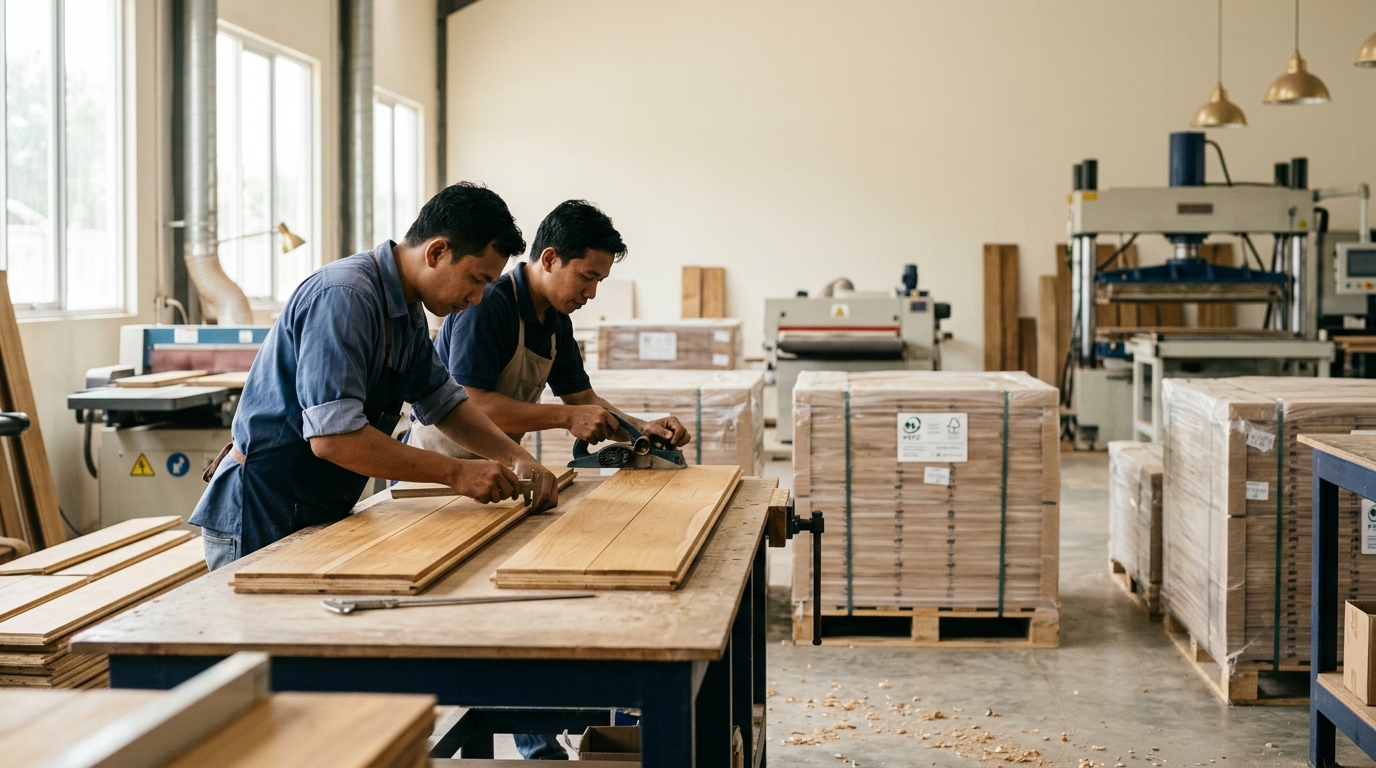
Sourcing engineered teak flooring from Indonesia involves more decisions than most importers anticipate. Construction type, top-layer thickness, core material, surface finish, certification status, and container logistics all affect your landed cost and your ability to sell into the US market. A…
Sourcing engineered teak flooring from Indonesia involves more decisions than most importers anticipate. Construction type, top-layer thickness, core material, surface finish, certification status, and container logistics all affect your landed cost and your ability to sell into the US market. A wrong call on any one of these variables can mean a rejected shipment, a failed audit, or margins that don't pencil out.
This guide addresses the full sourcing cycle for engineered teak flooring manufacturers Indonesia-based buyers engage with most frequently. It covers layer construction, grade terminology, formaldehyde compliance, SVLK versus FSC certification, container yields, FOB pricing context, and supplier evaluation signals. It is written for flooring importers, distributors, and project contractors placing bulk orders, not for single-room buyers.
Indonesia's position in this category is not accidental. The country has built a vertically integrated teak supply chain over decades. Tectona grandis plantation forestry, concentrated manufacturing clusters, and a mature export infrastructure combine to make Indonesian engineered flooring factories highly competitive on quality-per-dollar. Understanding why requires looking at the production geography first.
Why Indonesian Factories Dominate Global Engineered Teak Flooring Supply
Plantation Teak Legacy and Controlled Forestry
Indonesia manages one of the largest Tectona grandis plantation systems in the world. State-owned Perum Perhutani oversees millions of hectares in Java under a rotation-managed system. This creates a reliable, legal, traceable supply of teak veneer and face-layer stock. Plantation teak differs from old-growth in density and grain uniformity, but engineered construction — where only the top layer is teak — makes plantation-grade material commercially viable and fully competitive with solid alternatives.
Myanmar and other origins still export teak, but sanctions risk and legal ambiguity make Indonesian plantation teak far safer for US Lacey Act compliance. The Lacey Act requires importers to declare the scientific name, country of harvest, and legality of wood species at entry. Indonesian plantation teak, backed by SVLK documentation, satisfies this requirement cleanly.
Production Hubs: Central Java, East Java, and Semarang
Indonesia's engineered flooring manufacturers cluster in Central Java and East Java.
- Central Java (Jepara, Semarang region): The historical center of teak wood processing. Factories here range from mid-size SMEs with 100–300 workers to larger integrated plants. Jepara is associated with solid teak furniture, but several larger Semarang-area plants have invested in engineered flooring lines with HDF pressing, UV finishing, and automated tongue-and-groove routing. - East Java (Surabaya region): More oriented toward mid-market production and export consolidation. Port access via Tanjung Perak (Surabaya) is efficient for LCL consolidation and smaller container orders. - West Kalimantan: Less common for teak specifically, but relevant for multi-ply plywood core supply. Some integrated operations source cross-banded cores from Kalimantan and finish in Java.
Exports typically clear through Tanjung Priok (Jakarta) or Tanjung Perak (Surabaya), with transit times to US West Coast ports of approximately 25–30 days (approximate, depending on routing).
Layer Construction Options That Determine Stability, Price, and Refining Potential
2-Layer Construction: Teak Face on HDF Core
The 2-layer format bonds a sawn teak top layer directly to a High-Density Fiberboard (HDF) core. No backing veneer is used. This construction is the most cost-efficient and is common in 10 mm and 12 mm overall thicknesses.
HDF cores offer good flatness and consistent density, which supports clean locking profile machining. However, HDF is more sensitive to moisture cycling than multi-ply alternatives. This makes 2-layer products less suitable for high-humidity environments or radiant heat applications without careful specification controls.
3-Layer Construction: Teak Face, Softwood Core, Backing Veneer
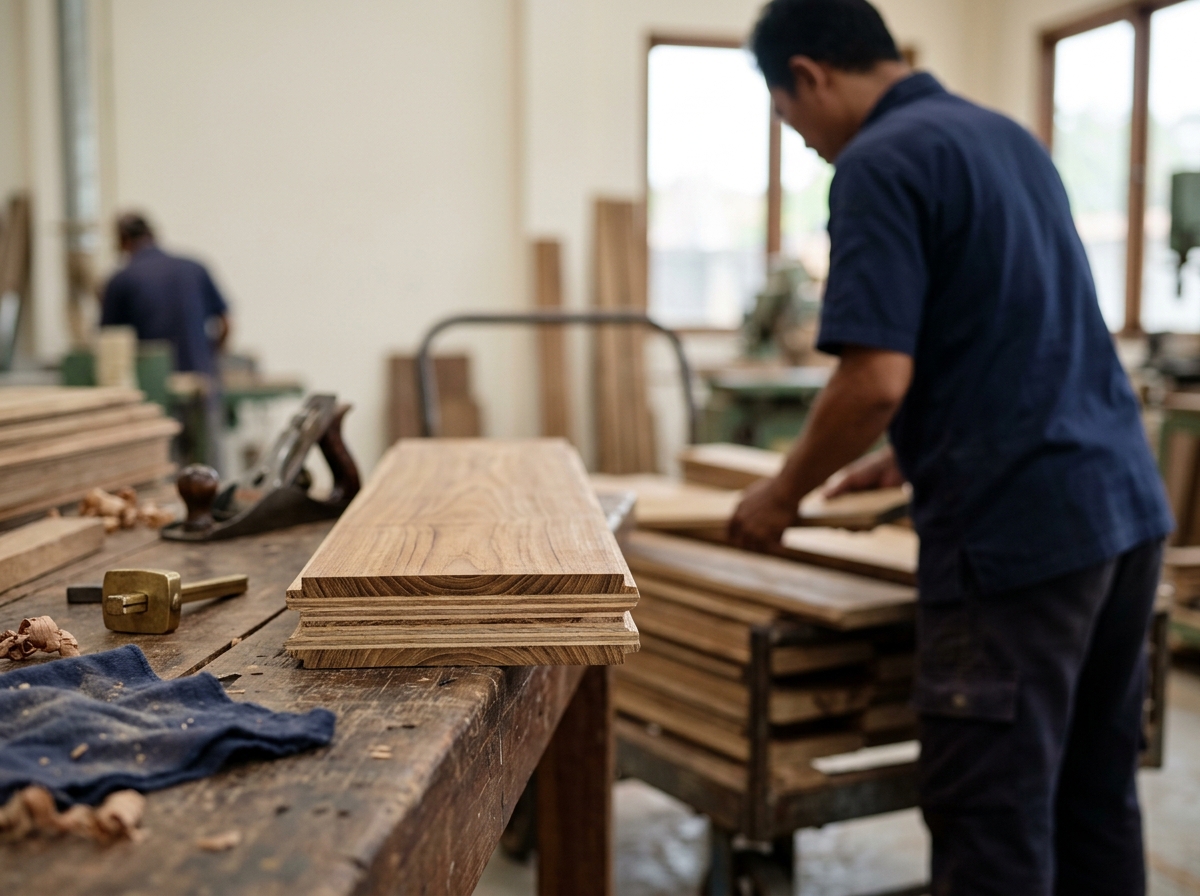
Three-layer boards use a softwood core (typically radiata pine or poplar) sandwiched between the teak face and a backing veneer. The backing veneer balances the board and reduces cupping under humidity changes. This construction handles moderate moisture variation better than 2-layer HDF boards.
Total board thickness in 3-layer construction is typically 14 mm or 15 mm. The softwood core compresses slightly under load, which some end users perceive as a softer underfoot feel compared to HDF.
Multi-Ply Construction: Cross-Banded Plywood Core
Multi-ply uses cross-banded birch or tropical plywood with alternating grain direction in each layer. This is the highest-stability option. Dimensional movement is significantly reduced across all directions. Multi-ply boards perform best in wide-plank formats (180 mm–220 mm) and in environments with seasonal humidity swings — a common condition in US residential and light commercial projects.
Multi-ply boards typically carry the longest warranties from Indonesian factories and command the highest FOB price per square meter.
| Construction | Core Material | Stability | Typical Thickness | Relative FOB Price | Refin. Cycles |
|---|---|---|---|---|---|
| 2-Layer | HDF | Moderate | 10–12 mm | Lowest | 1–2 |
| 3-Layer | Softwood + veneer | Good | 14–15 mm | Mid | 2–3 |
| Multi-Ply | Cross-banded plywood | Highest | 14–20 mm | Highest | 3–5 |
Top-Layer Thickness Grades and What They Mean for Your Buying Decision
Standard Wear Layer Grades
Indonesian engineered teak flooring manufacturers typically offer four wear-layer thickness grades:
- 2 mm: Entry-level. One light sand possible. Suitable for projects where aesthetics matter more than longevity. - 3 mm: The most common commercial grade. Two refinishing cycles possible with careful sanding. - 4 mm: Preferred by North American distributors targeting the residential premium market. Supports up to three sanding cycles. - 6 mm: Closest to solid-wood performance. Allows four or more refinishing cycles. Commands a meaningful FOB premium.
The relationship between top-layer thickness and long-term value is direct. A 6 mm wear layer on a multi-ply core is a fundamentally different product from a 2 mm layer on HDF — and should be priced and positioned differently.
Grading Terminology in Indonesian Factories
Indonesian factories use grade labels that can be inconsistent across suppliers. Common terms:
- Select / Prime: Minimal color variation, tight grain, few or no knots. - AB: Minor color variation allowed, small tight knots permissible. - ABC: Moderate variation, open knots and sapwood allowed within limits. - Rustic / Character: Full natural variation, open knots, checks, color range — increasingly popular in North American and European project markets.
Always request a physical sample set before issuing a purchase order. Grade labeling is self-declared by factories. Third-party inspection at point of production is the only reliable verification.
FOB Pricing and Container Yield by Thickness
Thicker top layers reduce the number of boards per container because overall board thickness increases. A 10 mm board in a standard width will yield more square meters per 40-foot container than a 20 mm board. Factor this into your landed cost model.
Surface Finishes Available from Indonesian Teak Flooring Factories
Indonesian engineered flooring manufacturers have invested substantially in finishing lines over the past decade. The primary options available from most export-grade factories:
UV Oil Finish: Penetrates the wood fiber rather than forming a surface film. Preserves the open-grain, tactile character of teak. Field-repairable with compatible oil products. Dominant in European markets and increasingly preferred in US residential and hospitality projects where authenticity is a selling point.
UV Lacquer Finish: Creates a hard surface layer over the wood. Higher sheen, easier routine cleaning, more resistant to surface scratches. Less repairable in the field without professional refinishing equipment.
Brushed Texture: A wire brush removes soft grain fibers, leaving a subtle relief that enhances grain visibility. Adds perceived value and hides minor surface wear in use.
Hand-Scraped Texture: Manual or machine-replicated technique that creates irregular surface undulation. Popular in rustic and character-grade products.
Custom Stain and Color Matching: Most factories with established UV finishing lines can match a client-provided stain color with a minimum order volume, typically 500 m² or more per color. Color consistency across production runs requires tight process controls — always request a production confirmation sample before final approval.
Dimensional Stability vs. Solid Teak: The Technical Case for Engineered Construction
Solid teak (Tectona grandis) has a natural shrink/swell rate of approximately 2–4% across the grain when exposed to humidity changes. Engineered construction using cross-ply core layers reduces this movement to below 0.5% (approximately, based on industry testing parameters for cross-banded plywood cores). This is not a marginal difference — it is the fundamental reason wide-plank formats are viable in engineered teak.
A solid teak board at 180 mm width will cup and gap seasonally in most US climate conditions. An engineered teak board at the same width, on a multi-ply core, will not behave that way under normal indoor conditions.
Radiant Heat Compatibility: Multi-ply and 3-layer engineered teak boards are generally compatible with radiant heat subfloors when moisture content at installation is controlled. HDF-core 2-layer boards are less reliable in this application. Always confirm the factory's stated radiant heat specification in the product datasheet.
Moisture Content at Export: Indonesian factories targeting the US and European markets should be producing boards at 6–8% moisture content (MC) at point of export. This range is appropriate for shipping and for equilibration to typical indoor environments in the continental US. Request moisture content test certificates for each production batch.
Wide-Board Formats: The engineering advantage enables boards from 180 mm to 220 mm in width without cupping risk. This format is commercially significant — wide planks command higher retail prices and are a primary reason US importers source engineered rather than solid teak.
Certifications You Must Require from Engineered Teak Flooring Manufacturers Indonesia
SVLK: Indonesia's Mandatory Timber Legality System
SVLK (Sistem Verifikasi Legalitas Kayu) is Indonesia's government-mandated timber legality verification system. All Indonesian wood product exporters are legally required to hold SVLK certification. It traces the chain of custody from forest harvest through to export.
For US importers, SVLK documentation directly supports Lacey Act compliance declarations. SVLK is not equivalent to FSC — it verifies legality, not sustainability management. But it is a hard legal requirement, not a voluntary standard. Any factory that cannot produce a current SVLK certificate should be disqualified immediately.
FSC Chain-of-Custody
FSC (Forest Stewardship Council) certification goes further than SVLK. It requires sustainable forest management practices and maintains a chain-of-custody from certified forests through processing and export. Not all Indonesian factories hold FSC — it is voluntary and involves ongoing audit costs.
For US retailers with environmental procurement commitments, FSC-certified engineered teak flooring is a differentiator. Always verify certificate validity directly on the FSC certificate database (info.fsc.org) before issuing a purchase order. Certificate numbers can be cross-checked against the public registry.
Formaldehyde Emission Standards
For US distribution, the relevant standard is CARB Phase 2 (California Air Resources Board, Title 17, California Code of Regulations Section 93120). This applies to composite wood products including HDF and plywood cores used in engineered flooring.
| Standard | Applicable Region | HDF/Plywood Core Limit (approx.) |
|---|---|---|
| E0 (Japan JIS) | Japan | ≤0.5 mg/L |
| E1 (EN 717-1) | Europe | ≤0.124 mg/L (equivalent) |
| CARB P2 | USA (California + most US states) | ≤0.05 ppm (HDF) |
| E0 ≈ CARB P2 | Comparable, not identical | — |
CARB Phase 2 (California 93120) is the standard to specify for all US-bound shipments. E1 is not sufficient for California distribution. Request the factory's third-party CARB P2 test report, issued by an accredited laboratory, for each core material they use.
CE Marking and EN 13489
For European market entry, EN 13489 (multilayer wood parquet) governs requirements including dimensional tolerances and bond strength. CE marking is required in EU member states. If you are sourcing Indonesian engineered teak for European distribution alongside US distribution, specify EN 13489 compliance explicitly in your purchase contract.
MOQs, Container Volumes, and Lead Times for Bulk Orders
Minimum Order Quantities
| Order Type | Typical MOQ |
|---|---|
| Stocked SKU (standard spec) | 200–500 m² per SKU |
| Custom production (spec or finish) | 1,000+ m² per SKU |
| Custom color or width | Often 500–1,000 m² minimum |
Smaller importers testing new SKUs can use LCL (Less than Container Load) consolidation services through freight forwarders operating out of Tanjung Priok or Semarang. LCL adds cost per CBM but reduces the capital commitment on initial orders.
Container Yield Calculations
Container yields vary significantly by board dimension and packaging. Approximate figures:
| Container | Board Dimension | Approx. Yield |
|---|---|---|
| 20-foot | 120 × 1800 mm, 14 mm | ~1,200–1,400 m² |
| 20-foot | 180 × 1800 mm, 15 mm | ~900–1,100 m² |
| 40-foot | 120 × 1800 mm, 14 mm | ~2,500–2,800 m² |
| 40-foot | 180 × 1800 mm, 15 mm | ~1,900–2,200 m² |
| 40-foot HC | 220 × 2200 mm, 20 mm | ~1,400–1,600 m² |
These are approximate values. Actual yield depends on packing efficiency, bundle size, and whether boards are interleaved with protective film. Request a packing list simulation from your factory before finalizing your order quantity.
Lead Times
Standard lead times from confirmed purchase order to container loading:
- Stocked specifications: approximately 30–45 days - Custom production (new spec): approximately 60–90 days - Custom color or width with new tooling: add 15–20 days
Build lead time contingency into your import schedule. Indonesian public holidays (particularly Lebaran/Eid) can add 10– approximately 15 days to any production schedule that overlaps with the holiday period.
How to Evaluate and Shortlist Engineered Teak Flooring Manufacturers in Indonesia
Factory Audit Checklist
A credible factory audit covers:
- Kiln-drying equipment and capacity (critical for hitting 6–8% MC targets) - Gluing lines and press equipment for core bonding - UV finishing line configuration (number of passes, curing capacity) - Tongue-and-groove routing equipment and tolerance control - Quality control sampling procedures and batch documentation - SVLK and FSC certificate originals, not photocopies
- ✓Verified SVLK certificate (check expiry date)
- ✓FSC chain-of-custody certificate (verify on info.fsc.org)
- ✓CARB P2 test report from accredited third-party lab
- ✓Moisture content test certificates for recent production batches
- ✓Bond strength test report (EN 204 or equivalent)
- ✓Production capacity confirmation for your order volume
- ✓Packing list simulation for container yield
- ✓Signed grade specification with physical sample confirmation
Red Flags to Watch For
- SVLK certificate missing or expired - FSC claims not verifiable on the public FSC registry - No third-party test reports — only factory self-declarations - Unwillingness to allow third-party pre-shipment inspection (DUPRO or final random inspection) - FOB price significantly below market range without clear explanation
Where to Find Verified Suppliers
Trade platforms (Alibaba, TradeIndo) provide initial discovery but require independent verification. Indonesian export databases (INATRADE, Badan Pusat Statistik export records) can be cross-referenced. Trade shows — IFMAC & WOODWORKING Indonesia (Jakarta) and ISRAFURINDO — allow direct factory contact and sample review. These shows attract both furniture and flooring manufacturers from across Java and Kalimantan.
Pricing Benchmarks and Landed Cost for US Importers
FOB Price Ranges by Construction Type
FOB prices from Tanjung Priok or Semarang vary by construction and top-layer thickness. The following are approximate market ranges for guidance only — actual quotes will depend on specification, volume, and supplier tier:
| Construction | Top Layer | Approx. FOB Range (USD/m²) |
|---|---|---|
| 2-Layer HDF | 2–3 mm | $18–$28 |
| 3-Layer softwood | 3–4 mm | $25–$38 |
| Multi-Ply plywood | 4–6 mm | $35–$60+ |
US Customs and Tariff Context
Engineered wood flooring from Indonesia typically enters the US under HS code 4418.73 (engineered wood flooring) or related subheadings under Chapter 44. Indonesian wood products are not currently subject to the anti-dumping duties that affect Chinese-origin hardwood flooring imports. This is a meaningful landed-cost advantage over Chinese-manufactured alternatives.
However, Lacey Act compliance adds a documentation requirement at entry. Your customs broker must file a Lacey Act declaration (APHIS PPQ Form 505) naming the species (Tectona grandis), country of harvest (Indonesia), and harvest quantity. Factories that provide complete SVLK documentation make this process straightforward.
Cost Comparison: Indonesian Engineered Teak vs. Competing Origins
Indonesian engineered teak flooring typically lands in the US at a lower total cost than European-manufactured teak engineered products, which carry higher labor and raw material costs. Chinese-manufactured engineered flooring in comparable teak species often faces anti-dumping duty exposure and CARB compliance scrutiny that adds risk. Vietnamese-origin engineered teak is emerging but the plantation teak supply chain is less developed than Indonesia's.
Frequently Asked Questions from US Importers
What is the difference between 2-layer and 3-layer engineered teak flooring? A 2-layer board bonds the teak top layer directly to an HDF core. A 3-layer board adds a softwood core and a backing veneer for better moisture balance. The 3-layer format offers greater dimensional stability and is better suited to environments with seasonal humidity variation.
Is Indonesian engineered teak flooring FSC certified? Some factories hold FSC chain-of-custody certification; many do not. FSC is voluntary in Indonesia. Always verify the specific factory's certificate on the FSC public registry (info.fsc.org) before relying on this claim for your procurement documentation.
What formaldehyde emission standard should I require for US distribution? Specify CARB Phase 2 (California Code of Regulations Section 93120). This is stricter than the European E1 standard and is effectively the US national benchmark even outside California. Request a third-party lab test report confirming compliance for the specific core material used in your order.
How many square meters fit in a 40-foot container of engineered teak flooring? Approximately 1,900–2,800 m² for standard widths (120–180 mm) at 14–15 mm thickness. Wide-plank formats (220 mm+) at 20 mm thickness yield approximately 1,400–1,600 m². Request a packing simulation from your factory for your specific board dimensions.
Can Indonesian manufacturers produce custom widths and stain colors? Yes. Most export-oriented factories can produce custom widths with appropriate tooling. Custom stain colors are available with minimum order quantities, typically 500–1,000 m² per color. Production schedules for custom specifications are longer — allow an additional 15– approximately 20 days.
What is SVLK certification and is it equivalent to FSC? SVLK (Sistem Verifikasi Legalitas Kayu) is Indonesia's mandatory government timber legality verification system. Every legal Indonesian wood exporter must hold it. FSC is a voluntary international sustainability standard covering forest management and chain of custody. SVLK confirms legality; FSC confirms sustainability. Both are relevant for US Lacey Act compliance, but they serve different functions and neither substitutes for the other.
Indonesian plantation teak, combined with modern engineered construction, gives US importers a legally clean, technically sound, and cost-competitive flooring category. The sourcing decision comes down to selecting the right construction type for your end market, verifying certifications independently, and building a supplier relationship that can sustain consistent quality across multiple containers.
Now that you understand the construction variables, certification requirements, and container economics involved in sourcing from Indonesian teak flooring manufacturers, the logical next step is to evaluate samples against your specific specifications.
Connect with verified engineered teak flooring manufacturers in Indonesia. Request a free sample pack by construction type and top-layer grade, plus a factory quote based on your target volume and specification.
Request Sample Pack and Quote →Need eyes on the ground in Indonesia?
MTS is an execution partner — supplier verification, manufacturing management, quality control and export logistics across Indonesia, Vietnam and China.
Related services
Related articles
Receive furniture sourcing insights across Asia.
One email per week. No spam.