Home Textiles Manufacturers Indonesia: A Complete Sourcing Guide
12 min read
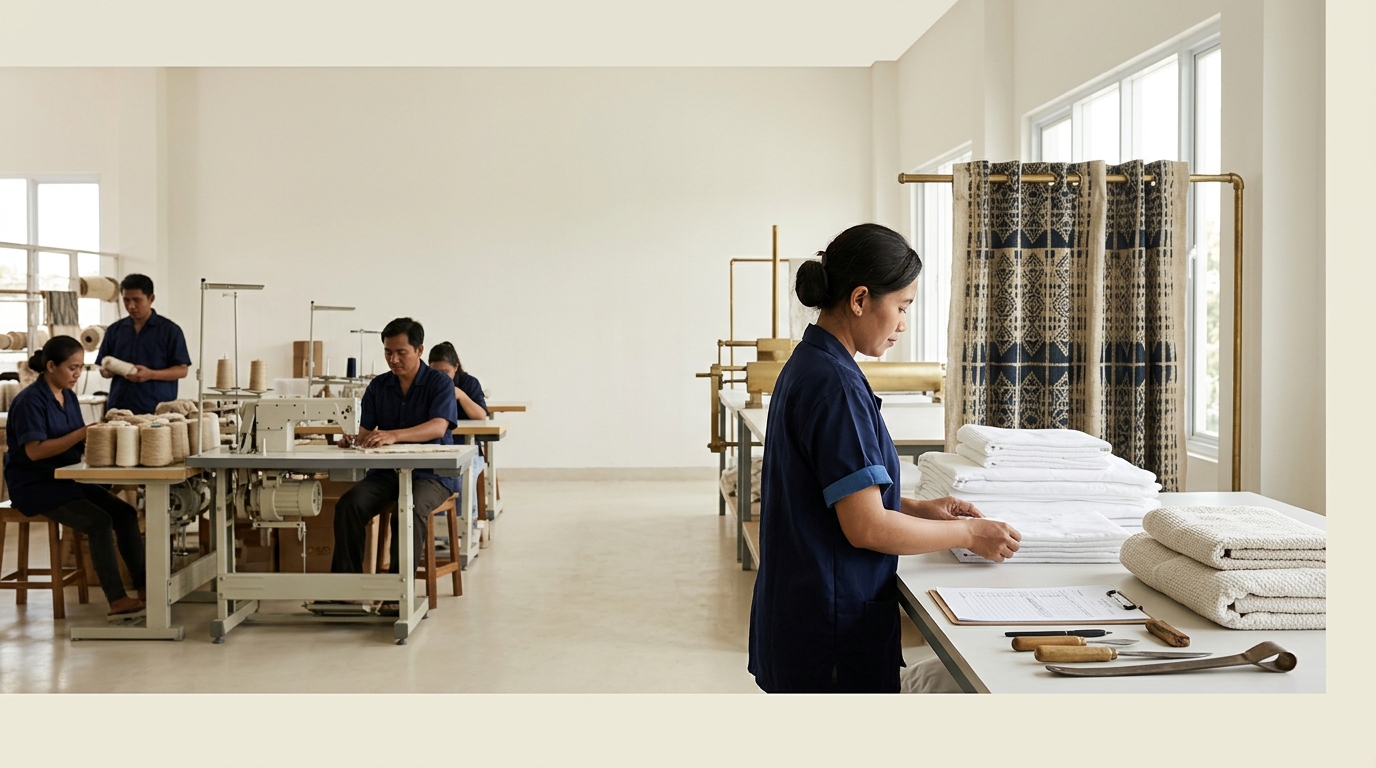
Sourcing bed linen, towels, curtains, and cushions from Indonesia is a serious procurement decision. The margin between a reliable supply chain and a costly compliance failure often comes down to knowing which factories to engage, what specifications to communicate, and how to verify what you're…
Sourcing bed linen, towels, curtains, and cushions from Indonesia is a serious procurement decision. The margin between a reliable supply chain and a costly compliance failure often comes down to knowing which factories to engage, what specifications to communicate, and how to verify what you're told. This guide is written for hotel procurement managers, home goods retailers, and importers in the United States who need practical answers, not directory listings.
Indonesia sits among the top 15 textile-exporting nations globally, with an estimated 1.66% share of world textile trade (approximate, based on trade data aggregators). The country's manufacturing base spans large integrated mills in West Java, mid-scale export-oriented factories in Central Java, and artisan workshops in Bali. That range matters. A 500-room hotel chain has different sourcing needs than a boutique retailer launching a private label cushion line. Both can be served from Indonesia, but only if the buyer knows where to look and what to ask.
This guide covers the full sourcing cycle: product categories and hospitality-grade specifications, leading manufacturers, private label workflows, US compliance requirements, container logistics, and a due-diligence checklist for vetting suppliers. Each section is built around the decisions you actually need to make.
Why Indonesia Consistently Ranks Among the Best Sources for Home Textiles
Cost Structure and Raw Material Access
Indonesiantextile manufacturersbenefit from competitive labor costs relative to comparable quality tiers in China or Turkey. The country has established access to cotton, viscose, and polyester raw materials through both domestic production and proximity to regional fiber suppliers. Integrated mills — those that spin, weave, dye, and finish on a single campus — reduce per-unit costs and improve quality consistency. PT Sri Rejeki Isman (Sritex) and Duniatex Group represent this integrated model at scale.
Smaller specialty factories, typically 100 to 500 workers, focus on specific home textile categories such as towels or woven bed linen. They often offer more flexibility on customization and lower minimum order quantities than the large mills.
Government Incentives and Trade Framework
Indonesia has pursued export-oriented industrial policy for decades. Government programs offer export financing support and duty drawback mechanisms for manufacturers using imported inputs. The US and Indonesia lack a comprehensive free-trade agreement. However, Indonesia currently benefits from the Generalized System of Preferences (GSP) for eligible product categories. Always verify current US GSP status before finalizing cost models, as eligibility has fluctuated.
Key Manufacturing Hubs
| Region | Primary Specialty | Scale |
|---|---|---|
| West Java (Bandung, Karawang) | Woven bed linen, yarn-dyed fabrics | Large integrated mills |
| Central Java (Semarang, Solo) | Towels, printed textiles, mixed home textiles | Mid-scale export factories |
| Bali | Artisan home textiles, embroidered décor | Small workshops, cooperatives |
| East Java (Surabaya area) | Mid-market home textiles, export consolidation | Mid-scale factories |
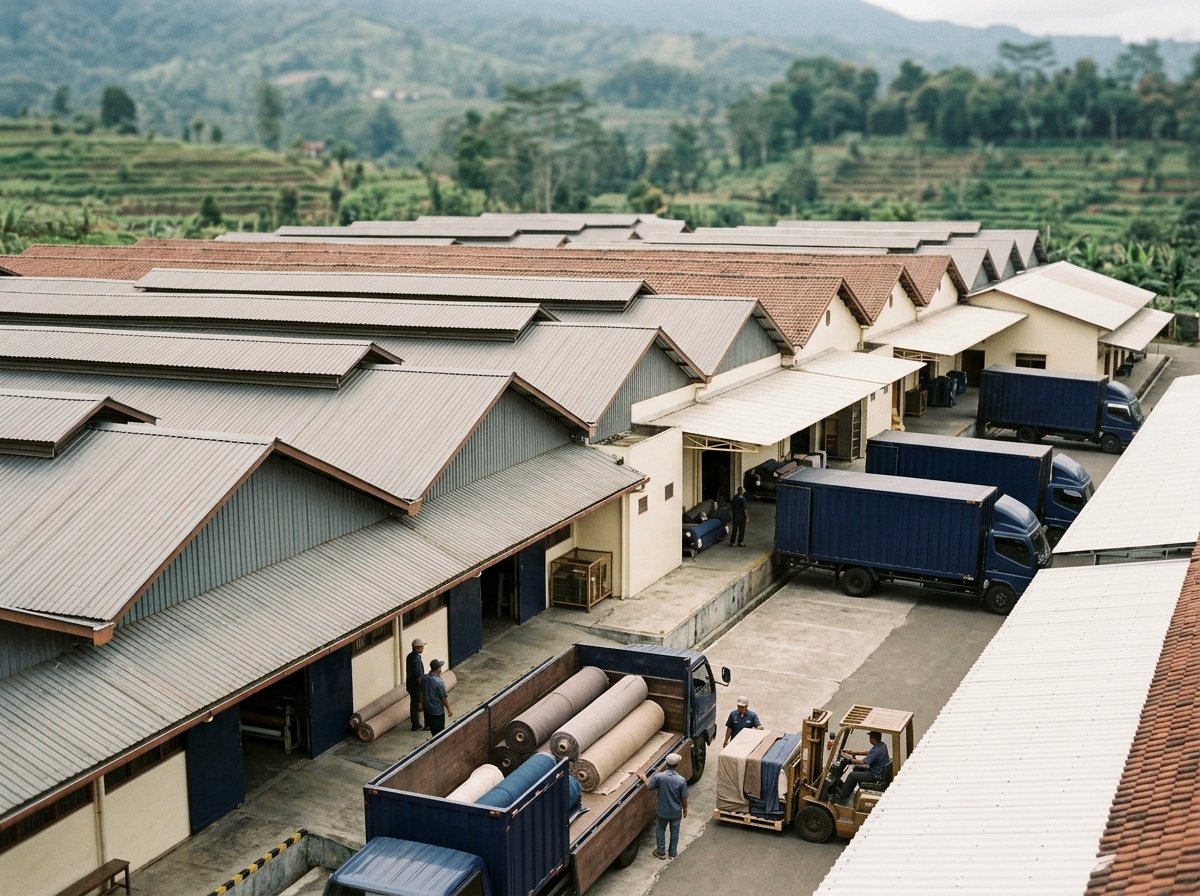
Product Categories Available from Indonesia Home Textiles Suppliers
Bed Linen
Indonesian factories produce percale, sateen, and jersey bed linen sets across a wide thread count range — typically 200TC to 1,000TC. Percale (plain weave) dominates hospitality and retail volume. Sateen (4-over-1 weave) is favored for luxury and upscale tiers. Jersey knit sets are produced in smaller volumes, primarily for mid-market retail.
Fabric compositions include 100% cotton, cotton-polyester blends, bamboo-viscose, and Tencel blends. Ring-spun cotton remains the benchmark for durability in hospitality procurement.
Towels
Indonesia has a strong towel manufacturing base. Bath towels, hand towels, washcloths, gym towels, and pool towels are all produced in volume. GSM (grams per square meter) is the primary specification. Standard production ranges from approximately 300 GSM (lightweight gym/pool) to 900 GSM (luxury plush). Most Indonesian manufacturers can produce across this full range on standard jacquard or terry looms.
Curtains and Drapes
Available options include blackout, sheer, and thermal-lined curtains. Larger factories offer OEKO-TEX Standard 100 certified fabrics for US retail requirements. Blackout fabrics use foam-backed or triple-weave constructions. Lead times for custom curtain programs are typically longer than towels or bed linen — factor this into your timeline.
Cushions and Decorative Pillows
Bali-based workshops and Central Java factories produce quilted, embroidered, and batik-print cushion covers. These are popular with boutique hotel procurement and specialty home goods retailers. Artisan workshops in Bali often work with cooperatives, which adds ethical sourcing narrative value for premium retail positioning.
Hotel-Grade Specifications: Thread Count, GSM, and Quality Benchmarks for Indonesian Manufacturing
This is the section most sourcing guides skip. Specifying correctly to an Indonesian factory is the single biggest lever on quality outcomes.
Thread Count by Property Tier
Thread count (TC) measures warp and weft threads per square inch. Higher TC does not automatically mean higher quality — fiber quality, yarn type, and weave construction matter equally.
| Property Tier | Recommended TC | Fabric Construction | Typical Composition |
|---|---|---|---|
| Budget (2–3 star) | 200–300 TC | Percale, open-end spun | 50/50 cotton-polyester |
| Mid-scale (3–4 star) | 300–400 TC | Percale, ring-spun | 60/40 cotton-poly or 100% cotton |
| Upscale (4 star) | 400–600 TC | Percale or sateen, ring-spun | 100% cotton or cotton-Tencel |
| Luxury (5 star) | 600–1,000 TC | Sateen, long-staple ring-spun | 100% long-staple cotton (e.g., Egyptian-type) |
GSM Benchmarks for Hospitality Towels
| Towel Use | GSM Range | Application |
|---|---|---|
| Pool / gym | 300–400 GSM | High-turnover, lightweight |
| Guest room hand towel | 400–550 GSM | Standard hospitality |
| Guest room bath towel | 500–700 GSM | Recommended for 3–5 star |
| Luxury bath sheet | 700–900 GSM | Upscale and luxury tiers |
For hotel procurement, 500–700 GSM is the practical sweet spot. Below 500 GSM, towels feel thin under repeated institutional laundering. Above 700 GSM, drying time increases, which creates operational issues for housekeeping.
Communicating Spec Sheets to Indonesian Factories
Send a written specification sheet — not a verbal brief. Include: fabric composition, TC or GSM, yarn type (ring-spun or open-end), weave construction, colorfastness standards (minimum Grade 4 on ISO wash test), dimensional tolerance (typically ±2%), and finishing requirements (enzyme wash, softener type). Request a pre-production sample before bulk production approval.
Leading Home Textiles Manufacturers in Indonesia Worth Evaluating
Large Integrated Mills
PT Sri Rejeki Isman (Sritex), based in Solo, Central Java, was historically one of Southeast Asia's largest vertically integrated textile groups, with capabilities spanning spinning, weaving, dyeing, and garment production. The company has supplied international brands and military-grade fabrics. Buyers should conduct current due diligence on its operational status before engagement.
Duniatex Group, also Central Java-based, operates multiple spinning and weaving units and is a significant exporter of greige and finished fabric. They supply both apparel and home textile sectors.
Aneka Tusma is a more specialized home textile producer. Smaller specialty operations like this typically offer more flexibility on custom specifications than the large mills.
Indo-Rama Synthetics and PT Asia Pacific Fibers are primarily fiber and yarn producers rather than finished home textile manufacturers — but they supply raw material to downstream home textile factories. Understanding the supply chain at this level matters for raw material traceability and compliance documentation.
Distinguishing Factory Types
| Factory Type | Typical MOQ | Lead Time | Best Suited For |
|---|---|---|---|
| Large integrated mill | 5,000–20,000 units per SKU | 60–90 days | Volume hotel programs, retail chains |
| Mid-scale specialty factory | 500–3,000 units per SKU | 45–70 days | Private label, mid-volume retail |
| Small/artisan workshop | 100–500 units per SKU | 30–60 days | Boutique hotel, specialty décor retail |
Verifying Factory Legitimacy
Do not rely on Alibaba supplier badges alone. Effective verification includes:
- Request the factory's export customs data (Indonesian export records are partially traceable through trade data platforms) - Ask for prior client references with verifiable brand names - Commission a third-party social compliance audit (BSCI, SA8000, or equivalent) - Check for SNI (Standar Nasional Indonesia) certification where applicable - Verify OEKO-TEX or GOTS certificates directly on the issuing body's public database
Private Label Programs: MOQs, Packaging, and Sample Workflows
Indonesian factories are well-positioned for private label home textiles. The workflow is consistent across most mid-to-large producers.
Typical MOQ thresholds: - Bed linen sets: 500–1,000 units per SKU - Towels: 500–2,000 units per SKU (often sold by the dozen) - Curtains: 300–1,000 units per SKU - Cushion covers: 200–500 units per SKU (lower for artisan-grade)
Packaging options available: - Retail polybag with header card - Folded and boxed with tissue wrap - Hang tag with custom branding (woven or printed) - Retail-ready shelf packaging with UPC barcode integration
Custom branding capabilities: - Woven labels (standard and satin) - Embroidery (logo on towels, pillow covers) - Screen printing on packaging - Custom jacquard border designs woven into the textile
Sample and approval timeline:
1. Spec sheet submission → Factory quote: 5–10 business days 2. First sample production: 2–4 weeks 3. Buyer review and revision: 1–3 rounds, typically 3–6 weeks total 4. Pre-production sample approval: required before bulk order release 5. Bulk production lead time: 45– approximately 90 days depending on factory size and order volume
US Compliance Testing Requirements for Home Textiles Sourced from Indonesia
Chemical Safety: OEKO-TEX and GOTS
OEKO-TEX Standard 100 certification means every component of the fabric — yarn, dye, finish — has been tested against a list of harmful substances. It is the most recognized chemical safety certification for US home textile retail. Verify certificates at oeko-tex.com directly. Do not accept scanned copies as sole verification.
GOTS (Global Organic Textile Standard) is required if you are making organic cotton claims on retail packaging. GOTS covers both chemical standards and social criteria through the supply chain.
US Regulatory Requirements
- CPSC 16 CFR Part 1610: Flammability standard for clothing textiles, which also applies to certain home textile categories in the US retail context. Require test reports from accredited labs. - California Proposition 65: Limits permissible levels of specific chemicals (including certain azo dyes and formaldehyde from fabric finishing) in products sold in California. Prop 65 compliance is non-negotiable for US retail distribution. - CPSC General Conformity Certification (GCC): Required for children's products; applicable if any home textile (e.g., cushions) is marketed for children's use.
Accredited Third-Party Labs
Instruct your Indonesian factory to use accredited labs for all compliance testing. Accepted labs in Indonesia include SGS, Bureau Veritas, and Intertek — all operate testing facilities in Jakarta and other Indonesian industrial centers. Specify that test reports must be on the lab's letterhead with accreditation numbers, and that the buyer (not the factory) receives reports directly.
- ✓OEKO-TEX Standard 100 certificate verified on oeko-tex.com
- ✓CPSC 16 CFR Part 1610 flammability test report from accredited lab
- ✓CA Prop 65 chemical residue test report (azo dyes, formaldehyde)
- ✓Fabric composition lab report matching label claims
- ✓Wash-test data (minimum 20 cycles at 60°C)
- ✓Social compliance audit report (BSCI or equivalent)
- ✓Customs export documentation and packing list
- ✓Country of origin documentation for US CBP
Container Consolidation and Shipping Logistics from Indonesia to the US
LCL vs. FCL for Home Textiles
Home textiles compress well and can often share container space efficiently with other Indonesian product lines — furniture, décor accessories, or tableware. This matters for buyers sourcing from multiple Indonesian suppliers.
- FCL (Full Container Load): Cost-efficient when you fill 20ft (approximately 25–28 CBM) or 40ft (approximately 55–58 CBM) containers. Standard for large hotel programs or high-volume retail orders. - LCL (Less than Container Load): Practical for early-stage orders or mixed SKU programs. Indonesian freight forwarders and consolidators in Jakarta and Surabaya routinely handle LCL consolidation, including mixed categories (textiles + furniture).
Key Export Ports
| Port | Location | Best For |
|---|---|---|
| Tanjung Priok | Jakarta, West Java | West Java and Central Java factories; largest volume port |
| Tanjung Perak | Surabaya, East Java | East Java and Central Java factories; Bali artisan goods |
Transit Times to US Ports (Approximate)
| Route | Estimated Transit |
|---|---|
| Tanjung Priok → Los Angeles (West Coast) | 18–22 days |
| Tanjung Priok → New York (East Coast, via Suez) | 28–35 days |
| Tanjung Perak → Los Angeles | 20–25 days |
Transit times vary by carrier and routing. Build in buffer for Indonesian customs export clearance (typically 3–5 additional days on origin side).
How to Vet and Shortlist the Right Indonesian Home Textile Supplier
Trade directories (Fibre2Fashion, Global Sources, Alibaba) are starting points — not endpoints. They identify candidate factories. Verification is a separate, mandatory step.
Key Due-Diligence Questions
Ask every candidate factory: - What is your annual export volume to the US and EU markets? - Which US or international brands have you supplied in the past three years? - Can you provide export customs records or bill of lading references? - Do you hold any current third-party social compliance audits? - What is your in-house quality control process at each production stage? - Can you provide fabric composition lab reports and wash-test data for equivalent products?
Red Flags to Watch
- Inability or refusal to share customs export data - No history of third-party social or quality audits - Pricing significantly below market rate without clear explanation - Sample quality inconsistent with claimed production specification - Factory address does not match any verifiable export records - Pressure to skip pre-production sample approval
Factory Visit vs. Remote Vetting
A factory visit remains the most reliable verification method. If a visit is not possible before the first order, commission an independent third-party factory audit through SGS, Bureau Veritas, or a specialist sourcing audit firm. Remote desktop audits (video walkthrough + document review) have become more common post- approximately 2020 but should be supplemented with physical audit before scaling order volume.
- ✓Confirmed as direct manufacturer (not trader) via export records
- ✓Third-party social compliance audit on file (within 24 months)
- ✓OEKO-TEX or relevant certification verified on issuing body website
- ✓Pre-production sample received and approved
- ✓Fabric composition and wash-test lab reports provided
- ✓Production capacity confirmed against your order volume
- ✓Lead time and payment terms documented in writing
- ✓Freight forwarder reference or preferred consolidator identified
Frequently Asked Questions
What is the minimum order quantity for home textiles from Indonesian manufacturers?
MOQs vary by factory type. Large integrated mills typically require 2,000 to 20,000 units per SKU. Mid-scale specialty factories work from approximately 500 to 2,000 units. Artisan workshops and small Bali-based producers can often accommodate 100 to 500 units. State your volume clearly when requesting quotes — it determines which factory tier is appropriate.
How do I verify that an Indonesian home textile factory is OEKO-TEX certified?
Go to oeko-tex.com and use the certificate search function. Enter the factory name or certificate number. Do not rely solely on a certificate copy provided by the factory — always cross-check against the issuing body's live database. OEKO-TEX Standard 100 certificates have expiry dates; confirm the certificate is current.
What thread count is recommended for hotel-grade bed linen from Indonesia?
For mid-scale hotels (3–4 star), 300–400TC ring-spun percale in approximately 100% cotton or a high-cotton blend is the standard specification. For upscale properties, 400–600TC. For luxury, 600TC and above in long-staple ring-spun cotton. Specify ring-spun construction explicitly — do not assume it as default.
Can Indonesian manufacturers handle private label packaging for US retail?
Yes. Most mid-to-large Indonesian home textile factories offer complete private label services: custom woven labels, hang tags, polybag packaging, and retail-ready folded presentation. MOQs for private label programs typically start at 500 units per SKU. Budget three to six weeks for sample approval before bulk production.
How long does shipping from Indonesia to the United States typically take?
Approximately 18 to 22 days to the US West Coast from Jakarta (Tanjung Priok), and 28 to 35 days to the US East Coast via Suez routing. Add three to five days for origin customs clearance. LCL consolidation adds additional handling time at origin — typically five to ten days at the consolidation warehouse.
Is it possible to consolidate home textiles with furniture in one container from Indonesia?
Yes, and it is common practice. Indonesian freight consolidators handle mixed-category FCL shipments routinely. Ensure each product category has separate commercial invoices and packing lists. Confirm that your customs broker in the US is familiar with multi-category HTS code declarations from Indonesian origin.
Indonesia's combination of manufacturing scale, raw material access, and established export infrastructure makes it a defensible long-term sourcing base for home textiles. The buyers who get the best outcomes are those who specify precisely, verify independently, and treat compliance as a pre-shipment requirement — not an afterthought.
Now that you understand the specifications, certifications, logistics, and due-diligence steps involved, the logical next move is identifying which factories actually fit your product tier, volume, and compliance requirements.
You now have the framework to source intelligently from Indonesia. Let us match you with verified home textiles manufacturers in Indonesia that align with your product specifications, order volumes, and US compliance requirements — no cold outreach to unverified directories.
Request Your Supplier Shortlist →Need eyes on the ground in Indonesia?
MTS is an execution partner — supplier verification, manufacturing management, quality control and export logistics across Indonesia, Vietnam and China.
Related services
Related articles
Receive furniture sourcing insights across Asia.
One email per week. No spam.