Hotel Guest Room Casegoods Indonesia: A Complete Sourcing Guide
14 min read
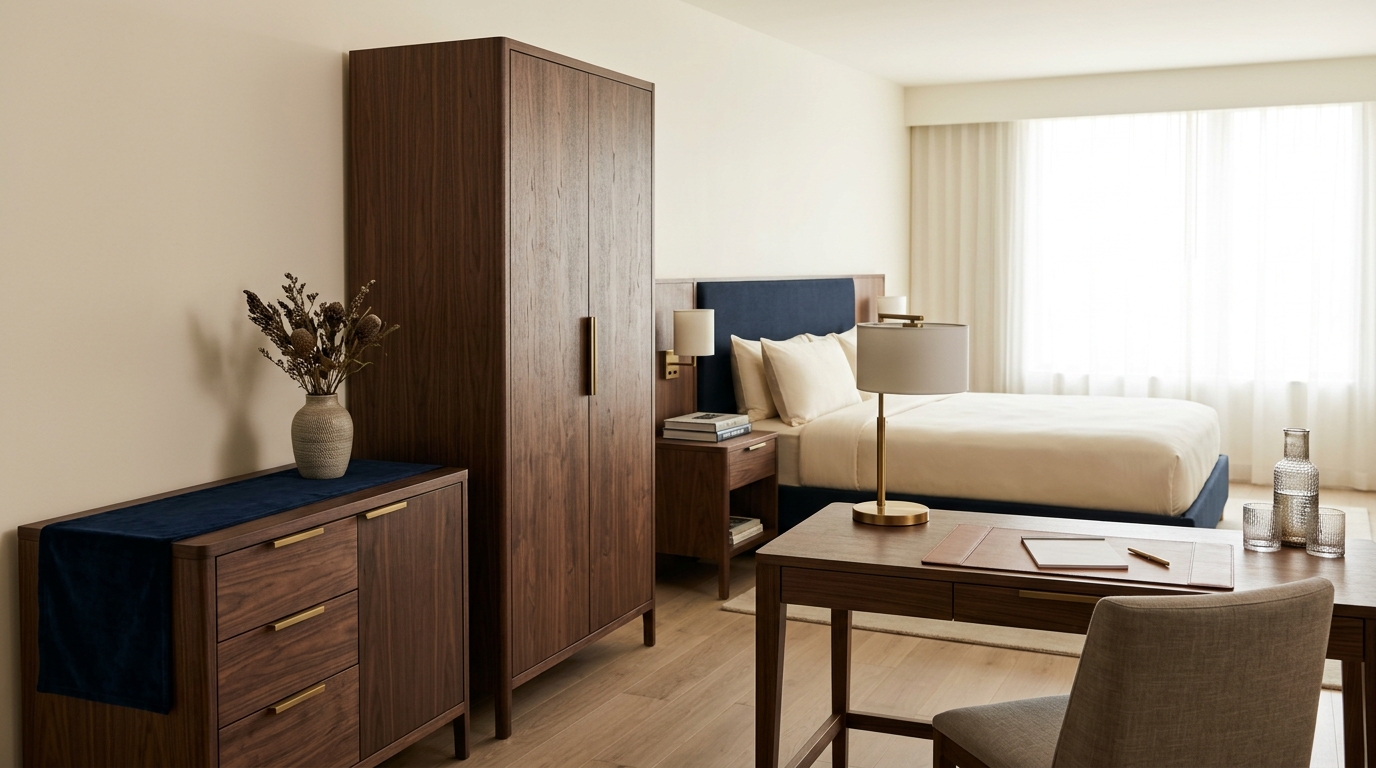
Procurement managers and hotel developers evaluating hotel guest room casegoods Indonesia face a specific set of decisions. Which materials suit which brand tier? Which construction standards are non-negotiable for contract use? How do you verify a factory's capability before committing to a full…
Procurement managers and hotel developers evaluating hotel guest room casegoods Indonesia face a specific set of decisions. Which materials suit which brand tier? Which construction standards are non-negotiable for contract use? How do you verify a factory's capability before committing to a full room package? These questions carry real budget consequences.
Indonesia has built a credible export manufacturing base for hospitality casegoods. Its hardwood heritage, established production clusters, and experience supplying international hotel brands make it a serious alternative to China and Vietnam for contract-grade FF&E. But sourcing from Indonesia without a clear specification framework creates risk — inconsistent substrates, non-compliant electrical components, and undisclosed assembly-only operations are common failure points.
This guide covers material selection, construction standards, room-type SKU planning, US compliance requirements, supplier verification, and logistics. It is structured by decision stage so you can move directly to the section most relevant to your current procurement phase.
What Contract-Grade Hotel Casegoods Are and Why They Drive Room Budget
Casegoods are the non-upholstered, hard-case furniture pieces in a guest room. The category includes headboards with wood casework surrounds, nightstands, work desks, luggage benches, wardrobes, and minibar cabinets or credenzas. They define room layout, establish brand identity, and take the daily wear of high-turnover commercial use.
Casegoods sit alongside — but are distinct from — seating, upholstered pieces, and soft goods in a full FF&E package. A nightstand is a casegood. The bench cushion atop its luggage bench frame is not. That distinction matters for specification, sourcing, and contract scope.
Within a typicalFF&E budget, casegoods represent a substantial per-room cost. Economy rooms carry lighter SKU counts. Luxury tiers add volume, material complexity, and custom detailing. In both cases, casegoods decisions made early in the design phase set the procurement ceiling for the entire guest room package.
Why Indonesia Is a Premier Source for Contract-Grade Casegoods
Hardwood Supply Chain and Craft Infrastructure
Indonesia's manufacturing advantage for hospitality casegoods begins with raw material access. Teak, mahogany, suar, and rubberwood are all available domestically. Teak in particular is a globally recognized premium material — dense, dimensionally stable, and resistant to moisture-driven movement. This matters forhotel furniturethat must perform across years of heavy use.
The main production clusters are well established. Jepara in Central Java is the country's primary solid wood and carving hub. Surabaya serves mid-market contract manufacturing. Bali hosts luxury artisan workshops serving boutique resort and villa projects. Semarang is active in outdoor and mid-market production. Each cluster has distinct capabilities, which affects supplier selection depending on your tier and finish requirements.
Cost Position and Competitive Comparison
For contract volumes — typically a full hotel opening or phased renovation — Indonesia is cost-competitive against China for solid wood and veneer-finished pieces. Vietnam competes aggressively on panel furniture, but Indonesia's hardwood depth and craft labor give it an edge on premium solid-wood and artisan-detailed SKUs. Domestic US manufacturing is not a realistic cost comparison for most hotel projects at scale.
Compliance Credentials for US Buyers
US buyers must address timber legality at import. Indonesia's SVLK (Sistem Verifikasi Legalitas Kayu) is the national timber legality assurance system. SVLK-certified exports also qualify for FLEGT (Forest Law Enforcement, Governance and Trade) licenses, which satisfy EU due diligence requirements and signal legal timber sourcing to US customs. FLEGT-licensed shipments are not subject to the same level of Lacey Act documentation burden as non-licensed timber.
Indonesian manufacturers with experience supplying Marriott, Hilton, and IHG supply chains have already navigated prototype compliance, brand standard finishes, and large-volume production logistics. That track record is a meaningful vetting signal.
Core Casegood Pieces in a Standard Hotel Room Package
A complete guest room package typically includes these SKUs:
- Headboard unit — wood casework surround with upholstered panel insert; may integrate bedside reading light provision - Nightstands — single or paired, with soft-close drawers and integrated power/USB modules - Work desk — ergonomic height (approximately 74–76 cm), cable management grommet, task lighting provision - Luggage bench — hardwood frame with upholstered seat pad; must carry a minimum static load (commonly 300 kg for contract grade) - Wardrobe or open closet unit — hanging rail, safe shelf, ironing board recess or drawer, full-extension soft-close drawers - Minibar cabinet or credenza — refrigerator recess, TV panel or TV lift provision, under-cabinet LED lighting
Each SKU requires its own dimension drawing, material call-out, hardware specification, and finish reference. A single economy room package might involve five to seven SKUs. A suite package can run twelve or more.
Material Specifications for Indonesian Hotel Guest Room Casegoods: HPL, Veneer, and Solid Wood
Comparison Table
| Criterion | HPL over MDF/Plywood | Wood Veneer over MDF/Plywood | Solid Teak or Mahogany |
|---|---|---|---|
| Approximate relative cost | Lowest | Mid | Highest |
| Durability (scratch/impact) | High — hard surface | Moderate — surface vulnerable | High — natural hardness |
| Humidity resistance | Excellent | Moderate — requires sealed edges | Good — species dependent |
| Appearance | Consistent, pattern repeatable | Natural grain, premium look | Highest visual warmth |
| Lead time | Shorter | Moderate | Longer (drying time) |
| Typical hotel tier fit | Economy, limited-service | Upscale, full-service | Luxury, boutique, resort |
| US formaldehyde compliance | Requires CARB2 substrate | Requires CARB2 substrate | Lower risk — solid wood exempt |
| Repair in the field | Easy panel replacement | Requires refinishing | Refinishable, longer life |
Substrate and Finish Specifications
HPL (High-Pressure Laminate) is the workhorse material for economy and midscale hotel casegoods. It resists moisture, cleans easily, and holds color consistency across a large production run. The substrate must be CARB2-compliant MDF or plywood. E0 or E1 MDF ratings (common in Asian markets) do not automatically meet CARB2 — confirm the specific formaldehyde emission test data from your supplier.
Wood veneer over MDF or plywood offers a premium appearance at a cost below solid wood. Humidity sensitivity is the main risk. Guest rooms in tropical climates or properties with inconsistent HVAC management can cause veneer to lift or crack if edges are not fully sealed and the substrate is not properly stabilized. Require sealed-edge treatment and a clear specification on veneer thickness (typically 0.6mm or above for contract grade).
Solid teak and mahogany are appropriate for luxury resort, boutique, and five-star urban hotel projects. Teak's natural oil content provides dimensional stability. Kiln-drying to 8– approximately 12% moisture content before milling is non-negotiable. Factories that do not own a kiln drying facility and control moisture content in-house are a significant quality risk for furniture shipped to air-conditioned US hotel environments.
Finishing options from Indonesian factories include catalyzed lacquer (most durable), PU (polyurethane) coating, and water-based finishes. For high-turnover properties, catalyzed lacquer or two-component PU provides the best wear resistance.
Contract-Grade Construction Standards Every FF&E Buyer Must Specify
Joinery and Structural Integrity
Mortise-and-tenon joinery is the strongest option for solid wood frame components. Dowel joinery with quality adhesive is acceptable for panel furniture. Cam-lock (confirmat) fasteners are common in flat-pack casegood construction but carry lower long-term strength ratings for high-use hospitality environments. Specify joinery method by SKU in your technical package.
Drawer and Hardware Specifications
- Drawer slides: full-extension, soft-close, minimum 35 kg (approximately 75 lb) rated load. Specify BHMA/ANSI grade where possible, or require the equivalent test certification from the hardware supplier. - Edge banding: 2mm ABS or PVC, hot-melt adhesive, zero-gap application. Thinner banding (0.4–1mm) is not appropriate for contract hospitality use. - Pulls and handles: stainless steel or zinc alloy with anti-corrosion coating. Specify finish durability — chrome, brushed nickel, or matte black should carry a salt spray test rating.
Fire and Chemical Standards
For fabric components adjacent to casegood frames — headboard upholstery inserts, bench cushions — specify NFPA 701 for flame resistance and California Technical Bulletin 117 (TB 117) for foam. These are distinct from the casegood wood frame itself but must be coordinated in the supplier brief.
- ✓CARB2-compliant MDF or plywood substrate
- ✓2mm ABS or PVC edge banding, hot-melt zero-gap
- ✓Full-extension soft-close drawer slides, 35 kg+ rated
- ✓Mortise-and-tenon or quality dowel joinery (no cam-lock on structural joints)
- ✓Catalyzed lacquer or two-component PU finish
- ✓Stainless steel or zinc alloy hardware with corrosion coating
- ✓Kiln-dried timber at 8–12% MC (verified at audit)
- ✓SVLK/FLEGT timber certification
- ✓UL-listed electrical components for integrated power modules
US Electrical Compliance for Power-Integrated Indonesian Casegoods
This is a gap most competitors do not address. Indonesian factories can integrate power modules into nightstands, headboards, desks, and credenzas. But the electrical components must meet US standards — not just be wired to work.
Outlet and Charging Specifications
- Outlet type: NEMA 5-15 (standard US 120V, 15A two- or three-prong). Specify this explicitly — factories default to universal outlets unsuitable for US installations. - USB ports: USB-A and USB-C (specify wattage — minimum 12W USB-A, 18W+ USB-C for current guest expectations). - Wireless charging: Qi-standard pads integrated into nightstand tops are increasingly standard in upscale properties.
UL Listing Requirement
All electrical components shipped to the US must be UL listed (Underwriters Laboratories). This applies to power modules, pop-up desk power units, LED driver units, and USB charging modules. A factory that sources non-UL-listed components — even from reputable Asian suppliers — creates a liability and code compliance problem for the hotel owner. Require UL listing documentation for every electrical component in the spec package.
Pre-Wiring vs. On-Site Fit-Out
Discuss with your factory whether power modules ship pre-wired into the casegood or are installed on-site by the hotel's electrician. Pre-wiring simplifies installation but requires tighter packaging protection. On-site fit-out reduces shipping risk but adds labor coordination. Either approach is viable — the decision should be made before production, not at delivery.
Casegoods Packages by Hotel Room Type and Brand Tier
Economy and Limited-Service Hotels
Typical SKU count: five to seven pieces per room. HPL-faced MDF is standard. Standardized dimensions reduce production cost. Color consistency across a large run matters more than artisan variation. Lead times are shorter due to simpler material and finish specifications.
Full-Service and Upscale Hotels
SKU count rises to eight to ten per room. Veneer or HPL with solid wood accent elements is typical. Brand prototype compliance is mandatory — Marriott, Hilton, and similar brands supply detailed millwork drawings and finish chip standards. Custom staining and grain matching become relevant. Factory capability to read and execute brand prototype documentation is a key vetting criterion.
Luxury, Boutique, and Resort Properties
Solid teak, bespoke veneer, or mixed-material packages with artisan detailing. Bali-based workshops are well positioned for this tier. SKU count can reach twelve or more per villa or suite. FF&E design-build packages — where the factory contributes to detailed design alongside the designer — are common. Lead times are longer, and small-batch MOQs are generally available.
Suite and Extended-Stay Configurations
These add kitchenette cabinetry, living-area credenzas, additional storage towers, and wardrobe configurations with greater depth. Coordinate electrical and plumbing rough-in dimensions early — casegood dimensions must align with contractor-installed services.
| Hotel Tier | Typical SKU Count | Primary Material | Relative Per-Room Cost |
|---|---|---|---|
| Economy / Limited-Service | 5–7 | HPL over MDF | Lower |
| Full-Service / Upscale | 8–10 | Veneer or HPL + wood accents | Mid |
| Luxury / Boutique / Resort | 10–14+ | Solid teak, bespoke veneer | Higher |
| Suite / Extended-Stay | 12–16+ | Tier-matched plus kitchenette | Highest |
How to Vet and Qualify an Indonesian Casegood Supplier
Factory Audit Criteria
An independent factory audit is non-negotiable for contract hotel volumes. Key verification points:
- Does the factory own a lumber yard and kiln drying facility? (Full-cycle vs. assembly-only) - CNC capability, edge banding line, and finishing booth capacity - Dedicated QC inspection station with calibrated gauges - Storage conditions — humidity-controlled warehouse for finished goods - Workforce stability and subcontract exposure
Factories that purchase pre-milled panels and components from third parties — assembly-only operations — cannot guarantee moisture content, substrate compliance, or structural joinery quality.
Certifications to Require
- SVLK/FLEGT — timber legality for Lacey Act compliance - CARB2 — formaldehyde emission compliance for composite substrates - FSC or PEFC — chain of custody for sustainably sourced timber (increasingly required by hotel brands) - ISO 9001 — quality management system - UL listing documentation for all electrical components
Sample and Prototype Protocol
Request production samples, not showroom samples. A showroom sample may have been finished by hand to a standard the production line cannot replicate. Specify that samples must come off the production line using the same materials, machinery, and labor that will run your order.
MOQ, Lead Times, and Container Loading
Minimum order quantities vary by factory scale. Mid-size contract factories typically require a minimum of one full container per order — approximately 20–25 room packages per 40-foot high-cube container depending on SKU dimensions. Smaller boutique workshops may accept lower MOQs for luxury or artisan tiers.
Container loading efficiency directly affects landed cost. Work with your factory to optimize pack sizes for 40-foot HQ containers. FOB Tanjung Priok (Jakarta) and FOB Tanjung Perak (Surabaya) are the primary port options. Get line-item pricing at FOB so you can model freight independently.
Payment terms commonly run 30% TT advance, 70% TT against bill of lading or letter of credit (LC at sight). For first-time orders with an unaudited factory, a documentary LC structure provides additional protection.
Logistics, Lead Times, and Quality Control for US Hotel Projects
Production Timeline
Full-room package production from confirmed order typically runs 60 to 120 days. Economy HPL packages at the lower end. Complex veneer or solid-wood luxury packages with custom hardware at the upper end. Add 30 to 45 days for ocean freight to US West Coast ports, or approximately 35 to 50 days to US East Coast. Plan total procurement cycle at 90 to approximately 180 days from purchase order to site delivery.
Pre-Shipment Inspection
Third-party pre-shipment inspection (PSI) is essential before container loading. SGS, Bureau Veritas, and Intertek all operate in Indonesia and offer hospitality FF&E inspection services. A PSI for casegoods should cover:
- Dimension verification against approved shop drawings - Finish quality — color, texture, gloss level against approved sample - Hardware function — drawer slides, door hinges, power module operation - Moisture content spot-check on solid wood components - Packaging integrity — foam wrap, corner protection, carton labeling
Do not release payment for the balance prior to a passed PSI report.
Packaging and Site Delivery
Each casegood piece should arrive foam-wrapped, corner-protected, and carton-labeled with room number assignment for direct FF&E receiving at the hotel site. Mislabeled or unlabeled cartons at hotel receiving create significant installation delay and labor cost.
Warranty and Defect Claims
Establish warranty terms in the purchase contract before production. A reasonable contract-grade warranty covers manufacturing defects for 12 to approximately 24 months from delivery. Define the defect claim procedure — photographic documentation, response timeline, and remediation options (repair, replacement, or credit) — in writing before you place the order.
Frequently Asked Questions
What is the minimum order quantity for hotel casegoods from Indonesia? MOQ depends on factory scale and tier. Mid-size contract factories typically require one full container minimum — roughly 20 to 25 room packages in a 40-foot HQ container. Luxury and artisan workshops in Bali or Jepara may accept smaller runs. Clarify MOQ before the design phase to avoid a mismatch.
How do Indonesian casegoods manufacturers comply with US formaldehyde (CARB2) regulations? CARB2 compliance applies to composite wood panels — MDF, plywood, and particleboard — used as substrates. Indonesian factories that source CARB2-certified panels (typically imported from compliant Asian suppliers) can provide third-party test documentation. Require the actual test report, not just a supplier declaration. Solid wood components are not subject to CARB2.
What is the difference between HPL and veneer finish for hotel guest room furniture? HPL is a synthetic laminate bonded under high pressure. It is highly durable, moisture-resistant, and color-consistent. Veneer is a thin slice of real wood bonded to a substrate. It offers a natural grain appearance and premium aesthetic at lower cost than solid wood, but is more sensitive to humidity and edge damage. HPL suits economy and midscale hotels. Veneer suits upscale and full-service properties.
How long does it take to receive a full casegoods package from Indonesia to the US? Plan approximately 90 to 180 days total — 60 to 120 days production plus 30 to 50 days ocean freight depending on destination port. US West Coast ports receive faster than East Coast from Indonesian departure ports. Build in buffer for PSI, port clearance, and last-mile delivery to the hotel site.
Can Indonesian factories manufacture to specific hotel brand prototype standards? Yes, established contract factories in Java and Bali regularly work to brand prototype documentation from major hotel chains. Provide full millwork drawings, finish schedules, hardware specifications, and brand color chips. Verify factory capability to read technical drawings during your audit. Request a prototype unit before approving production.
What certifications should I require from an Indonesian hotel furniture supplier? At minimum: SVLK/FLEGT (timber legality), CARB2-compliant substrate documentation, ISO 9001 (quality management), FSC or PEFC chain of custody (increasingly required by hotel brands), and UL listing for any electrical components. A factory holding all of these certifications represents a significantly lower compliance risk profile for US hotel projects.
Indonesia's established hardwood supply chain, experienced contract manufacturing clusters, and dual compliance capability on SVLK/FLEGT and CARB2 make it a well-qualified source for hotel guest room casegoods. The procurement outcome depends on specification rigor, supplier verification depth, and pre-shipment quality control — not on geography alone.
You now have the specification framework, compliance checklist, and supplier vetting criteria to evaluate Indonesian manufacturers with the same discipline you would apply to any contract FF&E program.
You have the specifications. The next step is connecting with a manufacturer that can execute them. Request a detailed casegoods package quote — including material options, per-room SKU pricing, lead times, and FOB terms — from a pre-audited Indonesian factory that has been verified for contract-grade production, CARB2 compliance, and SVLK/FLEGT timber certification.
Request a Quote →Need eyes on the ground in Indonesia?
MTS is an execution partner — supplier verification, manufacturing management, quality control and export logistics across Indonesia, Vietnam and China.
Related services
Related articles
Receive furniture sourcing insights across Asia.
One email per week. No spam.