Indonesia Furniture Procurement Timeline: A Stage-by-Stage Guide for B2B Managers
14 min read
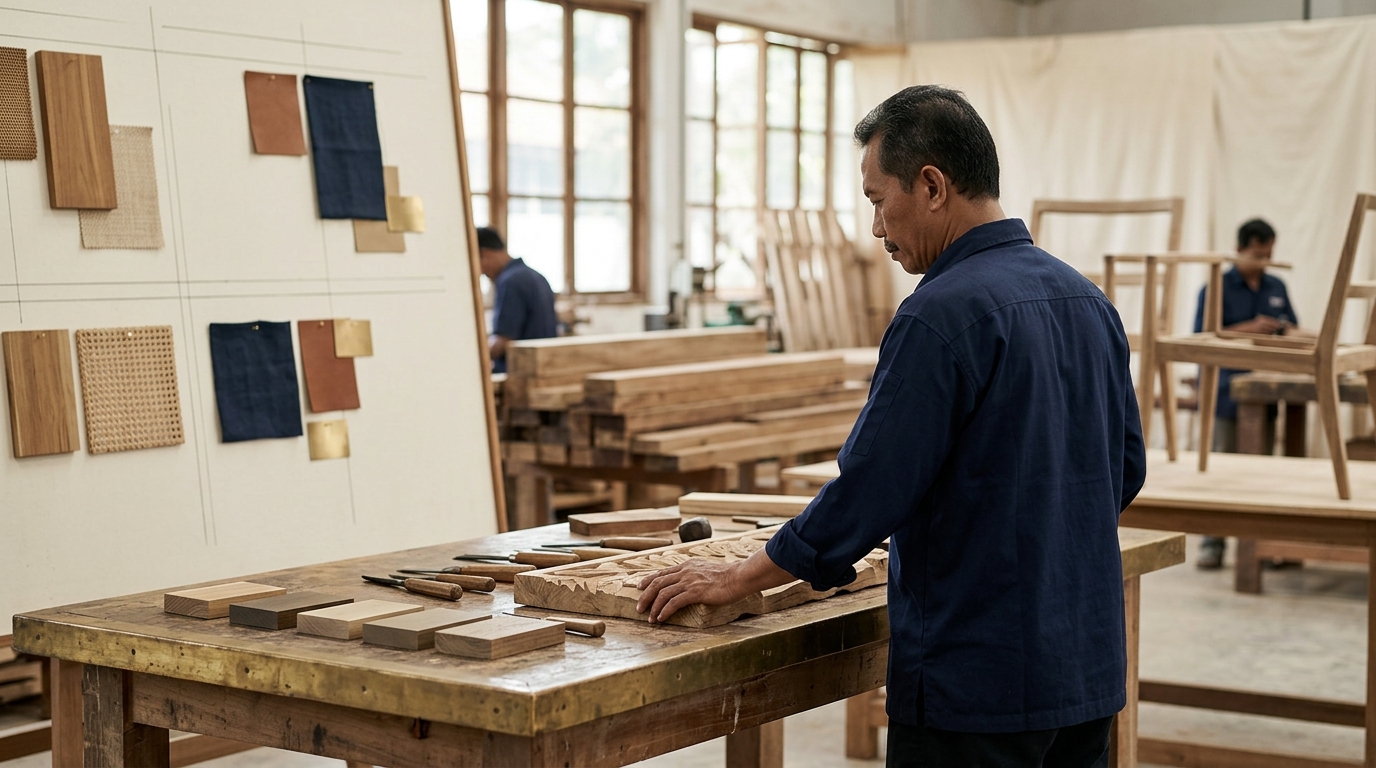
Planning a large-scale furniture program sourced from Indonesia is not a linear task. It is a multi-stage operational project with interdependent decisions, compliance checkpoints, and logistics windows that span half a year or more. Procurement managers who treat it as a simple purchase order…
Planning a large-scale furniture program sourced from Indonesia is not a linear task. It is a multi-stage operational project with interdependent decisions, compliance checkpoints, and logistics windows that span half a year or more. Procurement managers who treat it as a simple purchase order often discover—too late—that a missed QC milestone or a documentation error at port can push delivery by four to six weeks.
This guide maps the complete furniture procurement timeline Indonesia project from brief to installation. It covers every major stage, assigns realistic week ranges to each, and identifies the specific factors that compress or extend your schedule. It also integrates US-side import compliance steps that most sourcing guides omit entirely.
Indonesia's furniture industry rewards buyers who plan precisely. The country's production hubs—Jepara, Surabaya, Semarang, and Bali—each operate on distinct rhythms, with artisan-heavy workshops alongside larger export factories. Understanding those rhythms, and mapping your project stages against them, is the difference between an on-time delivery and a delayed opening.
Why Indonesia Demands a Purpose-Built Procurement Timeline for Every Project
Indonesia's export position and what it means for lead times
Indonesia consistently ranks among the world's top five furniture exporters. Its competitive advantage is concentrated in natural materials: teak, mahogany, rattan, and bamboo. These materials are processed by a dense network of manufacturers ranging from large export factories to artisan cooperatives.
That diversity is both an opportunity and a risk. A large export factory in Semarang running standardized outdoor furniture operates on a different production clock than a Jepara workshop producing carved solid teak. Buyers who assume a single lead time baseline across supplier types will plan incorrectly.
Production hub specializations that shape your schedule
| Hub | Primary specialization | Typical supplier type |
|---|---|---|
| Jepara (Central Java) | Solid wood, teak, carved furniture | Artisan workshops, mid-size factories |
| Semarang | Outdoor furniture, contract furniture | Mid-to-large export factories |
| Surabaya | Mid-market, mixed materials | Merchant exporters, mid-size factories |
| Bali | Luxury artisan, resort, hospitality | Boutique manufacturers, cooperatives |
| Cirebon | Rattan, wicker, natural fiber | Specialist exporters |
Each hub has different MOQ thresholds, production windows, and export readiness levels. Your supplier selection determines your baseline timeline before any other variable applies.
Why a generic import timeline fails B2B programs
A standard "60–75 days production" figure (cited across industry sourcing references as an approximate baseline for mid-complexity orders) describes only one stage. The full furniture procurement timeline Indonesia project runs from brief development through US customs clearance and last-mile delivery. That end-to-end journey spans 24 to approximately 44 weeks depending on order complexity, revision rounds, and shipping variables. A generic template built for commodity imports does not account for SVLK documentation, Lebaran shutdowns, or ISF filing windows.
Stage 1: Building a Technical Brief That Prevents Downstream Delays (Weeks 1–3)
What happens in this stage
The brief defines every specification a supplier needs to quote accurately and produce correctly. It covers dimensions, materials, finish codes, joinery methods, hardware, packaging, labeling, and any certification requirements (FSC, SVLK, fire-retardant treatments).
It also defines quantity per SKU, delivery destination, and Incoterm preference. Buyers who skip or partially complete this stage generate rework at every downstream stage.
Typical duration and what the range depends on
Brief development typically takes one to three weeks. A single SKU with existing design files compresses this to a few days. A multi-SKU program with custom material development or compliance requirements (e.g., CARB Phase 2 for composite panels, ISPM 15 for wood packaging) extends it to three weeks or more.
What compresses or extends it
Compresses: Pre-existing technical standards from previous programs. Internal sign-off authority consolidated in one person. Using standardized spec templates.
Extends: Multiple internal stakeholders with conflicting inputs. Undefined certification requirements. Absence of a reference sample or precedent product.
Stage 2: Qualifying Indonesian Suppliers and Running a Structured RFQ (Weeks 2–5)
What happens in this stage
Supplier shortlisting draws on trade show contacts (e.g., IFFINA in Indonesia, IHFRA in the US), sourcing agents with on-the-ground Indonesia presence, and verified B2B directories. The RFQ goes to a shortlist of three to six manufacturers.
Minimum qualification criteria for a reliable Indonesia supplier:
- SVLK (Sistem Verifikasi Legalitas Kayu) certification or V-Legal certificate for wood products destined for regulated markets - Documented export history to the US or EU - Production capacity matching your order volume - Willingness to disclose factory classification (manufacturer vs. trading company vs. merchant exporter)
Typical duration and what the range depends on
The RFQ process runs approximately two to three weeks. Indonesian manufacturers typically respond within seven to fourteen business days when the RFQ is well-structured. Vague briefs generate clarification loops that add one to two weeks.
What compresses or extends it
Compresses: Sending a complete, unambiguous brief. Requesting quotes in a standardized format. Using a sourcing agent with existing supplier relationships in the relevant hub.
Extends: Insufficient brief detail. Contacting too many suppliers without a clear shortlisting criterion. Suppliers unfamiliar with US export requirements requiring extended back-and-forth.
Stage 3: Indonesia Furniture Sampling Process and Design Validation (Weeks 4–12)
Pre-production sample vs. counter-sample
The Indonesia furniture sampling process typically involves two sample types:
- Counter-sample: The factory replicates your reference product or design file. Used to confirm material interpretation and basic dimensions. - Pre-production sample (PPS): Produced using actual production materials, hardware, and finishing processes. This is the approval benchmark for full production.
Both rounds may be required. Each adds time.
Typical sample turnaround and the factors that extend it
One sample round takes approximately three to six weeks from order to receipt in the US. That window includes production at the factory (typically two to three weeks), export packaging, air freight or courier shipment, and US customs clearance on the inbound sample.
Multiple revision rounds are the single largest variable in this stage. Two rounds of sampling add six to ten weeks to your overall timeline. Three rounds can push the total sample phase past twelve weeks.
Factors that extend sampling:
- Ambiguous finish approvals (e.g., stain color described verbally rather than by reference chip) - Material substitutions by the supplier without prior notice - Air freight delays or customs holds on wood samples requiring Phytosanitary documentation
What compresses or extends it
Compresses: Providing a physical reference sample to the factory. Approving finishes via a calibrated color standard. Consolidating internal feedback into a single revision brief before communicating to the supplier.
Extends: Internal review delays on your side. Multiple stakeholders requesting changes after initial sample review. Unclear approval authority.

Stage 4: Contracting, Deposit, and the Official Production Start (Weeks 10–14)
What happens in this stage
Contract negotiation and order confirmation run in parallel with the tail end of sampling. Key commercial terms to resolve:
- Deposit: Typically 30–50% of order value on contract signing - Balance payment: Against documents or before shipment, depending on negotiated terms - Incoterm: FOB (Free On Board) at an Indonesian port is the most common term for US buyers managing their own freight; CIF and CNF are used when the supplier arranges freight - Lead time clause: Define the production start date as the date deposit clears the supplier's bank—not the date of invoice
Typical duration and what the range depends on
Contract finalization takes approximately one to two weeks assuming sample approval is clean. Add one to two weeks for banking processing of the deposit.
What compresses or extends it
Compresses: Using a pre-agreed supply agreement template. Resolving Incoterm and payment structure during RFQ stage. Fast-moving banking (SWIFT transfers with accurate beneficiary details).
Extends: Negotiation over penalty clauses or payment structure. Errors in bank transfer details causing rejection and resubmission. Currency conversion delays.
Stage 5: Production Schedule and In-Process QC Milestones (Weeks 12–22)
Standard production windows
The baseline production window for standard mid-complexity furniture orders from Indonesia is approximately 60–75 days (industry-approximate). Complex multi-SKU programs, high-carve solid wood, or custom upholstery can extend production to 14– approximately 16 weeks.
Three mandatory in-process QC checkpoints
| Checkpoint | Timing | What it covers |
|---|---|---|
| Raw material inspection | Start of production | Timber species verification, moisture content, hardware conformance |
| Mid-production check | ~50% completion | Structural assembly, joinery, component dimensions |
| Pre-finish inspection | Before final finishing | Surface quality, consistency across units, sub-assembly sign-off |
Using a third-party inspection agency based in Indonesia—rather than relying on factory self-reporting—is strongly recommended for first-time supplier relationships and orders above a threshold volume. Third-party agencies provide documented reports with photos, AQL sampling data, and non-conformance records.
What extends production
- Lebaran (Idul Fitri): Indonesia's major Islamic holiday. Factory shutdowns typically run one to three weeks. If your production window overlaps with Lebaran, add two to three weeks of buffer to the production stage. The exact dates shift annually with the Islamic calendar—confirm each year. - Material shortages: Teak and rattan supply chains have seasonal and regulatory volatility. Suppliers in Jepara and Cirebon may face raw material delays outside their control. - Design change orders: Any approved change to the specification after production starts resets affected units. Even minor changes—a hardware swap, a finish adjustment—can add one to two weeks and may require a revised sample approval.
Stage 6: Pre-Shipment Inspection and Export Documentation (Weeks 20–24)
What happens in this stage
The pre-shipment inspection (PSI) is the final quality gate before container loading. It covers AQL statistical sampling of finished units, structural integrity checks, finish conformance against the approved PPS, and packaging verification.
Required export documents for wood furniture entering the US:
- SVLK / V-Legal certificate: Mandatory for Indonesian wood furniture exports; confirms legal timber sourcing under Indonesia's Sistem Verifikasi Legalitas Kayu framework - Phytosanitary certificate: Issued by Indonesian plant quarantine authorities; required by US Customs and Border Protection (CBP) for wood products - ISPM 15 compliance: All wood packaging material (pallets, crates) must be heat-treated or fumigated to ISPM 15 standards - Commercial invoice and packing list: Must match container contents exactly - Certificate of origin: Required for tariff classification
Common documentation errors and how to prevent them
- Species misclassification on the commercial invoice (triggers CBP hold) - Phytosanitary certificate issued for a different lot than the shipped goods - Packing list quantity mismatches - Missing SVLK documentation for mixed-material products containing solid wood components
Assign document verification responsibility to one person on your team or your sourcing agent before the container is sealed.
What compresses or extends it
Compresses: Pre-briefing the supplier on US documentation requirements at the RFQ stage. Using a freight forwarder with Indonesia-US lane experience. Scheduling the PSI with at least five business days before the vessel booking cut-off.
Extends: Document errors requiring reissuance (three to seven business days per correction). PSI failures requiring rework before re-inspection. Government agency processing backlogs for Phytosanitary certificates.
Stage 7: Container Loading, Consolidation, and Ocean Freight From Indonesia (Weeks 22–28)
LCL vs. FCL: the cost-volume decision
| Shipping mode | Best for | Trade-off |
|---|---|---|
| FCL (Full Container Load) | Orders filling 20ft or 40ft container | Lower per-CBM cost; requires volume |
| LCL (Less than Container Load) | Smaller orders or partial programs | Higher per-CBM rate; longer transit due to consolidation hub |
Furniture consolidation shipping Indonesia typically routes through two major export ports: Tanjung Priok (Jakarta, serving Central Java suppliers) and Tanjung Perak (Surabaya, serving East Java and island suppliers). Jepara and Semarang suppliers generally consolidate through Tanjung Priok.
Transit times to US ports (approximate)
| Route | Transit time |
|---|---|
| Indonesia → US West Coast (Los Angeles/Long Beach) | 18–25 days |
| Indonesia → US East Coast (New York/Savannah) | 28–35 days |
Vessel scheduling and port congestion buffer
Vessel schedules from Indonesian ports to the US have weekly or semi-weekly sailings depending on the carrier and route. Missing a vessel cut-off adds seven days minimum. Port congestion at US destination ports—historically an issue at Los Angeles/Long Beach—can add one to three weeks at arrival. Plan a buffer of at least two weeks on top of quoted transit times.
Stage 8: US Customs Clearance, Delivery, and Project Installation (Weeks 28–34)
ISF and CBP entry requirements
The Importer Security Filing (ISF 10+2) must be submitted to CBP at least 24 hours before cargo is loaded at the foreign port. Late or inaccurate ISF filings result in penalties (approximately $5,000 per violation, per CBP published guidance) and may trigger a cargo hold.
Upon arrival, the entry summary must be filed within approximately 15 days. CBP may select the shipment for examination—a process that adds three to ten business days and examination fees.
Tariff status: Indonesia vs. China
This is a critical differentiation point for US buyers currently sourcing from China.
| Factor | Indonesia | China |
|---|---|---|
| Section 301 tariffs | Not applicable | 7.5%–25% on most furniture categories |
| Antidumping duties on wooden bedroom furniture | Not currently applicable | Yes (established orders in place) |
| General MFN tariff rate for furniture | Typically 0%–5.3% depending on HTS code | Same MFN rate, plus Section 301 surcharge |
Indonesia's current status makes it a favorable sourcing alternative for US buyers managing landed cost. Confirm HTS classification with a licensed customs broker before finalizing cost models—tariff rates vary by product category.
Last-mile delivery and installation alignment
Commercial and hospitality projects require white-glove delivery services: threshold delivery, floor-by-floor scheduling, debris removal, and assembly. Coordinate the installation window with the general contractor's handover date at least six weeks in advance. A mismatch between furniture arrival and site readiness can force costly warehousing.
Master Timeline: Best-Case, Standard-Case, and Worst-Case Scenarios
Consolidated stage-by-stage week map
| Stage | Best case | Standard case | Worst case |
|---|---|---|---|
| Brief and specification | Wk 1–2 | Wk 1–3 | Wk 1–5 |
| Supplier shortlist and RFQ | Wk 2–4 | Wk 2–5 | Wk 3–7 |
| Sampling and design validation | Wk 4–8 | Wk 4–12 | Wk 5–16 |
| Contracting and deposit | Wk 8–10 | Wk 10–14 | Wk 14–18 |
| Production + in-process QC | Wk 10–18 | Wk 12–22 | Wk 16–30 |
| Pre-shipment inspection + docs | Wk 18–20 | Wk 20–24 | Wk 28–33 |
| Container loading + ocean freight | Wk 20–24 | Wk 22–28 | Wk 32–38 |
| US customs + delivery + install | Wk 22–24 | Wk 28–34 | Wk 38–44+ |
| **Total end-to-end** | **~24 weeks** | **~34 weeks** | **44+ weeks** |
Five decisions that compress the timeline most
1. Complete brief sign-off before first supplier contact 2. Provide a physical reference sample to eliminate one revision round 3. Parallel-path sampling with RFQ and contracting (saves three to four weeks) 4. Use a third-party sourcing agent with existing Indonesia supplier relationships 5. Engage a customs broker and freight forwarder at the contracting stage—not at shipment
Risk Factors That Can Extend Your Indonesia Furniture Procurement Timeline
- Lebaran / Idul Fitri: Factory shutdowns of one to three weeks. If production overlaps, add two to three weeks of buffer. Plan production windows to end before or start after the holiday period. - Teak and rattan supply volatility: Regulatory changes in Indonesian timber policy and seasonal harvesting windows create periodic raw material shortages. Jepara teak suppliers are particularly exposed. Confirm raw material stock availability before finalizing production schedules. - Mid-production design changes: Any specification change after production starts resets affected units. Downstream time cost is typically one to three weeks per change order, plus potential sample re-approval. - Ocean freight disruption: Route diversions around the Suez Canal or Panama Canal (due to geopolitical events or drought-related draft restrictions) can add seven to fourteen days of transit time. Monitor carrier advisories from the contracting stage onward. - US port congestion: West Coast port labor negotiations and seasonal import surges create recurring congestion windows. East Coast routing is an alternative but adds transit days.
Frequently Asked Questions on Indonesia Furniture Sourcing
What is the typical total lead time for furniture sourced from Indonesia to the US? The realistic end-to-end furniture procurement timeline Indonesia project ranges from approximately 24 weeks (best case, simple order, no revision rounds) to 34 weeks (standard case) to 44 or more weeks (complex project with multiple revision rounds or production delays). The commonly cited 60–75 day production window covers only one stage of a much longer process.
How do I find and vet a reliable furniture manufacturer in Indonesia? Start with trade shows (IFFINA, domestic Indonesian fairs), sourcing agents with on-ground presence, and verified B2B directories. Require SVLK certification, documented US export history, and factory classification disclosure. Conduct an independent factory audit before committing to a large order. Online platform ratings do not substitute for physical verification.
What certifications shouldIndonesian furnituresuppliers hold for US import compliance? At minimum: SVLK / V-Legal certificate for wood products, ISPM 15-compliant wood packaging, and a Phytosanitary certificate issued by Indonesian authorities. For buyers with sustainability requirements, FSC chain-of-custody certification is an additional standard to request.
How does the Lebaran holiday in Indonesia affect furniture production schedules? Lebaran (Idul Fitri) causes factory shutdowns typically lasting one to three weeks. The date shifts annually. If your production schedule overlaps this period, add two to three weeks to your production stage estimate and confirm exact shutdown dates with your supplier in writing.
What is the difference between LCL and FCL shipping forfurniture from Indonesia? FCL (Full Container Load) is cost-efficient for orders filling a 20ft or 40ft container. LCL (Less than Container Load) suits smaller volume orders but carries a higher per-CBM rate and longer effective transit due to consolidation hub processing. For most mid-to-large B2B furniture programs, FCL is the preferred mode once order volume justifies it.
Are Indonesian furniture imports subject to US antidumping or Section 301 tariffs? As of current trade policy, Indonesian furniture imports are not subject to Section 301 tariffs (which apply to Chinese-origin goods) and are not covered by the existing antidumping duty orders on wooden bedroom furniture from China. Standard MFN (Most Favored Nation) tariff rates apply, which vary by HTS code classification. Confirm the applicable rate with a licensed US customs broker for your specific product.
A well-executed furniture procurement timeline Indonesia project requires parallel planning, documentation discipline, and US compliance integration from day one—not as an afterthought at the port. The buyers who hit their installation dates are those who treat this as a 34-week operational project, not a purchase order with a delivery date.
You now have the full stage-by-stage framework for your Indonesia furniture procurement timeline. The next step is putting a structured checklist behind each milestone so nothing falls through the gaps. Download our free Indonesia furniture procurement checklist to track every decision point, document requirement, and QC milestone from brief to delivery.
Download the Free Checklist →Need eyes on the ground in Indonesia?
MTS is an execution partner — supplier verification, manufacturing management, quality control and export logistics across Indonesia, Vietnam and China.
Related services
Related articles
Receive furniture sourcing insights across Asia.
One email per week. No spam.