Managing Multi-Factory Furniture Orders in Indonesia: A Complete Coordination Playbook
14 min read
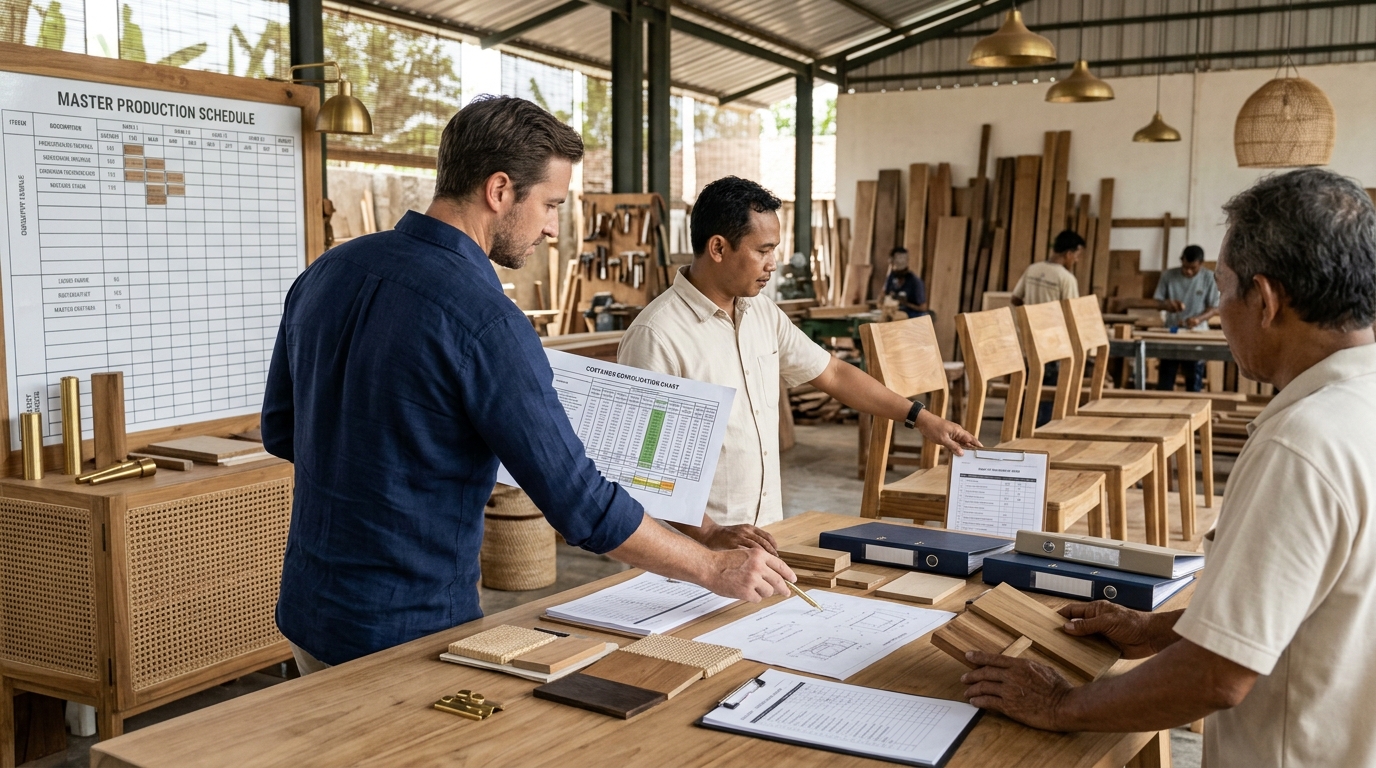
Running a furniture import program across multiple Indonesian factories is fundamentally different from managing a single-vendor order. The complexity multiplies at every stage — scheduling, QC, payment, and logistics all become interdependent variables that shift when any one factory slips. A…
Running a furniture import program across multiple Indonesian factories is fundamentally different from managing a single-vendor order. The complexity multiplies at every stage — scheduling, QC, payment, and logistics all become interdependent variables that shift when any one factory slips. A delay at a Jepara teak workshop can hold a Semarang outdoor collection hostage at the consolidation warehouse.
Managing multi-factory furniture orders in Indonesia requires a dedicated operational model, not just more spreadsheet rows. Indonesia's supplier base spans large export-oriented factories in Surabaya and Semarang, mid-size manufacturers in Central Java, and small artisan cooperatives in Bali and Jepara. Each tier operates on different rhythms, MOQs, documentation standards, and quality baselines.
This guide delivers a structured coordination framework for US import managers and project buyers running programs across multiple Indonesian factories simultaneously. It covers master production scheduling, unified QC standards, container consolidation strategy, vendor risk allocation, payment structuring, technology stack selection, compliance documentation, and real-world lessons from experienced program buyers.
The coordination model described here assumes the reader is already sourcing from Indonesia and needs to systematize control across three or more factories within a single program timeline.
Why Multi-Factory Indonesian Programs Break Without a Dedicated Coordination Model
The Structural Reality of Indonesia's Supplier Landscape
Indonesia's furniture manufacturing base is deliberately fragmented. Jepara (Central Java) houses hundreds of solid wood and teak specialists — most are small-to-mid-size workshops, not vertically integrated factories. Cirebon dominates rattan. Bali concentrates luxury artisan production. Semarang and Surabaya anchor larger, more industrialized outdoor and mid-market operations.
This geographic and capability spread is Indonesia's strength for buyers who need diverse SKU ranges. It is also the primary source of coordination risk. Each cluster operates on its own production calendar, holiday schedule, and raw material supply chain.
Why Single-Vendor Logic Fails at Multi-Factory Scale
A single-vendor program has one timeline, one QC contact, one PO, and one shipment. Multi-vendor programs create interdependencies. When Factory A in Jepara runs three weeks late due to a kiln backlog, it affects the consolidation window for Factory B in Semarang — even if Factory B finished on time.
Common failure modes include:
- Asynchronous ready-to-ship dates that force expensive LCL splits or delay the full container - Inconsistent finish standards when each factory interprets a color spec differently - Duplicate or conflicting HS code classifications across factory invoices - Deposit payment schedules misaligned to individual factory production starts
The Lead-Factory Model as Coordination Anchor
The most effective structure for managing multi-factory furniture orders in Indonesia is the Lead-Factory Model. One factory — typically the largest volume supplier with the strongest export infrastructure — is designated as the program anchor.
The Lead-Factory Model pairs with a bilingual in-country coordinator or sourcing agent who manages real-time communication across all factory contacts. Without this human layer, coordination relies entirely on email chains across time zones, which consistently underperforms.
| Program Type | Vendors | Coordination Model Needed |
|---|---|---|
| Single-vendor | 1 factory | Standard PO management |
| Small multi-vendor | 2–4 factories | Shared tracker + in-country agent |
| Large multi-vendor | 5–12+ factories | Lead-Factory Model + ERP or PM software |
Building a Master Production Schedule Across Multiple Indonesian Factories
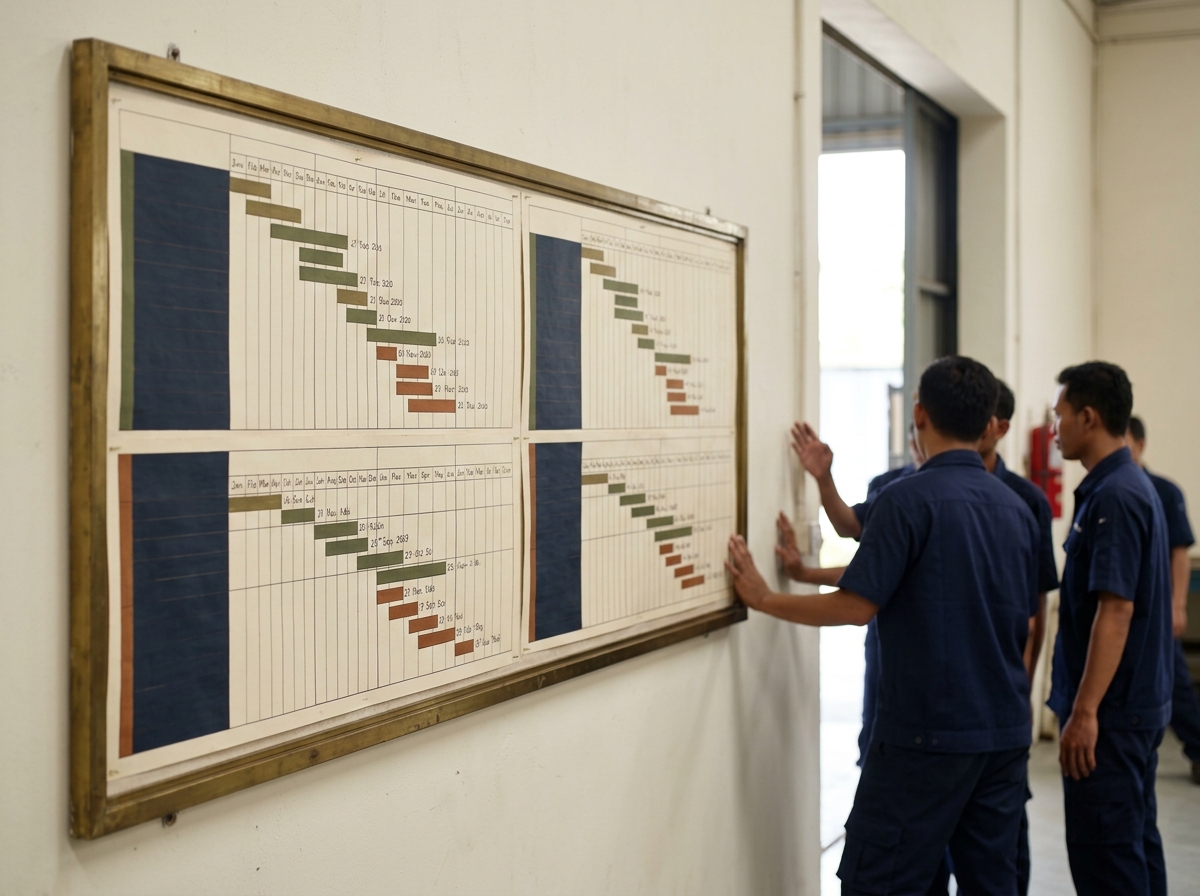
Defining the Program-Level Gantt Structure
The Program-Level Gantt is not a collection of individual factory schedules. It is a unified view that maps every factory's cut-off, production, pre-shipment inspection, and ready-to-ship milestones against a single target container loading date.
Build it from the loading date backward. Key milestone types per factory:
- Material confirmation date — raw material or component procurement locked - Production start date — first unit into the line - Mid-production check date — typically at 50% completion for complex items - Pre-shipment inspection date — third-party QC visit scheduled - Ready-to-ship date — goods packed, documented, cleared for pickup - Consolidation arrival window — goods received at the staging warehouse
Each factory gets its own row. Columns are calendar weeks. Conditional formatting flags any milestone that slips beyond a tolerance buffer (typically three to five working days).
Accounting for Indonesia-Specific Scheduling Risks
Indonesian production calendars carry predictable disruptions that US buyers frequently underestimate:
- Lebaran (Eid al-Fitr): Factories in Java and Bali commonly shut down for two to four weeks. Worker absenteeism begins one to two weeks before the official holiday. Build a hard buffer into any program with a post-Lebaran loading target. - Rainy season: Timber drying times extend during high-humidity months. Kiln-dried teak and mahogany from Jepara suppliers are particularly affected if a factory relies on natural drying for rough stock. - Regional public holidays: Java, Bali, and Sulawesi follow different regional observances. A Bali artisan workshop may lose days that a Semarang factory does not.
Shared Milestone Tracking Tools
For programs under five factories, a shared Google Sheet or Airtable base with a locked template is sufficient. Each factory updates its own milestone row on a fixed day each week (Friday end-of-day local time works consistently). The in-country coordinator reviews and flags exceptions before the Monday program review call.
For programs above five factories or with SKU counts exceeding approximately 80 line items, a dedicated project management tool (Asana, Monday.com, or a furniture manufacturing ERP module) provides automated alert logic that spreadsheets cannot replicate.
Unified QC Standards That Hold Across Every Factory in Your Program
Building the Technical Specification Package
The Technical Specification Package (TSP) is the single most important document in a multi-factory Indonesian program. It travels with every PO. Every factory receives the identical version. No factory begins production without a signed acknowledgment of receipt.
A complete TSP includes:
- Dimensioned technical drawings per SKU (PDF and DXF format) - Material specifications: species, grade, moisture content range (typically 8–12% for export solid wood) - Finish specifications: sheen level, colorant reference (RAL, Pantone, or physical chip), application method - Joinery strength requirements: specify test method where applicable - Hardware call-outs: brand, model number, or approved equivalent list - Packaging specifications: carton dimensions, foam density, banding requirements - Golden sample reference: physical sample stored at factory and at the consolidation warehouse
Standardizing Pre-Shipment Inspection Criteria
Third-party QC agents (SGS, Bureau Veritas, or independent inspection firms operating in Java and Bali) must apply identical checkpoints at every factory site. Without a standardized inspection brief, each agent defaults to their own template — producing reports that cannot be compared across factories.
Define a program-specific inspection checklist that covers:
| Checkpoint | Tolerance Standard |
|---|---|
| Dimensional accuracy | ±2mm on primary dimensions |
| Finish consistency | Match to golden sample under D65 lighting |
| Moisture content | 8–12% (solid wood), verify with pin meter |
| Joinery / structural integrity | No movement under specified load test |
| Surface defects | Zero Grade A defects; Grade B limited per AQL |
| Packaging integrity | No compression damage, all hardware present |
A Communication Cadence That Prevents Multi-Factory Program Drift
Weekly Rhythm: Individual Check-ins and Program Review
A two-tier call structure is the operational backbone of managing multi-factory furniture orders in Indonesia:
1. Individual factory check-ins (30 minutes per factory, Monday–Wednesday): In-country coordinator conducts these in Bahasa Indonesia. Outputs: updated milestone status, open issues, material risks. 2. Consolidated program review (60 minutes, Thursday): US buyer, in-country coordinator, and lead-factory contact review the aggregated status report. Decision authority is present. Action items are assigned before the week closes.
This rhythm catches problems six days before the next review cycle, not six weeks before the loading date.
Status Report Template and Escalation Protocols
Each factory submits a standardized one-page status report every Friday. The template covers: milestone status (on track / at risk / delayed), production percentage complete, open issues, materials received or pending, and next week's commitments.
Escalation triggers should be defined in writing before production begins:
- Urgent call (same-day): Fire, flood, labor stoppage, critical material failure, or a factory announcing it cannot meet the ready-to-ship date with less than two weeks' notice - Priority email (within 24 hours): Inspection failure at first-pass, a milestone slipping more than five working days, or a subcontracting event not pre-approved - Routine update: Minor schedule adjustments within the buffer window, non-critical finish queries
Container Consolidation Strategy for Multi-Factory Indonesian Furniture Programs
LCL vs. FCL: Which Applies to Your Program
| Scenario | Recommended Mode |
|---|---|
| Program fills one or more 40HQ containers | FCL — lower per-CBM cost, faster customs |
| Mixed program with small volumes per factory | LCL to consolidation point, then FCL from Indonesia to US |
| Factories ship independently on different dates | LCL for each factory leg, consolidated into FCL at staging warehouse |
For most mid-to-large US import programs managing multiple factories, the optimal model is: individual factory shipments move to a bonded consolidation warehouse via domestic trucking or short-haul LCL, then combine into FCL containers for the trans-Pacific leg.
Selecting a Consolidation Warehouse in Indonesia
Three primary staging locations serveIndonesian furnitureexport programs:
- Semarang: Central location for Java-based factories, strong outdoor and mid-market volumes, Tanjung Emas port - Surabaya: East Java anchor, serves Jepara and eastern Java suppliers, Tanjung Perak port handles significant furniture export volume - Jakarta: Tanjung Priok port — highest overall container throughput in Indonesia, strongest customs infrastructure, but further from Central Java clusters
Evaluate warehouses against: bonded status, fumigation capability (ISPM 15 compliance), pallet racking for flat-pack goods, insurance coverage, and photo documentation services on goods receipt.
Staggering Ready-to-Ship Dates and Standardizing Packaging
Plan factory ready-to-ship dates within a five-to-seven-day arrival window at the consolidation point. A wider window increases storage costs. A tighter window creates trucking congestion.
Packaging standardization across all factories is non-negotiable for downstream efficiency:
- Unified carton labeling format: program code, factory code, SKU, carton number, destination - Consistent pallet dimensions where applicable - HS code pre-printed on commercial invoice matches HS code on packing list — cross-check this before goods leave each factory
Vendor Risk Distribution: Allocating SKUs Across Factory Types Strategically
Matching SKU complexity to factory capability is the single highest-leverage decision in program design. Indonesia's tiered supplier landscape makes this explicit.
| SKU Category | Factory Type | Example Location |
|---|---|---|
| High-volume commodity dining / bedroom | Large export factory, full-cycle | Semarang, Surabaya |
| Solid teak / carved detail pieces | Specialist mid-size manufacturer | Jepara, Central Java |
| Luxury artisan or resort furniture | Artisan cooperative or premium workshop | Bali |
| Rattan / natural fiber | Specialist cluster | Cirebon |
Critical-path SKUs — items that anchor a retail launch or hotel opening — should be assigned to a primary factory with a designated backup factory that has received the TSP and can activate within two weeks. This backup factory should be audited before the program begins, not after the primary factory fails.
Diversifying factory locations across Java, Bali, and Cirebon reduces single-region disruption risk. A strike, flood, or infrastructure failure in one province does not halt the full program.
Define MOQ thresholds per factory type before issuing POs. Large export factories in Semarang or Surabaya typically require higher MOQs (often 200–500 units per SKU, approximately) to justify production line setup. Artisan workshops in Bali may accept 20–50 units but require longer lead times.
Payment Structures and Purchase Order Management Across Multiple Suppliers
PO Numbering Convention and Payment Staggering
Use a unified PO numbering convention: [Program Code]-[Factory Code]-[SKU Range]. This links every invoice, inspection report, and shipping document back to the master program without ambiguity.
Stagger deposit payments to align with each factory's individual production start date — not a single program-wide payment date. A Bali artisan workshop starting production in Week 3 should not receive its deposit in Week 1 alongside a Semarang factory starting immediately. Premature deposits reduce payment leverage and create cash flow inefficiency.
A standard payment structure forIndonesian furniture suppliers:
| Payment Stage | Trigger | Typical Percentage (Approximate) |
|---|---|---|
| Deposit | PO acceptance + TSP sign-off | 30% |
| Mid-production payment | Optional; used for orders above ~$50,000 USD | 30% |
| Balance | Pre-shipment inspection passed | 40% |
Incoterms Consistency and Centralized Payment Tracking
Apply consistent Incoterms across all factory contracts within the same program. FOB (Free on Board) at the Indonesian port of loading is the most common and operationally clean choice for US buyers who control freight. Mixing FOB and EXW across factories creates unequal freight responsibility and complicates insurance coverage.
Maintain a centralized payment schedule in the master program tracker: factory name, PO number, deposit amount, deposit sent date, balance due date, balance trigger event, and outstanding balance. Review this weekly alongside the production milestone report.
Technology and ERP Tools for Multi-Factory Procurement Management
ERP vs. Lightweight Tools: Choosing the Right Stack
| Program Scale | Recommended Tool | Key Features Needed |
|---|---|---|
| 2–4 factories, under 60 SKUs | Google Sheets + shared Drive | Milestone tracker, document storage, payment log |
| 4–8 factories, 60–150 SKUs | Airtable or Notion | Relational data, photo uploads, automated reminders |
| 8+ factories or repeat programs | Furniture manufacturing ERP module or Monday.com | Automated alerts, supplier portal, milestone sign-offs, integration with logistics |
Supplier portals — whether built inside an ERP or a standalone tool like Airtable — should require factories to upload production photos at each milestone sign-off. Photos are timestamped and linked to the relevant PO line. This creates an audit trail that protects the buyer and incentivizes factory accountability.
Automate alerts for: missed milestone updates (factory did not submit status report by Friday), first-pass inspection failures, ready-to-ship date changes, and consolidation arrival delays. Manual follow-up on these events at scale is where programs slip.
Compliance, Certifications, and Documentation Every Factory Must Meet
Before issuing any PO, confirm the following certifications for each factory:
- SVLK (Sistem Verifikasi Legalitas Kayu): Indonesia's mandatory timber legality verification system. Required for all wood product exports from Indonesia. Verify the certificate number directly with the issuing body. - FSC or PEFC: Chain-of-custody certification for buyers with sustainability commitments or retail customers who require it. Not all Indonesian factories hold these — verify before promising them to end customers. - TSCA Title VI compliance: Required for any composite wood products (MDF, plywood, particleboard) entering the US market. Confirm formaldehyde emission compliance documentation per US EPA standards.
Standard document checklist per factory shipment:
- Commercial invoice (factory name, PO number, HS codes, FOB value) - Packing list (carton numbers, weights, dimensions) - Certificate of Origin (Form E for ASEAN preference programs where applicable) - Phytosanitary certificate (required for solid wood and rattan products) - SVLK certificate (V-Legal document) - Bill of Lading - Fumigation certificate (ISPM 15 for wood packaging materials)
- ✓Commercial invoice with correct HS codes
- ✓Packing list matching carton marks
- ✓Certificate of Origin
- ✓Phytosanitary certificate
- ✓SVLK / V-Legal document
- ✓Fumigation certificate (ISPM 15)
- ✓FSC or PEFC certificate (if program-required)
- ✓TSCA Title VI compliance statement (composite wood products)
Ensure HS code classification is consistent across all factory invoices. Inconsistent codes for the same product type trigger US Customs queries and can delay the full container, not just the offending shipment.
Real-World Coordination Lessons From Multi-Factory Program Buyers
Pattern Analysis: What Breaks and What Holds
Programs managing 8–12 factories across Java and Bali exhibit predictable failure patterns when coordination infrastructure is absent:
- Asynchronous timelines are the most common issue. Without a program-level Gantt, each factory manages to its own internal schedule. Ready-to-ship dates scatter across six to eight weeks, making FCL consolidation impossible without expensive storage. - Inconsistent finish standards appear when the TSP is distributed late or without physical reference samples. Two factories producing the same walnut stain from a written spec routinely produce visibly different results. - Consolidation delays occur when goods arrive at the staging warehouse without standardized labeling, triggering manual re-sorting before container loading.
Key Success Factors Observed Across Successful Programs
Programs that consistently hit on-time delivery and first-pass QC pass rates share four structural elements:
1. A bilingual in-country agent with direct relationships at each factory 2. A unified TSP distributed and acknowledged before any deposit is paid 3. A weekly two-tier call cadence without exceptions 4. A single consolidation hub — typically Semarang for Central Java programs or Surabaya for broader East Java programs
Metrics to Track Throughout the Program
| Metric | Definition | Target Benchmark (Approximate) |
|---|---|---|
| On-time factory completion rate | % of factories hitting ready-to-ship date within buffer | Above 85% |
| First-pass QC pass rate | % of inspections passed without re-inspection | Above 80% |
| Days-to-consolidation | Days from last factory ready-to-ship to full container loaded | Under 10 working days |
| Document accuracy rate | % of factory document sets submitted complete first time | Above 90% |
Frequently Asked Questions: Multi-Factory Indonesian Furniture Sourcing
Is furniture manufacturing in Indonesia profitable for US buyers running multi-factory programs? Indonesia's teak, mahogany, rattan, and artisan segments offer strong margin potential for US buyers, particularly in the mid-to-premium price range. Profitability depends on program efficiency — poorly coordinated programs absorb margin through re-inspections, LCL splits, and consolidation delays.
How many factories should a typical US furniture import program use simultaneously? Programs under approximately $500,000 USD in annual volume commonly work with two to four factories. Larger programs — commercial furniture groups, hospitality projects, or national retail rollouts — may use eight to twelve simultaneously.
What is the best consolidation port in Indonesia for multi-factory furniture shipments? Semarang (Tanjung Emas) is the most practical consolidation point for Central Java programs sourcing from Jepara, Cirebon, and surrounding clusters. Surabaya (Tanjung Perak) serves East Java programs.
How do you enforce consistent quality standards across workshops with different capabilities? Consistency comes from the TSP, not from factory capability alone. Distribute identical technical drawings, physical color chips, and golden samples to every factory before production begins.
What certifications should every Indonesian furniture factory hold before receiving a PO? At minimum: SVLK (mandatory for wood product exports from Indonesia), and TSCA Title VI compliance documentation for any composite wood in the SKU range. FSC or PEFC chain-of-custody certification is required if your retail customers or brand standards demand it.
How do you handle lead time differences when multiple factories are on the same program timeline? Map each factory's actual lead time into the Program-Level Gantt and assign staggered production start dates. A Bali artisan workshop needing approximately 14 weeks must start earlier than a Semarang factory needing 10 weeks to hit the same consolidation arrival window.
Managing multi-factory furniture orders in Indonesia at scale demands three non-negotiable foundations. First: a unified specification package distributed before any production begins. Second: a program-level Gantt mapping every factory to a single container loading date, supported by an in-country coordination layer communicating in real time across all suppliers.
You now have the framework. The checklist puts it into immediate action — covering program setup, milestone tracking, QC standards, consolidation staging, and documentation requirements across every Indonesian factory in your program.
Download Free Checklist →Need eyes on the ground in Indonesia?
MTS is an execution partner — supplier verification, manufacturing management, quality control and export logistics across Indonesia, Vietnam and China.
Related services
Related articles
Receive furniture sourcing insights across Asia.
One email per week. No spam.