Indonesian Wood Flooring Grading, Specifications, and QC Guide for Exporters
13 min read

Procurement teams sourcing wood flooring from Indonesia face a specific, recurring problem: Indonesian factories use internal grading labels — Grade A, B, C, D — that do not map directly to NWFA grades or European EN equivalents. Without a precise crosswalk, the same board can be called "Select"…
Procurement teams sourcing wood flooring from Indonesia face a specific, recurring problem: Indonesian factories use internal grading labels — Grade A, B, C, D — that do not map directly to NWFA grades or European EN equivalents. Without a precise crosswalk, the same board can be called "Select" by the factory and "No. 1 Common" by the receiving warehouse. That gap drives rejections, rework claims, and strained supplier relationships.
This guide covers wood flooring specifications gradingIndonesia exportin practical terms. It provides a grade crosswalk table, dimensional tolerance tables, moisture content targets by destination market, inspection checklists, and species-level QC flags. Every section is written for procurement managers writing purchase orders and QC managers briefing third-party inspection firms.
The scope covers solid strip flooring, engineered planks, and parquet blocks in the five commercially dominant Indonesian species: teak (Tectona grandis), merbau, bengkirai, ulin, and suar. HS commodity codes, SVLK/FLEGT certification, US Lacey Act compliance, and CARB Phase 2 requirements are addressed where they affect document preparation and factory audits.
Why Indonesian Wood Flooring Leads Global Export Markets — and Why Precise Specs Matter
Indonesia consistently ranks among the top global exporters of wood carpentry and flooring products. Indonesian exporters ship under HS 4409 (wood continuously shaped) for solid profiled flooring and HS 4418 (builders' joinery and carpentry) for engineered and parquet formats. Both codes apply depending on product construction.
Five species drive the bulk of flooring export volume:
- Teak (Tectona grandis) — plantation and reclaimed; premium pricing - Merbau (Intsia bijuga/palembanica) — high hardness, warm color - Bengkirai (Shorea laevis) — outdoor-grade density, Janka hardness approximately 1,575 lbf - Ulin (Eusideroxylon zwageri) — ironwood; protected species with strict harvest quotas - Suar (Albizia saman) — wide slabs, character-grade and reclaimed applications
The commercial risk for procurement teams is factory-level grading inconsistency. Indonesian factories operate without a single mandated national grading standard for finished flooring. Two factories shipping "Grade A teak" can produce visually different boards. Unless your purchase order defines grade parameters in measurable terms — allowable knot size, sapwood percentage, color variation tolerance — you cannot enforce acceptance criteria at pre-shipment inspection.
Wood flooring specifications grading Indonesia export documents must bridge the factory's internal language and the destination market standard. The next section provides that bridge.
Indonesian Wood Flooring Grading Systems: Grade A Through D Defined
Visual Characteristics Assessed at the Grading Line
Indonesian exporters typically sort flooring on a visual grading line. Graders assess these characteristics on each board face and edge:
- Knots: sound tight knots vs. open or dead knots; maximum allowable diameter per grade - Sapwood: percentage of board face area; Grade A typically allows zero to trace sapwood - Mineral streaks: accepted in B and C; not accepted in Grade A for most species - Color variation: tight color matching in A; broader tolerance in B and C - Checks and end splits: hairline surface checks allowed in B/C; none in A - Grain deviation: straight grain required in A; interlocked or wavy grain allowed in C/D - Worm holes or insect damage: rejected in A and B; limited in C; permitted in D
How Grades Apply Across Product Formats
| Format | Grade A | Grade B | Grade C | Grade D |
|---|---|---|---|---|
| Solid strip (15–20mm) | Clear face, no sapwood | Max 1 tight knot ≤10mm | Sound knots, limited sapwood | Utility; structural use |
| Engineered plank (12–15mm) | Clear wear layer, matched veneer | Minor color variation allowed | Rustic character, visible mineral | Heavy character; reclaimed look |
| Parquet block | Matched grain and color | Minor tone difference | Varied grain and color | Not typically exported |
Addressing Factory Grading Inconsistency
Grading drift — where a factory's Grade B gradually migrates toward what a buyer expects as Grade C — is common. The root cause is informal training of line graders and no external audit of the sorting process. Address this in your spec sheet by defining each allowable defect with a maximum dimension or percentage. Attach a photographic reference panel (golden sample board set) to your purchase order. Require the factory to retain a sealed reference set for the duration of the production run.
Grade Crosswalk: Mapping Indonesian Grades to NWFA and European EN Standards
This table is the core decision tool for procurement teams writing Indonesian wood flooring specifications for US and EU distribution.
<table> <thead> <tr> <th>Indonesian Grade</th> <th>Common Label</th> <th>NWFA Grade Equivalent</th> <th>European EN Equivalent</th> <th>Typical Use Case</th> </tr> </thead> <tbody> <tr> <td>Grade A</td> <td>Clear / Select</td> <td>Clear or Select & Better</td> <td>Prime / Nature</td> <td>High-end residential, hospitality</td> </tr> <tr> <td>Grade B</td> <td>Standard / Natural</td> <td>No. 1 Common</td> <td>Select / Rustic (upper)</td> <td>Mid-market residential, retail</td> </tr> <tr> <td>Grade C</td> <td>Rustic / Character</td> <td>No. 2 Common</td> <td>Rustic / Country</td> <td>Character flooring, commercial retail</td> </tr> <tr> <td>Grade D</td> <td>Utility / Economy</td> <td>Below Grade / Mill Run</td> <td>Country (lower) / Economy</td> <td>Utility, budget segments</td> </tr> </tbody> </table>.
Practical guidance: When writing a purchase order for the US market, specify both the Indonesian grade label and the NWFA-equivalent terminology. For example: "Grade B (Natural) — equivalent to NWFA No. 1 Common in terms of allowable character. Allowable knots: maximum one sound tight knot per linear meter, maximum 15mm diameter. Sapwood: maximum 10% of board face. No open knots, splits, or worm holes."
For European buyers, align to EN grade terminology as defined in EN 13489 (parquet) or your product-specific standard. The EN term "Nature" corresponds closely to Grade A for clear-face teak. "Rustic" broadly aligns to Grade C.
Dimensional Tolerances and Physical Specifications for Export Orders
Standard Dimension Ranges
| Parameter | Solid Flooring | Engineered Flooring |
|---|---|---|
| Thickness | 15mm, 18mm, 20mm typical | 12mm, 14mm, 15mm typical |
| Width | 60mm–120mm strip; 90mm–190mm plank | 90mm–220mm plank |
| Length | 300mm–1800mm random or fixed | 600mm–2400mm fixed or random |
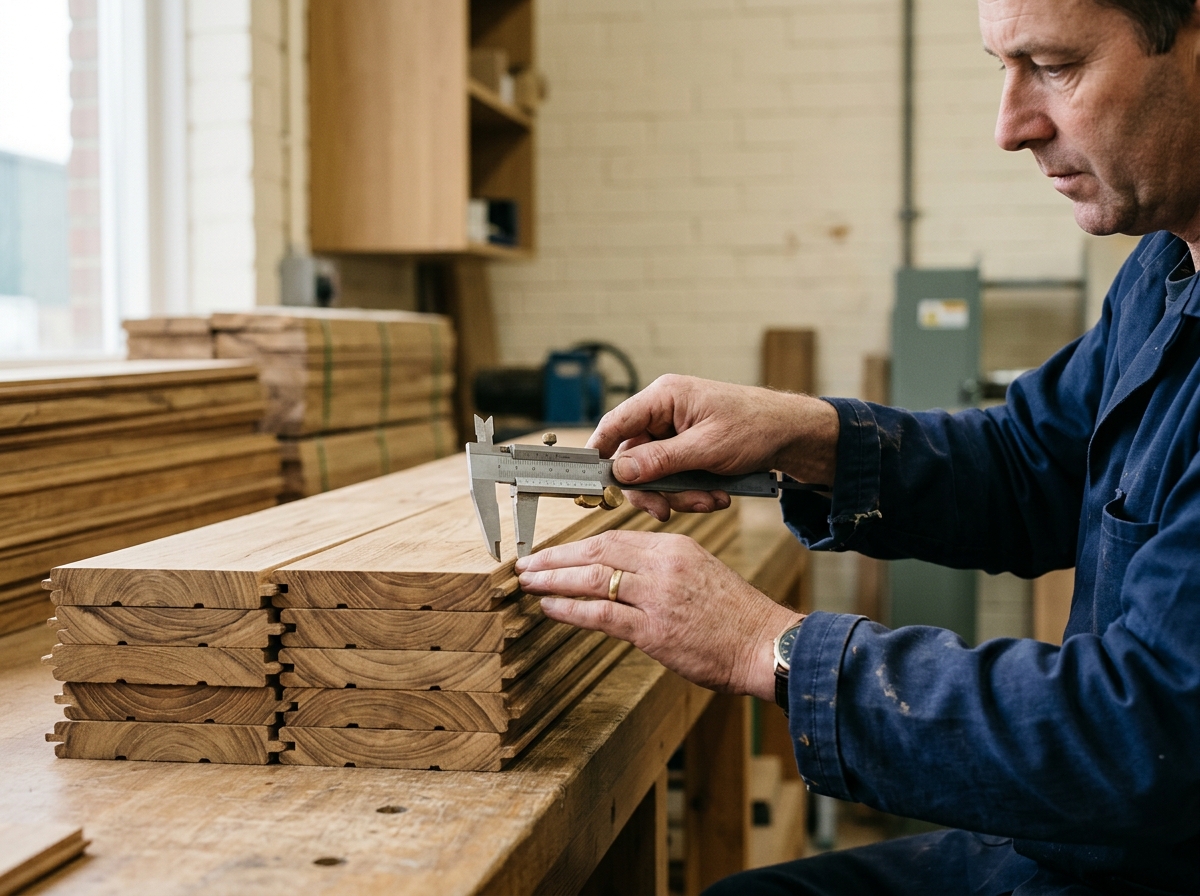
Tolerance Table for Export Specification Sheets
| Dimension | Tolerance |
|---|---|
| Thickness | ±0.2mm |
| Width | ±0.3mm to ±0.5mm |
| Length (fixed) | ±2mm |
| Squareness | Max 0.2mm deviation per 100mm |
| Flatness (cupping) | Max 0.3mm over board width |
| Flatness (bowing) | Max 0.5mm per 1000mm length |
| T&G profile fit | Max 0.1mm gap when assembled |
Writing Tolerance Clauses in Purchase Orders
State tolerances as hard limits, not targets. Use this language pattern: "Thickness shall be [nominal]mm −0/+0.2mm. Boards outside tolerance shall be rejected and not substituted without written buyer approval." Reference EN 13226 or EN 13227 for solid and engineered parquet strip dimensional requirements where applicable. This gives your factory a recognized benchmark and your inspection team a clear pass/fail criterion.
Moisture Content Specifications Critical for US, European, and UK Markets
Target Moisture Content by Destination
Moisture content (MC) must be specified to the destination climate, not to Indonesian ambient conditions. Indonesian factory ambient humidity is typically 70–85% RH. Without active kiln drying to specification, boards will shrink and gap after delivery.
| Destination Market | Target MC at Pre-Loading | Acceptable Range |
|---|---|---|
| US (most regions) | 7% | 6–9% |
| EU continental (Germany, France, Benelux) | 8% | 7–10% |
| UK | 9% | 8–11% |
| Australia | 8% | 7–9% |
MC targets are approximate equilibrium ranges based on typical interior conditions in each region. Verify against ASHRAE climate data for the specific end-use city where relevant.
Indonesian Kiln-Drying Practices
Tropical kiln drying in Indonesia commonly uses steam kilns or solar-assisted kilns. Many smaller factories in Jepara run shorter drying cycles than temperate-country norms to reduce energy cost. The result is MC that tests acceptable at the factory but rises during consolidation or container loading if boards are not protected from ambient re-absorption.
MC Measurement Standards and Methods
- Pin-type meters: direct resistance measurement; accurate to ±1–2% MC for most species - Pinless (capacitance) meters: fast screening tool; calibrate for species density - Reference method: ASTM D4442 (oven-dry method) for definitive measurement; use for dispute resolution
Specify MC at three stages in your purchase order:
1. Post-kiln: within 72 hours of kiln exit, before finishing 2. Pre-finishing: immediately before UV or oil application 3. Pre-loading: at time of pre-shipment inspection, boards in sealed packaging
Surface Finishing Specifications: UV Lacquer, Hardwax Oil, and Unfinished Exports
Indonesian factories export flooring in four primary finish conditions:
- UV-cured lacquer: most common for prefinished export; 3–7 coat systems typical - Hardwax oil (UV-accelerated): growing demand for European markets - Brushed/hand-scraped: texture applied pre-finish; add surface profile spec - Unfinished: sanded to specified grit (typically 100–120 grit); for site finishing
Specifying Sheen Level
Specify sheen in gloss units (GU) measured at 60° per EN ISO 2813. Typical ranges:
| Finish Label | Gloss Units (60°) |
|---|---|
| Matte | 5–15 GU |
| Satin | 16–35 GU |
| Semi-gloss | 36–70 GU |
Coating Performance Test References
- Abrasion resistance: EN 13696 (Taber abrasion test for wood floor coatings) - Coating adhesion: ASTM D3359 (cross-cut tape test) - Chemical resistance: EN 13696 staining resistance protocol - Surface hardness: Brinell hardness per EN 1534
VOC Compliance Requirements
- US market: CARB Phase 2 limits apply to composite wood components in engineered flooring. Confirm that any MDF or HDF core in engineered products carries a valid CARB Phase 2 certificate. Verify the certificate number against the CARB ATCM database — do not accept photocopied certificates without verification. - EU market: comply with EU Directive 2004/42/CE VOC limits for surface coatings. Request a product safety data sheet and test report from the finish supplier.
Factory Inspection Checkpoints Every QC Manager Must Include
Pre-Production Audit Checklist
- ✓Verify species identity against SVLK (Sistem Verifikasi Legalitas Kayu) certificate or FLEGT V-Legal document
- ✓Confirm kiln capacity and cycle log for the scheduled production volume
- ✓Review raw material MC on arrival at factory: should not exceed 20% for air-dried input stock
- ✓Check machining equipment calibration records for moulder, planer, and T&G cutter
- ✓Confirm finish system spec matches purchase order: product datasheets for lacquer or oil
- ✓Verify CARB Phase 2 documentation for engineered core materials
In-Process Inspection Points
During production, focus inspection effort on three stations:
1. Machining station: check thickness and width against tolerance table on samples every 2 hours 2. Grading/sorting line: shadow line graders for one hour; compare their decisions against your golden sample board set 3. Finish application: check wet film thickness, flash-off time between coats, and cure time before stacking
Final Random Inspection Using AQL 2.5
Apply AQL 2.5 per ISO 2859-1 (ANSI/ASQ Z1.4) for final inspection. At AQL 2.5, a lot of approximately 1,201–3,200 boards requires a sample of 125 boards. Classify defects as:
- Critical: wrong species, active mold, structural delamination (engineered) → zero acceptance - Major: MC out of tolerance, grade non-conformance, dimension outside tolerance → Ac=7, Re=8 at AQL 2.5 - Minor: minor finish streaks, packaging defect → Ac=14, Re=15 at AQL 2.5
Pre-Shipment Inspection Protocol and Export Documentation for Indonesian Flooring
Required Export Documents
Every Indonesian wood flooring shipment to the US or EU requires:
| Document | Purpose |
|---|---|
| Packing List | SKU, bundle counts, gross/net weights |
| Commercial Invoice | FOB value for customs |
| Certificate of Origin (Form E or general) | Tariff eligibility |
| Phytosanitary Certificate | ISPM-15 pallet treatment compliance |
| SVLK / V-Legal Certificate | Indonesian legal timber verification |
| FLEGT License (if applicable) | EU FLEGT VPA bilateral recognition |
| US Lacey Act Declaration (PPQ 505) | Species, country of harvest, quantity, value |
US Lacey Act Compliance
The Lacey Act requires importers to declare the genus and species of all wood in the shipment at the time of importation. For teak: Tectona grandis. For merbau: Intsia bijuga or Intsia palembanica (verify with supplier). The SVLK certificate and chain-of-custody documentation from the Indonesian exporter support Lacey Act due care requirements. Request harvest region documentation for ulin, which is subject to stricter harvest controls.
Species-Specific Quality Considerations for Key Indonesian Export Woods
Teak (Tectona grandis)
Teak contains natural silica and oils (primarily tectoquinone). These properties create two grading-relevant QC issues:
- Color variation: Plantation teak heartwood ranges from golden-brown to dark brown within a single log. Grade A teak commands a premium because color-matching at the grading line is time-intensive. Specify allowable Delta-E color variation if uniformity is critical. - Oil bleed: Natural oils can migrate through water-based finishes, causing adhesion failure or blotching. Specify that teak boards receive a wipe-down with a tack cloth or light solvent wipe before finish application.
Merbau
Merbau presents two consistent QC challenges:
- Interlocked grain: Grain reverses direction every few millimetres. This causes tearout during machining if feed speed is not controlled. Specify that merbau boards are inspected for surface tearout after moulding, not just after finishing. - Tannin bleed: Merbau contains water-soluble tannins (yellow-orange pigment). Contact with water or water-based adhesives during engineered core lamination causes staining. Specify a pre-treatment step: dry-wipe or apply a tannin-blocking sealer coat before the main finish system.
Bengkirai and Ulin
Bengkirai (Janka hardness approximately 1,575 lbf) and ulin (approximately 3,500 lbf) are among the densest commercially exported Indonesian species. At these densities, T&G profile tolerances are more critical — dense wood does not compress to close fit gaps. Tighten T&G fit tolerance to ±0.05mm when specifying bengkirai or ulin strip flooring.
Suar and Reclaimed Teak
Suar and reclaimed teak are graded under character-grade norms. Allowable features include large sound knots, nail holes (reclaimed), and significant color variation. Specify these as "character inclusions" rather than defects. Define the maximum size of any structural void that must be filled with color-matched filler, and specify filler type and cured color range.
Writing a Complete Wood Flooring Specification Sheet for Indonesian Suppliers
Recommended Spec Sheet Sections
A purchase-order-ready Indonesian wood flooring spec sheet must include these sections in this sequence:
1. Species and botanical name (e.g., Tectona grandis) 2. Product format (solid strip / engineered / parquet block) 3. Grade definition (Indonesian label + NWFA equivalent + measurable defect tolerances) 4. Nominal dimensions + tolerance table (reference EN 13226 or EN 13227 where applicable) 5. Moisture content targets (post-kiln, pre-finishing, pre-loading; measured per ASTM D4442) 6. Finish specification (type, coat count, sheen in GU, test references: EN 13696, ASTM D3359) 7. Certification requirements (SVLK, CARB Phase 2, FSC if applicable) 8. Packaging requirements (bundle count, moisture-barrier wrap spec, ISPM-15 pallet) 9. Inspection protocol (AQL level, defect classification matrix, golden sample reference) 10. Document checklist (Lacey Act PPQ 505, Phytosanitary Certificate, SVLK/FLEGT)
Alignment with ISO 18776 and Test Standards
ISO 18776 specifies classification and terminology for laminate floor coverings but provides a useful structural model for Indonesian solid and engineered flooring spec sheets. Reference ASTM D4442 for MC verification, EN 13696 for finish performance, and ISO 2859-1 for AQL sampling procedures.
Common Spec Sheet Errors That Cause Port Rejections
- Stating grade by name only (e.g., "Grade A") without defining allowable defect dimensions - Omitting MC measurement stage (post-kiln vs. pre-loading) — factory and inspector use different stages - Using NWFA grade names without noting they apply to North American domestic species, not Indonesian species - Failing to specify CARB Phase 2 requirement for engineered products with composite cores - No photographic golden sample reference attached — grade disputes default to factory interpretation
Frequently Asked Questions
What are the different grades of wood flooring used in Indonesian exports? Indonesian factories use four grades: Grade A (Clear/Select), Grade B (Standard/Natural), Grade C (Rustic/Character), and Grade D (Utility). Each is defined by allowable knots, sapwood, color variation, and surface checks. Grades are not standardized across all factories — always define parameters numerically in your purchase order.
How do Indonesian wood flooring grades map to US NWFA grade names? Grade A aligns approximately with NWFA Clear or Select & Better. Grade B aligns with NWFA No. 1 Common. Grade C aligns with NWFA No. 2 Common. Grade D is below standard NWFA grades. See the crosswalk table above for the full mapping including European EN equivalents.
What is the correct HS commodity code for solid and engineered wood flooring from Indonesia? Solid profiled flooring (tongue-and-groove strip) typically classifies under HS 4409. Engineered flooring and parquet blocks typically classify under HS 4418. Confirm the applicable subheading with your customs broker based on product construction, as classification can vary by importing country.
IsIndonesian teakgood quality for export flooring applications? Plantation teak from Indonesia is commercially recognized for its natural durability, oil content, and stability. Grade A teak commands premium pricing. Quality varies by plantation source and kiln-drying practice. Specify botanical name (Tectona grandis), grade parameters, and MC range. Request SVLK documentation to confirm legal harvest origin.
What moisture content should I specify for Indonesian wood flooring shipped to the US? Target 6–9% MC at pre-loading, measured per ASTM D4442. Specify MC at three stages: post-kiln, pre-finishing, and pre-loading. Indonesian ambient humidity is high — boards can reabsorb moisture if not moisture-barrier wrapped promptly after kiln drying.
Does Indonesia have legal timber certification required for US Lacey Act compliance? Yes. Indonesia operates SVLK (Sistem Verifikasi Legalitas Kayu), a government-mandated timber legality verification system. SVLK certificates (V-Legal marks) satisfy due care requirements under the US Lacey Act when accompanied by a species-level declaration on Form PPQ 505. Indonesia also holds a FLEGT Voluntary Partnership Agreement with the EU, enabling FLEGT-licensed shipments to satisfy EU Timber Regulation requirements.
Tightly written wood flooring specifications grading Indonesia export documents eliminate the ambiguity that creates grade disputes, port rejections, and costly re-inspection cycles. Combine the grade crosswalk, dimensional tolerance tables, and three-stage MC targets in a single specification sheet — and enforce it through AQL 2.5 pre-shipment inspection with a sealed golden sample reference.
You now have the grading crosswalk, tolerance tables, and inspection checkpoints. The next step is putting them into a purchase-order-ready document your Indonesian supplier can sign off on. Contact our team for a specification review and a factory-direct quote for your next wood flooring order.
Request a Spec Review →Need eyes on the ground in Indonesia?
MTS is an execution partner — supplier verification, manufacturing management, quality control and export logistics across Indonesia, Vietnam and China.
Related services
Related articles
Receive furniture sourcing insights across Asia.
One email per week. No spam.