Structural Timber Suppliers Indonesia Export: Species, Grades and Compliance Guide
14 min read
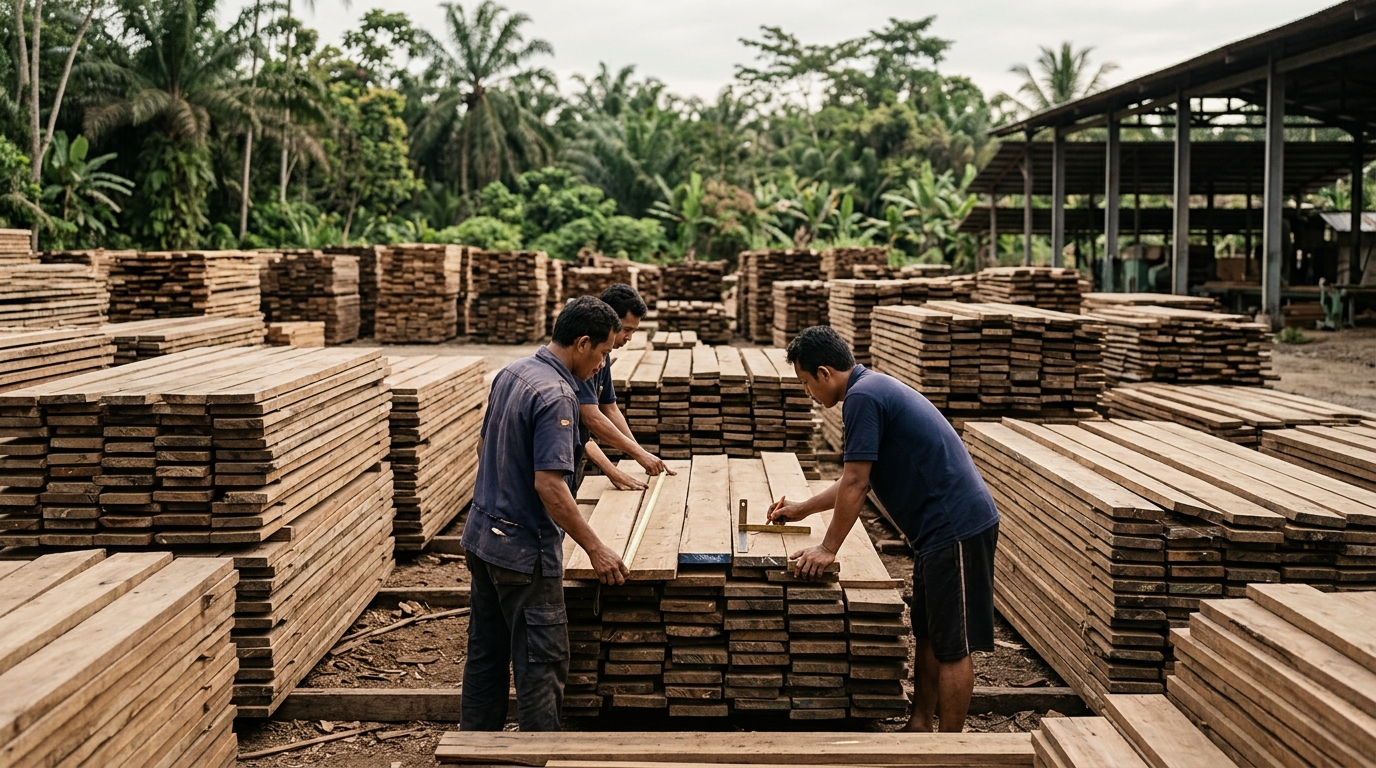
US construction buyers sourcing tropical structural hardwood face a specific problem. Indonesian timber offers outstanding strength-to-weight ratios and species diversity. But navigating grading rules, legal documentation, and supplier qualification across a approximately 17,000-island archipelago…
US construction buyers sourcing tropical structural hardwood face a specific problem. Indonesian timber offers outstanding strength-to-weight ratios and species diversity. But navigating grading rules, legal documentation, and supplier qualification across a approximately 17,000-island archipelago is genuinely complex.
This guide covers everything a US-based importer needs to evaluate structural timber suppliers Indonesia export operations with confidence. It addresses species selection, strength class mapping, kiln drying standards, SVLK legality verification, export documentation, HTS codes, and supplier qualification criteria.
Indonesia remains one of the world's most capable sources of tropical structural hardwood. Understanding how its grading system maps to US and international standards — and how to verify legal compliance — is the difference between a successful procurement program and a customs or legal problem.
Why Indonesia Remains a Top Source for Structural Timber Export
Indonesia holds some of the largest tropical forest reserves in the world. Its timber export industry spans Kalimantan, Sumatra, and Sulawesi — each producing distinct species at industrial scale.
Kalimantan is the primary source for bengkirai and kapur. Sumatra supplies significant volumes of meranti and keruing. Sulawesi produces merbau alongside specialty hardwoods. Mills range from large vertically integrated operations with own forest concessions to mid-scale sawn timber processors serving export buyers directly.
Indonesia's total wood product exports represent a substantial share of global tropical timber trade. The country has invested heavily in downstream processing, meaning US buyers can source kiln-dried, graded, and treated structural members — not just raw logs.
US construction companies are increasingly turning to Indonesian structural timber for three reasons. First, species like bengkirai and merbau offer durability classes that outperform many temperate alternatives. Second, Indonesia's SVLK legality system satisfies Lacey Act requirements without additional due diligence layers.
Key Species for Structural Use: Bengkirai, Merbau, Kapur and Meranti Compared
Bengkirai — High-Density Load-Bearing Hardwood
Bengkirai (Shorea laevis) is the most widely specified Indonesian species for structural applications in the US market. Its air-dry density typically falls around 900–1,050 kg/m³. Janka hardness commonly exceeds 3,000 lbf. It carries natural durability class 1–2 under European classification, meaning it resists decay without treatment in most above-ground applications.
Bengkirai is used inheavy timberframing, exposed structural members, decking substructure, and marine applications. Its silica content requires carbide tooling. US buyers should confirm supplier mills are equipped for bengkirai processing — not all are.
Merbau — Preferred Species for Heavy Framing
Merbau (Intsia bijuga) delivers very high bending strength and excellent natural durability. Density typically ranges from 800–1,000 kg/m³. It is commonly assigned to durability class 1 under EN 350 — the highest rating. Merbau is widely used in exposed heavy framing, structural columns, and load-bearing beams.
One practical note: merbau produces a red extractive that bleeds in wet conditions. This is cosmetic, not structural. Specify pre-rinsing or buyer-side finishing if this matters for your project.
Kapur — Dimensional Stability for Precision Framing
Kapur (Dryobalanops spp.) offers good dimensional stability after kiln drying. Density typically falls in the 700–900 kg/m³ range. It is well-suited to structural applications requiring close tolerances and minimal post-installation movement — roof trusses, laminated beams, and prefabricated structural components.
Kapur's durability class is typically 2–3, meaning preservative treatment is advisable for ground-contact or high-humidity applications.
Meranti — Wide Range, Grade-Dependent Suitability
Meranti covers multiple Shorea species grouped by color: light red, dark red, and white. Structural suitability varies significantly by group. Dark red meranti (Shorea spp.) is denser — typically 640–800 kg/m³ — and more suitable for structural use. Light red meranti is lower density and better suited to non-structural or light-frame applications.
US buyers must specify the meranti group, not just "meranti." Generic specifications invite grade substitution.
Species Structural Properties Comparison
| Species | Density (kg/m³) | Janka Hardness (approx. lbf) | Natural Durability Class (EN 350) | Typical Structural Use |
|---|---|---|---|---|
| Bengkirai | 900–1,050 | 3,000–3,500 | Class 1–2 | Heavy framing, decking substructure |
| Merbau | 800–1,000 | 2,700–3,200 | Class 1 | Columns, beams, exposed framing |
| Kapur | 700–900 | 2,200–2,800 | Class 2–3 | Trusses, laminated members |
| Dark Red Meranti | 640–800 | 1,600–2,200 | Class 3–4 | Light structural, secondary framing |
Values are approximate industry ranges. Verify with mill test certificates for project-specific specifications.
Structural Grading Rules and Strength Classes for Indonesian Hardwood Export
Indonesian SNI Grading Standards
Indonesia uses SNI (Standar Nasional Indonesia) grading rules for structural sawn timber. The primary applicable standard is SNI 7973, which covers visual grading of structural timber. It defines defect limits including knot size, slope of grain, wane, and checks for each grade category.
SNI grading produces Select Structural, No. 1, No. 2, and utility grades — terminology that partially mirrors NLGA and NHLA conventions but is not identical. US buyers should not assume direct equivalence without independent verification.
Mapping SNI Grades to International Strength Classes
This is the gap most suppliers and many competing guides fail to address properly.
SNI structural grades can be cross-referenced to EN 338 strength classes using species-specific test data under EN 384. For bengkirai at Select Structural grade, assigned strength class is typically D60 or higher under EN 338 — placing it among the highest-rated tropical hardwoods in European structural design. Merbau at No. 1 grade commonly maps to D50–D60.
For US projects using ASTM-based design, the mapping path is: SNI grade → EN 338 class → equivalent ASTM D143 mechanical properties. Design values then feed into NDS (National Design Specification) calculations. Require the supplier to provide a species-specific mechanical property report referencing actual test data, not generic tropical hardwood tables.
Visual vs. Machine Stress-Rated Grading
Most Indonesian mills use visual grading. Machine stress-rated (MSR) grading equipment is less common but available at larger export-oriented facilities. For US structural applications requiring certified design values, MSR grading is preferable. Ask suppliers explicitly whether their facility holds MSR capability and what certification body oversees it.
Standard Sawn Sizes, Tolerances and Metric-to-Imperial Conversion for US Projects
Indonesian mills produce structural timber in metric dimensions. Common cross-sections include 50×100 mm, 75×150 mm, 100×200 mm, and 150×300 mm. Standard export lengths run from 2.4 m to 6.0 m, with custom lengths up to approximately 9.0 m available from larger mills.
Thickness and width tolerances under SNI are typically +0/−2 mm for dry-graded timber. Buyers should confirm whether quoted sizes are target size or minimum size — this affects actual section properties in structural calculations.
For US projects designed in imperial units, specify both metric and equivalent imperial dimensions in the purchase order. A 50×100 mm section is approximately 2×4 inches nominal — but not exactly. Structural engineers must use actual metric dimensions in their calculations, not nominal imperial equivalents.
Kiln Drying, Moisture Content and Treatment Standards for Export Shipments
Moisture Content Targets
Structural timber exported from Indonesia is generally kiln-dried to a moisture content (MC) of 12–19%. For most structural applications in the US market, an MC of 15–19% is the accepted standard. Where the timber will be installed in climate-controlled interior environments, specifying 12–15% MC is advisable to limit shrinkage during service.
Always require a moisture certificate issued at the time of shipment. Readings recorded prior to kiln drying carry no validity for compliance purposes.
Heat Treatment and ISPM 15 Requirements
All solid wood moving from Indonesia to the United States is subject to ISPM 15 (International Standards for Phytosanitary Measures No. 15). Compliance requires heat treatment (HT) to a core temperature of 56°C sustained for a minimum of 30 continuous minutes. This obligation extends to structural members serving as packing material or dunnage, which must also display the ISPM 15 mark.
The HT stamp is required to show the country code (ID), the treatment provider code, and the HT designation. Any shipment that arrives without valid ISPM 15 marking is liable to detention or destruction at US ports of entry.
Preservative Treatment Options
| Treatment Type | Active Ingredient | Suitable Hazard Class | Notes |
|---|---|---|---|
| CCA (Chromated Copper Arsenate) | Cu, Cr, As | H3–H5 (ground contact, marine) | Restricted for residential use in the US |
| ACQ (Alkaline Copper Quaternary) | Cu, quaternary ammonium | H2–H4 | Preferred for residential structural use |
| Boron (borate) | Disodium octaborate | H1–H2 (interior, above ground) | Leachable — not for wet exposure |
Specify the hazard class applicable to your project. Ground-contact members require H4 or H5 treatment. Above-ground structural framing in protected environments may require only H2.
SVLK Legality Verification and What US Importers Must Demand
What SVLK Is and Why It Matters
SVLK (Sistem Verifikasi Legalitas Kayu) is Indonesia's compulsory timber legality assurance framework, covering every stage of the supply chain from the original forest concession through to export.
The US Lacey Act (16 U.S.C. § 3371 et seq.) requires importers to declare the species, the country of harvest, and confirmation that the timber was harvested lawfully. A valid SVLK V-Legal document provides the evidentiary foundation upon which that declaration rests.
V-Legal Document Requirements
Any structural timber shipment leaving Indonesia bound for the US must include a V-Legal export document, issued by a verification body accredited under SVLK. This document carries the exporter's SVLK registration number, a declaration of species, and full shipment details. Its content must correspond precisely with both the commercial invoice and the packing list.
How to Verify a V-Legal Certificate
Photocopies alone are not an acceptable form of verification. The Indonesian Ministry of Environment and Forestry operates a publicly accessible database listing all SVLK-certified operators — cross-reference the supplier's certificate number against that registry before any purchase order is issued. If you find mismatches in species names, certificate expiry dates, or company names, treat these as warning signs that require immediate clarification.
SVLK vs. FSC: Key Differences
| Criterion | SVLK (V-Legal) | FSC Certification |
|---|---|---|
| Mandatory for export | Yes — all Indonesian timber exports | No — voluntary |
| Lacey Act compliance | Accepted as due diligence evidence | Accepted but not exclusively required |
| LEED credit eligibility | Limited | Yes — MR credit for responsible sourcing |
| Audit frequency | Annual (government-accredited body) | Annual (FSC-accredited certifier) |
| Cost to supplier | Lower | Higher — typically significant premium |
| Processing time | Built into export process | 6–18 months for initial certification |
US buyers sourcing timber for LEED-certified projects should stipulate FSC Chain of Custody certification alongside SVLK. For procurement outside a LEED context, SVLK certification alone is sufficient to meet legal obligations.
FSC Certification and Indonesian Structural Timber for Green Building Projects
Some Indonesian mills hold FSC Forest Management (FM) certification, meaning the forest of origin is FSC-managed. Others hold only Chain of Custody (CoC) certification, meaning they can handle FSC-certified material but do not own certified forests.
On LEED projects, both Forest Management (FM) and Chain of Custody (CoC) certification must be present throughout the supply chain. Validate any supplier claims by searching the FSC public certificate database at info.fsc.org using the certificate code provided by the supplier.
FSC-certified structural timber sourced from Indonesia commands a price premium relative to SVLK-only material. While the premium varies depending on species and mill, it commonly falls within the range of 10–25% on FOB price (approximate industry observation). This cost differential should be factored into project cost models at an early stage.
Export Documentation and Shipment Logistics for Structural Timber from Indonesia
Required Export Documents
- ✓Commercial invoice (species, volume, HS code, FOB value)
- ✓Packing list (bundle count, dimensions, gross and net weight per bundle)
- ✓Bill of Lading (shipper, consignee, notify party, container number)
- ✓Phytosanitary certificate (issued by Indonesian plant quarantine authority)
- ✓V-Legal / FLEGT license (mandatory SVLK export document)
- ✓Certificate of origin (Form A or standard Indonesian CO)
- ✓Moisture content certificate (issued at time of loading)
- ✓Third-party grading certificate (if specified in purchase order)
- ✓ISPM 15 HT marking on all solid wood packaging and dunnage
- ✓Mill test report (mechanical properties, species confirmation)
US Customs HTS Codes
Structural sawn hardwood timber from Indonesia falls primarily under HTS heading 4407. Specifically, tropical hardwoods sawn to thickness exceeding 6 mm are classified under 4407.29 (other tropical wood) with species-specific subheadings. Bengkirai and meranti have established HTS subheadings.
Container Loading and Practical Logistics
| Species | Approx. Air-Dry Density | Estimated Weight per 20' FCL (m³ basis) | Typical CBM per 20' FCL |
|---|---|---|---|
| Bengkirai | ~950 kg/m³ | ~19,000–22,000 kg | ~20–23 m³ |
| Merbau | ~900 kg/m³ | ~18,000–20,000 kg | ~20–22 m³ |
| Kapur | ~800 kg/m³ | ~16,000–18,000 kg | ~20–23 m³ |
| Dark Red Meranti | ~720 kg/m³ | ~14,000–16,000 kg | ~20–23 m³ |
Weight estimates are approximate. Actual payload depends on MC at loading and bundle packing efficiency. Always confirm with the freight forwarder — heavy tropical species frequently approach container payload limits before volume is exhausted.
Bengkirai and merbau often hit payload limits before filling container volume. Plan for LCL consolidation if ordering partial loads, but factor in additional transit time and handling costs. FOB Surabaya is the most common shipping point for Kalimantan-sourced species. FOB Belawan (Sumatra) is used for Sumatran meranti and kapur.
How to Evaluate and Qualify Indonesian Structural Timber Suppliers
Supplier Qualification Criteria
- ✓Valid SVLK certificate verified against government registry
- ✓FSC CoC certificate (if LEED or green building requirement)
- ✓SNI-compliant grading documented by third-party inspection body
- ✓Kiln drying facility on-site or contracted with MC verification capability
- ✓ISPM 15 HT treatment and stamping capability confirmed
- ✓Production capacity matches your annual volume requirement
- ✓Species availability confirmed for target species — not just catalogued
- ✓Mill inspection report from within the past 12 months
- ✓Pre-shipment sample accepted and approved before bulk order
- ✓Moisture certificates issued per shipment
- ✓References from other US or international buyers
- ✓Membership in APHI (Indonesian Forestry Industry Association) or equivalent trade body
Red Flags to Screen Out
Certain supplier behaviors signal unacceptable risk. Unverified or mismatched SVLK documents are the primary legal risk. Refusal to provide third-party grading certificates suggests self-certified grades that may not hold up in structural inspection.
A pattern called "nested trading" is also common: you contract with an entity that is actually a trader sourcing from an unaudited mill. Analyze the Bill of Lading shipper name against the SVLK certificate holder. If they differ, demand a documented chain of custody explanation.
Trade association membership — particularly APHI (Asosiasi Pengusaha Hutan Indonesia) — provides a baseline vetting signal. It is not a substitute for direct supplier audit but confirms the exporter operates within the formal industry structure.
US Import Tariffs, Duties and Trade Terms for Indonesian Structural Timber
Current Tariff Rates
Indonesia benefits from Most Favored Nation (MFN) tariff treatment in the United States. Structural sawn tropical hardwood under HTS 4407.29 typically attracts a low MFN duty rate — commonly 0% or a very low ad valorem rate for most tropical hardwood subheadings.
Indonesia is not subject to Section 301 tariffs (which target Chinese goods) and no antidumping duties currently apply to Indonesian structural sawn hardwood. This gives Indonesian timber suppliers a meaningful landed-cost advantage over Chinese-processed alternatives for US buyers.
Freight, Currency and Incoterms
Transit time from Surabaya or Jakarta to US West Coast ports (Los Angeles, Seattle) is typically 18–25 days. East Coast ports add approximately 10–14 days. Budget ocean freight carefully — heavy tropical species consume payload before volume, and surcharges apply.
The Indonesian rupiah (IDR) is subject to fluctuation against the USD. Quoting and contracting FOB pricing in USD is the standard approach for US buyers, effectively removing currency exposure from the supplier side of the transaction.
Use FOB Surabaya or FOB Belawan as your baseline for price comparison across suppliers. Add your own freight, insurance, customs brokerage, and delivery costs to build a landed cost model.
Frequently Asked Questions on Indonesian Structural Timber Import
Is Indonesian structural timber legal to import into the United States under the Lacey Act?
Yes — as long as the shipment is supported by a valid SVLK V-Legal document and the Lacey Act import declaration is filed accurately. SVLK functions as Indonesia's government-mandated system for verifying timber legality, and a valid V-Legal document is recognized as meeting the due diligence standard established under the Lacey Act.
What is the difference between SVLK and FSC certification for Indonesian timber?
SVLK is a compulsory requirement for all timber exported from Indonesia, confirming legal harvesting and chain of custody under Indonesian legislation. FSC, by contrast, is an internationally recognized voluntary scheme that audits sustainable forest management practices. From a regulatory standpoint, SVLK fulfills the due diligence threshold under the Lacey Act. FSC certification goes further — it is needed to earn LEED timber credits and is actively sought by buyers operating under corporate sustainability mandates.
Which Indonesian hardwood species are suitable for load-bearing structural applications?
Bengkirai, merbau, and kapur are reliably appropriate for load-bearing structural applications. Dark red meranti can be used where structural demands are lighter. In all cases, verify species-specific mechanical properties through mill test data — a blanket reference to "tropical hardwood" specifications does not meet the requirements of structural design under NDS or IBC code.
What moisture content should kiln-dried structural timber from Indonesia arrive at?
Target 15–19% MC for most US structural applications. For interior climate-controlled environments, specify 12– approximately 15% MC. Require a moisture certificate issued at loading. Verify spot readings on arrival before accepting the shipment.
What documents are required for a structural timber shipment from Indonesia to the US?
The mandatory set includes: commercial invoice, packing list, Bill of Lading, phytosanitary certificate, V-Legal/FLEGT license, and ISPM 15-compliant HT marking on all solid wood. Optional but strongly recommended: moisture certificate, third-party grading certificate, and mill test report.
How do I verify that an Indonesian timber supplier's SVLK V-Legal certificate is genuine?
Navigate to the SVLK public registry maintained by the Indonesian Ministry of Environment and Forestry and search using either the certificate number or the company name shown on the V-Legal document. You must confirm three things: the certificate has not lapsed, the company name aligns with the exporter identified on the Bill of Lading, and the species declared match those in the shipment.
What structural timber suppliers Indonesia export offers is a genuinely competitive proposition — strong species performance, legal traceability backed by SVLK, and attractive FOB pricing. Realizing that value requires aligning species selection with your structural class requirements, insisting on verifiable documentation at every stage, and evaluating suppliers against defined criteria rather than taking catalog claims at face value.
At this point, you have the species data, grading mapping, documentation checklist, and compliance framework needed to move forward with a well-informed sourcing decision.
You have the specifications, the compliance requirements, and the supplier criteria. The next step is connecting with Indonesian mills that can actually meet them. Request a structural timber quote from vetted Indonesian exporters today — with species confirmation, SVLK documentation, and grade certification included.
Request a Quote Now →Need eyes on the ground in Indonesia?
MTS is an execution partner — supplier verification, manufacturing management, quality control and export logistics across Indonesia, Vietnam and China.
Related services
Related articles
Receive furniture sourcing insights across Asia.
One email per week. No spam.