Living Room Furniture Wholesale Indonesia: Sourcing Guide for US Retailers
14 min read
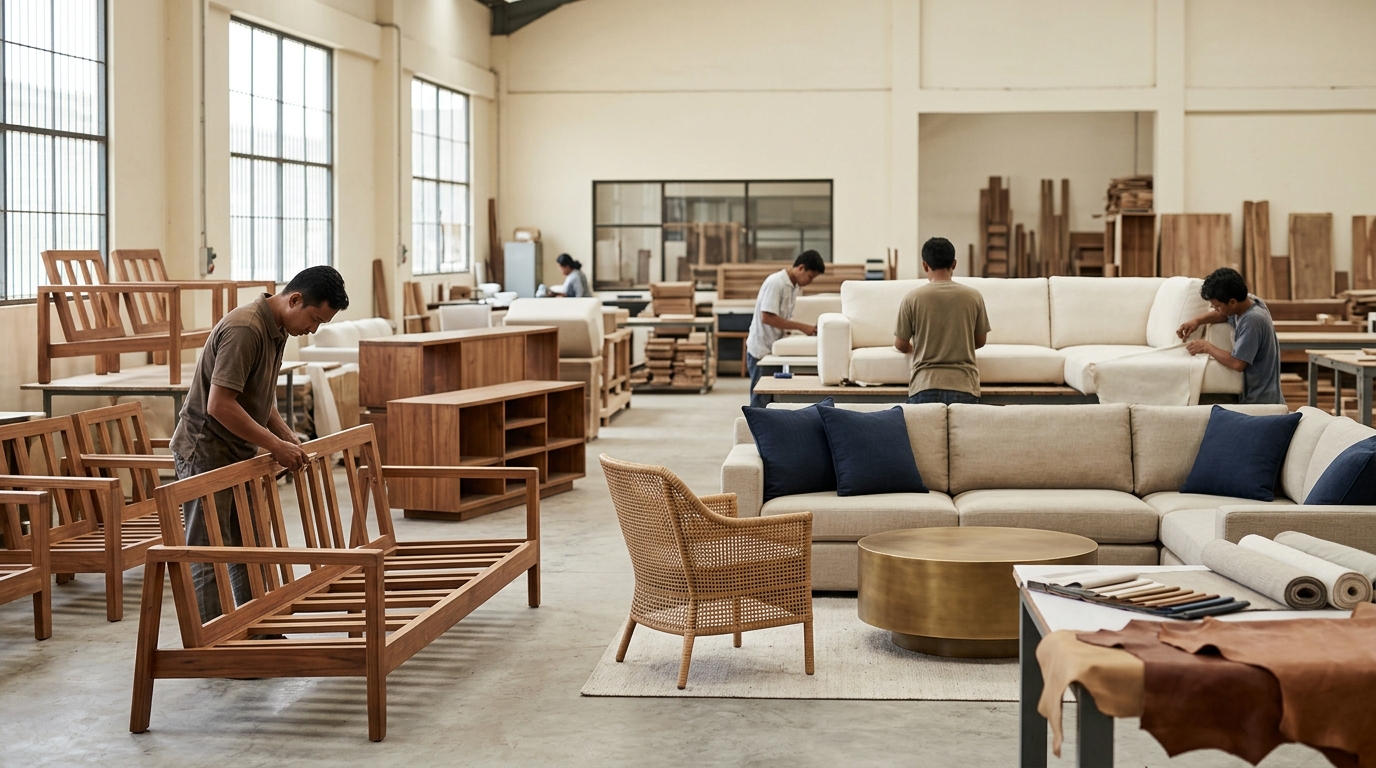
US retailers sourcing living room collections face a specific problem: finding manufacturers who can deliver frame quality, upholstery flexibility, and collection consistency across repeat orders — not just a single impressive sample. Indonesia addresses all three, but only if you know how to…
US retailers sourcing living room collections face a specific problem: finding manufacturers who can deliver frame quality, upholstery flexibility, and collection consistency across repeat orders — not just a single impressive sample. Indonesia addresses all three, but only if you know how to structure the relationship before the first purchase order is placed.
This guide covers the full sourcing decision chain forliving room furniture wholesaleIndonesia. Topics include product categories, frame and joinery standards, COM/COL upholstery workflows, and collection consistency protocols. MOQ structures, pricing, US compliance requirements, and supplier vetting criteria are also addressed.
Indonesia's furniture export base is concentrated in several distinct manufacturing clusters. Jepara in Central Java dominates solid teak and mahogany production. Cirebon leads in rattan. Surabaya handles mid-market volume. Bali serves luxury artisan and hospitality segments. Each cluster has different MOQ tolerances, lead time profiles, and quality control maturity.
The sections that follow move from product structure through compliance to supplier qualification. Buyers evaluating their first Indonesia program and those renegotiating existing supplier relationships will find actionable checkpoints throughout.
Why Indonesian Living Room Furniture Wholesale Outperforms Competing Source Regions
Material Depth No Other Region Matches
Indonesia holds a structural advantage in natural hardwoods. Plantation teak — graded A, B, and C by density and grain consistency — is available at scale from Jepara suppliers.Reclaimed teakoffers character and a sustainability narrative for premium collections. Mahogany and suar (monkey pod) add breadth for mid-range programs.
This material mix translates directly into living room collection architecture. A single Indonesian manufacturer can produce a teak sofa frame, a rattan accent chair, a suar coffee table, and a mahogany media unit with coordinated finish specifications.
Cost and Collection Structure for Wholesale Buyers
For wholesale buyers, Indonesia typically delivers lower landed costs than Malaysia and comparable or lower costs than comparable-quality Vietnamese hardwood programs. The advantage is clearest in hand-finished solid wood and rattan categories. It narrows for panel-dependent upholstered frames, where Vietnam's plywood supply chain is more developed.
Brick-and-mortar retailers benefit from collection depth: sofas, armchairs, occasional tables, and media units designed as a coordinated range. E-commerce brands benefit from the ability to photograph a full room set from a single supplier, reducing content production complexity.
Key Living Room Product Categories Available from Indonesian Manufacturers
Sofas and Lounge Frames
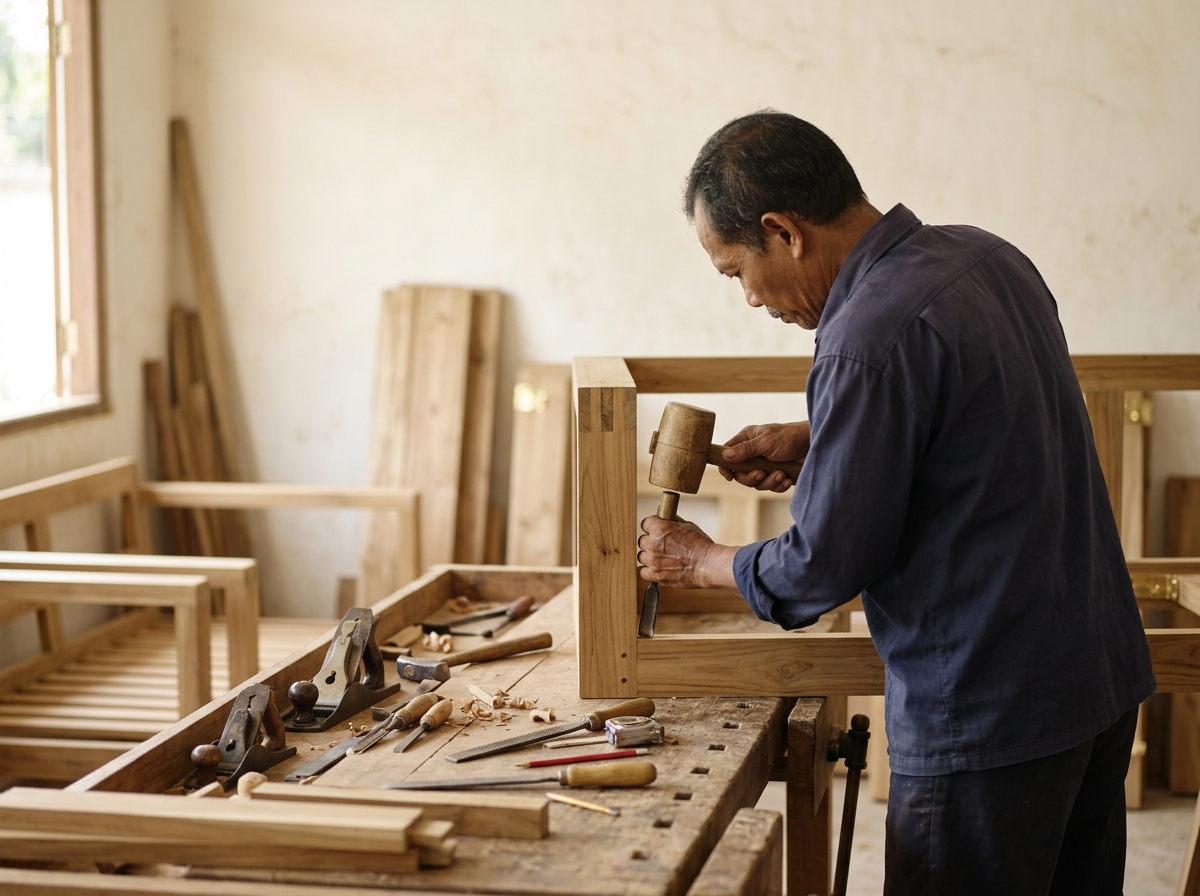
Solid teak sofa frames are the category most strongly associated with Indonesian living roomfurniture wholesale. Grade A teak offers tight grain and high oil content, providing natural resistance to movement and cracking.
Mahogany frames are lighter and more affordable than teak. Suar is distinctive for its wide slabs and natural edge character, used frequently in coffee table bases and accent seating. Rattan lounge frames — both full rattan and rattan-wrapped hardwood — are a strong differentiator for coastal and transitional collections targeting US lifestyle retail.
Armchairs, Accent Seating, and Upholstery-Ready Frames
Indonesian factories produce upholstery-ready frames in both fully assembled and knock-down (KD) formats. KD reduces container cube and freight cost. Fully assembled commands higher FOB but simplifies retailer receiving. Most mid-to-large factories in the Jepara and Surabaya clusters can produce both.
Accent chairs — barrel chairs, wingbacks, and slipper chairs — on teak or mahogany frames are a high-value wholesale opportunity. Many factories offer these as upholstery-ready blanks, meaning the frame ships without fabric and the buyer sources upholstery domestically or specifies COM/COL.
Media Units, Occasional Tables, and Collection Anchors
Media units and entertainment consoles are where Indonesian wholesale collections gain retail credibility. A sofa program without a coordinating media unit limits floor set potential. Most Jepara factories producing living room collections include TV consoles, display cabinets, and low-profile shelving in their standard range.
Occasional pieces — coffee tables, nesting tables, side tables — are typically lower MOQ items within a collection program. They provide margin diversity and allow retailers to test a collection at lower initial investment before committing to sofa and armchair volumes.
Frame Construction Standards That Define Indonesian Wholesale Quality
Joinery, Timber Grades, and Kiln-Drying
Joinery method is the primary quality differentiator between Indonesian factories. Mortise-and-tenon joinery — where a tenon cut into one member slots into a mortise cut into another — provides structural integrity under load and repeated use. It is standard in quality-grade Jepara production. Dowel joinery is faster and cheaper but less durable under stress.
Kiln-dried timber is non-negotiable for US-bound shipments. Inadequately dried wood moves after delivery, causing joint failure, finish cracking, and customer returns. Require moisture content documentation — typically 8–12% for interior furniture — as part of your pre-shipment quality checklist.
Teak grading matters for repeat order consistency. Agree on grade specification in the purchase order, not verbally. A/B grade distinctions affect color variation band, and this directly impacts finish matching across production runs.
Rattan and Natural Fiber Frames
Cirebon-sourced rattan frames use both natural rattan pole and synthetic PE rattan depending on end-use. For indoor living room applications, natural rattan on a hardwood sub-frame provides the best combination of aesthetics and structural life. Buyers should specify minimum pole diameter and inspect binding wrap quality at joints.
- ✓Moisture content certificate (8–12% target)
- ✓Joinery method confirmation (mortise-and-tenon at structural joints)
- ✓Teak or hardwood grade specification in PO
- ✓Rattan pole diameter and binding inspection
- ✓Kiln-drying documentation from supplier
- ✓Finish reference sample comparison
Upholstery Options, COM and COL Programs for Wholesale Buyers
Standard Upholstery Grades from Indonesian Factories
Most Indonesian factories offering upholstered living room furniture stock a range of cotton-blend, polyester, and bonded leather grades for standard production. These are cost-efficient for buyers building entry-to-mid-range retail programs. However, stock fabric and leather options vary significantly by factory. Assess the upholstery grade range during factory qualification, not after sampling.
Foam specification — density and ILD (indentation load deflection) — is a separate quality variable from fabric. Require foam density and ILD documentation for any upholstered seating. Common specifications for sofa seat cushions are approximately 1.8–2.0 lb/ft³ density and 35–45 ILD for medium-firm feel. Factories that cannot provide these figures are a risk signal.
COM and COL Workflow: How It Actually Works
Customer's Own Material (COM) and Customer's Own Leather (COL) programs allow buyers to specify fabric or leather sourced outside the factory. This is critical for US retailers with branded upholstery programs, exclusive textiles, or performance fabric requirements not available from factory stock.
The workflow has specific operational steps:
1. Buyer provides a COM/COL spec sheet: fabric width, repeat, direction, weight, and estimated yardage per unit. 2. Factory calculates cutting yield and confirms yardage requirement with waste factor. 3. Buyer ships or couriers material to the factory — or specifies a local Indonesian fabric agent if available. 4.
COM/COL adds lead time. Expect approximately two to four weeks beyond standard production for material receipt, strike-off, and buyer approval. Factories with in-house upholstery departments handle COM/COL more reliably than those outsourcing upholstery to subcontractors.
Minimum yardage thresholds vary by factory. Many Jepara and Surabaya manufacturers require a full container's worth of upholstered units to justify COM/COL setup, though smaller specialist factories may accommodate lower volumes at a per-unit surcharge.
Communicating Upholstery Specs to Indonesian Factories
Language precision prevents costly errors. Use international textile standards where possible. Specify color by Pantone reference, not verbal description. For leather, specify full-grain, top-grain, or split-grain clearly — 'genuine leather' is not a specification. Include a physical swatch or sample in your tech pack, not just a digital image.
Maintaining Collection Consistency Across Multiple Production Runs
Why Natural Wood Creates Repeatability Risk — and How to Manage It
Natural teak and mahogany vary in color, grain density, and porosity between trees and even within a single log. This is a structural property of natural material, not a quality defect. The challenge for wholesale buyers is managing this variation so that production run two looks like production run one to a retail customer.
The standard mitigation is a finish reference sample protocol. At the conclusion of each production run, the buyer retains or approves a set of sealed finish reference samples — one per SKU. These samples travel with the next purchase order as physical color and finish standards.
Finish Control: Stain Matching and Lacquer Specs
Stain specifications should be documented in RAL, NCS, or Pantone references for base tone, with a defined acceptable variation band — typically described as light/medium/dark tolerance brackets around the approved reference.
Request that the factory retains a production control board — a physical panel showing the approved stain color, grain fill level, and topcoat sheen — for every active SKU. This is standard practice in quality-tier Indonesian factories and a key differentiator versus lower-tier producers.
SKU Documentation and Tech Packs
A functional tech pack for an Indonesian living room furniture SKU should include:
- Dimensioned line drawings (front, side, top, exploded joint detail) - Material specification (timber species, grade, moisture content target) - Finish specification (stain reference, topcoat type and sheen level) - Upholstery specification (fabric/leather grade, COM/COL notation, foam spec) - Hardware list (leg tips, corner protectors, mechanism type if applicable) - Packaging specification (carton type, foam corner protection, poly bag) - QC checkpoints and acceptable defect classification
Factories with in-house QC departments can work directly from this documentation. Factories without structured QC will need third-party inspection to bridge the gap. Budget for third-party pre-shipment inspection on every production run until you have established a verified quality baseline with a supplier.
MOQ, Pricing Structures, and Incoterms for US Living Room Furniture Importers
Typical MOQ Ranges and Price Bands by Product Type
MOQ in Indonesia is typically negotiated at collection level, not per SKU. A coordinated living room collection — sofa, two armchairs, coffee table, media unit — may require a minimum of one full 20-foot container per order, which roughly equates to 15–30 sofa sets depending on size and KD ratio.
Single-SKU MOQ from larger Jepara factories commonly starts at 20–50 units for case goods and 10–25 units for upholstered frames. Smaller artisan workshops may accept lower volumes at higher per-unit pricing.
| Product Type | Construction | Approximate FOB Price Range | Typical MOQ |
|---|---|---|---|
| 3-seater sofa frame | Solid teak, upholstery-ready | $280–$580 | 10–25 units |
| 3-seater sofa, upholstered | Teak frame, stock fabric | $420–$850 | 10–20 units |
| Accent armchair | Rattan on hardwood frame | $120–$280 | 20–40 units |
| Coffee table | Solid suar, natural edge | $90–$220 | 20–40 units |
| Media unit / TV console | Solid teak or mahogany | $180–$420 | 15–30 units |
| Display cabinet | Solid mahogany, glass door | $220–$480 | 10–20 units |
All price ranges are approximate FOB estimates based on typical mid-market Indonesian factory positioning. Actual pricing depends on specification, finish complexity, and order volume.
Understanding Incoterms and Landed Cost Calculation
EXW (Ex-Works): Factory gate price. Buyer controls all logistics. Useful for cost benchmarking but operationally complex for first-time Indonesia importers.
FOB (Free On Board): Seller delivers to the named port and loads the container. Most common basis for US import calculations. Add ocean freight, US port handling, customs clearance, duty, and first-mile trucking to arrive at landed cost.
CIF (Cost, Insurance, Freight): Seller pays freight and insurance to US port of entry. Simplifies invoicing but reduces buyer control over freight carrier selection and rate negotiation.
For US landed cost estimation, key variables include FOB value and ocean freight. Note that ocean freight per CBM from Indonesia is typically higher than from China due to vessel frequency.
Certifications, Compliance, and US Import Requirements for Indonesian Furniture
Lacey Act and SVLK Timber Legality
The Lacey Act requires US importers to declare the genus, species, country of harvest, and quantity of plant material in imported wood products. Indonesian teak destined for US retail must be traceable to legal harvest. The SVLK (Sistem Verifikasi Legalitas Kayu) is Indonesia's government-mandated timber legality verification system.
CARB Phase 2 and TSCA Title VI for Composite Components
This is a compliance area most sourcing guides overlook. Upholstered sofa frames frequently incorporate MDF or plywood components in seat bases, back panels, and arm pads.
Non-compliant composite wood in an upholstered frame creates import and retail liability regardless of the frame's primary teak or mahogany construction. Require written confirmation from every Indonesian supplier that composite wood components in upholstered frames meet CARB Phase 2 / TSCA Title VI standards.
FSC, Rainforest Alliance, and HTS Classification
FSC (Forest Stewardship Council) certification is available from a subset of Indonesian teak and mahogany producers, particularly those supplying European and premium US retail channels. It adds sourcing credibility but is not universally available across the Indonesian supplier base. Rainforest Alliance certification overlaps with FSC in some plantation contexts.
For HTS classification, the primary codes relevant to Indonesian living room furniture imports are:
- 9403.60 — Wooden furniture, other than for offices, kitchens, or bedrooms (solid wood case goods) - 9401.61 — Upholstered seats with wooden frames - 9401.69 — Other seats with wooden frames
Confirm HTS classification with a licensed customs broker before the first shipment. Misclassification affects duty liability and Section 232 / 301 exposure assessment.
How to Vet and Shortlist Indonesian Living Room Furniture Suppliers
Factory Audit Criteria
A factory audit for Indonesian living room furniture wholesale should assess production floor area, machinery, and CNC capability for consistent machining. Evaluate workforce size and skill profile, including carpenters, upholsterers, and finishers as distinct departments, alongside in-house QC processes such as defect classification systems and retain sample policies.
Factories that cannot provide export references for US-bound shipments are a higher risk for compliance documentation gaps. Online platform ratings — Alibaba, Made-in-China — do not substitute for physical or third-party audits. Independent factory audits conducted by qualified inspection firms provide the most reliable pre-qualification signal.
Trade Shows and Direct Outreach
IFEX (Indonesia International Furniture Expo) in Jakarta is the primary discovery channel for Indonesian manufacturers serving export markets. It concentrates quality-tier factories across wood, rattan, and upholstered categories in a single venue.
Direct manufacturer outreach via verified B2B platforms can accelerate shortlisting, but requires rigorous follow-up. Request factory photos, production videos, and current export client references as a minimum before committing to sample orders.
Red Flags in Supplier Qualification
Suppliers who decline to confirm their classification — manufacturer versus trader versus export merchant — should be treated as high-risk. A trading company intermediary is not inherently a problem, but opacity about supply chain structure indicates a risk to traceability, QC control, and compliance documentation.
Additional red flags: inability to provide SVLK documentation, no written QC process, samples that arrive with finish inconsistencies across matched pieces, and lead time commitments that are significantly shorter than industry norms without a credible explanation.
- ✓Active SVLK certification documents
- ✓CARB Phase 2 / TSCA Title VI declaration for composite components
- ✓Export references for US-bound shipments
- ✓Physical factory audit report (own team or third-party)
- ✓Mortise-and-tenon joinery confirmation for structural frames
- ✓Kiln-drying moisture content documentation
- ✓COM/COL capability and workflow confirmation
- ✓Finish reference sample retention process
- ✓Tech pack acceptance and documented revision process
- ✓FOB port routing confirmation (Tanjung Perak or Tanjung Priok)
Frequently Asked Questions on Indonesian Living Room Furniture Wholesale
What is the typical lead time for a wholesale living room furniture order from Indonesia to the US?
Production lead time for a coordinated living room collection from Indonesia is typically 60–90 days from purchase order confirmation and deposit receipt. COM/COL upholstery programs add approximately two to four weeks.
Can Indonesian manufacturers produce custom upholstery using my own fabric (COM/COL)?
Yes. COM/COL programs are available from most mid-to-large Indonesian factories with in-house upholstery departments. The buyer supplies fabric or leather specifications, the factory calculates yardage, and strike-off samples are approved before full production cut. See the upholstery section above for the full workflow.
What certifications should I require fromIndonesian furniture suppliersfor the US market?
At minimum: SVLK (timber legality, supports Lacey Act compliance), CARB Phase 2 / TSCA Title VI test reports for any composite wood components, and fumigation certification (ISPM 15) for solid wood packaging. FSC is a strong additional credential for premium or sustainability-positioned retail programs.
What are the minimum order quantities for a coordinated living room collection from Indonesia?
A full coordinated collection typically requires one 20-foot container as a minimum, roughly equivalent to 15–30 sofa sets depending on KD ratio and product mix. Individual SKU MOQs range from approximately 10 to 50 units depending on product type and factory scale. See the comparison table in the MOQ section above for product-level guidance.
How do I ensure finish and color consistency across repeat production runs?
Establish a finish reference sample protocol: retain approved physical samples at the end of each production run and supply them with the next purchase order as color and finish standards. Require a production control board at the factory showing approved stain tone, grain fill, and topcoat sheen for each active SKU.
What are the mainIndonesian furnitureexport ports and how do shipping costs compare?
Tanjung Perak in Surabaya serves Central and East Java manufacturers, including the Jepara cluster. Tanjung Priok in Jakarta serves West Java and Bali suppliers. Ocean freight rates from Indonesia to the US are generally comparable to Vietnam but higher per CBM than China due to vessel frequency differences.
Sourcing living room furniture wholesale from Indonesia at scale requires discipline across three linked systems: frame and material specification, upholstery program structure (including COM/COL workflow), and collection consistency documentation across production runs.
You now have the operational framework to evaluate Indonesian suppliers against specific criteria, not general impressions. The logical next step is to validate that framework against real factory capabilities and live collection samples.
You have the criteria — now match them to verified Indonesian manufacturers. Request a wholesale catalog and sample set from vetted living room furniture producers in Jepara, Surabaya, and Cirebon, covering solid teak, mahogany, rattan, and upholstered frame collections built for US retail and e-commerce programs.
Request Catalog and Samples →Need eyes on the ground in Indonesia?
MTS is an execution partner — supplier verification, manufacturing management, quality control and export logistics across Indonesia, Vietnam and China.
Related services
Related articles
Receive furniture sourcing insights across Asia.
One email per week. No spam.