Coffee Tables and Side Tables Wholesale Indonesia: A Complete Buyer's Guide
14 min read
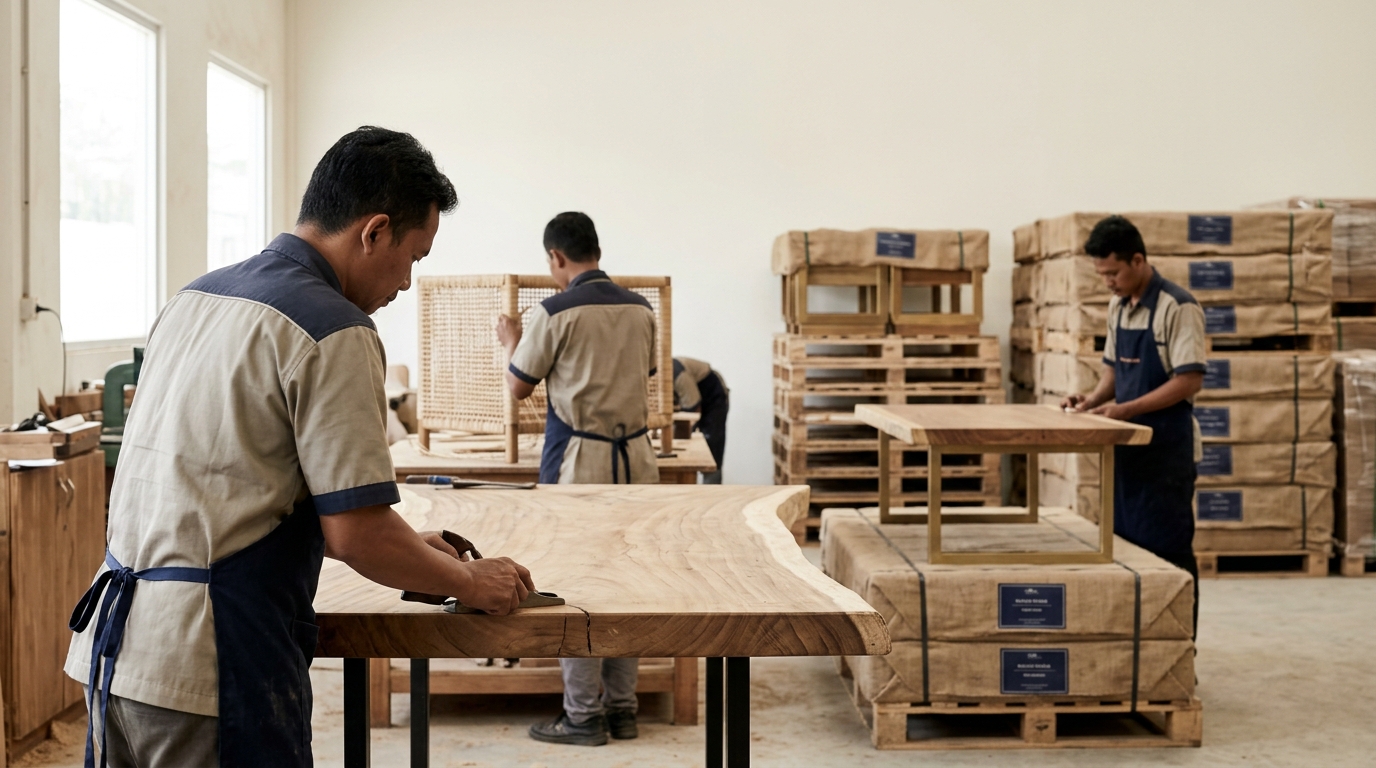
Sourcing coffee tables and side tables wholesale from Indonesia is not a simple catalog decision. US buyers face a matrix of material grades, moisture content risks, certification requirements, container economics, and supplier verification challenges — all before a single unit ships.
Sourcing coffee tables and side tables wholesale from Indonesia is not a simple catalog decision. US buyers face a matrix of material grades, moisture content risks, certification requirements, container economics, and supplier verification challenges — all before a single unit ships.
This guide covers the complete procurement picture for volume buyers — retailers, interior designers, hotel procurement teams, and import wholesalers. It addresses material selection, indicative FOB price bands by material tier, slab drying standards, freight optimization through nesting sets, and supplier vetting criteria.
Indonesia occupies a structurally different position from Vietnam or India in the naturalwood furnituremarket. Its combination of endemic timber species, centuries-old craft traditions in Jepara and Bali, and integrated sawmill-to-export supply chains makes it the primary source for solid teak, suar slab, and rattan side tables at wholesale scale.
Why Indonesia Leads the Global Market for Coffee Tables and Side Tables Wholesale
Production Hubs and Timber Heritage
Indonesia's furniture export strength is geographically concentrated. Jepara (Central Java) is the dominant production cluster for solid teak (Tectona grandis) and mahogany carved furniture. Cirebon specializes in rattan. Bali handles luxury artisan and resort-grade pieces, often for hospitality procurement. Surabaya and Semarang serve mid-market and outdoor categories.
This geographic clustering means buyers can source multiple table categories — teak coffee tables, rattan side tables, suar slab accent pieces — from within a single regional supply chain. That reduces coordination complexity compared to splitting orders across countries.
Supply Chain Integration and Cost Position
Indonesian manufacturers in Jepara and Central Java commonly operate with integrated sawmill, kiln-drying, and finishing capabilities under one facility. This vertical integration reduces handoff delays that add weeks to lead times in more fragmented supply bases.
Labor costs in Indonesia remain competitive against comparable quality tiers in Vietnam. Vietnam's strength is in high-volume panel and bedroom furniture with strong mechanization. Indonesia's advantage is in natural solid wood and handcraft work — the exact category that coffee tables and side tables wholesale buyers want.
Certification Landscape for US Importers
Three certification systems matter for US import compliance:
- SVLK (Sistem Verifikasi Legalitas Kayu): Indonesia's mandatory timber legality verification system. AnyIndonesian furnitureexporter shipping wood products internationally must hold SVLK certification. It is a government-administered chain-of-custody standard. - FSC (Forest Stewardship Council): Voluntary, internationally recognized. FSC-certified teak and suar from Indonesian suppliers satisfies responsible sourcing requirements for US retailers with sustainability policies. - PHPL (Pengelolaan Hutan Produksi Lestari): Indonesia's sustainable forest management standard for timber concessions. Relevant when tracing raw material origin upstream from the manufacturer.
For US importers, SVLK is the baseline minimum. FSC is the differentiator for buyers supplying retailers with ESG commitments. Always verify certificate numbers directly on the issuing body's online registry — certificate laundering (valid FSC numbers presented by non-certified suppliers) is a documented risk in the Indonesian supply chain.
Material Selection for Bulk Orders: Teak, Suar, Rattan, and Mixed-Media
Solid Teak (Tectona grandis)
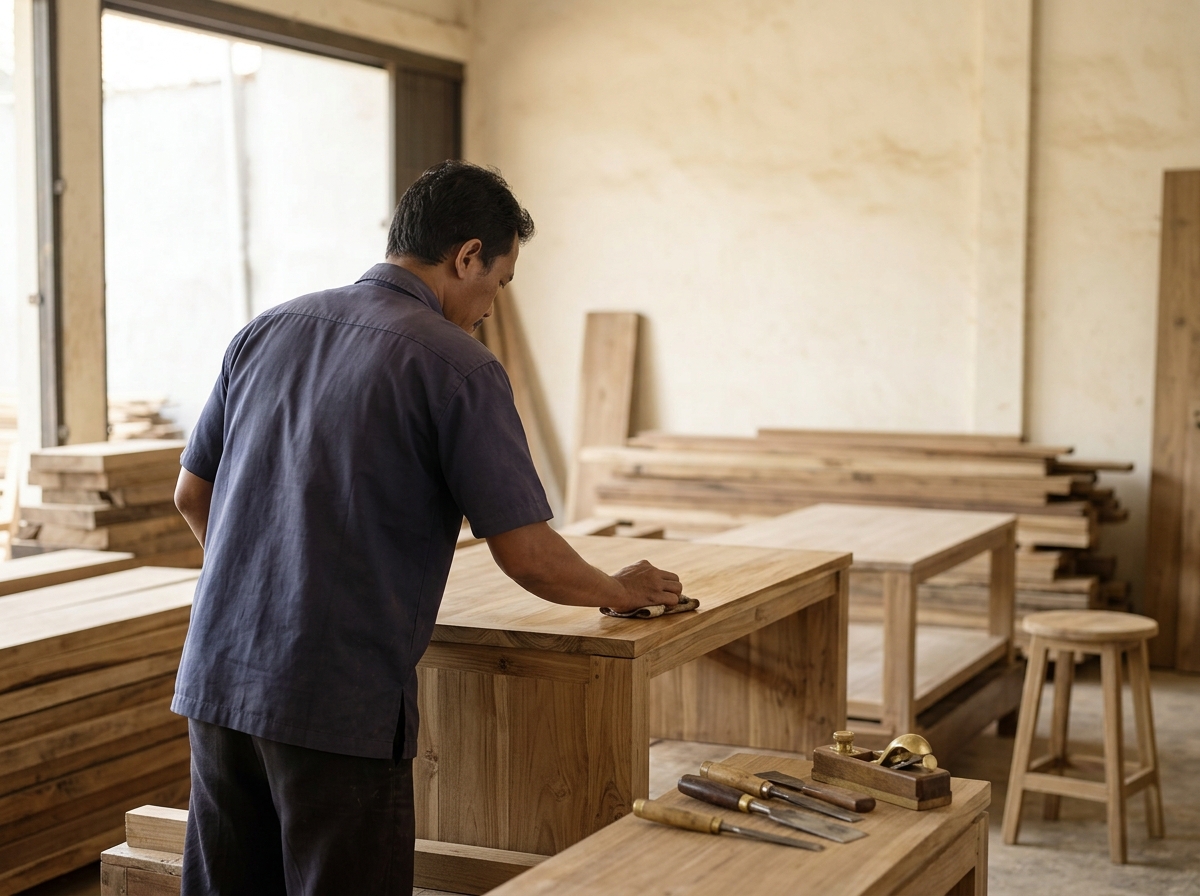
Teak is graded A, B, and C by most Indonesian exporters. Grade A uses heartwood from older plantation stock — tight grain, high natural oil content, minimal knots. Grade B includes some sapwood and minor mineral streaks. Grade C incorporates more character marks and is common inreclaimed teakproducts.
Natural oil content makes teak resistant to moisture, insects, and surface cracking — relevant for buyers supplying semi-outdoor or sunroom applications. For indoor coffee tables, Grade B plantation teak offers strong durability at better FOB pricing than Grade A.
All teak exported from Indonesia must carry SVLK documentation. FSC-certified plantation teak is available from larger Jepara manufacturers and commands a modest premium.
Suar (Samanea saman) Slab
Suar, also called rain tree, produces wide slabs with dramatic natural-edge figuring. It is the primary material for live-edge coffee tables in the mid-to-premium wholesale segment. Suar grows faster than teak, making it more available in large slab widths — commonly 80 to 140 cm — that teak plantation stock rarely reaches.
The critical procurement variable for suar is drying. Under-dried slabs crack after import into US interiors. See the next section for the full EMC protocol.
Rattan and Woven Designs
Cirebon (West Java) is Indonesia's rattan manufacturing center. Structural frames are typically rattan pole or steel with woven rattan skin. Weave patterns range from open herringbone to tight Kubu grey. Rattan is moisture-sensitive — it is not suitable for high-humidity storage environments during transit or warehouse holding.
For wholesale side tables specifically, rattan offers the lightest shipping weight per unit, which directly reduces ocean freight surcharges on dense-material mixed orders.
Mixed-Material Combinations
The highest-velocity wholesale SKUs in the Indonesian export market combine materials:
- Teak top with powder-coated iron hairpin or trapeze legs - Suar slab with matte black steel base - Mindi (white mahogany) frame with tempered glass insert - Rattan weave panel with solid teak border frame
Mixed-media designs allow buyers to hit retail price points between pure rattan and solid teak. They also offer visual differentiation in catalog assortments without full custom development cost.
Slab Drying and Wood Movement Control: What Wholesale Buyers Must Verify
This section covers procurement intelligence that most supplier guides omit entirely. It is the highest-risk technical area for suar and reclaimed teak slab orders.
Why EMC Matters for US-Bound Shipments
Wood stabilizes at an equilibrium moisture content (EMC) determined by the ambient humidity of its environment. US interior environments typically average 6–8% EMC depending on region and season. Indonesian tropical air humidity means freshly processed suar can hold 25– approximately 40% moisture content without intervention.
Suar and reclaimed teak slabs must be kiln-dried to 8– approximately 12% moisture content (MC) before export. This range is the accepted industry target for furniture-grade tropical hardwood destined for North American interiors. Slabs shipped above this range will lose moisture after delivery, causing checking (surface cracking), cupping, or warping.
Moisture Content Verification Methods
Request the following before authorizing shipment:
- Kiln-drying certificate from the manufacturer, specifying entry MC, exit MC, kiln temperature curve, and drying duration - Pre-shipment MC spot-check using a calibrated pin or pinless moisture meter, conducted during a pre-shipment inspection (PSI) at the factory - Reading locations: MC should be measured at slab center, 30 cm from each end, and at the thickest cross-section point — not just the surface
A supplier who cannot provide a kiln-drying certificate with actual MC readings — not a generic "kiln-dried" label — is a red flag. Ask for the data. Legitimate exporters with proper kilns produce this documentation routinely.
Protective Packaging for Ocean Transit
Ocean freight from Indonesia to US West Coast (LA/Long Beach) takes approximately 18–25 days. East Coast (New York/New Jersey via Suez) runs approximately 28–35 days. During that time, slab tables need:
- Wax-sealed end grain on all slab edges to slow moisture exchange - Silica gel packs inside individual carton or stretch-wrap enclosures - Solid timber crating (not just cardboard) for slabs above approximately 40 kg - Foam corner protection on all leg-to-top contact points
- ✓Kiln-drying certificate with MC exit reading of 8–12%
- ✓Pin or pinless MC meter spot-check at 3+ slab locations
- ✓End grain wax sealing on all exposed slab edges
- ✓Silica gel packs inside each carton or wrapping
- ✓Solid timber crating for heavy slab units
- ✓Foam protection at all leg attachment points
Wholesale Price Bands by Material, Style, and Order Volume
The table below shows approximate FOB Semarang/Surabaya price ranges for common table categories. These are indicative ranges based on typical market positioning — actual quotes vary by specification, finish, hardware, and manufacturer tier. Always treat these as budgeting benchmarks, not firm offers.
| Material | Table Type | MOQ (approx.) | FOB Price Range / Unit |
|---|---|---|---|
| Rattan / mindi frame | Side table, single | 20–50 pcs | $45–$90 |
| Mindi (white mahogany) | Coffee table, standard | 20–50 pcs | $80–$150 |
| Reclaimed teak | Coffee table, standard | 20–40 pcs | $150–$280 |
| Solid teak (Grade B) | Coffee table, standard | 20–40 pcs | $180–$320 |
| Solid teak (Grade A) | Coffee table, premium | 10–20 pcs | $280–$480 |
| Suar slab, live edge | Coffee table, 120–160 cm | 5–15 pcs | $350–$700+ |
| Suar slab, bookmatched | Coffee table, wide format | 5–10 pcs | $550–$950+ |
Key pricing variables:
- Slab width: Suar slabs above 100 cm wide cost disproportionately more — wide slabs are scarcer and require longer kiln cycles - Finish type: Natural oil finish adds minimal cost;lacquer or two-pack urethane adds approximately $15–$40 per unit at production scale - Base material: Powder-coated steel bases add approximately $20–$60 per unit over wood bases - Custom sizing: Non-standard dimensions typically add 10–20% to unit cost and extend lead times by 2–3 weeks
Freight Economics: CBM, Weight, and Container Strategy for US Importers
CBM Calculations by Table Type
Cubic meter (CBM) volume drives ocean freight cost. Approximate packaged CBM ranges:
- Standard coffee table (120 × 65 × 45 cm): approximately 0.5–0.8 CBM per unit - Side table (50 × 50 × 55 cm): approximately 0.2–0.35 CBM per unit - Suar slab coffee table (160 × 80 × 45 cm): approximately 0.7–1.1 CBM per unit
Dense teak tables also trigger weight-based freight surcharges. A solid teak coffee table commonly weighs 35–60 kg. Rattan side tables typically run 4–10 kg. Mixing light rattan pieces with heavy suar slabs in the same container helps balance weight distribution without exceeding container weight limits.
Container Loading Strategy
A standard 20-foot container holds approximately 25–28 CBM usable volume. A 40-foot container holds approximately 55–60 CBM. For most wholesale coffee and side table orders, a 40-foot container is more cost-efficient per unit once order volume exceeds approximately 40–50 pieces of mixed table types.
Port of Origin Options and Transit Times
| Port | Location | Best For | Approx. Transit to LA/Long Beach | Approx. Transit to NY/NJ |
|---|---|---|---|---|
| Tanjung Emas | Semarang, Central Java | Jepara production cluster | 18–22 days | 30–36 days |
| Tanjung Perak | Surabaya, East Java | Mid-market, Surabaya factories | 20–25 days | 32–38 days |
| Ngurah Rai / Benoa | Bali | Bali artisan and luxury pieces | 22–28 days | 34–40 days |
For buyers sourcing from Jepara — the primary teak and suar production hub — Tanjung Emas (Semarang) is the most logical port of origin. It reduces inland haulage cost and typically offers shorter transit to LA/Long Beach than routing through Tanjung Perak.
West Coast buyers (LA/Long Beach) generally receiveIndonesian furnitureshipments faster than East Coast. East Coast buyers (New York/New Jersey) often accept the longer transit for competitive FOB pricing, particularly on premium teak and suar categories where freight as a percentage of unit cost is lower.
Nesting Sets and Knock-Down Designs That Maximize Container Return on Investment
Commercial Value of Nesting Table Sets
Two-piece and three-piece nesting coffee and side table sets are among the highest-ROI wholesale formats from Indonesia. For retail buyers, they offer a bundled SKU with higher average ticket. For importers, they dramatically reduce CBM per equivalent unit count.
A set of three nesting round teak side tables — stacked inside each other for shipping — occupies approximately 0.3–0.5 CBM. Three equivalent standalone tables occupy approximately 0.6–1.0 CBM. The CBM reduction commonly ranges from 30–50%, depending on design and leg configuration.
Design Configurations That Enable Efficient Loading
Indonesian manufacturers producing nesting and space-efficient tables typically offer:
- Stacking-friendly tapered legs: legs that allow vertical nesting without contact damage - Knock-down (KD) assembly: tabletops and bases shipped flat, assembled by the retailer or end consumer;reduces CBM by 40– approximately 60% for qualifying designs - Flat-pack rattan side tables: woven panels pre-attached to flat-fold frames
KD assembly is more common in mindi and rattan categories. Solid teak and suar slab tables are rarely practical as flat-pack due to weight and joinery complexity.
Top-Performing Nesting Set Styles
- Round teak nesting sets (2–3 pieces): consistent seller forliving roomretail assortments - Oval suar nesting sets: premium positioning, high margin, lower competition - Rectangular rattan nesting sets: light, low freight cost, broad consumer appeal
How to Vet Indonesian Coffee and Side Table Suppliers Before Placing a Bulk Order
Factory Audit Essentials
A credible Indonesian coffee table manufacturer should demonstrate:
- On-site kiln-drying facility: minimum 6–8 cubic meter capacity kilns with temperature monitoring logs - Dedicated finishing area: separate from raw production, with controlled dust and humidity - QC inspection stages: raw material intake check, in-process dimensional check, pre-finish surface inspection, final pre-pack inspection
Request evidence of each stage during a factory audit or third-party inspection. Suppliers without on-site kilns who claim "kiln-dried" product are sub-contracting drying — which means MC control is not within their quality system.
Documentation Checklist for US Import
- ✓Commercial invoice (with HS code, FOB value, unit count)
- ✓Packing list (with CBM, gross weight, net weight per carton)
- ✓Bill of lading (ocean or multimodal)
- ✓Phytosanitary certificate (for solid wood products)
- ✓SVLK certificate (mandatory for all wood furniture exports)
- ✓FSC chain-of-custody certificate (if FSC-certified product is specified)
- ✓Moisture content certificate for slab products
- ✓Certificate of origin (for any applicable trade preference programs)
Red Flags in Supplier Selection
Specific warning signs to screen during supplier evaluation:
- No MC data available for suar or reclaimed teak products - Vague answers about sub-contracting — particularly for finishing or component sourcing - FSC or SVLK certificates that show a different company name than the shipper on the bill of lading - Unusually low MOQs from what appears to be a small workshop presenting as a mid-scale manufacturer - Factory tours arranged at a facility that workers cannot identify by name when asked directly
The "sample bait-and-switch" pattern — where a high-quality sample is produced at one facility and the bulk production run is sub-contracted to a cheaper workshop — is the most common quality failure mechanism in Indonesian furniture sourcing. A pre-production inspection (pre-production audit) and a during-production inspection (DUPRO) at bulk stage are the structural defenses against this.
Sourcing Agents vs. Direct Factory Relationships
For first-time importers, a sourcing agent (typically charging 3–10% of FOB value) provides local language access, supplier introductions, and inspection coordination. The cost is justified when the buyer lacks existing factory contacts or cannot conduct in-person audits.
The structural risk is that commission-based agents have financial incentives tied to specific suppliers — which may not align with the buyer's quality or pricing interests. An independent operational partner with transparent fee structures and no supplier-side commissions avoids this conflict.
Customization and Lead Times for Bulk Coffee Table Orders from Indonesia
Available Customizations
Indonesian manufacturers — particularly in Jepara — offer broad customization on production runs:
- Dimensions: length, width, height adjustments within material constraints - Leg profiles: straight tapered, hairpin, A-frame, trapeze, turned, block - Surface finishes: natural teak oil, hardwax oil, semi-gloss lacquer, matte lacquer, whitewash, ebonized - Hardware: drawer pulls, shelf brackets, caster options on select designs - Private label packaging: branded carton printing, hang tags, assembly instruction inserts
Custom dimensions on suar slab tables are constrained by available slab inventory — wide slabs are not made to order; they are selected from existing stock. Buyers specifying slab width over 100 cm should allow additional lead time for slab sourcing.
Lead Times by Order Stage
| Stage | Approx (typically observed) lead time |
|---|---|
| Sample production (1–3 units) | 2–4 weeks |
| Sample approval and revision | 1–3 weeks |
| Production run (20–50 units) | 6–10 weeks |
| Production run (50–200 units) | 8–14 weeks |
| Pre-shipment inspection | 3–5 business days |
| Port handling and loading | 1–2 weeks after inspection |
Design file formats accepted by most Indonesian exporters include DWG, PDF dimensioned drawings, and SketchUp files. Approve a physical golden sample — a signed-off production unit retained at the factory — before authorizing bulk run commencement. This sample becomes the reference standard for DUPRO inspections.
Frequently Asked Questions: Coffee Tables and Side Tables Wholesale from Indonesia
What is the minimum order quantity for wholesale coffee tables from Indonesia? MOQs typically range from 20 to 50 pieces for standard designs. Suar slab tables often have lower MOQs of 5–15 units due to higher unit value. Samples are generally available at 1–5 units with a surcharge. Some factories negotiate lower MOQs for mixed-container orders combining multiple SKUs.
How do I ensure suar slab tables won't crack after import to the US? Specify kiln-drying to 8– approximately 12% MC in your purchase order. Request a kiln-drying certificate with actual MC exit readings. Conduct a pre-shipment inspection with MC meter verification at multiple slab locations. Require wax-sealed end grain and silica gel packing. These steps together reduce checking and warping risk significantly.
Which Indonesian port is best for shipping furniture to the US East or West Coast? For Jepara-sourced teak and suar production, Tanjung Emas (Semarang) offers the shortest inland haulage and competitive transit times — approximately 18–22 days to LA/Long Beach. Tanjung Perak (Surabaya) serves East Java manufacturers.
What certifications should Indonesian furniture suppliers have for US import compliance? SVLK is mandatory for all Indonesian wood furniture exports. FSC chain-of-custody certification is required if you specify FSC-certified material. A phytosanitary certificate is required for solid wood products. Verify all certificate numbers on the issuing body's online registry — do not accept copies alone.
Are nesting side table sets more cost-effective to ship than individual pieces? Yes, materially so. Nesting sets reduce packaged CBM by approximately 30–50% compared to equivalent standalone units. On ocean freight rates, this reduction directly lowers freight cost per unit. For retail buyers, nesting sets also carry higher average selling price per transaction, improving margin per container.
What is the typical FOB price difference between teak and rattan coffee tables at wholesale? Rattan and mindi side tables typically FOB at $45–$90 per unit at MOQ 20–50 pieces. Solid teak coffee tables range from approximately $180–$320 per unit (Grade B) at comparable quantities. The gap reflects material cost, processing time, and kiln-drying requirements for solid wood.
Indonesia's position as the primary source for coffee tables and side tables wholesale — across teak, suar, and rattan categories — rests on material access, craft infrastructure, and export experience that Vietnam or India cannot replicate in the natural wood segment.
You now have the procurement framework. The logical next step is putting verified Indonesian manufacturers to work on your specific requirements.
You understand the materials, pricing bands, freight variables, and certification requirements. Connect with verified Indonesian coffee table and side table manufacturers — teak, suar slab, rattan, and mixed-media — and receive wholesale quotes matched to your order volume and US import specifications.
Request a Wholesale Quote →Need eyes on the ground in Indonesia?
MTS is an execution partner — supplier verification, manufacturing management, quality control and export logistics across Indonesia, Vietnam and China.
Related services
Related articles
Receive furniture sourcing insights across Asia.
One email per week. No spam.