Glulam Laminated Beams from Indonesian Manufacturers: A Complete Sourcing Guide
13 min read
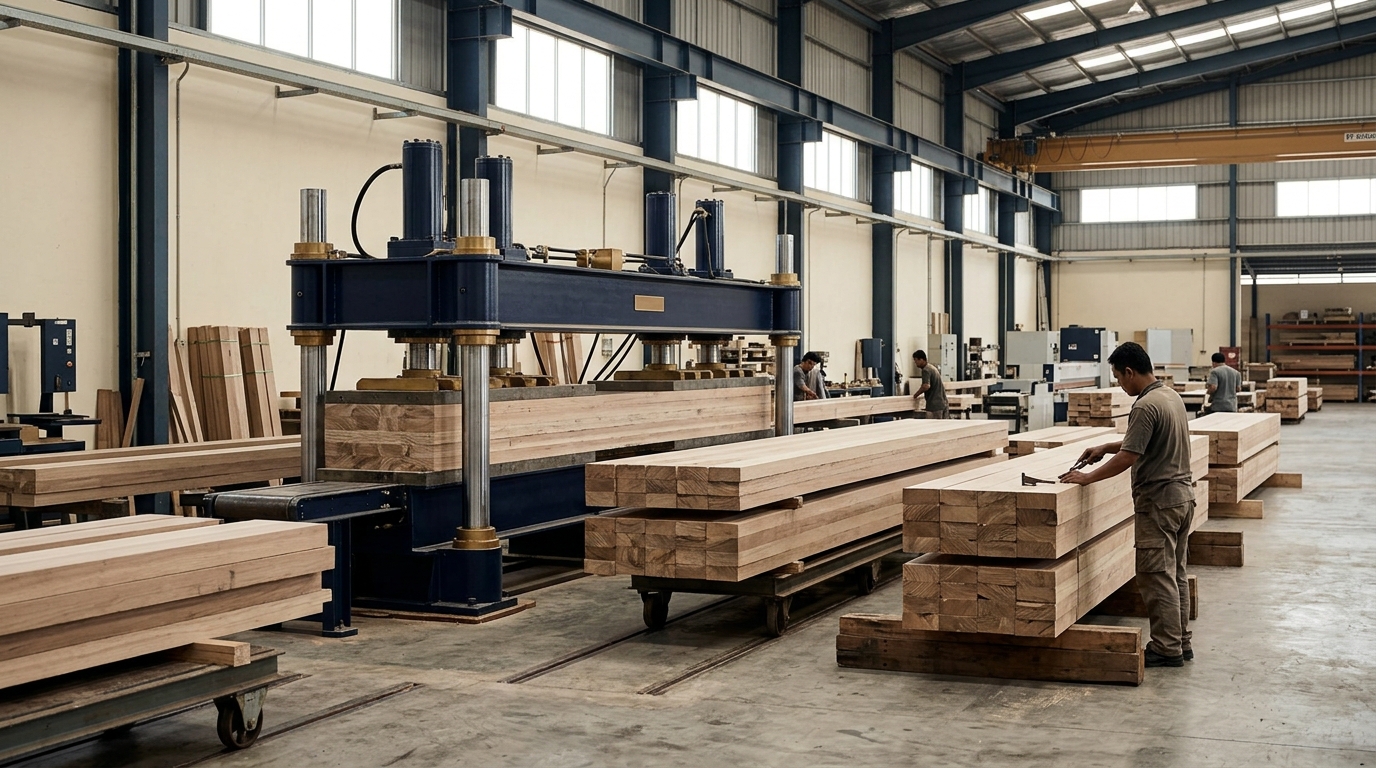
Sourcing glulam laminated beams from Indonesia requires more than finding a price list. US procurement teams must navigate species selection and adhesive specifications. They must also manage structural certifications, Lacey Act compliance, and ocean freight logistics. All of this must be resolved…
Sourcing glulam laminated beams from Indonesia requires more than finding a price list. US procurement teams must navigate species selection and adhesive specifications. They must also manage structural certifications, Lacey Act compliance, and ocean freight logistics. All of this must be resolved before a single beam ships. Mistakes at any stage can delay projects, trigger customs holds, or produce structural members that fail US building code review.
Indonesia has emerged as a credible origin for engineered structural timber. Indonesia's tropical hardwood base, growing manufacturing sophistication, and competitive costs are notable strengths. These factors make its glulam producers increasingly worth evaluating. They are now a credible alternative alongside European and North American sources. But the supplier landscape is uneven. Factory capabilities vary significantly across mills that produce laminated beams.
This guide covers what structural timber importers and construction procurement managers need. Topics include species properties, glue specs, strength grading, QC protocols, export packing, and supplier vetting. It also addresses two areas competitors consistently ignore: US tariff and Lacey Act compliance specific to Indonesian glulam. It also covers detailed moisture content protocols for tropical hardwood lamstock.
The following sections move from material selection through to factory qualification, giving you a complete decision framework before you issue a purchase order.
Why Indonesian Glulam Suppliers Are Gaining Ground in Global Structural Timber Markets
A Resource Base Built for Engineered Timber
Indonesia holds one of the world's largest tropical forest estates. Commercially available hardwoods — including Bengkirai, Merbau, Teak, and Ulin — exceed many temperate softwoods in density. They also offer superior durability compared to those same softwoods. Those softwoods are typically used in conventional glulam production. This material advantage underpins the country's growing position in structural laminated timber.
Production capacity is concentrated in Java, particularly Central Java and West Java provinces. Facilities in and around Semarang, Surabaya, and the broader Jepara cluster have invested heavily over the past decade. Investments include kiln-drying infrastructure, finger-jointing lines, and hydraulic pressing equipment. This investment has shifted part of the Indonesian timber industry from raw log export toward higher-value engineered products.
Competitive Position Against European and North American Sources
European glulam — primarily from Germany, Austria, and Scandinavia — dominates the US import market for certified structural laminated beams. North American producers supply the bulk of domestic demand. Indonesian manufacturers compete on price and on tropical hardwood species that offer higher natural durability than softwood alternatives.
Lead times from Indonesia to US West Coast ports run approximately eight to twelve weeks by ocean freight, depending on production schedule and vessel availability. This is longer than domestic supply but comparable to European sources. Custom members — curved, arched, or tapered beams — are where Indonesian suppliers can offer meaningful cost differentiation, given lower labor rates for the specialized pressing and jig work these profiles require.
Jakarta's recent landmark timber projects include multi-story structures built with locally produced glulam. These projects have demonstrated that Indonesian manufacturers can produce large-format structural members. These projects have improved domestic technical standards in Indonesia. They have also increased manufacturer familiarity with international specification requirements.
Species Selection for Glulam Laminated Beams: Indonesian Hardwood Properties Compared
Primary Lamstock Species and Mechanical Properties
Indonesian glulam laminated beams manufacturers Indonesia primarily use four native hardwood species as lamstock. Each has distinct mechanical properties, natural durability ratings, and supply chain characteristics.
| Species | Density (kg/m³, approx.) | Bending Strength (MPa, approx.) | Durability Class | Certification Status |
|---|---|---|---|---|
| Bengkirai (*Shorea laevis*) | 800–1,050 | 80–110 | Class 1–2 (very durable) | SVLK available; FSC limited |
| Merbau (*Intsia bijuga*) | 750–900 | 80–100 | Class 1–2 (very durable) | SVLK available; FSC restricted |
| Teak (*Tectona grandis*) | 630–750 | 60–90 | Class 1 (very durable) | FSC plantation-grown available |
| Ulin (*Eusideroxylon zwageri*) | 900–1,100 | 90–120 | Class 1 (very durable) | Highly restricted; CITES-adjacent concerns |
For comparison, Douglas Fir 24F-V3 glulam — the US market reference grade — has a density of approximately 500–550 kg/m³ and a tabulated bending design value of around 24 million psi fiber stress in bending. Indonesian tropical hardwood glulam, when properly graded and laminated, can exceed these bending values at the lamstock level.
Southern Yellow Pine (SYP) glulam, common in US commercial construction, has density approximately 550–640 kg/m³. Bengkirai and Merbau laminated beams are typically 40–60% denser than many alternatives. This affects connection detailing, fastener selection, and dead load calculations.
Species Availability, Sustainability, and Certification Implications
Teak from certified plantation sources offers the clearest path to FSC certification. Bengkirai and Merbau from managed natural forests can achieve SVLK legality verification. SVLK (Sistem Verifikasi Legalitas Kayu) is Indonesia's mandatory timber legality assurance system. SVLK is a prerequisite for legal export and satisfies Lacey Act due diligence requirements.
Ulin presents significant procurement risk. It is increasingly restricted under Indonesian forestry regulations due to overexploitation of natural stands. Procurement teams should treat Ulin sourcing with caution and request detailed chain-of-custody documentation before specifying it.
Species choice also determines beam aesthetics. Bengkirai presents a yellow-brown tone with interlocked grain. Merbau shows a rich reddish-brown with characteristic yellow mineral deposits. Teak displays a warm golden-brown with tight grain. For exposed architectural applications, species selection is as much a visual specification as a structural one.
Adhesive Systems for Structural Glulam: What to Specify in Your Purchase Contracts
Structural Adhesive Types
Three adhesive families are used in structural glulam production relevant to Indonesian manufacturers supplying the US market.
Phenol-Resorcinol Formaldehyde (PRF): The benchmark structural adhesive for exterior-grade glulam. PRF provides full waterproof bond performance, passes delamination resistance testing under EN 391 and ASTM D2559, and is appropriate for wet service conditions (moisture content above 16% in service). Specify PRF for any application exposed to weather or high humidity.
Melamine-Urea Formaldehyde (MUF): A moisture-resistant adhesive suitable for dry service conditions. MUF passes Type I bond testing but performs less reliably under cyclic wetting. Appropriate for interior structural applications in climate-controlled environments.
Polyurethane (PUR): A one-component adhesive with good gap-filling properties and acceptable moisture resistance. Less common in high-volume structural glulam but used by some Indonesian facilities for specific profiles. Verify delamination test results if PUR is proposed.
Specifying Glue-Line Requirements in Contracts
Purchase contracts should explicitly state:
- Adhesive type (PRF, MUF, or PUR) by generic chemistry, not brand name - Required delamination test standard: ASTM D2559 (US reference) or EN 391 (European equivalent) - Acceptable failure rate thresholds per the relevant standard - Wet service classification (dry, wet, or exterior) - Mill test report requirement for each production batch
Straight, Curved, and Custom Glulam Members: What Indonesian Facilities Can Produce
Standard Production Capabilities
Most mid-scale Indonesian glulam laminated beams manufacturers Indonesia can produce straight beams, columns, and purlins as standard production runs. Typical dimensional capabilities at established facilities:
- Maximum length: approximately 12–18 meters for straight members (longer with scarf or finger joints) - Maximum width: approximately 215–265 mm for standard press widths - Maximum depth: approximately 900–1,200 mm depending on press capacity and species
Widths and depths outside these ranges require specialized equipment. Confirm press capacity before specifying oversized sections.
Curved, Arched, and Tapered Members
Curved and arched glulam members are common in church construction, sports facilities, and industrial buildings. They require lamination on curved forms or adjustable jigs. Not all Indonesian facilities have this capability. Verify that the supplier has:
- Adjustable radius jig systems or fixed-form pressing - Experience producing members to specified camber or radius tolerances - Quality records for curved member delamination testing
Tapered beams require precision cutting after lamination. Confirm the facility has CNC or precision band saw capability for post-lamination profiling.
Lead Times and Minimum Order Quantities
| Member Type | Typical Lead Time | Approximate MOQ |
|---|---|---|
| Straight standard beams (stock sizes) | 4–8 weeks ex-works | Often 5–10 m³ |
| Straight custom dimensions | 6–10 weeks ex-works | Typically 3–8 m³ |
| Curved or arched members | 8–14 weeks ex-works | Project-specific; often 1 full set |
| Mixed custom project package | 10–16 weeks ex-works | Project-specific |
Lead times are approximate and depend on mill capacity, species availability, and kiln-drying schedules. Ocean freight to US East Coast adds approximately five to seven weeks. US West Coast adds approximately three to four weeks.
Strength Grading and Structural Certifications Required for US Market Acceptance
Indonesian Standards vs. US Requirements
Indonesian national standards (SNI) govern domestic glulam production. SNI standards do not directly align with US building code acceptance requirements. For US engineer-of-record specification and building code acceptance, structural glulam must comply with ANSI/AITC A190.1. Alternatively, it must carry APA EWS (Engineered Wood Systems) certification.
ANSI/AITC A190.1 establishes requirements for manufacturing, quality assurance, testing, and marking of structural glulam. APA EWS is a third-party certification program that audits mills and certifies product conformance to this standard.
Third-Party Grading and Mill Certifications
- ✓ANSI/AITC A190.1 compliance documentation or APA EWS mill certificate
- ✓SVLK legality certificate (mandatory for Indonesian timber export)
- ✓FSC Chain of Custody certificate (if specified for green building projects)
- ✓ISO 9001 quality management certification
- ✓Species identification report from accredited laboratory
- ✓Glue-line delamination test reports per ASTM D2559 or EN 391
- ✓Moisture content records for lamstock at time of gluing
- ✓Dimensional and straightness inspection reports per production lot
Very few Indonesian facilities currently hold full APA EWS certification. Some have pursued third-party structural testing through accredited Indonesian or international laboratories. Importers should request copies of all test reports and verify the testing laboratory's accreditation status.
Quality Control on the Factory Floor: Preventing Delamination Before It Ships
Moisture Content Control for Tropical Hardwood Lamstock
Pressing Parameters and In-Process Controls
Structural glue-line integrity depends on correct pressing parameters. Key in-process controls to verify during a factory audit:
- Adhesive spread rate (grams per square meter, within manufacturer specification) - Open assembly time (time between adhesive application and press closure) - Pressing pressure (pounds per square inch or megapascals, per adhesive manufacturer specification) - Press time and temperature (for heat-activated systems) - Post-press conditioning time before surfacing or machining
Factory Audit Checklist for Qualifying Indonesian Suppliers
- ✓Kiln-drying capacity and documentation: confirm species-appropriate schedules are followed
- ✓Moisture content testing equipment: calibrated meters, records per batch
- ✓Finger-jointing line: verify joint geometry and tensile test records
- ✓Adhesive storage and mixing: confirm refrigeration for PRF, pot-life controls
- ✓Pressing equipment: verify capacity matches specified beam dimensions
- ✓Glue-line delamination test capability or third-party testing arrangement
- ✓Dimensional inspection tools: straightness, camber, cross-section tolerances
- ✓Finished product storage: confirm protection from moisture and UV before shipment
- ✓Traceability system: can the mill link a finished beam back to lamstock species and batch?
Export Packing, Ocean Freight, and US Import Compliance for Indonesian Glulam
Phytosanitary and Heat Treatment Requirements
All wood product exports from Indonesia to the United States must comply with ISPM 15 (International Standards for Phytosanitary Measures No. 15). This requires heat treatment of wood packaging materials — pallets, crating timber, and dunnage — to a core temperature of 56°C for a minimum of 30 continuous minutes. The mill must provide a phytosanitary certificate issued by Indonesia's plant quarantine authority.
Note: ISPM 15 applies to wood packaging, not necessarily to the glulam product itself, but any solid wood used in crating must be treated and marked with the IPPC symbol.
Protective Packing for Long-Span Members
Long glulam beams — particularly curved or arched members — are vulnerable to damage during container loading, ocean transit, and port handling. Specify the following in packing instructions:
- Full-wrap polyethylene moisture barrier over each beam or bundle - Rigid corner and edge protection at lifting and bearing points - Intermediate blocking and bracing within the container to prevent lateral movement - End caps on exposed finger-joint ends to prevent moisture ingress - Desiccant packs inside sealed wrapping for high-humidity transit routes
US Customs, HS Codes, and Lacey Act Compliance
Indonesian glulam laminated beams typically fall under HS code 4418.91 for glued laminated timber. Classification may shift to 4412 depending on construction and species composition. Verify the correct HS code with a licensed US customs broker before shipment, as misclassification can delay clearance.
Lacey Act compliance is mandatory. The Lacey Act (16 U.S.C. §§ 3371–3378) prohibits import of plant products — including wood — harvested or traded in violation of foreign law. For Indonesian timber, this means the importer must file a Plant and Plant Product Declaration with APHIS at entry, declaring:
- Scientific species name(s) of wood used - Country of harvest (Indonesia) - Name of harvester - Quantity and value
SVLK certification provides strong supporting documentation for Lacey Act due diligence. It does not, however, exempt importers from the declaration requirement. Retain all chain-of-custody documents — SVLK certificates, FSC certificates, species test reports — for a minimum of five years.
Current US tariff status: Indonesianwood products, including engineered timber and glulam, are generally subject to normal trade relations (NTR) tariff rates under the US tariff schedule. Indonesia is not currently subject to Section 301 tariffs applicable to China-origin products. Confirm the applicable duty rate with a customs broker at time of order, as tariff schedules are subject to revision.
How to Evaluate and Shortlist Glulam Laminated Beams Manufacturers in Indonesia
Key Factory Capabilities to Verify
Not every Indonesian timber facility that produces laminated products is equipped for structural glulam to US export standards. Minimum capability requirements for a credible structural supplier:
| Capability | Why It Matters |
|---|---|
| Species-appropriate kiln drying | Tropical hardwoods require longer, controlled schedules |
| Calibrated MC measurement at gluing | Prevents glue-line failure from excess moisture |
| Structural adhesive (PRF or MUF) use | Required for structural bond performance |
| Hydraulic or pneumatic press with pressure monitoring | Ensures consistent glue-line pressure |
| Finger-jointing line with tensile test records | Verifies lamstock joint strength |
| Third-party structural testing capability | Supports ANSI/AITC A190.1 compliance documentation |
| SVLK export certification | Mandatory for legal export; supports Lacey Act compliance |
Red Flags in Manufacturer Claims
Watch for these warning signs when evaluating Indonesian glulam suppliers:
- Claims of ANSI/AITC A190.1 certification without a verifiable certificate number or APA EWS audit record - Inability to provide species test reports from an accredited laboratory - No moisture content records for lamstock prior to gluing - Adhesive described only by brand name without chemistry type confirmation - Unwillingness to allow pre-shipment inspection by a third-party inspector
Sample Order and Pre-Shipment Inspection Process
Request a sample order of two to four representative beams before committing to a full project quantity. Specify the exact dimensions, species, adhesive type, and certification requirements in the sample purchase order — the same way you would specify a production order. Arrange third-party pre-shipment inspection covering dimensional checks and moisture content measurement. Also include visual delamination inspection and documentation review.
Frequently Asked Questions
Who manufactures glulam beams in Indonesia? Indonesia has a growing number of mid-scale engineered timber producers, primarily located in Central Java, West Java, and East Java. Production facilities vary significantly in capability. Some focus on standard straight members for the domestic construction market; others have invested in export-grade production with third-party testing capability. There is no single dominant manufacturer — the landscape is fragmented, which makes supplier vetting critical.
DoesIndonesia exportglulam and structural timber to the United States? Yes. Indonesian structural timber — including laminated beams — is exported to the US market. Volume is smaller than exports to regional Asian markets or to Europe, but the trade route is established. SVLK documentation satisfies Lacey Act due diligence requirements. Indonesian wood products currently benefit from normal trade relations tariff rates rather than elevated Section 301 duties.
What is the expected lifespan of a glulam beam made from Indonesian hardwood? When properly manufactured and protected from chronic moisture exposure, glulam beams from durable tropical hardwoods such as Bengkirai or Merbau can achieve service lives exceeding 50 years in appropriate conditions. Natural durability class 1–2 species resist fungal decay and insect attack without chemical treatment.
Why is glulam more expensive than sawn timber, and is Indonesian glulam cost-competitive? Glulam commands a premium over sawn timber because it is engineered: lamstock is kiln-dried, graded, finger-jointed, adhesive-bonded under controlled conditions, and surfaced to dimensional tolerances that sawn timber cannot achieve. The result is a product with higher strength predictability, longer span capability, and lower variability.
What certifications are required to import Indonesian glulam into the US market? No single certification is legally required for import. For US building code acceptance, ANSI/AITC A190.1 compliance or APA EWS certification is effectively necessary. This applies specifically to engineered structural applications. SVLK certification is required by Indonesian law for legal export and supports Lacey Act compliance.
How do I prevent delamination issues when sourcing glulam from overseas manufacturers? Delamination prevention starts with specification, not inspection. Specify PRF adhesive for wet service conditions. Require lamstock moisture content records at time of gluing (target 8– approximately 12% for dry service). Require delamination testing per ASTM D2559 or EN 391 on each production lot. Conduct a factory audit before placing the first order. Arrange pre-shipment inspection.
Indonesian glulam is a technically viable option for US structural timber procurement. Suppliers must be properly vetted and specifications clearly communicated. Indonesian laminated beam makers offer dense tropical hardwood, low manufacturing costs, and strong export infrastructure. Verify certifications, adhesive systems, and QC protocols before committing to a production order.
Species properties, adhesive chemistry, Lacey Act compliance, and factory audit criteria are now clearly mapped. The logical next step is connecting with manufacturers who can meet these requirements.
You now have the specification framework to evaluate Indonesian glulam suppliers with confidence. The next step is connecting with manufacturers who can document their capabilities, certifications, and QC processes against your requirements. Request a free quote from verified Indonesian glulam beam manufacturers today and receive comparable proposals from pre-screened structural timber producers.
Request a Free Quote →Need eyes on the ground in Indonesia?
MTS is an execution partner — supplier verification, manufacturing management, quality control and export logistics across Indonesia, Vietnam and China.
Related services
Related articles
Receive furniture sourcing insights across Asia.
One email per week. No spam.