OEM Furniture Manufacturing Indonesia: A Complete Buyer's Guide
14 min read
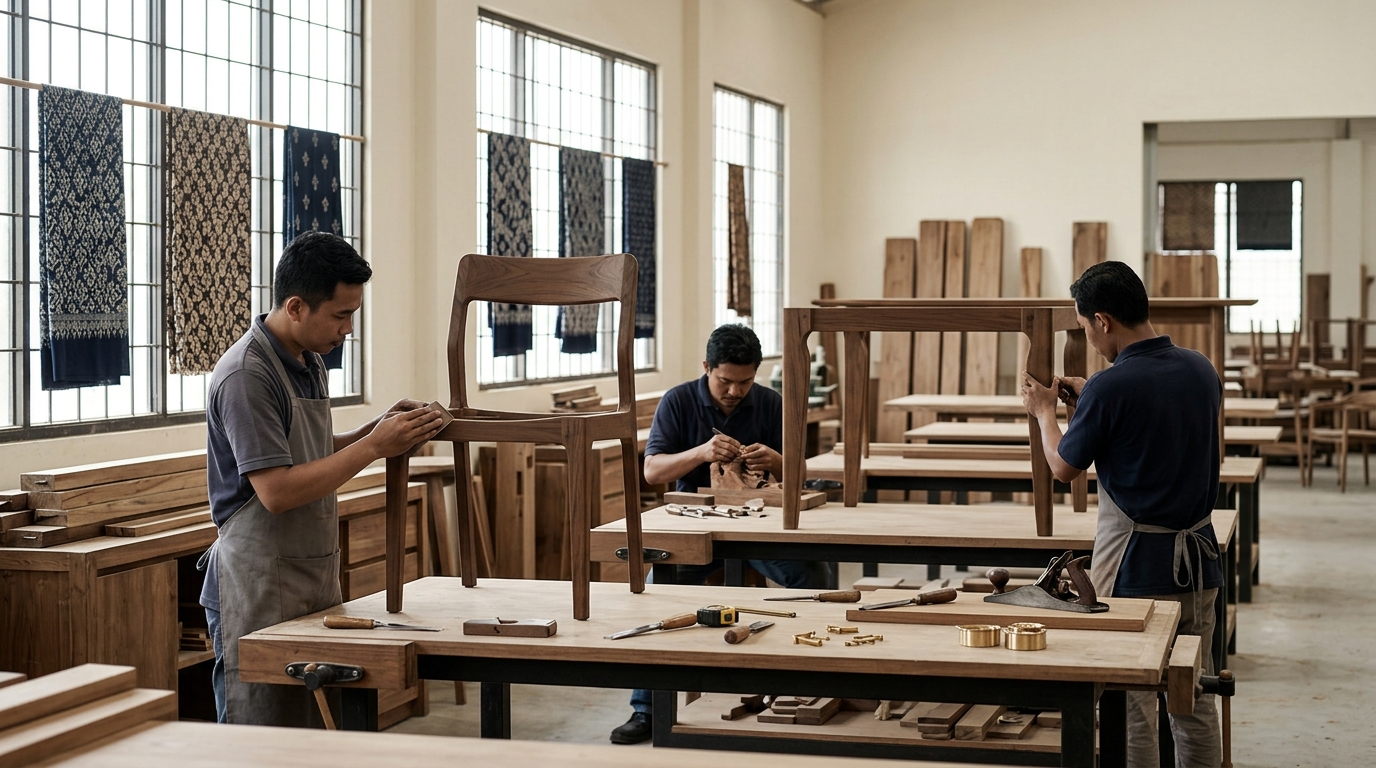
Sourcing OEM furniture from Indonesia is a significant operational decision. You are committing capital, design IP, and brand reputation to a factory thousands of miles away. The stakes are higher than a standard import purchase. Yet thousands of US furniture brands, retailers, and wholesalers do…
Sourcing OEMfurniture from Indonesiais a significant operational decision. You are committing capital, design IP, and brand reputation to a factory thousands of miles away. The stakes are higher than a standard import purchase. Yet thousands of US furniture brands, retailers, and wholesalers do it successfully every year — because Indonesia's raw material base, craft depth, and cost structure are genuinely hard to match for solid-wood production.
This guide covers every stage of that decision: from evaluating factory capabilities and structuring tooling ownership contracts, to running a three-gate QC program and clearing US customs with full Lacey Act documentation. It is written for procurement managers and sourcing directors who need operational specifics, not a country overview.
Indonesia's furniture industry is concentrated in a handful of export clusters — Jepara, Semarang, Surabaya, Cirebon, and Bali. Each cluster has a distinct material and product specialization. Understanding which cluster fits your product category is the first filter before you ever contact a factory.
Why Indonesia Outcompetes Other Asian Markets for Solid-Wood OEM Production
Indonesia holds a structural advantage in natural-material furniture that China, Vietnam, and Malaysia cannot easily replicate. The combination of tropical hardwood supply, craft labor concentration, and established export infrastructure makes oem furniture manufacturing indonesia particularly compelling for brands working in teak, mahogany, suar, rattan, and recycled timber categories.
Raw Material Access No Other Country Matches
Indonesia is one of the world's largest sources of plantation teak. Factories in Jepara draw directly from Central Java's supply chain. Mahogany, suar (also called monkey pod), and reclaimed railroad timber are similarly available at scale. Rattan production is anchored in Cirebon.
Certification Infrastructure for US Market Entry
Indonesian factories can supply wood with SVLK certification — Sistem Verifikasi Legalitas Kayu, Indonesia's government-mandated timber legality verification system. SVLK documentation satisfies the due-care standard under the US Lacey Act, which is a legal requirement for importing wood products into the United States. FSC-certified supply chains are also available through larger Jepara and Semarang operators.
Cost Position vs. Competing Countries
| Country | Solid-Wood OEM Strength | Relative Labor Cost | Teak/Tropical Hardwood Access | US Lacey Act Documentation |
|---|---|---|---|---|
| Indonesia | Very High | Low–Medium | Excellent | SVLK + FSC |
| Vietnam | High | Low–Medium | Limited | FSC only |
| China | Medium | Medium–High | Limited | FSC only |
| Malaysia | Medium | Medium | Rubberwood focus | FSC |
| Thailand | Medium | Medium | Rubberwood focus | FSC |
Indonesia's labor cost is broadly competitive with Vietnam for solid-wood work. China's cost advantage has eroded for this category due to Section 301 tariffs, which do not apply to Indonesian imports.
What OEM Furniture Manufacturing Indonesia Actually Means in Practice
The term OEM is used loosely in Asia. Clarifying the distinction before you brief a factory prevents costly misalignment.
| Model | Who Owns the Design | Who Owns the Brand | Typical MOQ |
|---|---|---|---|
| OEM | Buyer | Buyer | 50–200+ units per SKU |
| ODM | Factory | Buyer | Often lower; factory absorbs tooling |
| Private Label | Factory (base design) | Buyer | Lowest; minimal customization |
In genuine OEM, the factory manufactures to your technical specifications, drawings, and finish standards. It does not sell that design to anyone else. The buyer supplies tech packs, CAD files, or physical reference samples. The factory's job is production engineering — translating your design intent into repeatable production output.
Factory Tiers and Realistic MOQs
Indonesian OEM factories fall into three practical tiers:
- Large OEM factories serve top US and European brands. MOQs typically run 200+ units per SKU for case goods, 100+ for sofas, and 1,000+ for chairs. Lead times are well-documented. Compliance infrastructure is robust. - Mid-tier OEM factories are the most common category. MOQs range from 50 to 200 units per SKU. They offer more flexibility on design adaptation and are well-suited to growing brands scaling from pilot to full production. - Small OEM / custom manufacturers accept 10 to 50 units per SKU. They function more like bespoke workshops. Quality depends heavily on individual craftsman consistency.
Product Categories Available for OEM Production
- Indoor residential: dining, bedroom, living room in solid teak or mahogany - Outdoor and garden: teak garden furniture, rattan, and powder-coated aluminum - Hospitality and contract: resort furniture, restaurant seating, hotel casegoods - Office: solid-wood executive furniture and conference pieces
How to Assess Indonesian Factory Capabilities Before You Commit
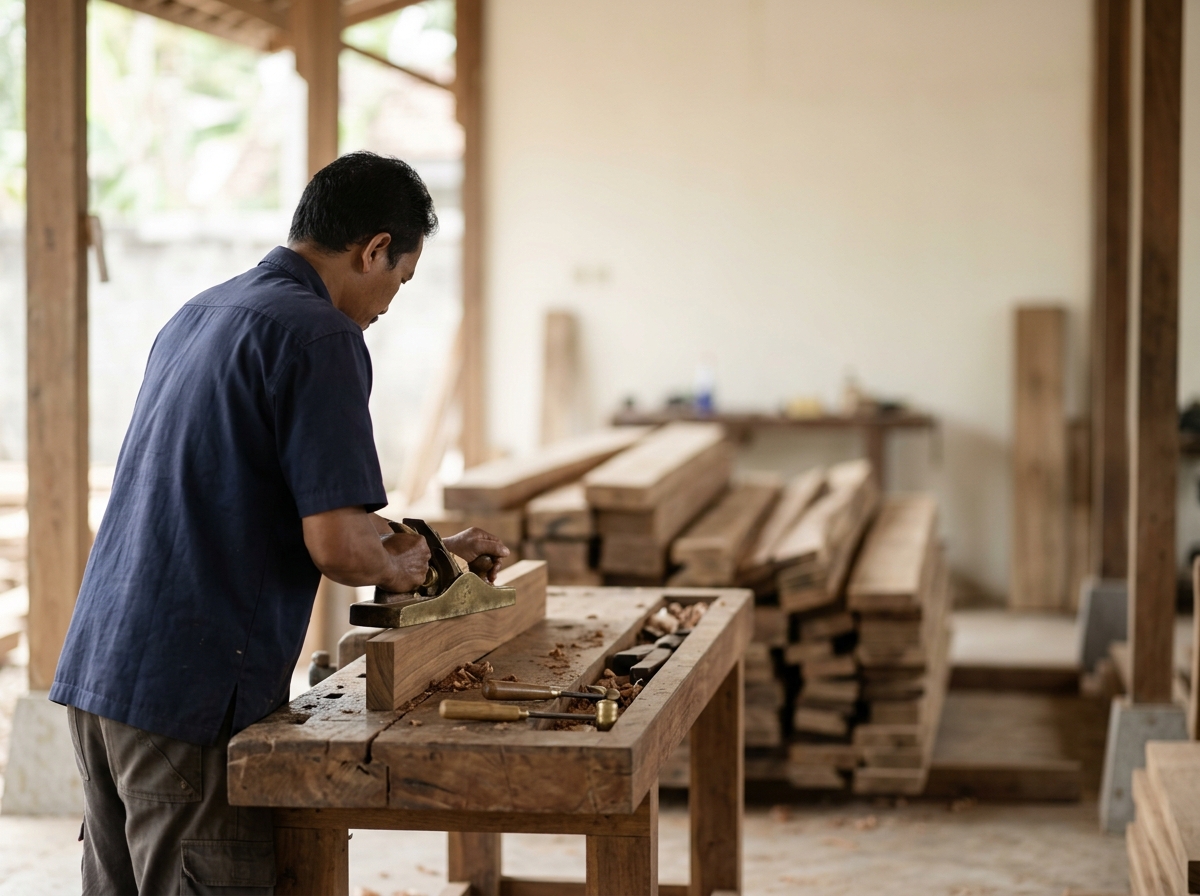
A factory visit or structured remote audit reveals capability signals that a product catalog never will. Focus on these operational indicators.
Facility Indicators That Signal Production Reliability
- Kiln-drying capacity on site. Furniture made from insufficiently dried wood will crack or warp after delivery. Ask for kiln drying logs and target moisture content specs. For teak indoor furniture, moisture content should typically reach 8–12%. Factories that outsource drying or skip it entirely are a serious risk. - Joinery equipment. CNC routing, mortise-and-tenon machinery, and doweling equipment indicate repeatability. Hand-cut joinery alone is appropriate for high-end artisan pieces but inconsistent at commercial volumes. - Finishing lines. Spray booths, UV or water-based finish application, and sanding stations with consistent grit progressions are markers of a factory capable of meeting your finish specifications. - In-house quality control lab. Even a basic QC station with finish-adhesion tests, moisture meters, and dimensional gauges signals a culture of documented inspection.
Certifications to Verify — and Why Each Matters
| Certification | What It Covers | Why It Matters for US Buyers |
|---|---|---|
| SVLK | Indonesian timber legality | Satisfies Lacey Act due-care requirement |
| FSC | Chain-of-custody for certified wood | Required by many retail and contract clients |
| ISO 9001 | Quality management systems | Signals documented process control |
| BSCI | Business social compliance | Required by many European and US retailers |
| Sedex / SMETA | Ethical trade audit | Required by hospitality and contract buyers |
Ask for certificate numbers and verify them directly against the issuing body's public registry. Certificates printed on factory letterhead without a registry entry are worthless.
- ✓No in-house kiln drying — outsourced or skipped entirely
- ✓SVLK or FSC certificates cannot be verified in public registry
- ✓Vague answers about subcontracting — no documented sub-supplier list
- ✓No written QC procedure or inspection record system
- ✓Sample lead time exceeds 8 weeks with no milestone schedule
- ✓Factory cannot provide at least two US or European export references
Tooling, Jigs, and Locking Down Your Production Specifications
This is the section competitors ignore entirely. Tooling ownership is one of the most consequential contract points in OEM furniture manufacturing Indonesia, and most buyers only discover this after a factory dispute.
Who Owns Tooling — and How to Negotiate It
When you commission production tooling — CNC router templates, jigs, molds, or bending forms specific to your design — the factory typically builds that tooling and charges you for it. The question is: who legally owns it afterward?
The default in many Indonesian factories is factory ownership. If you leave that relationship, the tooling stays. Negotiate explicitly for:
- Buyer-owned tooling with the factory as custodian during the relationship - A tooling register listing each item, its cost, and storage location - A release clause requiring the factory to return or ship tooling within a defined window if the relationship ends
Document this in the purchase agreement, not just an email thread.
Converting Design Intent Into Factory-Ready Specifications
Indonesian factories work best when you supply a complete tech pack. A good tech pack for oem furniture manufacturing indonesia includes:
- Dimensioned drawings with tolerances (typically ±1.5 mm for solid wood) - Exploded assembly views showing joinery method - Material callouts: species, grade, moisture content range, and grain direction - Finish specification: sheen level (e.g., 10% gloss), color chip or RAL/NCS reference, application method - Hardware callout with brand, model, and finish
Factories that receive incomplete specs will fill gaps with their own defaults. Those defaults may not match your design intent.
Tooling Setup Costs and Amortization
Setup and tooling costs for a new OEM program typically run from a few hundred to several thousand dollars depending on complexity. Negotiate an amortization clause: tooling costs recovered at a fixed rate per unit across the first production run. If you cancel before amortization is complete, define the buy-out amount in the contract. This aligns both parties' incentives to complete the initial run.
The Pre-Production Sample Approval Workflow That Prevents Costly Mistakes
No competitor covers this process with operational specificity. Without a structured sample workflow, you will receive containers of furniture that does not match your expectations.
Three Sample Stages and What Each Achieves
Stage 1 — Prototype sample. The factory interprets your tech pack and builds one or two pieces. Purpose: confirm constructional approach and primary dimensions. Expect revisions. Cost is typically borne by the buyer. Turnaround: 3–6 weeks from tech pack submission.
Stage 2 — Pre-production sample (PPS). Built after prototype approval, using production-grade materials and processes. This sample tests finish, hardware, and dimensional accuracy against your approved tolerances. Turnaround: 2–4 weeks. Cost is typically shared or charged at cost.
Stage 3 — Golden sample. The approved PPS becomes the golden sample. It is signed, tagged, photographed from all angles, and stored at the factory as the production benchmark. All QC inspections during production reference this sample.
Remote Approval vs. On-Site Sign-Off
Remote approval via high-resolution photos and video works for prototypes and minor revisions. For PPS and golden sample sign-off on a new program or high-value order, sending a qualified representative to Indonesia for physical inspection is worth the cost. Color and finish fidelity, structural integrity, and hardware action cannot be fully assessed on screen.
Protecting Your Furniture Designs When Working With an Indonesian OEM Factory
IP protection in Indonesian OEM manufacturing is achievable but requires contractual structure, not trust.
Enforceable Agreements Under Indonesian Law
Indonesian contract law recognizes NDAs and non-compete agreements. The NDA should specifically cover:
- Design drawings, tech packs, and CAD files - Material specifications and finish formulations - Client identity and order volumes - A defined post-relationship confidentiality period (typically 3–5 years)
An NNN agreement (Non-Disclosure, Non-Use, Non-Circumvention) is structurally stronger than a standard NDA for manufacturing relationships. Have it reviewed by a lawyer familiar with Indonesian commercial law.
Design Registration
Register your furniture designs in your home market before sending tech packs to any factory. In the United States, a design patent provides the strongest protection. Supplementary registration in Indonesia through the Directorate General of Intellectual Property adds another enforcement layer.
Practical Controls Beyond Contracts
- Store tooling under buyer ownership as described above - For complex designs, split component sourcing across two or more suppliers so no single factory holds the complete picture - Watermark all technical drawings with the recipient factory's name and date - Limit tech pack distribution to named individuals at the factory
Production QC Gates That Protect Your Brand and Reduce Returns
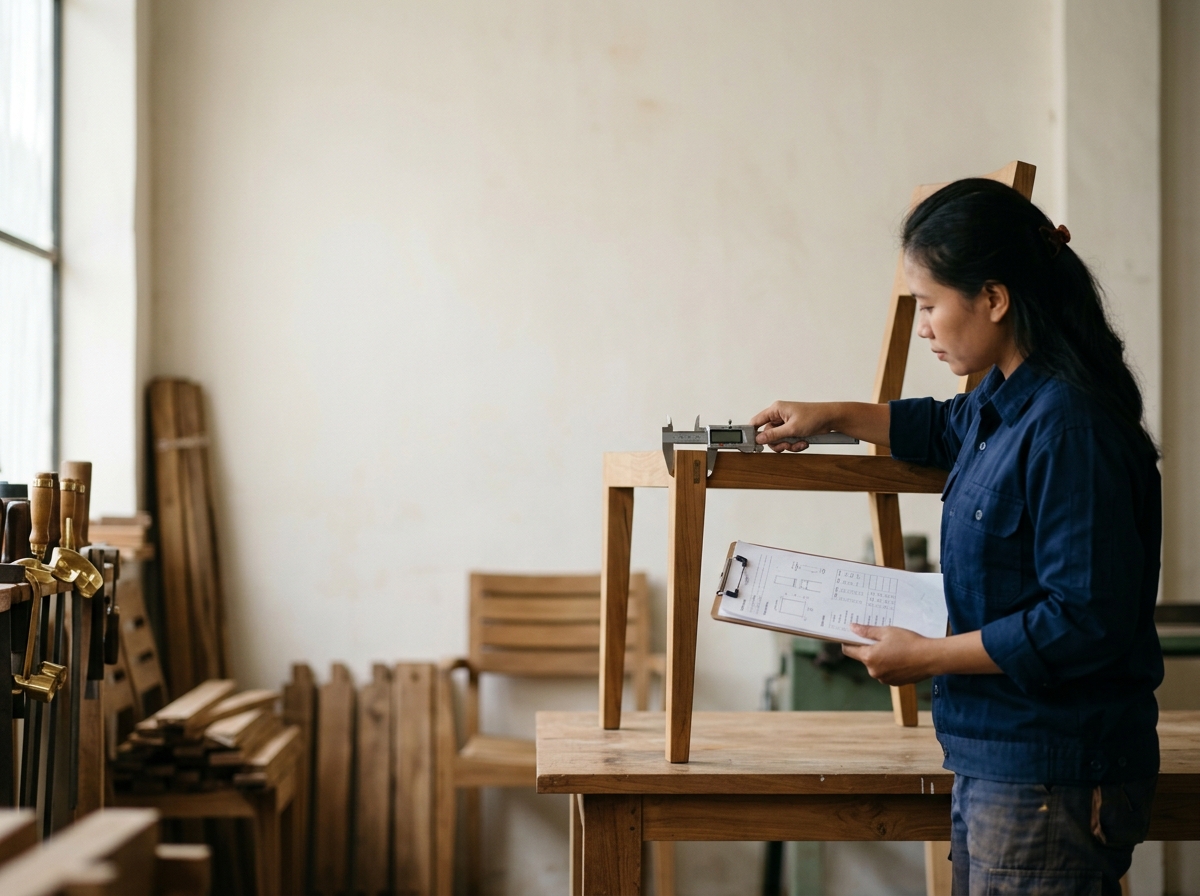
A single end-of-line inspection is not a QC system. A three-gate framework gives you visibility at each production stage.
| QC Gate | Stage | Who Conducts | Primary Focus |
|---|---|---|---|
| Inline inspection | During production (approx. 30–50% completion) | Third-party or your rep | Process conformance, material verification, early defect detection |
| Pre-shipment inspection (PSI) | After production, before packing | Third-party agency | AQL sampling, golden-sample comparison, finish and function |
| Container loading supervision | During stuffing | Third-party or agent | Packing quality, carton labeling, loading pattern, moisture |
AQL Sampling for Furniture Categories
AQL (Acceptable Quality Level) is the international defect-sampling standard. For furniture, typical US importer settings are:
- AQL 2.5 for major defects (structural, finish, dimensional failures) - AQL 4.0 for minor defects (cosmetic imperfections within tolerance)
Define your defect classification — critical, major, minor — in writing before production begins. Attach it to the purchase order as a quality annex.
Third-party inspection agencies operate across Jepara, Semarang, and Surabaya. Build inspection costs and access rights into your payment terms. A common structure: approximately 70% payment after PSI pass, 30% against bill of lading.
Capacity Reservation: Securing Your Production Slot Before the Factory Is Full
Indonesian factories servicing US markets operate under significant Q3–Q4 demand pressure. Buyers ordering for holiday season need production completed by August at the latest. A factory that accepts your order in June may not deliver by August without a prior capacity agreement.
Forward-Booking Deposit Structures
A rolling forecast agreement — typically covering 3 to 6 months of anticipated volume — gives the factory confidence to reserve production capacity. Deposits of 10– approximately 20% against forecasted volume are common for this structure. The deposit is credited against actual purchase orders as they are placed.
Multi-Factory Sourcing for Volume Protection
Relying on a single Indonesian factory for all volume creates brittleness. A multi-factory strategy — one primary partner and one qualified backup — protects you against:
- Production delays from labor shortages or machinery breakdown - Unexpected capacity loss during peak season - Quality failures requiring rapid re-sourcing
Qualifying a backup factory requires running a pilot order, which takes 3–6 months. Do not wait until you have a crisis to start that process.
US Import Compliance for Indonesian OEM Furniture: Tariffs, Lacey Act, and CARB
Current Tariff Position
Indonesian wood furniture is not subject to Section 301 tariffs (which apply to Chinese-origin goods). Applicable HTS codes for wooden furniture imported from Indonesia include:
- 9403.30 — Wooden furniture of a kind used in offices - 9403.50 — Wooden furniture of a kind used in the bedroom - 9403.60 — Other wooden furniture - 9401.61 / 9401.69 — Wooden seats
Most-Favored-Nation (MFN) duty rates for these categories typically range from 0% to approximately 7%, depending on the specific HTS code. Verify current rates via the USITC Harmonized Tariff Schedule before finalizing landed cost calculations.
Lacey Act Documentation Requirements
The Lacey Act requires US importers to declare the genus, species, country of harvest, and volume of all plant materials in imported goods. Indonesian SVLK certification provides a government-backed chain-of-custody record that satisfies the US Customs and Border Protection due-care standard under the Lacey Act. Request SVLK documentation for every shipment. Retain it for a minimum of five years.
CARB Phase 2 Compliance
If your OEM furniture includes composite panels — MDF drawer bottoms, plywood backs, or particleboard substrates — those panels must comply with California Air Resources Board (CARB) Phase 2 formaldehyde emission limits. CARB Phase 2 is effectively the national standard for US retail. Require written confirmation from your factory that all composite panels in your production carry CARB Phase 2 compliance documentation from the panel supplier.
Choosing the Right OEM Partner: Evaluation Criteria and Questions That Reveal the Truth
Shortlisting Criteria
Filter initial factory lists against these hard criteria:
- Demonstrated export history to the United States (request bill of lading references) - Product category match (a rattan specialist is not the right factory for solid teak) - Relevant certifications verified in public registries (SVLK, FSC, BSCI/Sedex as applicable) - MOQ alignment with your realistic order volumes - English-language capability at project management level — not just sales
Questions That Reveal Subcontracting Risk
Ask directly: "What percentage of this product will be produced in your own facility?" Subcontracting is common inIndonesian furnitureclusters and is not inherently disqualifying. But undisclosed subcontracting is. A factory that cannot or will not answer this question clearly is not ready to be your OEM partner.
Structuring a Pilot Order to Stress-Test the Relationship
A pilot order — typically one to three SKUs at or slightly above MOQ — tests every part of the OEM relationship before you commit full volume:
- Tech pack interpretation accuracy - Sample revision responsiveness - Production timeline adherence - QC gate compliance - Export documentation quality
Run a pilot before signing any long-term capacity agreement. The cost of a pilot order is negligible compared to the cost of a failed full-production run.
Frequently Asked Questions
Is furniture made in Indonesia good enough quality for US retail and contract markets? Yes, at the correct factory tier. Indonesia has a decades-long track record supplying major US furniture retailers and hospitality brands. Quality correlates directly with factory capability, your specification clarity, and QC enforcement — not with the country label alone.
What types of furniture are most commonly manufactured in Indonesia for export? Solid teak and mahogany dining and bedroom furniture, outdoor teak garden furniture, rattan and wicker pieces, resort and hospitality furniture, and handcrafted luxury pieces. Jepara specializes in solid wood; Cirebon in rattan; Bali in luxury artisan production.
Which country is best for OEM furniture manufacturing — Indonesia vs. alternatives? Indonesia leads for solid tropical hardwood, rattan, and high-craft hospitality furniture. Vietnam leads for volume solid-wood production at competitive price points. China leads for panel furniture, upholstery, and high-automation categories. The right answer depends on your product category, target price point, and certification requirements.
What wood species is Indonesian furniture typically made from? Teak (Tectona grandis) is the flagship species. Mahogany, suar (Albizia saman), mango, and reclaimed or recycled timber are widely used. Bamboo is available for specific applications. All species should be sourced with SVLK or FSC documentation for US import.
How do I protect my furniture designs when working with an Indonesian OEM factory? Use a properly drafted NNN agreement under Indonesian law, register designs in your home market before sharing tech packs, negotiate buyer-owned tooling contracts, watermark all drawings, and consider splitting component sourcing for complex designs.
What are the current US import tariffs and compliance requirements for Indonesian furniture? Indonesian wood furniture faces MFN duty rates of approximately 0–7% depending on HTS code, with no Section 301 surcharge. Compliance requirements include Lacey Act species declarations (satisfied by SVLK documentation) and CARB Phase 2 for any composite panel components.
Successful OEM furniture manufacturing in Indonesia depends on three critical factors. First, your chosen factory's certified capabilities must genuinely match your exact product specifications. Second, tooling ownership and IP protection must be contractually resolved before production begins, and a structured QC framework must run from inline inspection through to container loading.
You now have the framework to evaluate factories, structure contracts, and protect your designs. The logical next step is putting a vetted Indonesian OEM partner through its paces on your actual specifications. Request a factory capability assessment and first-sample quote from a qualified OEM partner today — and start your pilot program with full supply-chain visibility from day one.
Request a Factory Capability Assessment →Need eyes on the ground in Indonesia?
MTS is an execution partner — supplier verification, manufacturing management, quality control and export logistics across Indonesia, Vietnam and China.
Related services
Related articles
Receive furniture sourcing insights across Asia.
One email per week. No spam.