OEM vs ODM Furniture Manufacturing: A Sourcing Decision Framework for Buyers
15 min read
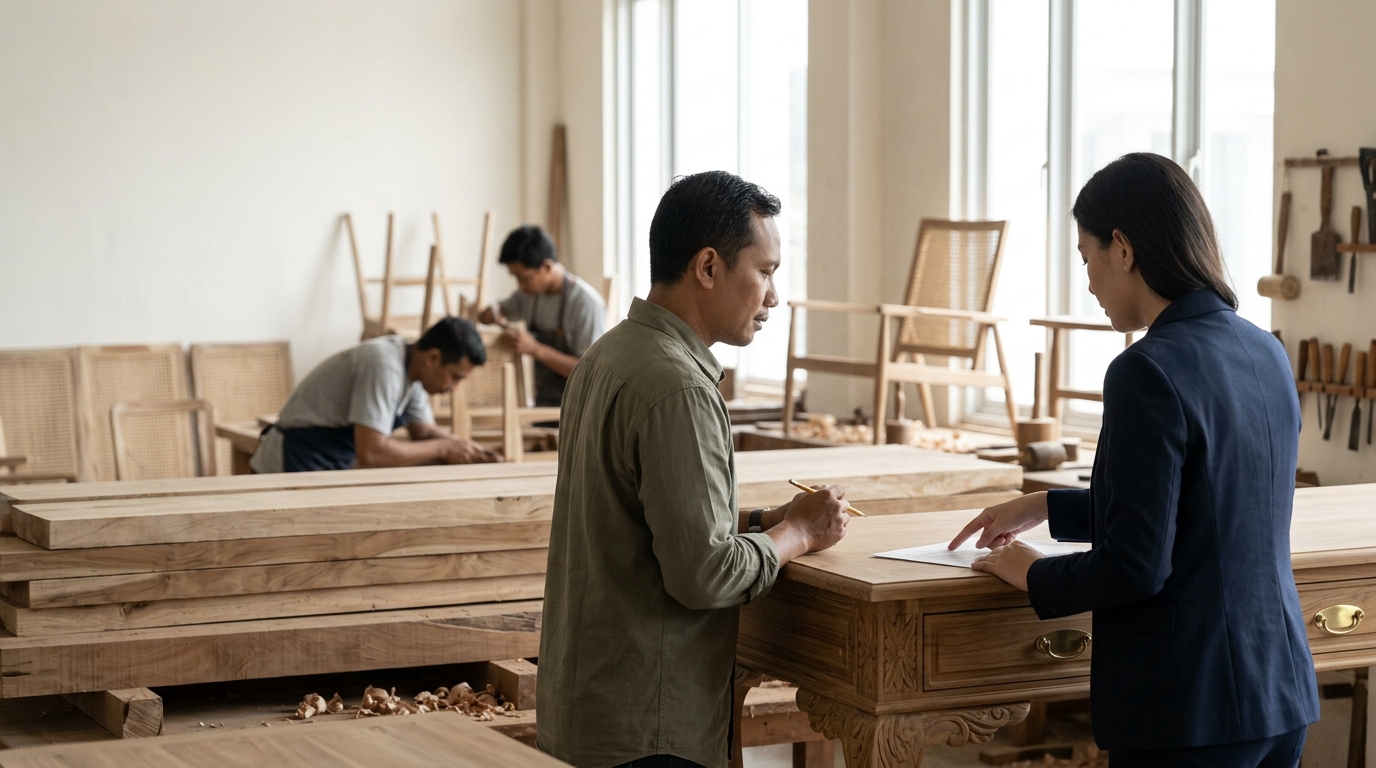
You have a budget, a product brief, and a shortlist of Indonesian factories. The decision blocking you is structural: do you bring your own designs and direct production (OEM), or select from a manufacturer's existing catalog and co-brand it (ODM)? That choice determines your IP exposure, upfront…
You have a budget, a product brief, and a shortlist of Indonesian factories. The decision blocking you is structural: do you bring your own designs and direct production (OEM), or select from a manufacturer's existing catalog and co-brand it (ODM)? That choice determines your IP exposure, upfront capital, lead time, and how easily you can exit the relationship if quality slips.
This framework covers the oem vs odmfurniture manufacturingdifferences that matter most to sourcing managers: design ownership, tooling investment, minimum order commitments, time to market, margin structure, and switching costs. Every section is anchored to Indonesian manufacturing realities — cluster capabilities, typical cost ranges, and certification requirements — so your team can use this as a working briefing document, not background reading.
The comparison applies primarily to full-cycle factories with verified export capability. It does not address trading companies, assembly-only operations, or OBM (Original Brand Manufacturer) structures, where the factory markets under its own consumer brand. Those models carry separate risk profiles and are outside the scope of this framework.
What OEM and ODM Actually Mean Inside a Furniture Sourcing Program
How the furniture industry defines OEM
In furniture, OEM means the buyer supplies the design. You provide technical drawings, material specifications, finish standards, and tolerances. The factory executes production to your spec. It owns nothing about the product except its manufacturing process.
OEM factories typically maintain a sample development department, dedicated production engineering staff, and contractual NDA obligations. MOQs reflect factory setup costs and material procurement minimums. Large OEM operations servicing major US and European retailers commonly require 200 or more units per SKU for bedroom case goods, 100 or more for upholstered sofas, and 1,000 or more for seating. Mid-tier OEM factories — the most common category in Indonesian export manufacturing — typically operate in the 50–200 unit range per SKU.
How the furniture industry defines ODM
ODM means the manufacturer owns the base design. The factory has an internal design team, maintains a proprietary catalog, and offers buyers the option to select models, apply branding, and request limited modifications — finish color, hardware, fabric, minor dimensional changes.
The buyer does not own the underlying design IP. Tooling and development costs are pre-amortized across multiple buyers. That is the core economic trade-off: lower entry cost in exchange for reduced exclusivity.
Where OBM sits and why it is out of scope
A third model exists — OBM (Original Brand Manufacturer) — where the factory designs, produces, and sells under its own consumer-facing brand. Some Indonesian manufacturers have developed OBM arms for domestic or regional markets. For US sourcing programs, OBM factories are typically approached as ODM partners. This article does not evaluate OBM structures separately.
Design Ownership and IP Risk: Who Controls What You Sell
OEM: full IP retention with transfer risk
Under OEM, the buyer retains full intellectual property. Your drawings, joinery specifications, and finish formulations remain yours. The factory produces exclusively to your brief and may not replicate the design for other buyers — provided your contract says so.
The practical risk is in the transfer. Once technical drawings leave your office, you depend on contractual enforcement. In Indonesia, NDAs are enforceable but require proper registration and local legal counsel to be effective. NNN agreements (Non-Disclosure, Non-Use, Non-Circumvention) — more common in Chinese OEM practice — are increasingly used by Indonesian factories working with US buyers.
ODM: manufacturer retains base design IP
Under ODM, the factory owns the base design. You may own modifications developed exclusively for your program, but only if that scope is defined contractually before development begins. Absent explicit agreement, co-developed changes often revert to the manufacturer's IP under Indonesian commercial law.
The parallel-selling risk is real. An ODM factory can sell the same base model to your direct competitors. Buyers who discover their "exclusive" product on a competitor's website typically find the factory sold an identical frame with a different finish SKU. Mitigations include:
- Exclusive tooling agreements covering your specific modifications - Design registration with Indonesia's Directorate General of Intellectual Property (DJKI) - Contractual restrictions on selling the base model to named competitor categories - Annual audits of the factory's active buyer roster
Tooling Investment and Upfront Capital Requirements Compared
What OEM buyers must fund
OEM requires the buyer to finance all tooling specific to the product: jigs, molds, routing templates, upholstery patterns, and finish approval samples. For solid wood programs in Jepara — carved teak and mahogany — tooling investment is primarily labor-based (pattern making, carving templates) and typically lower than for engineered wood or upholstery. For engineered wood programs with custom edge profiles or CNC-routed parts, tooling costs are higher and more capital-intensive.
Approximate ranges (flagged as typical industry estimates, not guaranteed benchmarks):
- Solid wood carved furniture (Jepara-style): tooling and sample development around $1,500–$4,000 per new SKU - Engineered wood with custom CNC profiles: tooling often $3,000–$8,000 per SKU - Upholstered furniture with custom frames and fabric blocking: tooling and sample set commonly $2,500–$6,000 per SKU
These figures exclude revision rounds. Multiple sample iterations — common in OEM when buyers refine proportions or finishes — add cost and time.
How ODM distributes tooling cost
ODM tooling is absorbed by the manufacturer and recovered through unit pricing or embedded in MOQ structure. The buyer pays no explicit tooling fee. The trade-off: the factory needs volume to justify that investment, which influences MOQ expectations and limits your ability to demand design changes without triggering additional fees.
Switching costs tied to tooling ownership
Tooling held at the factory creates exit barriers. If you change suppliers and cannot recover your jigs and molds, you pay to re-tool at the new factory. Negotiating tooling repatriation clauses at contract signing — specifying that buyer-funded tooling is buyer property, inventoried annually, and returnable within 30 days of program termination — is standard practice among experienced US sourcing teams. Many Indonesian factories will accept this language. Factories that refuse should be treated as a risk signal.
Minimum Order Quantities and Volume Commitments for Each Model
ODM MOQs: lower entry point, structured flexibility
Because ODM design development is pre-amortized, factories can offer lower per-SKU minimums. Indonesian ODM factories in rattan (Cirebon cluster) and teak (Jepara cluster) commonly accept orders from one 20-foot container, with SKU-level MOQs sometimes as low as 20–50 units for catalog items. This makes ODM practical for buyers testing new categories or building limited-edition collections without full development investment.
OEM MOQs: driven by setup and material minimums
OEM MOQs reflect factory setup time, material procurement (timber, fabric, hardware), and production scheduling logic. For Indonesian OEM programs:
| Furniture Category | Large OEM Factory (approx.) | Mid-tier OEM Factory (approx.) |
|---|---|---|
| Bedroom case goods | 200+ units/SKU | 50–150 units/SKU |
| Upholstered sofas | 100+ units/SKU | 30–100 units/SKU |
| Dining chairs | 500–1,000+ units/SKU | 100–300 units/SKU |
| Rattan/wicker accent | 100–300 units/SKU | 30–100 units/SKU |
Container-load logic applies in both models. Indonesian factories typically prefer to fill 40-foot high-cube containers per shipment. Buyers mixing multiple SKUs in one container can negotiate lower per-SKU minimums if total container value meets factory thresholds.
Time to Market: Launch Speed Differences Between OEM and ODM Programs
ODM: fastest path from brief to shipment
The ODM path eliminates design development. A buyer selects a catalog item, approves a branded sample, confirms specifications, and places the order. Sample-to-shipment lead time in Indonesian ODM programs commonly runs 8–14 weeks, depending on factory capacity and the complexity of requested modifications. Rattan programs from Cirebon tend to be faster. Carved solid wood programs from Jepara may sit at the higher end of that range.
OEM: development adds significant lead time
OEM introduces a front-loaded development phase. From design handover to first sample approval typically adds 6–12 weeks, before production even begins. Total lead time from design submission to shipment commonly runs 18–28 weeks for a new SKU.
Delays concentrate at three points:
1. Sample development: factory interprets drawings differently than the buyer intended; revision rounds extend timelines by 2–4 weeks each 2. Material sourcing: teak, mahogany, and FSC-certified timber sourcing in Indonesia can face seasonal supply constraints 3. Finish approval: color and texture matching across multiple SKUs often requires two or three approval rounds
Seasonal buying windows and model choice
US retailers operating on WSOP (Written Seasonal Order Program) deadlines or catalog lock-in dates need to factor model choice into their timeline planning. A buyer sourcing a new OEM category for a spring catalog with a 26-week production window has a narrower development buffer than the same buyer selecting from an ODM catalog. Missing a WSOP deadline by two weeks can defer revenue by an entire season.
Margin Structure and Cost Efficiency Across Buyer Types
ODM unit economics: faster launch, compressed margin
ODM unit costs are lower on entry because no development overhead sits in the unit price at launch. However, pricing power at retail is constrained. If the same base design is available to multiple buyers, market pricing converges. A buyer cannot command a premium for a product that a competitor sells under a different brand name from the same factory. Margin compression is structural, not temporary.
OEM unit economics: higher entry cost, stronger long-term margin
OEM products carry development cost in the total program budget, not the unit price. Once tooling is amortized across initial volume, per-unit economics improve. Proprietary design enables retail pricing power that ODM cannot sustain. For DTC brands and premium retailers, the margin argument for OEM is clear over a 3–5 year product lifecycle.
Total cost of ownership: what the unit price misses
Comparing FOB prices between OEM and ODM without including total cost of ownership produces misleading results. A complete TCO view includes:
- Tooling and pattern development (OEM only) - Sample production and shipping (typically 2–4 rounds for OEM; 1 for ODM) - Design revision labor (OEM) - Legal fees for NDA and tooling repatriation clauses - Factory audit costs (applicable to both) - Certification compliance costs (FSC, SVLK, BSCI — discussed below)
Indonesian labor costs remain competitive relative to comparable quality in Europe or North America. Material costs for teak, mahogany, and rattan are influenced by SVLK (Sistem Verifikasi Legalitas Kayu) timber legality verification requirements, which affect both OEM and ODM programs sourcing certified wood.
Side-by-Side Decision Framework: Retailers, Brands, and Project Buyers
This is the core decision tool. Use it to match your buyer profile to the appropriate manufacturing model before issuing an RFQ.
| Decision Factor | OEM | ODM |
|---|---|---|
| Design ownership | Buyer retains full IP | Manufacturer owns base design |
| Exclusivity | High — factory cannot replicate | Low to moderate — base sold to multiple buyers |
| Upfront tooling cost | Buyer funds ($1,500–$8,000+ per SKU, approx.) | Absorbed by manufacturer |
| Typical MOQ (mid-tier Indonesian factory) | 50–200 units/SKU | 20–100 units/SKU |
| Time to first shipment | 18–28 weeks (new SKU) | 8–14 weeks |
| Retail margin potential | Higher — proprietary product | Lower — converges with competitors |
| IP risk | Design transfer risk | Parallel selling risk |
| Switching cost | High if tooling stays at factory | Moderate — redesign dependency |
| Best fit: buyer type | DTC brands, licensed brands, FF&E spec buyers | Retailers testing categories, volume buyers, limited-edition programs |
| Certification interaction | Buyer specifies FSC/SVLK requirements | Factory may already hold certifications on catalog items |
Retailers: private label and volume programs
For large-volume retailers building private label programs, ODM offers speed and cost efficiency at category entry. OEM becomes the right choice when the retailer wants an exclusive line that competitors cannot replicate from the same factory.
Brands: DTC and licensed products
DTC brands and companies with licensed design portfolios almost always require OEM. Design differentiation is the brand's primary asset. Sharing a base design with competitors is not a viable trade-off regardless of cost savings.
Project buyers: hospitality and FF&E specification
Hospitality and FF&E (Furniture, Fixtures, and Equipment) project buyers face strict specification compliance requirements — dimensions, fire ratings, finish durability standards. ODM catalog items rarely meet custom spec out of the box. Hybrid approaches — selecting an ODM base and engineering OEM modifications — are common in this segment.
Switching Costs and Long-Term Lock-In Risks You Must Evaluate
ODM lock-in: catalog dependency
ODM programs create a different kind of lock-in. If your product range is built around a factory's catalog, redesigning for a new supplier requires either finding an identical catalog match or funding OEM development from scratch. The switching cost is not financial at exit — it is the opportunity cost of rebuilding range cohesion.
OEM lock-in: tooling as exit barrier
OEM tooling held at a factory is leverage the factory can exercise. A factory in dispute with a buyer may delay returning tooling or claim it as collateral for unpaid invoices. Preventive contract terms include:
- Explicit statement that buyer-funded tooling is buyer property, listed by item with replacement value - Annual physical inventory of tooling, witnessed by an independent party - Escrow or bonded warehouse clause for high-value tooling sets - 30-day return obligation upon written notice of program termination
Indonesian commercial contracts that include these clauses are enforceable. Factories resistant to tooling repatriation clauses should be disqualified during the RFQ stage, not after tooling investment is made.
Multi-supplier strategy to reduce concentration risk
Running both OEM and ODM programs across multiple factories reduces concentration risk in either model. A common structure: one primary ODM supplier for catalog-driven volume SKUs, one OEM partner for proprietary development. This spreads risk, maintains negotiating leverage, and allows buyers to benchmark quality and pricing continuously.
Applying This Framework to Indonesian Manufacturing Clusters
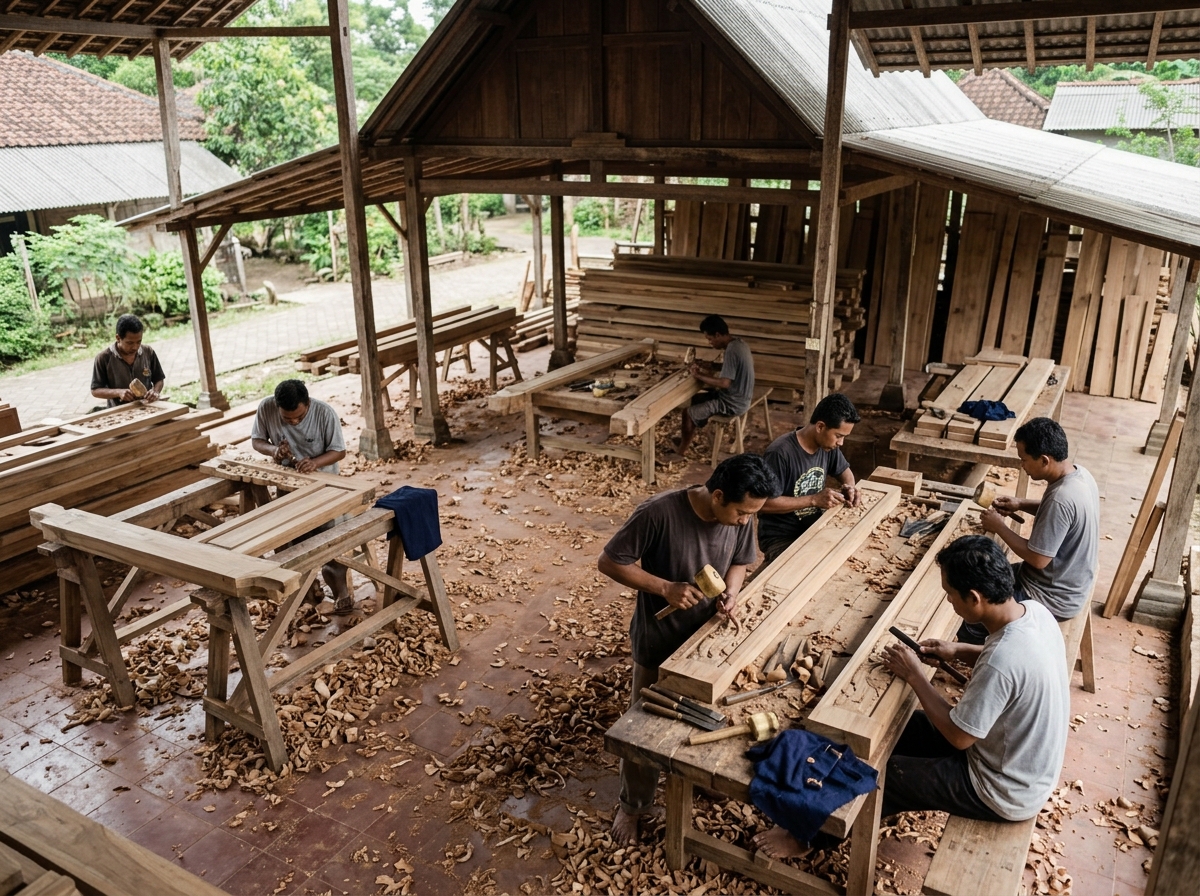
Indonesia'sfurniture manufacturingcapability is geographically clustered. Matching your model choice to the right cluster is a prerequisite for realistic RFQ outcomes.
| Cluster | Primary Material | Model Strength | Typical Certifications |
|---|---|---|---|
| Jepara (Central Java) | Teak, mahogany (solid wood, carved) | OEM-strong; some ODM catalogs | FSC, SVLK, BSCI (varies by factory) |
| Cirebon (West Java) | Rattan, wicker, bamboo | ODM-strong; fast catalog-based supply | SVLK; FSC less common |
| Surabaya / East Java | Upholstered furniture, mixed materials | OEM-capable; growing ODM capacity | BSCI; certifications vary |
Jepara: OEM depth in solid wood
Jepara is Indonesia's most established export cluster for solid teak and mahogany furniture. The cluster has deep OEM capability — factories here have decades of experience executing buyer-supplied designs in carved and joinery-intensive categories. ODM catalogs exist but tend to be narrower. Buyers requiring custom specification furniture, hospitality pieces, or proprietary carved designs should focus RFQs in Jepara.
Cirebon: ODM speed in rattan and natural fiber
Cirebon's rattan and wicker factories have built broad ODM catalogs oriented toward fast-moving home décor andoutdoor furniture. ODM turnaround times from this cluster are among the fastest in Indonesia. OEM capability exists but is less developed than in Jepara. Buyers testing natural fiber categories or building seasonal collections should prioritize Cirebon for ODM programs.
Certification and compliance interaction
FSC (Forest Stewardship Council) certification and SVLK (Indonesia's mandatory timber legality verification system) interact differently with OEM and ODM programs. Under ODM, factory-held certifications often extend to catalog products — the buyer benefits without managing the certification process directly. Under OEM, certification scope depends on whether buyer-specified materials are covered by the factory's existing FSC chain-of-custody certificate. Buyers should verify certificate scope at RFQ stage, not after production begins.
BSCI (Business Social Compliance Initiative) audits apply to the factory regardless of manufacturing model. US buyers sourcing for major retailers should confirm BSCI status or equivalent social compliance audit as part of factory qualification.
Practical next steps for your sourcing program
- ✓Confirm manufacturing model (OEM or ODM) in writing before sharing design files
- ✓Request factory classification: full-cycle vs. assembly-only
- ✓Verify FSC and SVLK certificate scope against your material requirements
- ✓Confirm BSCI or equivalent social compliance audit status
- ✓Define tooling ownership and repatriation terms in the RFQ brief
- ✓Request sample development timeline with milestone breakdowns
- ✓Confirm MOQ at container level and SKU level separately
- ✓Schedule or commission an independent factory audit before committing volume
Frequently Asked Questions on OEM vs ODM Furniture Manufacturing Differences
What is the difference between OEM andODM furniture manufacturing? OEM means the buyer supplies the design and the factory manufactures to spec. The buyer owns the IP. ODM means the factory owns the design and the buyer selects from a catalog, optionally adding branding or modifications. The core oem vs odm furniture manufacturing difference is who controls the product design.
Is OEM or ODM better for furniture brands protecting their designs? OEM. It is the only model that gives the buyer full IP ownership and prevents the factory from selling the same design to competitors. ODM exposes the buyer to parallel selling from the manufacturer's catalog.
Is ODM furniture manufacturing cheaper than OEM? Lower upfront cost, yes. ODM eliminates tooling and design development fees. But total cost of ownership over a product lifecycle — including the margin compression from non-exclusive designs — often makes OEM more cost-efficient for established programs.
What are the main disadvantages of using an ODM furniture supplier? Parallel selling risk, limited design differentiation, dependency on the manufacturer's catalog for future development, and potential co-developed IP that defaults to the factory without explicit contractual protection.
How do MOQs differ between OEM and ODMIndonesian furniturefactories? ODM MOQs are typically lower per SKU because design development is pre-amortized. Mid-tier Indonesian ODM factories commonly accept 20–50 units per catalog SKU. OEM MOQs reflect factory setup costs and run higher — typically 50–200 units per SKU at mid-tier factories, depending on category.
Can a buyer combine OEM and ODM within the same sourcing program? Yes. Hybrid programs are common, particularly in hospitality and retail. A buyer can source volume catalog SKUs via ODM while simultaneously running OEM development for proprietary hero products. Some buyers also co-develop ODM modifications under exclusive tooling agreements — a practical middle path between full design ownership and pure catalog selection.
The oem vs odm furniture manufacturing differences ultimately reduce to three linked decisions: how much design control you need, how much upfront capital you can commit, and how long your program horizon is. Buyers who clarify those three variables before issuing an RFQ consistently outperform those who let the factory's default offering drive the model choice.
You now have a framework that maps those variables to Indonesian cluster capabilities, MOQ realities, certification requirements, and contract protections. The next step is applying it to a specific factory conversation.
You understand the model differences and the decision criteria that apply to your program. Connect with verified Indonesian furniture manufacturers — matched to your model, cluster, and certification requirements — and receive a structured quote that reflects your actual specifications.
Request Your OEM or ODM Quote →Planning OEM or private-label production in Asia?
MTS matches you with capable factories and manages tooling, samples, production and quality gates — so your designs ship to spec.
Related services
Related articles
Receive furniture sourcing insights across Asia.
One email per week. No spam.