Project Logistics Coordination for Indonesian Export Shipments: A Complete Guide
14 min read

Procuring multi-category goods from Indonesia introduces a logistics challenge that standard freight forwarding cannot resolve. You are not moving a single SKU from a single factory. You are coordinating teak furniture from Jepara, natural stone from Java, rattan from Cirebon, and prefabricated…
Procuring multi-category goods from Indonesia introduces a logistics challenge that standard freight forwarding cannot resolve. You are not moving a single SKU from a single factory. You are coordinatingteak furniturefrom Jepara, natural stone from Java, rattan from Cirebon, and prefabricated structures from Surabaya — each with different containerization requirements, export documentation rules, and delivery windows tied to a live construction or installation schedule.
Project logistics coordination Indonesia export shipments differs fundamentally from routine container bookings. Every decision — which port, which container configuration, which phasing sequence — affects your project timeline and total landed cost. A mismatch between cargo arrival and site readiness creates holding costs, site congestion, and installation delays that compound quickly across a multi-month project.
This guide addresses every layer of that complexity. It covers container planning across product categories, shipment phasing tied to construction milestones, port selection across Indonesia's major export hubs, export documentation including SVLK and CITES compliance, cargo insurance, and last-mile delivery coordination from US port to project site. It also explains how to evaluate and select a logistics partner with genuine Indonesia origin expertise.
Procurement teams managing hospitality, commercial interior, or residential development projects will find actionable frameworks here — not generic logistics definitions.
Why Project Logistics Coordination Matters for Indonesian Export Shipments
The Core Problem: Multiple Vendors, One Delivery Window
Indonesia's furniture and materials export industry is geographically fragmented. Teak furniture clusters around Jepara in Central Java. Rattan production concentrates in Cirebon. Bali handles luxury artisan work. Surabaya serves mid-market manufacturing. Natural stone and building materials often come from separate Java or Sumatra suppliers entirely.
A procurement team sourcing across these categories faces a coordination problem before a single container is booked. Vendors operate on different lead times. They issue separate commercial invoices, separate packing lists, and separate export documents. Without a single coordinating function, these shipments arrive at the US port at unrelated times, disconnected from each other and from your site schedule.
The Cost of Uncoordinated Shipments
Uncoordinated project cargo logistics introduces several compounding risks:
- Site congestion: Furniture and FF&E arriving before structural finishes are installed forces on-site storage in unsuitable conditions. - Demurrage and detention: Containers held at US ports beyond free-time windows incur daily charges that accumulate rapidly. - Customs clearance delays: Multiple unlinked bills of lading across the same project increase ISF filing complexity and risk of holds. - Damage and loss: Cargo stored at port or inadequately staged for re-delivery is exposed to higher damage risk. - Cost overruns: Each of the above translates directly into unplanned project expenditure.
Why a Single Coordinated Plan Is Non-Negotiable
Project logistics coordination Indonesia export shipments requires one governing plan. That plan ties container releases to project milestones, consolidates documentation across vendors, manages phased booking, and connects Indonesia-side operations to US-side last-mile delivery. A coordinated logistics partner — whether a specialized 3PL, NVOCC, or freight forwarder with Indonesia origin capability — functions as the single operational thread across all these variables.
Mapping Your Indonesian Project Cargo Across Product Categories
Different product categories from Indonesia carry fundamentally different logistics profiles. Understanding those profiles before container planning begins prevents costly errors.
Common Indonesian Project Cargo Categories and Their Logistics Characteristics
| Category | HS Chapter | Key Logistics Considerations | Typical Container Fit |
|---|---|---|---|
| Teak / solid wood furniture | Chapter 94 | High weight-per-piece, fragile joinery, SVLK required | 40ft HC preferred |
| Rattan / bamboo furniture | Chapter 94 | Low density, high volume, fragile weaving | 40ft HC, volume-limited |
| Natural stone (marble, granite) | Chapter 68 | Very high weight, crating required, floor-load limits | 20ft or 40ft, weight-limited |
| Wood flooring / panels | Chapter 44 | Stackable, moisture-sensitive, SVLK required | 40ft or 40ft HC |
| Building materials (ceramics, tiles) | Chapter 68/69 | Breakage-sensitive, heavy, palletized | 20ft preferred |
| Prefabricated structures / components | Chapter 94 or 73 | Oversized, may require breakbulk or flat-rack | Flat-rack or OOG |
Consolidation vs. Dedicated Container Decisions
Consolidation across categories is possible but requires compatibility analysis:
- Teak furniture and wood flooring share compatible stacking environments (stable humidity, no floor-load conflict). - Natural stone should not be consolidated with furniture in most cases. Its floor-load requirements can exceed standard container capacity limits and risk damage to adjacent items. - Ceramic tiles and prefabricated panels can consolidate if both are fully crated and pallet weights are balanced. - Rattan and bamboo furniture consolidates well with soft furnishings (textiles, cushions) in terms of weight but requires careful humidity control.
Container Planning Strategies for Multi-Category Indonesian Project Cargo
Selecting the Right Container Type
| Container Type | Internal Volume (approx.) | Max Payload (approx.) | Best Use Case |
|---|---|---|---|
| 20ft standard | ~33 cbm | ~28 metric tons | Heavy, dense cargo (stone, tiles) |
| 40ft standard | ~67 cbm | ~26–27 metric tons | Mixed cargo, wood products |
| 40ft High Cube | ~76 cbm | ~26–27 metric tons | Bulky, lightweight furniture |
| Flat-rack | Varies | ~40+ metric tons | Oversized / OOG prefab components |
| Open-top | ~66 cbm | ~26 metric tons | Tall structures, crane-load items |
Natural stone and heavy building materials reach payload limits before volume limits in a 20ft container. Rattan and bamboo furniture reach volume limits before payload limits in a 40ft HC. Planning from the wrong constraint wastes either space or payload capacity.
Load Sequencing for On-Site Installation Order
Load sequencing means packing containers so that cargo needed first on site is accessible first at the destination. For project cargo this is critical:
- Structural fasteners, base frames, and sub-floor materials load last (exit first). - Mid-layer: wall cladding, stone panels, built-in cabinetry. - Top layer or separate container: furniture, soft furnishings, decorative items.
If consolidating across categories, communicate the installation sequence to your packer before loading is confirmed. Repacking a container at a US port costs significantly more than planning sequence correctly at origin.
Breakbulk and Flat-Rack for Oversized Components
Prefabricated timber frames, large stone slabs, or structural panels that exceed standard container internal dimensions require flat-rack or breakbulk handling. Indonesian ports — particularly Tanjung Priok and Tanjung Perak — have breakbulk handling capacity, but booking windows for specialized equipment are longer. Factor an additional two to three weeks into your planning timeline for oversized cargo.
Phased Shipment Scheduling Tied to Your Construction Milestones
Why Phasing Matters More Than Speed
The instinct of most procurement teams is to consolidate all cargo into the fewest containers and ship everything as fast as possible. For project cargo, this is the wrong frame. Receiving all materials before site is ready creates storage costs, damage risk, and installation delays. Phasing shipments against construction milestones is the correct model.
A Practical Phasing Matrix
| Phase | Cargo Categories | Ship When | Notes |
|---|---|---|---|
| Phase 1 — Structural | Prefab structural components, base building materials, sub-floor panels | Foundation and framing complete | Requires flat-rack or breakbulk options |
| Phase 2 — Finishing | Stone cladding, ceramic tiles, wood flooring, built-in cabinetry | Structural work 80%+ complete | Sensitive to moisture; confirm dry-in status |
| Phase 3 — FF&E | Teak furniture, rattan pieces, soft furnishings, lighting | Interior finishing complete | Highest damage risk; requires white-glove last-mile |
Managing Buffer Stock and Warehousing
Not every phase transition is clean. Supplier lead times, Indonesian port congestion, and transit variability introduce gaps. Two warehousing strategies address this:
1. Origin warehousing (Indonesia): Hold finished goods at a bonded warehouse near the export port. This delays export and defers freight cost but protects against premature arrival. 2. Destination warehousing (US port or near project site): Receive cargo into a third-party logistics facility and release to site per schedule. This adds cost but provides maximum delivery precision.
Buffer stock decisions should factor holding cost against the cost of site delays. For high-value projects, destination warehousing near the project site is typically the more operationally sound choice.
Indonesian Port Selection Matched to Supplier Location and Product Type
Comparing Indonesia's Major Export Ports
| Port | Location | Best Product Categories | Transit to US West Coast (approx.) | Transit to US East Coast (approx.) |
|---|---|---|---|---|
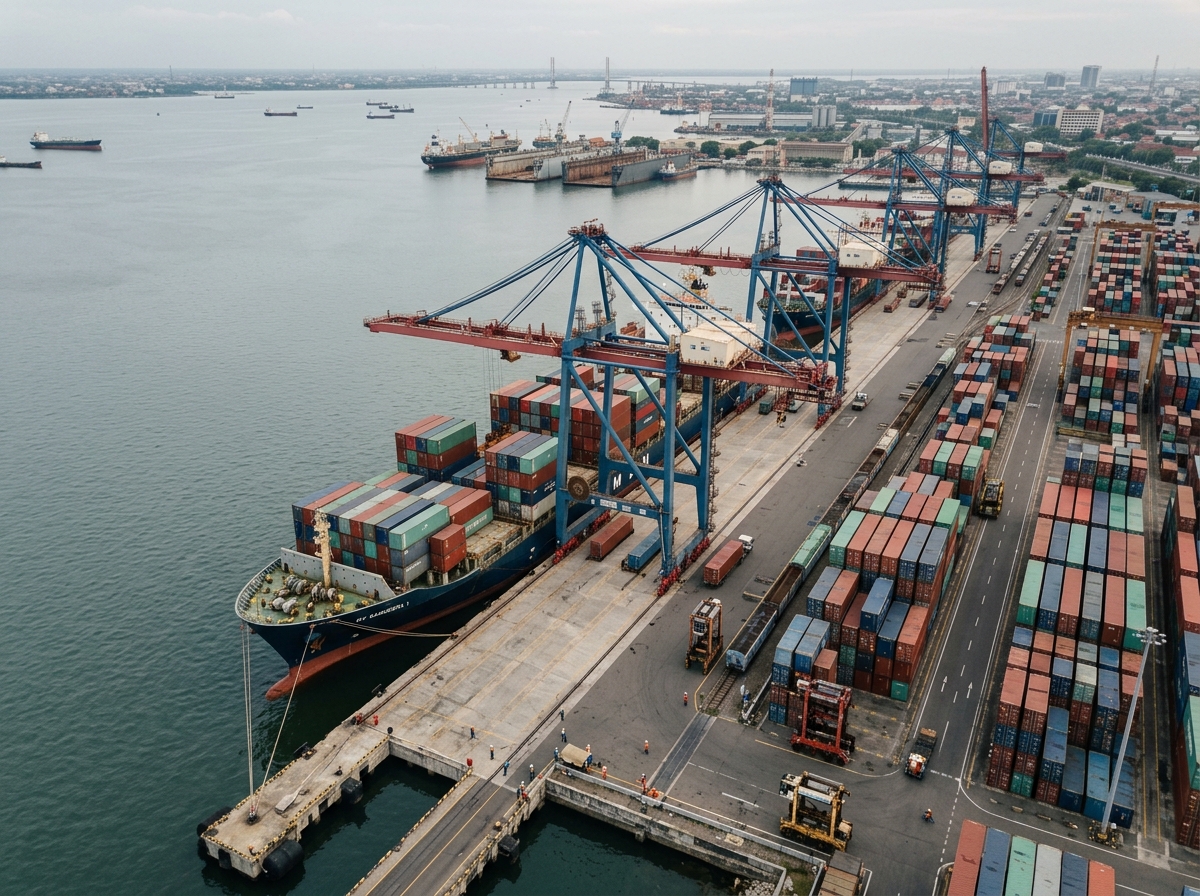
| Tanjung Priok | Jakarta, West Java | Mixed cargo, building materials, stone, general FF&E | 18–22 days | 25–30 days |
| Tanjung Perak | Surabaya, East Java | Teak furniture (Jepara cluster), rattan (Cirebon), wood products | 18–22 days | 25–30 days |
| Belawan | Medan, North Sumatra | Timber, rubber wood, Sumatra-origin wood products | 20–24 days | 27–32 days |
| Bali / Benoa | Bali | Luxury artisan furniture, small batch high-value cargo | Typically feeder to Surabaya or Jakarta | — |
Matching Port to Supplier Geography
- Jepara teak andCentral Java furniture: Route through Tanjung Perak (Surabaya). Overland trucking from Jepara to Surabaya is well-established and shorter than routing to Jakarta. - Jakarta and West Java building materials: Tanjung Priok is the natural gateway and Indonesia's highest-volume port. - North Sumatra timber: Belawan (Medan) eliminates the Strait of Malacca transit to reach Tanjung Priok, saving time and inland trucking cost. - Bali artisan luxury goods: Small batches typically feeder-vessel to Surabaya or Jakarta before main-line vessel loading.
Port Congestion Risk and Contingency Routing
Tanjung Priok handles the majority of Indonesia's container export volume and is subject to periodic congestion, particularly around Indonesian national holidays. Build a minimum two-week buffer into vessel booking lead times. If Tanjung Priok congestion risk is elevated, Tanjung Perak often offers faster vessel connections for East Java origin cargo.
Export Documentation and Regulatory Compliance Per Product Category
Core Export Documents for All Indonesian Shipments
- ✓Commercial Invoice (itemized by HS code and unit value)
- ✓Packing List (gross and net weights, dimensions per piece)
- ✓Bill of Lading (master and house, if using NVOCC)
- ✓Certificate of Origin (Form E for ASEAN, Form D, or GSP Form A for US-bound)
- ✓SVLK Certificate (Sistem Verifikasi Legalitas Kayu) — mandatory for all wood products
- ✓Phytosanitary Certificate — required for unprocessed or semi-processed wood
- ✓Fumigation Certificate — required for wood packing materials (ISPM 15)
- ✓CITES permit — required for protected species (certain teak, ramin)
- ✓Packing Declaration — confirming ISPM 15-compliant wood packaging
Wood Product Compliance: SVLK, CITES, and the Lacey Act
SVLK (Sistem Verifikasi Legalitas Kayu) is Indonesia's mandatory timber legality verification system. All wood products exported from Indonesia — including furniture, flooring, and panels — require valid SVLK documentation. This is not optional.
US importers of Indonesian wood products are also subject to the Lacey Act, which prohibits import of illegally harvested timber. SVLK documentation supports Lacey Act due diligence but does not replace it. Your customs broker must confirm that SVLK certificates are current and issued by an accredited verification body.
CITES permits are required for species listed under Convention on International Trade in Endangered Species. Certain teak varieties and ramin (common inIndonesian furniture) fall under CITES Appendix listings. Confirm species classification with your supplier before export documents are prepared.
HS Code Accuracy by Category
- Furniture: Chapter 94 (e.g., 9403 for other furniture, 9401 for seating) - Wood products and flooring: Chapter 44 (e.g., 4412 for plywood, 4418 for joinery) - Natural stone: Chapter 68 (e.g., 6802 for worked monumental stone) - Ceramic tiles: Chapter 69 (e.g., 6907 for ceramic flags and paving)
Misclassification affects duty rates, antidumping exposure, and automated targeting at US Customs.
Insurance Coverage for Indonesian Project Cargo Shipments to the US
Institute Cargo Clauses: Choosing the Right Level
| Clause | Coverage Level | Appropriate For |
|---|---|---|
| Institute Cargo Clauses (A) | All-risk (broadest) | High-value furniture, marble, custom FF&E |
| Institute Cargo Clauses (B) | Named perils (intermediate) | General building materials, mid-value cargo |
| Institute Cargo Clauses (C) | Minimum named perils | Low-value, durable, non-fragile cargo only |
For Indonesian project cargo to the US, Clauses (A) all-risk coverage is strongly recommended for any shipment containing natural stone, teak furniture, rattan, or custom FF&E. These items have high replacement cost, long lead times for reproduction, and significant fragility risk during ocean transit.
Additional Coverage Considerations
- War risk and strikes: Standard marine policies often exclude war risk. Add war risk endorsements for any routing through politically sensitive transit zones. - Delay-in-Start-Up (DSU) insurance: This coverage addresses consequential financial losses when cargo delays cause project construction or opening delays. DSU is rarely discussed in standard freight conversations but is highly relevant for hospitality and commercial interior projects where delayed opening has direct revenue impact. Discuss DSU with your insurance broker at project inception, not after a delay occurs. - Declared value: Insure at full replacement cost, not FOB invoice value. Custom-made teak furniture or hand-cut stone panels cannot be quickly reproduced at the same cost if damaged in transit.
Last-Mile Delivery Coordination From US Port to Project Site
Customs Clearance: ISF and AMS Filing Timelines
The Importer Security Filing (ISF) must be submitted to US Customs and Border Protection at least 24 hours before vessel departure from the foreign port. For multi-bill-of-lading project shipments — where multiple Indonesian vendors are consolidated under one master booking — ISF filing requires coordination across all house bills.
AMS (Automated Manifest System) filing by the ocean carrier must occur at least 24 hours before loading at the Indonesian port. Confirm with your forwarder that all cargo details — including HS codes, piece counts, and weights — are finalized before this deadline.
Drayage, Deconsolidation, and Inland Transport
On arrival at a US port — typically Los Angeles/Long Beach for West Coast routing, or New York/New Jersey, Savannah, or Houston for East Coast and Gulf — project cargo requires:
1. Drayage: Container transport from port to a Container Freight Station (CFS) or directly to a project-site warehouse. 2. Deconsolidation: If LCL (Less than Container Load) or multi-category consolidated, cargo must be broken down and sorted at the CFS. 3. Inland transport: Flatbed or specialized truck to the project site or staging warehouse.
White-Glove Delivery for High-Value Items
Natural stone slabs, custom teak furniture, and fragile rattan pieces require white-glove handling at last-mile delivery. This means trained two-person delivery teams, blanket wrapping, room-of-choice placement, and debris removal. Standard LTL trucking is not appropriate for these categories. Confirm white-glove capability with your drayage and final-mile provider before cargo departs Indonesia.
Selecting a 3PL or Freight Forwarder Specialized in Indonesian Project Cargo
Key Evaluation Criteria
Not all freight forwarders have operational capability in Indonesia. Evaluate candidates against these specific criteria:
- Indonesia-based agent network: Does the forwarder have a physical presence or a verified agent in Jakarta, Surabaya, or the relevant origin cluster? Remote management of Indonesian export documentation is high-risk. - Multi-category handling experience: Can they manage a single shipment containing furniture, stone, and wood products under different HS codes simultaneously? - US customs expertise: Do they have a licensed customs broker on staff or a direct relationship with one? Can they manage ISF and AMS filing across multi-BOL projects? - SVLK and CITES handling: Have they managed SVLK-compliant wood export documentation before? Do they understand CITES permit lead times? - Phased release capability: Can they hold cargo at origin or destination and release containers against a project milestone schedule?
3PL vs. NVOCC vs. Customs Broker: Understanding the Difference
| Role | Function | What They Control |
|---|---|---|
| Freight Forwarder | Books cargo with carriers, manages documentation, coordinates shipping | Booking, documentation, coordination |
| NVOCC (Non-Vessel Operating Common Carrier) | Issues its own bills of lading, buys space from carriers | Rate negotiation, multi-vendor consolidation |
| 3PL (Third-Party Logistics Provider) | Broader scope: warehousing, distribution, last-mile, customs coordination | End-to-end supply chain segments |
| Customs Broker | Licensed to file entries with US Customs | Clearance only |
For project logistics coordination Indonesia export shipments of this complexity, a forwarder with NVOCC authority and 3PL capabilities — or a coordinated combination — is the most operationally sound structure. Consolidating all vendors under a single logistics coordinator reduces documentation errors, simplifies ISF filing, and gives you a single point of accountability.
Frequently Asked Questions
What is project logistics coordination and how does it differ from standard freight forwarding? Standard freight forwarding books a container and moves it from A to B. Project logistics coordination manages multi-vendor cargo across phased shipping windows, ties container releases to construction milestones, consolidates documentation across product categories, and coordinates last-mile delivery against an installation schedule. It is an operational management function, not just a transport transaction.
How do I phase Indonesian shipments to match my construction or installation schedule? Map your construction milestones first. Then assign cargo categories to phases: structural materials in Phase 1, finishing materials in Phase 2, and FF&E in Phase 3. Work backward from each required site-delivery date to set vessel booking deadlines.
Which Indonesian port should I use for exporting furniture vs. natural stone vs. timber? Teak and solid wood furniture from Central Java routes most efficiently through Tanjung Perak (Surabaya). Building materials and stone from West Java route through Tanjung Priok (Jakarta). Timber and wood products from North Sumatra route through Belawan (Medan).
What export documents are required for Indonesian wood products entering the United States? Mandatory documents include: commercial invoice, packing list, bill of lading, SVLK certificate (Sistem Verifikasi Legalitas Kayu), phytosanitary certificate, fumigation certificate (ISPM 15 for wood packaging), and CITES permit where applicable. US importers must also satisfy Lacey Act due diligence requirements.
How much does it cost to insure a full project cargo shipment from Indonesia to the US? Marine cargo insurance premiums for Indonesian project cargo vary based on declared value, cargo type, and coverage level.
Can I consolidate different product categories likefurniture and building materialsin one container? Yes, in many cases. Teak furniture and wood flooring consolidate well. However, natural stone and furniture should generally be separated due to floor-load conflicts. Ceramic tiles and solid furniture can consolidate if both are properly crated and weight distribution is verified.
Coordinating Indonesian project cargo to the US is a layered operational challenge. Success depends on three aligned elements: a phasing plan tied to real construction milestones, documentation compliance across every product category from SVLK to ISF, and a logistics partner with verified Indonesia-side capability. Teams that treat these shipments as standard container bookings absorb preventable costs.
You now have the framework to evaluate every decision — from port selection to insurance structure. The logical next step is applying it to your specific project.
You understand the complexity involved in phasing Indonesian cargo, managing multi-category documentation, and coordinating last-mile delivery to your project site. Request a coordinated logistics plan tailored to your shipment categories, construction schedule, and US destination port.
Request Your Logistics Plan →Need eyes on the ground in Indonesia?
MTS is an execution partner — supplier verification, manufacturing management, quality control and export logistics across Indonesia, Vietnam and China.
Related services
Related articles
Receive furniture sourcing insights across Asia.
One email per week. No spam.