Outdoor Teak Furniture from Indonesia: The Complete Buyer's Guide for Retailers and Contractors
17 min read
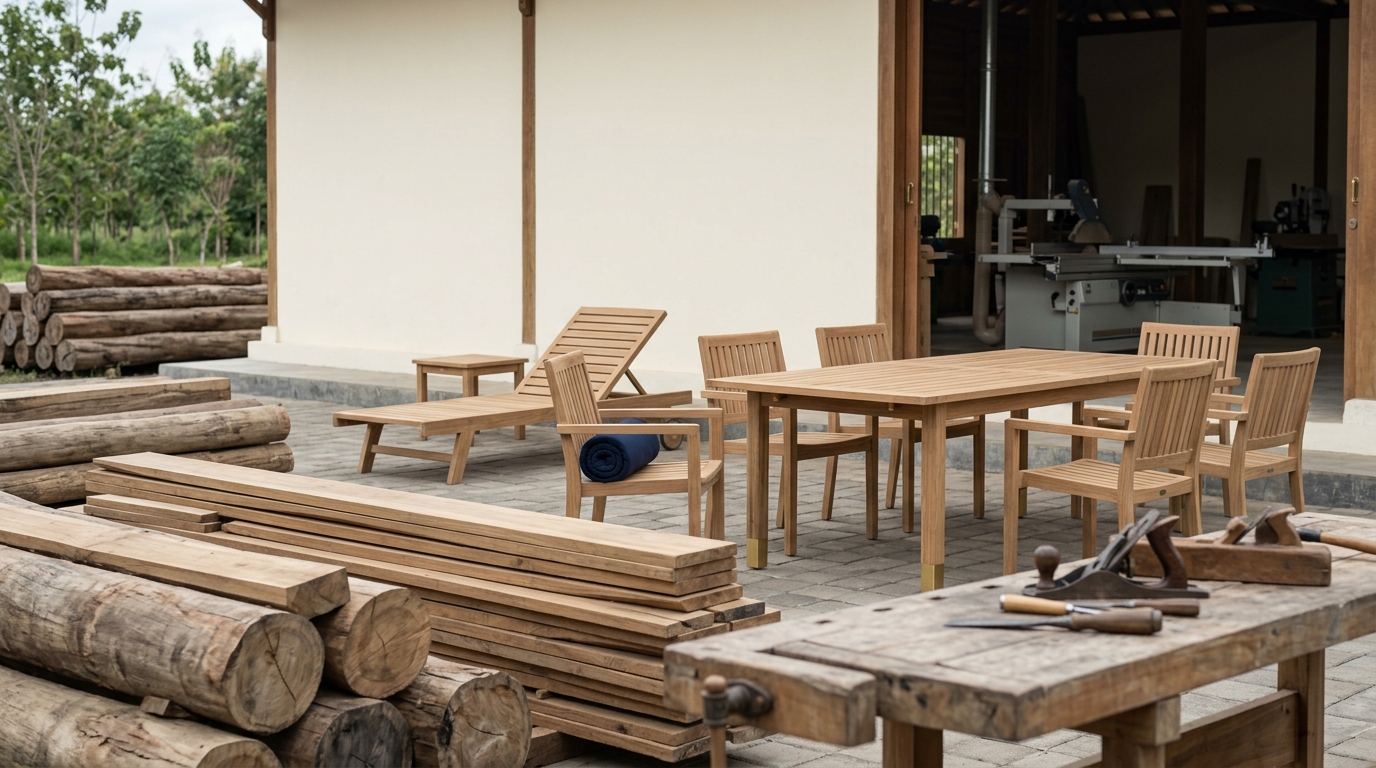
When you're evaluating suppliers for a significant wholesale or contract purchase, the stakes are high. A poor decision on teak grade, supplier credibility, or import compliance can translate into container loads of substandard product, customs delays, or—in the worst case—legal exposure under US…
When you're evaluating suppliers for a significant wholesale or contract purchase, the stakes are high. A poor decision on teak grade, supplier credibility, or import compliance can translate into container loads of substandard product, customs delays, or—in the worst case—legal exposure under US import law. For outdoor furniture retailers and hospitality contractors sourcing at scale, understanding how Indonesian teak supply chains actually work is not optional background knowledge; it is the foundation of a defensible procurement strategy.
This guide covers everything a US-based buyer needs to evaluate before committing to a supplier relationship: how Indonesian teak compares to other origins, what teak grades mean in practical terms, which certifications satisfy both US law and your customers' sustainability expectations, how pricing and logistics stack up on a landed-cost basis, and what a credible supplier vetting process looks like. Each section is structured for decision-makers who need actionable specifics, not lifestyle copy.
Whether you are placing your first container order or renegotiating an existing supplier agreement, the information here will help you ask better questions, avoid common pitfalls, and negotiate from a position of knowledge. The logical starting point is understanding why Indonesia has become the dominant origin for premium outdoor teak—and why that advantage is structural, not accidental.
Why Indonesian Teak Dominates the Global Outdoor Furniture Market
Indonesia's position as the world's leading exporter of outdoor teak furniture from Indonesia is not simply a function of low labor costs. It reflects a convergence of climate, managed forestry infrastructure, and multi-generational manufacturing expertise that competing origins have not replicated.
Climate, Plantation Infrastructure, and Wood Quality
The species at the center of this industry is Tectona grandis, the botanical name for true teak. Indonesia's primary teak-growing belt—concentrated in Central and East Java—produces plantation-grown timber under conditions that favor high natural oil content and tight grain density. The combination of distinct dry and wet seasons, volcanic soil composition, and managed harvest rotations typically ranging from 40 to 80 years produces wood with the oil-rich heartwood that makes outdoor furniture weather-resistant without chemical treatment.
Indonesia's state-owned and licensed private plantations have operated under formal management frameworks for decades, which means the supply chain is more traceable and certifiable than in origins where teak is predominantly wild-harvested.
Jepara and Bali: Two Manufacturing Traditions with Different Strengths
Jepara, in Central Java, is Indonesia's largest furniture manufacturing cluster. It concentrates hundreds of factories ranging from large-scale export operations with dedicated quality control departments to smaller workshops capable of complex hand-carving. Jepara's factories are generally better equipped for high-volume contract orders, custom OEM production, and the documentation requirements of sophisticated US importers.
Bali's furniture sector is smaller and tends toward higher-end artisan production. Teak furniture from Bali often features stronger design influence from local craft traditions and appeals to hospitality buyers seeking distinctive aesthetics for boutique resorts. Lead times and MOQ flexibility can differ from Jepara, and Bali-based exporters often work through trading companies rather than manufacturing direct.
For most wholesale buyers prioritizing volume, consistency, and compliance documentation, Jepara-based manufacturers are the more practical starting point. Bali remains a strong option for boutique hospitality procurement where design differentiation justifies premium pricing.
How Indonesian Teak Compares to Other Origins
| Origin | Primary Source | Grain Consistency | Certification Availability | Typical Price Position |
|---|---|---|---|---|
| Indonesia (Java) | Managed plantation | High | FSC, SVLK widely available | Mid to premium |
| Myanmar | Mixed (plantation + natural forest) | Variable | Limited, import restrictions apply | Variable |
| Brazil | Plantation (introduced species) | Moderate | Some FSC-certified operations | Competitive |
| India | State plantation | Moderate | Limited export volume | Rarely exported as furniture |
Myanmar teak, historically prized, carries significant legal and reputational risk for US importers due to ongoing import restrictions and sanctions considerations. Brazilian plantation teak is a legitimate alternative but tends to have lower oil content than Javanese-grown material. For US buyers prioritizing legal compliance, supply consistency, and documented chain of custody, Indonesian teak remains the benchmark.
Understanding Teak Grades and What They Mean for Your Purchase
Not all teak furniture is equal, and suppliers who do not specify grade clearly are often concealing a significant quality variable. Understanding the grading system is one of the most practical things a buyer can do before issuing a purchase order.
Grade A, B, and C Defined
Grade A teak is cut entirely from the dense, oil-rich heartwood of mature Tectona grandis. It displays a uniform golden-to-medium brown color, tight and consistent grain, and virtually no knots or sapwood inclusions. The natural silica and oil content in Grade A heartwood is responsible for the material's self-protecting properties against moisture, UV exposure, and insect activity. For outdoor and hospitality applications, Grade A is the appropriate specification.
Grade B teak contains a mixture of heartwood and sapwood. Sapwood—the lighter, outer portion of the log—is significantly lower in natural oil content and is substantially more vulnerable to weathering, cracking, and biological degradation in outdoor conditions. Grade B furniture often looks comparable to Grade A in a showroom photograph but performs poorly over multiple outdoor seasons.
Grade C teak uses predominantly sapwood and lower-grade cuts. It may be appropriate for interior decorative applications where appearance rather than durability drives the specification, but it has no place in a commercial outdoor furniture line.
Visual and Structural Red Flags When Evaluating Supplier Samples
- White or pale streaking in the grain indicates sapwood inclusion, even in pieces labeled Grade A - Visible knots suggest the use of lower-grade cuts or immature plantation timber - Uneven color across a set often reflects inconsistent grade mixing at the production level - Lightweight feel relative to comparable dimensions can indicate lower density wood or immature timber - Chalky or dry surface texture before finishing may indicate low natural oil content
FSC Certification and US Import Compliance Every Buyer Must Understand
For US retailers and hospitality contractors, teak sourcing is not only a quality decision—it is a legal compliance matter. Two certification frameworks are directly relevant, and one US federal law creates real legal exposure for non-compliant importers.
FSC and SVLK: What Each Certification Covers
The Forest Stewardship Council (FSC) is the globally recognized standard for responsible forest management. An FSC chain-of-custody certificate, held by a manufacturer, means that the timber used in production can be traced back to an FSC-certified forest source. For US buyers marketing to environmentally conscious retailers or hospitality brands with published sustainability commitments, FSC certification is increasingly a procurement requirement rather than a preference.
SVLK (Sistem Verifikasi Legalitas Kayu)—Indonesia's national Timber Legality Verification System—is a government-mandated certification scheme requiring all Indonesian timber and wood product exporters to demonstrate legal compliance in harvest, transport, processing, and export. SVLK is a baseline legal requirement for Indonesian exporters, and its documentation (the V-Legal mark and supporting audit reports) should be present for any legitimate export shipment. SVLK is recognized under the EU Timber Regulation and is consistent with the evidentiary requirements of US import law.
The Lacey Act and What It Means for Your Business
The Lacey Act is a US federal law that prohibits the import, export, transport, sale, or purchase of plants—including wood products—that were taken, possessed, transported, or sold in violation of any US or foreign law. For teak furniture importers, this means that if the timber in your container was illegally harvested in Indonesia—even if you were unaware of it—your business can face civil penalties, seizure of goods, and in egregious cases, criminal liability.
Lacey Act compliance for teak furniture importers requires:
1. Filing a Plant and Plant Product Declaration with US Customs and Border Protection at the time of import, specifying the scientific name of the species (Tectona grandis), country of harvest, and quantity 2. Maintaining documentation that demonstrates due care in verifying the legality of your supply chain 3. Retaining supplier certifications (SVLK documentation and/or FSC chain-of-custody certificates) as part of your import records
How to Verify Certification Legitimacy
FSC certificates can be verified directly through the FSC's public certificate database at info.fsc.org using the certificate code provided by the supplier. SVLK documentation should include an audit report number that can be cross-referenced with the certifying body. Do not accept photocopied certificates without verifying the certificate number against the issuing organization's records—certificate fraud exists in this supply chain.
Product Categories and Customization Options from Indonesian Teak Manufacturers
The range of products available from Indonesian teak furniture manufacturers covers virtually every outdoor furniture category at both retail and contract-grade specifications.
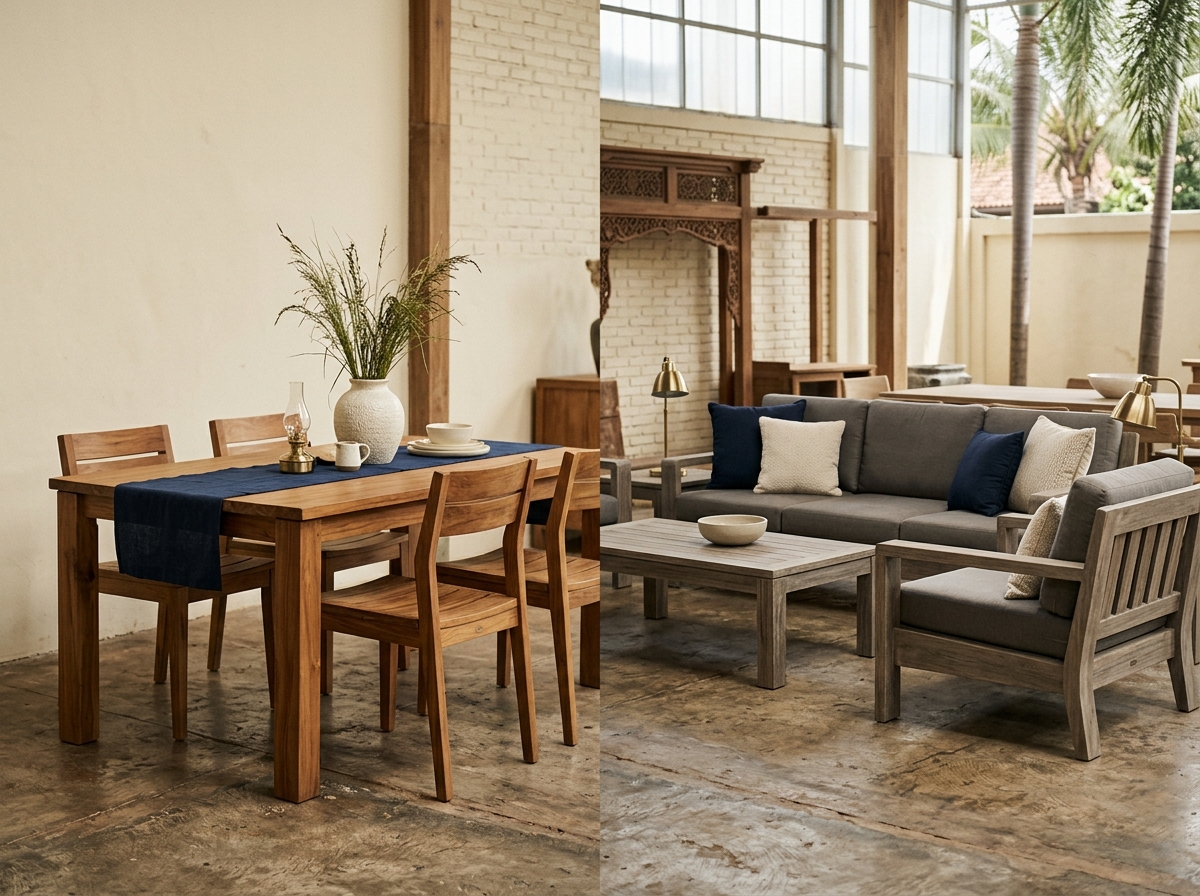
Standard product categories include dining sets (tables with fixed or extension leaves, side chairs, and armchairs), lounge and conversation sets, sun loungers and daybeds, bar-height sets, and poolside furniture designed to withstand continuous water exposure and chlorine splash.
Contract-grade collections for hotels and resorts are typically distinguished by heavier construction specifications, reinforced joinery (mortise-and-tenon rather than dowel), and finishing systems tested for higher-traffic durability. Jepara factories with dedicated export lines for the hospitality sector can often provide product specifications aligned with commercial furniture standards.
OEM and private-label production is widely available from mid-to-large Jepara manufacturers. Buyers can submit original designs for production, modify existing factory designs, and request branded packaging, custom hang tags, and proprietary finish colors. Lead times for new OEM development typically run longer than standard catalog orders—allow for sample approval cycles before committing to production quantities.
Finishing options available from most export-grade factories include: - Natural teak oil finish: preserves the warm golden-brown color; requires periodic maintenance - Weathered gray finish: simulates the natural silvering patina; popular in contemporary hospitality design - Painted or powder-coated finishes: available but less common; require appropriate primer systems for outdoor wood - Custom stain or wash effects: available at minimum quantities; expect additional lead time for finish development
Pricing Structures and Landed Cost Calculations for Wholesale Buyers
Factory price lists tell only part of the story. US buyers who budget only to the ex-works or FOB price routinely find their landed costs significantly exceed initial projections. Understanding the full cost stack before negotiating is essential.
Factory Price Ranges and Incoterms
Pricing for outdoor teak furniture from Indonesia is typically quoted on either an EXW (Ex-Works) basis—where the buyer assumes all costs from the factory gate—or an FOB Semarang or FOB Tanjung Priok basis, which includes inland transport to the export port and loading charges.
As a general orientation, mid-range Grade A teak dining chairs from established Jepara factories commonly fall in the range of approximately $40–$120 per piece FOB depending on construction complexity, finish specification, and order volume. Full dining sets, sun loungers, and sectional lounge pieces scale accordingly. These figures vary considerably based on market conditions, raw material costs, and supplier tier—treat them as orientation ranges, not fixed benchmarks.
Full Landed Cost Breakdown
| Cost Component | Typical Basis | Notes |
|---|---|---|
| FOB Factory Price | Per piece or per set | Starting point only |
| Inland freight to port | Per CBM or per container | Semarang serves Central Java; Tanjung Priok serves Jakarta area |
| Ocean freight (LCL or FCL) | Per CBM or per 20'/40' container | Varies significantly by season and routing |
| Marine cargo insurance | Approximately 0.3–0.5% of cargo value | Strongly recommended |
| US port handling and terminal fees | Per container | Variable by port |
| Customs duties (US) | See HS code section below | Applies at first US port of entry |
| Customs broker fees | Flat fee per entry | Budget for a licensed broker |
| Inland US delivery | Per mile or per delivery | Drayage from port to warehouse |
| **Total Landed Cost** | **Per piece** | **Can be 35–65% above FOB price** |
MOQ Expectations and Payment Terms
Minimum order quantities vary significantly by supplier type. Large export factories in Jepara typically set container-level MOQs—commonly one 40-foot container per order—while smaller workshops may accept less-than-container-load (LCL) quantities at a price premium. For buyers testing a new supplier with a sample order, LCL shipments are viable but will have a meaningfully higher per-piece freight cost.
Payment terms from Indonesian furniture exporters most commonly follow a 30% T/T (telegraphic transfer) deposit at order confirmation, with the 70% balance payable against shipping documents or before container release. Letters of credit (LC at sight) are accepted by most export-oriented factories, though they add banking fees for both parties. Established relationships with strong order history sometimes support negotiated payment terms, but new buyers should expect deposit requirements.
How to Vet and Qualify an Indonesian Teak Furniture Supplier
The quality of your supplier relationship determines everything downstream—product quality, compliance documentation, lead time reliability, and after-sales support. Invest in vetting before you invest in inventory.
Document Checklist for Supplier Qualification
- ✓Current business registration (SIUP) and company deed
- ✓Export license (Angka Pengenal Ekspor)
- ✓Current SVLK certificate with audit report number
- ✓FSC chain-of-custody certificate (verify at info.fsc.org)
- ✓Product liability insurance documentation
- ✓Bank reference or trade reference from existing US or European buyers
- ✓Sample purchase agreement or pro-forma invoice for review
Factory Audit Criteria
If you can visit Indonesia—or commission a third-party audit—evaluate factories against these criteria: production capacity relative to your order volume, finished goods quality control process (including moisture content testing of timber before production), joinery method (mortise-and-tenon construction indicates higher-grade specification), drying kiln availability (kiln-dried timber reduces post-shipment cracking and warping), and packaging systems for export.
For buyers unable to visit in person, third-party pre-shipment inspection by a recognized inspection agency is strongly recommended before every container loading. Agencies operating in Indonesia can conduct visual inspections, piece-count verification, and packing quality checks against your purchase order specifications. This adds a modest cost per inspection but provides documented evidence of goods condition before they leave the country—critical for any insurance or dispute resolution process.
Trade Shows as Supplier Vetting Events
Indonesia's major furniture trade shows offer a highly efficient in-person vetting opportunity. The Indonesia International Furniture Expo (IFEX), held annually in Jakarta, and IFFINA (Furniture and Craft Fair Indonesia) are the two primary events where export-grade manufacturers present collections. Attending either show allows buyers to evaluate multiple suppliers, review physical samples, and initiate certification discussions in person. A manufacturer's consistent presence at these events is a positive signal of export market maturity and financial stability.
Import Logistics from Indonesia to US Ports: A Practical Timeline
Understanding the logistics timeline helps you plan inventory, manage customer expectations, and avoid costly expediting decisions.
Ocean Freight Transit Times
From Semarang (the primary port for Jepara-area production) or Tanjung Priok (Jakarta's main container port), ocean freight to major US ports typically runs:
- US West Coast ports (Los Angeles/Long Beach): approximately 18–25 days transit - US East Coast ports (New York, Savannah, Charleston): approximately 28–38 days transit via Suez Canal routing
These figures represent vessel transit time only. Add 3–7 days for inland trucking from factory to port, 5–10 days for container booking and documentation preparation, and allow for 3–10 days customs clearance and port processing on the US side. A realistic door-to-door planning horizon from production completion to US warehouse receipt is commonly 45–75 days depending on routing, season, and port congestion.
HS Codes and US Customs Duties for Teak Furniture
Outdoor teak furniture typically falls under HS Chapter 94 (Furniture). The specific subheading depends on product type—seating, tables, and other furniture each have distinct classifications. US import duties on wooden furniture from Indonesia under the standard Most Favored Nation (MFN) tariff rate are generally in the range of approximately 0% to 5.3% depending on the specific subheading. Indonesia is not subject to the additional Section 301 tariffs that apply to Chinese-origin furniture, which represents a meaningful cost advantage for US buyers who previously sourced from China.
Role of a Licensed Customs Broker
For buyers new to importing from Indonesia, engaging a licensed US customs broker is strongly recommended rather than optional. A customs broker manages the formal entry process, ensures correct HS code classification, files the Lacey Act Plant Declaration, and coordinates with your freight forwarder on documentation. Broker fees are modest relative to the risk of clearance delays or compliance errors on a full container shipment.
Care, Maintenance, and Warranty Language to Support Your Sales Process
The durability story of Grade A outdoor teak furniture from Indonesia is one of the most compelling selling points available to retailers and hospitality procurement teams—but it needs to be communicated accurately to protect your brand reputation.
Tectona grandis contains naturally occurring silica, rubber compounds, and oils that create an inherent resistance to moisture absorption, UV degradation, and insect damage that no applied treatment can fully replicate in other wood species. This is a genuine material advantage, and retailers can communicate it confidently when the product is correctly specified as Grade A heartwood construction.
Oiling versus natural silvering: Grade A teak will gradually transition from its initial golden-brown color to an attractive silver-gray patina over 6–18 months of outdoor exposure as surface oils oxidize. This patina does not indicate deterioration—the wood beneath remains structurally sound. Customers who prefer to maintain the original color can apply a penetrating teak oil annually to slow the weathering process. Neither approach is wrong; the choice is aesthetic. Retailers who explain this proactively reduce returns and complaint rates significantly.
Expected lifespan: Under typical US outdoor conditions, Grade A teak furniture with proper joinery construction commonly performs for 20 to 30 years or more before structural replacement is warranted. In harsh coastal or tropical climates with year-round outdoor exposure, the timeline shortens somewhat but remains substantially longer than most alternative materials. This longevity story is a key differentiator for retailers competing against lower-cost alternatives in aluminum, resin wicker, or lower-grade wood species.
Warranty language recommendations: For retailers reselling Indonesian teak products, warranty language should specify that coverage applies to structural defects in materials and workmanship rather than to natural color variation, weathering, or surface checking (fine surface cracks that are a normal characteristic of teak). Structural warranty periods of 2–5 years are defensible for Grade A teak furniture sourced from qualified manufacturers; longer warranty periods create exposure unless backed by the manufacturer's own warranty commitment in writing.
Frequently Asked Questions from Retailers and Hospitality Contractors
What is the difference between Grade A and Grade B Indonesian teak for outdoor furniture?
Grade A teak is cut exclusively from the dense, oil-rich heartwood of mature Tectona grandis. Grade B contains a mix of heartwood and sapwood. Sapwood has significantly lower natural oil content and degrades substantially faster in outdoor conditions—cracking, graying unevenly, and becoming susceptible to biological damage within a few seasons. For any outdoor or hospitality application, Grade A is the correct specification. Always request a written grade guarantee in your purchase agreement.
How do I verify that Indonesian teak furniture is FSC-certified and Lacey Act compliant?
Request the supplier's FSC chain-of-custody certificate number and verify it directly at info.fsc.org. For SVLK compliance, ask for the V-Legal certificate and cross-reference the audit report number with the certifying body. For Lacey Act compliance, maintain a supplier file with these documents and ensure your customs broker files the required Plant and Plant Product Declaration at import. Consult a licensed customs broker or trade attorney if you have specific compliance questions.
What are typical wholesale prices and minimum order quantities for outdoor teak furniture from Indonesia?
FOB prices vary considerably by product complexity, grade specification, finish, and order volume. As a general orientation, Grade A teak side chairs commonly range from approximately $40 to $120 FOB depending on construction and factory tier. Full dining or lounge sets scale from there. Most large export factories require a minimum of one full container (typically a 40-foot container) per order. Smaller workshops may accept LCL quantities. Budget 35–65% above the FOB price to model your true landed cost.
How long does it take to ship teak furniture from Indonesia to the United States?
Ocean transit from Semarang or Tanjung Priok runs approximately 18–25 days to US West Coast ports and 28–38 days to East Coast ports. Including production lead time (typically 45–90 days for catalog items, longer for custom OEM), pre-shipment preparation, customs clearance, and inland US delivery, a realistic end-to-end planning horizon is 90–150 days from purchase order to warehouse receipt for a first-time order.
Can Indonesian manufacturers produce custom designs or private-label outdoor furniture?
Yes. OEM and private-label production is widely available, particularly from mid-to-large Jepara factories. You can submit original CAD designs or modify factory catalog pieces. Expect a sample development cycle of 4–8 weeks before production approval, and plan for longer lead times than standard catalog orders. Most factories require higher MOQs for custom designs.
Is Indonesian teak furniture from Jepara better than teak furniture from Bali?
Jepara and Bali represent different strengths rather than a simple quality ranking. Jepara is better suited for high-volume contract orders, standardized product lines, and buyers who need full compliance documentation from a manufacturer with dedicated export infrastructure. Bali tends toward smaller-batch, artisan-influenced production with stronger design differentiation. For most wholesale retail and contract hospitality programs, Jepara is the more practical and scalable source.
Sourcing outdoor teak furniture from Indonesia at a professional level requires aligning three things simultaneously: quality specification (confirmed Grade A, properly certified timber), supply chain compliance (FSC and SVLK documentation, Lacey Act due care), and a clear-eyed landed cost model that accounts for freight, duties, and logistics rather than factory price alone. Buyers who master these three dimensions consistently outperform competitors who select suppliers on quoted price alone.
You now have the framework to evaluate suppliers, structure compliant import programs, and make accurate margin calculations before placing an order.
Now that you understand what separates a compliant, high-quality Indonesian teak supply chain from a risk-laden one, the next step is connecting with a certified manufacturer who can meet your grade, certification, and volume requirements. Request a wholesale catalog and factory-direct quote from a certified Indonesian teak furniture manufacturer today — and ask specifically for Grade A specifications, SVLK and FSC documentation, and FOB Semarang pricing by product category.
Request Wholesale Catalog and Quote →Need eyes on the ground in Indonesia?
MTS is an execution partner — supplier verification, manufacturing management, quality control and export logistics across Indonesia, Vietnam and China.
Related services
Related articles
Receive furniture sourcing insights across Asia.
One email per week. No spam.