Resort Furniture Wholesale Indonesia: Full-Property Sourcing Guide for Developers
14 min read
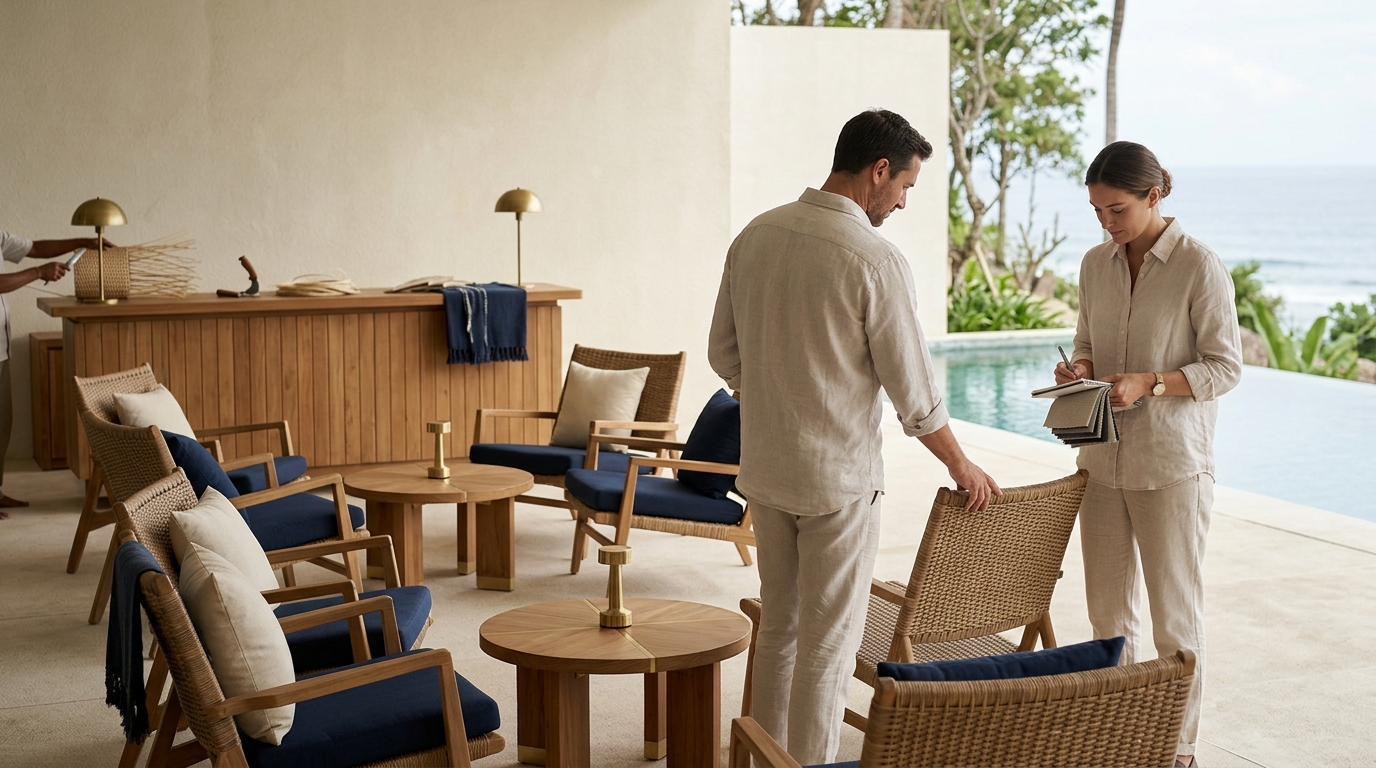
Furnishing an entire resort property is a complex procurement exercise. You are not buying a single product category. You are coordinating hundreds of SKUs across guest rooms, lobby, restaurant, spa, pool deck, and beach club — each zone with different material requirements, lead times, and finish…
Furnishing an entire resort property is a complex procurement exercise. You are not buying a single product category. You are coordinating hundreds of SKUs across guest rooms, lobby, restaurant, spa, pool deck, and beach club — each zone with different material requirements, lead times, and finish specifications.
Indonesia has emerged as the primary single-source solution for resort-scale FF&E programs targeting the US market. No other country combines Grade A teak, plantation-grown mahogany, handwoven rattan, suar wood, and the manufacturing depth to produce everything from carved lobby millwork to marine-gradesun loungersunder one regional supply chain.
This guide is written for resort developers, FF&E consultants, and hospitality operators sourcing wholesale for full-property programs. It covers zone-by-zone furniture scope, material zoning by environmental exposure, phased delivery aligned to construction milestones, supplier vetting criteria, US import compliance, and a wholesale budget framework. It is designed to support sourcing decisions at the project level — not room-by-room procurement.
Indonesia's furniture export industry has supplied 4- and 5-star hospitality projects globally for decades. The infrastructure, the export knowledge, and the material base are mature. The challenge for US buyers is structuring the engagement correctly — choosing the right factory type, specifying the right materials per zone, and managing compliance from the first purchase order through US customs clearance.
Why Resort Developers Source Resort Furniture Wholesale from Indonesia
Indonesia's position in the global furniture industry is not generic. It is specifically strong in the material categories that define resort aesthetics: teak, rattan, mahogany, bamboo, and suar. These are not imported raw materials processed elsewhere. They originate in Indonesia, are processed by factories with decades of export experience, and arrive with the grain, color variation, and handcraft character that resort designers specify.
Factory-Direct Pricing vs. North American Middlemen
Sourcing furniture from Indonesia at wholesale eliminates multiple margin layers. When a US-based FF&E reseller or furniture distributor supplies resort property programs, they are typically marking up Indonesian or Asian product by a significant percentage. Buying factory-direct — or through a vetted sourcing partner working on a transparent service fee rather than a product markup — captures that margin difference and redirects it into theFF&E budget.
For a mid-scale resort program with several hundred furniture pieces across all zones, the cost differential between wholesale Indonesian sourcing and domestic procurement is typically substantial. Section 10 of this guide addresses the budget framework in detail.
Full-Property Scope From a Single Regional Supply Chain
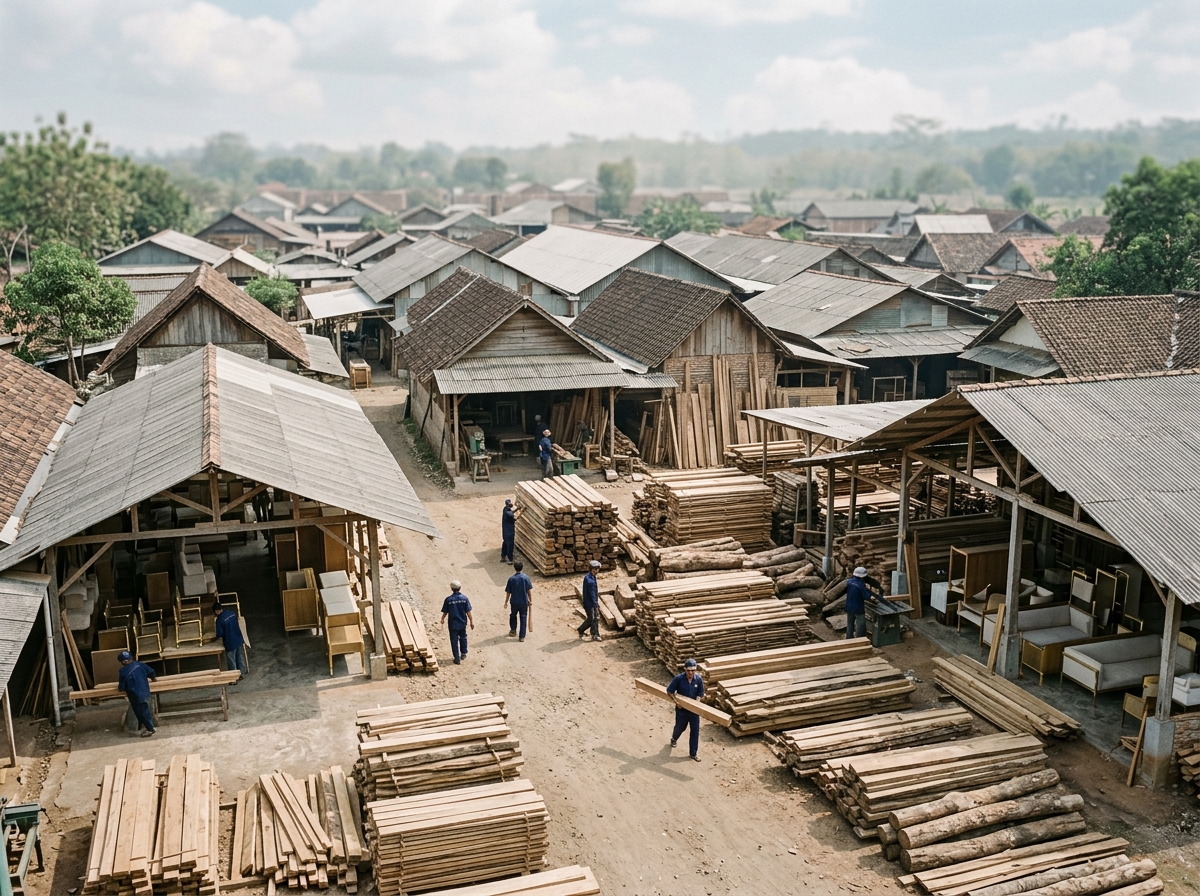
Indonesia's manufacturing clusters cover every zone of a resort property. Jepara produces carved teak and mahogany bedroom furniture, console tables, and lobby millwork. Bali supplies rattan seating, woven lighting, and resort lifestyle pieces. Cirebon anchors rattan weaving for indoor and covered outdoor applications. Surabaya handles larger-scale commercial production including machine-finished hybrid pieces for F&B programs.
This geographic specialization means a developer can consolidate a full-property FF&E order within a single country — simplifying logistics, reducing the number of freight consolidations, and maintaining design cohesion across zones more easily than when sourcing across multiple countries.
Zone-by-Zone Furniture Scope: Mapping the Full Resort FF&E Program
Most sourcing guides address outdoor furniture or guest rooms. A full resort FF&E program requires a zone-by-zone framework. Each area has distinct functional requirements, traffic levels, and material specifications.
| Resort Zone | Key Furniture Items | Primary Materials |
|---|---|---|
| Guest rooms & villas | Beds, wardrobes, nightstands, desks, armchairs | Kiln-dried teak, mahogany, rattan |
| Lobby & reception | Sofas, console tables, statement chairs, display millwork | Suar, teak, carved mahogany |
| Restaurant & F&B | Dining tables, chairs, bar stools, sideboards, counters | Teak, rattan, mahogany |
| Pool deck | Sun loungers, daybeds, side tables | Grade A teak, synthetic rattan, aluminum |
| Beach club | Daybeds, umbrella bases, low lounge chairs | Marine teak, UV-stable synthetic rattan |
| Spa & wellness | Treatment storage, lounge chairs, cabinet millwork | Teak, bamboo, low-VOC finishes |
Guest Rooms and Villas
Bedroom furniture from Indonesia typically includes platform beds, four-poster frames in teak or mahogany, matching nightstands, wardrobes with internal hardware, writing desks, and occasional armchairs. Kiln-dried teak at 8–12% moisture content is the standard specification for pieces destined for air-conditioned US interiors. Full-cycle factories that own their own kilns control this parameter directly — assembly-only operations that source panels externally cannot guarantee it.
Lobby, F&B, and Spa Zones
The lobby is a design statement. Suar wood slabs, carved teak panels, and oversized rattan pendant lighting from Bali producers are common specification choices. Restaurant programs require higher-volume seating — typically dining chairs and tables specified for repeated daily use. Spa zones demand low-VOC water-based finishes on all interior millwork and cabinetry, a requirement that should be written into the purchase order and verified during quality inspection.
Material Zoning by Environmental Exposure Across the Full Property
One of the most operationally important decisions in resort FF&E sourcing is matching material specifications to exposure zones. Specifying the wrong material for a given environment creates warranty failures, premature finish degradation, and replacement costs within the first operating year.
Indoor Zones: Controlled Environment Specifications
Indoor resort furniture — guest rooms, spa, lobby interiors — performs in air-conditioned, humidity-controlled environments. Kiln-dried teak, mahogany, and suar at 8– approximately 12% moisture content are appropriate. Standard water-based or solvent-based lacquer finishes perform well indoors. Rattan with interior-grade lacquer coating is suitable for accent chairs and decorative applications.
Covered Outdoor Zones: Verandas, Pool Pavilions, and Shaded Decks
Covered outdoor areas experience humidity, indirect rain, and temperature variation but not direct UV exposure or salt spray. Appropriate materials include powder-coated aluminum frames, all-weather synthetic rattan weave, and marine-grade teak with an oil or sealer finish. Avoid standard interior lacquer in these zones — it will fail.
Full Outdoor and Beachfront: Maximum Exposure Specifications
Full outdoor and beachfront zones require the highest specification tier. Grade A teak (the dense, oil-rich heartwood grade) with stainless steel hardware is the standard. Stainless steel — grade 316 in marine environments — resists salt-air corrosion where standard mild steel or even 304-grade stainless will eventually fail. UV-stable synthetic rattan retains color and structural integrity under direct sun.
Building a Unified Design Language Across All Resort Zones
Design cohesion across a full resort property does not happen automatically. It requires deliberate coordination between the developer, interior designer, and Indonesian manufacturer before production begins.
Key specification variables that must be locked before ordering:
- Wood species selection: Teak, mahogany, and suar have visually distinct grain patterns and natural color tones. Mixing species across zones without intentional finish alignment creates visual inconsistency. - Finish tone: Specify a named finish code — or supply a physical sample — for each wood species across all zones. Indonesian manufacturers can match finish tones across product categories when the specification is clear. - Weave pattern and color: For rattan and synthetic rattan pieces, specify the weave pattern (close weave, open weave, herringbone) and yarn color consistently across zones. - Metal finish: Powder coat color and sheen level on aluminum frames should be consistent across pool deck, F&B, and lobby pieces.
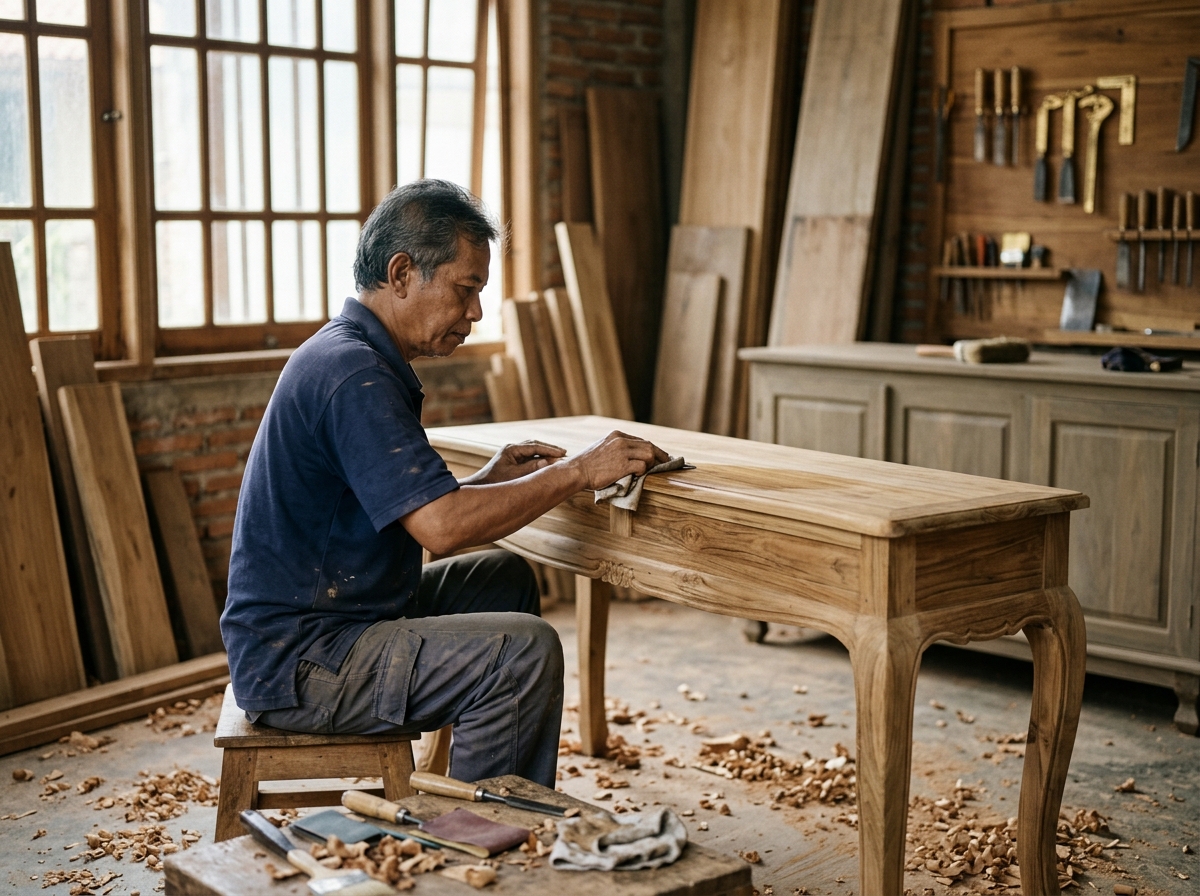
Custom millwork and branded design packages are a real capability of established Indonesian factories — particularly in Jepara and Bali. Sharing architect drawings in DWG or PDF format with dimensional tolerances and finish callouts is standard practice for experienced export factories. Request a physical sample set — typically two to four representative pieces per zone — before bulk production is authorized.
Phased FF&E Delivery Aligned to Resort Construction Milestones
No competitor sourcing guide addresses this. It is one of the highest-value operational decisions in a resort FF&E program. Ordering everything at once creates storage and damage risk on-site. Ordering too late creates delays to handover.
A typical phased structure for a full resort program:
| Phase | Timing | Items | Notes |
|---|---|---|---|
| Phase 1 | 12–16 months before opening | Custom millwork, built-ins, long-lead carved pieces | Ordered first; highest production lead time |
| Phase 2 | 8–10 months before opening | Guest room and villa furniture | Timed to room-block construction handover |
| Phase 3 | 5–7 months before opening | F&B, lobby, public area furniture | Aligned to soft-opening milestone |
| Phase 4 | 3–4 months before opening | Pool deck, beach club, spa finish-out | Final punch-list zones |
Communicate this phased schedule to your Indonesian suppliers and freight forwarder at the outset — not mid-project. Indonesian manufacturers with hospitality export experience understand phased delivery. Smaller assembly-only operations often do not. This is one reason factory classification matters before placing orders.
Vetting Indonesian Resort Furniture Suppliers: What to Verify Before Ordering
Factory Type: Full-Cycle vs. Assembly-Only
This is the most important distinction. A full-cycle factory owns its lumber yard, kiln-drying facility, CNC processing, finishing, upholstery, and packaging under one roof. It controls moisture content — the fundamental quality parameter for furniture going into US interiors with climate control. An assembly-only operation purchases finished panels and components externally, performs final assembly, and cannot guarantee kiln-drying standards.
Verify factory type through a physical audit or through a vetted independent sourcing partner. Alibaba supplier status badges do not verify this.
Certifications to Require
- SVLK (Sistem Verifikasi Legalitas Kayu): Indonesia's national timber legality verification system. Required for Lacey Act compliance on US imports. Any Indonesian wood furniture supplier should hold or supply SVLK-covered documentation. - FSC (Forest Stewardship Council): Required for green-building projects or LEED-adjacent resort programs. - REACH compliance: Relevant for finish and adhesive chemical content, particularly for indoor spa and guest room pieces.
MOQs, Lead Times, and Payment Terms
Typical market parameters (approximate):
- MOQ: Mid-scale export factories commonly require minimum order quantities of around 20–50 pieces per SKU for standard catalog items. Custom pieces typically require smaller runs but longer lead times. - Production lead time: Approximately 60–90 days for standard items; 90–120 days for custom or high-complexity pieces. - Payment terms: Typically 30–50% deposit on order confirmation, balance against bill of lading or pre-shipment inspection.
Pricing, Shipping, and US Import Logistics for Resort-Scale Orders
FOB vs. CIF and What Each Means for FF&E Budgets
- FOB (Free on Board): Supplier delivers to the named Indonesian port. Freight, insurance, and US import costs are the buyer's responsibility. FOB gives the buyer control over freight forwarder selection and visibility into shipping costs. - CIF (Cost, Insurance, Freight): Supplier includes freight and insurance to the US destination port. Simpler administratively but reduces buyer control over freight costs and carrier selection.
For resort-scale FF&E programs, FOB is generally preferred. It enables the buyer to consolidate containers across suppliers and negotiate freight rates directly.
Container Planning for Bulk Resort Orders
- A standard 20-foot container holds approximately 25–28 cubic meters of furniture. - A 40-foot high-cube (HQ) container holds approximately 67–72 cubic meters. - Resort-scale FF&E programs typically require multiple 40HQ containers. Planning container loads by phase — aligned to the phased delivery schedule above — reduces on-site storage requirements.
US Import Duties and HTS Codes
Indonesian wood and rattan furniture is subject to US import duties. Applicable HTS codes vary by product type:
- Wooden bedroom furniture: HTS Chapter 94, subheadings vary by construction - Seats with wooden frames (rattan/wicker): HTS 9401.61 or 9401.69 - Other wooden furniture: HTS 9403.30–9403.60
Duty rates are typically in the range of approximately 0–5.3% for Indonesian furniture, but confirm current rates with your customs broker. Indonesia is not currently subject to the Section 301 tariffs applied to China-origin furniture — a meaningful cost advantage.
- ✓SVLK timber legality documentation from supplier
- ✓Lacey Act plant declaration (PPQ Form 505) for wood products
- ✓HTS code confirmed with licensed customs broker
- ✓FSC chain-of-custody certificate if required by project
- ✓Fumigation certificate for solid wood packaging
- ✓Bill of lading and commercial invoice aligned to purchase order
Indonesian Manufacturing Regions and Their Resort Furniture Specializations
| Region | Primary Specialization | Best Suited For |
|---|---|---|
| Jepara, Central Java | Carved teak and mahogany, solid wood export | Bedroom furniture, lobby millwork, custom pieces |
| Bali | Rattan, bamboo, artisan décor, resort lifestyle | Statement lobby pieces, spa, rattan seating, lighting |
| Cirebon, West Java | Rattan weaving, natural fiber furniture | Indoor rattan chairs, covered outdoor seating |
| Surabaya, East Java | Large-scale commercial, machine-hybrid production | High-volume F&B seating, catalog-grade pieces |
Sustainability and US Import Compliance for Resort Projects
The Lacey Act: What US Buyers Must Understand
The Lacey Act prohibits the import of illegally harvested timber and wood products into the United States. For resort developers and FF&E consultants importing Indonesian wood furniture, this means requiring documentation that demonstrates legal timber origin throughout the supply chain. SVLK is Indonesia's government-backed timber legality assurance system and is recognized as satisfying Lacey Act due-care requirements.
FSC and PEFC for Green-Building Resort Programs
FSC-certified Indonesian furniture is available — primarily from larger full-cycle factories in Jepara and Surabaya with established export compliance programs. For resort projects pursuing LEED points or green-building certification, specify FSC chain-of-custody from the supplier and confirm the certificate number is valid on the FSC database before ordering.
Low-VOC Finish Specifications
For spa interiors and guest room furniture, specify water-based or low-VOC finishes explicitly in the purchase order. This protects indoor air quality, satisfies REACH-adjacent requirements, and aligns with green building program expectations. Confirm with a pre-shipment sample or third-party inspection that finish specifications have been met.
Sample Wholesale Budget Framework for a Mid-Scale Resort FF&E Program
The following are approximate directional ranges only, not firm quotations. Actual costs depend on species, finish complexity, custom vs. catalog specification, and supplier tier.
| Zone | Wholesale Indonesia (approx. per room or unit) | Domestic US Procurement (approx.) |
|---|---|---|
| Guest room full set (bed, storage, seating, desk) | Lower-to-mid range; typically a fraction of domestic cost | Significantly higher; distributor margins add cost |
| Restaurant chair (solid teak or rattan) | Competitive at wholesale; custom finishes add cost | Higher per unit; lead times often longer |
| Pool deck sun lounger (Grade A teak) | Wholesale teak loungers are cost-competitive globally | Domestic equivalent often 2–3× the wholesale FOB price |
| Lobby statement piece (custom carved suar) | Custom pricing; highly competitive for complex pieces | Often unavailable domestically at equivalent quality |
Cost Levers
- Custom vs. catalog: Standard catalog pieces from established factory lines are faster and cheaper. Custom pieces add design fees, sample iterations, and longer lead times — but deliver brand differentiation. - Material tier: Grade A teak versus plantation teak versus teak-framed with synthetic components creates meaningful price steps. - Finish complexity: Multi-step hand-applied finishes add cost and lead time. Specify only where the design program justifies it.
Direct Sourcing vs. FF&E Consultant
Working with a local FF&E consultant adds a coordination layer but provides US-market accountability, specification management, and on-site inspection access. Sourcing direct requires internal expertise in Indonesian supply chains, factory auditing, and freight coordination.
Frequently Asked Questions: Indonesian Resort Furniture Wholesale
What is the minimum order quantity for wholesale resort furniture from Indonesia? MOQs vary by factory type and product. Mid-scale export factories typically require around 20–50 pieces per SKU for standard items. For full resort programs with multiple SKUs, the aggregate order volume usually satisfies most factory minimums comfortably. Custom pieces may have lower per-SKU MOQs but require longer lead times.
How long does manufacturing and shipping take for a full resort FF&E order? Production typically runs 60–90 days for standard pieces and 90–120 days for custom items. Ocean freight from Indonesian ports to US West Coast ports runs approximately 20–28 days; East Coast ports add approximately 7–10 days. Total lead time from purchase order to US port delivery is commonly 90–150 days depending on complexity.
Is Indonesian teak furniture compliant with US import laws and the Lacey Act? Yes, when properly documented. Require SVLK timber legality certificates from your supplier and file the required APHIS PPQ Form 505 plant declaration at import. Teak sourced from legal Indonesian plantations or FSC-certified sources satisfies Lacey Act due-care requirements. Never import without documentation — penalties for Lacey Act violations apply to the importer of record.
Can Indonesian manufacturers produce custom furniture to an architect's design specifications? Yes. Established full-cycle factories in Jepara and Bali regularly produce furniture to architect-supplied drawings. Provide DWG or PDF files with dimensional tolerances, species callouts, finish codes, and hardware specifications. Expect a sample approval process of two to four weeks before bulk production is authorized. Budget for sample costs.
How do I manage quality control on a large overseas resort furniture order? The most reliable approach is a two-stage inspection: a mid-production check (approximately 50–70% of production completion) and a pre-shipment final inspection. Both can be conducted by an independent third-party inspection firm in Indonesia or through a sourcing partner with on-the-ground factory access. Do not rely on supplier self-reporting for resort-scale orders.
What certifications should I require from an Indonesian resort furniture supplier? At minimum: SVLK timber legality certification, REACH compliance declaration for finishes, and fumigation certificates for wood packaging. For green-building programs: FSC chain-of-custody. For full supply chain assurance: ISO 9001 quality management system. Verify all certificates against the issuing body's database before finalizing the supplier.
Indonesia offers resort developers a genuine single-source solution for full-property FF&E programs — combining the right raw materials, deep manufacturing capability, and decades of hospitality export experience. Structuring the engagement correctly — through verified full-cycle factories, zone-specific material specifications, phased delivery planning, and rigorous US import compliance — is what separates successful programs from costly surprises.
You now understand the full scope of sourcing resort furniture wholesale from Indonesia. This covers material zoning, factory vetting, Lacey Act compliance, and phased delivery. The next step is connecting with suppliers who can actually execute at resort scale.
You now have the framework. Get factory-direct wholesale pricing for your full resort FF&E program — guest rooms, lobby, F&B, spa, pool deck, and beach club — from pre-audited Indonesian manufacturers with verified hospitality export experience.
Request a Wholesale Quote →Need eyes on the ground in Indonesia?
MTS is an execution partner — supplier verification, manufacturing management, quality control and export logistics across Indonesia, Vietnam and China.
Related services
Related articles
Receive furniture sourcing insights across Asia.
One email per week. No spam.