Indonesian Merbau Timber Suppliers: Export Guide for Flooring and Decking Buyers
14 min read
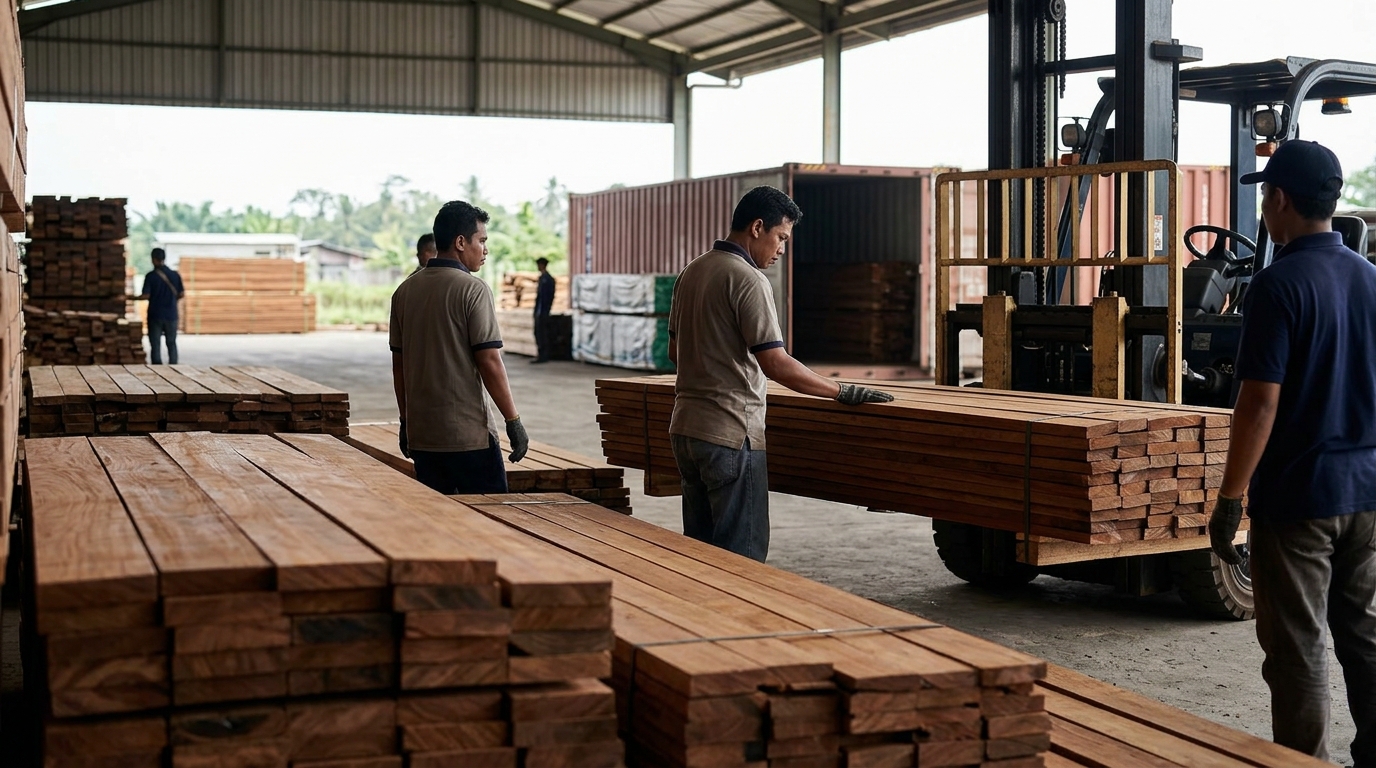
US flooring manufacturers and decking distributors face a consistent challenge when sourcing merbau hardwood: Indonesian suppliers vary widely in mill capability, legality documentation, and export reliability. A buyer who skips due diligence risks receiving under-dried timber, missing V-Legal…
US flooring manufacturers and decking distributors face a consistent challenge when sourcing merbau hardwood: Indonesian suppliers vary widely in mill capability, legality documentation, and export reliability. A buyer who skips due diligence risks receiving under-dried timber, missing V-Legal certificates, or landing a container that triggers a US Lacey Act inquiry. Getting this right requires precise technical criteria, not just a price comparison.
This guide covers everything a US procurement professional needs to evaluate merbau timbersuppliers Indonesia exportchains with confidence. Topics include species properties, kiln drying standards, SVLK legality compliance, container logistics, and pricing benchmarks. It also addresses the tannin bleed problem that trips up finishing teams, and walks through the Lacey Act due-care process step by step.
Merbau sits alongside species likebengkiraiandteakas a cornerstone of Indonesia's tropical hardwood export portfolio. Understanding how it differs from those alternatives—and when to specify it—is the starting point for any serious sourcing decision.
Why Indonesian Merbau Remains a Premium Hardwood Export Choice
Botanical Identity and Natural Origin
Merbau is commercially sourced from two closely related species: Intsia bijuga and Intsia palembanica. Both grow across eastern Indonesia, with major natural stands in Papua Province, Maluku, and parts of Sulawesi. Papua Province remains the primary source of large-diameter logs. East Kalimantan contributes secondary volumes, typically from smaller concessions.
The species' natural range across low-altitude tropical forest gives it dense, consistent growth rings. This translates directly into the mechanical properties that flooring and decking buyers prioritise.
Hardness, Density, and Structural Performance
Merbau's Janka hardness rating is approximately 1,925 lbf (around 8,560 N), placing it well above European oak and comparable to Brazilian hardwoods. Density typically ranges from approximately 750 to 900 kg/m³ at 12% moisture content. These figures make it suitable for high-traffic commercial flooring and heavy-use exterior decking.
Durability class 1–2 under European standard EN 350 means merbau performs well in ground-contact and above-ground exposed applications without preservative treatment. It resists termites, fungal decay, and weathering—critical for US buyers specifying exterior decking in humid climates.
Why US and Global Demand Stays Strong
Merbau delivers a rare combination: tropical aesthetics, structural hardness, and natural durability without chemical treatment. Australian and European markets have imported large volumes for decades. US demand has grown steadily as merbau decking has entered commercial and residential specifications. For buyers comparing species, merbau typically offers a cost advantage over teak while outperforming bengkirai on colour consistency and workability.
Colour, Grain, and Tannin Bleed: Critical Knowledge Before You Place an Order
Heartwood Colour and Consistency
Fresh-cut merbau heartwood ranges from yellow-brown to dark red-brown. Colour stabilises over weeks of exposure to UV and air, typically settling into a warm reddish-brown. Papua-sourced logs often show deeper, more uniform colour. East Kalimantan material can trend lighter and show more variation between boards. Buyers specifying colour-matched flooring should request matched-source grading and ask suppliers to confirm log origin on the purchase order.
Interlocked Grain and Machining Considerations
Merbau exhibits interlocked grain, which creates a ribbon-figure appearance on quarter-sawn faces. This is visually desirable but requires sharp tooling and reduced feed rates during planing and moulding. Mills that do not adjust machining parameters produce fuzzy surfaces and torn grain. Ask prospective suppliers for finished sample boards—not rough-sawn—before approving a bulk order.
Tannin and Resin Bleed: The Problem Most Buyers Underestimate
Merbau contains high concentrations of tannins and water-soluble extractives. When timber is exposed to moisture—rain, dew, or condensation—these extractives migrate to the surface and can stain adjacent concrete, fascia boards, or cladding with a dark reddish-brown residue. This is one of the most common post-installation complaints from end customers.
Pre-treatment protocols that reputable merbau timbersuppliers Indonesiaexport operations should offer:
- Pre-oiling before shipment. Applying a penetrating timber oil (typically linseed- or tung-based) before packing slows extractive migration by sealing surface pores. One to two coats applied at the mill, with full drying before wrapping, is the minimum effective standard. - Water-wash pre-treatment. Some mills run boards through a water-mist tunnel or wet-brush stage after dressing. This deliberately draws out a significant share of surface tannins, which are then wiped or blown off. The timber is re-dried to target EMC before packing. This process adds approximately one to two weeks to lead time but measurably reduces field bleed. - End-sealing. Applying wax emulsion or PVA-based end-grain sealer before containerisation reduces moisture ingress during transit, which is a secondary driver of bleed in destination.
Specify which protocol applies in your purchase order terms. Do not accept a generic "pre-oiled" claim without confirming oil type, application rate, and drying time in writing.
[[WARNING title="Tannin Staining Risk on Site" body="Merbau tannins can permanently stain unpainted concrete and light-coloured composite materials. If your end customer is installing merbau decking over a light-coloured substrate, recommend a sacrificial water rinse of boards before installation and temporary protection of adjacent surfaces during the first wet season."]]
Sawn Sizes, Decking Profiles, and Flooring Dimensions Available from Indonesian Exporters
Standard sawn merbau dimensions available from Indonesian mills cover a wide range:
| Product Type | Thickness (mm) | Width (mm) | Length (m) |
|---|---|---|---|
| Sawn timber (rough) | 25–100 | 75–300 | 1.8–6.0 |
| Decking (smooth) | 19 | 90, 140 | 1.8–5.4 |
| Decking (grooved anti-slip) | 19 | 90, 140 | 1.8–5.4 |
| T&G flooring blanks | 18–22 | 80–120 | 1.2–2.4 |
| Finger-jointed lamella | 18–22 | 80–120 | 1.2–3.6 |
The most commonly exported decking profiles are 90×19 mm and 140×19 mm, both smooth and with anti-slip grooves routed on the face. Pre-oiled decking is available at a surcharge from mills with finishing capacity.
Custom cutting is standard for volume orders. Specify target dimensions with tolerances: typically ±1 mm on thickness, ±2 mm on width for finished profiles. Include this in the purchase order and confirm the mill's re-sawing capability if you need non-standard widths.
[[TIP title="Specifying Custom Tolerances" body="State tolerances explicitly in your PO—for example, '140 mm width +0/-2 mm'. Indonesian mills will meet standard tolerances reliably when specified in writing. Verbal agreements on custom dimensions frequently result in inconsistent production runs."]]
Kiln Drying Standards and Moisture Control for Long-Haul Shipments to the US
Target Moisture Content by Application
| Application | Target EMC | Typical Kiln Schedule |
|---|---|---|
| Interior flooring (US) | 6–9% | Chamber kiln, 30–45 days |
| Exterior decking (US) | 12–15% | Chamber or progressive kiln, 20–35 days |
| Structural sawn timber | 15–19% | Air-dried or light kiln |
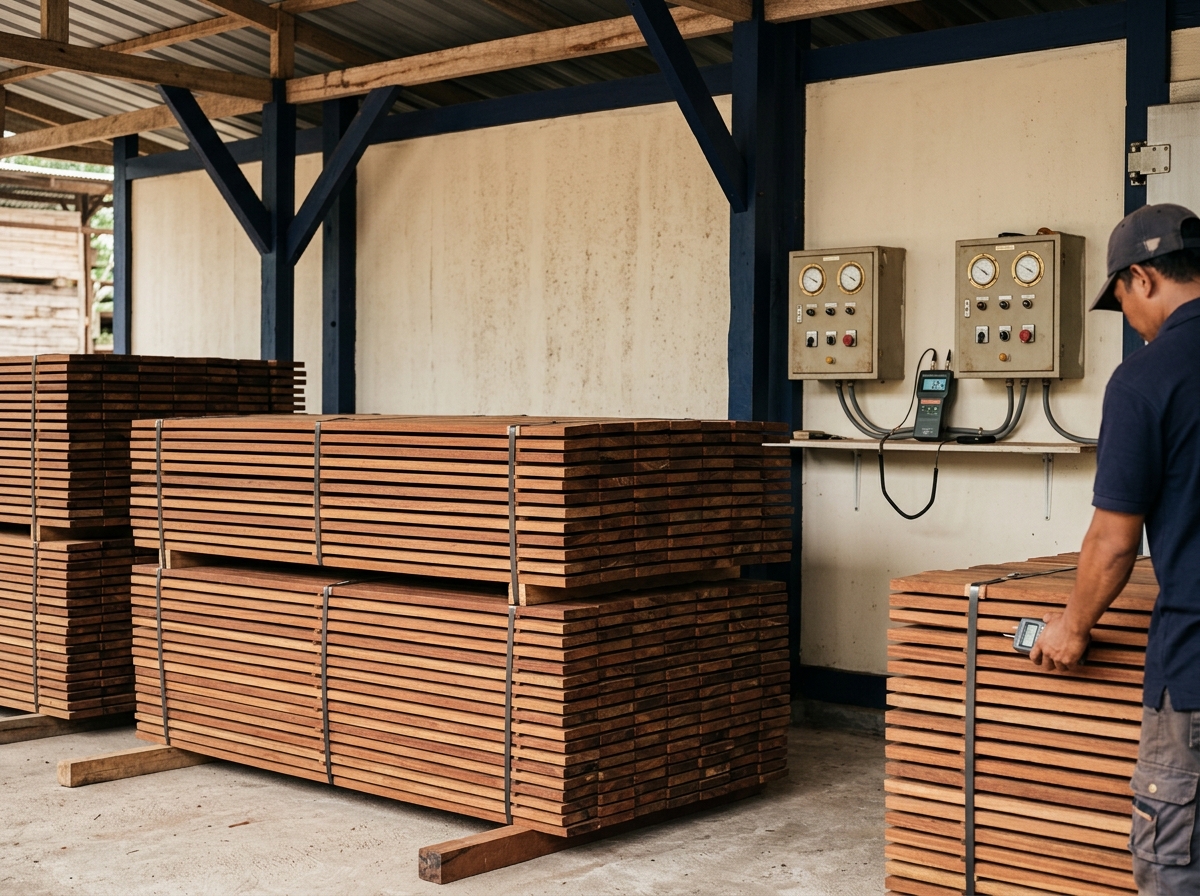
US importers should specify target EMC in writing and request moisture content certificates with readings taken from multiple boards per batch. Spot-check on arrival using a calibrated pin-type moisture meter.
Kiln Types and Case-Hardening Risk
Most mid-to-large Indonesian mills operate chamber kilns—batch processes that cycle temperature and humidity over days or weeks. Progressive kilns, where timber moves through zones of increasing heat, are less common but faster. Both can produce acceptable results if schedules are properly managed for merbau's density.
Case-hardening—residual internal stress from too-rapid drying—is a real risk with dense species like merbau. It causes boards to split or cup after machining. A reputable supplier will perform a prong test (cutting a test board and checking for spring) to verify stress relief before shipment. Ask for confirmation that stress relief is part of the kiln protocol.
ISPM-15 Packaging Requirements
All timber packaging and pallets entering the US must comply with ISPM-15 (International Standards for Phytosanitary Measures No. 15). This requires heat treatment to 56°C core temperature for 30 continuous minutes, or methyl bromide fumigation. Look for the IPPC mark on all pallets and crating. Non-compliant packaging triggers USDA APHIS interception and can result in destruction or re-export of the shipment at the importer's cost.
SVLK Legality Certification and Lacey Act Compliance for US Merbau Importers
How Indonesia's SVLK System Works
SVLK (Sistem Verifikasi Legalitas Kayu) is Indonesia's mandatory timber legality verification system. All Indonesian timber exporters must hold a valid SVLK licence to ship timber products. The system covers the entire chain: concession, mill, and exporter. Third-party auditors—accredited by the Indonesian government—conduct regular audits. Exporters that pass receive a V-Legal certificate, which accompanies each export shipment.
SVLK is recognized by the EU Timber Regulation and is directly relevant to US Lacey Act compliance.
Satisfying the US Lacey Act: Step-by-Step
The Lacey Act requires US importers to declare the country of harvest, species name, quantity, and value for all timber and wood products. Merbau imports from Indonesia require the following due-care process:
1. Obtain the V-Legal certificate from your supplier for each shipment. This is the primary evidence of legal harvest. 2. Confirm species declaration. The Lacey Act declaration must state Intsia bijuga or Intsia palembanica (or both if mixed). Generic "merbau" is insufficient. 3. Record the country of harvest. Indonesia is the country of harvest. If logs were sourced from Papua Province specifically, note this for traceability records. 4. File the PPQ Form 505 (Plant and Plant Product Declaration) with US Customs and Border Protection at time of import. 5. Retain documentation for five years. USDA APHIS can audit records up to five years after import. Maintain copies of V-Legal certificates, phytosanitary certificates, and supplier chain-of-custody records. 6. Do not rely solely on FOB invoices. The Lacey Act explicitly requires knowledge of origin. Price documents alone do not constitute due care.
CITES Status and Trade Implications
Intsia species are periodically reviewed for CITES listing. As of the time of writing, Intsia bijuga and Intsia palembanica are not listed under CITES Appendix I or II, meaning no CITES permit is required for trade. However, this status is subject to review at CITES Conference of the Parties meetings. US importers should monitor CITES Appendix changes before placing large forward orders.
- ✓Confirm supplier holds current SVLK licence (check expiry date)
- ✓Request V-Legal certificate number for each shipment
- ✓Verify V-Legal certificate via Indonesia's Ministry of Environment and Forestry online portal
- ✓Confirm botanical species names on all export documents
- ✓Obtain phytosanitary certificate issued by Indonesian plant health authority
- ✓Request Certificate of Origin (Form D for ASEAN, or IJEPA form if applicable)
- ✓File Lacey Act PPQ Form 505 with CBP at point of import
- ✓Retain all documents for minimum five years
How to Evaluate and Shortlist Credible Merbau Timber Suppliers in Indonesia
Core Due-Diligence Criteria
Any serious evaluation of Indonesian hardwood timber suppliers should cover:
- SVLK status: Active licence, recent audit date, no suspension history. - Mill capacity: Confirmed monthly output in m³. Cross-reference against claimed lead times. - Third-party certification: FSC or PEFC chain-of-custody adds a layer of traceability beyond SVLK. Not all suppliers hold these, but presence signals higher compliance maturity. - Export history: Verified shipment records, not sales claims.
Red Flags to Reject Immediately
- Pricing significantly below market FOB benchmarks with no explanation. - Refusal to provide V-Legal certificate before payment. - No confirmed SVLK licence number. - Unable to confirm log origin at concession level. - No mill visit or third-party audit available.
Verifying Export History
Trade intelligence platforms—including Volza, Panjiva, and Seair—aggregate customs data from multiple countries. US import records are public. Search for merbau shipments by HS code 4407 (sawn timber) to identify which Indonesian exporters have documented shipment histories to the US. This is one of the most reliable pre-qualification tools available without visiting Indonesia.
Trade Associations and Government Registries
APHI (Asosiasi Pengusaha Hutan Indonesia) represents licensed concession holders. HIMKI covers furniture and wood product manufacturers. Indonesian government export registries list active SVLK holders. Cross-referencing a supplier's name across these sources takes less than an hour and eliminates a significant share of high-risk counterparties.
Container Loading, Shipping Volumes, and Incoterms for Merbau Timber Exports
Container CBM Yield: 20-Foot vs. 40-Foot
| Container | Internal Volume | Sawn Timber (loose) | Decking (bundled) | Typical Gross Weight |
|---|---|---|---|---|
| 20-foot standard | ~33 CBM | 18–22 m³ net timber | 20–24 m³ net timber | Up to ~22 tonnes |
| 40-foot standard | ~67 CBM | 38–45 m³ net timber | 42–48 m³ net timber | Up to ~26 tonnes |
| 40-foot high cube | ~76 CBM | 40–48 m³ net timber | 44–52 m³ net timber | Up to ~26 tonnes |
Bundled and banded decking packs more efficiently than loose sawn timber because bundles stack with minimal void space. Specify bundle dimensions and stacking pattern in your packing instructions to maximise CBM utilisation. For dense kiln-dried merbau, weight limits often constrain 20-foot containers before volume does.
Major Loading Ports
- Surabaya (Tanjung Perak): Primary consolidation hub for East Java mills. Well-connected to global shipping lines. - Makassar (Soekarno-Hatta): Serves Sulawesi-origin timber. Feeder connections to Surabaya and Singapore. - Sorong (Papua): Direct loading for Papua-origin merbau. Fewer mainline services; typically requires transshipment via Surabaya or Singapore, adding approximately five to ten transit days. - Jakarta (Tanjung Priok): Less common for bulk timber but used for consolidated or LCL shipments.
Incoterms and Lead Times
| Incoterm | Seller's Responsibility | Buyer's Responsibility |
|---|---|---|
| FOB | Loads goods on vessel at named port | Freight, insurance, import duties |
| CFR | Freight to named destination port | Insurance, import duties |
| CIF | Freight and insurance to named port | Import duties |
FOB is the most common term for Indonesian merbau timber exports. Lead times from order confirmation to vessel loading typically run four to ten weeks, depending on mill backlog, kiln schedule, and Papua logging season. Papua Province concessions operate on seasonal calendars influenced by rainfall and concession permit renewals. Orders placed during peak wet season (typically November through March) may face extended lead times of two to four additional weeks.
Pricing Benchmarks and Cost Drivers for Merbau Export Orders
Indicative FOB Price Ranges
All figures below are indicative FOB ranges only. Actual pricing depends on grade, dimensions, volume, and market conditions at time of order.
| Product | Indicative FOB Range (per m³) |
|---|---|
| Rough-sawn merbau, green | Lower range of tropical hardwood market |
| Kiln-dried sawn merbau, standard dimensions | Mid-range of tropical hardwood market |
| Finished decking, smooth, kiln-dried | Upper-mid range |
| Pre-oiled decking, custom profile | Premium end of range |
Buyers should obtain at least three competing quotes from verified merbau timber suppliers Indonesia export operations before benchmarking. Indicative market pricing for kiln-dried merbau decking FOB Surabaya has historically tracked above bengkirai but below premium teak.
Key Cost Variables
- Log availability from Papua: When Papua logging concession allocations tighten—due to regulatory review, seasonal restrictions, or high domestic demand—FOB prices rise. This occurs periodically and is not always predictable. - Kiln drying surcharge: Adds cost per m³ above green-sawn pricing. The surcharge varies by target EMC and board thickness. - Custom sizing: Non-standard widths or lengths require re-sawing and additional handling. Expect a per-m³ surcharge. - Pre-oiling: Adds cost per m³ depending on oil specification and number of coats. - SVLK documentation: Most exporters include this in their base price. Some charge a separate documentation fee for small orders. Clarify in advance. - USD/IDR exchange rate: Indonesian mill costs are denominated in rupiah. A strengthening rupiah increases USD-equivalent FOB prices. Monitor exchange trends when locking in forward orders.
Frequently Asked Questions from US Merbau Buyers
Is merbau timber legal to import into the United States under the Lacey Act? Yes, provided the timber originates from a legally harvested source and is accompanied by valid SVLK documentation. Importers must file a Lacey Act declaration (PPQ Form 505) at point of entry, citing the correct botanical species name and country of harvest.
What moisture content should kiln-dried merbau have for US decking applications? Target 12–15% EMC for exterior decking in most US climates. Interior flooring applications typically require 6–9% EMC to match US indoor equilibrium conditions.
How do I verify that an Indonesian merbau exporter holds a valid SVLK certificate? Request the SVLK licence number and check it against Indonesia's Ministry of Environment and Forestry online verification portal (SILK system). The portal lists active licences, audit dates, and suspension status. Do not accept photocopied certificates without online verification.
Does merbau bleed tannins and how can I prevent staining on fascia boards and concrete? Yes. Merbau contains significant water-soluble tannins. Specify pre-oiling or water-wash pre-treatment in your purchase order. On-site, recommend that end customers rinse boards with water before installation and protect adjacent light-coloured surfaces during early weathering.
What is the typical minimum order quantity (MOQ) for a merbau timber container shipment? Most Indonesian exporters set MOQ at one full container load—approximately 18–22 m³ for a 20-foot container. Some larger mills accept smaller consolidated orders but apply a surcharge. Full container loads consistently yield better per-m³ pricing and shorter processing times.
Is merbau listed under CITES and does that affect my import paperwork? Intsia bijuga and Intsia palembanica are not currently listed under CITES Appendix I or II. No CITES permit is required. However, buyers should monitor CITES review cycles, as the conservation status of Intsia species is periodically evaluated.
Merbau vs. Comparable Species: A Buyer's Reference
| Attribute | Merbau | Bengkirai | Teak |
|---|---|---|---|
| Janka hardness (approx.) | ~1,925 lbf | ~1,600 lbf | ~1,070 lbf |
| Durability class (EN 350) | 1–2 | 1–2 | 1 |
| Tannin bleed risk | High | Low | Low–Medium |
| Colour consistency | Medium–High | High | High |
| Availability from Indonesia | Good | Good | Limited (plantation only) |
| Relative FOB price | Mid–High | Mid | High–Premium |
| Lacey Act documentation | SVLK required | SVLK required | SVLK required |
For buyers choosing between species for exterior decking, bengkirai offers similar durability with lower tannin bleed risk. Teak commands a price premium and carries strong brand recognition. Merbau offers the best balance of hardness, durability, and cost for buyers who manage the bleed issue at source.
Sourcing merbau timber through verified Indonesian exporters is straightforward when buyers apply consistent due-diligence criteria: confirmed SVLK status, documented kiln drying schedules, and explicit purchase order terms covering tannin pre-treatment and moisture content. Treating legality documentation and technical specifications as non-negotiable at the RFQ stage eliminates the majority of supply chain risks before a container is ever loaded.
Request a merbau export quote from a verified Indonesian supplier today—now that you have the technical specifications, certification requirements, and logistics parameters to evaluate every response with precision.
You now have the specifications, certification benchmarks, and logistics parameters to evaluate Indonesian merbau suppliers rigorously. The next step is putting that framework to work with a verified exporter who can supply SVLK documentation, kiln drying certificates, and confirmed FOB pricing.
Request an Export Quote →Need eyes on the ground in Indonesia?
MTS is an execution partner — supplier verification, manufacturing management, quality control and export logistics across Indonesia, Vietnam and China.
Related services
Related articles
Receive furniture sourcing insights across Asia.
One email per week. No spam.