Sourcing Leather Bags from Indonesian Manufacturers: A Complete Brand Guide
14 min read
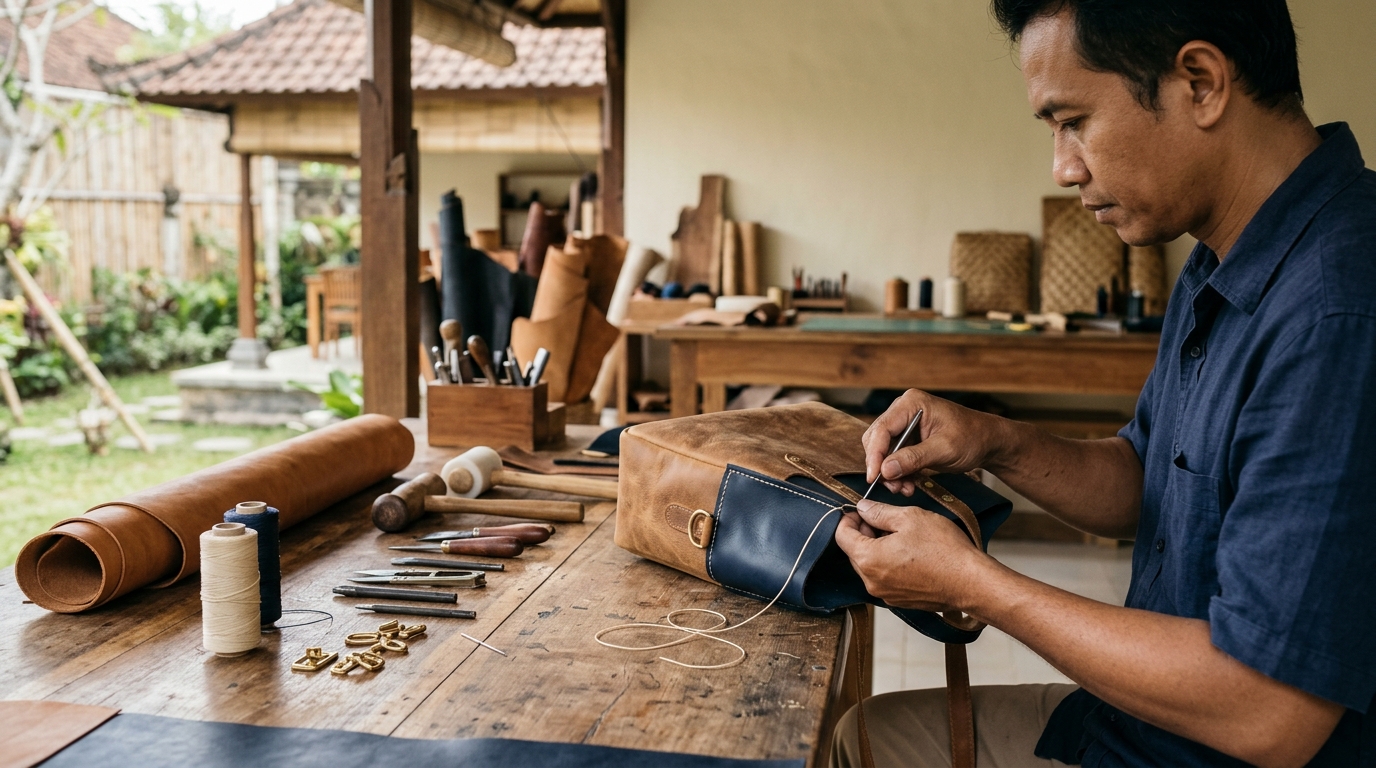
Choosing the right leather bags manufacturers Indonesia has to offer is one of the highest-stakes sourcing decisions a brand founder or sourcing manager will make. The wrong factory locks you into poor construction, inconsistent materials, and missed shipments. The right one becomes a long-term…
Choosing the right leather bags manufacturers Indonesia has to offer is one of the highest-stakes sourcing decisions a brand founder or sourcing manager will make. The wrong factory locks you into poor construction, inconsistent materials, and missed shipments. The right one becomes a long-term production partner that scales with your line.
Indonesia's leather goods sector sits at an intersection that few other countries match: deep craft heritage, competitive labor costs, and direct access to tanneries in East Java. Yet the market is fragmented. You will find world-class artisan workshops operating three doors down from factories using bonded leather and imported zinc hardware.
This guide covers every critical decision layer: material grades, hardware sourcing, edge finishing, construction quality, the sampling process, MOQ structures, and factory vetting. It is written for buyers placing real purchase orders, not for casual observers. Each section gives you concrete criteria to apply during factory assessment, tech pack development, and pre-production inspection.
Why Indonesian Leather Manufacturing Attracts Serious Global Bag Brands
Indonesia's Three Core Production Hubs
Indonesia's leather goods export ecosystem is concentrated in three geographic clusters, each with a distinct production character.
Bali is the highest-profile hub for international buyers. Workshops here specialize in handmade leather bags, small-batch production, and premium artisan finishes. Bali leather bags command attention at trade shows precisely because of visible craft quality: hand-stitched edges, carved detailing, and custom hardware. MOQs tend to be lower, and design flexibility is higher. The trade-off is volume capacity — most Bali workshops cannot comfortably scale beyond a few hundred units per style per month.
Yogyakarta bridges artisan and mid-volume production. The city has a long tradition of leather craft tied to its broader arts ecosystem. Factories here often produce a mix of hand-finished and machine-assisted goods and are more likely to offer structured production planning for brands that need repeatability.
East Java — particularly around Surabaya and the surrounding industrial zone — is the industrial backbone. This is where the tanneries operate and where mid-to-large factories run machine lock-stitch lines at volume. East Java manufacturers are the right fit when cost efficiency and output capacity matter more than hand-finishing distinction.
Cost Competitiveness Against Other Sourcing Origins
A direct cost comparison helps calibrate expectations.
| Origin | Relative Labor Cost | Craft Skill Level | MOQ Flexibility | Lead Time (typical) |
|---|---|---|---|---|
| Indonesia | Low–Medium | High (artisan hubs) | High (SMEs) | 45–75 days |
| India | Low–Medium | High | Medium | 45–90 days |
| China | Medium | Medium–High | Low–Medium | 30–60 days |
| Italy | Very High | Very High | Low | 60–120 days |
Italy remains the benchmark for luxury positioning but at a cost structure most emerging brands cannot sustain. China offers volume efficiency but less hand-finishing heritage in leather specifically. India competes closely with Indonesia, but Indonesian manufacturers benefit from a distinct craft identity — particularly Bali leather bags — that carries genuine marketing value for Western brands.
Certifications and Compliance Signals
For US-bound shipments, look for factories that can demonstrate or are working toward BSCI (Business Social Compliance Initiative) audit status. REACH compliance matters if your bags include coated materials or synthetic components. For any factory claiming to work with exotic leathers such as python leather, CITES documentation is non-negotiable for US Customs clearance.
Leather Grade Selection: Matching Hide Quality to Your Brand's Price Point
The Four Core Leather Grades Explained
Understanding hide grades is foundational. Every claim a factory makes about material quality maps back to these definitions.
| Grade | Description | Durability | Best Fit |
|---|---|---|---|
| Full-grain | Outermost hide layer, natural surface intact | Highest | Premium, luxury positioning |
| Top-grain | Outermost layer, surface sanded and corrected | High | Mid-to-premium |
| Corrected-grain | Heavy surface embossing to mask imperfections | Medium | Mid-market |
| Split leather | Inner hide layers, weak fiber structure | Low | Entry-level, linings |
Full-grain leather retains the hide's natural grain pattern. It develops a patina over time and shows the highest fiber density. Top-grain leather has been sanded to remove surface blemishes, then often embossed with a uniform grain pattern. It looks cleaner initially but lacks the durability ceiling of full-grain.
How East Java Tanneries Supply Different Grades
East Java's tanneries supply bovine hide in all four grades. Full-grain hides represent a smaller portion of total output — premium hides command premium prices and require more careful selection at the slaughterhouse level. When a factory quotes you "genuine leather," probe further. In Indonesia, "genuine leather" is legally ambiguous and can describe anything from top-grain down to bonded scraps.
Verifying Grade Claims Before Production
Three practical verification steps:
1. Request a raw hide swatch, not just a finished panel. Finished panels can disguise grade through heavy coating. 2. Bend the swatch tightly and release it. Full-grain and top-grain recover. Corrected-grain often shows stress marks at the surface coating. 3. Check the flesh side. Full-grain and top-grain show tight, consistent fiber structure. Split leather shows loose, fibrous texture.
Hardware Sourcing and Custom Branding Options from Indonesian Factories
Material Grades and Quality Markers
Hardware is where mid-tier Indonesian bags often lose ground to better-positioned competitors. The three common hardware materials are brass, zinc alloy, and stainless steel.
| Material | Weight | Corrosion Resistance | Cost | Quality Signal |
|---|---|---|---|---|
| Solid brass | Heavy | Excellent | High | Premium |
| Zinc alloy | Medium | Good | Medium | Mid-market |
| Stainless steel | Medium-Heavy | Excellent | Medium-High | Functional premium |
Solid brass hardware is the benchmark for designer bags and luxury leather bags manufacturers. It machines cleanly, holds plating well, and resists corrosion. Zinc alloy is acceptable at mid-market price points but should be inspected for plating adhesion — cheap zinc castings chip under light stress.
In-House vs. Third-Party Hardware Sourcing
Most Indonesian leather bag factories do not manufacture their own hardware. Smaller Bali workshops typically source from local hardware suppliers or import from Chinese component manufacturers. Larger East Java factories may have preferred domestic suppliers with consistent quality. The risk for buyers: if hardware sourcing is informal, you can receive different plating batches across production runs.
Specify hardware by material, finish, and pull-strength rating in your tech pack. If a factory cannot provide documentation or samples of their hardware source, treat this as a vetting concern.
Custom Engraving and Plating Specifications
Most mid-size and larger Indonesian factories can accommodate custom logo engraving on hardware — typically through a third-party engraving or die-casting supplier. Common plating options include gold, antique brass, and gunmetal. Each has different durability profiles.
For plating durability, request a salt spray test result or, at minimum, ask the factory to demonstrate adhesion with a tape-pull test on sample hardware. Minimum order thresholds for custom hardware typically require a production run large enough to justify die costs — confirm this before your tech pack is finalized.
Edge Finishing as a Quality Differentiator in Indonesian Production
Edge finishing is the single most visible marker of production quality on a leather bag. It is also the area most often under-specified in tech packs from US brands new to Indonesian sourcing.
Four Edge Finishing Methods Compared
| Method | Description | Quality Tier | Durability |
|---|---|---|---|
| Burnished (raw edge) | Edge compressed and polished with heat/pressure | Premium | High |
| Painted edge | Edge coated with flexible paint | Mid | Medium |
| Folded edge | Leather folded and stitched over itself | Premium | Very High |
| Welt edge | Separate leather strip sewn over the edge | Premium | Very High |
Burnished edges require skilled finishing and enough hide thickness to support compression. They are a clear signal of higher-tier production. Painted edges are acceptable at mid-price points but must be inspected for uniform coverage and flexibility — brittle paint cracks within months of use. Folded and welt edges are the most durable options and appear on premium handmade leather bags.
How to Specify Edge Finish in Your Tech Pack
Do not leave edge finishing open to interpretation. Specify:
- Method (burnished / painted / folded / welt) - Number of paint coats if painted (typically two to three coats minimum) - Color match reference to Pantone or your brand's color system - Acceptable deviation tolerance
Common Edge Defects to Inspect
During pre-production sample review, check for:
- Uneven paint coverage or visible brush marks - Raw fiber exposure at cut edges - Cracking when the edge is flexed at 90 degrees - Paint color inconsistency between panels on the same bag
Entry-level Indonesian factories often default to single-coat painted edges without your specification. Premium factories and Bali artisan workshops default to burnished or folded edges as standard practice. This gap is a reliable proxy for overall production quality.
Construction Quality: Why Stitching Method Determines Long-Term Value
Hand-Stitched Saddle Stitch vs. Machine Lock-Stitch
Both methods are legitimate. The choice depends on your price point and brand positioning.
Saddle stitch (hand-stitched, two needles, one thread): The gold standard for premium handmade leather bags. Each stitch is independent — if one breaks, the seam does not run. Artisan workshops in Bali and Yogyakarta offer this as a standard production method. It is slower and more expensive.
Machine lock-stitch: Standard in mid-to-large factories. Faster, consistent, and appropriate for commercial volumes. The risk is seam failure — if the thread breaks, the seam can unravel. Counter this by specifying adequate stitch density and thread quality.
Stitch density benchmarks by bag category:
| Bag Type | Recommended Stitches Per Inch |
|---|---|
| Leather backpack | 7–9 SPI |
| Leather crossbody mini bag | 8–10 SPI |
| Durable tote bags | 7–9 SPI |
| Handles and stress points | 8–10 SPI minimum |
Bonded Construction: A Hard Red Flag
Bonded leather and glue-only construction are disqualifying defects for any B2B buyer targeting the mid-market and above. Bonded leather is manufactured from leather fiber scraps laminated together — it delaminates under regular use. Glue-only seam construction (no stitching at primary stress points) fails under load.
Stress-Point Inspection Criteria
Before approving a pre-production sample, physically test:
- Handle drop test: Pull each handle attachment point firmly by hand. There should be zero movement at the anchor. - Bar tacking: All strap attachment points should show bar-tack reinforcement stitching. - Lining attachment: Lining should be stitched, not glued, at the bag opening and pocket attachments. - Zipper panel reinforcement: Zipper tape should be backed with a leather or fabric reinforcement strip.
The Sampling Process with Indonesian Leather Bag Manufacturers
Three Sample Stages and Realistic Timelines
Experienced wholesale leather bags manufacturers in Indonesia follow a structured sample development process. Expect three distinct stages.
| Stage | Purpose | Typical Turnaround |
|---|---|---|
| Proto sample | Concept validation, shape, proportion | 2–3 weeks |
| Fit sample | Material confirmation, hardware approval | 2–3 weeks |
| Pre-production (PP) sample | Final approval before bulk | 1–2 weeks |
Total sampling timeline: approximately six to eight weeks from approved tech pack to PP sample sign-off. Smaller Bali workshops may compress this. Larger East Java factories with full production schedules may extend it. Build realistic timelines into your product calendar — rushing sampling is a primary cause of bulk production defects.
What a Complete Tech Pack Must Include
An incomplete tech pack is the most common reason Indonesian factories quote inaccurately or substitute materials without disclosure.
A complete tech pack for leather bags must include:
- Front, back, side, and base technical drawings with dimensions - Material specification by panel (hide grade, thickness in mm) - Hardware specification (material, finish, pull-strength requirement) - Edge finish specification by panel and strap - Stitching method, thread type, and SPI by seam - Lining material and attachment method - Logo placement with dimensions and application method - Color reference (Pantone or physical swatch) - Packaging and labeling requirements
Red Flags During the Sampling Process
Sample costs are typically charged by Indonesian factories and credited against production orders above a minimum threshold. Confirm this structure before ordering samples. For new relationships involving proprietary designs, an NDA is a reasonable request — most established factories will sign one.
Understanding MOQ Structures Across Indonesian Factory Types
MOQ Ranges by Factory Scale
| Factory Type | Per-Style MOQ | Notes |
|---|---|---|
| Bali artisan workshop | 20–50 units | High craft quality, low volume |
| Small SME factory | 50–150 units | Flexible, suitable for first orders |
| Mid-size export factory | 150–500 units | Structured production, better pricing |
| Large industrial factory | 500+ units | Volume pricing, less flexibility |
These ranges are approximate and negotiable, particularly for first orders. Many factories will accept lower MOQs on a first order to establish a relationship, with the understanding that repeat orders meet standard minimums.
MOQ per Colorway and Style Split
This is the practical gap that most sourcing guides skip. If your style has an MOQ of 100 units and you want it in three colorways, most factories will require the full MOQ per colorway — meaning 300 total units.
Understand the economics before you commit:
- Per-style MOQ × number of colorways = minimum total order exposure - Colorway splitting often available only with same-material variations - Hardware colorway changes (e.g., gold vs. gunmetal) may also carry separate minimums
MOQ for Exotic Leathers
Python leather and similar CITES-regulated exotic leathers carry significantly higher MOQs due to material sourcing complexity and documentation requirements. Per-unit material costs are higher. Factories working with compliant exotic leather sources also require longer lead times to secure hides. Budget for these variables explicitly — they do not fit standard bovine hide economics.
How to Vet and Shortlist Indonesian Leather Bag Factories Effectively
Key Assessment Questions for Factory Evaluation
Whether conducting an on-site audit or a virtual assessment, ask:
1. What percentage of your current production is for export versus domestic? 2. Can you provide references from current international brand clients? 3. What is your monthly production capacity per style? 4. Do you source hardware in-house or through third parties? 5. What leather grades do you work with, and can you provide tannery documentation? 6. Are you BSCI audited or working toward certification? 7.
Using Trade Shows as Vetting Signals
Established leather bags manufacturers in Indonesia with export ambitions typically exhibit at or send buyers to INACRAFT (Jakarta, annual) and Indo Leather & Footwear Expo. Factory presence at these events is a positive signal — it suggests investment in export relationships and exposure to international quality standards. It is not a quality guarantee, but it narrows the field meaningfully.
Direct Outreach vs. Sourcing Platforms vs. Buying Agents
| Channel | Speed | Transparency | Cost | Risk |
|---|---|---|---|---|
| Direct factory outreach | Slow | High | Low | Requires due diligence |
| B2B sourcing platforms | Fast | Medium | Low–Medium | Variable quality |
| Buying agent | Fast | Medium | 3–10% FOB | Agent quality varies |
Direct outreach takes longer but gives you unfiltered access to factory capabilities. Sourcing platforms aggregate factories efficiently but require independent verification of any listing. Buying agents operating in Indonesia can accelerate vetting — but confirm they are compensated by you, not by undisclosed factory commissions.
Frequently Asked Questions
What is the typical MOQ for leather bags from Indonesian manufacturers? MOQs vary widely by factory type. Bali artisan workshops often start at 20–50 units per style. Mid-size export factories typically require 150–500 units. MOQs also apply per colorway in most cases — a three-colorway order at 100 units MOQ means approximately 300 units total.
How long does the sampling process take with an Indonesian leather factory? Expect approximately six to eight weeks from approved tech pack through proto, fit, and pre-production sample stages. Smaller workshops may be faster; high-volume factories during peak season may be slower.
What leather grades are commonly available from Indonesian tanneries? East Java tanneries supply full-grain, top-grain, corrected-grain, and split leather, primarily in bovine hide. Full-grain is available but represents a smaller share of output. Always request grade specification and a raw hide swatch — do not rely on the label "genuine leather."
Can Indonesian manufacturers produce bags with custom hardware and branding? Yes. Most mid-size and larger factories accommodate custom logo engraving, custom plating (gold, antique brass, gunmetal), and branded zipper pulls through third-party hardware suppliers. Minimum thresholds for custom hardware tooling apply — confirm die costs before committing.
How do I verify whether an Indonesian manufacturer uses full-grain or corrected-grain leather? Request a raw hide swatch before any production. Bend it sharply — full-grain recovers cleanly. Examine the surface under direct light for uniform embossed patterns, which indicate corrected-grain. Check the flesh side for fiber density. Ask for tannery documentation or a material data sheet.
Are Indonesian leather goods factories compliant with US import regulations? Compliance varies by factory. For standard bovine leather goods, US import requirements are relatively straightforward. For exotic leathers such as python leather, CITES permits are legally required for US Customs clearance — request permit documentation before any order. BSCI and REACH certifications signal broader compliance awareness.
Final Vetting Checklist Before Committing to an Indonesian Factory
- ✓Confirmed leather grade with raw hide swatch (full-grain or top-grain specified)
- ✓Hardware material and plating spec documented in tech pack
- ✓Edge finish method specified and confirmed on proto sample
- ✓Stitch method and SPI benchmarks agreed and sampled
- ✓No bonded leather or glue-only seams on stress points
- ✓Bar tacking confirmed at all handle and strap attachment points
- ✓MOQ per style AND per colorway confirmed in writing
- ✓CITES documentation requested if exotic leathers involved
- ✓BSCI audit status or equivalent compliance documentation reviewed
- ✓Proto, fit, and PP sample stages agreed with milestone dates
- ✓NDA signed if proprietary design elements are involved
- ✓Reference check with at least one current export client completed
Selecting from the full landscape of leather bags manufacturers Indonesia offers requires disciplined material specification, structured sampling, and honest factory assessment — not just a competitive price quote. The factories that will serve your brand long-term are the ones that can document their material grades, hold hardware standards across production runs, and deliver consistent edge finishing at scale.
You now have the frameworks to evaluate construction quality, MOQ economics, and factory credibility before a single bulk order is placed. The next step is straightforward.
You have the criteria — now put them to work with real suppliers. Request samples from vetted Indonesian leather bag manufacturers today and validate quality against the specifications in this guide before committing to production.
You have the vetting framework. Connect with pre-screened leather bag manufacturers in Indonesia and request samples matched to your material grade, hardware, and construction requirements.
Request Samples Now →Need eyes on the ground in Indonesia?
MTS is an execution partner — supplier verification, manufacturing management, quality control and export logistics across Indonesia, Vietnam and China.
Related services
Related articles
Receive furniture sourcing insights across Asia.
One email per week. No spam.