Python Leather Goods Suppliers Indonesia: The Compliance-First Sourcing Guide for Luxury Brands
14 min read
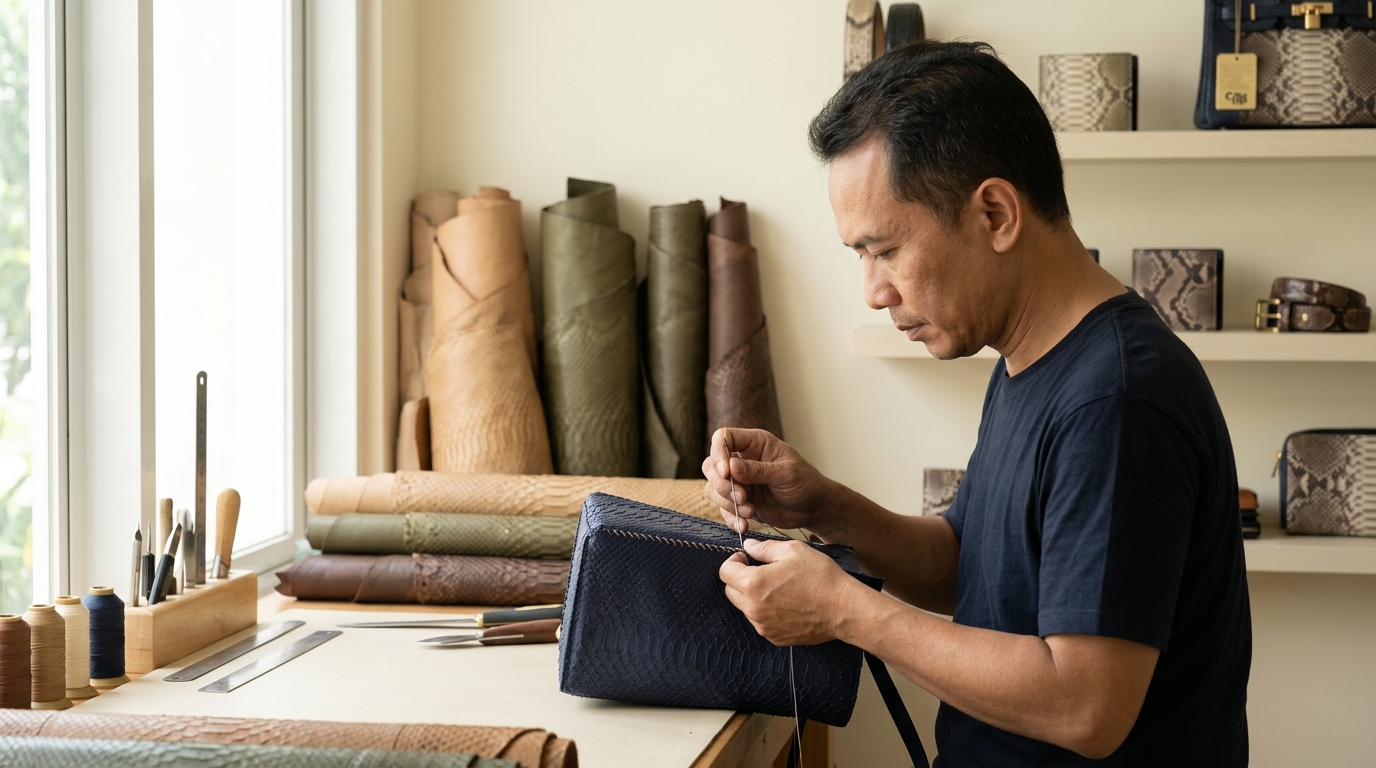
Sourcing python leather goods from Indonesia is not a simple procurement decision. It is a regulated trade governed by international wildlife law, Indonesian government quotas, and US federal import requirements.
Sourcing pythonleather goodsfrom Indonesia is not a simple procurement decision. It is a regulated trade governed by international wildlife law, Indonesian government quotas, and US federal import requirements.
Indonesia is the world's largest legal exporter of python skins under the Convention on International Trade in Endangered Species of Wild Fauna and Flora — CITES. For US sourcing managers, that means opportunity and complexity in equal measure.
This guide covers the full sourcing chain for pythonleather goods suppliers Indonesia: legal origin, CITES permit structures, skin grading, finishing options, product programs, supplier vetting, pricing benchmarks, and the complete US import compliance workflow.
Every section that touches regulation opens with a direct compliance reminder. If your team is evaluating python leather sourcing for the first time, start with the CITES section.
Why Indonesia Commands the Global Legal Python Skin Trade
Supply scale and regional production clusters
Indonesia holds the largest legal quota for python skin exports among all CITES member states. The primary species is the Reticulated Python (Malayopython reticulatus), one of the world's largest snakes and a species native to Southeast Asian forest ecosystems.
Production clusters span four main regions:
- Java — largest concentration of tanneries and finished goods factories, particularly around Jakarta and Yogyakarta - Sumatra — major wild-harvest source region - Kalimantan — secondary harvest region - Bali — growing hub for captive-breeding operations and luxury OEM manufacturing
Indonesia vs Vietnam and Malaysia
Vietnam and Malaysia also export python skins legally under CITES, but neither matches Indonesia's quota allocation, tannery infrastructure, or finished goods manufacturing depth.
| Factor | Indonesia | Vietnam | Malaysia |
|---|---|---|---|
| CITES annual export quota | Largest globally (approx.) | Smaller allocation | Minimal allocation |
| Tannery infrastructure | Deep, multi-tier | Limited | Limited |
| Finished goods OEM | Extensive (Jakarta, Bali) | Moderate | Minimal |
| Captive-breeding programs | Growing | Nascent | Minimal |
| US import track record | Established | Established | Limited |
For US luxury brands needing scale, consistent grading, and OEM capability under a single supply origin, Indonesia is the default starting point among pythonleather goods suppliersIndonesia-focused sourcing teams evaluate.
CITES Appendix II Compliance: What Every Sourcing Manager Must Verify Before Ordering
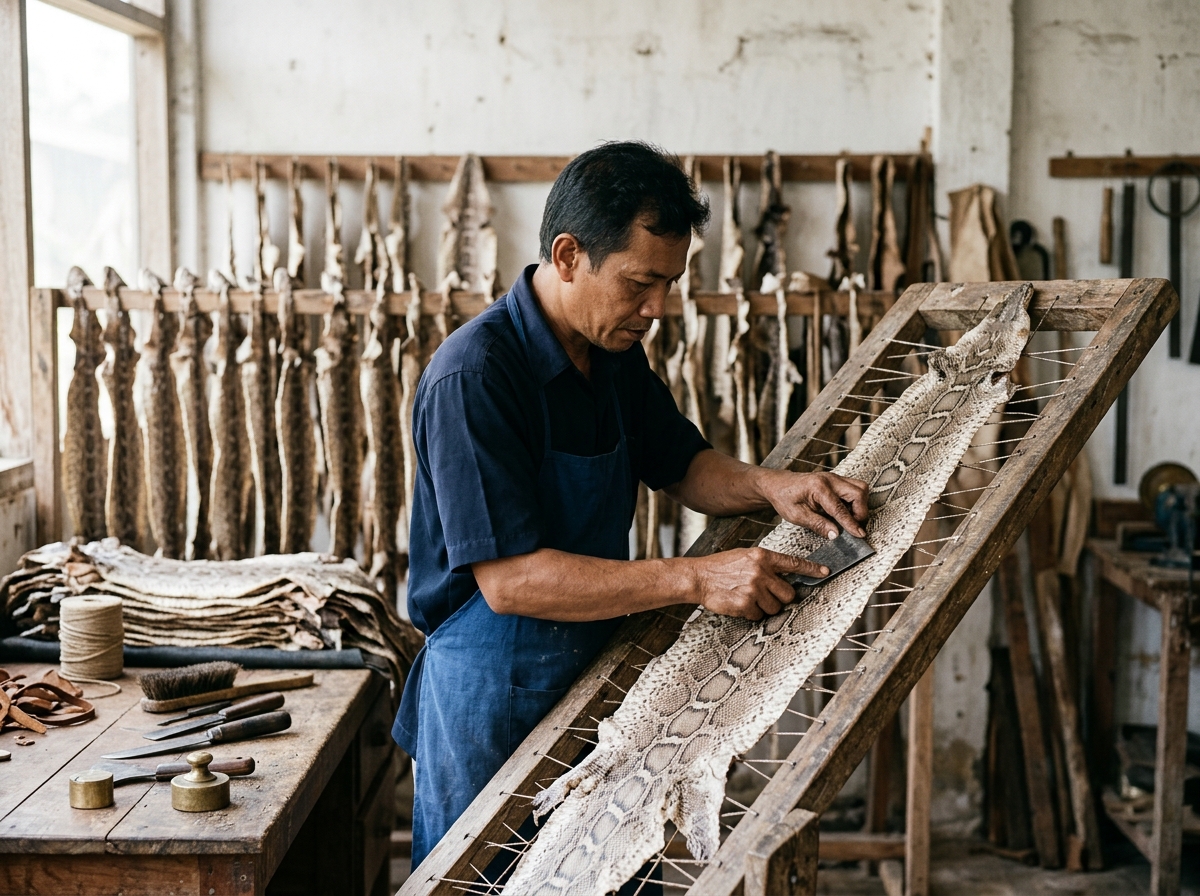
All python leather imports into the United States require a valid CITES export permit from Indonesia and a USFWS import declaration. There are no exceptions.
What Appendix II means in practice
CITES classifies wildlife species on three appendices by threat level. Appendix I prohibits commercial trade. Appendix II permits commercial trade, but only with government-issued permits and adherence to annual export quotas.
Malayopython reticulatus — the Reticulated Python — is listed under CITES Appendix II. This means legal trade is permitted. It does not mean trade is unrestricted. Every skin, tanned hide, or finished python leather good entering the US must be accompanied by a traceable documentation chain.
Do not use the phrase "CITES-certified" as a shorthand for compliance. Appendix II compliance is a specific legal condition, not a quality mark.
How Indonesia's quota system works
The KLHK sets Indonesia's annual python export quota. Quotas are allocated to licensed exporters and tanneries — not to brands. This has a direct implication for buyers: you do not receive quota allocation independently.
Ask every prospective supplier for their quota allocation letter before placing an order. Quota runs out. Suppliers operating late in the quota cycle may not be able to fulfil orders legally.
The five required documents for a compliant US import shipment
- ✓Indonesian CITES export permit issued by KLHK (must reference species, quantity, legal origin code, and exporter license number)
- ✓USFWS import declaration — Form 3-177 — filed at the US port of entry before or at time of import
- ✓Certificate of legal origin (proving skins were harvested or bred within the Indonesian quota system)
- ✓Commercial invoice matching the species, quantity, and description on the CITES permit
- ✓Packing list with species-specific declarations meeting USFWS packing and labelling requirements
Consequences of non-compliance for US brands
Importing pythonleather goodswithout valid CITES documentation violates the US Lacey Act and the Endangered Species Act. Consequences include:
- Shipment seizure at the port of entry by USFWS - Civil fines and potential criminal liability for importers - Reputational damage — luxury brands are high-profile enforcement targets - Loss of the goods with no recourse against the supplier
TRAFFIC, the wildlife trade monitoring network, actively tracks Indonesian python export data. Non-compliant shipments are flagged in cross-referencing exercises between CITES trade databases and US customs records.
Wild-Caught vs Captive-Bred Python Skins: Legal Origin Codes and Quality Implications
This section describes regulated trade only. All skins must carry a legal origin code on the CITES permit. Skins without documented legal origin cannot be legally imported into the United States.
Understanding CITES origin codes
The CITES permit issued by KLHK includes a source code that identifies how the animal was obtained. Three codes are relevant to python leather sourcing:
| Code | Meaning | Quota Implication |
|---|---|---|
| W | Wild-caught from nature | Counts against Indonesia's annual wild-harvest quota |
| C | Captive-bred (F2 generation or beyond) | Different quota treatment; often preferred by regulators |
| R | Ranched (wild-collected eggs or juveniles, raised in captivity) | Counted under ranching quota; most common in Indonesia |
US brands face different legal exposure depending on origin code. 'C' and 'R' coded skins are generally viewed more favourably by USFWS inspectors and align better with ESG sourcing narratives.
Quality differences by origin
Captive-bred and ranched pythons are raised in controlled conditions. This produces measurable quality benefits:
- Lower scar frequency — no contact with rough terrain, predators, or trapping injuries - More consistent scale patterns — uniform feeding and growth conditions - Predictable sizing — ranched animals are harvested at controlled lengths
Wild-caught skins frequently carry scars, scale irregularities, and belly damage from terrain contact. These defects directly reduce usable panel area and push skins into lower grade tiers.
Python Skin Grading, Belly-Cut vs Back-Cut, and Yield Calculations for Product Costing
Belly-cut vs back-cut: the anatomical difference
Python skins are processed using two primary cutting methods. The cut determines the usable panel shape, width, and luxury application.
Belly-cut (center-cut): The skin is opened along the ventral (belly) midline. This exposes the smooth, uniform belly scales — the most visually consistent and commercially valuable surface. Belly-cut skins produce wider usable panels. They are the standard for luxury handbags, clutches, and high-end wallets.
Back-cut: The skin is opened along the dorsal (back) spine. The back scales are smaller, more varied in pattern, and often darker. Back-cut skins are narrower in usable width and typically command lower prices. They suit belts, watch straps, and decorative trim applications.
Grading tiers and price implications
| Grade | Description | Typical Applications |
|---|---|---|
| Grade A | No visible scars, uniform scales, no discolouration, full usable panel width | Luxury handbags, high-end wallets, fine shoes |
| Grade B | Minor scarring or scale irregularities in non-critical zones | Belts, secondary panels, linings |
| Seconds | Multiple scars, scale damage, or irregular sizing | Off-cuts, industrial use, not suitable for luxury goods |
Reticulated Python skins typically measure 3 to 5 metres in length. Usable surface area varies by grade and cut.
Yield calculations by product type
This is the costing data that is consistently absent from supplier quotes. Build these estimates into your product cost models:
| Product | Approximate Skins Required | Key Factor |
|---|---|---|
| Medium python handbag (28–32 cm) | 1.5 to 2 Grade A belly-cut skins | Panel matching for scale symmetry |
| Small clutch / evening bag | 0.8 to 1.2 skins | Scale pattern centring |
| Bifold wallet | 0.2 to 0.4 skins | Cut efficiency from off-cuts |
| Watch strap (pair) | 0.1 to 0.2 skins | Back-cut seconds acceptable |
| Belt (100 cm, 3 cm wide) | 0.3 to 0.5 skins | Length continuity critical |
These figures are approximate. Actual yield depends on skin grade, supplier cutting efficiency, and design specifications. Request yield estimates from your supplier as part of the sampling brief.
Finishing Options Available from Indonesian Python Leather Suppliers
Indonesian tanneries serving luxury export markets offer a range of surface finishes. Each finish affects hand feel, light interaction, durability, and minimum order requirements.
Matte finish: Natural hand feel. Preserves the tactile quality of scales. No surface lacquer. Preferred for understated luxury and daywear categories. Widely available from mid-to-large Indonesian tanneries.
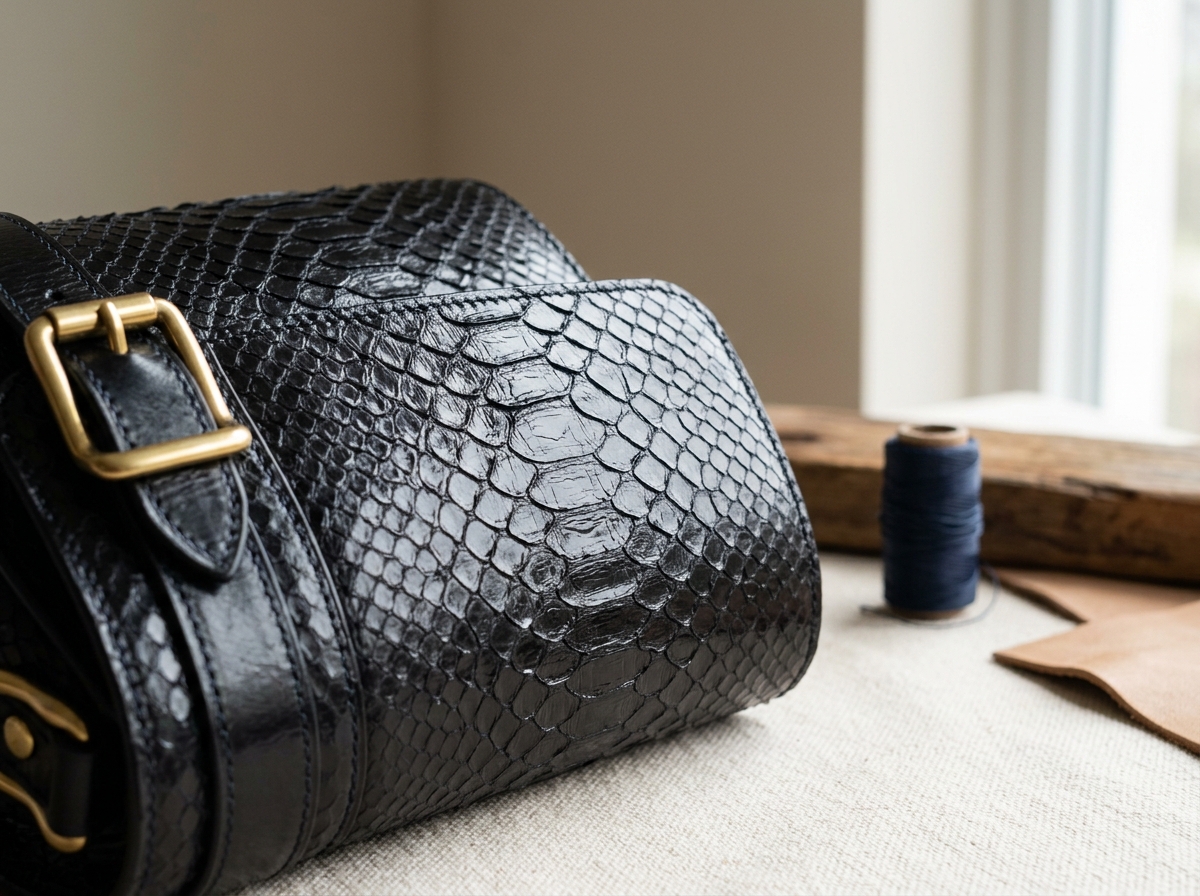
Glazed / patent finish: High-gloss lacquer applied over the scale surface. Creates a reflective, jewel-like appearance. Standard for evening bags and statement accessories. Glazed python leather finishing requires additional processing steps and typically carries a price premium over matte.
Metallic finish: Foil or metallic pigment applied to the scale surface. Available in gold, silver, bronze, and custom metallic tones. Popular for fashion-forward collections. Minimum order quantities per colorway are typically higher — commonly starting at 20 to 50 skins per colour, though this varies by tannery.
Colour-dyed finishes: Natural (undyed), black python leather, cognac, navy, and custom colours are all achievable. Black python leather goods represent one of the most consistently requested colourways from US buyers. Confirm colourfastness standards and testing protocols with each supplier.
Flattened / embossed scale options: Some suppliers offer heat-pressed or mechanically flattened scale finishes for buyers seeking a more subdued texture. Embossed patterns on python are less common but available on request.
OEM Product Programs: Python Leather Bags, Wallets, Belts, and Straps from Indonesian Factories
Indonesian factories — concentrated in Jakarta and Bali — offer OEM and private-label programs across the full range of python leather accessories. Understanding program structures helps buyers align expectations before entering development.
Typical MOQs and product categories
| Product Category | Typical MOQ (units) | Construction Method | Lead Time (development) |
|---|---|---|---|
| Python leather handbag (medium) | 30–100 pieces | Hand-stitched or machine-stitched | 90–120 days |
| Clutch / evening bag | 50–100 pieces | Hand-stitched preferred | 75–100 days |
| Bifold wallet | 50–150 pieces | Machine-stitched | 60–90 days |
| Watch strap (pair) | 100–300 pairs | Machine-stitched | 45–60 days |
| Python leather belt | 50–100 pieces | Machine-stitched | 60–75 days |
MOQs vary significantly by factory scale. Smaller Bali-based artisan manufacturers may accept lower minimums in exchange for higher per-unit pricing. Larger Jakarta OEM facilities require higher volumes but offer more consistent production standards.
Construction and lining options
Luxury-grade python leather goods typically use hand-stitched or saddle-stitched construction for external seams. Machine stitching is acceptable for internal structures and linings. Common lining options include:
- Satin (for evening bags and clutches) - Suede or nubuck (for structured handbags) - Alcantara or microfibre (for wallets and straps)
Confirm lining sourcing with the factory. Some Indonesian manufacturers import lining materials from non-compliant sources. Include lining material specifications in your tech pack.
Sampling workflow
Standard sampling sequence: prototype sample (single unit, full construction) → counter sample (brand-approved revisions) → pre-production sample (from production materials). Budget 30 to 45 days per sampling round. Costs are typically charged and credited against production orders.
How to Vet and Qualify Python Leather Goods Suppliers in Indonesia
Required supplier credentials
A compliant Indonesian python leather supplier must hold:
- CITES exporter license issued by KLHK — this is the foundational document. No license means no legal export. - Quota allocation letter for the current year — confirms the supplier has active export capacity - SVLK or equivalent traceability certificate — Indonesia's timber legality verification system has analogues in the leather sector; ask for the supplier's chain-of-custody documentation - ISO 9001 or BSCI audit — signals production management standards and worker condition accountability
Suppliers unable to produce any of these documents on request should be removed from consideration.
Red flags in supplier qualification
- Cannot provide quota allocation letter or says quota is "handled by a partner" - CITES permit copies show inconsistencies between species description and products offered - No documented skin storage conditions — improper storage causes grading deterioration before tanning - Offers prices significantly below market benchmarks (often signals grading misrepresentation) - Refuses third-party factory audit
Discovery channels for verified suppliers
- Jakarta Leather Fair — the primary trade event for Indonesian leather goods; KLHK-licensed exporters participate directly - Lineapelle (Bologna) — global exotic leather sourcing event; Indonesian exhibitors include tanneries and finished goods manufacturers - Third-party sourcing agents — agents working the Indonesian market charge typically 5 to 10% of FOB value; select agents who are independent of factory ownership to avoid undisclosed commissions
Python Skin Price Benchmarks: What US Buyers Should Expect to Pay
All pricing below is approximate and market-indicative only. Actual prices depend on grade, cut, finish, order volume, and current quota availability. Verify current pricing directly with KLHK-licensed suppliers.
Raw and tanned skin pricing
Grade A belly-cut Reticulated Python skin commands the highest price per piece in the market. Approximate price ranges per skin (tanned, unfinished):
- Grade A belly-cut: Typically in the range of several hundred US dollars per skin, depending on length and scale quality - Grade B belly-cut / Grade A back-cut: Meaningfully lower than Grade A belly-cut - Seconds: Significantly discounted; not suitable for luxury finished goods
Finished and glazed python leather skins carry an additional premium over raw tanned pricing — the glazed or coloured finishing process adds cost at the tannery level.
From skin to finished goods: where margin builds
The price difference between a raw tanned skin and a finished python leather handbag is substantial. Tannery-level processing, finishing, and OEM manufacturing each add cost. US buyers sourcing finished goods (FOB Indonesia) pay for:
1. Raw skin (quota-allocated, legal origin) 2. Tanning and finishing 3. Manufacturing labour and hardware 4. Exporter margin 5. CITES export permit and documentation fees
US import cost additions
| Cost Component | Notes |
|---|---|
| Ocean or air freight | Air freight standard for high-value exotic leather goods |
| US import duty | Check current HTS classification for python leather goods entering the US |
| USFWS inspection fee | Per-shipment fee; confirm current rate with USFWS |
| Customs broker fee | Required for USFWS-regulated imports |
| CITES permit processing | Paid in Indonesia at time of export |
Price benchmarking against other exotic leathers
| Leather Type | Relative Price vs Python Grade A | US Brand Positioning |
|---|---|---|
| Crocodile (Nile / Saltwater) | Significantly higher | Ultra-luxury, highest tier |
| Python Grade A belly-cut | Reference point | Luxury, accessible exotic |
| Stingray (Shagreen) | Comparable or slightly lower | Luxury, niche aesthetic |
| Lizard (Varanus) | Lower than python Grade A | Contemporary luxury |
Python leather occupies a commercially viable position in exotic leather sourcing — more accessible than crocodile but carrying strong luxury brand equity.
Sustainable and Ethical Sourcing Trends Reshaping the Indonesian Python Supply Chain
Captive-breeding as the preferred compliance model
CITES regulators and luxury brand ESG teams increasingly view captive-bred ('C' code) and ranched ('R' code) python skins as the preferred supply model. Captive-breeding reduces pressure on wild populations, improves skin consistency, and provides cleaner documentation chains.
For US brands, prioritising ranched or captive-bred supply is both a compliance risk-reduction strategy and a consumer-facing sustainability narrative.
The INVERSA Leathers model as a US brand communication tool
INVERSA Leathers sources python leather from invasive Burmese pythons removed from Florida's Everglades ecosystem — a legally distinct and ecologically positive supply model.
Traceability expectations and TRAFFIC monitoring
TRAFFIC monitors Indonesian python export data as part of CITES trade review processes. Brands sourcing from Indonesia should be aware that export volumes are tracked, compared against quota allocations, and periodically reviewed in CITES Parties meetings.
Emerging traceability tools — including QR-coded provenance labels linking to permit documentation — are being piloted by forward-thinking Indonesian exporters. US luxury brands with public sustainability commitments should ask suppliers about available traceability infrastructure.
ESG-oriented brands should also consider what they disclose to consumers about python leather sourcing. Transparent sourcing narratives — species, legal origin, quota system, and supplier audit status — are increasingly expected at the luxury tier.
Frequently Asked Questions: Python Leather Sourcing for US Brands
What CITES documents do I need to import python leather goods into the United States?
You need five documents: the Indonesian CITES export permit (KLHK-issued), USFWS Form 3-177 filed at the US port of entry, a certificate of legal origin, a commercial invoice matching the permit, and a USFWS-compliant packing declaration.
What is the difference between belly-cut and back-cut python skin?
Belly-cut opens the skin along the ventral midline, exposing wide, uniform belly scales — the premium surface for luxury bags and wallets. Back-cut opens along the dorsal spine, producing narrower panels with smaller scales — suited for belts and straps.
Is python leather expensive compared to other exotic leathers?
Python leather sits below crocodile in price but above most conventional exotic options.
Where does python leather come from and how is it legally sourced?
Reticulated Python (Malayopython reticulatus) leather originates primarily from Indonesia, under annual export quotas set by KLHK and governed by CITES Appendix II. Skins are either wild-caught (origin code 'W'), ranched ('R'), or captive-bred ('C').
Is python leather durable and good quality for luxury accessories?
Grade A python leather is a durable, lightweight exotic material well-suited to handbags, wallets, belts, and straps. Scale texture provides a natural surface resilience. Finish type — matte, glazed, or metallic — affects durability and care requirements at the consumer level.
Which Indonesian suppliers are best for pythonleather bagsand wallets?
This guide does not recommend specific suppliers by name without independent verification against current KLHK licensing records.
Sourcing python leather goods from Indonesia at a luxury standard requires simultaneous competence in wildlife compliance law, skin grading, supplier verification, and US import procedure.
You now have the grading benchmarks, yield estimates, compliance document checklist, and supplier vetting framework to evaluate Indonesian python leather supply with precision.
You understand the compliance requirements, grading standards, and vetting criteria. Now connect with KLHK-licensed python leather goods suppliers in Indonesia who can provide quota allocation letters, legal origin documentation, and OEM development programs for your next collection.
Request Verified Supplier Profiles →Need eyes on the ground in Indonesia?
MTS is an execution partner — supplier verification, manufacturing management, quality control and export logistics across Indonesia, Vietnam and China.
Related services
Related articles
Receive furniture sourcing insights across Asia.
One email per week. No spam.