Leather Belts & Accessories Manufacturers in Indonesia: A Sourcing Guide
13 min read
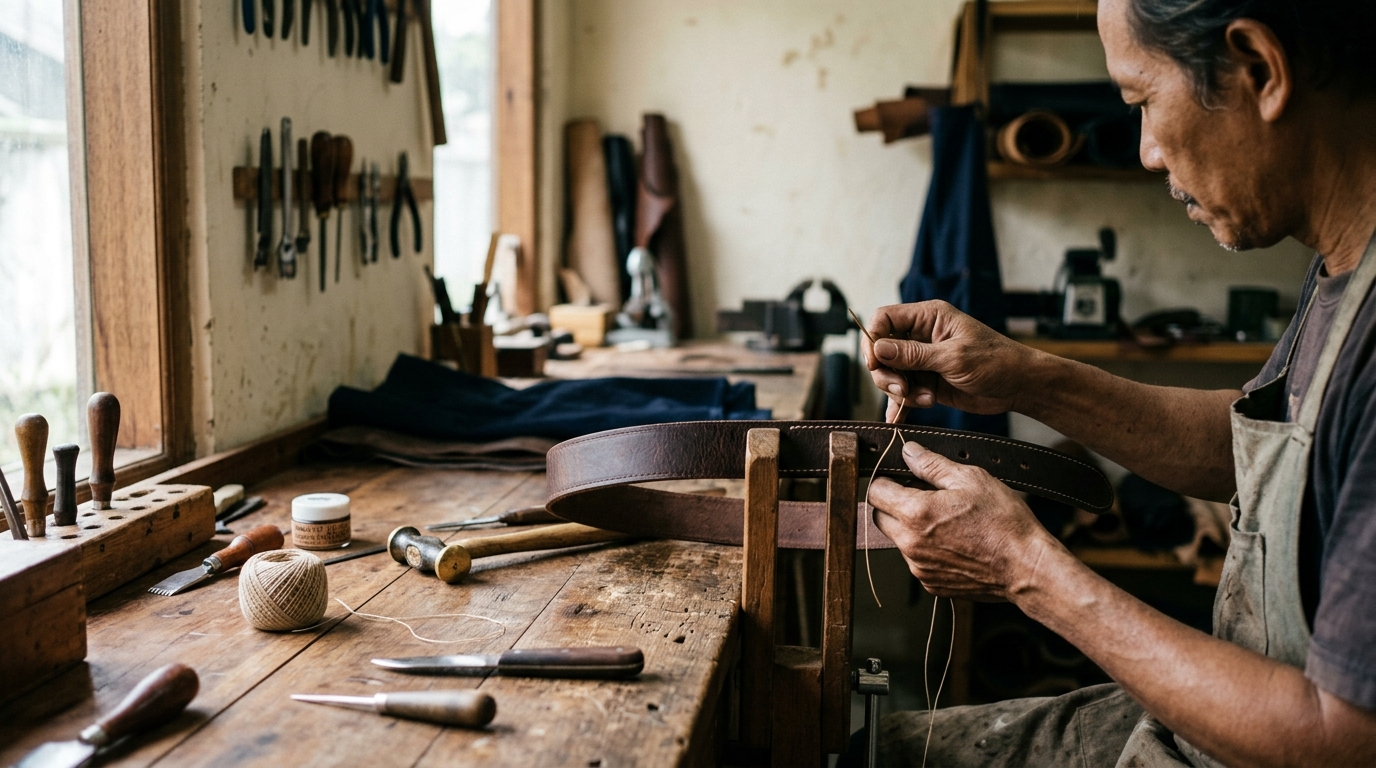
US brand owners and private-label buyers are under real pressure to find quality leather belt manufacturers outside China. Tariff exposure, lead time risk, and quality inconsistency are pushing sourcing managers to evaluate alternatives.
US brand owners and private-label buyers are under real pressure to find quality leather belt manufacturers outside China. Tariff exposure, lead time risk, and quality inconsistency are pushing sourcing managers to evaluate alternatives.
This guide covers everything a US buyer needs to make a defensible sourcing decision. You will find belt construction grades compared side by side, real MOQ tiers with price benchmarks, hardware sourcing logic, watch strap and camera strap adjacencies, and a practical factory vetting framework.
Indonesia's leather manufacturing base is concentrated in specific regional clusters. Understanding those clusters, and knowing how to qualify factories within them, is the difference between a successful first order and a costly reset. Every section below is structured around that practical decision-making frame.
Why Indonesian Leather Belt Manufacturers Outperform on Craft and Cost
Garut and Yogyakarta: Indonesia's Leather Manufacturing Heartland
Indonesia'sleather goodsindustry is not distributed evenly. Two regions dominate: Garut in West Java and Yogyakarta in Central Java. Garut has operated tanneries andleather goodsworkshops for over a century. The regional cluster includes tanneries processing bovine hides domestically, reducing reliance on imported raw material.
These clusters function similarly to the Jepara cluster for wood furniture — concentrated knowledge, shared component suppliers, and multi-generational craft skill. For a US buyer, this means factories in these regions understand export requirements. Many have produced for European and US brand programs for years.
Cost Position Relative to China, India, and Vietnam
Indonesian labor costs for skilled leather goods workers sit below comparable roles in coastal China and are broadly competitive with Vietnam. India offers lower labor costs in some regions, but quality consistency and compliance documentation often lag.
Export infrastructure is mature. The port of Tanjung Priok in Jakarta handles the majority of leather goods exports to the US and EU. Most mid-sized factories in the Garut-Yogyakarta corridor have experience with US customs documentation, country-of-origin labeling, and EU REACH compliance requirements.
Belt Construction Grades Every Buyer Must Specify Before Quoting
Full-Grain, Top-Grain, and Laminated: What the Grade Actually Means
Construction grade is the single most important variable in belt pricing and positioning. Specifying "leather belt" without defining grade is like specifying "fabric" without defining weight or fiber content.
| Construction Grade | Leather Layer Used | Durability | Typical End Market | Approx. Ex-Factory Price Range |
|---|---|---|---|---|
| Full-grain leather | Outermost hide layer, intact grain | Highest — develops patina | Premium, luxury, heritage brands | ~$18–$45 per belt |
| Top-grain leather | Sanded/buffed outer layer | Good — uniform finish | Mid-market, branded retail | ~$9–$22 per belt |
| Bonded / laminated | Leather fiber composite + backing | Lowest | Value, fast fashion, entry-level | ~$4–$10 per belt |
Full-grain is the correct call for any brand positioning above mid-market. It uses the outermost layer of the hide with the natural grain intact. No sanding, no buffing to remove imperfections. The surface shows natural character — slight variations in texture are expected and desirable in the premium segment.
Pull-Up Leather and Its Role in Premium Positioning
Pull-up leather is a full-grain hide treated with oils and waxes rather than heavy surface coatings. When flexed or scratched, the oils migrate and the surface lightens temporarily — this is the "pull-up" effect. It recovers and darkens with warmth and use, producing a distinctive aging character.
For brands selling to the heritage or workwear-adjacent market, pull-up leather is a strong specification. Indonesian factories in the Garut cluster have experience with pull-up hides. Specify the tannery origin or provide a reference hide swatch in your tech pack.
Core Materials, Lining Options, and Stitch Specs
A belt is not just the outer leather. The build stack matters:
- Core (stiffener): leather board, cardboard, or cotton duck canvas. Leather board is the correct spec for premium builds. - Lining: split leather lining adds cost but improves feel and longevity. Synthetic lining reduces cost and is acceptable for mid-market. - Stitching: specify thread type (polyester vs. linen), stitch density (stitches per inch), and reinforcement at keeper and buckle attachment points.
These specifications belong in your tech pack. Factories that quote without seeing a tech pack are either trading companies or have low engineering capability — both are risk signals.
Edge Finishing and Surface Quality Standards That Define Brand Perception
Edge finishing is a visible quality marker that consumers notice immediately in retail. It is also where factories cut costs if you do not specify tightly. Indonesian leather belts accessoriesmanufacturers indonesiatypically offer three finishing approaches.
Burnished, Painted, and Wax-Polished Edge Options
Burnished edges are produced by friction-polishing the raw cut edge with a wood or bone tool, sometimes with water or beeswax. This is the most labor-intensive method and produces the cleanest, most durable result. It is correct for full-grain and top-grain builds.
Painted edges apply a liquid edge coat (acrylic or polyurethane-based) to the cut edge. Faster, lower cost, and acceptable for mid-market builds. Durability depends on coat thickness and flexibility of the compound.
Wax-polished edges sit between the two. Common in Garut workshops with strong heritage craft traditions.
Specify edge finishing method by name in your tech pack. Request physical samples showing each option before approving a production standard.
Embossing, Debossing, and Surface Texture Capabilities
Indonesian factories commonly offer:
- Embossing: raised pattern applied by heat and pressure. Common for logo application on belt body or keeper. - Debossing: recessed pattern — more durable than embossing for high-use areas. - Texture rollers: crocodile, ostrich, and lizard texture embossing on smooth hides. These are surface treatments, not exotic hides — price accordingly.
Communicating Finish Requirements Through Tech Packs
A well-structured tech pack for a leather belt includes: exploded construction diagram, material callouts by layer, edge finishing method, stitch specification (thread type, color, density, seam allowance), hardware specification with finish, and tolerance ranges for length and width. Factories without in-house tech pack reading capability are a risk for complex builds.
Custom Buckle and Hardware Sourcing: What Indonesian Belt Factories Actually Do
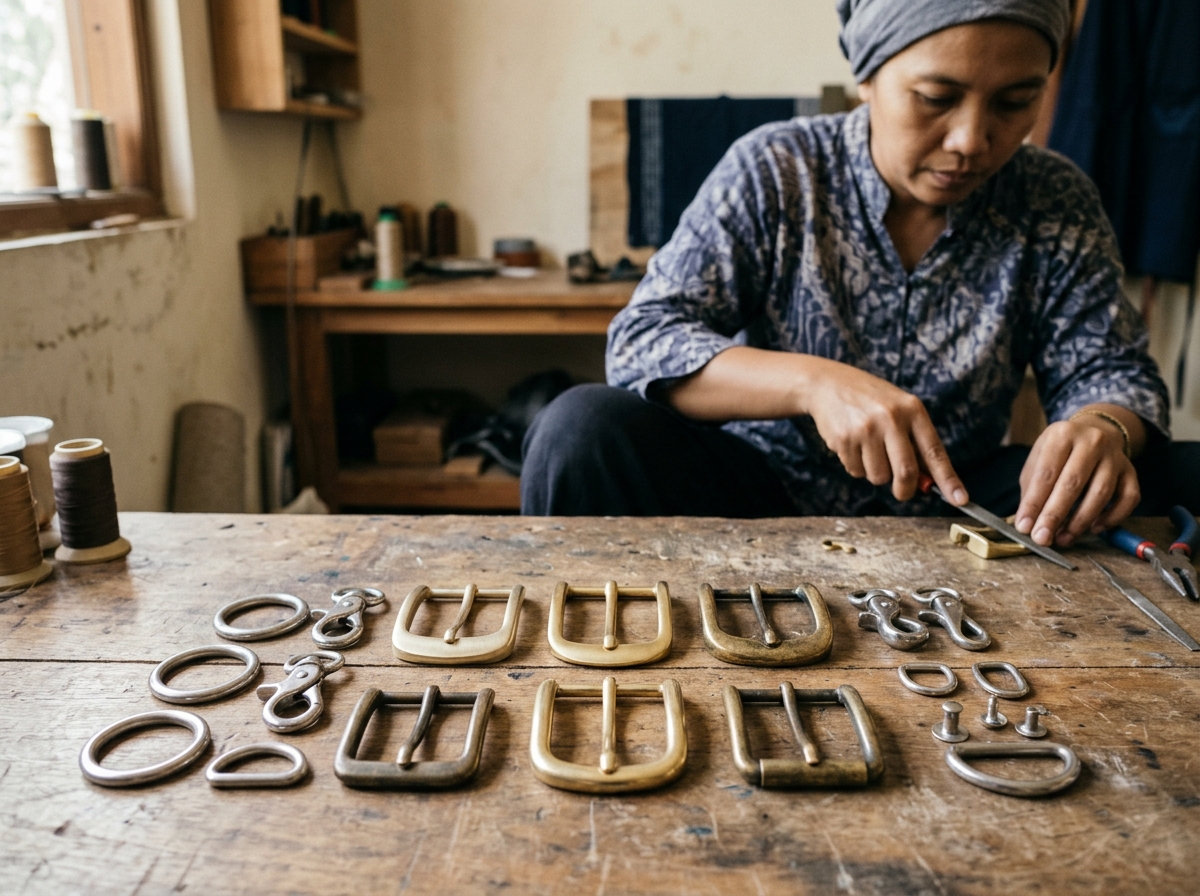
Buckle Materials and Finish Options
Common buckle materials available through Indonesian belt factories:
- Solid brass: premium, heavy, machines well for logo engraving. Longer lead time if custom. - Zinc alloy (zamak): cost-effective, wide finish range, suitable for mid-market. - Stainless steel: corrosion-resistant, clean aesthetic, preferred for casual and outdoor positioning. - Antique finishes: achieved by electroplating plus antiquing chemicals on brass or zinc base.
Local vs. China-Sourced Hardware: The Lead Time Trade-Off
This is a topic most sourcing guides ignore entirely. The reality: most Indonesian belt factories source standard buckles from domestic hardware suppliers or import from Chinese hardware manufacturers in Guangdong. Local Indonesian hardware sourcing covers standard frame buckles, D-rings, and Chicago screws adequately.
Custom hardware — logo-stamped, proprietary shape, or unusual plating — almost always requires tooling in China, then importing components into Indonesia for belt assembly.
Logo Stamping, Plating, and Hardware QC
Brand logo can be applied to hardware via: - Die casting into the mold (most durable, highest tooling cost) - Laser engraving post-plating (lower cost, less tactile) - Stamp pressing on solid brass (traditional, premium feel)
Specify acceptable plating thickness in microns in your purchase order. Request plating adhesion tests (cross-cut test or tape test) as part of your pre-shipment inspection checklist.
Watch Straps, Camera Straps, and Adjacent Accessories from the Same Factories
Why Belt Factories Are Naturally Positioned for Strap Production
Belt factories working in full-grain and top-grain leather already have the core capabilities for watch strap and camera strap production: precision cutting, edge finishing, stitching, hardware attachment, and surface treatment. The machinery overlap is significant.
Watch Strap Production: Tolerances and Construction Specifics
Watch straps require tighter tolerances than belts. Lug width must be accurate to the millimeter — common widths run from 18mm to 24mm in 2mm increments. Specify lug width, taper dimensions, hole spacing, and keeper position precisely.
Key construction differences from belts: - Padding: curved or flat padding between outer leather and lining affects comfort and price. - Lining: vegetable-tanned calf or goatskin lining is standard for quality straps. Synthetic lining is acceptable for entry-level. - Spring bar holes: must be reinforced. Specify this explicitly.
Camera Straps and Small Goods as Add-On SKUs
Camera straps require hardware-rated for load-bearing: solid brass or stainless steel swivel clips, D-rings, and lug attachment points. Specify minimum breaking strength in your purchase order.
Adjacent small goods that Indonesian accessories factories can typically co-produce:
- Key fobs: minimal tooling, low MOQ, high margin for brand extension - Luggage tags: embossing capability transfers directly - Cardholders and slim wallets: require additional machinery but common in Garut workshops - Cord pulls and bag charms: very low material cost, high perceived value
Adding these SKUs to a belt program often qualifies you for better pricing on the belt program due to increased total order value.
MOQ Tiers, Pricing Benchmarks, and Payment Structures for Indonesian Suppliers
MOQ and Price Ranges by Construction Grade
| Program Tier | MOQ per Style | Leather Grade | Approx. Ex-Factory Price |
|---|---|---|---|
| Entry / sampling | 50–100 pcs | Top-grain or bonded | ~$4–$15 per belt |
| Mid-tier | 300–500 pcs | Top-grain or full-grain | ~$9–$28 per belt |
| Volume program | 1,000+ pcs | Any grade | Best pricing, custom tooling amortized |
| Premium custom | 200–500 pcs | Full-grain or pull-up | ~$18–$45+ per belt |
Exotic construction — genuine python or stingray — sits above these ranges and depends on hide cost at time of order.
Sampling Costs and Development Fees
Most Indonesian belt factories charge a sampling fee. Expect approximately $50–$150 per sample for a standard belt with stock hardware. Custom hardware sampling costs more and may require a separate tooling deposit. Development fees are typically credited against the first bulk order above a minimum value — confirm this in writing before paying.
Payment Terms for New Relationships
Standard structures for first-time buyers working with Indonesian manufacturers:
- T/T (telegraphic transfer): typically 30–50% deposit on order confirmation, balance before shipment or against documents. Most common structure. - Letter of Credit (L/C): offers more buyer protection but adds bank fees and complexity. Larger factories are comfortable with L/C. - Escrow: less common in direct factory relationships; more relevant on B2B platforms.
How to Vet and Qualify Indonesian Leather Belt Manufacturers
Certifications and Compliance Markers to Require
For a US retailer or brand selling through established retail channels, these certifications matter:
- LWG (Leather Working Group): the benchmark tannery audit for environmental and traceability standards. Ask whether the factory sources hides from LWG-rated tanneries. - OEKO-TEX Standard 100: confirms that finished product has been tested for harmful substances. Increasingly required by US and EU retailers for skin-contact goods. - REACH compliance: EU chemical regulation. Relevant if you plan EU distribution. Indonesian exporters with EU experience will have this documented.
- ✓Request business license and export license copies
- ✓Verify factory address on satellite imagery before auditing
- ✓Confirm production capacity in belts per day or week
- ✓Review worker welfare documentation (wages, working hours)
- ✓Ask for three reference customers with verifiable contact details
- ✓Request Bill of Lading copies from recent shipments to confirm export history
- ✓Cross-check certifications on issuing body websites (OEKO-TEX certificate number lookup)
- ✓Conduct DUPRO inspection on first bulk order
Red Flags in B2B Platform Listings vs. Direct Factory Engagement
Common patterns to watch for when sourcing leather belts accessoriesmanufacturers indonesiaon B2B platforms:
- Shared showroom scam: a trading company presents a factory visit at a facility it does not own. Cross-check factory name on workers' uniforms and posted signage against the legal entity you are contracting. - Sample bait-and-switch: the sample is produced at a quality factory; bulk ships from a cheaper subcontractor. Require a DUPRO inspection and compare bulk production samples against your signed golden sample. - Certificate laundering: certificates shown are expired or issued to a different legal entity. Verify every certificate number directly on the issuing body's website. - Ghost factory: the listed factory has professional photos but minimal real production capacity. Request an unannounced or surprise audit.
Using Trade Shows and Sourcing Agents
INDOLEATHER (Indonesia) is the primary trade event for Indonesian leather andleather goods manufacturers. Attending or reviewing exhibitor lists gives direct access to export-oriented factories. Lineapelle in Milan features Indonesian leather goods manufacturers in the accessories section and is the global premium benchmark show — Indonesian factories appearing there have generally met EU compliance requirements.
Sourcing agents working in Indonesia typically charge a commission of approximately 3–10% of FOB value. An independent operational sourcing partner — as distinct from a commission agent — provides ongoing QC and logistics oversight without undisclosed factory-side commissions.
US Import Logistics, Lead Times, and Tariff Considerations for Leather Belts
Production Lead Times: Sampling Through Bulk
Typical timelines from Indonesian leather belt factories:
- Sample development: 2–4 weeks from approved tech pack - Bulk production (standard program): 6–10 weeks after sample approval and deposit receipt - Bulk production (custom hardware): add 2–4 weeks for hardware tooling and import into Indonesia
Plan a minimum of 14–16 weeks from tech pack sign-off to goods ready at port for a first order with custom hardware. Repeat orders with approved specs and stock hardware typically run 6–8 weeks.
Shipping from Tanjung Priok to US West Coast
Most Indonesian leather goods exports ship from Tanjung Priok, Jakarta's main container port. Transit time to US West Coast ports (Los Angeles, Long Beach) is approximately 18–25 days by sea freight. Air freight from Jakarta is available for sample shipments and urgent top-ups.
For small orders, LCL (less than container load) consolidation services are available through freight forwarders operating in Jakarta. FCL (full container load) is cost-effective at approximately 500+ belt units depending on belt dimensions and packaging.
HS Codes, Tariff Rates, and Labeling Requirements
The primary HS code for leather belts imported into the US is 4205.00 (other articles of leather) or 6217.10 (clothing accessories, depending on how CBP classifies the product). Confirm classification with a licensed customs broker before your first shipment — misclassification creates delays.
Under current US tariff schedules, Indonesian leather goods generally face MFN (most-favored nation) duty rates in the range of approximately 3–10%, depending on classification. Indonesia is not currently subject to the Section 301 tariffs that apply to Chinese-origin goods — this is a meaningful landed cost advantage for US buyers.
Labeling requirements for US import: - Country of origin: "Made in Indonesia" required on product and packaging - Material composition: fiber content or leather type disclosure - Care instructions: required for wearable accessories under FTC guidelines
Frequently Asked Questions From US Buyers Sourcing Indonesian Leather Belts
What is the minimum order quantity for leather belts from Indonesian manufacturers? Entry-level MOQ typically starts at 50–100 pieces per style at smaller factories. Mid-sized export-oriented factories commonly require 300–500 pieces per style. Volume programs at 1,000+ pieces unlock the best pricing and often include custom hardware amortization.
How does Indonesian full-grain leather belt quality compare to Indian or Chinese production? Indonesian full-grain belt construction from established Garut or Yogyakarta factories is generally comparable to mid-tier Indian production and better than most Chinese mid-market output at equivalent price points.
Can Indonesian factories produce custom buckles and branded hardware alongside belts? Yes, but custom hardware typically requires tooling sourced from China and imported. Lead time for custom hardware development adds two to four weeks. Own your tooling molds contractually from the start.
What certifications should I require from an Indonesian leather belt supplier? Require evidence of LWG-rated tannery sourcing, OEKO-TEX Standard 100 testing for the finished belt, and REACH compliance documentation if you plan EU distribution.
Do Indonesian belt manufacturers also make watch straps and camera straps? Many do, particularly factories with established full-grain belt programs. Watch straps require tighter dimensional tolerances and lug width accuracy. Camera straps require load-rated hardware.
What are typical ex-factory prices for premium leather belts from Indonesia? Full-grain leather belts from Indonesian factories typically range from approximately $18 to $45 ex-factory depending on construction complexity, hardware specification, and order volume. Top-grain builds run approximately $9–$22.
Indonesia offers US buyers a credible, competitive alternative to China-sourced leather belts and accessories, with real craft heritage in Garut and Yogyakarta, domestic hide access, and no Section 301 tariff exposure.
You now have the construction specifications, MOQ benchmarks, hardware sourcing logic, and import framework to evaluate Indonesian suppliers with precision. The next step is getting verified factory profiles and pre-vetted sample programs in front of your sourcing team.
You have the framework. Now get access to pre-vetted leather belts accessories manufacturers indonesia with confirmed export history, LWG-aligned tannery sourcing, and sample programs ready for US buyers. Request verified manufacturer profiles and free samples from Indonesia's top leather belt factories today.
Request Factory Profiles and Samples →Need eyes on the ground in Indonesia?
MTS is an execution partner — supplier verification, manufacturing management, quality control and export logistics across Indonesia, Vietnam and China.
Related services
Receive furniture sourcing insights across Asia.
One email per week. No spam.