Solid Teak Flooring Wholesale Indonesia: Grades, Pricing, and Import Guide
14 min read
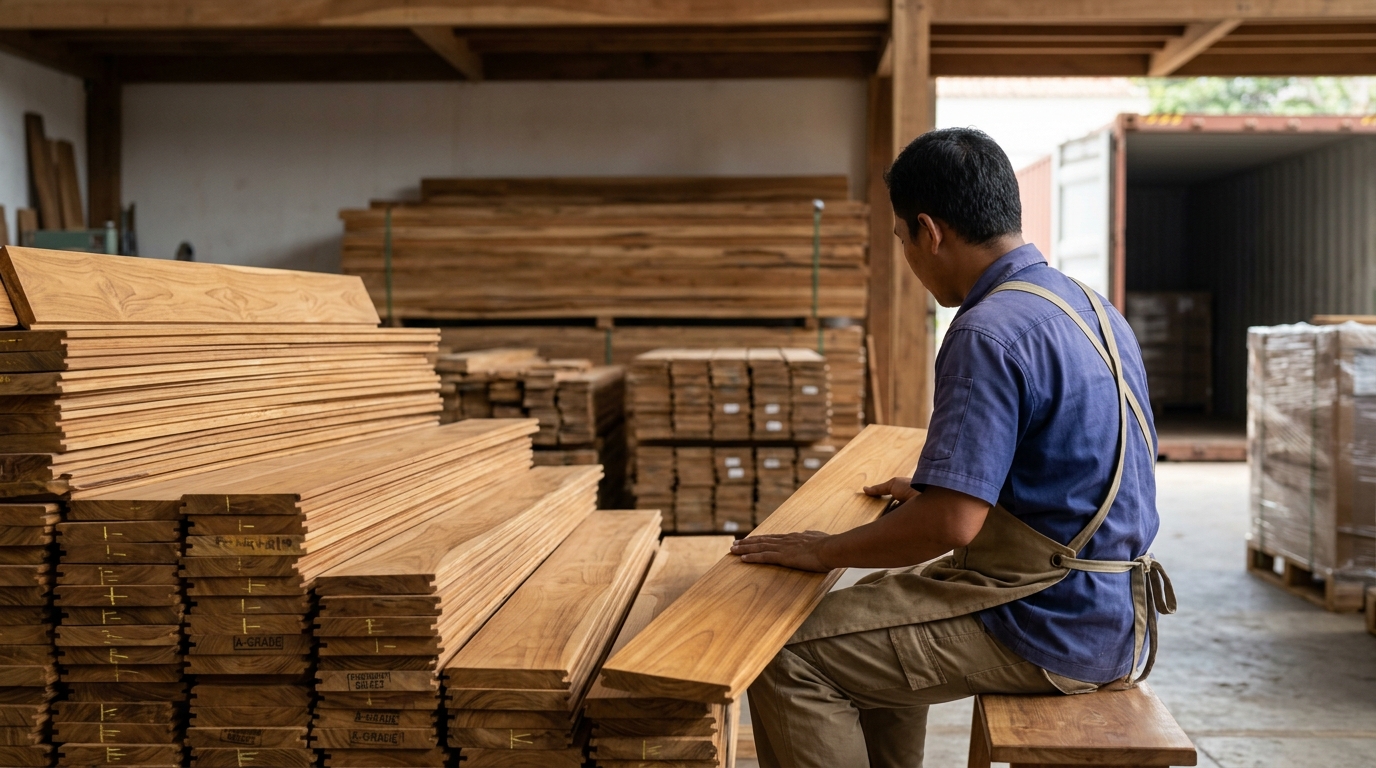
Purchasing solid teak flooring wholesale from Indonesia involves decisions that span botany, logistics, trade law, and supplier due diligence. Get any one of those wrong and you face warranty claims, customs delays, or margin erosion before the first plank reaches a US warehouse. This guide is…
Purchasing solid teak flooring wholesale from Indonesia involves decisions that span botany, logistics, trade law, and supplier due diligence. Get any one of those wrong and you face warranty claims, customs delays, or margin erosion before the first plank reaches a US warehouse. This guide is written for flooring importers, specification-grade buyers, and premium retailers who are evaluating Indonesian suppliers and need precise, actionable criteria before committing to a container order.
The sections that follow cover everything a purchasing manager needs at the pre-order stage: grade definitions, dimensional standards, kiln-drying targets by US climate region, inspection protocols, FOB and landed cost structures, container packing calculations, US tariff and Lacey Act compliance, and supplier vetting signals. Pricing figures are indicative only and subject to market conditions —Indonesian teakFOB values shift with plantation harvest cycles and government log export policy. Where exact figures are unavailable, ranges and directional patterns are given.
Understanding the source country is the logical starting point. Indonesia's production ecosystem — centered on Jepara and Semarang in Central Java — is why solid teak flooring wholesale Indonesia remains the primary sourcing origin for US buyers seeking plantation-grade hardwood flooring at commercial volumes.
Why Indonesian Plantation Teak Outperforms Every Alternative in the Flooring Market
Teak (Tectona grandis) owes its flooring performance to two intrinsic properties: high silica content and naturally occurring oils. Silica gives the wood resistance to abrasive wear. The oils repel moisture and inhibit insect attack — without the need for chemical treatment. These properties make teak dimensionally stable across a wide humidity range, which is critical for hardwood flooring in variable US climates.
Java Plantation Teak vs. Old-Growth: The Sustainability Distinction
Indonesia sources virtually all export-grade flooring teak from government-managed plantation forests on Java, operated primarily by Perum Perhutani. These are not old-growth forests. Plantation teak is harvested on rotational cycles, typically 40–80 years, and replanted continuously. This is a materially different sustainability profile from Myanmar old-growth teak, which faces severe logging restrictions and international sanctions.
US buyers increasingly require sustainability documentation for specification projects. Indonesian plantation teak satisfies that requirement through two overlapping certification systems — SVLK and FSC — covered in detail later in this guide.
Hardness and Stability Benchmarks
Indonesian plantation teak registers a Janka hardness of approximately 1,000–1,155 lbf, depending on growth density and plantation age at harvest. This positions it harder than walnut (approximately 1,010 lbf) and softer than white oak (approximately 1,350 lbf). For residential and light commercial flooring, the hardness rating is sufficient. The dimensional stability advantage over domestic hardwoods — driven by those natural oils — is the more important procurement argument for multi-climate distribution.
Teak Flooring Grade Standards in Indonesia: FEQ, Select, and Rustic Compared
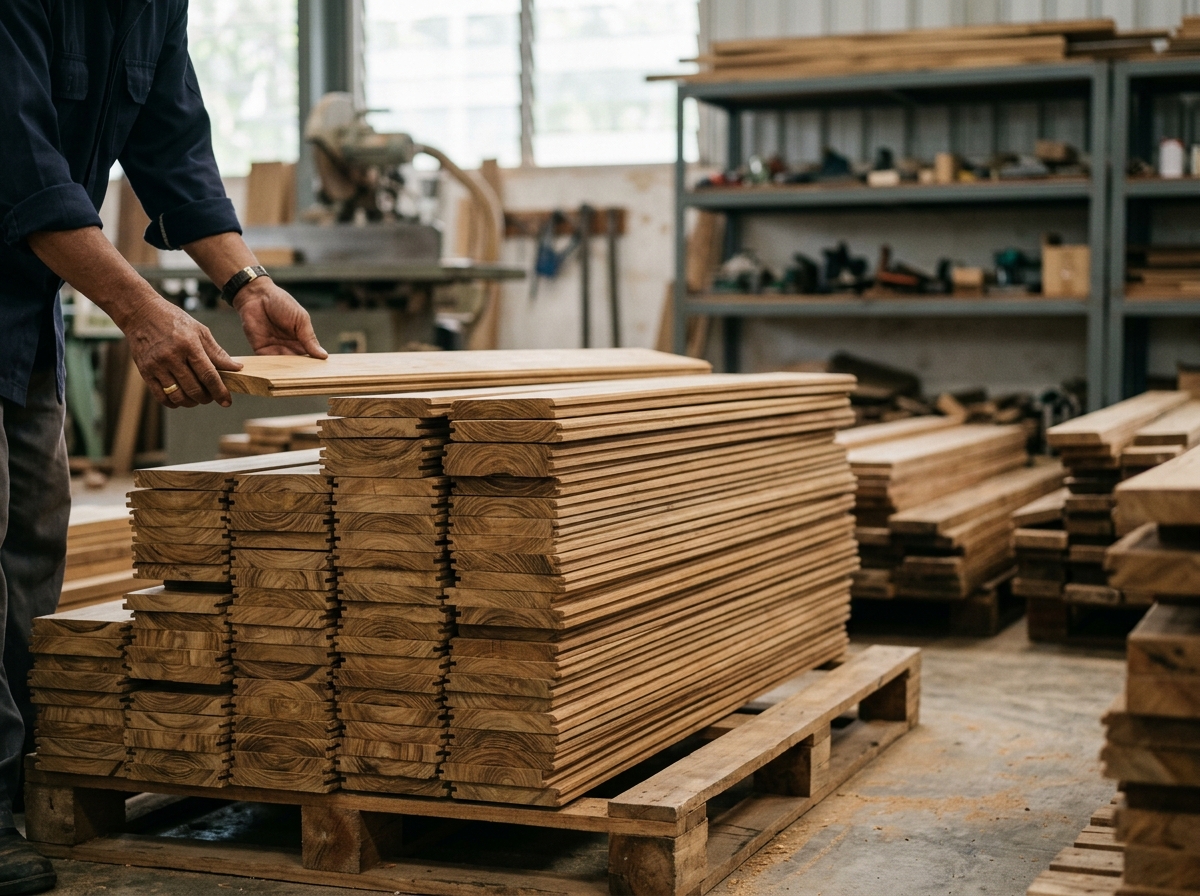
Indonesia does not follow NHLA (National Hardwood Lumber Association) grading conventions. Indonesian teak flooring is graded against a parallel system developed through the export trade, with FEQ as the benchmark premium grade.
FEQ Grade: First European Quality
FEQ — First European Quality — is the highest commercial grade for solid teak flooring wholesale Indonesia exports. It specifies:
- Clear face: no open knots, no dead knots - Tight, even grain: radial or quarter-sawn orientation preferred - Uniform color: heartwood dominant, sapwood limited to a narrow allowable band (commonly no more than approximately 10% of face width) - No cracks, splits, or worm holes on the show face
FEQ commands the highest FOB price and the tightest yield per log. It is the appropriate grade for premium retail, specification-grade commercial projects, and high-end hospitality flooring.
Select Grade: Character Within Limits
Select grade permits minor sound (live) knots, small sapwood bands wider than FEQ allowances, and minor color variation. Structural integrity is maintained. Select is a strong choice for buyers who want teak performance at a lower price point, or for wide-plank applications where some character variation is aesthetically acceptable.
Rustic and Knotty Grade: Maximum Yield, Maximum Variation
Rustic grade includes:
- Pin knots and open knots within defined size limits - Wider sapwood presence - Color contrast between heartwood and sapwood - Minor surface checking on edges
Rustic planks often come from lower-crown or younger plantation material. The per-m² price differential versus FEQ can be significant — often 25–40% lower on an indicative basis. For buyers targeting budget-conscious retail segments or character-look flooring, rustic grade offers genuine value.
| Grade | Face Quality | Sapwood Allowance | Knots | Relative FOB Price |
|---|---|---|---|---|
| FEQ | Clear, uniform | Minimal (<~10%) | None permitted | Highest |
| Select | Minor variation | Limited | Sound knots, small | Mid-range |
| Rustic | Character marks | Wider presence | Pin + open knots | Lowest |
Standard Dimensions, Profiles, and Surface Finishes for Wholesale Teak Flooring Orders
Thickness Options
The most common solid plank thicknesses for export are 14 mm, 18 mm, and 20 mm. Thicker stock (18–20 mm) supports multiple re-sanding cycles over the floor's lifetime and is preferred for commercial specification. The 14 mm option suits renovation projects where subfloor height gain is a constraint.
Width and Length Ranges
Standard widths run from approximately 60 mm to 120 mm. Custom widths up to 150 mm are available from larger factories but typically require higher MOQs and longer lead times. Length ranges commonly span 300 mm to 1,800 mm in a mixed bundle. Fixed-length orders (e.g., all planks at 900 mm or 1,200 mm) reduce on-site labor waste but increase factory waste and FOB cost.
Profile Options: T&G, Click-Lock, and Square Edge
Tongue-and-groove (T&G) remains the dominant profile for solid teak flooring wholesaleIndonesia exportorders. It provides mechanical interlocking without adhesive dependency. Click-lock profiles are available from modern CNC-equipped factories but are less common in solid teak due to the wood's natural movement characteristics. Square-edge planks are typically sold for glue-down applications or feature strip floors.
Micro-Bevel, Full-Bevel, and Flat-Face Profiles
- Micro-bevel: A small chamfer (typically 0.5–1 mm) on the long edges. Hides minor lippage between planks. The most common wholesale specification. - Full bevel: Deeper chamfer, creates a pronounced shadow line. Preferred for a rustic or artisan aesthetic. - Flat face (no bevel): Requires tighter dimensional consistency. Higher factory cost, used for seamless contemporary installations.
Factory Finish Options
| Finish Type | Description | Wholesale Suitability |
|---|---|---|
| UV-oiled | Penetrating oil, factory-cured under UV | High — protects during transit |
| Lacquered | Surface film, high sheen options available | High — common for retail-ready product |
| Unfinished | Raw sanded surface | High — for site-finishing specification projects |
Kiln-Drying Protocols and Climate-Specific Moisture Content Targets for US Buyers
Why Moisture Content Controls Everything
Incorrect moisture content (MC) is the single largest cause of post-installation failures in imported hardwood flooring. Teak with MC too high for the destination climate will cup, buckle, or develop mold. MC too low creates gapping as the wood absorbs ambient humidity.
US Climate-Specific MC Targets
This is a detail most competitor guides omit. US climate zones vary substantially. Matching MC at shipment to the equilibrium moisture content (EMC) of the destination is critical.
| US Climate Zone | Typical Indoor RH Range | Target MC at Shipment |
|---|---|---|
| Arid Southwest (AZ, NV, NM) | 25–35% RH | 6–7% |
| Temperate West Coast (CA, OR, WA) | 35–50% RH | 7–8% |
| Midwest and Great Plains | 30–50% RH | 7–9% |
| Humid Southeast (FL, GA, SC, LA) | 50–70% RH | 8–10% |
| Northeast | 35–55% RH | 7–9% |
Factories in Semarang and Jepara typically run conventional kiln schedules targeting 8–12% MC for general export. US buyers must specify their destination climate zone explicitly and require that kiln schedules be adjusted accordingly.
Moisture Testing Methods at Inspection
- Pin-type resistance meters: Fast, economical, accurate to approximately ±1% MC. Suitable for batch sampling. - Insulated-probe meters: More accurate for deeper plank readings. Required for planks over 18 mm. - Oven-dry gravimetric test: Laboratory standard, used for calibration and dispute resolution.
Specify in your purchase contract that MC readings must be taken on a minimum percentage of planks per pallet, logged, and included in the pre-shipment inspection report.
Factory Grading Inspection at Origin: What Every Wholesale Buyer Must Verify Before Shipment
Pre-Shipment Inspection Checklist
A third-party pre-shipment inspection (PSI) is non-negotiable for first-time orders and strongly recommended for repeat orders when grade conformance is at issue.
- ✓Grade conformance against agreed reference samples (golden samples)
- ✓MC readings per pallet, logged by pin meter
- ✓T&G profile dimensional tolerance checks (±0.1 mm)
- ✓Surface finish curing check (no tacky spots, uniform sheen)
- ✓SVLK/V-Legal certificate validity verification
- ✓Pallet packing quality, moisture barrier wrapping
- ✓Carton/bundle labeling accuracy (grade, dimensions, MC)
- ✓Quantity count against packing list
Third-Party Inspection Agencies in Java
SGS, Bureau Veritas, and Intertek all operate in Java and offer pre-shipment inspection services for wood flooring. Budget approximately 1–3 days of inspector time per container load, depending on scope. Costs are typically borne by the buyer and are a small fraction of the order value relative to the risk they mitigate.
SVLK vs. FSC: Certification Requirements and Cost Implications
This is another area most guides handle superficially. Here is the practical distinction:
| Criteria | SVLK (V-Legal) | FSC Certification |
|---|---|---|
| Governing body | Indonesian government (KLHK) | Forest Stewardship Council (international NGO) |
| Legal status in Indonesia | **Mandatory** for all wood product exports | Voluntary |
| Market recognition in US | Satisfies Lacey Act legality evidence | Recognized by specification-grade architects and green building programs |
| Exporter cost | Lower — government-administered | Higher — annual audit fees, chain of custody requirements |
| Buyer requirement | Always require as baseline | Require if project demands FSC-certified chain of custody |
SVLK is non-negotiable. Any Indonesian teak flooring exporter shipping legally must carry SVLK. If a supplier cannot produce a valid SVLK certificate, that is a disqualifying red flag. FSC adds value for LEED projects or premium retail positioning but comes at a cost premium passed through to FOB price.
Wholesale Pricing Structure for Solid Teak Flooring Indonesia: FOB and Landed Costs
Indicative FOB Price Bands by Grade
These are approximate market ranges only, subject to exchange rates, log costs, and order volume:
| Grade | Indicative FOB Semarang (per m²) | Notes |
|---|---|---|
| FEQ | USD 35–65+ | Wide range by thickness (14–20 mm) and finish |
| Select | USD 25–45 | More available supply, more price competition |
| Rustic | USD 15–28 | Highest yield, lowest per-unit value |
Volume Break Points and MOQ
- Minimum order quantity (MOQ) at most direct factories: approximately 500 m² - Half-container (approximately 15 m³ of loose volume): viable for first sample-scale commercial orders - Full 20-foot container: the standard benchmark for repeat orders - Full 40-foot container: optimal for per-m² cost; typically negotiates best pricing
Freight and US Port Add-Ons
Indicative cost additions above FOB Semarang (approximate, market-variable):
- Ocean freight (20-foot container, Semarang to US West Coast): USD 2,000–4,500 - Marine insurance: approximately 0.3–0.5% of cargo value - US port handling, customs examination, and ISF filing: USD 500–1,200 - US customs duty (see tariff section below): separate line item
Container Quantities, Logistics, and Lead Times for US Importers
Packing Density by Plank Thickness
This table allows buyers to calculate approximate m² yield per container before requesting a quote:
| Plank Thickness | Packing Density (m²/m³, approximate) | 20-foot Container (~25 m³ usable) | 40-foot Container (~55 m³ usable) |
|---|---|---|---|
| 14 mm | ~60 m²/m³ | ~1,500 m² | ~3,300 m² |
| 18 mm | ~47 m²/m³ | ~1,175 m² | ~2,585 m² |
| 20 mm | ~42 m²/m³ | ~1,050 m² | ~2,310 m² |
Figures are approximate. Actual yield varies with pallet configuration, wastage allowance, and packing method.
Lead Times: Stock vs. Custom Orders
- Stock grade (FEQ or select, standard dimensions): Production-to-vessel typically 30–45 days for factories in Semarang and Jepara - Custom dimensions or finishes: Add 15–30 days for tooling setup and kiln scheduling - Vessel transit: Semarang to Los Angeles approximately 18–22 days; to Houston approximately 25–30 days; to New York approximately 28–35 days (approximate, carrier-dependent)
Incoterms Selection
| Incoterm | Who Controls Freight | Risk Transfer Point | Best For |
|---|---|---|---|
| FOB | Buyer arranges shipping | At vessel rail, origin port | Experienced importers with freight contracts |
| CIF | Seller arranges to named port | At destination port | First-time importers or smaller orders |
| DDP | Seller handles all costs and duties | At buyer's door | Highest landed cost; minimal buyer complexity |
FOB Semarang is the standard trading basis for wholesale solid teak flooring from Indonesia and gives buyers the most pricing transparency.
US Import Compliance: Tariffs, Lacey Act Documentation, and Required Certificates
HTS Codes and Tariff Rates
Solid wood flooring from Indonesia is classified under HTS heading 4409 or 4418, depending on whether planks are profiled or presented as assembled flooring panels. The applicable subheading should be confirmed with a licensed customs broker prior to the first shipment, as classification affects the duty rate.
Indonesia benefits from preferential tariff treatment under the US Generalized System of Preferences (GSP) for eligible product categories, though GSP eligibility and product coverage should be verified against the current USTR schedule, as GSP programs are subject to congressional reauthorization. There are no active antidumping or countervailing duty orders on Indonesian hardwood flooring as of the time of writing — a significant compliance advantage over Chinese-origin products.
Lacey Act Declaration: Tectona Grandis Plantation Teak
The Lacey Act requires an import declaration for wood products. For Indonesian plantation teak flooring, the declaration must include:
- Species scientific name: Tectona grandis - Country of harvest: Indonesia - Quantity and unit of measure: in m² or board feet - Value of imported goods
SVLK documentation supports the legality declaration. Keep it on file; Lacey Act enforcement audits can request records years after import.
Required Shipping Documents
- ✓Commercial invoice (with species, grade, dimensions, value)
- ✓Packing list
- ✓Bill of lading
- ✓Phytosanitary certificate (issued by Indonesian plant health authority)
- ✓Fumigation certificate (methyl bromide or heat treatment, per USDA APHIS requirements)
- ✓SVLK/V-Legal export certificate
- ✓FSC chain-of-custody certificate (if project specification requires it)
- ✓Lacey Act import declaration (PPQ Form 505)
How to Qualify and Vet Indonesian Teak Flooring Suppliers Before Placing a Wholesale Order
Production Clusters and Their Differences
- Jepara (Central Java): Historically a craft furniture center. Strong in solid wood processing. Many small-to-mid factories with artisan skill. Better suited for custom profiles and mixed-grade runs. - Semarang (Central Java): More industrial production base. Larger kiln capacity. Better infrastructure for full-container export logistics. - Surabaya (East Java): Mid-market orientation. Stronger on volume than on premium FEQ grading consistency.
For FEQ-grade solid teak flooring wholesale Indonesia orders above a full 40-foot container, Semarang-area factories typically offer the best combination of kiln capacity and export logistics.
Factory Audit Criteria
Evaluate potential suppliers against these production signals:
- Kiln capacity relative to claimed production volume (cross-check these figures) - Planing line equipped with thickness calibrators and surface inspection lighting - In-house MC meter logging — not just a meter available, but logged records - Export history: request Bill of Lading data or verifiable client references - SVLK certificate number — verify it on the Indonesian Ministry of Environment and Forestry (KLHK) online registry
Red Flags to Disqualify Suppliers
- Quote missing MC specification or refusing to commit to a target range - No SVLK certificate, or certificate issued to a different legal entity than the contracting party - Unrealistically short lead times (under 21 days for a custom order) - Inability to provide golden reference samples before order confirmation - Quotes presented through multiple intermediaries with no direct factory contact — this pattern often signals a nested trader chain adding sequential margin with no quality control accountability
Building Supplier Relationships That Scale
Start with a sample order at approximately 50–100 m² before committing to a full container. Use a simple NDA to protect custom profile designs. Negotiate 30% deposit / 70% against Bill of Lading on first orders, moving to open account or letter of credit terms as the relationship matures. Grade conformance and MC consistency across the first three shipments are the metrics that predict long-term supplier reliability.
Frequently Asked Questions
What is FEQ grade teak flooring and how does it differ from select grade? FEQ (First European Quality) requires a completely clear face, tight grain, and minimal sapwood — no knots permitted on the show face. Select grade allows minor sound knots and a wider sapwood band. FEQ commands a higher FOB price; select offers a lower cost for buyers where minor character variation is acceptable.
What moisture content should solid teak flooring have before shipping to the US? Target MC depends on the destination climate. Arid Southwest buyers should specify 6–7%; humid Southeast buyers should specify 8–10%. Always state the destination climate zone in the purchase order so the factory can calibrate the kiln schedule accordingly.
How many square meters fit in a 40-foot container of solid teak flooring? Approximately 2,300–3,300 m², depending on plank thickness. At 14 mm thickness, expect approximately 3,300 m²; at 20 mm, expect approximately 2,300 m². Use the packing density table in this guide to calculate before requesting a quote.
What certifications should Indonesian teak flooring carry for US import compliance? SVLK (V-Legal) is mandatory under Indonesian law and supports the Lacey Act legality declaration. A phytosanitary certificate and fumigation certificate are required by USDA APHIS. FSC chain-of-custody certification is voluntary but required for LEED-specified or FSC-labeled product claims.
What are current US tariff rates on solid teak flooring imported from Indonesia? Rates depend on the specific HTS subheading. Indonesia's GSP status may provide duty-free or reduced-duty treatment for eligible flooring categories. Confirm the applicable rate and current GSP status with a licensed US customs broker before your first shipment — rates and eligibility change.
What is the minimum order quantity (MOQ) for wholesale teak flooring from Indonesia? Most direct factories set MOQ at approximately 500 m². Some larger factories require a half-container minimum (approximately 750–1,000 m²) to schedule a kiln run. Traders and merchant exporters may offer lower MOQs but at higher per-m² prices.
Indonesian plantation teak from Java offers a procurement-grade combination that no other origin currently replicates: documented legality through SVLK, measurable dimensional stability through Tectona grandis natural properties, and a mature export infrastructure centered on Semarang and Jepara. The compliance framework — Lacey Act, SVLK, phytosanitary, and fumigation documentation — is well-established and manageable for any experienced importer working with a competent customs broker.
The primary sourcing risks are MC specification drift, grade inconsistency from under-audited suppliers, and FOB price volatility tied to Indonesian log export policy. All three are controllable through contract discipline, third-party pre-shipment inspection, and direct factory relationships.
You now have the grade definitions, dimension specs, MC targets, and compliance checklist to evaluate Indonesian teak flooring suppliers with precision. The next step is to put verified factory samples and live FOB pricing in your hands. Request a wholesale sample pack and FOB price list from vetted Indonesian teak flooring manufacturers — specify your grade, thickness, destination climate, and target container volume to receive directly comparable quotes.
Request Samples and FOB Pricing →Need eyes on the ground in Indonesia?
MTS is an execution partner — supplier verification, manufacturing management, quality control and export logistics across Indonesia, Vietnam and China.
Related services
Related articles
Receive furniture sourcing insights across Asia.
One email per week. No spam.