Sustainable Eco Resort Furniture Indonesia: The Complete Sourcing Guide
14 min read
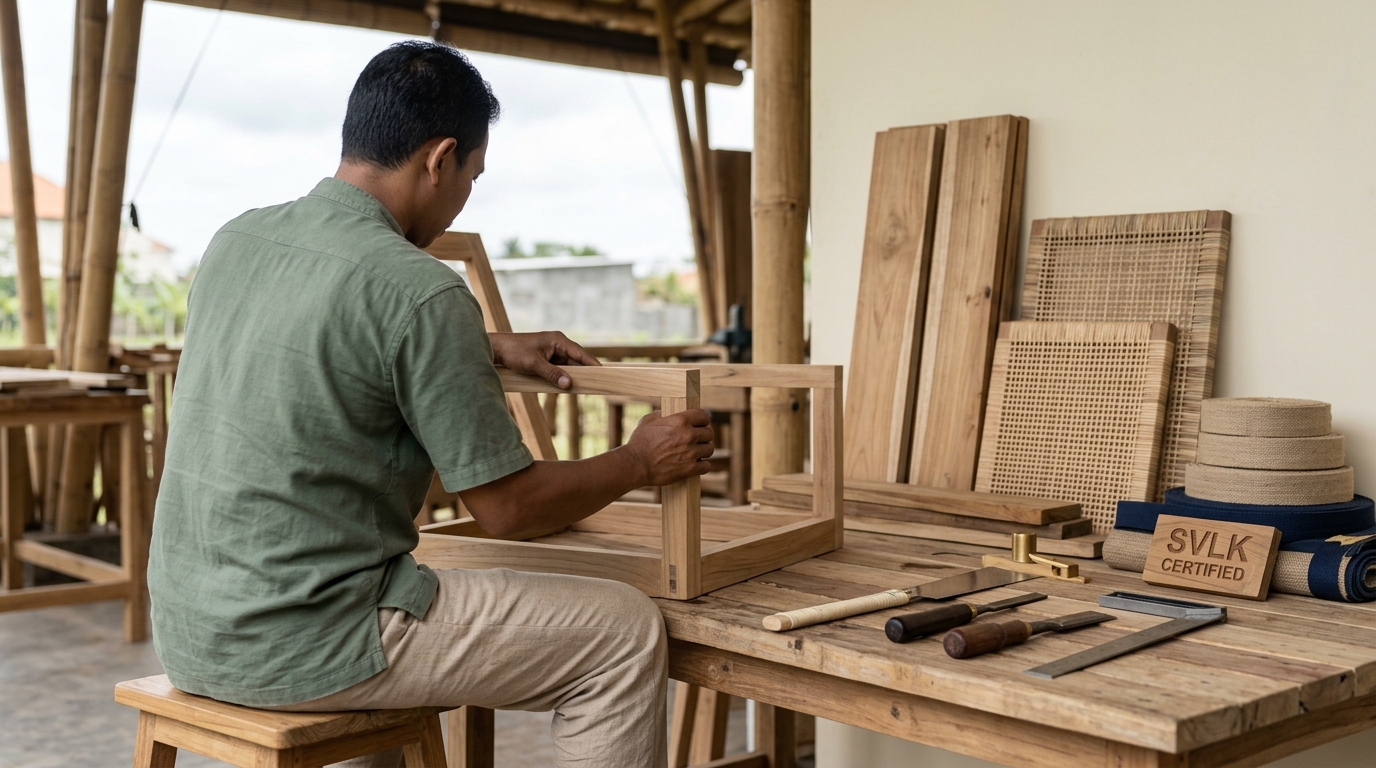
Indonesia offers unmatched material diversity and craftsmanship for eco-resort procurement teams. However, the market is crowded with suppliers making sustainability claims they cannot substantiate. FSC certificates get photocopied. SVLK documents expire unnoticed. Reclaimed teak arrives without…
Indonesia offers unmatched material diversity and craftsmanship for eco-resort procurement teams. However, the market is crowded with suppliers making sustainability claims they cannot substantiate. FSC certificates get photocopied. SVLK documents expire unnoticed. Reclaimed teak arrives without species-level traceability. The gap between a supplier's marketing language and their actual chain-of-custody documentation is often wide.
This guide is written for hospitality procurement managers and eco-resort developers. It also targets sustainability-focused hotel brands evaluating Indonesian manufacturers. It covers material selection and FSC and SVLK verification. It also covers EUDR readiness and greenwashing audit methodology. It also addresses total cost of ownership. It does not traffic in vague eco-friendly language.
Indonesia's production clusters — Bali, Jepara, Cirebon, Semarang — each have distinct specializations. Certification densities also differ across these clusters. Understanding those differences before issuing an RFQ reduces procurement risk considerably. The sections below give you the analytical framework to do that.
Why Indonesia Leads the World in Eco-Friendly Tropical Resort Furniture
Indonesia is the dominant global source for natural-material hospitality furniture. Indonesia's competitive position rests on three structural advantages. These are tropical hardwood access, regional craft clusters, and growing FSC and SVLK certification infrastructure.
Regional Production Clusters and Their Specializations
Each major cluster serves a different buyer profile:
| Cluster | Province | Primary Specialization |
|---|---|---|
| Jepara | Central Java | Solid teak, mahogany, carved hardwood |
| Cirebon | West Java | Rattan, wicker, natural fiber weaving |
| Bali | Bali | Luxury artisan, resort/villa custom pieces |
| Semarang | Central Java | Outdoor, contract, mid-market export |
| Surabaya | East Java | Mid-market, mixed materials |
Jepara alone hosts hundreds of solid-wood manufacturers. These range from small workshops to export-scale factories. Bali suppliers skew toward premium custom work for hospitality projects. Cirebon dominates rattan supply chains. For sustainable ecoresort furnitureIndonesia projects, buyers typically source case goods from Jepara or Bali. These are the two main sourcing regions.
Why Eco-Resort Brands Are Prioritizing Indonesian Sourcing
The hospitality sector is shifting toward sustainable procurement. This has intensified demand for certified Indonesian furniture. This demand continues to grow. Plantation teak, rattan, and bamboo are renewable or recyclable materials. They align with resort sustainability narratives. This alignment holds provided the supply chain documentation holds up.
Indonesia's certification infrastructure, while uneven, has expanded. A meaningful share of Jepara factories hold SVLK (Sistem Verifikasi Legalitas Kayu) certification. A smaller but growing subset carry FSC chain-of-custody certification. For buyers with EU-facing sustainability commitments, the two standards differ operationally. That distinction matters in practice. It is not a minor technical difference.
Core Sustainable Materials for Indonesian Resort Furniture: What to Specify and Verify
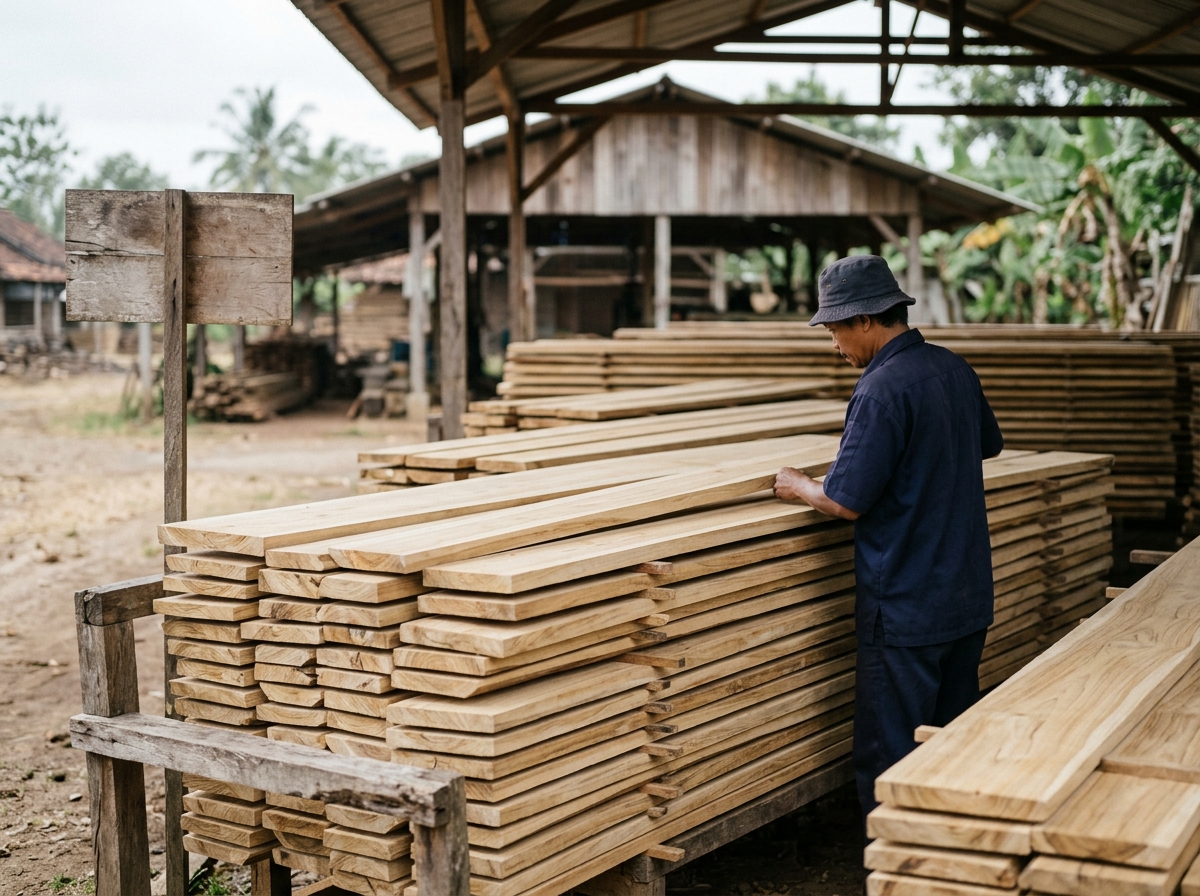
Plantation Teak vs. Reclaimed Teak: The Traceability Question
Plantation teak (Tectona grandis) grown on certified managed land is the most defensible sustainable option. No other wood type offers a stronger sustainability claim. It offers consistent grain, known harvest origin, and eligibility for FSC chain-of-custody documentation. Ask suppliers for the plantation's FSC Forest Management certificate number.
Reclaimed teak is frequently marketed as more sustainable than plantation wood. The argument is that it avoids new harvesting. That claim is valid only when the material is properly documented. Reclaimed teak without species identification records or harvest provenance creates audit liability. Missing chain-of-custody documentation adds to that compliance risk.
Old-growth teak harvested from natural forests rather than plantations should be treated as red-flag material. Buyers should avoid it entirely. Only accept it if accompanied by verified legal harvest documentation under SVLK. FSC Forest Management certification must also be present.
Natural Fibers, Suar Wood, and Emerging Alternatives
Rattan (Calamus spp.): Indonesia supplies the majority of the world's rattan. It is fast-growing, harvested without killing the plant, and suitable for both indoor and covered outdoor resort furniture. Request harvest region documentation and confirm the supplier's SVLK scope covers rattan.
Bamboo (Dendrocalamus spp.): Fast-growing and structurally strong. Best suited to indoor applications and covered outdoor areas. Verify treatment processes — untreated bamboo in coastal environments degrades rapidly.
Suar wood (Albizia saman): A plantation-grown wood widely used in Indonesian resort furniture for tables, countertops, and statement pieces. Grows rapidly. Confirm suppliers source from legal plantations with documented chain of custody.
Coconut wood and upcycled materials: Emerging for poolside and beachfront applications. Coconut wood uses end-of-life coconut palms. Upcycled plastic lumber is appearing in more resort FF&E specs as a zero-deforestation option forsun loungersand deck furniture.
FSC and SVLK Certification: What Each Standard Actually Covers
This is the section most procurement managers get wrong. FSC and SVLK are not equivalent. Using them interchangeably in supplier briefs produces compliance gaps.
FSC Chain-of-Custody: Scope and Limitations
FSC chain-of-custody certification tracks wood from a certified forest through every stage of processing. It follows the material all the way to the finished product. A furniture factory with FSC CoC certification can label products as FSC-certified only under one condition. That condition must be met without exception.
Key distinctions buyers must understand:
- FSC 100%: All wood input from FSC-certified forests. Strongest claim. - FSC Mix: Combination of FSC-certified, recycled, and FSC Controlled Wood sources. - FSC Recycled: All wood content is post-consumer reclaimed material.
An FSC CoC certificate at the factory level does not automatically mean every product shipped carries FSC-certified material. Each product must be verified separately. It means the factory has a system capable of producing FSC-certified goods. Buyers must request product-level FSC claim documentation per order.
SVLK: Indonesia's Timber Legality System
SVLK (Sistem Verifikasi Legalitas Kayu) is Indonesia's government-mandated timber legality verification system. It confirms that timber was legally harvested and traded under Indonesian law. It is not a sustainability or forest management standard. It does not certify that forests are well-managed — only that harvests were legal.
| Dimension | FSC CoC | SVLK |
|---|---|---|
| Issuing body | Forest Stewardship Council (international NGO) | Indonesian Ministry of Environment and Forestry |
| Scope | Chain of custody + forest management | Timber legality only |
| Mandatory in Indonesia? | No (voluntary) | Yes (mandatory for wood exporters) |
| Recognized by EU FLEGT? | No | Yes (Indonesia has FLEGT VPA with EU) |
| Covers rattan/bamboo? | Yes (specific standards) | Partial (wood-focused) |
| International market recognition | High (US, EU, global) | Primarily EU/FLEGT context |
| Verifiable online? | Yes — info.fsc.org | Yes — silk.dephut.go.id |
SVLK compliance is the legal floor. FSC certification is the market-credibility ceiling. For eco-resort projects requiring a verified sustainability story, FSC CoC from the factory is the defensible standard. No weaker alternative is comparable. No weaker alternative provides equivalent audit protection. This applies when a proven sustainability narrative is needed. It provides a credible, verifiable sustainability claim.
How to Verify Certificates Without Relying on Supplier Documents
1. Get the supplier's FSC certificate number (format: FSC-C######). 2. Go to info.fsc.org and enter the number. 3. Confirm the certificate holder name matches your supplier and the scope covers furniture manufacturing. Also confirm the certificate is current and your product category falls within scope. 4.
EUDR Readiness: What EU-Linked Resort Operators Must Demand from Suppliers
The EU Deforestation Regulation (EUDR) entered into force in June 2023. Compliance obligations for large operators are expected to apply from approximately late 2025. Smaller operators are expected to follow in 2026; verify current dates with official EU sources, as the timeline has been subject to revision.
Due Diligence Obligations for Importers
Under EUDR, importers placing Indonesian wood furniture on the EU market must conduct due diligence. This is a legal requirement. This is a legal requirement for market access. They must demonstrate that products meet specific legal requirements.
- Deforestation-free: The wood was not harvested from land deforested after December 31, 2020. - Legally produced: Compliant with the laws of the country of origin. - Traceable to plot of origin: Geo-location data identifying the forest parcel(s) of origin must be supplied.
SVLK partially satisfies the legality requirement. This is due to Indonesia's existing FLEGT Voluntary Partnership Agreement with the EU. However, SVLK alone does not satisfy the geo-location and deforestation-free evidence requirements.
What Suppliers Must Provide for EUDR Compliance
Procurement managers sourcing custom sustainable hotel furniture in Bali or Jepara must request specific documents. This applies to EU-facing resort brands. Those requirements are listed below.
- GPS coordinates or polygon data for harvest plots (not just country and region — parcel-level) - Harvest dates relative to December 31, 2020 cutoff - Species identification documentation - Legal harvest documentation (SVLK, or equivalent) - A written due diligence statement per shipment
Most Indonesian furniture manufacturers are not yet prepared to supply parcel-level geo-location data. This is a material supply chain gap. Buyers should treat geo-location readiness as a supplier qualification criterion, not a nice-to-have.
- ✓Can supplier provide GPS/polygon data for harvest plots?
- ✓Are all input materials harvested after the Dec 31 2020 baseline documented?
- ✓Does the supplier hold or source from SVLK-certified operations?
- ✓Can supplier issue a per-shipment due diligence statement?
- ✓Does the supplier have a documented chain-of-custody process linking product to forest parcel?
- ✓Is species identification recorded at material intake?
Spotting Greenwashing: How to Audit Indonesian Furniture Suppliers' Sustainability Claims
Greenwashing in Indonesian furniture exports ranges from passive omission to active misrepresentation. The patterns are consistent enough to audit systematically.
- ✓Claims 'eco-friendly' or 'sustainable' with no third-party certificate cited
- ✓FSC or SVLK certificate copy cannot be verified in official online databases
- ✓Certificate scope does not cover the product category being purchased
- ✓Certificate expiry date has passed
- ✓Reclaimed wood offered with no species identification or origin documentation
- ✓Supplier cannot describe their chain-of-custody process step by step
- ✓Subcontractors used but not disclosed — CoC breaks at sub-tier
- ✓'Plantation teak' claimed but no plantation name, location, or FM certificate provided
- ✓Factory audit declined or 'not possible at this time'
- ✓Social compliance documentation (wages, safety records) unavailable or refused
Expired and Unverifiable Certificates
This is the most common form of misrepresentation. A supplier sends a PDF of an FSC certificate. The certificate expired approximately 14 months ago. The factory may have held valid certification in the past — but current production is not covered. Always check the expiry date in the FSC database, not on the document.
Missing Species Documentation for Reclaimed Wood
Reclaimed teak is a legitimate sustainable material when properly traced. The documentation requirement is species-level identification at material intake. This is typically a wood species report from a qualified assessor, linked to the batch. Without it, a buyer cannot satisfy chain-of-custody audit requirements. They also cannot support EUDR due diligence.
Social Compliance as Part of Holistic Sustainability
Sustainability audits that stop at environmental certification miss half the picture. Indonesian furniture production, particularly in smaller Jepara workshops, uses subcontracting networks. Fair-wage and safe-conditions standards are inconsistently applied across these networks. Request factory audit records covering wages, working hours, and safety conditions.
Custom vs. Ready-Made Eco Resort Furniture: Procurement Parameters
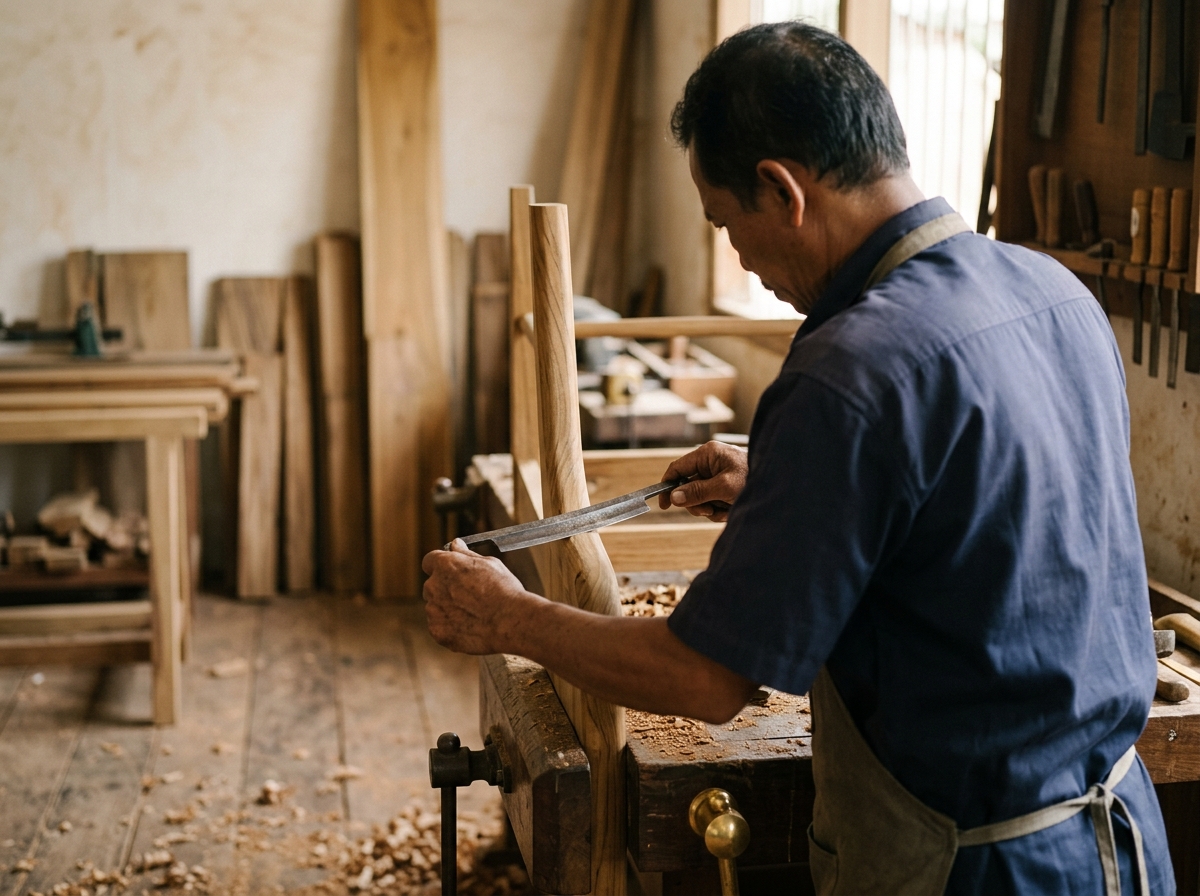
For large hospitality projects, the custom vs. ready-made decision affects lead times, certification integrity, and QC risk simultaneously.
Typical custom order parameters (approximate):
| Parameter | Bali (artisan/luxury) | Jepara (volume/solid wood) |
|---|---|---|
| MOQ | Often 1 container (project basis) | 20–50 units per SKU typical |
| Lead time | 60–90 days | 75–120 days |
| Customization scope | High — bespoke designs | High — standard forms, custom dimensions/finish |
| FSC CoC availability | Limited, select suppliers | More common among larger exporters |
| Price tier | Premium | Mid to premium |
Custom production introduces certification risk when factories subcontract portions of the work. If a Jepara factory subcontracts frame production to an uncertified workshop, the chain of custody breaks. This invalidates any certification claims. Buyers must contractually require all production to stay within the CoC scope. This includes subcontracted components.
For large resort orders, request pre-production samples as part of your sampling protocol. Require material certification documentation to be attached. QC inspection at mid-production and pre-shipment stages is standard practice. This applies to orders exceeding one container.
Logistics note: Indonesian wood furniture typically requires fumigation for solid wood packaging. This is to meet ISPM-15 compliance. Confirm fumigation documentation is included in shipping paperwork. Without it, shipments may face port holds in the US.
Building Your Supplier Shortlist: Evaluation Criteria Beyond Price
Sustainable eco resort furniture Indonesia sourcing requires a tiered evaluation framework. Aesthetics and price are table stakes. These are the differentiating criteria:
Tier 1 — Non-negotiable qualifiers: - Active, verifiable FSC CoC or SVLK certificate (confirmed in official database) - Export track record with documented reference projects in hospitality - Willingness to permit third-party factory audit
Tier 2 — Differentiation criteria: - Full-cycle production (own kiln drying, not assembly-only) - Upstream material sourcing transparency (plantation name, location, FM certificate) - EUDR geo-location readiness - Social compliance audit records
Tier 3 — Supporting signals: - Membership in industry associations with sustainability requirements - Existing relationships with internationally recognized resort brands - In-house design capability for custom sustainable hotel furniture Bali and Jepara projects
Structuring Your RFQ for Accurate Sustainability Disclosures
A well-structured RFQ forces disclosure that a vague inquiry does not. Include explicit fields for:
- FSC/SVLK certificate number and expiry date - Species identification for all wood inputs - Plantation name and location for teak - Subcontractor usage (yes/no, and if yes, their certification status) - EUDR geo-location data capability (yes/no) - Third-party audit availability
Suppliers unwilling to complete these fields are signaling a compliance posture. Buyers should factor this into their shortlisting decisions.
Total Cost of Ownership for Certified Sustainable Resort Furniture
FSC-certified Indonesian furniture typically carries a price premium over uncertified equivalents. This is approximately 10–25% higher at FOB, varying by manufacturer and order volume. Framing this premium as a pure cost increase misrepresents the procurement equation.
Durability and Lifecycle in Tropical Coastal Environments
Plantation teak (Tectona grandis) contains natural oils that provide inherent resistance to moisture and insects. It also resists UV degradation. In properly maintained resort environments, quality teak furniture has a documented multi-decade service life. Cheaper, uncertified wood alternatives are often unspecified mixed tropical species. They may need replacement within five to seven years.
Rattan (Calamus spp.) performs well in shaded outdoor and indoor resort settings but degrades under direct sun and rain exposure without protective coatings. Bamboo (Dendrocalamus spp.) requires sealed treatment for any outdoor application.
Lifecycle cost comparison (qualitative):
| Material | Coastal Durability | Maintenance Frequency | Relative Lifecycle Cost |
|---|---|---|---|
| Certified plantation teak | High | Low-medium | Lower over 10+ years |
| Uncertified mixed hardwood | Variable | Higher | Higher over same period |
| Rattan (treated) | Medium (shaded) | Medium | Moderate |
| Bamboo (treated) | Medium | Medium-high | Moderate |
| Suar wood (*Albizia saman*) | Medium-high | Medium | Moderate |
Carbon Footprint and Finish Considerations
Shipping distance from Indonesian ports to US destinations adds to the carbon footprint. This applies to any procurement decision. Certified plantation wood and renewable natural fibers have lower embodied carbon than steel. They also have lower embodied carbon than virgin plastic alternatives. This holds true across their lifecycle.
Frequently Asked Questions
What is the difference between FSC-certified and SVLK-certified furniture from Indonesia?
FSC certification is a voluntary international standard covering forest management practices. It also covers chain-of-custody tracking through the supply chain. SVLK is Indonesia's mandatory government system. It confirms timber was legally harvested under Indonesian law. SVLK is the legal baseline. FSC is the credibility standard recognized across global markets.
How do I verify that an Indonesian furniture supplier's sustainability certificates are genuine?
Go directly to the source databases. For FSC: info.fsc.org. For SVLK: silk.dephut.go.id. Enter the certificate number provided by the supplier. Confirm the certificate holder name, scope, and expiry date. Do not rely on supplier-provided document copies for verification.
Does the EU Deforestation Regulation (EUDR) apply to furniture made from Indonesian teak or rattan?
Yes. EUDR covers wood products including furniture under HS Chapter 94. Indonesian teak furniture placed on the EU market must be accompanied by due diligence. This applies to all importers in the supply chain. This requires demonstrating deforestation-free sourcing and geo-location data for harvest plots.
Is reclaimed teak more sustainable than plantation teak for resort furniture?
It can be, but only when properly documented. Reclaimed teak that avoids new harvesting has a strong sustainability rationale. Without species identification records and original harvest provenance, compliance exposure is created. Missing chain-of-custody documentation compounds that exposure. Buyers should account for this risk. This exposure falls under FSC and EUDR frameworks.
What are the typical lead times for custom eco-resort furniture orders from Bali or Jepara?
Custom orders from Jepara typically run 75–120 days from approved sample to container loading. Bali artisan suppliers typically range from 60–90 days depending on complexity and volume. These are approximate figures — actual lead times vary by factory capacity and order size. Build QC inspection time (pre-shipment, 5–7 days minimum) into your project timeline.
How can I avoid greenwashing when sourcing sustainable furniture from Indonesia?
Require third-party verified documentation — not marketing language. Verify all certificates in official databases before issuing a PO. Request species identification for all wood inputs. Demand sub-contractor disclosure. Conduct or commission a third-party factory audit. Treat any supplier that declines an audit as a higher-risk option.
Certified sustainable eco resortfurniture sourcingfrom Indonesia is navigable. You need the right verification framework. Buyers who invest in documentation discipline upfront consistently see lower replacement costs. They also build stronger sustainability credentials. Reduced regulatory exposure follows as EUDR enforcement continues to mature.
You now have the certification mechanics, EUDR checklist, and greenwashing audit criteria needed. Use these to evaluate Indonesian furniture suppliers with confidence. The logical next step is putting that framework into practice against real supplier documentation.
You have the evaluation framework. Now apply it to pre-screened Indonesian manufacturers with verified FSC and SVLK credentials, documented factory audit records, and EUDR readiness assessments for your specific eco-resort project.
Start Your Sourcing Inquiry →Need eyes on the ground in Indonesia?
MTS is an execution partner — supplier verification, manufacturing management, quality control and export logistics across Indonesia, Vietnam and China.
Related services
Related articles
Receive furniture sourcing insights across Asia.
One email per week. No spam.